Wednesday, June 10, 2015

Fright Flashback: Vacations Gone Awry

Welcome back to Fright Flashback, where every week until the end of summer we will visit an older horror film that is in some way a spiritual precursor to an upcoming new release. This week we are anticipating Jurassic World, in which a dino-themed amusement park experiences yet another deadly malfunction. In celebration, we'll be revisiting The Ruins, which depicts death and carnage on an idyllic Mexican vacation.

Year: 2008
Director: Carter Smith
Cast: Shawn Ashmore, Jonathan Tucker, Jena Malone
Run Time: 1 hour 30 minutes
MPAA Ratng: R

The Ruins is my favorite book. It's a bleak, unforgiving horror novel populated with likable, believable, three-dimensional characters who it puts through the freaking wringer. I try to read it every summer and every time I question why I do this to myself. That's why I love The Ruins. It's a delicately-paced horror story that pushes its characters to the breaking point, a transfixing campfire yarn that chills you to the marrow.

The Ruins is not my favorite movie. Although the screenplay was written by Scott Smith (who also wrote the novel) and it stars my perennial favorite Shawn Ashmore, it transforms a pitch black humanistic terror tale into a generic post-Saw gory vacation flick à la Wrong Turn or Rest Stop.

Luckily, I still like generic gory horror starring Shawn Ashmore, but it's just not the same experience as reading the book, which is like being tethered to a wild boar wearing a coat made of electric eels. So. If you haven't read the book and especially if you know nothing about it, I urge you to ignore the rest of this review and pick up a copy. Don't read a synopsis. Don't even look at your Netflix queue until you're finished. Experience the magic of having your endocrine system ripped out by a paperback. Then you can feel free to watch this movie and/or finish this review.

Welcome back! And I'm sorry.

The Ruins tells the story of a group of college graduates ready for one last adventure before their lives spread them apart. Emphasis on last. Jeff (Jonathan Tucker) is a self-righteous young man, an eagle scout type pre-med student who is bored with lounging by the pool; Amy (Jena Malone) is his girlfriend, a wet blanket piece of work whose favorite activity is complaining and/or attempting to make out with other dudes - she's real fun, this one; Stacy (Laura Ramsey) is her best friend, a smart, capable girl; Eric (Shawn Ashmore), Stacy's boyfriend, is more the fratty type but he's smart and confident, a good match for Stacy.

At their beach resort hotel, they meet a beleaguered German tourist named Mathias (Joe Anderson). His brother Henrich went off to meet a hot archaeologist at a dig site in the jungle and hasn't returned. Dun dun DUN! Along with their Greek friend Dimitri (Dimitri Baveas), they agree to head out to the site and see if they can find Henrich. When they arrive, they find a massive flat pyramid with a mine shaft at the top. It's completely empty, but the second they set foot on the rock, the nearby Mayan forces arrive and threaten them, forcing them up the hill and shooting Dimitri when he tries to leave.

Knowing they're trapped, the friends settle in and ration their provisions, waiting until Dimitri's friends come looking for them or they can come up with a plan of escape. However, a malevolent force on the ruin doesn't want them to leave. [SPOILERS FROM HERE ON OUT, PEOPLE IN THE DARK PLEASE GO HOME IF YOU KNOW WHAT'S GOOD FOR YOU] The vines covering the pyramid are sentient and very hungry. They can imitate human speech, dissolve flesh with their acidic sap, and are generally cleverer than you expect your garden variety weed to be.

This sounds dumb. Believe me, I know. But stick with me here.

Do it for the vine.

True, the vines are certainly more showy than in the book, which renders them a terrifying, unknowable menace, but if we were to list every aspect of the film at which the book is superior, we would be here   until Scott Smith releases another book*. So yes, the vines in this incarnation of the story reveal their true nature far too soon, and are a little too active to be insidious and creepy, occupying the spotlight instead of the festering shadows.

*That joke is funny, because Scott Smith has only written four things in his life. Two novels (A Simple Plan in 1993, The Ruins in 2006) and the screenplay adaptations for both those novels. God, I'm clever.

But! Through a heady concoction of seamless special effects work and a truly stunning bit of audio design which layers the rustling of the vines into an indelibly unnerving soundscape, the vines are nevertheless believable as a real menace instead of yet another cheesy horror movie villain attempting to push the envelope but cutting themselves on the flap.

This decently impressive work on the vines in spite of a script too overeager to show them off somewhat balances out the deficiencies of the paper thin characters. Moment by moment ticks by, leaning on the book far too heavily for any suitable emotional substance. It's almost like watching a Cliff's Notes version of the book, peppered with wooden, obvious dialogue and brutal narrative shortcuts.

Amy has not yet learned to lower her expectations when watching modern horror movies.

Unfortunateiy, the acting is about on the same rough-hewn level of the character work. Jonathan Tucker has always had trouble with his enunciation, and his speech - which sounds like he forgot to take out his retainer in the morning - becomes a liability as the stakes get higher. When he gets flustered he sounds rather like Daffy Duck instead of a large and in charge wilderness man. 

Malone and Ramsey are likewise on and off, though Malone more so. The only unmarred performer is Ashmore, who isn't exactly dazzling, but turns in a committed performances that holds the rest of the ensemble together like glue. Or rather, something adhesive but not quite that strong. He holds them together like high grade molasses.

But these flaws are no worse than the majority of contemporary horror, and it is with great pleasure that I can say that The Ruins is still a largely enjoyable experience. There are several downright pretty shots (especially when the cinematographer gets it in his mind to do something with the vast expanse of bright blue sky the setting has afforded), the characters are shallow but they get the job done, there is a heavy focus on shirtless men (which I can appreciate for gender equality reasons as well as... personal ones), and the gore is terrific and hard to watch. 

I see this as a badge of honor, considering that The Ruins came out the same year as Saw IV. It's not quite fun, but as a gory adventure flick for the bloodthirsty Saw crowd, it certainly avoids most of the grimness and despair that that implies. It's not a flick I'd jump to throw on at parties, but in the future I can see myself re-approaching The Ruins without an ounce of regret and some measure of enjoyment. Come on. This was 2008. That's Oscar-worthy praise right there.

TL;DR: The Ruins is a feeble literary adaptation, but a pretty decent post-Saw gore flick.
Rating: 6/10
Word Count: 1238

Tuesday, June 9, 2015

Census Bloodbath: A Cry In The Dark

Year: 1981
Director: Percival Rubens
Cast: Jennifer Holmes, Cameron Mitchell, Craig Gardner
Run Time: 1 hour 34 minutes
MPAA Rating: R

According to the plot description of The Demon, which was shot in South Africa in 1979 but released on US video in 1981, the malevolent killer can "bring your worst fears to life." The only way I can see this being accurate is if your worst fear is having to watch an acutely crappy slasher picture.

This is gonna be one of those reviews. All the pictures I can find are either stupefyingly dull or severely degraded. The Demon is not, shall we say, a classic.

The Demon consists of about two and a half plots, none of which are linked with any sort of connective tissue other than the presence of a shadowy killer (who isn't even credited, so I have no idea who played him - it seems like even the filmmakers themselves didn't particularly care for this movie). The first (and least interesting) plot follows the Parker family. When their fourteen-year-old daughter Emily (Ashleigh Sendin) is abducted by the demon, her parents hire Colonel Bill Carson (Cameron Mitchell of Blood and Black Lace, Memorial Valley Massacre, Bloody Movie, and Night Train to Terror - the man's a trouper), a detective with ESP to help find her.

Mainly his investigation consists of groaning asthmatically, sniffing pillows, and ripping apart bedclothes while the score feebly bleats behind him, then going off to overact at a dull, grey ocean which the film cuts to every ten minutes or so despite the fact that it plays no significant role in the film's plot or geography. As one can expect, this method accomplishes exactly nothing and he is shot in the head before he can even find the killer. This storyline connects with the second, considerably more interesting plot at exactly zero points.

Let's move on from that hot mess, shall we? Young schoolteacher Mary (Jennifer Holmes) is living by the city with her eighteen-year-old cousin Jo (Zoli Marki), having romantic misadventures while occasionally seeing a creepy figure appraising them from outside the windows. Mary is in a long-term relationship with the charming but unfortunately be-mustached Bobby (Mark Tanous), but Jo is embarking on a newfound romance with Dean Turner (Craig Gardner), a woefully rich trust fund stud who she is teaching how to be a better person.

This romance is genuinely sweet and, compounded with the terrific chemistry Marki maintains with both Tanous and Holmes, brings the film within a hair's breadth of being actually watchable.

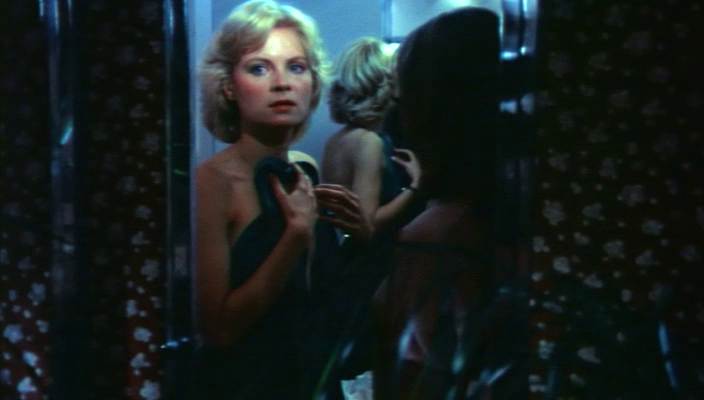
Also, The Demon has no qualms about showing its female leads topless, if that's the kind of thing you're into.

The rest of the film is made up of scenes depicting the killer's perilously underlit antics about town, doing things we can't see to people we don't know or care about, and being generically evil, doing pushups and ripping up magazine centerfolds. The killer, more than anything, is where The Demon well and truly falls apart. 

His scenes are awash in blackness, probably intended to create a mood like "ominous dread" but only managing "I accidentally left my sunglasses on and it's past 8PM." His scenes thus become a messy confused jumble, like "Did he just punch a motorcyclist? Is that white blob in the corner of the frame his face? Who are these men he's slaughtering in a stairwell? Are they gangsters? Avon employees? Did he kill them or adjust their bow ties? Are they wearing bow ties? Who am I?"

The film attempts to explain the menace, shoving broad soliloquies on the topic in Cameron Mitchell's mouth, but all we get out of him is the fact that he's an aberration of the species and he likes bright lights, apparently. Not to mention that the way he is explicated is on a completely different spectrum from how he actually acts. He is painted as a ghoul of darkest night, harnessing your fears and using them against you, but all he seems to do is bumble around in the dark with no motivation or personality, arbitrarily acting upon his unfortunate tendency of smothering people with plastic bags. 

To be fair, maybe this movie is an in-depth, probing exploration of people whose deepest darkest fear is plastic bags, in which case I have not given the film enough credit.

In short, The Demon is inept as all hell. Side characters are introduced and frequently cut to with absolutely no payoff, Emily's skeleton is found hanging in a tree but that scene does not inform any of the moments that follow, and the musical accompaniment is slack, occasionally letting out a feeble toot when something really important happens. It's dull as seaweed; an underlit, tiresome slog.

But then there's Jo and Mary. These two girls are characters who seem like they've been transplanted from some other, better movie. Maybe a scrapped sequel to He Knows You're Alone or something. And their final scene is a cracking good time, with Jennifer Holmes selling a plot point that sends her careening topless through an attic before carving a poncho for herself out of a shower curtain. With this, the film reaches a heretofore underserved campy register before alighting upon the best scene in the film, as she utterly destroys the killer using household bathroom supplies.

This strange, action-packed, astonishingly awesome scene (along with the spurts of keen romance scattered throughout) in no way makes up for the doldrums of the previous 75 minutes, but it makes The Demon a curio I'm not too keen to let go of. 

Killer: The Demon (Who Even Knows)
Final Girl: Mary (Jennifer Holmes)
Best Kill: Mary locks herself in the bathroom, squirts soap all over the floor, and sprays the killer with an adjustable sink head when he breaks through the door. He slips on the soap and she stabs him in the neck with scissors. This is awesome.
Sign of the Times: Jo wears what appears to be a termite tent on her hot date.


Scariest Moment: Mary is chased through her house by the killer after discovering her cousin's dead body.
Weirdest Moment: A scene takes place in a roller rink named "Boobs Disco."
Champion Dialogue: "I promise I won't let him ruffle my fur until he's given me a bank reference, financial statement, and his credit rating."
Body Count: 10
  1. Emily is abducted and killed offscreen.
  2. Truck Driver is suffocated with a plastic bag.
  3. Some Dude is slashed to death with a clawed glove.
  4. Some Other Dude is slashed to death with a clawed glove.
  5. A Third Dude is thrown from a balcony.
  6. Mr. Parker is strangled and has his neck broken.
  7. Colonel Bill Carson is shot in the head.
  8. Dean is suffocated with a plastic bag. 
  9. Jo is killed offscreen.
  10. The Demon is stabbed in the throat with scissors. 
TL;DR: The Demon is a dull, inept trash slasher redeemed only by a genuinely sweet romance and a stunning Final Girl.
Rating: 3/10
Word Count: 1165

Monday, June 8, 2015

Fright Flashback: They Made A Third One?

Welcome back to Fright Flashback, where *ahem* "every" week until the end of summer we will visit an older horror film that is in some way a spiritual precursor to an upcoming new release. This week we are were anticipating Insidious: Chapter 3, the third entry in a non-R-rated haunted house franchise. In celebration, we'll be revisiting Poltergeist III, which reached that point in its own franchise about two and a half decades earlier.

Year: 1988
Director: Gary Sherman
Cast: Heather O'Rourke, Tom Skerritt, Nancy Allen
Run Time: 1 hour 38 minutes
MPAA Rating: PG-13

1988 may have been the perfect year for a Poltergeist sequel. The original film was so iconic and intensely personal (though to whom it was intensely personal is up for debate. *cough cough Spielberg*), that its inevitable followup necessarily lacked it luster and thematic appeal. So there MGM was with a horror franchise already run into the ground thanks to a perilously dull second part, while meanwhile Freddy and Jason were racking up body counts in the hundreds and box office receipts in the millions.

In order to keep their property afloat, they upped the ante. And, seeing as this was the late 80's, that means pure lunacy. They transplanted the story to a Chicago high rise, boosted the body count, and pulled out all the practical effects that not very much money can buy, draping everything in fashions so untowardly ridiculous, they went out of style the second principal photography shut down. Maybe even the second the costume designer stepped out of the department store with their credit card in hand.

Each individual layer of that outfit doesn't even match itself.

This oddball approach to the story gave it just enough juice to cap off the trilogy on an exciting and lasting note. Thank you, 1988.

Poltergeist III puts Carol Anne Freeling (Heather O'Rourke) in the custody of her Aunt Pat (Nancy Allen) and Uncle Bruce (Tom Skerritt), because sometimes successful adult actors don't want to return to a horror series for a third time. Carol Anne has been enrolled in a school for child prodigies which is headed by the wicked Dr. Seaton (Richard Fire), who believes that the ghosts haunting the young girl are a result of a mass hypnotic suggestion perpetrated in a desperate bid for attention. The fact that he firmly believes in hypnosis but not ghosts is but the smallest logical leap the plot makes. They's starting us off easy, you see.

When Carol Anne is left alone with her cousin Donna (Lara Flynn Boyle) during her aunt's art gallery opening, Donna ditches to go to her crush Scott's (Kip Wentz) party downstairs, leaving Carol Anne alone with the ghost of Reverend Kane (Nathan Davis), who is inhabiting the mirrors and has taken supernatural control of the building. When Donna, Scott, and Carol Anne are sucked into the mirror dimension, Pat, Bruce, and Dr. Seaton (who is also Scott's father) must team up with the medium Tangina (Zelda Rubinstein) to put an end to this haunting business once and for all.

Honestly, I wouldn't mind if that awful red jumper got banished to the shadow dimension.

First and foremost, the practical effects that went into the mirror work is stunning. They're not quite as extravagant and state-of-the-art as any individual effect from the first film, but they're admirably timeless. They don't show any seams because they don't have any.

The other special effects are likewise pretty consistently superb, though there are a few minor slip-ups, especially when it comes to recreating Kane. The original actor, Julian Beck, died of stomach cancer in the middle of shooting Poltergeist II: The Other Side, and the film's feeble recreation of his chilling, gaunt face looks no spookier than an old potato.

In addition to having a generally more consistent pacing than Part 2 when it comes to showcasing special effects, some of the gags in the film are pure nightmare fuel. Only read this if you've seen it or have absolutely zero interest, but in moments like when [Donna bursts screaming from Tangina's shriveled corpse], Poltergeist III transcends from being a kooky special effects thrill ride to a balls-trippingly horrifying hell dimension.

I LOVE THE 80'S, YOU GUYS!

Although this is all terrific, there was a trade-off made when the Poltergeist franchise finally succumbed to the influence of the 80's. In exchange for zanier fashions and a more consistent, creepier effects palette, the film had to sacrifice depth. The original Poltergeist had a novel's worth of comments and criticisms on the state of American suburbia and the sequel, while dull, at least attempted to follow in its footsteps.

While Poltergeist III does have some interesting material to chew on in the form of the high rise building containing everything a person could possibly need so they never have to leave a single building (home, jobs, shopping, and dining - it's the ne plus ultra of comfortable suburbia hidden within the city), the idea of distant relatives being reluctantly incorporated into a loving family, as well as the possibility that Carol Anne might accidentally be creating the ghosts within her own imagination, it just doesn't have anything matching the level of analysis of the previous films. There are some terrific raw elements in there, but they aren't synthesized into anything particularly meaningful.

Rather, the film favors a series of abrupt stop-and-start plot beats that play second fiddle to the terrific and sometimes bone-chilling effects. One minute, Aunt Pat is begging to ditch the Evil Little Brat, the next she is proclaiming her undying love for her. One minute Tangina is soliloquizing about some nonsensical Power of Purity or some such, the next she's appearing in a cloud of water, tossing magical necklaces about like she's Oprah and giving cryptic advice. It's all a fascinating jumble, but it ain't classical storytelling.

The power of Poltergeist III lies in its ability to be a stunning jack-in-the-box without the subtext. That's why it'll never be a classic like the original. But at least it sloughs off the dreary monotony of its immediate predecessor in favor of a thrilling roller coaster ride. You won't catch me complaining about that.

You won't catch me. I'm too fast.

So, yes. This movie has flaws. A great many of them, in all honesty, including the fact that it doesn't make full use of the opportunities presented by its setting and that, if you're not a fan of people screaming "Carol Anne!" then this movie isn't for you. I have it on good authority that her name is repeated 121 times throughout the film, and if you cut out every line that's reiterated two times or more, Poltergeist III would be a short film.

But! But! The cinematography is daring, at times reminding me of Shock Treatment, which is secretly high praise, considering that film's penchant for wrenching terrifically ambitious shots out of a staggeringly low budget. And director Gary Sherman coaxes far superior performances out of O'Rourke and Rubinstein, leaving the limp Poltergeist II dead in the water.

And once more, I'd like to remind you that this film is a living catwalk of the apocalyptic anarchy that was taking hold of the fashion market in 1988. Nobody is safe from the denim jackets, pastel scarves, garish costume jewelry, neon eye shadow, and towering piles of crunchy, starched hair that you could snap off and pick your teeth with. It's daring, it's bold, it's pandemonium. And it's glorious. The scenes with the teenagers are like a cross between a Go-Go's music video and the first act of a slasher, all perfect chemistry and terrible pattern clashing. It's a wonderful treat, and Poltergeist III is better for it.

It's not a well thought-out movie, no. But it's so unabashedly fun and has such surprising skill behind its construction, it deserves a place in the pantheon as one of the better sequels to come out of the back half of the decade. Don't let this one pass you by.

TL;DR: Poltergeist III has a gibberish plot and strange theology, but it has an inestimable 80's charm.
Rating: 6/10
Word Count: 1357
Reviews In This Series
Poltergeist (Hooper, 1982)
Poltergeist II: The Other Side (Gibson, 1986)
Poltergeist III (Sherman, 1988)
Poltergeist (Kenan, 2015)

Sunday, June 7, 2015

Ghost Of Franchises Past

Year: 2015
Director: Leigh Whannell
Cast: Dermot Mulroney, Stefanie Scott, Lin Shaye
Run Time: 1 hour 37 minutes
MPAA Rating: PG-13

James Wan and Leigh Whannell are a kick-ass horror team. Their first joint outing, Saw, changed the horror game of the early 2000's. I may not be a big fan of where that rabbit hole led, but the fact remans that their grubby shocker was one of the best of the business at the turn of the millennium. And their followup, Insidious (Dead Silence? Never heard of it.), is a chilling throwback haunted house tale that brought the fangs back to PG-13 horror and reintroduced the world to horror icon Lin Shaye, paving the way for a series of successful spooky tales like The Conjuring and Sinister.

Now, I was no fan of Insidious: Chapter 2, which I found to be juvenile and hackneyed, but the fact remains that their teamwork still produced a film with a handful of stellar scares and a fascinating visual palette. And God help me, but I do secretly love when horror franchises go a little off the rails.

The thing about Insidious: Chapter 3 is that its the first film in the franchise to cleave the union. With James Wan busy working on bigger, skydivier things, Whannell was left to his own devices, taking on the role of director on top of his screenwriting and acting duties. It's a lot to handle, and he does so admirably, considering. This third entry in the franchise has neither the creative gusto of the first or the brassy, bold aesthetic of the second, but it's a remarkably decent entry in a series unabashedly prone to reinvigorating the hoariest clichés of the genre.

This image could be from literally any movie released this decade. And my money's on Deliver Us From Evil, to tell you the truth.

Inidious 3 takes place several years before the events of the original film, meaning that the cell phones are blockier, the cars are more old-fashioned, and Dermot Mulroney gets starring roles in films. High school student Quinn Brenner (Stefanie Scott) lives with her overwhelmed single father Sean (Dermot Mulroney), who has an important, manly job like Contractor or Foreman or something. She meets with the medium Elise (Lin Shaye) in an attempt to contact her dear, departed mother. Unfortunately, when she reaches out into the spirit world, something else reaches back. 

After she breaks her legs in a car accident following an audition for a renowned theater school, she finds herself being haunted by The Man Who Can't Breathe (Michael Reid MacKay, who also played the Mummy in the prestigious Monster Squad), a mysterious inky black ghost wearing a gas mask that seems to live upstairs and travels through the vents into her room at night. Calling upon the help of Elise and her soon-to-be sidekicks Specs (Leigh Whannell) and Tucker (Angus Sampson), the Brenners must face the most evilest evil ever unleashed.

Which retroactively makes the first two films just that much more confusing - you'd think Elise would know how to handle things by then.

This time, instead of taking cues from Poltergeist like the first films, the plot has a very Exorcist slant. Points for variety I guess. You know: little girl possessed by an entity that may or may not be masquerading as her sickness, single parent watching nervously from the sidelines, and a plot that focuses more on the expert helping her (Elise, being the big franchise link here, gets a much expanded role, including shutting down her business following the grief of her husband's death and threats from an otherworldly force). It's textbook stuff, really.

Insidious: Chapter 3 has its share of flaws but I enjoyed it, so let's keep things positive and get the complaining out now so we can get to the good stuff. First of all, the plot is very dub. That was unavoidable, especially for a film set in the same universe as Insidious 2, in which plot twists were to be found in places that should have been thoroughly checked over 3 decades before. I'm still mad. Nothing in this film is quite so enervating as that, thankfully, but there are still a variety of insoluble problems at the script level.

The beginning is beholden to some claptrap paranormal-babble, which is par for the course, but the simplistic, kindergarten-esque insistence on dark vs light is a little cloying. However, the real issues begin with the third act, which always seems to be the turning point for these films, and Leigh Whannell's weakest link as a writer. The heroes attempt to solve their problem by doing the exact same thing that screwed them up the first time, the only way they're saved is through a Mount Olympus-worth of deus ex machina, we're asked to be shocked by several twists so immensely obvious they can be seen from space, and at one point Lin Shaye inexplicably turns into Ripley from Aliens.

In addition, Dermot Mulroney can't find anything to do with his character, which is a shame considering that he's the thematic and emotional lynchpin of the film,with his fear that he might lose hi daughter to the inevitability of death just like his wife. It's interesting enough in its recitation that he doesn't ruin the film, but the role might as well have been performed by a cardboard cutout of Mel Gibson. Luckily Lin Shaye returns to form, instilling real terror into her broken and fragile Elise, though she trips up occasionally on her more treacly cheerful scenes.

I don't think this woman has played a happy role in her life.

But hey! We can be negative until the cows come home, but we can't milk them with a frown. Or... something. Let's move on to the good stuff. 

Insidious 3 isn't a knock-your-socks-off terror gauntlet, but it's a well-oiled boo machine with a couple lasting frights sprinkled amid the jump scares. There's perhaps nothing more frightening than the one or two truly stellar moments of Insidious 2, but as a whole, it is far more consistent in encapsulating the roller coaster of screams that most modern horror strives to be. The viscous, oily design of The Man Who Can't Breathe is nightmare fuel in its own right, and his intensely terrifying visage amps up even the most feebly generic moments.

The franchise's signature comic relief is also present, in extremely palatable amounts. Leigh Whannell and Angus Sampson have shown a penchant for horror comedy (though, if I were to pick between Insidious and 100 Bloody Acres, it would be the latter any day of the week), and here their work is reliably charming, though it thankfully doesn't overpower the horror.

The Further is perhaps the least appealing returning element, though it does afford the film its only truly spectacular image: a blood red elevator door lost in a chill blue ghost dimension. Why the ghosts would feel the need to use an elevator, especially in their ectoplasmic domain remains unknown. But hey! Insidious: Chapter 3 is decently pretty, pretty scary, and scarily funny, so it's far from a disappointment, all things considered.

TL;DR: Insidious: Chapter 3 is a great addition to its franchise with its cheery dumbness and a variety of effective if cliché scares.
Rating: 6/10
Should I Spend Money On This? Only if you really liked the first one. You do not need to see the second. Don't feel the urge to catch up, I beg you. 
Word Count: 1252
Reviews In This Series
Insidious (Wan, 2010)
Insidious: Chapter 2 (Wan, 2013)
Insidious: Chapter 3 (Whannell, 2015)
Insidious: The Last Key (Robitel, 2018)

Thursday, June 4, 2015

The Chavs And The Chav-Nots

Year: 2015
Director: Matthew Vaughn
Cast: Taron Egerton, Colin Firth, Samuel L. Jackson
Run Time: 2 hours 9 minutes
MPAA Rating: R

Comic book movies are getting stale. Don't get me wrong, I dug Avengers 2 and Guardians of the Galaxy. But let's be honest. Do we need a third Spider-Man reboot? Do we need another sarcastic superhero fighting someone who has developed powers exactly the same but slightly stronger than his

Luckily we have Matthew Vaughn. Love him or hate him, he has a talent for making some of the more interesting comic adaptations scattered around the movie landscape. His style is rigorously anti-mainstream, full of blood and guts and a kind of ruthless energy that has been lost amid a litany of Iron Man sequels. But enough about superheroes. Kingsman: The Secret Service is a goddamn spy comic book movie and it is awesome.

And contrary to popular belief, no, it is not a sequel to The King's Speech.

Kingsman tells the story of young Eggsy (Taron Egerton), a thuggish British teen growing up in poverty. His father was a member of a secret spy agency known as the Kingsmen, the modern knights of the round table. When he is referred to this organization via Galahad (Colin Firth), he begins his training with a group of posh candidates who look down on him for his social status.

But when it becomes clear that the American tech mogul Valentine (Samuel L. Jackson) is going to use his ubiquitous technology to cull the Earth's population (ie. all the people not rich or noble enough to "deserve" life) with a frequency that turns people into insatiable, violent rage beasts, Eggsy might just be the only one noble, clever, and strong enough to defeat him.

Only the pure of heart and pure of ab are worthy to wield the sword of the Kingsmen.

The story is very been-there-done-that and Kingsman knows it. Its more meta moments are a bit weak and pandering, but as a pastiche of the greatest spies from James Bond to Jack Bauer, it's aces. It's zanily kinetic, no-holds-barred fun. 

Whether it's a girl with metal legs that can cut through a man like a knife through water, driving backwards through heavy British traffic, or a cavalcade of super cool gadgets (the likes of which have hardly been seen since the early Bond days), Kingsman ups the ante on the typical spy movie clichés, turning up the gas at every turn.

In typical Vaughn fashion, the action is a little more blood-soaked than the typical spy movies, especially those before the glorious rise of the 1980's. But never fear! Though the available grue is more than enough to satisfy the cravings of grotesquely depraved gorehounds like myself, it's also toned down enough to be palatable to all but the weakest stomachs. Basically, if you can handle putting a Hello Kitty Band-Aid on your cut, you can handle this movie. 

...More or less. There is one sequence where even I found the violence to be excessive, actually crossing the line between "over the top" and "maybe we should consider lowering the top." But save for that one slip-up, the violence is nothing less than a comic-fueled bonanza of excruciatingly cool spy combat.

Baby, let your colors burst.

In addition to its exuberant action, the Kingsman has a surprisingly refined funny bone. Samuel L. Jackson is perhaps given the best material (concerning his character's distaste for violence), but Egerton absolutely owns a thuggish role that inhabits a world of unintentional comedy. However, the biggest surprise in the film is Colin Firth, who displays a side of himself that's never been seen before, shifting effortlessly between being perilously genteel and a hard-edged lightning bolt.

Underneath it all, Kingsman  even has something to say! I mean, how lucky are we? Like a disconcerting amount of 2015 films, its main villain makes a convincing argument on the back of the devastation of global warming, and the bulk of the story addresses the indecent class disparity that affects everyone in our society, whether we like it or not. 

The Kingsmen is an organization with noble blood, purportedly seeking to preserve the safety of the people. But the fact remains that these supposed knights balk when it is suggested that a commoner join their team. In its way, Kingsman shows that an endless search for money and status makes us fallible, no matter how noble our goals. I shan't go into too much detail on this, for fear of spoiling the third act, but rest assured that Kingsman is highly politicized, and whether you agree with it or not, it's reassuring to see genre filmmaking returning to a place of intelligence and promoting conversation.

Just look at the class disparity! Colin Firth can't even afford a dope-ass hat.

That said, Kingsman is not perfect. For one, its approach to women tries hard not to be demeaning, but only occasionally succeeds. Two strong female characters become warped and twisted beyond hope: one is shuttled off to the side to flail meaningfully but uselessly on the sidelines, and the other is turned into a twisted gorgon, a hyperbolically sexual stereotype that is just plain embarrassing no matter what side of the glass ceiling you're on.

And I prefer to be on this side, thank you very much.

But all in all, Kingsman: The Secret Service is just plain fun. With the perfect cast, a manically charming director, and a great deal of high-octane action stuffed in to taste, it's a thrilling romp through the spy genre from a modern perspective. Go seek it out if you haven't yet. Not all February releases are crap, as it turns out.

TL;DR: Kingsman: The Secret Service is a thrilling and clever modern spin on the classic spy adventure genre.
Rating: 8/10
Word Count: 972

Wednesday, June 3, 2015

Driving Me Mad

Year: 1985
Director: George Miller & George Ogilvie
Cast: Mel Gibson, Tina Turner, Bruce Spence
Run Time: 1 hour 47 minutes
MPAA Rating: PG-13

Several things happened during the four year gap between the release of Mad Max 2: Road Warrior and Mad Max Beyond Thunderdome, things which had an immense impact on its production:

1) George Miller was trying to get an original film off the ground, but the studio encouraged him to sauter that plot (of an adult discovering a Lord of the Flies-type group of children in the wild) onto a Mad Max storyline.

2) George Miller's producing partner Byron Kennedy passed away in a helicopter accident while scouting locations for the film.

3) The early 80's.

These first two resulted in a shattered, distracted auteur splitting his time on the film with co-director George Ogilvie, deigning only to direct the action sequences and leaving the character stuff to the man behind The Feds: Deception. The third resulted in...

Tinadome.

Mad Max Beyond Thunderdome opens with a shot straight out of Lawrence of Arabia - a bleak, irradiated wasteland of sand and dust being cut through by a camel-driven wagon. The wagon is attacked by a pilot (Bruce Spence of The Road Warrior, playing a different aeronautically-inclined character) and out tumbles out Max (Mel Gibson), an ex-cop and desert wanderer with a truly unfortunate case of Braveheart hair.

Every man dies. Not every man really dyes.

Following his stolen equipment, Max comes upon Bartertown, a desert shantytown ruled by the flashy and emphatic Aunty Entity (Tina Turner). Their primitive government is literally run on crap - their energy is provided by the excrement of pigs in the subterranean methane dungeon known as the Underworld. This area is led by MasterBlaster (Angelo Rossitto & Paul Larsson), a smart, tiny man who combines his powers with a huge, brute warrior with an iron mask by riding on his back.

Aunty hires Max to assassinate Blaster by brawling with him in the Thunderdome, Bartertown's cage match dispute system. Then a whole new story starts, whereupon Max stumbles across the aforementioned Lord of the Flies kidlets, a tribe who have taken residence in a nearby gorge and the only ample water source in the wasteland. Upon his arrival, they take him for the missing leader, Captain Walker, and beg him to take them to Tomorrow-Morrow Land, which is one of their many irritating slang words, this one referring to the gleaming cities of the past, which they still believe to exist.

Max reluctantly tags along to help them find a better home, though, honestly, their camp seems like a McFreaking paradise compared to the barren dystopia surrounding them. Thus begins the most conflicting sequence in the film as it shifts between Goonies-style slapstick antics and the requisite nailbiting car chase sequences.

It's like a cross between Fast & Furious and The Magic School Bus.

It's terrifically uneven, spasmodically twitching between both modes and reducing the high stakes of the previous films to useless tinder. The frustrating thing is that, when the film is good, it's genuinely superb. The closing chase is an exciting, natural extension of the tanker chase from Road Warrior, pitting a herd of cars against a runaway train, and the bungee-jumping acrobatic fight in the Thunderdome is an unforgettable mixture of camp and overzealous intensity.

But it takes ages for the film to return to the series' characteristic automotive splendor (in fact, I don't believe we even see a car in use until well past the hour mark), and the adventure sequences with the tribe of children are achingly over-the-top. When they're busying themselves with wacky antics like hitting people with frying pans and cheerily misunderstanding simple things, I half expect Robin Williams to come bursting in on a skateboard.

This inanity permeates the rest of the film, spurred on by the spirit of 1985. Quips and awful puns overpopulate the film like a scourge of locusts, not too deep to truly disable the films capacity to be great, but enough to dampen its potency somewhat.

They should leave the puns to me, where I can handle them safely and responsibly, with a mane-imum of casualties.

But despite its lumpen tonality, Beyond Thunderdome is still a Mad Max picture, and as such it revels in its weirdness. The film throws itself into its aesthetic, which contains a couple more dreadful matte paintings than I daresay we're used to, but is still as electric and iconic as ever. There might be a couple dozen more monkeys than usual, and some of the characters would be more at home in a Western from 2 of the 3 writers of Scary Movie, but it occupies exactly the same maniacal space that makes the Mad Max films so special.

The costume designer works with the delirious ferocity of a heroin-addicted crack rock, tossing several be-mohawked leather daddies, a dwarf with a Noh mask backpack, a mechanic in a leather speedo, and just about everything that was available on short notice from the costume department of the damned.

Now Appearing in: Your Nightmares.

The most interesting thing about Beyond Thunderdome is that, perhaps because it is already doing so much, it also has the most to say out of the Mad Max trilogy. Behind its juvenile nonsense and crackling action sequences, the film is an allegory about the future and how we shape it. The future of yesterday (ie. glittering skyscrapers and a metropolitan utopia) is gone, and it is up to the children to find out what's next for humanity. 

Bartertown has its own rough-and-tumble semblance of society, but those irradiated adults are the product of the same culture that destroyed itself in the first place. Their moral decay is no surprise to anyone, but The Lost Boys/Girls are wholly new. They know nothing other than the wasteland, and they alone hold the last spark of hope for humanity.

Mad Max might be their savior for the time being, but they're the ones who - if anyone can manage to do it - can heal the world. He's just a visitor. They don't need another hero, because there's nothing left to save. And that's beautiful.

Also, I bet you didn't think I could work that lyric into a thoughtful analysis.

Peace.

TL;DR: Mad Max Beyond Thunderdome is tonally uneven but nevertheless thematically and aesthetically valuable.
Rating: 6/10
Word Count: 1064
Reviews In This Series
Mad Max (Miller, 1979)
Mad Max 2: The Road Warrior (Miller, 1981)
Mad Max Beyond Thunderdome (Miller & Ogilvie, 1985)
Mad Max: Fury Road (Miller, 2015)

Tuesday, June 2, 2015

Get These Monkeys Off My Back

As a super important future famous blogger, I've been attempting to up the ante with my movie reviewing over the past year, providing a frankly ridiculous amount of content on the off-chance that somebody wants to read 2,000 words about the splendors of The House on Sorority Row. But loath as I am to admit it, I am a fallible human. And the daunting list of movies I have yet to write about is weighing on me like the Earth's globe on Atlas' back.

What follows is four capsule reviews for films that I've seen over the past month but haven't had the time (or, frankly, the interest level) to fully explore in a broader article. You know, it might actually do me good to explore a shorter form of review writing. Consider this an experiment should I ever become the next Roger Ebert.

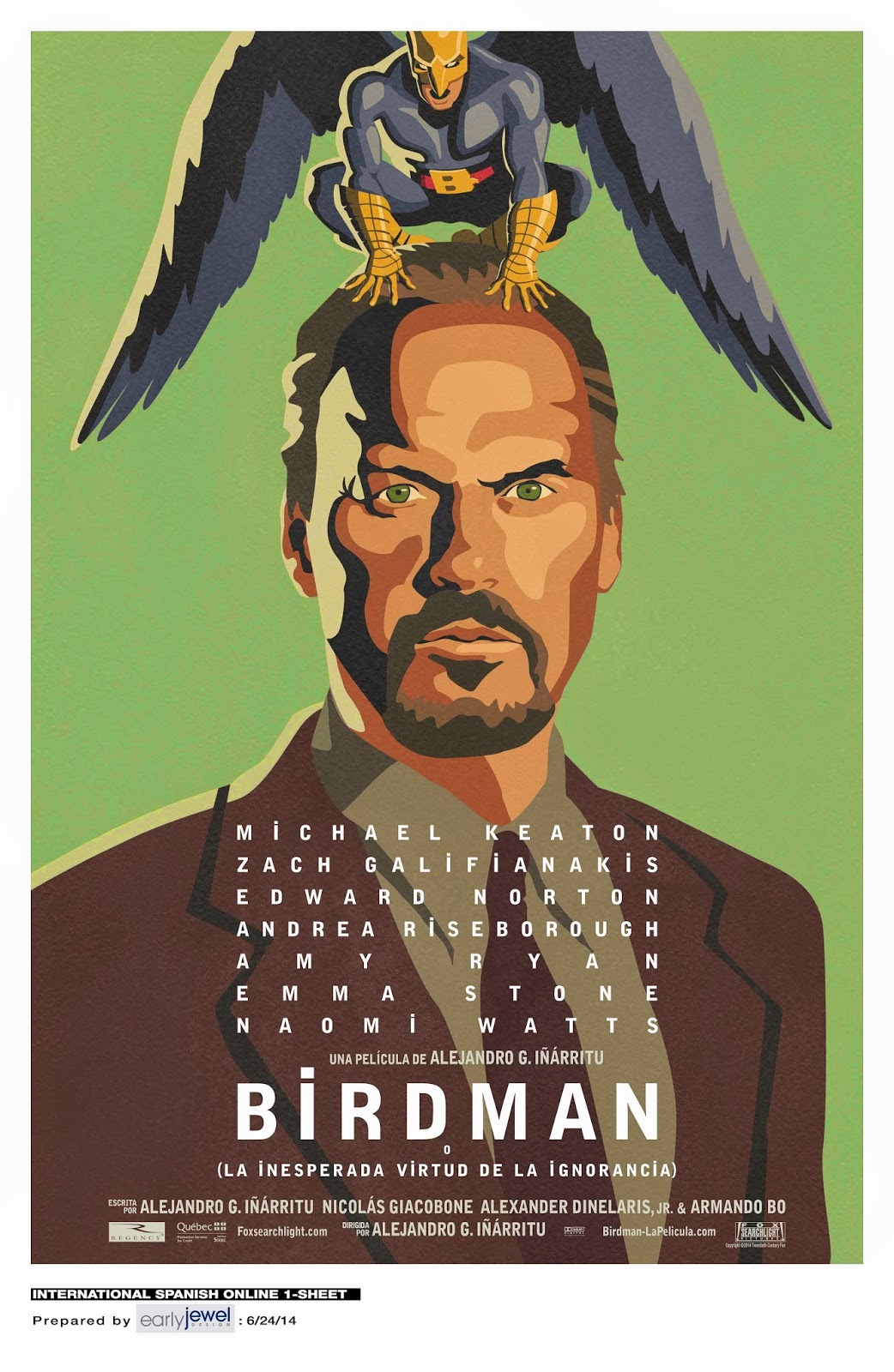
Birdman: or (The Unexpected Virtue of Ignorance)

Year: 2014
Director: Alejandro G. Iñárritu
Cast: Michael Keaton, Zach Galifianakis, Edward Norton
Run Time: 1 hour 59 minutes
MPAA Rating: R

A washed-up movie star attempts to revive his career with a Broadway play.

Countless films have worried at the edge between reality and fantasy like a dog with its favorite bone, including two of my very favorite horror films, so Birdman is in good company. But, and I say this without even the faintest whiff of sarcasm: Birdman ain't no Wes Craven's New Nightmare

The cardinal sin of the "comedy" Birdman is that it takes itself far too seriously. Many of its core scenes and conceits are pitched up to a more over-the-top register that would best function as laugh-out-loud comedy, but there's only one single line in the film that is obviously intended to elicit a chuckle. The rest is as dour and self-serious as the rest of the Oscarbait in the worm bucket, and that weighs down the film like an anchor.

There is some interesting material to chew on about how social media is shaping our generation's perception of art and reality, as well as how actors can get so trapped within a famous role that it casts a shadow over their entire lives. This is interesting to film enthusiasts and (more importantly) members of the Academy, but it's remarkably separate from the reality of the average American filmgoer. It absolutely doesn't need to play to the lowest common denominator, but Birdman's sense of what "reality" actually is, is already so mired in artifice that the film loops around itself uselessly like when I try to put the garden hose away.

In the process of all this philosophizing, Birdman loses itself among a pile of heaving, exhausting Important Movie cliches, like the Inexplicable Lesbians, the Real Life Connection, and the All in One Shot gimmick. Slathered with some improperly proportioned magical realism, a variety of subplots that utterly fail to go anywhere at all, and an astonishingly artless ending, Birdman is a frustrating nut to crack.

But when you finally break through to that sweet sweet nut meat (I am writing this very late at night), there's something special in there. Birdman is a film with an impeccable sense of rhythm, a variety of delectable lighting arrangements, and a series of off-the-wall performances pulled from actors who really have no business being in a movie like this. Emma Stone rips a nothing part to pieces with a spiky vulnerability, Zach Galifianakis tones down his usual energy to become a wonderful straight man, and Edward Norton shines as a loose cannon actor with a feeble grip on his own humanity.

And, after all, Michael Keaton has been getting all the awards buzz, so let's not forget to mention him. Although he gave a Brave performance more than he gave a Great one, Keaton carries the movie on his back across the finish line. His imbues his character with a wild-eyed animalism that propels the narrative through its illusion of a single shot without a single hitch or draggy moment. 

For my purposes, it is not a truly remarkable film, at times veering into an immensely irritating one. But for art cinema-inclined viewers, Birdman is one to RedBox before it's too late.

Rating: 6/10


Edge of Tomorrow

Year: 2014
Director: Doug Liman
Cast: Tom Cruise, Emily Blunt, Bill Paxton
Run Time: 1 hour 53 minutes
MPAA Rating: PG-13

An unwittingly drafted soldier finds that, every time he dies in battle, he wakes up the day before only to repeat his misery.

Edge of Tomorrow represents everything that's wrong with Hollywood today. 

By that I mean that it's a fantastic original movie, but it was misrepresented in advertising, brought in only slightly more than half its budget in box office, and was scuttled away to home video with a confusing new title to perish in ignominy.

It's a real shame. An adaptation of the manga All You Need Is Kill, Edge of Tomorrow presents a fun, fresh, sci-fi fueled twist to time loop storytelling, pitting Tom Cruise's eternal movie star glamor (which, as this movie proves, can survive even the weirdest twists and turns of his personal life - hail Xenu) against the endlessly unappreciated high caliber efforts of Emily Bunt. Blunt takes on the most kinetic, action-packed role of her career with aplomb, dragging a loopy sci-fi plot headfirst into gritty, believable reality.

On top of all of this, Edge of Tomorrow is, like, unbelievably funny. I'm serious. The film takes the notion of comic relief and stretches it liberally throughout the entire film like that Bible story with the fish. It's just shy of genuinely being classifiable as a "comedy," but it's a raucous good time all the same. The best part is that the humor bubbles up naturally from the situations and characters instead of being imposed upon the film by some unseen, arbitrary entity like certain of the more dour sequences in Avengers: Age of Ultron.

The endless repetition of plot points that comes with the territory of time travel films is treated with fleet footing, capturing the highlights while always furthering its central story arc. Between the repeated story beats with ever-changing perspectives and the secretly pretty cool alien tentacle CGI, Edge of Tomorrow feels like a particularly difficult video game level and captures the intrinsic joy that comes with solving an intractable problem while simultaneously having a great time shooting bad guys into piles of goo.

But there's something pulsing beneath the surface, too. Both characters are recognizably human and have fully developed arcs. This is something that shouldn't even technically make sense considering that Emily Blunt's character resets at the beginning of each day, but the film is so invested in its storytelling that it works no matter the obstacle.

There are some technical difficulties that derail the film slightly, like an undercooked third act and a severe lack of proper lighting during several key sequences, but Edge of Tomorrow is wicked fun, and worth a watch from anyone who hasn't seen it yet. Which is pretty much everyone, because the world is a terrible, unfair place.

Rating: 8/10


Groundhog Day

Year: 1993
Director: Harold Ramis
Cast: Bill Murray, Andie MacDowell, Chris Elliott
Run Time: 1 hour 41 minutes
MPAA Rating: PG

A curmudgeonly weatherman gets trapped in a time loop and is forced to repeat Groundhog Day endlessly until he becomes a better person.

Two guesses as to how I decided to pick this one.

Groundhog Day is an indisputable classic of the 90's comedy genre, one for which I have an immense amount of esteem and absolutely nothing new to say, so this will be my shortest review yet. Depending on your inclination, you may either cheer or jeer here.

...

Alright, we're back. Set in the small Pennsylvania town of Punxatawney, Groundhog Day is more than just the story of one man finding his inner Samaritan. It's about the clash between the town and the city folk, and the lack of respect for others that the city garners in otherwise good people. 

As Murray's weatherman discovers the better person inside of him, he simultaneously develops a working interest in the lives of those around him. It is these people more than anything who help make him better rather than any supernatural force or deus ex machina. And Bill Murray is at the top of his game, giving his sardonic bastard a likable humanity without letting his brittle exterior of the first act show any chinks in his armor. 

Subtextual undercurrents, Bill Murray being pitch perfect... Throw in a lush, reactive score, an inventive visual schema, and a hard-hitting lesson about the fact that, sometimes, bad things are destined to happen and there's nothing we can do about it, and you've got yourself an unforgettable comedy with real heart.

Oh, and Andie MacDowell is OK, but her accent is ridiculous.

Rating: 8/10

Wild

Year: 2014
Director: Jean-Marc Vallée
Cast: Reese Witherspoon, Laura Dern, Gaby Hoffmann
Run Time: 1 hour 55 minutes
MPAA Rating: R

The true story of Cheryl Strayed, a kind of annoying hipster who decided that hiking the Pacific Crest Trail would solve all of her personal problems.

The next breadcrumb on our trail of Oscarbait leading us out of the 2015 Academy Awards is Wild, the first outing for Reese Witherspoon's new production company, Pacific Standard. I daresay, it's in good company with Birdman because it has several shining glimmers of pure cinema sandwiched in between what ends up being an immensely frustrating, self-indulgent project.

The biggest flaw of Wild is unfortunately inextricably attached to it: the subject matter. Based on the popular memoir Wild: From Lost to Found on the Pacific Crest Trail by Cheryl Strayed, the film necessarily must take on her character and situation at face value. The only problem is that, at all times, Cheryl Strayed can be relied upon to be the most douchey, irksome person in the room.

Now I'm not even referring to her backstory, which involves biblical amounts of heroin and cheating on her husband. That's par for the course in this kind of Find Your Clarity picture. What I'm referring to first and foremost is her habit of quoting famous authors in this manner: "I took the road less traveled, and that has made all the difference." - Robert Frost (and Cheryl Strayed) Like, what. Were you there helping him write his magnum opus, Cheryl? No you weren't. Now stop prancing about like you're so much better than everybody else and crapping all over authors you've never even read. So there.

I'm sorry. I just really despise Cheryl Strayed. At least as portrayed in the film, she is the worst kind of pretentious hipster and could hardly care less about the plight of other people, although her mind-altering journey is ostensibly about coping with the loss of her mother, played by Laura Dern over what adds up to about a minute of screen time. But enough about that.

I will give Wild this: When it makes an effort to be an art film, it really rises to the challenge of creating something visually stimulating. The rhythmic, stream-of-consciousness editing patterns link together disparate images in a reckless collage of life, at least in the patches where they crop up.

And Reese Witherspoon really does a terrific job here, for better or for worse, taking a physical challenge and inhabiting a role that drags her straight out of her comfort zone to expose some really raw, true emotion. She is also essential in providing the film's infrequent undercurrents of humor, which are a welcome presence in the midst of such a straightforward story.

I have my doubts as to whether the conclusion of the story is as clear-cut as screenwriter Nick Hornby seems to think it is, but when it comes amidst such a magnetic performance and easy, beautiful visuals, it's not hard to ignore. All in all, Wild is a plus, but for a great deal of the time it wastes a lot of its energy pushing against that current.

Rating: 6/10
Word Count: 2007