Showing posts with label Alejandro G. Iñárritu. Show all posts

Thursday, January 21, 2016

Hugh Glass And The Terrible, Horrible, No Good, Very Bad Day

Year: 2015
Director: Alejandro G. Iñárritu
Cast: Leonardo DiCaprio, Tom Hardy, Domhnall Gleeson
Run Time: 2 hours 36 minutes
MPAA Rating: R

It’s Oscar season, so it’s easy to get swept up in the prestige picture fever. But now, more than ever, should be the time to make bold statements. To defy the status quo. To admit that I really didn’t like The Revenant. Like, at all. To be fair, so far the collected works of Alejandro Gonzalez Iñárritu have pretty much confounded me, so it might be possible to pass it off as a genetic thing. This is a filmmaker with whom I have a deep, personal disconnection. So now is the time to remind you that all Popcorn Culture scores (and, let’s admit it, ALL critic scores) are entirely subjective. So feel free to disagree. I’m happy to be a voice for the minority.

Bear with me.

In The Revenant, Hugh Glass (Leonardo DiCaprio) is a scout for a group of 1800’s frontiersmen collecting pelts in the Louisiana Purchase territory. The team is led by Captain Henry (Domhnall Gleeson, and don’t try to pronounce that if you don’t have the appropriate safety gear) and includes Glass’ Native American son Hawk (Forrest Goodluck) and the perilously Southern John Fitzgerald (Tom Hardy). After Glass is quite rudely mauled by a bear, he is left for dead in the wilderness (after like an hour, because Iñárritu missed the lesson in film school that said each page of the script shouldn't last 20 minutes). He is then forced to battle his way across the frozen tundra, fighting for survival despite his injuries, the elements, and roaming bands of vicious savages, not to mention the Frenchmen.

If Leo doesn’t win the Oscar for this, he will literally eat a man.

Now, I may not have liked this movie, but I never said it wasn’t well-realized. The frozen landscapes of Canada and Southern Argentina are photographed with a sinister beauty, displaying an eye for capturing the starkest, most unearthly formations of barren trees and rocks that nature could possibly provide. Emmanuel Lubeski is on hand to knock out some of those famous long takes, most notably in an exquisitely choreographed battle between the natives and the frontiersmen. And speaking of that battle, the special effects in The Revenant are phenomenal, without a doubt the best thing in the film.

You see, The Revenant is a gory, visceral movie, sometimes unbearably brutal in is carnage. The makeup effects that achieve this are spectacularly conceived and – with the small exception of certain shots of the bear – completely seamless. When The Revenant combines these grotesquely realistic kills with its sweeping long takes, it operates at its fullest, most breathtaking capacity.

Also, Leonardo DiCaprio’s performance leaves nothing to complain about. I wouldn’t say I was bowled over, but I would hardly begrudge him the Oscar, especially considering that his only real competition in this year’s weak slate is returning crownee Eddie Redmayne. Leo is asked to carry this movie on his back, and in order to do so he must relinquish his star power and embrace his feral side, which he certainly commits to. It’s a stripped-down, raw performance that might just be the best in his wholly adequate career.

I mean, other than his role in Critters 3, obviously.

Yes, I’m aware I just listed a lot of good things about The Revenant. And that’s why it’s in the awards conversation. It’s not a bad film. But there’s a difference between being well-realized and actually telling a good story. The technical aspects, which are inarguably pristine, are only half the battle. And The Revenant can only be described as a battle, between austere art cinema and Iñárritu’s staggering auteurist pomposity.

For one thing, the film is too goddamn long. If it filled its time with original, essential scenes, it wouldn’t feel like such a slog, but Iñárritu insists on returning over and over again to a bluntly metaphorical dream sequence/flashback that would make even Terrence Malick blush. The film’s theme is constantly repeated via these flashbacks and eventually a broken record voiceover that begins to act like a psychic cheese grater, shaving away every layer of your patience one scrape at a time.

The surreal imagery these sequences insist upon don’t exactly help, especially considering that all but one shot feels just like student filmmaker masturbation. It’s sickeningly ostentatious and it carves a huge chunk out of the effectiveness of the rest of the film’s realism and austerity.

I want Leo fighting the elements, not Tree of Life 2: Full Throttle.

Another problem with the urgency with which impatiently metaphorical imagery seeps into the film is that there’s next to no consistency in how cold it is at any given time. There is a clear progression to Glass’s interaction with the weather, but the film loses track of its visual representation in the midst of plugging in as many shots of sweeping grandeur as possible.

However, all this pales in comparison to the film’s biggest flaw, which is unfortunately my beloved Tom Hardy. He gives his performance in such a ludicrously pronounced Southern accent that it’s nigh-on impossible to understand even fifty percent of what he’s saying. Between this and his Dark Night Rises performance as Bane, I’m not entirely convinced that he’s not doing this on purpose. It’s like watching a foreign film, where the language barrier is so dense that you can’t even tell if it’s a good performance or not. He’s kind of like the anthropomorphic representation of the film itself: a well-meaning effort towards prestige that completely obfuscates its original intentions beneath a thick layer of unintelligible nonsense.

No, I did not like The Revenant. It’s totally OK if you did. There’s a lot there. But from where I’m standing, this is Iñárritu’s second strained, mangled Oscarbait effort in as many years.

TL;DR: The Revenant is an arduous, pretentious watch that is well-realized but not enough to salvage a good story.
Rating: 5/10
Word Count: 1002

Tuesday, June 2, 2015

Get These Monkeys Off My Back

As a super important future famous blogger, I've been attempting to up the ante with my movie reviewing over the past year, providing a frankly ridiculous amount of content on the off-chance that somebody wants to read 2,000 words about the splendors of The House on Sorority Row. But loath as I am to admit it, I am a fallible human. And the daunting list of movies I have yet to write about is weighing on me like the Earth's globe on Atlas' back.

What follows is four capsule reviews for films that I've seen over the past month but haven't had the time (or, frankly, the interest level) to fully explore in a broader article. You know, it might actually do me good to explore a shorter form of review writing. Consider this an experiment should I ever become the next Roger Ebert.

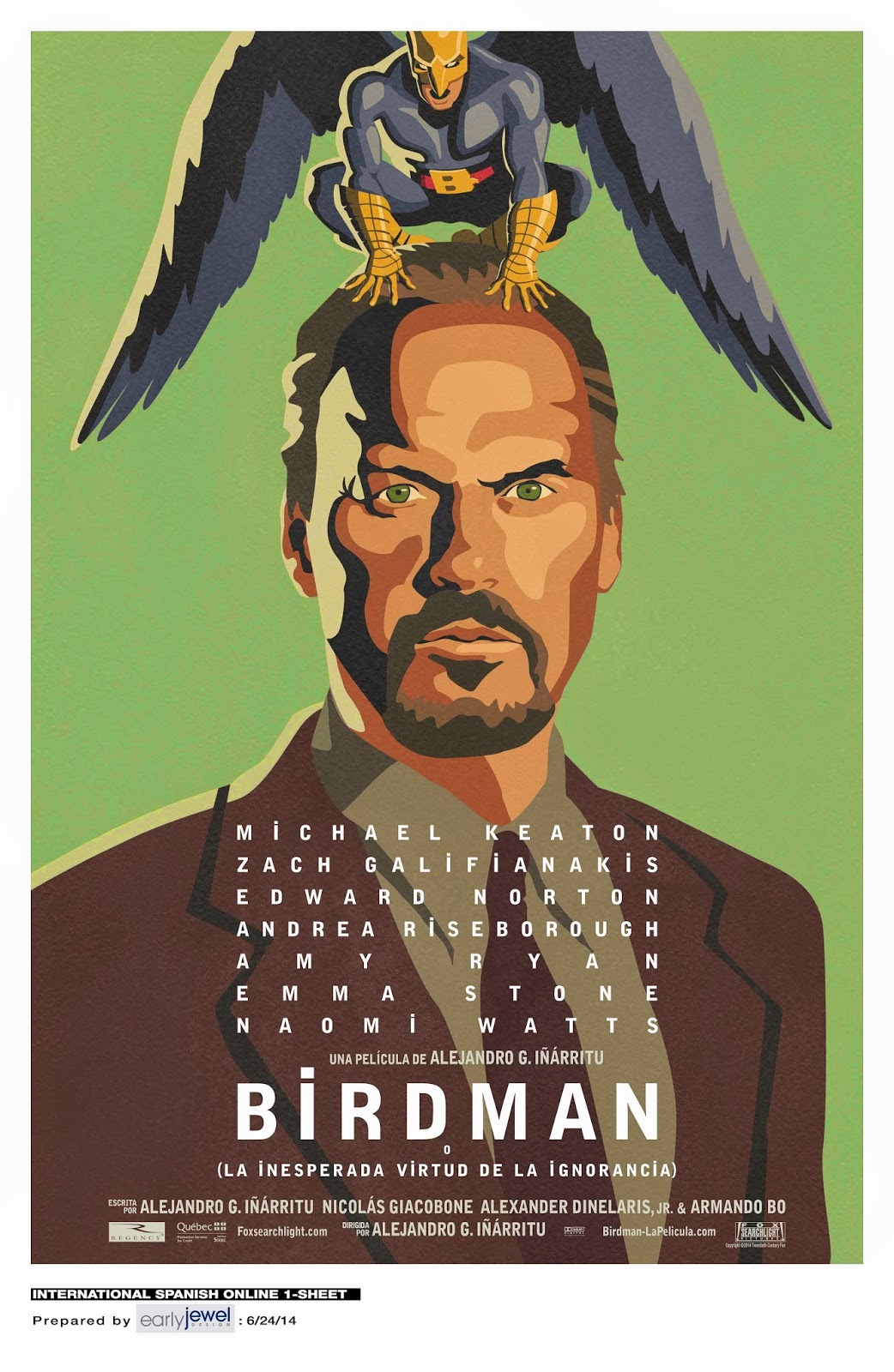
Birdman: or (The Unexpected Virtue of Ignorance)

Year: 2014
Director: Alejandro G. Iñárritu
Cast: Michael Keaton, Zach Galifianakis, Edward Norton
Run Time: 1 hour 59 minutes
MPAA Rating: R

A washed-up movie star attempts to revive his career with a Broadway play.

Countless films have worried at the edge between reality and fantasy like a dog with its favorite bone, including two of my very favorite horror films, so Birdman is in good company. But, and I say this without even the faintest whiff of sarcasm: Birdman ain't no Wes Craven's New Nightmare

The cardinal sin of the "comedy" Birdman is that it takes itself far too seriously. Many of its core scenes and conceits are pitched up to a more over-the-top register that would best function as laugh-out-loud comedy, but there's only one single line in the film that is obviously intended to elicit a chuckle. The rest is as dour and self-serious as the rest of the Oscarbait in the worm bucket, and that weighs down the film like an anchor.

There is some interesting material to chew on about how social media is shaping our generation's perception of art and reality, as well as how actors can get so trapped within a famous role that it casts a shadow over their entire lives. This is interesting to film enthusiasts and (more importantly) members of the Academy, but it's remarkably separate from the reality of the average American filmgoer. It absolutely doesn't need to play to the lowest common denominator, but Birdman's sense of what "reality" actually is, is already so mired in artifice that the film loops around itself uselessly like when I try to put the garden hose away.

In the process of all this philosophizing, Birdman loses itself among a pile of heaving, exhausting Important Movie cliches, like the Inexplicable Lesbians, the Real Life Connection, and the All in One Shot gimmick. Slathered with some improperly proportioned magical realism, a variety of subplots that utterly fail to go anywhere at all, and an astonishingly artless ending, Birdman is a frustrating nut to crack.

But when you finally break through to that sweet sweet nut meat (I am writing this very late at night), there's something special in there. Birdman is a film with an impeccable sense of rhythm, a variety of delectable lighting arrangements, and a series of off-the-wall performances pulled from actors who really have no business being in a movie like this. Emma Stone rips a nothing part to pieces with a spiky vulnerability, Zach Galifianakis tones down his usual energy to become a wonderful straight man, and Edward Norton shines as a loose cannon actor with a feeble grip on his own humanity.

And, after all, Michael Keaton has been getting all the awards buzz, so let's not forget to mention him. Although he gave a Brave performance more than he gave a Great one, Keaton carries the movie on his back across the finish line. His imbues his character with a wild-eyed animalism that propels the narrative through its illusion of a single shot without a single hitch or draggy moment. 

For my purposes, it is not a truly remarkable film, at times veering into an immensely irritating one. But for art cinema-inclined viewers, Birdman is one to RedBox before it's too late.

Rating: 6/10


Edge of Tomorrow

Year: 2014
Director: Doug Liman
Cast: Tom Cruise, Emily Blunt, Bill Paxton
Run Time: 1 hour 53 minutes
MPAA Rating: PG-13

An unwittingly drafted soldier finds that, every time he dies in battle, he wakes up the day before only to repeat his misery.

Edge of Tomorrow represents everything that's wrong with Hollywood today. 

By that I mean that it's a fantastic original movie, but it was misrepresented in advertising, brought in only slightly more than half its budget in box office, and was scuttled away to home video with a confusing new title to perish in ignominy.

It's a real shame. An adaptation of the manga All You Need Is Kill, Edge of Tomorrow presents a fun, fresh, sci-fi fueled twist to time loop storytelling, pitting Tom Cruise's eternal movie star glamor (which, as this movie proves, can survive even the weirdest twists and turns of his personal life - hail Xenu) against the endlessly unappreciated high caliber efforts of Emily Bunt. Blunt takes on the most kinetic, action-packed role of her career with aplomb, dragging a loopy sci-fi plot headfirst into gritty, believable reality.

On top of all of this, Edge of Tomorrow is, like, unbelievably funny. I'm serious. The film takes the notion of comic relief and stretches it liberally throughout the entire film like that Bible story with the fish. It's just shy of genuinely being classifiable as a "comedy," but it's a raucous good time all the same. The best part is that the humor bubbles up naturally from the situations and characters instead of being imposed upon the film by some unseen, arbitrary entity like certain of the more dour sequences in Avengers: Age of Ultron.

The endless repetition of plot points that comes with the territory of time travel films is treated with fleet footing, capturing the highlights while always furthering its central story arc. Between the repeated story beats with ever-changing perspectives and the secretly pretty cool alien tentacle CGI, Edge of Tomorrow feels like a particularly difficult video game level and captures the intrinsic joy that comes with solving an intractable problem while simultaneously having a great time shooting bad guys into piles of goo.

But there's something pulsing beneath the surface, too. Both characters are recognizably human and have fully developed arcs. This is something that shouldn't even technically make sense considering that Emily Blunt's character resets at the beginning of each day, but the film is so invested in its storytelling that it works no matter the obstacle.

There are some technical difficulties that derail the film slightly, like an undercooked third act and a severe lack of proper lighting during several key sequences, but Edge of Tomorrow is wicked fun, and worth a watch from anyone who hasn't seen it yet. Which is pretty much everyone, because the world is a terrible, unfair place.

Rating: 8/10


Groundhog Day

Year: 1993
Director: Harold Ramis
Cast: Bill Murray, Andie MacDowell, Chris Elliott
Run Time: 1 hour 41 minutes
MPAA Rating: PG

A curmudgeonly weatherman gets trapped in a time loop and is forced to repeat Groundhog Day endlessly until he becomes a better person.

Two guesses as to how I decided to pick this one.

Groundhog Day is an indisputable classic of the 90's comedy genre, one for which I have an immense amount of esteem and absolutely nothing new to say, so this will be my shortest review yet. Depending on your inclination, you may either cheer or jeer here.

...

Alright, we're back. Set in the small Pennsylvania town of Punxatawney, Groundhog Day is more than just the story of one man finding his inner Samaritan. It's about the clash between the town and the city folk, and the lack of respect for others that the city garners in otherwise good people. 

As Murray's weatherman discovers the better person inside of him, he simultaneously develops a working interest in the lives of those around him. It is these people more than anything who help make him better rather than any supernatural force or deus ex machina. And Bill Murray is at the top of his game, giving his sardonic bastard a likable humanity without letting his brittle exterior of the first act show any chinks in his armor. 

Subtextual undercurrents, Bill Murray being pitch perfect... Throw in a lush, reactive score, an inventive visual schema, and a hard-hitting lesson about the fact that, sometimes, bad things are destined to happen and there's nothing we can do about it, and you've got yourself an unforgettable comedy with real heart.

Oh, and Andie MacDowell is OK, but her accent is ridiculous.

Rating: 8/10

Wild

Year: 2014
Director: Jean-Marc Vallée
Cast: Reese Witherspoon, Laura Dern, Gaby Hoffmann
Run Time: 1 hour 55 minutes
MPAA Rating: R

The true story of Cheryl Strayed, a kind of annoying hipster who decided that hiking the Pacific Crest Trail would solve all of her personal problems.

The next breadcrumb on our trail of Oscarbait leading us out of the 2015 Academy Awards is Wild, the first outing for Reese Witherspoon's new production company, Pacific Standard. I daresay, it's in good company with Birdman because it has several shining glimmers of pure cinema sandwiched in between what ends up being an immensely frustrating, self-indulgent project.

The biggest flaw of Wild is unfortunately inextricably attached to it: the subject matter. Based on the popular memoir Wild: From Lost to Found on the Pacific Crest Trail by Cheryl Strayed, the film necessarily must take on her character and situation at face value. The only problem is that, at all times, Cheryl Strayed can be relied upon to be the most douchey, irksome person in the room.

Now I'm not even referring to her backstory, which involves biblical amounts of heroin and cheating on her husband. That's par for the course in this kind of Find Your Clarity picture. What I'm referring to first and foremost is her habit of quoting famous authors in this manner: "I took the road less traveled, and that has made all the difference." - Robert Frost (and Cheryl Strayed) Like, what. Were you there helping him write his magnum opus, Cheryl? No you weren't. Now stop prancing about like you're so much better than everybody else and crapping all over authors you've never even read. So there.

I'm sorry. I just really despise Cheryl Strayed. At least as portrayed in the film, she is the worst kind of pretentious hipster and could hardly care less about the plight of other people, although her mind-altering journey is ostensibly about coping with the loss of her mother, played by Laura Dern over what adds up to about a minute of screen time. But enough about that.

I will give Wild this: When it makes an effort to be an art film, it really rises to the challenge of creating something visually stimulating. The rhythmic, stream-of-consciousness editing patterns link together disparate images in a reckless collage of life, at least in the patches where they crop up.

And Reese Witherspoon really does a terrific job here, for better or for worse, taking a physical challenge and inhabiting a role that drags her straight out of her comfort zone to expose some really raw, true emotion. She is also essential in providing the film's infrequent undercurrents of humor, which are a welcome presence in the midst of such a straightforward story.

I have my doubts as to whether the conclusion of the story is as clear-cut as screenwriter Nick Hornby seems to think it is, but when it comes amidst such a magnetic performance and easy, beautiful visuals, it's not hard to ignore. All in all, Wild is a plus, but for a great deal of the time it wastes a lot of its energy pushing against that current.

Rating: 6/10
Word Count: 2007

Friday, March 13, 2015

Culture Clash

Year: 2006
Director: Alejandro G. Iñárritu
Cast: Brad Pitt, Cate Blanchett, Adriana Barraza
Run Time: 2 hours 23 minutes
MPAA Rating: R

The story of the Tower of Babel goes as follows:
Once upon a time, everyone on Earth spoke the same language. Settlers in the land of Shinar sought to build a city with a tower reaching into the sky, so their people would never be separated. God looked out upon the construction and realized that there was nothing the people couldn't do if they worked together. He wasn't a big fan of that, so he cast a god spell on them, scattering the builders across the Earth and bestowing them with different languages so they couldn't understand one another or work together ever again. Google Translate having not been invented yet, the construction of the tower was halted and the city became known as Babel, which is now our word for an incomprehensible mash of language.
I have a theory that the production of the 2006 Best Picture-nominated film Babel went a little something like that story. It's a perplexing mash of loosely-connected storytelling, simultaneously thrumming with a conspicuously ham-fisted moral and a set of incomprehensible private musings of its own. Directed by Alejandro González Iñárritu (of this year's Best Picture, Birdman), Babel is a bewildering clutter, but it's not without its charms.

Sexy grey Brad Pitt is probably the least of its charms, so that's saying something.

The story of Babel goes as follows:
1) In Morocco, two young boys play with their father's gun, shooting it at passing cars. After they hit a tour bus an injure a woman inside, the corrupt local policemen pursue their family. And Brennan writes a strongly-worded letter to their parents.
2) In Morocco, unhappily married couple Richard (Brad Pitt) and Susan (Cate Blanchett) go on vacation in an attempt to move past the unfortunate death of their young son. After Susan is shot by a stray bullet through the window of their tour bus, they spend several days in a nearby town awaiting the arrival of the proper medical authorities. Susan spends pretty much the whole time lying on the floor unconscious. Surprisingly, Cate Blanchett does not win an Oscar for this role.
3) In America, Richard and Susan's kids are left to the care of their Mexican nanny Amelia (Adriana Barraza). When their trip is extended by an unfortunate bullet wound, she is forced to take them with her to her son's wedding down in Mexico. They spend a blissful day together, marred by a conflict with the immigration authorities on the way back home. George Bush is unharmed.
4) In Japan, deaf teen Chieko (Rinko Kikuchi of Pacific Rim) attempts a sexual awakening, but finds that very few older men are interested in her insatiable lust. This is before Instagram was invented, so you can understand her pain. 
So what we get from all of this is... that Alejandro Iñárritu really likes Crash. In all seriousness though, Babel takes after its namesake: Each of the linked stories (The Japan story is dubiously connected to Morocco through Chieko's father) paints a larger picture, that of two different cultures combatting one another, causing issues through lack of compassion and understanding. Basically, it's the cinematic explanation for why we never built that damn tower.

It's those teens with their swingsets and their premarital sex. Ruining it for us all.

The problem with the interconnected stories is that they intersect at such few and inconsistent points, it raises the question of why they felt the need to even try in the first place. Those first three stories go  together pretty strong, but the Japan angle is barely hanging on by a thread. In any other film, I'd say yank that plot out like a loose tooth, but unfortunately Chieko's story is one of the most interesting in the whole kaboodle.

Of all the culture clashes we see throughout the film, Chieko's is the only one that takes place within one umbrella culture. She and the people she struggles with are all Japanese, united under one language and set of traditions. However, her deafness creates a whole new subculture that bumps and grinds against her superculture. Chieko's story is by far the most intriguing to watch play out, second only to Amelia's, which has the most pathos thanks to the director's intimate understanding of the Mexican culture.

With the two strongest stories muscling for screentime in the wings, Babel keeps returning to damn Morocco, with poor Cate Blanchett lying wanly on her rug while Brad Pitt looks angsty and artily bedraggled. It's Oscarbait so pure and undiluted, it makes me a little sick to my stomach.

He's got the shakes. This must be his first time.

There are fantastic parts of Babel. Much of the sound design involved in painting Chieko's world, for instance, or the fleshed-out arc of Amelia's story that rips your heart to shreds. But the film as a whole is unfairly bogged down with an imbalanced focus on the least interesting facets of its narrative, its deliberate pacing, and its startlingly devoted propensity for handheld camerawork.

And don't even get me started on the plot twists that splatter out of the third act like the last of the whipped cream in the tube. They're almost amusingly banal, as if they had gotten M. Night Shyamalan's accountant brother to write them. I won't give anything away, but imagine that the ending of The Sixth Sense was "Bruce Willis was a doctor and his storyline took place five minutes before the other one." It's not a good look.

But really, Babel hits where it counts. I wish it were a little more focused, or maybe that Amelia and Chieko got films of their own instead of being forced to fight to the death with the hyperbolically duller storylines. But all in all, it's not a waste of time. If you're looking to watch an Important movie, Babel will certainly have you covered. And at least you can comfort yourself with Brad Pitt's face while you ignore everything coming out of his mouth.

Kind of like in World War Z!

TL;DR: Babel is a decent prestige drama, but has an unfortunate predilection for its least interesting storylines.
Rating: 6/10
Word Count: 1049