Showing posts with label Craig T. Nelson. Show all posts

Tuesday, June 19, 2018

Mr. Mom, Who Was Bitten By A Radioactive Mom And Now Has All The Powers Of A Mom

Year: 2018
Director: Brad Bird
Cast: Craig T. Nelson, Holly Hunter, Sarah Vowell
Run Time: 1 hour 58 minutes
MPAA Rating: PG

A quick caveat: That epilepsy warning is no joke. I have a photosensitivity, so the strobe effect that dominates three scenes lasting one to two minutes each prevented me from watching a certain portion of the film. Maybe those were the worst scenes in the movie or the best, but at any rate they don't factor into my review except for sound design I guess.

It's been fourteen years since the superhero family The Incredibles first graced cinema screens. It would probably suffice to say that the superhero movie landscape has changed since then, so I was interested in seeing how well the film played against the inundated landscape of the Marvel cinematic universe and its sickly basement-dwelling cousin the DC extended universe. Probably to its advantage, it doesn't change its stylized retro sci-fi gleam one bit. We sure get a lot of superheroes but we're still not getting that.

Angle-wise, there's just SO much going on here.

Incredibles 2 picks up literally the second the previous entry left off, with the Incredible family - superstrong dad Bob/Mr. Incredible (Craig T. Nelson), stretchy mom Helen/Elastigirl (Holly Hunter), force field-creating invisible girl Violet (Sarah Vowell), and super fast Dash (Huck Milner) - stopping an attack by the villainous Underminer (John Ratzenberger). However, the destruction caused by this effort hasn't helped the public perception of "supers," and the law enforcing the illegalization of superpowers is holding fast.

That is, until Winston Deavor (Bob Odenkirk) puts his hat in the ring. The wealthy telecommunications magnate is a fan of supers and has put together a plan with his inventor sister Evelyn (Catherine Keener) to hire Elastigirl for an underground PR campaign showing the world just how necessary superheroics are. While she heads off to the nearest metropolis to begin work, Mr. Incredible is left at home with the kids, which would be overwhelming even if the baby Jack-Jack (Eli Fucile) wasn't developing, oh, every power in existence.

Conveniently, this Elastigirl gig is timed with the rise of the Screenslaver, a freaky masked villain who uses screens to hypnotize people and is hellbent on tearing a lazy public away from the television they seem to worship. She sets off to stop the Screenslaver while Bob stays home with the kids. You know, just like the woke cinema classic Mr. Mom!

This is also maybe the freakiest thing ever included in a Pixar movie and they literally made two movies about monsters.

I obviously wasn't super sold on the Mr. Mom angle the trailers made apparent. It still reeks of the mentality that women in the workforce is a bizarre novelty and that men are dumb cavemen idiots who can't parent their own children. The most recent incarnation of this story was that soul-bleachingly mediocre Matt LeBlanc sitcom Man with a Plan, so I can't say I had high hopes.

Luckily, Incredibles 2 doesn't foreground the gender normative elements I was worried it would. It tells a story of the universal struggle to be a parent, with the chaos of having a newborn baby amplified by Jack Jack's powers. He can multiply his body, set the house on fire if he doesn't get a cookie, and his atomic sneezes send him phasing through various walls and ceilings. He's uncontainable and every parent's literal nightmare.

Naturally, he continues to be the best part of the film, and his mini-fight scene with a raccoon is maybe the best superhero moment in cinema this decade. But the other characters are all given a lot to do, with the exception of maybe Dash, whose energy generates a whole lot of fun, but it's all sugar and no substance. But yes, once again the family is at the center of the film, their characters and dynamics being the primary driving force of the story, aided and abetted by all the useful metaphors that superheroics can provide.
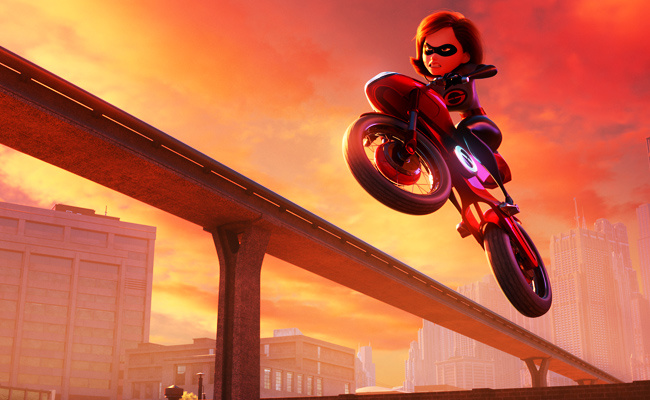
I'm not a regular mom. I'm a cool mom.

But although they're certainly not the crux of the story, those crime-fighting sequences really are exciting. They run the gamut from Spider-Man 2 setpieces to James Bond high camp villainy to good ole "capable people work together to prevent a disaster," and it's probably the best choreographed and edited animated action in American cinema, followed far behind by maybe Big Hero 6 and almost nothing else. Incredibles 2 is so fun and splashy that it makes you forget that we've already gotten a Black Panther, an Infinity War, and a Deadpool 2 within the past eight seconds. It's popcorn movie magic at its finest, using the limitless imagination of animation to deliver some impossibly dazzling stunts.

It maybe lacks the depth of the original film's more concrete, well-thought-out storyline, but I'd be hard-pressed to look at this year's slate of summer films and see anything that will be remotely as exciting and fist-pumping as this triumph, the best non-Toy Story Pixar sequel to date, and most likely in perpetuity.

A Note on the Short Film Bao: I'm obviously very glad that Pixar has started to realize that other cultures can and should be represented in animation, and this video about an anthropomorphic dumpling is certainly working Pixar's formula in a unique way - from its soft, stylized character designs to its casually magical, circular narrative. It's certainly very cute and a lively dialogue-free effort in visual storytelling, but I found the central metaphor to be more than a little bit ruined by the narrative turn it takes in the end, which for me undermined the story I thought I was watching. But nevertheless, a worthwhile effort that is no "Piper" but it's certainly no "Lava," so I'll take that middle ground any day. 7/10

TL;DR: Incredibles 2 is the best non-Toy Story sequel Pixar has ever made.
Rating: 8/10
Word Count: 988
Reviews In This Series
Incredibles 2 (Bird, 2018)

Saturday, May 23, 2015

They're Back

Year: 1986
Director: Brian Gibson
Cast: JoBeth Williams, Craig T. Nelson, Heather O'Rourke
Run Time: 1 hour 29 minutes
MPAA Rating: PG-13

It was only a matter of time before they made a Poltergeist sequel. After all, the original film came out in 1982, just one year after the 80's sequel inferno ignited with the success of Friday the 13th Part 2. 

It's a mystery why they waited so long, but presumably the filmmakers wanted to be respectful of the legacy of Dominique Dunne. The actress, who played the Freelings' teen daughter, was tragically murdered shortly after the film's release, forming the first in a series of unfortunate deaths that became known as the "Poltergeist Curse."

But I'm not here to write about Hollywood gossip and tenuous paranormal theories (though if the show Ghost Hunters is any indication, there's a market for that). I'm here to write about some horror sequels, because that's what I love to do. 

God help me.

Poltergeist II: The Other Side is the dictionary definition of diminishing returns. The box office was lower, the returning cast was altogether weaker, and the special effects extravaganza that defined the original film had subsided into the background. The plot could have given away this fact all on its own, with its ultimate revelation that the Freelings' house in the Cuesta Verde suburb complex was built on a burial ground which was... built on a different burial ground. This time, the tomb of an unlucky cult.

One of my favorite things is when horror franchises get desperate enough to resort to crazy plot devices to keep their overarching narrative going. This is like Christmas for me.

So anyway, the Freelings - father Steve (Craig T. Nelson), mother Diane (JoBeth Williams), son Robbie (Oliver Robins), and daughter Carol Anne (Heather O'Rourke) - are back, and this time they're living with their grandmother (Geraldine Fitzgerald). When the demonic cult leader/ghost/whatever the needs of the scene require Reverend Henry Kane (Julian Beck) begins haunting their new abode, inflicting the power of the spirit world upon the family yet again, they realize that their nightmare isn't over.

Nor are the effects that look like a Scooby Doo computer game come to life.

Of course Tangina (Zelda Rubinstein) is back, but the utterly weird effect she instilled upon the first film is dashed through overfamiliarity, a too early appearance, and its dilution through the utterly inadequate Taylor (Will Sampson). Taylor is at once a grotesque caricature of Native American shamans and a purveyor of dangerously concentrated Sequel Explanation nonsense. When he's not sitting in his teepee or trying to steal Steve's car, he is portentously babbling about the evil forces that are hard at work at not scaring us at all.

Because, let's face it, Poltergeist II: The Other Side is about as scary as a bowl of milk. The special effects are mostly nonexistent, only perking up beyond "a third grader drew lightning on the screen" on two occasions. Now, one of these moments is pure H. R. Giger nightmare fuel, but for the most part the film can't focus on anything long enough to wring true terror from it.

To be fair, this was a film beset with difficulties. Following Julian Beck's untimely death from stomach cancer during the middle of filming (The Curse! Burn the witch!), the filmmakers were forced to retool the ending sequence, throwing off the balance of the story immensely. While Kane's visage and Beck's performance are suitably extravagant, he never comes across as a truly potent evil figure, and his being shuffled out of the film halfway through renders the entire third act aimless and perplexing, during which arbitrary characters are bestowed with inconsequential clairvoyance left and right and the plot wastes away, wheezing in the corner.

A series of deus ex machina moments prolong a perfunctory and muddled ending that occurs without finality or triumph, merely a slight whiff of putrid air.

The power of family continues to prevail over the power of hack screenwriting.

Despite featuring performances from more or less the exact same cast, the years and the decreased production values have sucked the impact out of things. Previous standout JoBeth Williams is shunted aside aside in a role that highlights the ineffably weaker Craig T. Nelson's Steve as the central figure. His already unsteady performance is toppled by a script that requires him to wear a terrible haircut and a more or less permanent scowl, then parade around without a shirt an inexplicably numerous amount of times.

Zelda Rubinstein and Heather O'Rourke, the two most ethereally compelling figures from Poltergeist, are likewise given short shrift. O'Rourke had some raw talent, but with any child actor, she needed a good director to draw it out of her. Brian Gibson (of the Tina Turner biopic What's Love Got to Do with It - so at least he has some experience with horror) was evidently not that director. And poor Miss Rubinstein seems actively bored in a paranormal role turned as mundane as the neighborhood milkman.

She looks like she just dropped by to borrow a cup of sugar.

But in spite of its cavalcade of flaws, there's something mildly interesting lurking just beneath the waxen surface of Poltergeist II. First off, some of the original film's humor survives, especially in the family's reaction to their previous predicament (i.e. they have no TV and are forced to listen to sports on the radio; they discuss what exactly they should say on their insurance forms considering that their house crumpled itself into the void).

In addition, there is an occasional gesture toward the political acuity of Poltergeist. Where the first film was all about the dark side of Reagan-era suburbia, the sequel shines a light on the crisis of American masculinity. It's not nearly so intelligent as I made it sound, but the chink in Steve's armor is his doubt about being able to keep his family together. With his position as patriarchal authority figure in question, he allows the spirits to manipulate him through his weakness and fear.

There's an additional subplot that, while I wish it were explored more in depth, stings with truth. It comes to light that Diane initially wanted to have an abortion when she found out she was pregnant with Carol Anne. This revelation allows a rift to grow in the family unit as the ghosts gain strength, but is defeated when their love for one another overcomes this obstacle.

I don't have a caption for this. I just like this picture.

So all in all, Poltergeist II: The Other Side isn't remotely scary, falls prey to a disorganized screenplay, and doesn't truly explore the consequences of the titular other side. It's not particularly worth watching for any but the true faithful haunted house fandom, but if you decide to pursue it, there are several nuggets that you can manage to mine. Preferably if you're writing a thesis on ghost films or something, because at least you can make productive use of your wasted time.

TL;DR: Poltergeist II: The Other Side is a lackluster sequel that lacks direction and scares.
Rating: 5/10
Word Count: 1193
Reviews In This Series
Poltergeist (Hooper, 1982)
Poltergeist II: The Other Side (Gibson, 1986)
Poltergeist III (Sherman, 1988)
Poltergeist (Kenan, 2015)

Wednesday, May 20, 2015

Fright Flashback: They're Here

It's that time of year again! While you're getting out the sunblock and your big floppy hat, please give a warm summer welcome to Fright Flashback! Every week I will be reviewing an old horror movie that shares a theme, cast/crew member, or genre with the week's big release: a sort of spiritual predecessor. Again, very special thanks to Tim Brayton at Antagony and Ecstasy for the idea I more or less shamelessly ripped off and modified. I stand on the shoulders of giants, what can I say? It's comfortable there.

This week's new release is the long-delayed remake of just about the only horror classic left on the chopping block: Poltergeist. In celebration, we are heading back to 1982 to appraise the original property.

Year: 1982
Director: Paul Blart: Mall Cop
Cast: JoBeth Williams, Craig T. Nelson, Heather O'Rourke
Run Time: 1 hour 54 minutes
MPAA Rating: PG

I haven't seen the original Poltergeist since I was a child, and there is perhaps no better condition in which to view it. As one grows older, one gains a more mature appreciation for the deeper themes present in what is a truly remarkable movie, but the level on which Poltergeist works best is in its pure spectacle, and the childlike wonder and appreciation for the terrors that lurk in the dark shadows of the suburban idyll.

Also, frankly, children have a higher tolerance for chintzy 80's special effects.

There has long been contention about the directorial authorship of Poltergeist, and I would be remiss by not at least nodding toward the controversy. Though the credited director is Tobe Hooper of The Texas Chain Saw Massacre and, one year previously, The Funhouse, reportedly the bulk of his work was performed by producer Steven Spielberg during a break on his own film, E. T. (both films came out within a week of each other - what a time to be alive, am I right?). 

Honestly, my money is on heavy Spielberg involvement, but it's rather beside the point. We'll never know the true answer, and the fact is that both of them were there, resulting in an indisputable classic of the genre. What more is there to say?

Just let sleeping clowns lie.

Poltergeist's plot is a simple one, albeit dressed up with some rather detailed theological accoutrements. The Freelings are a middle class family who live in one of the identical houses of the Cuesta Verde suburb of an unnamed California town. Father Steve (Craig T. Nelson) is a realtor responsible for selling a good half of the properties in the district, mother Diane (JoBeth Williams) is young and loving, but softly frustrated with her responsibilities as a parent.

Having had her first daughter, Dana (Dominique Dunne), at the tender age of 16, her youth has been compromised. Robbie (Oilver Robins), the only boy, and Carol Anne (Heather O'Rourke), the youngest, don't exactly subtract from her strain. The conflict of Poltergeist reflects the conflict inside Diane: despite making every effort at achieving the trappings of domestic bliss, something is insidiously, indelibly wrong with the whole affair.

The very nooks and crannies of the Freelings' familiar abode become a hotbed of paranormal activity when a ghostly presence asserts itself through the static on the television (Remember when TV actually ended? I don't.). At first, the disturbances are harmless, almost playful, but they quickly crescendo into a nightmarish conglomeration of terrors, culminating in Carol Anne's being spirited away into another realm. With the help of the paranormal crack team of Dr. Lesh (Beatrice Straight) and her associates, as well as a third act showstopper appearance by the advanced medium Tangina (Zelda Rubinstein), the family attempts to reclaim their lost child from the unknowable menace.

The housing market was really rough in the early 80's.

First and foremost, Poltergeist is a rapturous showcase for MGM's state-of-the-art special effects. Second, it is a lovingly detailed character drama about the American family. Third, it is a down-home shocker chockablock with instantly iconic moments.

Let's begin with the first, especially because that most cherished element is perhaps the weakest of the film. I don't mean to say that the ample special effects are anything but spectacular. They are, but if we're going to be completely honest, most of them have aged about as well as the Flock of Seagulls haircut. 

It's easy enough to still find tension in these moments thanks to the emotional heft of the characters and storyline, but the film devotes a great deal of time to curdled milk visual effects that remain charmingly cheesy but dangerously challenge the truth and reality at the core of its narrative.

Sometimes it feels a little like an Eldritch Horror-themed high school prom.

That's all well and good, but if you dig a little deeper under the topsoil of shiny chrome ghoulies, Poltergeist has an impenetrably solid thematic bedrock. The entire first act serves to deliver the ultimate experience in suburban bliss, only to tear it down time and time again for the remainder of the film. In its ineffably phantasmagorical way, it peels back the facade of the American Dream to reveal that, in fact, all is not good in the neighborhood.

The trappings of suburban bliss become conduits for hellish monstrosities: chairs, dolls, closets, televisions, and even the very landscape surrounding the house. And yet the family unit remains strong. No, Speilberg and Co. are not warring against the nuclear family - his many many films during this era would disprove that immediately - but rather the Reagan-era greed and materialism that led them to this moment in this place surrounded by these suburban trappings (obtained to the detriment of the graveyard that once stood on that very ground, forcibly evicted by a mercenary realty company*).

Behold: The Suburban Nightmare!

Not only is this fascinating, it's downright terrifying. As I said before, the special effects have long since lost their luster as anything other than a sideshow amusement, but the film so firmly believes in its world that its easy to get caught up in the undertow. 

JoBeth Williams especially sells the hell out of even the most Novelty Barn-looking effects, dragging the film into raw, unadulterated reality with an unfiltered performance of pure strength. Craig T. Nelson can't quite match her (his eyes are remarkably uninvolved in whatever he seems to be doing or saying), but as the useless patriarchal figure he does the trick.

And don't even get me started on Zelda Rubinstein, whose exorbitant weirdness sets the film ablaze with a new inferno after its pace starts to flag a bit in the third act, during which we must sit through an alarming amount of philosobabble. It is in this quadrant of the film where it hits the peak of its strangeness, but her unrestrained performance breathes life into a scene that, when you think about it, is literally just a small woman throwing tennis balls at a strobe light. 

Honestly, the simplicity of the finale ignites the imagination rather than exhausting the eyes, providing the perfect backdrop for the film's emotional climax.

But I digress. I was speaking about acting, and I would be remiss if I neglected to mention Heather O'Rourke. Although her untimely death at age 11 casts an eerie pall over the entire performance, she deserves immense credit for what she was able to deliver without the shadow of tragedy. Simultaneously angelic and uncanny, her performance crystallizes the tension of the film with a thoroughly engaging, disturbing, immensely adorable charm. It's hard to explain rationally, and it may just be a credit to whatever director happened to be coaching her, but it's a performance that you feel in your gut, not your brain.

I'm a little in awe of how mystifyingly unsettling she is, and what happened to her is a damn shame.

But for all that Poltergeist is genuinely frightening, it also packs a keen sense of fun. Another tally mark in the "Spielberg" column, the film is like an amusement park adventure ride, with an unflagging levity weaved throughout the horror. Jerry Goldsmith's score compounds this tone tremendously, with a leeringly creepy spin on childhood nursery rhymes that tilts unexpectedly into open-faced childlike wonder.

I have some personal qualms about the overlong ending, which plays off like a laundry list of VFX sequences that were conceived in the brainstorming process but were forgotten until the end of production and haphazardly shoved in one after the other like shiny playthings in a toddler's toy box. 

It also doesn't help that nearly every single one of these effects are by far the best (and most credible) of the entire film (a personal favorite being the elongating hallway). And all of them take place after the conclusion of the film's climactic sequence.

But honestly, any faults with Poltergeist, no matter how large, are mere nitpicks. There are enough that I hesitate to instantly proclaim its masterpiece status, but as a whole the film is an unutterable classic of the form, and I would scarcely dare to impeach that.

*Side Note: It is explicitly noted in the film that the house is not built on an ancient Indian burial ground. That little tidbit seems to have slipped away on the wind.

TL;DR: Poltergeist is a lavish, effects-filled thrill ride, but its most important value is as a treatise on the hazards and fears behind American suburbia.
Rating: 8/10
Word Count: 1568
Reviews In This Series
Poltergeist (Hooper, 1982)
Poltergeist II: The Other Side (Gibson, 1986)
Poltergeist III (Sherman, 1988)
Poltergeist (Kenan, 2015)