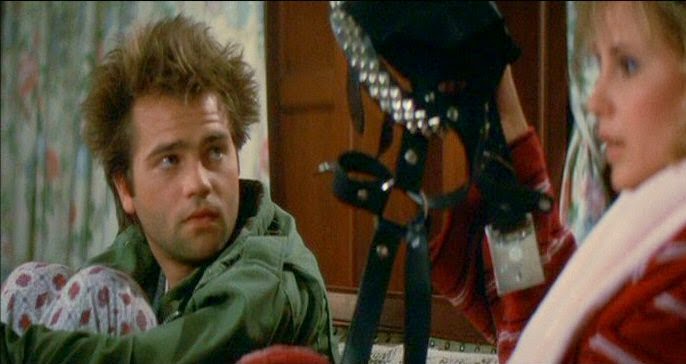
Tuesday, April 14, 2015

Census Bloodbath: Rural Furor

Year: 1981
Director: Frank De Felitta
Cast: Charles Durning, Robert F. Lyons, Claude Earl Jones
Run Time: 1 hour 35 minutes
MPAA Rating: N/A

Canadian slasher movies are better. It's just true. Sure, our polite Northern friends can churn out crap just like the rest of us (here's looking at you, Humongous), but their hack 'n slash pics ineffably, inevitably turn out more engaging and fun than their American counterparts. Consider Terror Train over New Year's Evil, or My Bloody Valentine over any other film ever released. Even their direct to video cash-ins like Prom Night IV: Deliver Us From Evil have their measure of charm.

But in October 1981, the Canadian slasher complex would face its biggest challenge yet: the television movie. TV movies are generally notorious for their crouton-sized budgets, their community theater performances, and their noxious Hallmark plotting, but a TV slasher flick? Without blood and guts or boobs and butts? Removing the slasher from its raison d'être is genre suicide.

Enter Canada.

1981's Dark Night of the Scarecrow is a unique film for many reasons, but the fact that it's pretty darn good is not the least of them. Thanks to the restrictions and limitations of television the filmmakers were forced to get creative, and the product is an off-model slasher with a chilling EC Comics-esque premise and a good deal of suspense. Sure, there's no drippings or strippings, a small body count, and no traditional Final Girl, but for that reason its success is all the more remarkable.

You don't need Karo syrup to find this scarecrow creepy as hell.

In classic Canadian slasher tradition, Dark Night of the Scarecrow is set as far from the Yukon as humanly possible, this time the American South. One day, the wicked and corrupt postman Otis Hazelrigg (Charles Durning) spots an opportunity to enact his violent fantasies on the mentally challenged Bubba Ritter (Larry Drake, who would later fill the title role in Dr. Giggles).

After Bubba's best friend Marylee (Tonya Crowe), a young neighborhood girl, is attacked by a dog, he is blamed for her injuries and summarily executed by Hazelrigg and his bloodthirsty cronies. They find him hiding in the cornfield dressed as a scarecrow and shoot him to death, planting a weapon - a pitchfork - on his body. They're quickly found not guilty by the local court. So before the killings even begin, the real terror can be found in the atrocities committed by closed-minded human beings on the less fortunate. Blammo. Film theory.

Needless to say, somebody wants revenge on Hazelrigg and his posse, the dim-witted yokel mechanic Skeeter (Robert F. Lyons), the greedy feed factory owner Philby (Claude Earl Jones of the same year's Evilspeak), and their less interesting friend Harless (Lane Smith). I guess you could say he's the DUFF of the group. Somebody is pursuing them, placing scarecrows outside their homes to taunt them, and murdering them in respectfully chaste but darkly nasty ways.

The suspects abound, including Bubba's stern but loving mother (Jocelyn Brando, Marlon's older sister), his best friend Marylee, the D. A. (Tom Taylor of Maniac Cop) who lost the case against them, or maybe something more inexplicable.

My vote is on the little girl. She's hardcore. Those flower leis can crush a windpipe no sweat.

Dark Night of the Scarecrow certainly has its weak spots. I mean, come on, it is a TV movie. The acting is a little showy across the board, the sets are sparse (in one memorable sequence, Otis opens his massive desk drawer to reveal that its only contents are a single pistol), the opening sequence is laboriously extended, and its background soundscape is comprised of endlessly looped cicada chirps like the world's worst white noise sleep tape.

But the film more than makes up for its lo-fi splendor. First off, it's surprisingly dark. The scene where Mrs. Ritter is forced to explain to Marylee why she won't be seeing Bubba anymore rips out your heartstrings and plays a funeral dirge on them like a cello. Which is the saddest instrument. How are short musicians supposed to reach all the way up there?

But I digress. Dark Night of the Scarecrow is more than just a murder spree, because it has to be. With a focus on back home drama over gore (although the kills are all impactful and slyly foreshadowed), the story it tells is richly spooky and full of intrigue. And as Otis and his buds tear their way through the town in a mad dash to discover the culprit, their interactions reveal a detailed sketch of life in a rural town in the early 80's.

Sure, the screenwriters have probably never even eaten grits, let alone visited Texas, but the small town atmosphere crosses all borders. The community depicted here is full and lively, forming a realistic backdrop for the more uncanny scares.

"This is the least canny thing I've ever experienced!"

As for the scares themselves? They don't exactly come thick and fast, dispersed as they are amid the townspeople's frequent interactions. But when they arrive, they're terrifically bone chilling and effective. The presence of the scarecrow constantly lingers in the back of one's mind, so whenever a character gazes out of the frame, the shivers return before anything is even revealed. Not to mention that the scarecrow design itself is quite impeccable. It's a shame the film never saw a bigger audience, because that would be one award-winning Halloween costume if anybody actually cared to recreate it.

All in all, I'd without a doubt tout this film as a lost second tier classic. It doesn't have the camp factor of a House on Sorority Row or the deft intellect of a Nightmare on Elm Street, but it's worth recognition. Do I wish the protagonists weren't also despicable human beings? Yes. Am I glad to watch them inch closer and closer to their inevitable demise? Hell yes. It's a balance, I suppose. Check out Dark Night of the Scarecrow if you're in the mood for some low key, but hair-raising fun!

Killer: The Scarecrow [The ghost of Bubba Ritter (Larry Drake)]
Final Girl: None
Best Kill: Philby is buried alive in his feed silo until only his flapping, helpless hand is visible.
Sign of the Times: Nothing in particular, but Skeeter's trademark polka dot hat is pretty atrocious.


Scariest Moment: Whenever the scarecrow appears, heralding the next death.


Weirdest Moment: While a dog mauls Marylee, the scene cuts away to close-up shots of unimpressed garden gnomes.


Champion Dialogue: "The only thing official you ever done is lick stamps!"
Body Count: 6; only three of which are perpetrated by the Scarecrow.
  1. Bubba is shot to death.
  2. Harless falls into a woodchipper.
  3. Mrs. Ritter has a heart attack.
  4. Philby is buried alive in his feed silo.
  5. Skeeter is hit in the head with a shovel.
  6. Otis is pitchforked in the gut. 
TL;DR: Dark Night of the Scarecrow makes good use of its limitations to be a deliciously creepy low budget chiller.
Rating: 7/10
Word Count: 1174

Monday, April 13, 2015

Census Bloodbath: Suffering Is Good For Pleasure

Year: 1981
Director: Jesús Franco
Cast: Olivia Pascal, Christoph Moosbrugger, Nadja Gerganoff
Run Time: 1 hour 24 minutes
MPAA Rating: R

European slasher films are something special. Whether they're top shelf fare like Suspiria and Twitch of the Death Nerve or low rent knock-offs like Trhauma and Murder Syndrome, there's always a spark that dances in the eyes of the Eurotrash flicks. Perhaps its just that I've grown used to the Western modes of storytelling or that I allow the language barrier to gloss over simple mistakes, but whatever it is, these films are truly, undeniably different.

1981's Bloody Moon (AKA Die Säge des Todes) is one of these films. What would have otherwise been an unremarkable smear on a forgotten footnote of cinema history is double-filtered through the addled mind of Spanish sleazemeister Jesús Franco and the resources of West Germany, then slathered with the most literally transcribed, un-emphatic dub ever created by stoned Americans trapped overnight in a recording studio with nothing else to do.

It's not a film you'll want to take home to mama, but it's unique in that ineffable way that the American films of the time couldn't capture. It's certainly not better than the bulk of its peers, but its logistical missteps, overwrought dialogue, and surreal scene structure at least create an indelibly memorable experience.

Case in point.

Bloody Moon takes place on a remote resort in Spain, which one Professor Alvaro (Christoph Moosbrugger) has converted into a language school. The estate is the home of Countess Maria Gonzales (María Rubio), an elderly spinster in a wheelchair. Although her niece Manuela (Nadja Gerganoff) takes care of the place, she has bequeathed her fortune to her nephew Miguel (Alexander Waechter), who has a deformed face (it's burned, I guess, but it just looks like spilled oatmeal crusted around his forehead) and the unfortunate quirk of murdering women who won't sleep with him.

As the new crop of students arrives for the semester, late arrival Angela (Olivia Pascal) begins to suspect that a mysterious prowler is stalking her and her friends. There's barely enough characterization of the women in this film to even qualify them as Meat rather than Wallpaper, but they are Inga (Jasmin Losensky), a whiny, unlucky in love type - think the beginning of a Jennifer Aniston movie, Eva (Ann-Beate Engelke), a blonde, and Laura (Corinna Drews), a blonde who dies wearing cheetah print hot pants.

After a series of gruesome murders, Angela must rush to discover the identity of the killer. Is it Miguel, who is always hanging around, peeping into windows? Is it Manuela, who seduces her brother and leers up at the moon topless every night? (See? European films are something special.) Alvaro, who is having trouble paying his rent and is so despicably lazy that his "school" is just a set of booths with headphones where the students listen to language tapes? Antonio (Peter Exacoustos), the resident tennis stud/gardener with a hive of jealous women orbiting around him? Or is it Paco (Otto Retzer), the groundskeeper who always seems to be quietly hallucinating in the background while handling sharp objects?

Well, that's for me to know and you to find out, but rest assured the central mystery draws from the best and brightest tropes of the giallo film. A suspect list of biblical proportions? Check. An elderly stateswoman with a dangling inheritance? Check. A nonsensical plot that exists only insofar as it is scooting helpless women toward their untimely demise? Check, check, and check.

I've learned so much about garden tool nomenclature while watching these films.

As a low budget Eurotrash slash picture, do I even need to tell you that Bloody Moon isn't scary to the slightest degree? Sure, there's sequences that drum up some semblance of a gut feeling, but these are generally through the defiance of expectations, like "Deary me, they killed a real snake. Someone call PETA." or "Yeah, I legitimately didn't expect them to run that child over with a car." They even manage to screw up the perennial Spring-Loaded Cat scare, making our fateful feline nose open a door and then somehow leap up at the unsuspecting victim from floor level. 

It's cartoonishly terrible, but at least this allows the film to lean into the curve and embrace its campiness. The actors chew the plaster off the walls, the music sounds like either Pac-Man's death throes or Frankie Avalon and Ritchie Valens' attempt at Gone with the Wind, and the cinematographer ambles along, liberally applying zooms wherever he deems necessary. And that's everywhere. There's plenty of trash panache littered around, like the obligatory roller disco sequence, the wooden dummy that appears in a bungalow during the height of a chase sequence, or the conspicuously foam-textured boulder inexplicably careening from the bluffs toward our heroine.

There's dozens of these moments floating around the film, completely separate from any sense of narrative motivation or realism, buried like chestnuts in the thick bed of indigestible dialogue. I know I mentioned the laughably bizarre dub earlier, but it's time to dive in. Each line is tortuously wrenched from its mother tongue, fastidiously converted word by unrelenting word until it's nothing but an incomprehensible, slavering mash. 

One of my favorite chestnuts takes a place of honor as the title of this review, but other favorites include "Caress me everywhere, melt in my arms," "I could use a drink like beer," and "As a lover, he's fantastic." The entire film is like this. It's like Yoda reading Shakespeare and it is exquisite.

And come to think of it, Miguel kind of looks like the illicit love child of Yoda and Shakespeare.

The only straightforward appeal that Bloody Moon has lies in its gore sequences, which are tremendously fake, but fun and blood-soaked in the best kind of slasher tradition. These sequences were enough to earn the film an honored spot on the UK's Video Nasties list, and they are a veritable Ice Bucket Challenge of grue, splattering its victims every which way with scissors, gardening tools, granite blocks with giant buzz saws, and much much more.

The plot is far too dull and rudimentary to carry the weight of its superior camp sequences, but Bloody Moon is worth checking out for the amateur masochist on the prowl. It's the perfect movie for a low pressure evening hangout if you have friends who aren't too great at paying attention. A less than hearty, but feebly determined thumbs up from me!

Killer: [Alvaro (Christoph Moosbrugger) and Manuela (Nadja Gerganoff)]
Final Girl: Angela (Olivia Pascal)
Best Kill: Inga lets a man with a stocking over his face tie her to a cement slab because she thinks it's kinky, but then he cuts her head off with a circular saw.
Sign of the Times: I don't know whether this is supposed to be a towel or a dress, but it's doing both jobs poorly.


Scariest Moment: The language students are forced to learn the "vosotros" conjugation.
Weirdest Moment: Inga pretends she has a lover in her bungalow by bouncing on her bed and moaning.
Champion Dialogue: "For progress in Spanish, nothing beats lessons in bed."
Body Count: 9; not including a snake that gets decapitated with garden shears.
  1. Party Girl is stabbed in the gut with scissors.
  2. Aunt Maria is burned to death with a torch.
  3. Eva is stabbed through the boob.
  4. Inga is decapitated with a circular saw.
  5. Souvenir Kid is run over with a car.
  6. Laura has her neck crushed with tongs.
  7. Miguel is stabbed through the neck with a knitting needle.
  8. Alvaro is sliced in the chest with a chainsaw.
  9. Manuela is strangled. 
TL;DR: Bloody Moon is a suspenseless giallo riff, but the campiness and gore slightly make up for it.
Rating: 4/10
Word Count: 1295

Thursday, April 9, 2015

Class Struggles: Part Two

I suppose that I should be thankful for my film classes, because they expose me to cleaverless films that I might otherwise have never seen. Come with me on a journey back to my Russian cinema class, as I explore what might prove to be two of my favorite Russian films ever, though there's honestly not much competition in that regard so far.

Ballad of a Soldier (Баллада о солдате / Ballada o soldate)


Year: 1959
Director: Grigoriy Chukhray
Cast: Vladimir Ivashov, Zhanna Prokhorenko, Antonina Maksimova
Run Time: 1 hour 28 minutes

A young war hero is given a brief vacation, and he touches hearts on the road back to his mother's house.

The Russians love to make films about war. Whether it was the pro-Bolshevik Revolution propaganda films of the Stalinist period, the "up and at 'em" World War II pictures, or the more somber, naturalistic period pieces that followed the post-Stalin Thaw, no topic has been more thoroughly explored by the cinema of a nation. Unless you count France's love affair with black and white cigarette smoke.

1959's Ballad of a Soldier is one of those Thaw period films, created during the time in which the Russian people were given a chance to reflect honestly and earnestly on the impact the war had on their nation. The paranoid iron thumb of Mssr. Stalin was gone, and filmmakers tentatively poked their heads out of the sand to explore that persnickety value known as Truth.

Through the escapades of one lucky enlistee on his brief journey home, Ballad of a Soldier tells the story of an ailing nation. Pvt. Alyosha, played by the adorable Vladimir Ivashov, spends his entire trip back helping others, to the point where he sacrifices all but one minute of time with his mother in service of his fellow countrymen. On his travels he meets an injured veteran who's afraid his wife will leave him, a woman who has shacked up with another man while her fiancé is on the front, a Ukrainian family put in harm's way thanks to Stalin's relocation programs, and a young girl with whom he falls in love, all over the course of three days.

He lives a life over that long weekend, exploring the consequences of the war in every nook and cranny of the country, touching hearts and changing lives, kissing his mother on the cheek, and returning to the front, never to be heard from again. This film is all about the future potential that was wrested from the young men who were sent into the fray, and it is profoundly affecting. While Alyosha's mother pines for her lost child and her unfixed roof (standing in for the broader sense of Mother Russia, left in disarray), so do we, acknowledging the loss of a life meant to be lived, converted into just another fallen soldier.

Nobody ever said Russian cinema was cheerful.

Rating: 8/10

The Steamroller and the Violin (Каток и скрипка / Katok i skripka)

Year: 1961
Director: Andrei Tarkovsky
Cast: Igor Fomchenko, Vladimir Zamanskiy, Marina Adzhubei
Run Time: 46 minutes

A young violin player and a construction worker strike up an unlikely friendship.

Andrei Tarkovsky is a filmmaker best known for his habit of hiding encoded messages in his films which the audience must then analyze and decode. The Steamroller and the Violin is his very first film (in fact, it's his film school thesis), so it's not quite so complex as all that, but it's still a tremendously valuable watch for anybody even remotely interested in the history of Russian cinema.

Exposing the hidden class system that fueled Soviet Russia, the film details a privileged and bullied boy's attempts to make a friend, which are squashed by his mother who doesn't want him consorting with Those people. At a brisk 46 minutes, it can't really be about much more than it, can it? But it uses its time wisely, painting an image of two people's lives with elegance and grace, without pushing them to adhere to any sort of rigid plot. It's like a more focused form of Italian Neorealism.

As the boy and the construction worker make their way around town, their interactions are filtered through reflections, reflections, everywhere. Whether it's in a puddle of water or the dozens of inexplicable mirrors that pepper the production design, the film constantly reflects on itself and its own meaning in a manner that's simultaneously student film heavy-handed and professionally precise.

The most unforgettable element of The Steamroller and the Violin is its inimitable style. It's earthy and worn, but packed with sophisticated double meaning, especially in its most playful moment - when the boy and the man become separated with a building between them in the process of being demolished. It's meaningful, skilled, and charming despite its relatively clumsy subtext, and proves beyond a shadow of a doubt that this is a filmmaker to watch out for. Well, to have watched out for.

The only question that remains is... If Tarkovsky can do it the first time out of the gate, why are all American student films so damn bad?

Rating: 7/10
Word Count: 849
Reviews In This Series
Class Struggles: Part One (March 29, 2015)
Class Struggles: Part Two (April 9, 2015)
Class Struggles: Part Three (April 22, 2015)
Class Struggles: Part Four (April 24, 2015)
Class Struggles: Part Five (May 6, 2015)
Class Struggles: Bonus Round (May 11, 2015)

Wednesday, April 8, 2015

Census Bloodbath: Stranger Danger

Year: 1981
Director: Ken Wiederhorn
Cast: Lauren Tewes, Jennifer Jason Leigh, John DiSanti
Run Time: 1 hour 24 minutes
MPAA Rating: R

Eyes of a Stranger is a slasher film displaced in time. A sleazy rape-murder thriller in the vein of the late-70's grindhouse era, the film came late to the party in March 1981, by which time the despotic teen splatter film had risen to its rightful throne. It's a lonely straggler, left out in the cold by the genre's abrupt transition following the release of Friday the 13th.

The true misfortune of this is that Eyes of a Stranger is possibly the best of its skeevy brethren, certainly far more than its lackluster counterpart from 1980, the utterly reprehensible Don't Answer the Phone. Taking cues from the vibrantly grimy Maniac, the film rises above its lowly stature to actually bestow a modicum of artistic merit upon itself.

Not that I'm asking for high art from my meat cleaver movies.

The film tells the story of Jane Harris (Lauren Tewes), an empathetic Miami reporter who is profoundly personally affected by a recent rash of rape-murder crimes that has been striking the city. These crimes trigger her feelings of guilt about the molestation of her sister Tracy (Jennifer Jason Leigh in her first feature film role), which left her deaf and blind. When she begins to suspect that her neighbor Stanley Herbert (John DiSanti) is the culprit, she takes it upon herself to investigate, despite the protestations of her lawyer boyfriend David (Peter DuPre).

While it could have just been yet another throwaway trifle of misogyny, Eyes of a Stranger has much more to it than that. On top of two strong female protagonists, the film has a focused sense of style and an exquisite amount of tension during many sequences. It's almost like it's actually a movie instead of a string of nasty kill scenes. What an idea!

Don't get me wrong, there's still plenty to dislike about Eyes of a Stranger. Its focus on rape as a key element of the murder sequences prevents them from being any fun, though the bulk of the sex crimes are thankfully relegated to the offscreen void. That keeps the kills from becoming too nasty, but it also keeps them from becoming much of anything. In a film with a flimsier plot, this would have sunk the entire affair like a lead iceberg.

But lo and behold, we have a surprisingly solid thriller narrative anchored by characters with actual dynamics. The victims are still generally one-dimensional and introduced only to die five minutes later, but the main storyline is nothing to shake a stick at. As the body count begins to pile up, Jane's foolhardiness puts a strain on her relationship with David, with whom she has been using Tracy as an excuse to avoid shacking up.

Despite the fact that she can handily do laundry, make toast, go swimming, and all sorts of totally normal teen things all by herself. As a matter of fact, I think the laundry thing puts her ahead of the average teen.

So, in Eyes of a Stranger we have realistic characters interacting in a world with consequences, many of whom are performed with surprising skill. Tewes is absolutely stunning, creating a nuanced backstory told completely by her face, and Jason Leigh milks tension out of every moment she's in, no matter how brightly lit or visually unimpressive they may otherwise be. Only DiSanti is a weak link, providing an utterly banal villain performance in which he is out-acted by his car, which has a swooping Night Rider design and sinister eye-like headlamps. Honestly, if there's ever a sequel in the works, any smart producer would tap that car first thing.

Earlier I mentioned the film's sense of style and I'm going to expand upon that now, because segues are the worst. Especially in the first act, the world of Eyes of a Stranger is populated with rich, vivid colors that, much like its spiritual forebear Maniac, invoke the atmosphere of the classic Italian gialli.  The swooping camera slowly carves its path through highly saturated greens and reds, lending the film an air of class and panache before it brutalizes the audience.

I've already spoken out about the imbalance in the kill sequences, which struggle to avoid the nastier side of exploitation, in which violent rape is merely an excuse to see boobs, but many other moments before and after the questionable acts are fraught with genuine tension. I shudder to spoil too many of these, because they're really quite alarming, but Eyes of a Stranger puts in a bid at actually achieving scares, something many an anemic slasher has utterly failed to do.

On top of all this, the film has an intimate, detailed sense of its own geography, it paws at thematic potential with a half-cocked subtextual discussion on sight and the male gaze, a unique exploration of the life of a girl cut off from her senses, and it's possibly one of the most female-empowering films of its ilk. Even in the finale, which sets up a "the hero races to the scene" subplot, the women prevail over all and the bonds of sisterhood prove to be the most effective defense. It's like Frozen but with more belt stranglings!

Although to be honest, I'm a little sad nobody even attempted to whack Olaf the snowman.

Tom Savini doesn't get a lot to do, but his effects perk up the film where it counts, and creates an ultimately very enjoyable experience. I'm extremely hesitant to throw my support behind Eyes of a Stranger because despite its charms, it's still beholden to its pedigree of sleaze, but all in all it's a worthwhile watch.

Killer: Stanley Herbert (John DiSanti)
Final Girl: Jane Harris (Lauren Tewes) and Tracy Harris (Jennifer Jason Leigh)
Best Kill: Jeff is decapitated and his head is placed in a fish tank, much like the awesome He Knows You're Alone from the year before.


Sign of the Times: I'd be screaming too if I was asked to put on that forest green tracksuit.


Scariest Moment: Tracy goes about her business in the kitchen, but when she claps her dog doesn't come. We see that it's dead on the floor and realize that the killer is in the house.
Weirdest Moment: Debbie watches Shock Waves on TV. This is weird because nobody has ever willingly watched Shock Waves.
Champion Dialogue: "Why don't you go stick it in your ear and then go jump in the bay?"
Body Count: 7; not including a corpse found in the beginning of the film, or Tracy's seeing-eye dog.
  1. Jeff is decapitated.
  2. Debbie is strangled with a belt offscreen.
  3. Annette is killed offscreen.
  4. Smoocher is stabbed in the neck with a switchblade.
  5. Smoochette has her throat slit.
  6. Stripper is killed offscreen.
  7. Stanley Herbert is shot in the head. 
TL;DR: Eyes of a Stranger is weighed down by a sleazy atmosphere, but features some terrific performances and a great deal of legitimate tension.
Rating: 6/10
Word Count: 1178

Tuesday, April 7, 2015

Bore Of The Worlds

Year: 2015
Director: Tim Johnson
Cast: Jim Parsons, Rihanna, Steve Martin
Run Time: 1 hour 34 minutes
MPAA Rating: PG

I am neither a child nor a drunk frat guy. As such, farts utterly fail to amuse me. If you disagree with this sentiment, please feel free to skip the rest of this review and go play Call of Duty. If you are a child, feel free to win. Knock those frat guys down a peg, why don't you?

Home, according to people who are far more educated on the topic than me, found DreamWorks Animation on a precipice. The studio that brought us Shrek and How to Train Your Dragon has fallen upon hard times and the success of the company hinged upon the box office take of a little film starring a pop star and that annoying nerd from Big Bang Theory. 2015 isn't exactly the Golden Age of animation.

Luckily for the studio and B-level animation fans everywhere, Home pulled its weight in the theatrical market. Unluckily for just about everyone, it's probably the most listlessly generic family comedy in a generation. In the wake of genuinely intelligent and entertaining kiddie fare like The Lego Movie and Big Hero 6, perhaps it just seems more egregiously wan that it truly is. But the case remains that the film is nothing but a prattling, pop music-shilling wisp, providing naught but the most base level quality at every turn.

"Kids love adorable sidekicks, right? Why not give the little bastards two? That'll really get them buying plushies. Hey Dave, quit hogging the Spray Cheez." - Some DreamWorks Executive, probably

Home tells the story of Oh (Jim Parsons), a small purple Boov. The Boov are an alien race that excel at one thing: running away. After their cowardly Captain Smeck (Steve Martin on Dramamine) panics at a treaty meeting and accidentally steals a valuable stone from their enemy the Gorg, they must find a new place for their race to hide. The solution? A little blue marble known as Earth covered in a self-destructive, hairy scourge known as the human race.

The Boov rampage the planet with their superior technology, relocating humanity to a planned living community in Australia. Honestly, it sounds kind of nice. There's no work to be done, and an amusement park made of ice cream dominates the landscape. But Home was made in America, so this socialist utopia is obviously unspeakably evil. Thanks, Obama.

When Oh accidentally sends a housewarming e-vite to the Gorg (a note to developers: maybe rethink that function in the next focus meeting), the Boov scramble to prevent their nemesis from finding their new hiding place. Oh becomes a fugitive and forms an unlikely team with the renegade human child Gratuity "Tip" Tucci (Rihanna), who just wants to find her mother (Jennifer Lopez), who was stolen from her during the Boov invasion.

On their journey together, Oh discovers that uniformity and cowardice shouldn't be his only tenets in life, and Tip discovers that they're both outcasts, learning that she is too keen on pushing people away. "The power of friendship" and "beauty isn't skin deep" and all that great stuff. Hooray!

"Never trust a guy with a mustache."

There are numerous film-breaking problems with Home, not the least of which is its devastatingly ugly animation style. The humans are nothing more than glassy-eyed Pop! Vinyl figurines, and the Boov are just unrendered Play-Doh excretions. Its dully functional narrative harbors exactly zero surprises, and the apocalyptic profusion of Rihanna singles that peppers the film renders it nothing more than a schizophrenic concept album. 

Especially in the first half, the muslin thin plot is torn to bits by odious slapstick, an alarming wealth of low rent scatological humor, and the utterly mystifying grammatical construction of the Boov dialect, which is something like a dyslexic Yoda being smothered with a thesaurus. It is perfunctory, feeble, and distractingly inconsistent. You're telling me that the Boov have such a mastery of human culture that they regularly fall to pieces at a terrible "Busta Rhymes" pun, but are unable to comprehend what a high five is? 

OK, that one is nitpicky, but give me a break. Maybe don't have a character wear a tire as a hat, then make a pun revealing that he knows exactly what function the object affixed to his cranium truly serves. It's damn sloppy is what it is, and I won't stand for it.

Though maybe the film in which a car runs on a Slurpee machine shouldn't be analyzed with a fine-toothed comb.

OK, despite my unbridled anger at that tire thing, Home isn't exactly the Marquis du Sade of children's movies. There's enough in there to be at least remotely entertaining, and the comedy does pick up once the endless setup flatulates its way offscreen. It's still generally broad and unenthusiastic, but several lines are gutbusters with a remarkably mature outlook on the world.

There's also some genuinely decent world building, especially regarding the clever design of Boov technology, which is generally soft and round with an efficient and engaging functionality, using a consistent and aesthetically pleasing bubble motif. And the "camera" engages with the material, creating motion more often than not, indicating that at least somebody cared about the film (for the record, it's not me).

And the voice cast is decent: Parsons and Martin milk their personas for exactly as much as they're worth nowadays, and Rihanna gives a performance that isn't exactly memorable, but is certainly more than anybody could have thought her capable of. Likewise, the film's commitment to diversity and racial representation is impossible to overlook.

The cherry on top? There's exactly one memorable image in the film. That's not necessarily a plus, but it's a doozy, and it's one I'll be thinking about for a long time to come. So there's that.

All in all, the film as a whole is pleasant enough, but it's nothing to write home about. And that pun is better than about 75 percent of the movie, so you're welcome.

Peace.

TL;DR: Home is a tragically generic, relentlessly mercenary kiddie picture, but it has at least a couple moments of real entertainment.
Rating: 5/10
Should I Spend Money On This? I'd say no. It's already earned enough to save DreamWorks and prove that minority protagonists are viable in the market, so save your hard-earned cash. And also I'm sorry for the delay in getting this review out. I'm a busy boy.
Word Count: 1083

Thursday, April 2, 2015

Battle Of The Sexes

Year: 2015
Director: David Robert Mitchell
Cast: Maika Monroe, Keir Gilchrist, Olivia Luccardi
Run Time: 1 hour 40 minutes
MPAA Rating: R

Sex is never a good idea if you're in a horror film. Whether it's the puritanical slashers revenging themselves upon the youthful and libidinous, the Satanic cults that want to infest your womb, or the various horrible diseases, infections, and possessions it opens you up to, just avoid doing the do at all costs. Listen closely. Can you hear faint music that sounds like this? Do yourself a favor and join a convent or something.

Sex has been a part of horror for as long as the genre's been around, dating back to classic literature and even folklore. There's a million reasons to be afraid of the illicit pleasure that has the power to wither, corrupt, cure, infect, and create with wanton arbitrariness, but It Follows has almost miraculously found a new one. 

I mean besides the fact that doing it in the backseat of a car is a cramped, sticky nightmare.

It Follows follows the story of the following: Jay Height (Maika Monroe of The Guest) is a young college student in Detroit. Her ancient rabbit ears television set would seem to indicate that she's in the 80's, but her friend is reading an eBook on some ridiculous Star Trek clamshell compact nonsense that I'm not sure has even been invented yet. So I came to the conclusion that maybe the TV is supposed to indicate that she's poor. But her bedroom is bigger than mine. So... science fiction, it is.

Anyway, Jay goes on a date with the hunkish Hugh (Jake Weary, who somehow survived the terror of being in all 3 Fred movies). All night he acts very strangely, looking over his shoulder and being profoundly distracted. Nevertheless, she finds him likable enough for a quick shag in the backseat of his car, after which he reveals that he is being followed by a relentless shape-shifting creature. It takes the form of whatever person will most help it blend in with your environment, ceaselessly walking toward you until it can reach you and perform a murder most foul. You can outrun it for a stretch, but it will always come trudging, ever trudging for your soul.

The only way to temporarily abate the following is to have sex with another person, at which point the It moves onto them. Once it murders them, it comes back to you. It's like a homicidal game of hot potato. Jay takes to the road with her useless friends: her sister Kelly (Lili Sepe), their bookish friend Yara (Olivia Luccardi), their horny hanger-on Paul (Keir Gilchrist of the tremendously underrated United States of Tara), and their half-stud, half-hippy garbage neighbor Greg (Daniel Zovatto) to avoid the It while trying to discover a way to defeat it.

And being very symmetrical in the process.

It Follows can be described the same way that Hugh describes the monster: "It's very slow, but it's not dumb." The film's pacing, much like its intermittently interesting electro-score by Disasterpeace, has that very same deliberate, interminable pounding. In the beginning, this is a mortifyingly dull weakness, but as the steam builds in the film's pressure cooker, it becomes an unstoppable oppressive force.

The film isn't quite scary enough to give nightmares to more than the most impressionable of teenyboppers, but the tension it creates in its later sequences is still insidiously effective, even for hardened horror viewers. 

The various forms of the It twist the mundane world into a deranged nightmare, and the unflagging determination of the slow but steady menace creates an overwhelming pressure in the background of every scene. On top of that, due to the disguised nature of the beast, victims are required to flee to less-populated areas (which are usually a death sentence in these kinds of films), creating an unsettling cognitive dissonance in the minds of the viewers.

Of course, there's also a smattering of the usual suspect jump scares that feel particularly cheap among the riches to be found here. It's like eating a bowl of juicy raspberries and finding a Cap'n Crunch crunchberry hiding in your spoon. It's startling, yes, but it doesn't make you appreciate the experience any more.

Not when I could spend my time being followed around by a raspberry instead. (I think I've lost control of this metaphor.)

That's the real problem with It Follows. For everything it does spectacularly, terrifically well, there's one small rankling element that knocks it down a peg. Much like Paula Abdul's relationship with the cartoon cat, it's two steps forward, two steps back. And yes, I just referenced "Opposites Attract" on a blog in 2015. I deserve a Pulitzer.

Seriously though, every great element of the film has a small negative one latched onto it like a remora on the belly of a shark. 

Example #1: The film is utterly gorgeous. David Robert Mitchell provides It Follows with a slick, well-polished look that balances colors and symmetry in a unique and arresting way. BUT the machinations of the monster lack internal logic, sometimes choosing the exact form that would cause it to stand out rather than blend in with the masses. The forms it picks are scary, yes, so I'm only nitpicking here, but they don't quite gel with Its motivations as we understand them.

Example #2: The monster is one of the absolute best low budget exercises in terror ever conceived. It's astoundingly cheap, but still feels effectively chilling and supernatural without requiring any extensive special effects. BUT other elements of the production value belie its low budget a little too much for a wide release. The audio can be a little muddy at times, the film's predilection for 360 degree shots is not entirely supported by the resolution of the camera, and the shakiness of the cinematography (especially in an early sequence with a wheelchair) is a constant reminder of the camera's presence, breaking the film's reality a little too often.

Example #3: It Follows is super smart. There are loads of valid ways to interpret the film, because the film is cleverly layered in a way that promotes conversation and active viewership. With today's anemic slate of original horror, this is a tremendous boon. [Highlight for my personal interpretation: Although there's a lot to talk about with the sexual angle, like the STD from Hell that prevents future loving relationships from flourishing, or the idea that sex and intimacy are dangerous and terrifying. My personal feeling is that the It represents the ever-present truth of your mortality, which you can push from your mind by seeking pleasure and feigning ignorance, but inevitably comes to retrieve you. At any rate, It Follows is emphatically NOT a date movie.] BUT there's a dismaying amount of heavy-handed symbolism, mainly in the form of Yara reading literary passages from her damn ass seashell e-reader thing that have a direct link with the events onscreen. Wow, what a coincidence. Such merit, so art.

At least the cinematography is still gorgeous no matter what.

So, for these reasons, despite desperately wanting to give It Follows an 8/10 rating, I really can't find it within myself to do so. But I still highly recommend the film. It's clever, intelligent, original horror starring one of the genre's quickly rising stars in her second role of the past year that really should put her on the map. There's a subtle sense of humor, a modern treatise on sex and dating, and a refreshingly non-exploitative use of nudity. All in all, it's a win-win-win even if it ain't perfect.

Brennan says check it out!

TL;DR: It Follows is a terrific original horror film with a clever low budget concept, but it's a little too ponderous to be truly unforgettable.
Rating: 7/10
Should I Spend Money On This? Yes! Support original horror!
Word Count: 1319

Wednesday, April 1, 2015

Census Bloodbath: Pranks For The Memories

Year: 1986
Director: Fred Walton
Cast: Deborah Foreman, Amy Steel, Clayton Rohner
Run Time: 1 hour 29 minutes
MPAA Rating: R

Sad April Fool's Day! 

Just kidding! Happy April Fool's Day!

That's about all the pranking energy I have in me at this point, I'm afraid. As a kid, I was the best in the business, but I'm retired now. Luckily for us, today's slasher feature has us covered for all of our practical joking needs. April Fool's Day, released by Paramount in 1986, is a film birthed from a congregation of slasher royalty.

Friday the 13th producer Frank Mancuso, Jr. pulled together some of the biggest names in the business for April Fool's Day, including Nightmare on Elm Street composer Charles Bernstein, Fade to Black/The Funhouse/Friday the 13th 4, 5, & 6/Breakin' 2: Electric Boogaloo/Everything You've Ever Loved casting director Fern Champion, When A Stranger Calls director Fred Walton, and Friday the 13th Part 2 Final Girl Amy Steel. It's kind of like the Avengers for the slasher set, if you will.

Only they do battle with terrible 80's hairstyles instead of world-eating aliens.

April Fool's Day tells the story of one Muffy St. John (Deborah Foreman of 1988's Destroyer), a tragically rich young woman who hosts an April Fool's/birthday/spring break getaway weekend for her college friends at her secluded island mansion. After a prank unintentionally leads to a gory ferry accident, the constable and the ferry captain head to the mainland, leaving the unfortunate kids all alone for the weekend. Of course a mysterious someone begins picking them all off, but let's Meet the Meat before they're seasoned and sliced, shall we?

The group in April Fool's Day is considerably large, but each of the kiddos has a distinct, multi-faceted personality that renders them unique and compelling. The one thing this diverse group has in common is that none of them seem to like Muffy all that much. 

There's Nikki (Deborah Goodrich), the clever, promiscuous sexpot with a Mad Magazine sense of humor; Chaz (Clayton Rohner of I, Madman), Nikki's boyfriend, the kinda cute, really horny film major who doesn't take anything seriously; Arch (Thomas F. Wilson aka freaking Biff Tannen from Back to the Future), Chaz's bestest buddy, and one of those straight dudes who spends an improbable amount of time pretending he wants to bang his friend; Hal (Jay Baker), a kinda dorky Southern gold digger who fears for his own inheritance; Skip (Griffin O'Neal), Muffy's jovial stoner cousin; Nan (Leah Pinsent), a bookish, prudish, bubbly girl who packs a separate suitcase for her homework; Kit (Amy Steel), who, thanks to her androgynous name and veteran performer is without a doubt our Final Girl despite her only character trait being that she's a tad irritable; and Rob (Ken Olandt), Kit's boyfriend who feels like he isn't worthy because he goes to a state school. 

He's wrong. He's not worthy because of his terrible mullet.

Their interactions are underscored with a truly intriguing element of class anxiety. Most of the guests are sheltered and privileged in their own right, but many are envious of Muffy "On a Clear Day You Can See the Kennedys" St. John's considerable means, and Rob feels inadequate because of his lower socioeconomic status. It is perhaps too much to ask for a late-period slasher to explore this topic in a full, satisfying manner, let alone worm its way into a decent thesis, but April Fool's Day uses this unconsummated motif as a bedrock for incredibly solid characterizations.

The yuppie movement having come into full swing by the mid-80's, these obnoxious but lovable characters plant the film firmly in a historical context, far more than the typical slasher ephemera of feathered hair and neon legwarmers. Compounded with one character's expression of nuclear fears, and another's shamefully hidden abortion, April Fool's Day becomes a half-decent social piece on the futility and anxiety of the upper and middle class in the materialistic 1980's.

It's a good thing, too, because as an out-and-out slasher film, April Fool's Day isn't exactly a peach. The dialogue and filmmaking are solid, and there's some decent atmosphere, but the Thought Police MPAA crackdown on slashers in the latter half of the decade stunts the film considerably. The one sex scene is about as un-exploitative as Nancy Drew's dream journal, and the gore is light, to say the least.

When your climactic gore reveal could be fixed up with some Tampax and a teaspoon of Alka-Seltzer, it might not be ready for prime time.

BUT! The tone is jovial and the atmosphere is decently spooky, in the best evocation of the spirit of April Fool's. While the kiddos have fun with dribble glasses and gimp masks, Bernstein's remarkably held-back synth music keeps the creep factor up for scenes that have actual, genuine tension from time to time. Though the kills may be muffled, the preceding moments can be deliciously tense and one sequence in a well actually manages to dredge up a goosebump or two.

And wait! There's more! The cast is packed with actors who had more than just a simulacrum of a career, so the performances are across the board pretty decent. The only weak links are the flaky Deborah Foreman as Muffy "It's OK, It's Perrier" St. John, who for the life of her can't figure out just what to do with her damn hands, flapping them wildly around her face like rabid bats, and (unfortunately) Amy Steel, who is brought down by a dull character and reduced to a kind of drowsy irritation for too many of her line readings. 

Kit only becomes interesting in a historical context when she comes on to Rob, providing the actress her second consecutive non-virginal Final Girl character. I don't know what it is about Ms. Steel, but directors love to film her jumping dudes' bones, and this scene is certainly more sultry than her chaste pre-coital scene with Paul in Friday the 13th. Despite her lackluster performance, this scene is more than enough to launch her into the Final Girl pantheon for defying stereotypes. Go Kit! Feminism!

On another note, the film is also quite well-shot, with picturesque scenery and nighttime lighting that manages to avoid drowning the frame in darkness. You'd think that slasher filmmakers would pick up a book or two on night cinematography when they prepare to shoot a film almost entirely after sunset. But you would be severely overestimating how much the people behind the camera cared about these things. Most of the time, I count myself lucky if I don't see a boom mike in frame, but here the cinematography is skilled and professional and I can't respect that enough.

Also whoever picked out that outfit deserves an Oscar.

Alright, here's where things get SPOILERific. If you care about the ending to a 30-year-old B-slasher, skip ahead to the image of the homoerotic frat bros.

As you might have been able to guess, the ending of April Fool's Day reveals that the Agatha Christie-esque body count antics are all one big prank. Muffy is performing a dry run for a murder mystery getaway weekend she plans to sell to the public, in which her evil twin Buffy escapes from an asylum and mows down the guests. Her friends are her unfortunate first victims. 

This ending is a sprightly reversal on slasher expectations from a team intimately familiar with the formula, but it also prevents the film from being a classic example of the form. For obvious reasons, all the deaths are kept offscreen, reducing the impact of the kills and irritating the horehounds in the audience. The film is clever enough to spring back from this deficiency, but it causes the third act to drag something fierce before the Final Girl sequence kicks in.

Speaking of the finale, the film's premise also prevents the Final Girl from fighting back against the killer. It wouldn't exactly be a classic prank if Kit stabbed Muffy in her smug face, so she is reduced to panicked running that is rendered interesting by some inspired set design, but doesn't have the dynamism of her chainsaw tussle with the truly dangerous Jason Voorhees. The final reveal is chilling thanks to some subtle, jarring sound design, but in the end its clever reversal is not quite worth the losses it inflicts on the film as a whole.

Welcome back, my love.

All in all, April Fool's Day isn't a film that I would recommend to a casual horror fan, but for those willing to explore its coy depths, it's a rewarding character slasher with a well-honed sense of fun. It won't change your perspective on the genre or anything, but it's a more than acceptable romp through the social climate of 1986 with some puckish mayhem thrown in for good measure.

Killer: [Buffy St. John (Deborah Foreman) but actually nobody]
Final Girl: Kit (Amy Steel)
Best Kill: Chaz is castrated while wearing a gimp mask, so that's fun.
Sign of the Times: As much as I love Chaz's baggy jacket/V-neck/patterned pajama pants combo, I'm pretty sure it's a capitol offense to wear it in today's fashion climate.


Scariest Moment: Arch is hung from a tree above a lunging snake.
Weirdest Moment: In an attempt to nail the classic Spring-Loaded Cat scare, April Fools Day launches a forlorn feline directly down onto poor Skip from the stratosphere.
Champion Dialogue: "Your fly's open and your Hostess Twinkie is hangin' out."
Body Count: 8 [But actually 0]
  1. Skip is killed offscreen.
  2. Arch is decapitated. 
  3. Nan has her throat slit.
  4. Chaz is castrated.
  5. Nikki is stabbed to death.
  6. Hal is hung.
  7. Muffy is decapitated.
  8. [Muffy has her throat slit.
TL;DR: April Fool's Day is a demure slasher, but makes up for it with great characters and a fairly suspenseful twist on the genre.
Rating: 7/10
Word Count: 1650