Showing posts with label John Agar. Show all posts

Thursday, October 31, 2024

Cardboard Science: Be a Doll

Year: 1958
Director: Bert I. Gordon
Cast: June Kenney, John Agar, John Hoyt
Run Time: 1 hour 19 minutes

And just like that, it's Halloween again. I'm hoping to be back into fighting shape to do a full three-part Cardboard Science/Census Bloodbath crossover with Hunter Allen of Kinemalogue next year as part of what will be our 12th annual Great Switcheroo, but traditions must be honored in whatever way we can, so for this 11th Switcheroo we're trading a single title once again. He will be covering a 1980s slasher over on his blog, so keep an eye out, while I have been assigned the 1958 sci-fi movie Attack of the Puppet People from B-movie stalwart Bert I. Gordon, who we've encountered thrice before with The Cyclops (terrible), Beginning of the End (cheesy), and The Amazing Colossal Man (solid). Midway plot spoilers will abound in this review, so if you're genuinely curious to see it before reading ahead, I highly recommend that you do so!

Spoiler #1: There are no puppet people in this movie. Spoiler #2: They don't attack anything, certainly not a dog, using a steak knife. And you thought slasher posters were big ol' liars!

So, Attack of the Puppet People, after a brief ominous prologue, picks up with Sally Reynolds (June Kenney of B.I.G.'s The Spider) answering a want ad to become the secretary of Dolls Inc. While Mr. Franz (John Hoyt of When Worlds Collide), the unusual owner and sole employee of the doll factory, makes her nervous and want to back out, he press-gangs her into starting right away. As she settles into her role, she falls for salesman Bob Westley (John Agar of Revenge of the Creature, Tarantula, The Mole People, and The Brain from Planet Arous) for reasons unknown, all while nursing a growing suspicion that the mysterious disappearances of people around the office building must somehow be related to Franz, his eerily lifelike collection of dolls that look like the missing people, and his secret locked room in the back of the factory.

When she tries to quit her job and leave town with Bob, she finds out that her suspicions were entirely correct. Franz goes haywire and shrinks her down to doll size. You see, he's been lonely since his wife left, and whenever other people threaten to leave him too, he turns them into dolls so he can love them forever. Don't worry. They go into a trance state when they're in their jars, but he takes them out and revives them whenever he can think of something fun to do with them. They soon meet other people who have been doll-ified, including Georgia Lane (Laurie Mitchell of Queen of Outer Space), who's kind of into being pampered by Mr. Franz and not having any responsibilities, and Laurie (Marlene Willis), a teenage girl who Franz keeps trying to force to sing. There's also a bland square-jawed military guy and a blond guy whose name I can't remember who does not seem to have any character traits, so we're actually fitting quite well into the slasher tradition of cardboard filler characterizations here.

Never say these crossovers aren't well-conceived. Meet the Meat, everybody!

Attack of the Puppet People is the rare 1950s sci-fi picture that works both before and after the big reveal where the special effects sequences kick in. While Sally is kind of a flat protagonist (we learn next to nothing about her desires, personality, or even where she lives), Mr. Franz more than makes up for it with an eccentric, layered performance from Hoyt that is easy to bounce off of with a wide-eye stare or two. This helps keep the tension cooking in the mystery portion, and once the doll people are unveiled, the second half of the movie is jammed to the brim with escape thriller setpieces that hum with vibrancy.

While Franz is finding it increasingly difficult to hide his involvement in the growing roster of missing persons cases and trying to juggle the intrusions of his overbearing friend Emil (Michael Mark of The Wasp Woman and Return of the Fly) and the suspicions of policeman Sgt. Paterson (Jack Kosslyn of The Amazing Colossal ManWar of the Colossal Beast, and The Spider), the doll people are trying everything in their power to escape. Well, the male ones are. This is the 1950s, after all.

As much as it makes me seem like I've hit myself in the head with a hammer before writing this review, this portion of the movie reminded me of nothing other than What Ever Happened to Baby Jane? in the way it is constantly able to string the audience along with attempts that seem like they just might work before going invariably awry. This stellar parade of thrilling moments is aided by some of the best special effects work of the notorious B.I.G.'s career. 

It's pretty easy - and cheap - to make people seem small. Just make some big props and mount the camera up high. This is exactly what they do, in fact, and it works like gangbusters. But this also allows the bigger and more exciting sequences to feel convincing and dangerous in a way that the superimposed locusts of Beginning of the End simply do not. Sequences like climbing up to a giant doorknob or being forced to perform opposite a marionette (an exquisite giant puppet that is effortlessly creepy) just plain work and hold up quite well to modern scrutiny, largely because those props and setpieces were actually present on set with light hitting them and everything.

The filmmaker even has a pretty solid eye for the composite shots where Franz is interacting with the little people. The two main sets where this happens are built specifically so that walls in the back block off the doll people's environment, allowing the effects shot to have easy, square seams rather than trying to cut a silhouette around a moving figure (this trick does happen later on, with a tiny cat, and it looks as terrible as you'd expect). While the effects have their flaws, including the cat as well as the bits where the dolls are in their jars, which are clearly just 2D printed images, almost everything involving the core characters is convincing and grand, to the point that they show off a bit by having Franz set things on top of their squared-off environment and interact with them in ways that aren't just having him on the left side of the screen and them on the right.

This was probably a hell of a lot of fun to shoot.

While I'm not suggesting that Attack of the Puppet People is one of the great subtextual works of its time, these thriller moments are given added depth by Franz. He is superb both on the page and on the screen, with Hoyt and screenwriter George Worthing Yates working in tandem to deliver one of the greatest tragic antiheroes of the cinema. Franz's loneliness is intense and very real, and it drives his actions in a way that makes it almost impossible not to sympathize with him to some degree. While you're rooting for his prisoners to escape, you're also forced to contend with a deeply melancholy portrait of a broken man, whose position in the story is underscored by the Dr. Jekyll and Mr. Hyde marionette that makes an extended appearance in the third act.

It is perhaps telling that the final moment of the movie focuses on Franz, as it has spent an unusual amount of time developing him as a more layered - and significantly more devastating - version of the stock mad scientist character of '30s horror and '50s sci-fi. In fact, he's probably the second-best scientist character I've seen in one of these Cardboard Science movies, only behind Godzilla's brooding and brilliant Dr. Serizawa. Hoyt makes sure you can feel Franz's emptiness when he sees his friends running away from him, and it's a gut punch every time, even though what he's doing is categorically, well, mad.

So sure, I have some quibbles with the movie, beyond the ones I've already brought up. For instance, Agar's performance slips considerably during the scene where Bob has to panic. Maybe he's too much of an All-American Hero to feel those kinds of emotions, I don't know. Plus, the movie never actually follows up on the characters that Franz turns into dolls over the course of first act, namely his ex-secretary Janet and the mailman Ernie. The plot just forgets about them entirely and, even though we see additional dolls in his collection, focuses the entirety of the second half of the movie on Sally, Bob, and these four other characters we have no real reason to care about. It's a weird choice, definitely.

But with all that said, while Attack of the Puppet People is maybe not the best movie that Hunter has shown me over the years (we've covered Godzilla and Invasion of the Body Snatchers here, after all), it's damn close. I'm beyond delighted to have had the opportunity to give it a whirl.

That which is indistinguishable from magic:

*The explanation of the science here is deliciously wacky, comparing the resizing of humans to moving a slide projector closer to the wall. First, of course, Franz deatomizes them via a high sonic frequency. His example of this is a high note shattering a glass, which I would argue should mean that their bodies would just break into tiny fragments of bone and viscera, not atoms, but Cronenberg never remade this movie so I guess we'll never know.
*Bob and Sally fret about having to run the equivalent of six miles through the city in their tiny forms, and then immediately do so in the space of a cut. Somebody sign these two up for the Olympics.

The morality of the past, in the future!:

*The want ad that Sally responds to is asking for, and I quote, a "general office girl." Mr. Franz is cancelled.
*Men are constantly grabbing Sally by the shoulders within seconds of meeting her for the first time. She doesn't seem to mind, though, because she gets engaged to the first one who does it. But yikes.

Sensawunda:

*There's a long sequence where Bob and Sally watch The Amazing Colossal Man at a drive-in that was deeply unnecessary but reminded me of the joy of Switcheroos past, so I'm not mad about it.
*The "does anybody know the phone number for the police?" sequence sure taught me a lot about what a scattershot mess the telecommunications system used to be. Like, I'm glad I don't ever have to know what an "exchange" is.

TL;DR: Attack of the Puppet People is a surprisingly excellent thrill ride from one of the 1950s' least consistent purveyors of B-movie schlock.
Rating: 8/10
Word Count: 1811

Cardboard Science on Popcorn Culture 
2014: Invaders from Mars (1953) The Day the Earth Stood Still (1951) Them! (1954)
2015: The Giant Claw (1957) It Came from Beneath the Sea (1955) The Brain from Planet Arous (1957)
2016: Invasion of the Body Snatchers (1956) Godzilla (1954) The Beginning of the End (1957)
2017: It Conquered the World (1958) I Married a Monster from Outer Space (1958) Forbidden Planet (1956)
2018: The Fly (1958) Attack of the 50 Ft. Woman (1958) Fiend without a Face (1958)
2019: Mysterious Island (1961) Robinson Crusoe on Mars (1964) Plan 9 from Outer Space (1959)
2023: Invasion of the Saucer Men (1957)
2024: Attack of the Puppet People (1958)

Census Bloodbath on Kinemalogue
2014: My Bloody Valentine (1981) Pieces (1982) The Burning (1981)
2015: Terror Train (1980) The House on Sorority Row (1983) Killer Party (1986)
2016: The Initiation (1984) Chopping Mall (1986) I, Madman  (1989)
2017: Slumber Party Massacre (1982) Hello Mary Lou: Prom Night II (1987) Happy Birthday to Me (1981)
2018: The Prowler (1981) Slumber Party Massacre II (1987) Death Spa (1989)
2019: Phantom of the Mall: Eric's Revenge (1989) Psycho III (1986) StageFright: Aquarius (1987)
2020: Night School (1981) The Fan (1981) Madhouse (1981)
2023: Blood Rage (1987)
2024: Sleepaway Camp (1983)

Monday, October 3, 2022

Cardboard Science: Over A Barrel

Year: 1955
Director: Jack Arnold
Cast: John Agar, Mara Corday, Leo G. Carroll
Run Time: 1 hour 20 minutes

It's that time of year again! The leaves are turning colors (if you live somewhere other than California, at least) and the weather has cooled (again, if you live elsewhere - it is currently 90 degrees as I'm writing this), and as Halloween approaches, I am once again delivering on my blood pact with Hunter Allen of Kinemalogue. That's right, it's time for the Ninth Annual (that number can't possibly be right) Great Switcheroo, where I give him three of my '80s slasher titles and he generously trades three '50s B-movies. Keep an eye on his blog, where those reviews will be coming a little later in the month. But I like to get a jump on things and start the month big, and what could be bigger than Tarantula?

Tarantula, in addition to being one of the films mentioned in the "Science Fiction, Double Feature" opening number of The Rocky Horror Picture Show, is chock full of folks who have cropped up in Cardboard Science entries past. This includes everyone's favorite squarejaw John Agar (the star of none other than The Brain from Planet Arous), Mara Corday (of The Giant Claw), and director Jack Arnold (who brought us both It Came from Outer Space and Creature from the Black Lagoon).

He's so prolific, it's like he's got eight legs or something.

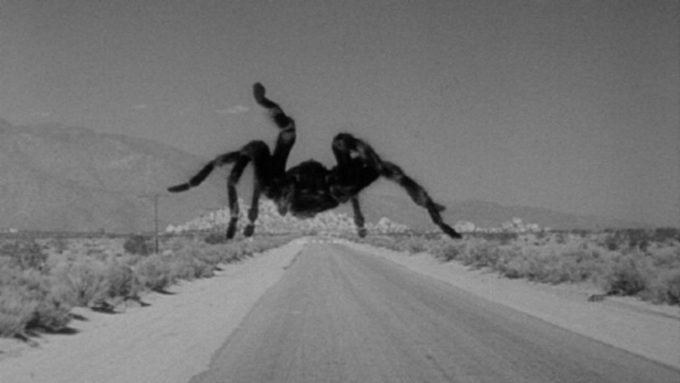
Tarantula follows Dr. Matt Hastings (John Agar) of Desert Rock, Arizona, as he investigates the mysterious death of a man inflicted with an elephantiasis-esque disease. This brings him into the orbit of Professor Gerald Deemer (Leo G. Carroll), who is seeking to discover a nutrient that will feed the Earth's booming population, as well as his beautiful new live-in assistant, Stephanie "Steve" Clayton (Mara Corday). Of course the nutrient causes uncontrolled growth in animals and of course Deemer injects it into a tarantula, because why wouldn't you? There's a fire in the lab and bada bing, bada boom, you've got yourself a giant mutant tarantula taking to the hills.

Pictured: The hills, as played by the same two mile stretch of California scrub where they shot every sci-fi movie for 12 years. And a mutant. We'll put a pin in that for now.

So, I've seen my fair share of giant bug films at this point. We had giant killer ants in Them! and giant killer locusts in Beginning of the End. It would be foolhardy to suggest that I expected the special effects in Tarantula to be any good at all. But I've got say, there's just not a lot of there there, even by the standards of these kinds of movies. 

The shots of the spider roaming through the hillsides are... fine, though they are not numerous. The plate containing the shot of the spider seems a little fuzzy even at the best of times, his feet never really connecting with the ground properly. Now, don't get me wrong, this is all fine. They did what they could with the technology and budget they were working with.

What's most frustrating about the spider - other than the fact that it's kind of a negligible feature of a movie named Tarantula - is that they can think of absolutely nothing to do with it. There sure are a greatdeal of shots of twitching mandibles inching closer to screaming men, but those get old rather quickly, and there just isn't any pizzazz to the sequence where they battle the humongous arachnid. It really makes you miss the dazzling stupidity of something like The Giant Claw's final battle when all you get is three minutes of the military shooting bigger and bigger weapons at the spider until they succeed.

Third time's a charm!

It's not like Them! had a particularly academically rigorous third act, but at least it had folks in the trenches fighting big monsters! Here we are watching people watch a spider get shot three times, and it's a huge radioactive snooze. The movie thrives when it gets smaller, ironically, as there is an incredibly random subplot of human test subjects developing strange mutations. Those effects are solid in exactly the B-movie way you want, and there are also a few shots of caged animals in early stages of growth hormone injection that look quite terrific by any standard.

It's too much to ask that the human plot really carry the weight of a project like this, but the characters here aren't particularly interesting either (with the exception of an extremely minor character - the snooping receptionist Josh). One's knowledge of the genre (as well as the absurdly over-the-top score) might lead one to expect that Agar and Corday are destined to fall in love and at least provide the requisite "they're kissing at the end of the movie even though they've known each other for all of 12 seconds" moment, but that's not in the cards either. Which is transgressive, I suppose, but I rather think it's an accident deriving from the fact that the screenwriters don't seem to care one whit about any of these characters.

Carroll is doing fine work here, providing his scenes with a twinge of menace that the rest of the film is sorely lacking. Otherwise, unfortunately, it's boilerplate all the way down, without enough flavor to make it memorable or even memorably bad.

That which is indistinguishable from magic:
*Forget the tarantula, these people need glasses. They drive down the road and then an ominous sting announces the arrival of the tarantula - from the same direction they were driving in. It's physically impossible to not have noticed it. 

The morality of the past, in the future!:
*There's something tremendously 1950s about the opening sequence, where a dying man who is wandering through the desert in his pajamas is still wearing dress shoes and socks.
*John Agar's assertion that being in the desert is so boring it makes couples want to fuck is probably still solid advice. His disgusted comments on giving women the right to vote leading to them becoming scientists less so.
*The worldwide population number that has thrown Leo G. Carroll into such a tizzy is 3 billion. Imagine.

Sensawunda:
*The most terrifying scene in the movie is an early shot when John Agar enters his office, and an extra on a bench is just watching him with lifeless eyes and the broadest grin on his face, like he's advertising Smile 65 years ahead of schedule.

TL;DR: Tarantula is a boilerplate giant monster attack movie, without too much to recommend it above any of its brethren.
Rating: 5/10
Word Count: 1107
Cardboard Science on Popcorn Culture
2014: Invaders from Mars (1953) The Day the Earth Stood Still (1951) Them! (1954)
2015: The Giant Claw (1957) It Came from Beneath the Sea (1955) The Brain from Planet Arous (1957)
2016: Invasion of the Body Snatchers (1956) Godzilla (1954) The Beginning of the End (1957)
2017: It Conquered the World (1958) I Married a Monster from Outer Space (1958) Forbidden Planet (1956)
2018: The Fly (1958) Attack of the 50 Ft. Woman (1958) Fiend without a Face (1958)
2019: Mysterious Island (1961) Robinson Crusoe on Mars (1964) Plan 9 from Outer Space (1959)
2022: Tarantula (1955) The Amazing Colossal Man (1957) Journey to the Center of the Earth (1959)

Census Bloodbath on Kinemalogue
2014: My Bloody Valentine (1981) Pieces (1982) The Burning (1981)
2015: Terror Train (1980) The House on Sorority Row (1983) Killer Party (1986)
2016: The Initiation (1984) Chopping Mall (1986) I, Madman  (1989)
2017: Slumber Party Massacre (1982) Hello Mary Lou: Prom Night II (1987) Happy Birthday to Me (1981)
2018: The Prowler (1981) Slumber Party Massacre II (1987) Death Spa (1989)
2019: Phantom of the Mall: Eric's Revenge (1989) Psycho III (1986) StageFright: Aquarius (1987)
2020: Night School (1981) The Fan (1981) Madhouse (1981)

Tuesday, October 27, 2015

Cardboard Science: Insane In The Membrane

Year: 1957
Director: Nathan Hertz
Cast: John Agar, Joyce Meadows, Robert Fuller
Run Time: 1 hour 11 minutes
MPAA Rating: N/A

Welcome back to our second annual crossover with Hunter Allen over at Kinemalogue! It’s time for our second 50’s sci-fi flick, and either I’m building up a tolerance or Hunter picked titles with more Brennan-y appeal this time around (I’m still nursing wounds from Invaders From Mars). Our newest foray into the vast thicket of B-movies is 1957’s The Brain From Planet Arous, a schlock spectacle of otherworldly proportions.

Pun always intended.

Here’s the skinny: Steve March (John Agar) is one of America’s leading nuclear scientists, because the movie would have its 50’s sci-fi license revoked if the A-bomb wasn’t in there somewhere. When he and his sex-on-a-stick partner Dan (noted Western actor Robert Fuller) make a trip to investigate the high levels of radiation at the nearby Mystery Mountain (which was apparently named by the guys who wrote Lone Ranger radio serials), they encounter a giant floating brain named Gor (Dale Tate). Two guesses as to what planet he’s form.

Gor possesses Steve’s body via a clumsy superimposition effect that jerks the projection back and forth until it lines up properly. He’s hellbent on using his magical explodey powers and superior intelligence to take over the world and force Earthlings to build a fleet of ships to launch an attack on his home planet, the name of which slips my mind. However, once he meets Steve’s fiancée Sally (Joyce Meadows), he falls instantly in love and gets distracted attempting to tonguelessly kiss her as hard as the Hayes Code would allow.

I guess you could say he’s from Planet AROUSED.

Sally and her father John (Thomas B. Henry) investigate Steve’s sudden fit of tumescence and come across Zol (also Dale Tate), an Arousian policeman (would that be the Thought Police? Buh dum chh), who’s on a quest to capture Gor. He inhabits the body of their dog George (and I will hug him and pet him and squeeze him), and together they team up to find out Gor’s plan while keeping watch on him. He can only be destroyed when he leaves his host body to gather oxygen, which he only does once every 24 hours.

i.e. About as often as the budget allows.

The plot has two modes: “Sally fretfully fakes love for ‘Steve’ while he cackles and drops hints about his evil plans,” and “Gor explodes some stuff in the Santa Clarita desert and makes demands of the UN.” This back and forth gets a tad dull but at 70 brisk minutes of content that’s about as racy as Basic Instinct for 1957 audiences, it more than makes up for its redundant repetition.

The Brain From Planet Arous boasts all the hallmarks of a cheesy 50’s crapfest. Gor immediately outlines his evil plans to Steve, so thoroughly that he would have used a PowerPoint if he could. The acting is stilted and overly indicating. And the special effects are charmingly cheap, like an action film made by the kids in your English class. Hair dryer radar guns, perfectly healthy looking “charred” corpses, and big ol’ brain models wobbling around on strings abound in the film. At least the overly simple ending lacks the absurd abstraction of the antimatter nonsense of The Giant Claw. However, depending on your outlook, this can either go in the pro or con column.

We obviously know where Hunter stands, and I’ve been trained to love DIY filmmaking by my abysmal slashers, so for me at least, I enjoy the cut of Brain’s jib. The only truly distressing element is the film’s insistence on showing every detail of the characters slowly traipsing through the desert and tripping over rocks, papering it over with blibbering string music designed to make you feel like something is actually happening.

Spoiler Alert: It’s not.

I can forgive a bit of padding if it’s in service to a film this utterly bizarre. The eerie calmness with which our protagonists accept the idea of a giant floating brain is just the tip of the iceberg. For one, the dialogue is still astoundingly clever Much like The Giant Claw before it, the screenwriters have an inherent skill for banter hat they can’t seem to shut off, even if their plots fly mightily off the rails. The fact that any part of this movie was accomplished with skill leads to the sneaking suspicion that maybe other people on set also had talent.

I know it’s a ridiculous notion, but I can’t help but find that certain scenes lend credence to it. A shot of Steve’s distorted face through a water cooler is one such moment, a visual triumph that’s far out of the movie’s apparent league. It obfuscates reality, creates a sense of unease, and – in short – succeeds where the giant rubber brains intrinsically fail. And the film does have one cool effect: Whenever Gor activates his power, Steve’s eyes become glassy marbles of evil. It’s a very low fi, Village of the Damned trick, but that’s exactly why it works so well even to this day. It might just be a pair of contacts, but there’s something so ontologically wrong with that look that it short-circuits your wiring.

Once you get into this mindset, you start considering the possibility that maybe the brain movie people were actually using their own brains as well as the ones they borrowed from the neighbor kid’s model maker kit. This approach works wonders, unearthing a glittering deposit of potential subtext While TBFPA’s approach to nuclear woes isn’t as cut and dry as, say, Them!, there are several veins of more personal horror to mine.

There’s the obvious parallel between Gor and egotistical, powerful leaders who claim to have the “power of pure intellect,” but use it to coldly strike people down for the greater good. But his possession of Steve’s body and mental faculties creates a Jekyll and Hyde/Wolf Man scenario. Gor acts as Steve’s ravenous id, pushing the civilized man into the pursuit of money, power, and sex. In the buttoned-up 50’s, these primitive drives were especially discouraged, and Steve’s main struggle is for control over the desires that threaten to rule his genteel body.

On the flip side, from Sally’s perspective, this could represent women’s fears of the changing societal and sexual mores as America slipped implacably into the 60’s. Sally is hardly a strong character, whimpering and weeping every chance she gets, but she gets some of the most screen time and her triumph lies in asserting the roles of a clean cut, heteronormative suburban couple. Think about it.

Well, either that or producers had two weeks and some brain puppets and decided to make a movie.

The brilliant thing about The Brain From Planet Arous isn’t its intelligence, but the fact that there could be more beneath the surface. It works on an analytical level and it works – to a point – on a structural level, so either way you choose to take it, it delivers. How come assembly line filmmaking seemed to work so well back then, and today we’re stuck with a half dozen Transformers movies? The world is a scary place.

That which is indistinguishable from magic:
  • Yeah, definitely follow that berserk Geiger counter into that cave without a protective suit on. You’ll be fine.
  • Steve’s high tech radio turns off immediately after delivering relevant information.
The morality of the past, in the future!:
  • India and China are the only non-white countries that exist, according to Gor.
  • Sally’s dearest, most desperate wish is to receive a dishwasher for her birthday.
  • At one point, Sally legitimately calls Steve “Master.” If this film got into the hands of Tumblr, we’d have an all-out war on our hands.
  • Sally’s conviction that another brain was inhabiting the body of their dog is written off as “you and your imagination,” despite the fact that Steve has literally every reason to believe that body-hopping brains exist.
Sensawunda:
  • In the opening scene, Dan reads a book titled “Science Fiction.” In case you weren’t sure what movie you were watching.
  • Robert Fuller’s plunging neckline might be the most revealing outfit in cinema history up to that point.
  • Lead actor John Agar would cap off his career with yet another instantly dated nuclear flick, the magnetic late 80’s treasure Miracle Mile.
  • That poster is honestly the single best design I've seen in my entire life.
TL;DR: The Brain From Planet Arous is a short and sweet camp picture with an occasional burst of talent.
Rating: 6/10
Word Count: 1435
Cardboard Science on Popcorn Culture
2014: Invaders from Mars (1953) The Day the Earth Stood Still (1951) Them! (1954)
2015: The Giant Claw (1957) It Came from Beneath the Sea (1955) The Brain from Planet Arous (1957)
2016: Invasion of the Body Snatchers (1956) Godzilla (1954) The Beginning of the End (1957)
2017: It Conquered the World (1958) I Married a Monster from Outer Space (1958) Forbidden Planet (1956)
2018: The Fly (1958) Attack of the 50 Ft. Woman (1958) Fiend Without a Face (1958)
2019: Mysterious Island (1961) Robinson Crusoe on Mars (1964) Plan 9 from Outer Space (1959)

Census Bloodbath on Kinemalogue
2014: My Bloody Valentine (1981) Pieces (1982) The Burning (1981)
2015: Terror Train (1980) The House on Sorority Row (1983) Killer Party (1986)
2016: The Initiation (1984) Chopping Mall (1986) I, Madman  (1989)
2017: Slumber Party Massacre (1982) Hello Mary Lou: Prom Night II (1987) Happy Birthday to Me (1981)
2018: The Prowler (1981) Slumber Party Massacre II (1987) Death Spa (1989)
2019: Phantom of the Mall: Eric's Revenge (1989) Psycho III (1986) StageFright: Aquarius (1987)
Saturday, September 20, 2014

Nuke Kids On The Block

Year: 1989
Director: Steve De Jarnatt
Cast: Anthony Edwards, Mare Winningham, John Agar
Run Time: 1 hour 27 minutes
MPAA Rating: R

Nuclear war was a common topic in American film of the 1980's, rivaled only by the glut of "whoops, we made a radiation monster" films of the 50's. Perhaps the most famous is 1983's WarGames, in which a young Matthew Broderick almost incites the nuclear holocaust by playing a computer game - something avid fans of online gaming might have experience with if they've ever cost an experienced team a round.

It's not like the threat of nuclear devastation has ever completely gone away, but in today's everyday world it seems about as far-fetched a possibility as an asteroid smashing into the planet. It's something people might fear, but in a more abstract, less immediate way. However, because I am a connoisseur of finding things to worry about, I have a unique empathetic skill among my age group - the ability to put myself in a position where I can relate to the nuclear fears of the generations before my own.

For that reason and that reason alone, I was able to extract every last crumb of tension from the premise of the remarkably silly late-nuclear period movie that is 1989's Miracle Mile. However, if you are not me, this movie will almost entirely fail to rile you. But it's fun enough as a hunk of 80's trash that I'd still recommend it to the non-discerning viewer.

And any fan of dollar store brand Dolph Lundgrens.

Harry Washello (Anthony Edwards) is a struggling musician living in Los Angeles. When he meets Julie Peters (Mare Winningham) at a local museum, it's love at first sight. For the first twenty minutes or so, the film progresses like a generic indie rom-com (They do quirky things like visit the tar pits, play with a prism, and buy lobsters from a restaurant only to set them free. Also Julie's grandparents are deeply in love but haven't spoken with one another for 15 years.), made even stranger by the fact that this genre wouldn't be in vogue until a couple decades later. My guess is that they were going for a straight romance but the stars they chose were so flippin' nerdy that they accidentally shunted the script into being ahead of its time.

Not exactly Scarlett O'Hara and Rhett Butler.

But after he sleeps through their second date, Harry ends up eating away his feelings at a diner at 4 in the morning. As if that wasn't enough stress to deal with, he answers a call on a pay phone and discovers that the American government has ordered a nuclear strike and the retaliation is due to come in 70 minutes, destroying the city.

Thus begins an epically cheesy cross-city journey as Harry attempts to locate Julie and get her to an escape helicopter - featuring a Tangerine Dream soundtrack, Nightmare on Elm Street 5's Kelly Jo Minter, and Mare Winningham's orange feathered mullet - a tangerine nightmare, if you will. 

But first, the single best scene in the movie and perhaps the only moment where it operates on a level outside of fatuous 80's frivolity. You see, the original concept for Miracle Mile was that it would be a segment in Twilight Zone: The Movie, evoking classic episodes like "The Monsters Are Due on Maple Street" with a single location depicting various individuals bouncing off of one another under the strain of a potentially imaginary threat.

And if you're looking for a group of unique individuals with diverse backgrounds to populate your story, you could do worse than an LA diner at 4 in the morning. Here we get two womanizing workmen, a flight attendant in training, a stern businesswoman, a snarky drag queen, a hapless waitress, and a hotheaded cook struggling to face the harshest reality the cultural climate could possibly provide.

This section of the film is taut, edgy, and clever, providing a thin slice of true humanity in a movie that will soon devolve into admittedly enjoyable but much less rewarding excesses. But for those shining moments, Miracle Mile exposes the truly remarkable anthology segment it could have been.

Although the stranglehold of the 80's can never be fully eradicated.

Although nothing else can quite match the dizzy heights of this scene's incisive tension, the rest of the film is pure confection SPOILERS [save for the shockingly bleak ending that would be emotionally resonant if it didn't follow 50 minutes of pure 80's tomfoolery]. Once the cross-city antics begin, character motivations fly right out the window. In fact, they smash headfirst through a wall and call it a window.

Harry wanders through a barren Los Angeles at a speed more suitable for a trip to the supermarket than a frantic escape making terrible decisions left and right, including but not limited to leaving the helicopter pad to explore a neon-spandex nightmare gym and refusing to tell Julie what's going on until the very last second, rendering her completely useless to his cause. Also a guy decides to avoid ten years in jail for stealing stereos by lighting two cops on fire. It's like the screenwriters exhausted themselves after the diner scene and just let Mare Winningham's mullet write the rest of the script as it brushed across a keyboard.

An American Hero.

The 80's signifiers take care of the rest, bulking up the back half of the movie with enough content to remain engaging. And the filmmaking itself is decent, especially in the first act - in which nearly every camera shot just begs us to look to the skies:

And I'm sure this is symbolic of... something. Ice age = nuclear winter? Kevin Smith's new movie sucking? I dunno, I'm sure someone can fill in the blanks. I can't move my eyes from her hair long enough to focus on the composition.

Miracle Mile, for what it's worth, could be much much worse than it is. As it stands, it ranges from being a delectable nuclear thriller to an ebullient cheese tray, so at the very least it's never boring. I wish the third act could sustain its tone more to really bring the apocalyptic mayhem home, but this depiction of the end of the world is not at the end of my list.

Solid effort. Would detonate.

TL;DR: Miracle Mile is a cheesy 80's train wreck, but at times manages to be the taut nuclear thriller that it wants to be.
Rating: 6/10
Word Count: 1038