Thursday, October 29, 2020

Cardboard Science: They See Me Rodan, They Hatin'

Our third and final entry in the Great Switcheroo with Hunter Allen at Kinemalogue!

Year: 1956
Director: Ishirô Honda
Cast: Kenji Sahara, Yumi Shirakawa, Akihiko Hirata
Run Time: 1 hour 14 minutes

Hunter has been spectacularly kind to me this year in general. We've covered all the bases that most interest me in the world of 50's science fiction. An obscure forgotten work, a title mentioned in "Science Fiction, Double Feature," and now a daikaiju eiga, which roughly translated means "Japanese monster knocks shit down." Specifically, today we're here to talk about Rodan, the fourth kaiju movie from Ishirô Honda, the director and co-writer of the original Godzilla, which has been one of my favorite films from the annals of Cardboard Science.

I'm just cool that way, loving Godzilla is just more proof that my opinion is always very unique and special and different from everyone else's.

Rodan opens in a small Japanese mining town, where miners are dying at a rapid rate in one of the pits, scuppering initial suspicions that Goro (Rinsaku Ogata), a miner with a temper problem, killed one of his rivals. As the staff begins to pare down, the protagonists emerge, or at least the human beings who we can most reasonably call protagonists in a genre that always becomes largely disinterested in humans by the third act: engineer Shigeru Kawamura (Kenji Sahara) and Goro's distraught sister Kiyo (Yumi Shirakawa). They are in love, and isn't that nice for them. Moving on.

H-bomb testing and maybe global warming has caused tectonic plates to shift, creating the perfect environment for some long-buried eggs to hatch, unleashing giant dragonfly larvae upon the town that cause general mayhem until an enormous cave-in releases a much bigger problem: the enormous flying beast Rodan, who takes to the skies to cause havoc on the Eastern seaboard. The mining crew and the Japanese military scramble to find ways to contain the monstrous Pteranadon.

But not before it smashes up a Japanese cityscape or two.

So here's the thing. Not only is Godzilla a kick-ass monster movie, it's a profound and harrowing reflection on a nation bearing the literal and metaphorical fallout of the nuclear bomb. Rodan is... not that. And it's not trying to be! Almost certainly the three Godzilla movies Honda made before helming Rodan got that out of his system. He's just here to have fun, content with the barest scrapings of environmental subtext.

He largely succeeds too, though Rodan is fun in a much different way than Godzilla, and that way doesn't resonate with me quite the same. Rodan is a flying beast, so the warfare has largely moved from the ground to the air, with fighter pilots squaring off against the monster in dogfights that would be familiar to any fan of World War II cinema. Think Red Tails, but with a creature that can create sonic booms with its wings. Military cinema in general fails to please me, so foregounding that element over a dude in a suit stomping through a miniature Tokyo was naturally going to lose me a bit.

Objective reviewing doesn't actually exist, folks!

And while nobody comes to a Japanese kaiju movie to be bowled over by realism, some of the drawbacks to Rodan's special effects are too glaring to not come at a bit of a price. Having a completely airborne monster poses more of a challenge, and his rubbery wings (which barely flap, and somehow make a hilarious jet engine noise) don't seem to be lifting him so much as the string in his back. Convincing flying is always hard to pull off, and they certainly didn't have the resources to do so in 1956. But there's a reason the scenes with the giant larvae are more fun. They're tactile and the actors can actually interact with them, because their many moving parts (which create an unnerving, unceasing motion) are operated like a Chinese parade dragon rather than a dangling puppet.

All this is not to say I didn't enjoy the mayhem Rodan brings to the table. Especially in the scene where he smashes up a port city, this is where the detail in set dressing really comes out to play. Cars and trains are knocked into buildings, all the tiles are blown off a roof, and  a bunch of other physical, practical destruction redeem any faults the airplay might have. Honestly everything practical here is pretty satisfying, including the cave-in early on.

The human storylines falter a lot in the lead-up to the monster battle (Shigeru's amnesia is a wholly unneeded soap opera twist that comes from nowhere, and the romantic subplot fails to stick the landing), but I did enjoy the first act that is less special effects, more ominous dread. Whether its a cut to the bloody helmet of a pilot who perishes by an unseen force, or the grim vision of corpses floating in the flooded mine, Rodan certainly packs in the atmosphere when it can't afford to be showing nonstop monster shenanigans (although I dearly wish they hadn't included the element of Rodan's unseen attacks on Beijing and Manila, because if you're going to mention them, why not show them?).

And there's another tip of the hat toward a more serious tone with the grand finale, which is a strangely downbeat and lingering reflection on the tragedy of the great monster's destruction. But all in all Rodan just wants to goof around, and it does so with reasonable verve and vigor, even if Rodan the monster is hardly as compelling a central figure as some other kaiju I could name.

That which is indistinguishable from magic:

  • Ooooh, those remote control toy tanks fighting Rodan sure are precious!
  • Apparently Rodan can grow from a hatchling - albeit a large one - to a beast with a 270 foot wingspan in about half a day. That must be a HARSH puberty.

The morality of the past, in the future!:

  • I like the romance subplot only insofar as the people involved are very pretty, because otherwise this is the blandest, chastest nonsense any side of the pond.

Sensawunda:

  • I truly don't know why they included a second Rodan if all they're gonna do is shout, "it's a second Rodan!" and then also burn it up with lava, no sweat.

TL;DR: Rodan is a satisfying kaiju picture, though one that lacks the emotional punch or effects wizardry that the director is capable of.
Rating: 6/10
Word Count: 1076

Cardboard Science on Popcorn Culture
2014: Invaders from Mars (1953) The Day the Earth Stood Still (1951) Them! (1954)
2015: The Giant Claw (1957) It Came from Beneath the Sea (1955) The Brain from Planet Arous (1957)
2016: Invasion of the Body Snatchers (1956) Godzilla (1954) The Beginning of the End (1957)
2017: It Conquered the World (1958) I Married a Monster from Outer Space (1958) Forbidden Planet (1956)
2018: The Fly (1958) Attack of the 50 Ft. Woman (1958) Fiend without a Face (1958)
2019: Mysterious Island (1961) Robinson Crusoe on Mars (1964) Plan 9 from Outer Space (1959)
2020: The Colossus of New York (1958) It Came from Outer Space (1953) Rodan (1956)

Census Bloodbath on Kinemalogue
2014: My Bloody Valentine (1981) Pieces (1982) The Burning (1981)
2015: Terror Train (1980) The House on Sorority Row (1983) Killer Party (1986)
2016: The Initiation (1984) Chopping Mall (1986) I, Madman  (1989)
2017: Slumber Party Massacre (1982) Hello Mary Lou: Prom Night II (1987) Happy Birthday to Me (1981)
2018: The Prowler (1981) Slumber Party Massacre II (1987) Death Spa (1989)
2019: Phantom of the Mall: Eric's Revenge (1989) Psycho III (1986) StageFright: Aquarius (1987)
2020: Night School (1981)

Wednesday, October 28, 2020

Census Bloodbath: Island Crime

Year: 1982
Director: Bill Naud
Cast: Marie-Alise Recasner, Rick Dean, Ron Gardner
Run Time: 1 hour 22 minutes

I never thought I'd get to see Island of Blood. AKA Whodunit?. AKA Scared Alive, for some reason. I've being doing my slasher research and gathering information on where to source these movies since early 2013, and Island of Blood has been one that resolutely refused to appear on home media, streaming, thrifting, or even in my crystal ball after a sizable blood sacrifice. There almost certainly will be movies I have to skip over in this project due to lack of availability, and I thought this would be the first one. Enter Tubi. The streaming service has finally answered my prayer because they stream the most random shit, and included in that junk pile was, would you believe it, Island of Blood.

Usually when you have to put this much work into merely watching a film, there's a reason you weren't able to find it. I have been disappointed at the end of many a hunt, even for a film with as cool a poster as this one. So you can imagine my surprise when Island of Blood was... wholly acceptable!

Remember we're grading on a scale.

Island of Blood is like if somebody mashed up Curtains and The Slayer with a little bit of Terror on Tour, though it's a rare person who has that exact frame of reference, so I should probably still go through the plot. A group of young people has just arrived on a secluded island for the filming of a "positive" motion picture about "up up" people who are putting on a rock concert to save their high school. Director Franklin Phlegm (Ron Gardner) and producer Steve Faith (Terence Goodman) are running rehearsals while they wait for the crew to arrive, but a killer has taken it upon themselves to do a bit of a casting cull: murdering the people on the island one by one according to the lyrics of a truly terrible original 80's rock song that is constantly playing on the killer's Walkman.

But first let's Meet the Meat! There's star of the show Betty Jean AKA "BJ (Bari Suber), a girl whose older husband died leaving her his fortune, which she has used to buy her way into the movie despite an extreme lack of talent; Taylor (Gary Phillips), a doom and gloom guitarist who is convinced the world is going to end in a nuclear holocaust any day now; Donna (Marie-Alise Recasner) the token person of color who can't stop talking about being from Detroit, though she does provide us with the sterling insult "you fishface honky"; Rick (Richard Helm), a dumb jock who takes off his shirt in a blissfully long sequence; Jim (Rick Dean), one of BJ's hired helpers, and a clearly unhinged anarchist from square one; Lyn (Jeanine Marie), a dancer who's on crutches and very angry about it; and John (Jim Piper, an ADR voice on Dr. Giggles, and that's pretty much the only pedigree we get here), the condescending lead of the movie, cast even though he very clearly should be playing a pimply nerd.

Is the killer one of them? Or perhaps disgruntled island caretaker Bert (Jared McVay)?

Stay tuned to find out, because I truly don't mind spoiling this movie! I consider it a service because the third act is pretty incoherent, so SOMEONE needed to parse it all out.

Maybe it's just that I've just seen one dozen too many low budget slasher movies that are infinitely worse than this, but I actually enjoyed Island of Blood quite a bit. It has its flaws (don't worry, we'll get to them), but it succeeds more than it fails. First off, I can't say I expected anything in this film to be a Hollywood satire, let alone a pretty amusing one. In particular, BJ's rehearsal scenes with the director are a fierce battle of egos as she contends with his truly awful dialogue (one line includes the phrase "guys and gals" both at the beginning and the end) and he tries not to burst into a rage at her terrible flat acting and her complete misunderstanding of her talent ("Was that too much emotion? Should I give it less?"). There's also a bit of fun to be had with the sociopathic pursuit of success that allows the characters to justify why they keep working on this dumb movie even though half the cast is six feet under.

The score is also pretty decent, swinging between atonal Law & Order clunks and clangs to obvious cheeky Psycho riffs to a hilariously jaunty funeral dirge played on a synth.

Then there are the kills, which are totally fine! They're within the daffy, unrealistic range you might expect, but they're at least trying! Even the kills that are offscreen aren't trying to hide anything - we get to see the aftermath a little bit later, so they're not just hiding the death to avoid having to create a special effect.   And I do like the framing device of the Walkman playing a lyric of the song on repeat to portend the manner of the next victim's death, though I do wish we had a chance early on to hear the whole song in advance so we might have a bit of anticipation as to what fate will befall everyone. Also there's literally no motivation for the kills to be presented this way, but hey. I'd rather have a framing device than not have one, y'know?

It's also not a horribly executed whodunit. Just a pretty badly executed one. We spend far too much time on the Jim red herring that we the audience don't get to cast too much suspicion on anybody else, but there are plenty of delicious parlor room scenes with people throwing accusations one way or another.

Does this screenshot have much to do with what I just wrote? No. Is it visible? Not really. Is it the only other screenshot I could find? Bingo.

Even with all that qualified praise, shockingly this film has flaws. The beginning and end are more than incoherent (it starts with a death by shooting - not what you want from a slasher - and we never find out who the victim is or how they relate to literally anything), to the point that at first I was neither completely sure how many people died nor who the killer was (except that he looked good shirtless, but not Rick good). Plus, the cat & mouse scenes of people wandering through dark rooms in the final twenty minutes leave something to be desired. Like anything interesting. And for a long time the kills are just jammed in between random scenes, like bad softcore scenes shoehorned into a late night film to make it more marketable. 

But really, at the end of the day, if you're looking for a goofy dumb slasher and have a high tolerance for low budget acting and lighting, look no further than Island of Blood. Its bizarre cinematic instincts are beyond compelling, from the fully clothed sex scene ("it's chilly!") to the character picking up a common power tool and exclaiming "it fires nails like a gun!" to the fact that this movie is framed and shot for the first hour like the killer might actually just be a sentient Walkman. Remember that I am providing this recommendation with a grain of salt the size of Pluto. But it was a blissful reprieve from the bottom-of-the-barrel slasher sludge that usually populates the segment of my 1982 list that we've reached - the alphabetical list at the end containing all the films that are so obscure they don't even have release date information on IMDb beyond the year.

Killer: Steve (Terence Goodman)
Final Girl: BJ (Bari Suber)
Best Kill: The "get bunked" moment (with thanks to the Kill by Kill podcast for the phrase) where a man gets stabbed through his mattress with a knife that is wickedly big.
Sign of the Times: There is an Evil Real Estate Broker, and if that wasn't enough, his outfit certainly is.


Scariest Moment: Right before Rick's death, the camera keeps cutting to a bunch of roses shaking in the wind. It happened so many times, I was sure something was going to happen with these goddamn roses. Nothing does, but it's very unsettling.
Weirdest Moment: Taylor makes fun of Jim using a Mickey Mouse impression, then hits him in the gut with the neck of his guitar.
Champion Dialogue: "It's weird being on an island!"
Body Count: 11
  1. Swimmer is shot.
  2. BJ's Assistant is boiled alive in a swimming pool.
  3. Clown is stabbed in the head with a spear. (I assume this clown is Taylor, because he doesn't show up again afterward, but for the life of me I can't figure out why he'd be in the basement dressed as a clown.)
  4. Donna has acid poured into her shower.
  5. Mr. Phlegm is stabbed in the gut through his mattress.
  6. Rick is dismembered with a chainsaw.
  7. John is decapitated.
  8. Lyn is shot with a nail gun.
  9. Jim is shot with a nail gun.
  10. Bert is stabbed in the back.
  11. Steve is shot.
TL;DR: Island of Blood is a cheapie, occasionally incomprehensible slasher, but dammit I had a good time.
Rating: 6/10
Word Count: 1560

Census Bloodbath: Peter, Paul, And Bury

Year: 1982
Director: This is the only Australian film to have no credited director, so we'll honor that weird fact
Cast:  Diana McLean, Jon Blake, Janet Kingsbury 
Run Time: 1 hour 32 minutes

It is the accepted wisdom of the slasher cognoscenti that if a slasher movie comes from Canada, more often than not it's going to be superior to its American counterparts. But even though the slasher movie was primarily a North American phenomenon, countries across the globe weighed in with their own takes on the genre. And where do they fit in?

In the English-speaking world, Australia seems to have taken third place in terms of quantity, having already released Nightmares, Lady Stay Dead, Road GamesNext of Kin, and Strange Behavior before the 1982 premiere of today's film, Early Frost. But as far as quality goes, I haven't been able to get a bead on it. We're all over the map, quite literally, but at the very least this one isn't at the bottom of the list.

Though the dearth of exciting screenshots doesn't exactly speak well to its staying power.

Of all these Australian entries, Early Frost is certainly the least slasher-y so far, even though the body count is a good five times that of Road Games. Sure, people are dying at a pretty decent clip, starting with a drowned body discovered in Blacktown by private investigator Mike Hayes (Guy Doleman) during a divorce case. But we're mostly here to focus on alcoholic housewife Val Meadows (Diana McLean), who has two kids - 20-year-old Peter (Jon Blake) and pre-teen Joey (Daniel Cumerford) - though she'd much rather spend time with her adulterous lover Paul Sloane (Kit Taylor, who we'll catch up with later in 1987's Cassandra and 1989's Innocent Prey), whose divorce investigation is the one that turned up that body in the first place.

A series of strange accidents befall her, leading her to believe that somebody is trying to kill her. The mounting body count would certainly lend credence to that theory. Though, weirdly, she doesn't seem that interested when her best friend Peg (Janet Kingsbury) and her son (David Franklin) begin to uncover clues that point to her being the next victim. Could she be the killer?

Spoiler alert: No, she's not the killer, just an incredibly inconsistent person.

The parts of Early Frost that want to function as a character study are its biggest liability. Val Meadows is not an interesting or layered figure. She's a vindictive, sour person, and the flashbacks we see just serve to prove that she was vindictive and sour in the past too. We don't investigate why she is the way that she is or where her horrible detestation for her own sons came from. This is no The Babadook. And the movie doesn't even think to ask the question of why Peg would want to hang out with this woman for even one second (although it's clear Peg was never a priority because 20 minutes before the end the script forgets she ever existed).

As I've revealed during past entries in the surprisingly robust "women's picture slasher" run of 1982, I am unerringly compelled toward domestic tales starring female characters, so I can't say I had a terrible time watching this. But it doesn't do itself any favors. And I'm not asking that Val be made "likable," I just want to understand her beyond the surface level thrills we get here while she's clearly spinning out.

At lest that surface level is semi-fun to gaze upon. Early Frost isn't in the game of providing gruesome, creative slasher movie deaths with plenty of sharp implements, but the kills still have an unusual level of tension and surprise. Because the movie splits its time between family drama and slasher killings, it's easy to be lulled into a false sense of genre security. You are lulled by the quiet tensions simmering beneath the surface of a family and then all of a sudden someone is being jabbed in the butt with a syringe, having their face jammed full of glass shards in a terrible fall, or drowning horribly. 

It certainly keeps you on your toes.

There's also some admittedly irrelevant material that I had fun with, like the soundtrack that is wall to wall Australian pastiches of the most popular music genres at the time (mostly composed by Mike Harvey). There's an effervescent, bouncy quality to the soundscape. And while I also know I'm an easy lay for an original song from a slasher movie, a lot of what we got from 1982 movies was proto-metal that I didn't really care for, so this is for sure a standout.

And it's even quite pretty to watch on occasion, especially in a scene where Val is in the foreground lit by the flashing red neon light of a motel sign while Paul undresses on the bed behind her. Unfortunately the plot starts off a little muddy and things never get clearer from there. I honestly couldn't tell you exactly what happened in the final ten minutes. This is partly to do with the low-lit scene not really surviving the VHS transfer, but it's also due to Early Frost's peculiar indifference to actually engaging with its murder plot in any real way (for instance, we learn that the killer is targeting all the women from a group photo, but we never learn why, or even any backstory as to where or when the photo was taken).

It's certainly not the worst movie I've watched for this project. Hell, it's not even a bad movie. It's just muddled and disappointing, not actively unwatchable. So hooray? Still doesn't make me want to ever see it again.

Killer: Honestly I'm a little unclear but most likely Joey Meadows (Daniel Cumerford)
Final Girl: I guess Peter Meadows (Jon Blake)
Best Kill: Mr. Hayes' car doesn't just explode, it full on Michael Bays the shit out of him.
Sign of the Times: The newspapers describe the events of the movie as the discovery of the body of "an attractive middle-aged widow." Maybe this is wishful thinking, but I'd hope that obituaries in 2020 aren't quite so horny for dead women.
Scariest Moment: Whenever the killer is watching potential victims, shots from their POV are scored with an extremely loud Darth Vader-esque breathing effect that sounds really tinny, strange, and off-putting.
Weirdest Moment: Val asks Peter for a birthday kiss in the middle of his party, and there's an extreme close-up on her glistening lips.
Champion Dialogue: "I don't care if you drink yourself to a standstill."
Body Count: 6

  1. Mrs. Sloane is drowned offscreen.
  2. Worker is knocked off a ladder by a rolling cart and falls through a glass display case.
  3. Mrs. Jobling is injected with air and has an embolism.
  4. Mr. Hayes dies in a car explosion.
  5. John Meadows drowns in a flashback.
  6. Val is shot with a harpoon gun.

TL;DR: Early Frost isn't a particularly good psychological thriller, but it's enjoyable enough to watch and the kills are just the right kind of bananas.
Rating: 5/10
Word Count: 1183

Tuesday, October 27, 2020

Census Bloodbath: The Mind of a Married Woman

Year: 1982
Director: Martin Green
Cast: Aldo Ray, Kory Clark, Chuck Jamison
Run Time: 1 hour 28 minutes

OK, I have a bone to pick with my slasher resources. I can be very lenient with what counts as a slasher movie. I'm perfectly happy to include Road Games, which only has one onscreen death, because it is about the pursuit of an active serial killer. And I hesitantly embraced Hotline, even though the killer commits zero murders during the time frame of the film, for similar reasons. But 1982's Dark Sanity is really testing my patience. What imaginary line does a film have to cross become a slasher? If it has an axe-wielding murderer, a plummy reveal of their identity, and a severed head, but not a single human being dies onscreen during the events of the film, what the hell is it?

I'm very tempted to say "not a slasher," but again I'd rather err on the side of including it so I didn't just waste 88 minutes of my time.

Dark Sanity, also known as Straight Jacket, tells the tale of Karen Nichols (Kory Clark), a woman who has just been released from the hospital after her alcoholism triggered violent psychic visions that she had repressed since she was a child. She has been off the sauce for 9 months and she and her husband Al (Chuck Jamison) have moved to L.A. for a fresh start.

Unfortunately, as she slowly learns from her neighbor Madge (no actress listed on the extremely sparse IMDb listing, sadly, because her character reminded me of Mona from I, Madman, everyone's favorite earthy lady), the creepy gardener Benny (no actor listed, though he looks uncannily like Scott Adsit from 30 Rock), and local ex-cop Larry Craig (Aldo Ray, the only person in this movie there's chance you've heard of), their new house is the site of a dreadful murder. Lucy Duncan was decapitated and nobody has ever been able to find the head! The police apprehended their son, but Larry has also been having psychic visions and enlists Karen to help him discover the true identity of the murderer.


These visions are... not stylish.

As I may have mentioned, Dark Sanity challenges the very reason we're gathered hear to talk about it. If it's not a slasher movie, it doesn't deserve space on this feature. For the most part it just isn't. It's a gaslighting story about a woman who has been told for years by doctors and her husband that her clairvoyance is a mental illness, who has taken to believing them. I like a domestic psychological drama, even if the execution is dogshit, so I guess that's good news on both counts, because this is neither a slasher nor a well-made movie. And yet there are those elements I mentioned above. 

Although the only thing we could conceivably call a body count kill (Mrs. Duncan's death is only seen in choppy visions of the aftermath, the killer gleefully bearing her severed head) is of a cat, there is ever so slightly enough drawing on the tropes of the slasher genre in the final ten minutes as well as the material with the creepy groundskeeper red herring. I can maybe appreciate that it is structured almost like When a Stranger Calls, bookended by slasher moments rather than being a true blue all-out slasher. 

Even if the movie fails at giving me what I need, I'm at the very least not at a loss as to Champion Dialogue options. Almost every single line in the film is a trite cliche but altered in some ineffable way, like it was run through a shoddy translation service before being handed to the actors. "I'll mash you like a bug on a windshield." "Hello, police department?" My absolute favorite being the weirdly erotic "Don't let the door slam against your ass on the way out!"

No? Just Me? Alrighty then.

But whatever type of movie Dark Sanity is, it's a quite poor one. The sound design is truly out of hand, with random tiny actions exploding from the speakers like a gunshot and foley work so misguided that a hissing snake sounds exactly like my phone vibrating (I actually had to check if I was getting a call). And at no point in the movie does any character actually act like a human being: Karen imagines that an empty closet is full of clothes and screams like a banshee. Al's boss's wife goes on and on about how much she loves Jack Benny, who died a full six years before this film came out. The movie itself makes decisions just like one of its characters, when 15 minutes before the end it cuts to a three minute scene of Benny shooting the shit with a random bartender we've never met before.

Also obviously the acting is sub-par. Aldo Ray is sleepwalking through the part, though he seems to think he's in a soap opera which is amusing. And everybody else ranges from unremarkable to flat-out abysmal. Al's boss in particular has completely hollow eyes that always fail to match whatever rigor mortis facial expression he attempts to pull.

The actual act of sitting through Dark Sanity wasn't entirely excruciating, because the best moments had that domestic chiller quality I enjoy, and the worst moments are generally amusing in their inanity. But would I recommend it to a single human being? Of course not! The reason I do this project is to separate the wheat from the chaff, and this is definitely all chaff.

Killer: Madge
Final Girl: Karen Nichols (Kory Clark)
Best Kill: The flashback sequence is barely even a kill, but it's the only human death, and honestly the severed head prop is actually halfway decent.
Sign of the Times: I'm having a hard time choosing between the fact that a beer cost fifty cents, or that Madge had to hang up a phone call while watching her soap opera because she couldn't just pause the television.
Scariest Moment: When Al gets fired and comes home to drunkenly scream at Karen and try to force feed her whiskey, it is genuinely affecting and tense.
Weirdest Moment: Madge comes in to show Karen a new workout, which is literally just pushups but with terrible form.
Champion Dialogue: "Your missus is just fine as frog's fur."
Body Count: 2; but then again, not really

  1. Lucy Duncan is beheaded in flashback.
  2. Ezekiel the cat is beheaded offscreen.

TL;DR: Dark Sanity is not a slasher film, and while it's got a certain unique charm, it's also not a GOOD film.
Rating: 3/10
Word Count: 1105

Monday, October 26, 2020

Census Bloodbath: Boringhouse

Year: 1982
Director: John Wintergate
Cast: John Wintergate, Kalassu, Lindsay Freeman
Run Time: 1 hour 38 minutes
MPAA Rating: R

Boardinghouse, which is a cult film according to all its own promotional materials (so why wouldn't I believe them?), is also one of the very first horror films to be shot on video, to be transferred to film for projection while keeping the budget low and the film prepped and ready for the fledgling rental market. It certainly was a watershed moment that set the standard for all SOV horror flicks to come, which are also very very bad.


Though I'm sure there are some great ones waiting in the wings for perusal as we head deeper into the 80's. Nervous laughter.

Boardinghouse is the twisted vision of John Wintergate (who had a bit part in the also bad Terror on Tour in 1980) who directs (as Johnn Wintergate, apparently a typo), writes (as Jonema), provides special makeup effects (as J. Wintergate), and stars in two roles (as Hawk Adly, definitely a typo because the story goes he wanted to be called "Hank"). His character Jim Royce (he also plays the unnamed gardener, billed as "Gardner" because why not at least be consistent) has inherited a large Los Angeles home from his uncle, which he converts into a boardinghouse in the hopes of attracting a bevy of aspiring actresses and models to come live there for cheap.

His dreams quickly become a reality, and he's lounging around dressed like Hugh Hefner while being massaged and flirted with by at least 8 beautiful women whose numbers seem to randomly fluctuate. The only ones who have any bearing on the story are Debbie (Penthouse model Lindsay Freeman), who has an untraceable accent and a dark secret, and Victoria (Kalassu, Wintergate's real life wife, with whom he has an annoying New Age music group that made music into the 2010's), who seems to rise to the top as lead contender for being his love interest. Also two of them are named Cindy and Sandy because maybe the film actively hates us? Jim studies telekinesis, and gets some of the other girls into it. And wouldn't you know it, but people around the house start dying in strange paranormal accidents.


Don't you just hate it when that happens?

Legend (and the two-disc DVD release) has it that the original director's cut of Boardinghouse is 2 hours and 40 minutes long, which actually explains several things. Distributors lopping an hour off certainly accounts for a lot of the subplots that either go nowhere or slam into the movie out of the clear blue sky (literally at one point a Black boarder appears out of thin air - and trust me, if she had been there before I would have noticed her in the writhing ocean of pallid flesh this movie calls a cast). But that level of sheer self indulgence the original run time belies (even the 1 hour 38 minute run time we got theatrically is needlessly indulgent) points to the source of every single sin this movie commits: John Wintergate, for whom auteur theory is doing no favors.

Calling Boardinghouse the The Room of the 80's slasher genre would be doing a huge disservice to that cult masterpiece, but Wintergate is certainly the Tommy Wiseau of his era, down to the psychological profile (he also claimed this film was an intentional comedy after a heap of bad reviews). He's a man who was starting to age out of Hollywood and likely overcompensated by putting a huge amount of work into his physique (his body is ripped, and I know this because he spends at least half of the movie with his chest bared, and at least half of that time in nothing but teeny tiny briefs). He seems to have found the means to create his own movie out of the twin impulses of positioning himself as a movie star and hiring people to be his friends and lovers. 

This film is creepy not because of any horror content, but because of Wintergate himself. Boardinghouse does itself no favors by making constant jokes about the casting couch, because it seems like every woman was hired just because he wanted to make out with them on camera. It's repulsive to watch on the surface level of its plot (no landlord should pick up a tenant and carry her into the shower, even if she is covered in yogurt), but it's downright skin-crawling the more you learn about the director and the making of the film.


There's exploitation, and then there's using a film starring your wife as a personal dating service.

Beyond all that, every other aspect of Boardinghouse's construction is dodgy. The acting is dreadful, of course. The female characters are all goggle-eyed sex vixens and the men range from hollow to "I'm legitimately worried he might be having an episode." The cinematography has that grimy shot-on-video glow of course, but also a heap of misguided camcorder zooms and shoddy colorful video effects slathered on top of everything. And the special effects are uniformly terrible. You can see the hands tugging along quite a few of the objects in the telekinesis scenes, the cinematographer loves to catch himself in mirror reflections, and for an electrocution scene, the effect is achieved by shining a flashlight into the man's mouth from off camera.

At the very least, the scare sequences have some solid vision, even if they're never achieved properly. I could see a lot of the imagery used here actually having an impact in a good movie, especially the scene where corpse hands burst from a woman's bed to grab her, or the material using a bloody pig head that grabs at people (there's a lot of grabbing in this movie). And some of the kills are even a little fun (we have a cheeky hand-in-garbage-disposal moment, for one thing). What's weird is that almost none of the people who die (and there are a lot of them) are actually the boarders. They're mostly just random side characters who wander into the movie. 

Not that I'm advocating for female characters to die specifically, but if you fill a house with babes with no personalities in a slasher movie, you murder them. That's just how it's done. Failing to accomplish that makes the movie more confusing (usually it's easier to tell what indistinguishable white woman is which in a slasher film once several of them have been killed off) and provides more evidence that Wintergate is making this film for the wrong reasons (see: the scene where a terrified woman tries to escape a shower by pressing her breasts into the glass over and over again).

At the end of the day, Boardinghouse might be a cult film for some, but those people have to be a loooot more interested in the naked female body than I am. And I do concede that there are plenty of people who fit this description. If you want to watch an incoherent, choppy story where a bunch of nobodies do nothing, and then get pushed into pools (or any suitable body of water that renders sheer garments see-through), then have at it. But for me, this film has an automatic "go to the bottom 5 slashers of 1982 list free" card.

Killer: Debbie (Lindsay Freeman)
Final Girl: There's plenty of them, and none of them matter. Although I guess Victoria (Kalassu), because she's the last one we see.
Best Kill: There's a part where a woman squeezes out her own eyes which has some aggressively dreadful cuts, but the fakey effect at the end is actually super gross to look at.
Sign of the Times: I know that making the rent cheap was meant to be the enticement to fill the house with babes, but even if you were doing that in 2020 (which you shouldn't), you'd charge more than $100 a month. Inflation's a harsh mistress.
Scariest Moment: After What's Her Name is scared in the shower, she sees herself as a pig-headed, male-pattern-balding monster in the bathroom mirror.
Weirdest Moment: When two of the women get into a playful, sexy splash fight in the jacuzzi, one tries to drown the other, and then gets her top ripped off in retaliation.
Champion Dialogue: "Hey, what is this gun?"
Body Count: 12; but perplexingly only 3 of them are the boarders.

  1. Don Hoffman drowns in the pool.
  2. Mrs. Hoffman gets her hand caught in the garbage disposal and dies somehow.
  3. Nurse Sherry hangs herself.
  4. Orderly rips out his own guts.
  5. Harris is electrocuted.
  6. Cindy drowns herself in the ocean.
  7. Pumpkin the Cat is hit with a hammer.
  8. The Black Boarder is shot.
  9. Detective shoots himself.
  10. Gardener is impaled on... something sharp, I guess. It's hard to see.
  11. Sandy plucks out her own eyes.
  12. Agent is telekinesis-ed to death.

TL;DR: Boardinghouse is a horrible, dreadful slog with some random pockets of imagery that is interesting in concept but not execution.
Rating: 2/10
Word Count: 1504

Friday, October 23, 2020

Cardboard Science: At A Deadly Pace

Round 2 of the 7th Annual Great Switcheroo with Hunter Allen at Kinemalogue

Year: 1953
Director: Jack Arnold
Cast: Richard Carlson, Barbara Rush, Charles Drake
Run Time: 1 hour 21 minutes

I'm always excited when Hunter assigns me a 50's sci-fi film that was mentioned in "Science Fiction Double Feature" from The Rocky Horror Picture Show, much in the same way that I was always excited to cover a college slasher mentioned in Randy's rant from Scream 2. I just like to understand references, OK? So far he's been meting them out with incredible patience, considering this is only the third one we're covering for Cardboard Science! (Night of the Demon, which is also referenced, was also covered for other reasons). But not only does the 3-D film It Came from Outer Space bear that particular distinction, it's an entry from 50's B-movie golden boy Jack Arnold, who also directed The Incredible Shrinking Man, Tarantula, and The Creature from the Black Lagoon.

In fact, it seems entirely likely that this film was the project that got Jack Arnold the gig for Black Lagoon, certainly his better known 3-D work. But enough about the behind-the-scenes fluff! Let's get on with the show!'

Put on your shitty cardboard 3-D glasses that will dig into the tops of your ears, and get ready to rock!

It Came from Outer Space opens with a giant meteor crash landing over a small town in Arizona, witnessed by astrologer John Putnam (Richard Carlson), who is brash, headstrong, and a fervent believer in scientific progress for the greater good, and his girlfriend Ellen Fields (Barbara Rush), who is a woman. The meteor just so happens to be an alien spaceship, although nobody in town actually believes John's claims (including, briefly, Ellen, who he refused to allow to come down into the crater with him because she was born with a vagina).

However, the aliens seem to be kidnapping local townsfolk, including telephone repairman Frank (Russell Johnson, best known as the Professor in Gilligan's Island), and disguising themselves as them in order to gather supplies to repair their spaceship. John desperately wants to find out what they're up to and prove his discovery not to be a hoax. But frankly, they couldn't be less interested in humanity as a whole and really just want to get out of this dump we call Earth.

And especially in 2020, who wouldn't agree with them?

It Came from Outer Space is certainly most notable for the way the aliens palpably just don't give a shit about what humanity is up to. It's a unique approach to the story (from the mind of Ray Bradbury, no less) that the visitors from another planet are neither friend nor foe. Unfortunately this doesn't really drum up much conflict beyond John stoically flailing around. This is an especially talky example of the science fiction B-picture (think The Day the Earth Stood Still but dumber), and the characters who are talking just aren't the most dynamic the genre had to offer.

It's honestly mystifying to me why this film got the 3-D treatment in the first place, other than to drum up general interest. Other than the meteor and the pleasantly protruding eye stalk of the hulking, yeti-like aliens (the few times we actually get to see them), the 3-D gags just aren't showing their faces. It does allow for some sets with more depth of field, but other than a mysterious glimpse into the murky depths of the alien spacecraft, we're getting a whole lot of your average suburban interiors. I will grant that the desert roads stretching out behind our characters in 3-D while they drive to the crash site probably look pretty neat though.

But back to that ship sequence. It's uniquely ponderous, the camera wandering into the darkness of the craft unbidden, leaving us to attempt to parse out the murky environs and mysterious noises it produces and providing an eerie, uncanny atmosphere that is actually almost scary. As a matter of fact, It Came from Outer Space is almost scary in a lot of ways. The string orchestra on the soundtrack twists and contorts their sound in a way that predict the more electronic-based scores coming down the pike later in the 50's, and the first gasps of the Body Snatcher effect before you find out what's going on certainly drum up some terrific tension.

Although, just once I'd like to see an alien in a human body speak in anything other than a flat monotone. They already speak English so it's not much of a stretch. Maybe the aliens sound like Krusty the Clown or something. Have some fun with it!

As an effects extravaganza, I've already mentioned that they aren't quite as committed to spectacle as one might hope, but what we get is generally pretty well rendered, at least. Sure, there are shots like the smoke rising from the crater where you can see the individual puffs being coughed out of the machine in the lower left corner. Or the landslide that somehow causes a bunch of rocks to be poured over the lip of an unmoving cliff. But those are the exceptions. It Came from Outer Space boasts a pretty rad laser-shooting baton, a reasonably convincing and organic alien eyeball stalk, and plenty of Alien Vision, which presents a view of the world through a bubble that mostly just makes things a little muddy and unclear, but is absolutely unique nonetheless (come to think of it, this effect almost certainly works better in 3-D, so that's another point in their favor).

I have watched better body snatcher movies for this project (Invasion of the Body Snatchers, duh). And better didactic moral message movies (The Day the Earth Stood Still). Better movies about It (It Conquered the World). And hell, even better movies about where It came from (It Came from Beneath the Sea). But all in all, there is enough going on here to keep it fresh, even if it's not in support of a story or characters I very much care for.

That which is indistinguishable from magic:

  • John waxes poetic about scientific progress, dismissing his naysayers by saying that people used to believe things like the Earth was flat and all quickly changed their minds due to the all-consuming good of Science. He might want to crack a history textbook or two beore his next big monologue.
  • Why, exactly, does an astronomer in small town Arizona carry a gun in his car?

The morality of the past, in the future!:

  • Maybe I'm too keyed into the chaste 50's vibes, but when I learned that the unmarried John and Ellen were hanging out alone at his house, after midnight, unsupervised, I was scandalized.
  • There is a fifteen year age gap between the actors playing John and Ellen, which is honestly pretty decent for the time.
  • Maybe this is only funny to me, but the fact that the town policeman could just stand and shout on a street corner and instantly gather a mob of fifteen men wearing identical hats willing to do his bidding really got me going.

Sensawunda:

  • We open on John and Ellen lounging in front of a huge roaring fireplace. On a spring evening. In Arizona. Yeah, I don't think so. 

TL;DR: It Came from Outer Space is a decent moralizing science fiction film, but I wish there were more alien fights, what can I say?
Rating: 6/10
Word Count: 1247

Cardboard Science on Popcorn Culture
2014: Invaders from Mars (1953) The Day the Earth Stood Still (1951) Them! (1954)
2015: The Giant Claw (1957) It Came from Beneath the Sea (1955) The Brain from Planet Arous (1957)
2016: Invasion of the Body Snatchers (1956) Godzilla (1954) The Beginning of the End (1957)
2017: It Conquered the World (1958) I Married a Monster from Outer Space (1958) Forbidden Planet (1956)
2018: The Fly (1958) Attack of the 50 Ft. Woman (1958) Fiend without a Face (1958)
2019: Mysterious Island (1961) Robinson Crusoe on Mars (1964) Plan 9 from Outer Space (1959)
2020: The Colossus of New York (1958) It Came from Outer Space (1953) Rodan (1956)

Census Bloodbath on Kinemalogue
2014: My Bloody Valentine (1981) Pieces (1982) The Burning (1981)
2015: Terror Train (1980) The House on Sorority Row (1983) Killer Party (1986)
2016: The Initiation (1984) Chopping Mall (1986) I, Madman  (1989)
2017: Slumber Party Massacre (1982) Hello Mary Lou: Prom Night II (1987) Happy Birthday to Me (1981)
2018: The Prowler (1981) Slumber Party Massacre II (1987) Death Spa (1989)
2019: Phantom of the Mall: Eric's Revenge (1989) Psycho III (1986) StageFright: Aquarius (1987)
2020:

Thursday, October 22, 2020

Census Bloodbath: Sibling Rivalry

Year: 1982
Director: Richard Lang
Cast: Dennis Weaver, Valerie Harper, Robin Ignico
Run Time: 1 hour 33 minutes

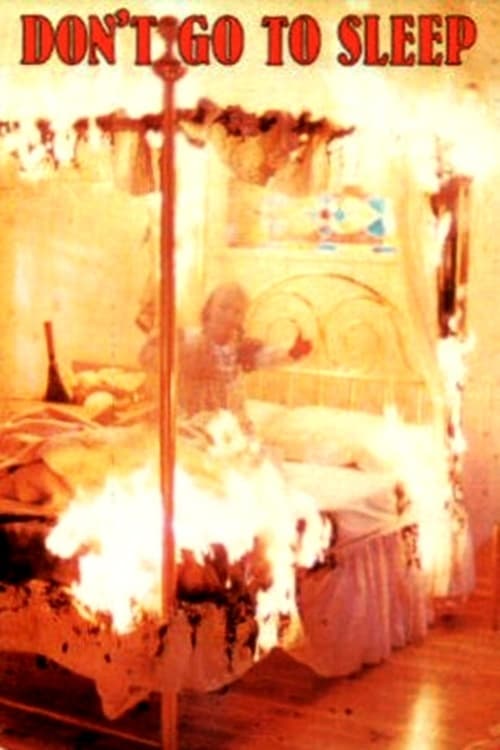
TV movie slashers aren't all bad. In fact there are a few I like a considerable amount, like 1981's Dark Night of the Scarecrow and Fantasies, which we covered late last year. But for every one of those, there's an insipid affair like Hotline. It's a mixed bag, but the horror collective group mind seems to have minted 1982's Don't Go to Sleep as a classic of the form. Unfortunately, that group in question is of the generation where they might have stumbled upon this movie on TV when they were actually a child, and the potency they remember might have something to do with those soft, malleable childhood brain tissues.

Malleable and oh-so breakable.

Don't Go to Sleep starts with a pretty generic setup. It's just not the setup for a slasher movie. It's the beginning of every haunted house tale you've ever seen. A young family is moving into a new house: mother Laura (Valerie Harper, because there's always a classic TV veteran on hand for one of these), who I can't even come up with a single character trait to describe; father Philip (Dennis Weaver, of Duel, the ur-TV movie), who is nervous about starting his new job and has a tendency to drink too much; daughter Mary (Robin Ignico), who has bad dreams; youngest sibling Kevin (Oliver Robins of Poltergeist, so 1982 was quite a banner year for him), who is a pernicious little brat with an iguana; and elderly grandmother Bernice (Ruth Gordon, who needs no introduction), a chain-smoking, blowsy firebrand whom Philip resents.

There's a member of the family I didn't mention because she's dead. Eldest daughter Jennifer (Kristin Cumming) died in a car wreck earlier that year and the family is still reeling. When her ghost appears to Mary, she starts convincing her to take out the rest of her family one by one so they can finally be together like they were meant to be. 

And I breathe a sigh of relief because this haunted house movie eventually gives way to a slasher so I'm not wasting my time watching it.

Don't Go to Sleep, which earns its title in exactly zero ways, isn't a bad TV movie. In fact in many ways it's quite effective. It's just hampered by the stilted, low budget nature of what it is. Especially in any scene where the family is conversing together as a group, there's not an ounce of naturalism, with each member clearly waiting their turn to say what they're supposed to say. And on the other end of the timing spectrum, there's the fact that Laura keeps demanding "answer me!" to her children, even though they were already speaking and her outburst in fact interrupts them so they can no longer answer.

But when things get spooky, like when the dolls' heads start being twisted around, or that scene that provides the indelible fiery bed image you surely noticed above, Don't Go to Sleep at least piques the interest, even if it fails to chill the bones of a seasoned horror veteran. 

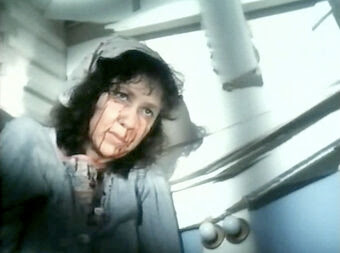
And there is an absolutely unique scene involving a pizza cutter that is lightly iconic, for good reason. Richard Lang, who as far as I can tell was a fairly anonymous TV director, really saw this genre movie as a chance to flex his muscles and he crams it full of unique angles and sinewy, flowing camera moves. Combine the aesthetic effort with Robin Ignicio's adorably enormous eyes that become simmering pools of pure black night when she scowls, and you've got yourself a lightly spooky tale that at least avoids being intolerably goofy despite the script's best efforts.

The effect her eyes produce is also helped by the fact that the VHS dub quality isn't GREAT.

But we need to talk about Kevin. Kevin SUCKS. This is not a critique of Oliver Robins, but the character himself. He's a shitty little brat who jealously guards his toys even though Mary clearly has no desire to play with them, torments his grief-ridden sister with pranks in the middle of the night, demands his dad buy him a motorcycle, steals cookies off the counter, and just plays with random loose Bunsen burners like an absolute psychopath. At least in the first half of the movie, we spend far more time with him than either of his sisters, and this is a huge liability, at least for my own personal interest in wanting to sit through the rest of the film.

And if we're being honest, anyone who isn't a little girl or Ruth Gordon isn't really worth spending time with. Any time they're alone together, Weaver and Harper have to volley back and forth some of the plummiest dialogue this side of the icebox. And while she in particular is giving a pretty solid performance, her sheer intensity brings down the mood. By combining this goofy body count thriller (with deaths involving an iguana and a Frisbee, you can't tell me I was meant to take this seriously) with the cracked psyche of a grieving mother, you just get a tonal hash that never fully comes together.

And that's before the ending that takes waaaay too long to explain a scene that is extremely easy to piece together from context clues like an hour earlier. It wasn't an unpleasant watch, but the good entirely fails to outweigh the mediocre. 

Killer: Mary (Robin Ignico)
Final Girl: Laura (Valerie Harper)
Best Kill: I mean I can't say I expected to be writing the phrase "Ruth Gordon dies of an inguana-induced heart attack," so I guess it must be that one.
Sign of the Times: That stigma against therapy is veeeeeeeeeeeeeery present. Phil thinks it will reflect poorly on his parenting if his daughter goes to therapy after two of her family members have died in the same year.
Scariest Moment: Mary's bed catches fire in the middle of the night.
Weirdest Moment: There's a scene that mimics the POV shot from the opening of Halloween, except the kid is holding an iguana instead of a knife.
Champion Dialogue: "She smells like cigarettes and it smells like yuck."
Body Count: 4
  1. Bernice has a heart attack.
  2. Kevin is pushed off the roof.
  3. Phil is electrocuted in the bath.
  4. Jennifer dies in a car explosion in flashback.
TL;DR: Don't Go to Sleep is passable TV movie fare, but it could have embraced its identity as a slasher with more keeness.
Rating: 6/10
Word Count: 1097

Wednesday, October 21, 2020

Census Bloodbath: Murder On Line 1

Year: 1982
Director: Michael Anderson
Cast: Richard Chamberlain, John Houseman, Sara Botsford 
Run Time: 1 hour 35 minutes
MPAA Rating: R

The slasher genre had gone through a startlingly huge variety of murder weapons, even by 1982 when the subgenre was still in its infancy. We've gotten murders by ice pick, barbed wire, hammer, machete, spear... And that's just in Friday the 13th Part 2. But I can say with reasonable confidence that Murder by Phone (AKA Bells) is probably the first time the murderer commits their kills using an exploding telephone. That concept alone was enough to get me firmly on board with the film before ever pressing play, because there's only so many times one can watch a group of nubile young people assemble in one remote location all in a row.

And I'm well on my way to getting that particular Guinness World Record.

Murder by Phone tells the story of ecology PhD Nat Bridger (Richard Chamberlain), who travels to Anytown Canada for a big conference, where he is lodging with his old mentor Stanley Markowitz (John Houseman). As a favor to the parents of a former student of his, he promises to look into her recent death. He soon discovers that she was killed by an exploding pay phone in a subway station and begins to unlock the secrets of the hidden evil underbelly of the local phone company with the help of sexy artist Ridley Taylor (Sara Botsford), who has been painting a mural for the company and thus has access to all their blueprints and labs, as tends to happen.

Meanwhile, the mysterious killer, who has invented a machine that emits a frequency that paralyzes people then blows up their phone with an electrical surge, is seeking revenge on anyone who wrongs him. Nat and Ridley, with their constant meddling, are getting closer and closer to being on that list.

This movie is also notable for featuring the first slasher movie killer whose only weakness is the invention of speakerphone.

Obviously what I want to talk about here is the kills. When the killer has the exact same M.O. every time, a movie can suffer a little bit from the repetition, but when the M.O. is so off-the-wall and silly, it's hard to get tired of it. Plus, director Michael Anderson (of the original Around the World in 80 Days, weirdly) finds new fresh ways to stage them each time. There's pretty much always something glass behind the victims for them to go flying into spectacularly, but beyond that there are always new little flourishes and details that keep things going strong.

When these flourishes include things like a pencil being snapped between a man's clenching jaws, a pair of eyeglasses exploding off someone's face, and blood spattering over a Mickey Mouse telephone receiver, it's easy to imagine why one might not find the scenes too same-y. There's probably no matching the potency of the first kill, which has the live-wire editing of Hausu and harnesses the element of surprise because you don't yet know exactly how these moments are going to play out, but they are all tremendously fun and come at a reliably well-paced clip.

Unfortunately, the main plot of the movie doesn't quite reach the frivolous heights of the kills, because how could that possibly be the case? It suffers from the same disease as the scenes with humans talking in a Godzilla movie. The filmmakers know you just want to get to the good stuff, but they have to shove something in between the special effects mayhem to help those scenes stand out (and bring down their budget). And that's not to say that the plot is bad, it's just not as ecstatically bonkers as the motherfucking exploding phone.

I love my job.

All the material with Dr. Bridger's investigation is pleasant but generic, throwing him together with a beautiful woman so she can have sex with him and be imperiled (though her character is much stronger than the more misogynistic turns at this formula, like previous film Blood Link. Although come to think of it, she seems actively turned on by Nat's mansplaining and doesn't kick him in the nuts when he grabs her hair and pulls her into a kiss when she's trying to make him leave, so we truly are grading these on a curve). And at the very least, the filmmakers aren't desperate enough to keep our attention by dumping a bucket of naked breasts onscreen anytime the killer isn't doing his business. In fact, the most nudity we get is a post-shower shirtless Richard Chamberlain, which I for one was incredibly grateful for.

It doesn't count as exploitation if it's a white man. It's parity.

On top of it all, Murder by Phone does take it upon itself to even be suspenseful on occasion. There are several Hitchcockian moments like the scene where a victim's son is trying to listen in on the other line so you're not sure how it's going to shake out, and the way the killer slowly, deliberately, stabs each number into his rotary dialer provides a lot of tension as he gets nearer and nearer to placing his fatal calls. 

I will say though that I'm surprised and a little disappointed that the filmmakers never really take advantage of the paranoia of the fact that any time the phone rings, it might just be the killer calling. There is a feint in that direction when Nat gives Ridley a secret code to know when it's him calling, but immediately after that he tells her to wait by the phone in case the detective calls him back. The characters don't seem to remember that there's a killer blowing up phones until after they've already picked up. 

This is a definite missed opportunity, but the good thing about Murder by Phone is that this is pretty much the only opportunity it leaves on the table. Every other way you could express the log line of "killer phone" is milked to the fullest extent, and as such it's an entirely delightful, exciting piece of weirdo retro filmmaking. 

Killer: Noah Clayton (Robin Gammell of Deadly Lessons)
Final Girl: Nat Bridger (Richard Chamberlain)
Best Kill: Who could possibly pick? Well, I can. A business executive is launched out of a high rise window to the concrete below.
Sign of the Times: The tour guide waxes rhapsodic about how goddamn many landline phones will be all over the world by the year 2000.
Scariest Moment: Both Nat and the killer are trying to call Ridley at the same time, and we don't know whose call is going to go through.
Weirdest Moment: Ridley tells Nat about how her stepdad punched her in the face once, then they start making out.
Champion Dialogue: "I grew up on knuckles and booze, it gave me my terrific sense of humor."
Body Count: 6
  1. Sandra gets phone-sploded.
  2. Gordon Smith gets phone-sploded.
  3. Mrs. J. Anderson gets phone-sploded.
  4. Connie gets phone-sploded.
  5. Stan Markowitz gets phone-sploded.
  6. Noah Clayton gets super phone-sploded.
TL;DR: Murder by Phone isn't as consistently raucous as its best moments, but it's still a fun weirdo gem.
Rating: 7/10
Word Count: 1201