Monday, October 26, 2020

Census Bloodbath: Boringhouse

Year: 1982
Director: John Wintergate
Cast: John Wintergate, Kalassu, Lindsay Freeman
Run Time: 1 hour 38 minutes
MPAA Rating: R

Boardinghouse, which is a cult film according to all its own promotional materials (so why wouldn't I believe them?), is also one of the very first horror films to be shot on video, to be transferred to film for projection while keeping the budget low and the film prepped and ready for the fledgling rental market. It certainly was a watershed moment that set the standard for all SOV horror flicks to come, which are also very very bad.


Though I'm sure there are some great ones waiting in the wings for perusal as we head deeper into the 80's. Nervous laughter.

Boardinghouse is the twisted vision of John Wintergate (who had a bit part in the also bad Terror on Tour in 1980) who directs (as Johnn Wintergate, apparently a typo), writes (as Jonema), provides special makeup effects (as J. Wintergate), and stars in two roles (as Hawk Adly, definitely a typo because the story goes he wanted to be called "Hank"). His character Jim Royce (he also plays the unnamed gardener, billed as "Gardner" because why not at least be consistent) has inherited a large Los Angeles home from his uncle, which he converts into a boardinghouse in the hopes of attracting a bevy of aspiring actresses and models to come live there for cheap.

His dreams quickly become a reality, and he's lounging around dressed like Hugh Hefner while being massaged and flirted with by at least 8 beautiful women whose numbers seem to randomly fluctuate. The only ones who have any bearing on the story are Debbie (Penthouse model Lindsay Freeman), who has an untraceable accent and a dark secret, and Victoria (Kalassu, Wintergate's real life wife, with whom he has an annoying New Age music group that made music into the 2010's), who seems to rise to the top as lead contender for being his love interest. Also two of them are named Cindy and Sandy because maybe the film actively hates us? Jim studies telekinesis, and gets some of the other girls into it. And wouldn't you know it, but people around the house start dying in strange paranormal accidents.


Don't you just hate it when that happens?

Legend (and the two-disc DVD release) has it that the original director's cut of Boardinghouse is 2 hours and 40 minutes long, which actually explains several things. Distributors lopping an hour off certainly accounts for a lot of the subplots that either go nowhere or slam into the movie out of the clear blue sky (literally at one point a Black boarder appears out of thin air - and trust me, if she had been there before I would have noticed her in the writhing ocean of pallid flesh this movie calls a cast). But that level of sheer self indulgence the original run time belies (even the 1 hour 38 minute run time we got theatrically is needlessly indulgent) points to the source of every single sin this movie commits: John Wintergate, for whom auteur theory is doing no favors.

Calling Boardinghouse the The Room of the 80's slasher genre would be doing a huge disservice to that cult masterpiece, but Wintergate is certainly the Tommy Wiseau of his era, down to the psychological profile (he also claimed this film was an intentional comedy after a heap of bad reviews). He's a man who was starting to age out of Hollywood and likely overcompensated by putting a huge amount of work into his physique (his body is ripped, and I know this because he spends at least half of the movie with his chest bared, and at least half of that time in nothing but teeny tiny briefs). He seems to have found the means to create his own movie out of the twin impulses of positioning himself as a movie star and hiring people to be his friends and lovers. 

This film is creepy not because of any horror content, but because of Wintergate himself. Boardinghouse does itself no favors by making constant jokes about the casting couch, because it seems like every woman was hired just because he wanted to make out with them on camera. It's repulsive to watch on the surface level of its plot (no landlord should pick up a tenant and carry her into the shower, even if she is covered in yogurt), but it's downright skin-crawling the more you learn about the director and the making of the film.


There's exploitation, and then there's using a film starring your wife as a personal dating service.

Beyond all that, every other aspect of Boardinghouse's construction is dodgy. The acting is dreadful, of course. The female characters are all goggle-eyed sex vixens and the men range from hollow to "I'm legitimately worried he might be having an episode." The cinematography has that grimy shot-on-video glow of course, but also a heap of misguided camcorder zooms and shoddy colorful video effects slathered on top of everything. And the special effects are uniformly terrible. You can see the hands tugging along quite a few of the objects in the telekinesis scenes, the cinematographer loves to catch himself in mirror reflections, and for an electrocution scene, the effect is achieved by shining a flashlight into the man's mouth from off camera.

At the very least, the scare sequences have some solid vision, even if they're never achieved properly. I could see a lot of the imagery used here actually having an impact in a good movie, especially the scene where corpse hands burst from a woman's bed to grab her, or the material using a bloody pig head that grabs at people (there's a lot of grabbing in this movie). And some of the kills are even a little fun (we have a cheeky hand-in-garbage-disposal moment, for one thing). What's weird is that almost none of the people who die (and there are a lot of them) are actually the boarders. They're mostly just random side characters who wander into the movie. 

Not that I'm advocating for female characters to die specifically, but if you fill a house with babes with no personalities in a slasher movie, you murder them. That's just how it's done. Failing to accomplish that makes the movie more confusing (usually it's easier to tell what indistinguishable white woman is which in a slasher film once several of them have been killed off) and provides more evidence that Wintergate is making this film for the wrong reasons (see: the scene where a terrified woman tries to escape a shower by pressing her breasts into the glass over and over again).

At the end of the day, Boardinghouse might be a cult film for some, but those people have to be a loooot more interested in the naked female body than I am. And I do concede that there are plenty of people who fit this description. If you want to watch an incoherent, choppy story where a bunch of nobodies do nothing, and then get pushed into pools (or any suitable body of water that renders sheer garments see-through), then have at it. But for me, this film has an automatic "go to the bottom 5 slashers of 1982 list free" card.

Killer: Debbie (Lindsay Freeman)
Final Girl: There's plenty of them, and none of them matter. Although I guess Victoria (Kalassu), because she's the last one we see.
Best Kill: There's a part where a woman squeezes out her own eyes which has some aggressively dreadful cuts, but the fakey effect at the end is actually super gross to look at.
Sign of the Times: I know that making the rent cheap was meant to be the enticement to fill the house with babes, but even if you were doing that in 2020 (which you shouldn't), you'd charge more than $100 a month. Inflation's a harsh mistress.
Scariest Moment: After What's Her Name is scared in the shower, she sees herself as a pig-headed, male-pattern-balding monster in the bathroom mirror.
Weirdest Moment: When two of the women get into a playful, sexy splash fight in the jacuzzi, one tries to drown the other, and then gets her top ripped off in retaliation.
Champion Dialogue: "Hey, what is this gun?"
Body Count: 12; but perplexingly only 3 of them are the boarders.

  1. Don Hoffman drowns in the pool.
  2. Mrs. Hoffman gets her hand caught in the garbage disposal and dies somehow.
  3. Nurse Sherry hangs herself.
  4. Orderly rips out his own guts.
  5. Harris is electrocuted.
  6. Cindy drowns herself in the ocean.
  7. Pumpkin the Cat is hit with a hammer.
  8. The Black Boarder is shot.
  9. Detective shoots himself.
  10. Gardener is impaled on... something sharp, I guess. It's hard to see.
  11. Sandy plucks out her own eyes.
  12. Agent is telekinesis-ed to death.

TL;DR: Boardinghouse is a horrible, dreadful slog with some random pockets of imagery that is interesting in concept but not execution.
Rating: 2/10
Word Count: 1504

Friday, October 23, 2020

Cardboard Science: At A Deadly Pace

Round 2 of the 7th Annual Great Switcheroo with Hunter Allen at Kinemalogue

Year: 1953
Director: Jack Arnold
Cast: Richard Carlson, Barbara Rush, Charles Drake
Run Time: 1 hour 21 minutes

I'm always excited when Hunter assigns me a 50's sci-fi film that was mentioned in "Science Fiction Double Feature" from The Rocky Horror Picture Show, much in the same way that I was always excited to cover a college slasher mentioned in Randy's rant from Scream 2. I just like to understand references, OK? So far he's been meting them out with incredible patience, considering this is only the third one we're covering for Cardboard Science! (Night of the Demon, which is also referenced, was also covered for other reasons). But not only does the 3-D film It Came from Outer Space bear that particular distinction, it's an entry from 50's B-movie golden boy Jack Arnold, who also directed The Incredible Shrinking Man, Tarantula, and The Creature from the Black Lagoon.

In fact, it seems entirely likely that this film was the project that got Jack Arnold the gig for Black Lagoon, certainly his better known 3-D work. But enough about the behind-the-scenes fluff! Let's get on with the show!'

Put on your shitty cardboard 3-D glasses that will dig into the tops of your ears, and get ready to rock!

It Came from Outer Space opens with a giant meteor crash landing over a small town in Arizona, witnessed by astrologer John Putnam (Richard Carlson), who is brash, headstrong, and a fervent believer in scientific progress for the greater good, and his girlfriend Ellen Fields (Barbara Rush), who is a woman. The meteor just so happens to be an alien spaceship, although nobody in town actually believes John's claims (including, briefly, Ellen, who he refused to allow to come down into the crater with him because she was born with a vagina).

However, the aliens seem to be kidnapping local townsfolk, including telephone repairman Frank (Russell Johnson, best known as the Professor in Gilligan's Island), and disguising themselves as them in order to gather supplies to repair their spaceship. John desperately wants to find out what they're up to and prove his discovery not to be a hoax. But frankly, they couldn't be less interested in humanity as a whole and really just want to get out of this dump we call Earth.

And especially in 2020, who wouldn't agree with them?

It Came from Outer Space is certainly most notable for the way the aliens palpably just don't give a shit about what humanity is up to. It's a unique approach to the story (from the mind of Ray Bradbury, no less) that the visitors from another planet are neither friend nor foe. Unfortunately this doesn't really drum up much conflict beyond John stoically flailing around. This is an especially talky example of the science fiction B-picture (think The Day the Earth Stood Still but dumber), and the characters who are talking just aren't the most dynamic the genre had to offer.

It's honestly mystifying to me why this film got the 3-D treatment in the first place, other than to drum up general interest. Other than the meteor and the pleasantly protruding eye stalk of the hulking, yeti-like aliens (the few times we actually get to see them), the 3-D gags just aren't showing their faces. It does allow for some sets with more depth of field, but other than a mysterious glimpse into the murky depths of the alien spacecraft, we're getting a whole lot of your average suburban interiors. I will grant that the desert roads stretching out behind our characters in 3-D while they drive to the crash site probably look pretty neat though.

But back to that ship sequence. It's uniquely ponderous, the camera wandering into the darkness of the craft unbidden, leaving us to attempt to parse out the murky environs and mysterious noises it produces and providing an eerie, uncanny atmosphere that is actually almost scary. As a matter of fact, It Came from Outer Space is almost scary in a lot of ways. The string orchestra on the soundtrack twists and contorts their sound in a way that predict the more electronic-based scores coming down the pike later in the 50's, and the first gasps of the Body Snatcher effect before you find out what's going on certainly drum up some terrific tension.

Although, just once I'd like to see an alien in a human body speak in anything other than a flat monotone. They already speak English so it's not much of a stretch. Maybe the aliens sound like Krusty the Clown or something. Have some fun with it!

As an effects extravaganza, I've already mentioned that they aren't quite as committed to spectacle as one might hope, but what we get is generally pretty well rendered, at least. Sure, there are shots like the smoke rising from the crater where you can see the individual puffs being coughed out of the machine in the lower left corner. Or the landslide that somehow causes a bunch of rocks to be poured over the lip of an unmoving cliff. But those are the exceptions. It Came from Outer Space boasts a pretty rad laser-shooting baton, a reasonably convincing and organic alien eyeball stalk, and plenty of Alien Vision, which presents a view of the world through a bubble that mostly just makes things a little muddy and unclear, but is absolutely unique nonetheless (come to think of it, this effect almost certainly works better in 3-D, so that's another point in their favor).

I have watched better body snatcher movies for this project (Invasion of the Body Snatchers, duh). And better didactic moral message movies (The Day the Earth Stood Still). Better movies about It (It Conquered the World). And hell, even better movies about where It came from (It Came from Beneath the Sea). But all in all, there is enough going on here to keep it fresh, even if it's not in support of a story or characters I very much care for.

That which is indistinguishable from magic:

  • John waxes poetic about scientific progress, dismissing his naysayers by saying that people used to believe things like the Earth was flat and all quickly changed their minds due to the all-consuming good of Science. He might want to crack a history textbook or two beore his next big monologue.
  • Why, exactly, does an astronomer in small town Arizona carry a gun in his car?

The morality of the past, in the future!:

  • Maybe I'm too keyed into the chaste 50's vibes, but when I learned that the unmarried John and Ellen were hanging out alone at his house, after midnight, unsupervised, I was scandalized.
  • There is a fifteen year age gap between the actors playing John and Ellen, which is honestly pretty decent for the time.
  • Maybe this is only funny to me, but the fact that the town policeman could just stand and shout on a street corner and instantly gather a mob of fifteen men wearing identical hats willing to do his bidding really got me going.

Sensawunda:

  • We open on John and Ellen lounging in front of a huge roaring fireplace. On a spring evening. In Arizona. Yeah, I don't think so. 

TL;DR: It Came from Outer Space is a decent moralizing science fiction film, but I wish there were more alien fights, what can I say?
Rating: 6/10
Word Count: 1247

Cardboard Science on Popcorn Culture
2014: Invaders from Mars (1953) The Day the Earth Stood Still (1951) Them! (1954)
2015: The Giant Claw (1957) It Came from Beneath the Sea (1955) The Brain from Planet Arous (1957)
2016: Invasion of the Body Snatchers (1956) Godzilla (1954) The Beginning of the End (1957)
2017: It Conquered the World (1958) I Married a Monster from Outer Space (1958) Forbidden Planet (1956)
2018: The Fly (1958) Attack of the 50 Ft. Woman (1958) Fiend without a Face (1958)
2019: Mysterious Island (1961) Robinson Crusoe on Mars (1964) Plan 9 from Outer Space (1959)
2020: The Colossus of New York (1958) It Came from Outer Space (1953) Rodan (1956)

Census Bloodbath on Kinemalogue
2014: My Bloody Valentine (1981) Pieces (1982) The Burning (1981)
2015: Terror Train (1980) The House on Sorority Row (1983) Killer Party (1986)
2016: The Initiation (1984) Chopping Mall (1986) I, Madman  (1989)
2017: Slumber Party Massacre (1982) Hello Mary Lou: Prom Night II (1987) Happy Birthday to Me (1981)
2018: The Prowler (1981) Slumber Party Massacre II (1987) Death Spa (1989)
2019: Phantom of the Mall: Eric's Revenge (1989) Psycho III (1986) StageFright: Aquarius (1987)
2020:

Thursday, October 22, 2020

Census Bloodbath: Sibling Rivalry

Year: 1982
Director: Richard Lang
Cast: Dennis Weaver, Valerie Harper, Robin Ignico
Run Time: 1 hour 33 minutes

TV movie slashers aren't all bad. In fact there are a few I like a considerable amount, like 1981's Dark Night of the Scarecrow and Fantasies, which we covered late last year. But for every one of those, there's an insipid affair like Hotline. It's a mixed bag, but the horror collective group mind seems to have minted 1982's Don't Go to Sleep as a classic of the form. Unfortunately, that group in question is of the generation where they might have stumbled upon this movie on TV when they were actually a child, and the potency they remember might have something to do with those soft, malleable childhood brain tissues.

Malleable and oh-so breakable.

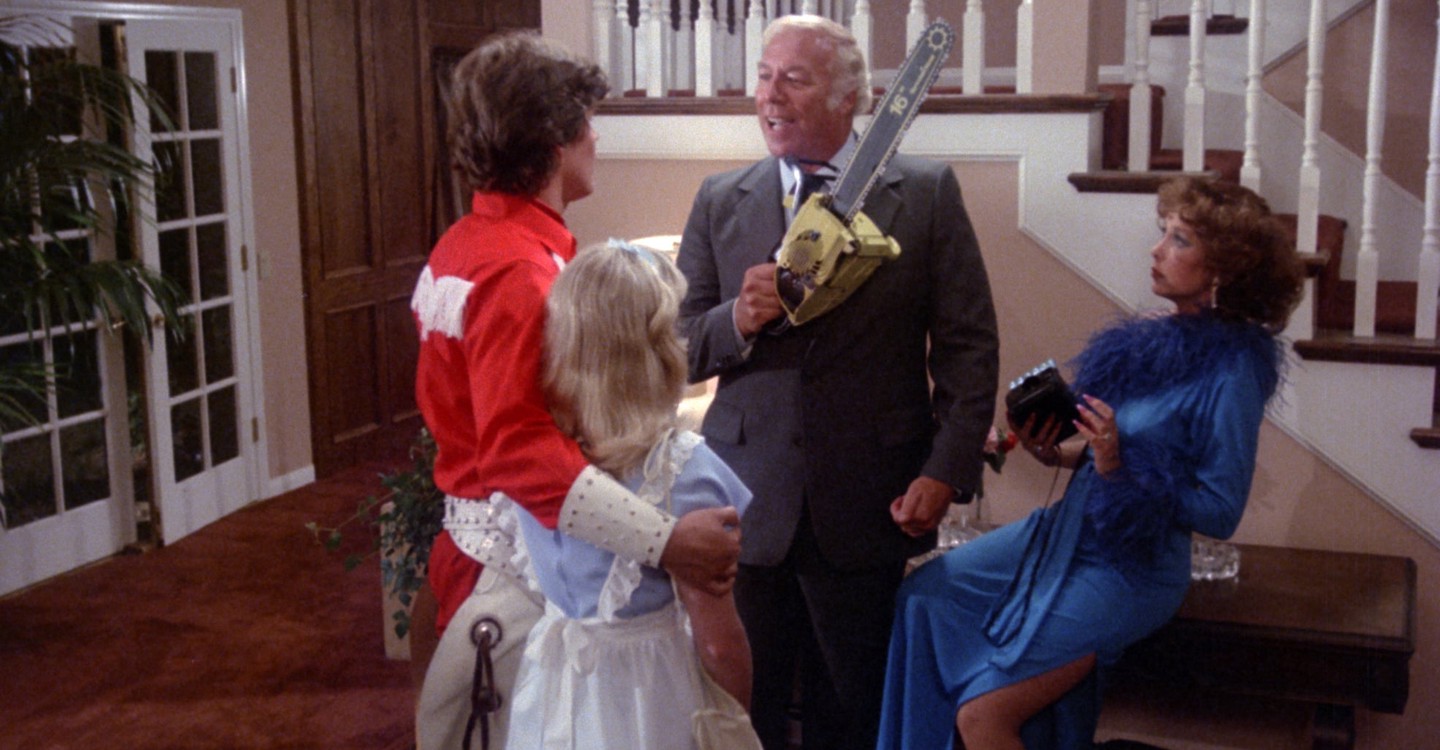
Don't Go to Sleep starts with a pretty generic setup. It's just not the setup for a slasher movie. It's the beginning of every haunted house tale you've ever seen. A young family is moving into a new house: mother Laura (Valerie Harper, because there's always a classic TV veteran on hand for one of these), who I can't even come up with a single character trait to describe; father Philip (Dennis Weaver, of Duel, the ur-TV movie), who is nervous about starting his new job and has a tendency to drink too much; daughter Mary (Robin Ignico), who has bad dreams; youngest sibling Kevin (Oliver Robins of Poltergeist, so 1982 was quite a banner year for him), who is a pernicious little brat with an iguana; and elderly grandmother Bernice (Ruth Gordon, who needs no introduction), a chain-smoking, blowsy firebrand whom Philip resents.

There's a member of the family I didn't mention because she's dead. Eldest daughter Jennifer (Kristin Cumming) died in a car wreck earlier that year and the family is still reeling. When her ghost appears to Mary, she starts convincing her to take out the rest of her family one by one so they can finally be together like they were meant to be. 

And I breathe a sigh of relief because this haunted house movie eventually gives way to a slasher so I'm not wasting my time watching it.

Don't Go to Sleep, which earns its title in exactly zero ways, isn't a bad TV movie. In fact in many ways it's quite effective. It's just hampered by the stilted, low budget nature of what it is. Especially in any scene where the family is conversing together as a group, there's not an ounce of naturalism, with each member clearly waiting their turn to say what they're supposed to say. And on the other end of the timing spectrum, there's the fact that Laura keeps demanding "answer me!" to her children, even though they were already speaking and her outburst in fact interrupts them so they can no longer answer.

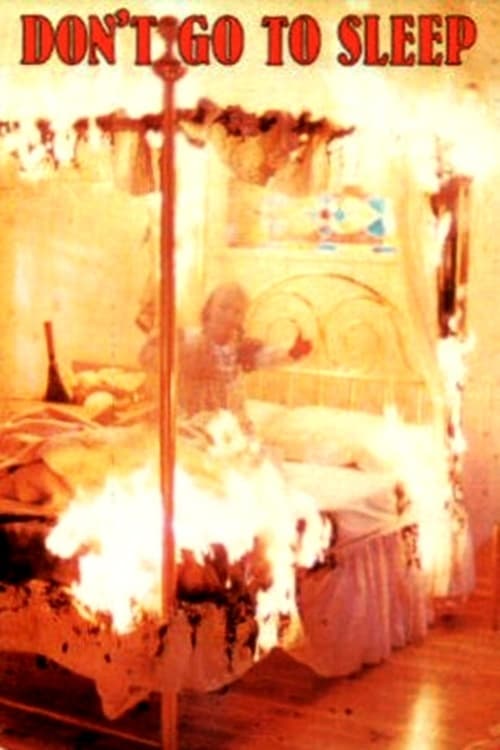
But when things get spooky, like when the dolls' heads start being twisted around, or that scene that provides the indelible fiery bed image you surely noticed above, Don't Go to Sleep at least piques the interest, even if it fails to chill the bones of a seasoned horror veteran. 

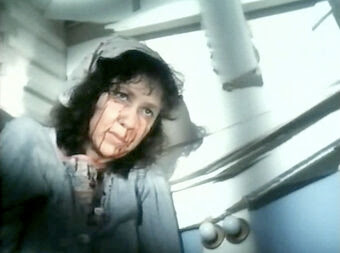
And there is an absolutely unique scene involving a pizza cutter that is lightly iconic, for good reason. Richard Lang, who as far as I can tell was a fairly anonymous TV director, really saw this genre movie as a chance to flex his muscles and he crams it full of unique angles and sinewy, flowing camera moves. Combine the aesthetic effort with Robin Ignicio's adorably enormous eyes that become simmering pools of pure black night when she scowls, and you've got yourself a lightly spooky tale that at least avoids being intolerably goofy despite the script's best efforts.

The effect her eyes produce is also helped by the fact that the VHS dub quality isn't GREAT.

But we need to talk about Kevin. Kevin SUCKS. This is not a critique of Oliver Robins, but the character himself. He's a shitty little brat who jealously guards his toys even though Mary clearly has no desire to play with them, torments his grief-ridden sister with pranks in the middle of the night, demands his dad buy him a motorcycle, steals cookies off the counter, and just plays with random loose Bunsen burners like an absolute psychopath. At least in the first half of the movie, we spend far more time with him than either of his sisters, and this is a huge liability, at least for my own personal interest in wanting to sit through the rest of the film.

And if we're being honest, anyone who isn't a little girl or Ruth Gordon isn't really worth spending time with. Any time they're alone together, Weaver and Harper have to volley back and forth some of the plummiest dialogue this side of the icebox. And while she in particular is giving a pretty solid performance, her sheer intensity brings down the mood. By combining this goofy body count thriller (with deaths involving an iguana and a Frisbee, you can't tell me I was meant to take this seriously) with the cracked psyche of a grieving mother, you just get a tonal hash that never fully comes together.

And that's before the ending that takes waaaay too long to explain a scene that is extremely easy to piece together from context clues like an hour earlier. It wasn't an unpleasant watch, but the good entirely fails to outweigh the mediocre. 

Killer: Mary (Robin Ignico)
Final Girl: Laura (Valerie Harper)
Best Kill: I mean I can't say I expected to be writing the phrase "Ruth Gordon dies of an inguana-induced heart attack," so I guess it must be that one.
Sign of the Times: That stigma against therapy is veeeeeeeeeeeeeery present. Phil thinks it will reflect poorly on his parenting if his daughter goes to therapy after two of her family members have died in the same year.
Scariest Moment: Mary's bed catches fire in the middle of the night.
Weirdest Moment: There's a scene that mimics the POV shot from the opening of Halloween, except the kid is holding an iguana instead of a knife.
Champion Dialogue: "She smells like cigarettes and it smells like yuck."
Body Count: 4
  1. Bernice has a heart attack.
  2. Kevin is pushed off the roof.
  3. Phil is electrocuted in the bath.
  4. Jennifer dies in a car explosion in flashback.
TL;DR: Don't Go to Sleep is passable TV movie fare, but it could have embraced its identity as a slasher with more keeness.
Rating: 6/10
Word Count: 1097

Wednesday, October 21, 2020

Census Bloodbath: Murder On Line 1

Year: 1982
Director: Michael Anderson
Cast: Richard Chamberlain, John Houseman, Sara Botsford 
Run Time: 1 hour 35 minutes
MPAA Rating: R

The slasher genre had gone through a startlingly huge variety of murder weapons, even by 1982 when the subgenre was still in its infancy. We've gotten murders by ice pick, barbed wire, hammer, machete, spear... And that's just in Friday the 13th Part 2. But I can say with reasonable confidence that Murder by Phone (AKA Bells) is probably the first time the murderer commits their kills using an exploding telephone. That concept alone was enough to get me firmly on board with the film before ever pressing play, because there's only so many times one can watch a group of nubile young people assemble in one remote location all in a row.

And I'm well on my way to getting that particular Guinness World Record.

Murder by Phone tells the story of ecology PhD Nat Bridger (Richard Chamberlain), who travels to Anytown Canada for a big conference, where he is lodging with his old mentor Stanley Markowitz (John Houseman). As a favor to the parents of a former student of his, he promises to look into her recent death. He soon discovers that she was killed by an exploding pay phone in a subway station and begins to unlock the secrets of the hidden evil underbelly of the local phone company with the help of sexy artist Ridley Taylor (Sara Botsford), who has been painting a mural for the company and thus has access to all their blueprints and labs, as tends to happen.

Meanwhile, the mysterious killer, who has invented a machine that emits a frequency that paralyzes people then blows up their phone with an electrical surge, is seeking revenge on anyone who wrongs him. Nat and Ridley, with their constant meddling, are getting closer and closer to being on that list.

This movie is also notable for featuring the first slasher movie killer whose only weakness is the invention of speakerphone.

Obviously what I want to talk about here is the kills. When the killer has the exact same M.O. every time, a movie can suffer a little bit from the repetition, but when the M.O. is so off-the-wall and silly, it's hard to get tired of it. Plus, director Michael Anderson (of the original Around the World in 80 Days, weirdly) finds new fresh ways to stage them each time. There's pretty much always something glass behind the victims for them to go flying into spectacularly, but beyond that there are always new little flourishes and details that keep things going strong.

When these flourishes include things like a pencil being snapped between a man's clenching jaws, a pair of eyeglasses exploding off someone's face, and blood spattering over a Mickey Mouse telephone receiver, it's easy to imagine why one might not find the scenes too same-y. There's probably no matching the potency of the first kill, which has the live-wire editing of Hausu and harnesses the element of surprise because you don't yet know exactly how these moments are going to play out, but they are all tremendously fun and come at a reliably well-paced clip.

Unfortunately, the main plot of the movie doesn't quite reach the frivolous heights of the kills, because how could that possibly be the case? It suffers from the same disease as the scenes with humans talking in a Godzilla movie. The filmmakers know you just want to get to the good stuff, but they have to shove something in between the special effects mayhem to help those scenes stand out (and bring down their budget). And that's not to say that the plot is bad, it's just not as ecstatically bonkers as the motherfucking exploding phone.

I love my job.

All the material with Dr. Bridger's investigation is pleasant but generic, throwing him together with a beautiful woman so she can have sex with him and be imperiled (though her character is much stronger than the more misogynistic turns at this formula, like previous film Blood Link. Although come to think of it, she seems actively turned on by Nat's mansplaining and doesn't kick him in the nuts when he grabs her hair and pulls her into a kiss when she's trying to make him leave, so we truly are grading these on a curve). And at the very least, the filmmakers aren't desperate enough to keep our attention by dumping a bucket of naked breasts onscreen anytime the killer isn't doing his business. In fact, the most nudity we get is a post-shower shirtless Richard Chamberlain, which I for one was incredibly grateful for.

It doesn't count as exploitation if it's a white man. It's parity.

On top of it all, Murder by Phone does take it upon itself to even be suspenseful on occasion. There are several Hitchcockian moments like the scene where a victim's son is trying to listen in on the other line so you're not sure how it's going to shake out, and the way the killer slowly, deliberately, stabs each number into his rotary dialer provides a lot of tension as he gets nearer and nearer to placing his fatal calls. 

I will say though that I'm surprised and a little disappointed that the filmmakers never really take advantage of the paranoia of the fact that any time the phone rings, it might just be the killer calling. There is a feint in that direction when Nat gives Ridley a secret code to know when it's him calling, but immediately after that he tells her to wait by the phone in case the detective calls him back. The characters don't seem to remember that there's a killer blowing up phones until after they've already picked up. 

This is a definite missed opportunity, but the good thing about Murder by Phone is that this is pretty much the only opportunity it leaves on the table. Every other way you could express the log line of "killer phone" is milked to the fullest extent, and as such it's an entirely delightful, exciting piece of weirdo retro filmmaking. 

Killer: Noah Clayton (Robin Gammell of Deadly Lessons)
Final Girl: Nat Bridger (Richard Chamberlain)
Best Kill: Who could possibly pick? Well, I can. A business executive is launched out of a high rise window to the concrete below.
Sign of the Times: The tour guide waxes rhapsodic about how goddamn many landline phones will be all over the world by the year 2000.
Scariest Moment: Both Nat and the killer are trying to call Ridley at the same time, and we don't know whose call is going to go through.
Weirdest Moment: Ridley tells Nat about how her stepdad punched her in the face once, then they start making out.
Champion Dialogue: "I grew up on knuckles and booze, it gave me my terrific sense of humor."
Body Count: 6
  1. Sandra gets phone-sploded.
  2. Gordon Smith gets phone-sploded.
  3. Mrs. J. Anderson gets phone-sploded.
  4. Connie gets phone-sploded.
  5. Stan Markowitz gets phone-sploded.
  6. Noah Clayton gets super phone-sploded.
TL;DR: Murder by Phone isn't as consistently raucous as its best moments, but it's still a fun weirdo gem.
Rating: 7/10
Word Count: 1201

Tuesday, October 20, 2020

Census Bloodbath: Pull The Other One

Year: 1982
Director: Greydon Clark
Cast: Joe Don Baker, Stella Stevens, George Kennedy 
Run Time: 1 hour 23 minutes
MPAA Rating: PG

It makes perfect sense that 1982 would be the year with the highest concentration of slasher parodies. The boom began in earnest in mid-1980 with Friday the 13th, and reached its highest theatrical concentration in 1981 (Night School, Friday the 13th Part 2, Graduation Day, The Burning, and The Fan were all released in a single three-week period). Combine that with the enormous success of Airplane! in 1980, and you've got yourself a recipe for a glut in that very specific sub-subgenre. 

The trend kicked off with the star-studded and decent Pandemonium and the execrable National Lampoon's Class Reunion, which began John Hughes screenwriting career and somehow didn't tank him immediately (he's white). The capper of this trilogy was Wacko, a film that lands somewhere between them quality-wise, though (spoiler alert) it's much closer to Class Reunion on that very limited scale.

Maybe humor didn't get funny until 1983?

Wacko "tells" the "story" of Mary Graves (Julia Duffy of Night Warning and a million TV shows you've actually heard of), whose older sister was killed by The Lawnmower Killer 13 years ago during the Halloween Pumpkin Prom. Wouldn't you know it, now it's time for her Halloween Pumpkin Prom, and someone else has donned the pumpkin mask to kill some kids. She's attending with her boyfriend Norman Bates (Scott McGinnis), who makes lawnmower noises every time he gets horny, and boy they just weren't even trying with naming this character, huh?

The other notable teens are her best friends Bambi (Elizabeth Daily of Bad Dreams and also she's the fucking voice of Babe), Rosie (Michele Tobin), and Rosie's date Tony Schlongoli (Andrew Dice Clay in his first film role), who has a dick so huge that he bursts through his pants whenever he gets a boner. Comedy! Unfortunately we don't get to spend a lot of time with the actual characters, because the producers spent a third of their budget on the name actors playing the adults, including George Kennedy (seen similarly slumming it in Just Before Dawn the year prior) as Mary's father, Stella Stevens as her mother, and Joe Don Baker as film noir-esque detective Dick Harbinger.

Their roles are all embarrassing, but they're laughing their way to the bank.

I suppose we should talk about the comedy, because there's literally nothing to this movie other than an endless litany of gags layered over one another. Sometimes that can be successful. That structure is one of the reasons people praise Arrested Development to high heaven. But in order for that to work, the gags need to be good (see: Arrested Development season 5). 

There is some mildly amusing stuff that crops up every now and again, because out of 100,000 jokes, there's a statistical improbability that not a single one will make you laugh. But none of these successful gags (including a rope hanging out of the window of an escaped mental patient's first floor room, and a student saying of her chemistry teacher "he makes science so believable!") have anything to do with Wacko's ostensible purpose to parody the slasher film formula in any meaningful way.

There are very forced gags pointing out the tendency for these films to have unnecessary dream sequences or perverted gardener red herrings, but in a style that recalls Scary Movie, a lot of the gags feature totally unrelated horror properties (including The Omen, The Exorcist, and Alien) and scattershot cultural detritus (the West Side Story musical number that introduces Tony is both hideously staged and resolutely unfunny, and it does not shock me to find out that it was Andrew Dice Clay's idea). Wacko is so lackadaisically committed to the slasher conceit that the only death in the first hour isn't even perpetrated by the killer who is supposedly stalking around town.

That said, the film's third-best line comes when Mary worries that her father might kill someone with the replacement medical instruments he's been using because he can't find his scalpel, and her mother calmly chides her: "Your father is a doctor. He kills people EVERY day."

And once the kills kick in during the film's Prom Night-inspired final act, they prove to be entirely bloodless and starved for creativity. Even a death involving a teen's head being shoved into a garbage disposal is just an excuse for a flood of gags (the lunch lady shows up to tell the killer he needs to be running the water to turn on the disposal, and then it's randomly revealed that she is the teen in question's mother) rather than a fun, outré death. There is not one drop of blood, or even a little motion implying the jiggling of the machine. It's just static and demure in every possible way.

It's surprising that the kills are so underplayed, because everything else in the movie is played up to the rafters. Any running gag is repeated no fewer than one thousand times, and the jokes are so crammed into every single element of the movie that any time it stops to breathe for even a two second shot like somebody walking across the lawn, the sound designer throws in a random elephant trumpet sound... just because?

Other than the occasional, incidental laughs, there are only two things I liked about Wacko. The first is that Julia Duffy is a great casting choice, and her cartoonish baby voice provides a heightened, over-earnest register that the whole movie should have taken and run with. And the second thing is that the band that plays at the prom is a group called Avalon, who I actually quite like. So this movie has at least added to my "Slashdance" playlist of songs from slasher movies, even if it hasn't benefited me to watch in any other way.

Killer: Dick Harbinger (Joe Don Baker)
Final Girl: Mary Graves (Julia Duffy)
Best Kill: The chemistry teacher saws a woman in half to prove something about matter, and seems mildly disappointed when he finds out he's murdered her.
Sign of the Times: Andrew Clay hadn't even earned the "Dice" in his name yet!
Scariest Moment: The dad spying on his scantily clad daughters and constantly being laughed off is just... bone-chilling.
Weirdest Moment: There's a random car chase scene where one car uses a ramp to launch over another car as it explodes.
Champion Dialogue: "I'm really honored that you're still a virgin."
Body Count: 6
  1. Lady is sawed in half in Chemistry class.
  2. Vice Principal has his head squeezed in a vise.
  3. Bambi is decapitated with an axe.
  4. Tony has his head shoved in a garbage disposal.
  5. Rosie is put into some sort of... meat grinder conveyor belt?
  6. Dick Harbinger is impaled with an American flag, stabbed a bunch, and probably shot; frankly I'd stopped paying attention at that point.
TL;DR: Wacko is funnier on paper than it is in practice, and it's not that funny on paper.
Rating: 2/10
Word Count: 1174

Monday, October 19, 2020

Census Bloodbath: Twin-sanity

Year: 1982
Director: Alberto De Martino
Cast: Michael Moriarty, Penelope Milford, Geraldine Fitzgerald 
Run Time: 1 hour 38 minutes
MPAA Rating: R

Blood Link is an early 80's slasher made by Italians, which a stone cold horror scholar could have sniffed out just from the poster, which borrows heavily from the poster for the same year's The New York Ripper, and by borrows heavily I mean wholesale steals the entire image except for Michael Moriarty's face shoved in there at the bottom. That kind of brazen thievery bears the distinct markings of the Italian horror producers of the late 20th century (the same group of people who, you might remember, advertised Twitch of the Death Nerve as The Last House on the Left Part 2 even though it came out several years before Last House).

You can also tell from the fact that every female character takes her top off at some point in the movie.

In Blood Link, Dr. Craig Mannings (Michael Moriarty) is living his best life, building an experimental therapy practice with his girlfriend who he refuses to marry, Dr. Julie Warren (Penelope Milford). Unfortunately this revolutionary new therapy (which involves electrocuting people through acupuncture needles - neat!) has unlocked a part of his brain and he can now occasionally see through the eyes of his long-lost conjoined twin brother Keith (Michael Moriarty). Wouldn't you know it, but this twin is a bit evil, and has been wandering around Germany murdering women for who knows how long.

He heads off to Europe to see if he can't drag his twin back to the states to get help, but becomes mixed up in his twin's evil schemes, because having the same face as somebody who has been murdering people in broad daylight is a little bit of a liability. He arrives just as a case of mistaken identity has thrown Keith into the path of Craig's former patient, prizefighter Bud Waldo (Cameron Mitchell of Memorial Valley Massacre, Terror Night, Without Warning, Blood and Black Lace, Silent Scream, and The Demon, phew) and his daughter Christine (Sarah Langenfeld).

Plus we get a whole bunch of shots straight out of The Parent Trap.

Blood Link very clearly wants to be an elegant early-70's style giallo like The Bird with the Crystal Plumage, but it's missing one key element: Dario Argento. His early work was just as nasty-minded and misogynistic as this movie is, but he at least presented it with style and panache. Alberto De Martino wouldn't know panache if it sprayed blood all over his fish tank. 

Sure, he gets a few cracks in at some pretty shots (it's very nice whenever the camera peers up into the mirrored ceiling of a prostitute's room, and there's one solid shot of the aforementioned fish tank lighting up an artfully arranged corpse), and Ennio Morricone's lush score makes a solid effort to class up the proceedings (minus the moments when the titular blood link is activated, which just sounds like a telegram coming in). But Blood Link is just plain nasty - cruel and gross in all the wrong ways.

I'm not saying that the slasher genre isn't built on the backbone of objectifying then murdering women, but rarely has that approach been so cut and dry, converting the already unsubtle subtext of phallic knife slayings into out-and-out text with clunky dialogue about Keith's impotence that it tries to gussy up with lots and lots of pointless philosophizing about twins. It has nothing to say, it just knows it needs to fill up the scenes between uncomfortable rapey menacing of women with something.

It's not scary other than when you're contemplating who out in the world would actually find this entertaining (the climax of the movie is a rape scene in a park, which should show you how little interest this has in really being a psychological horror film), and it's certainly not fun. It's just... unpleasant.

Meanwhile, Michael Moriarty continues to fuck his way across Europe like a regular Robert Langdon.

It doesn't even have the decency to at least spruce up the murder scenes with fun special effects. No, just a lot of grunting and stabbing in the back, and moving right along. And Michael Moriarty does not provide a fun presence to spend 100 minutes with. He might be playing two characters, but he's giving about half a performance between them. Every line spoken by Craig is spoken in a miserable monotone like Ross saying "hi..." in the pilot episode of Friends, and Keith is mostly performed the same except for the random moments where he becomes Jim Carrey as the Grinch.

This is exploitation filmmaking at its most bare bones. It's not quite pornography, not quite horror, not worth your time. It definitely makes sense why they didn't even bother making Blood Link its own poster. I don't want you to mistake me as saying this is one of the worst slasher films I've ever seen - it's not even in the bottom 100 - but it certainly gave me no pleasure to watch. It's largely competent at putting images on the screen and presents its tawdry narrative with clarity, so it's at least above par for an entry this deep into any Census Bloodbath year.

Killer: Keith Mannings (Michael Moriarty)
Final Girl: Julie Warren (Penelope Milford), but only as an afterthought
Best Kill: The reveal of how the twins' parents died, which shows them having sex in a garage for some reason and being hilariously crushed by a speeding truck.
Sign of the Times: We just can't stop calling people with creepy messages on those courtesy telephones at the airport, can we?
Scariest Moment: When training with Bud, Keith starts to get more and more violent and intense.
Weirdest Moment: One other thing the twins have in common is that they like to stir jam into their coffee.
Champion Dialogue: "Breakfast in bed is a disgusting luxury. I love it."
Body Count: 9
  1. Cougar is stabbed in the back.
  2. Prostitute #1 has her head smashed through a window.
  3. Bud Waldo has a heart attack while being beaten to death.
  4. Christine is stabbed to death.
  5. Prostitute #2 is stabbed in the back.
  6. Smuggler is stabbed in the chest.
  7. Keith (or was it Craig? cue dramatic music) is stabbed in the back.
  8. Mom and
  9. Dad are crushed with a truck in flashback.
TL;DR: Blood Link is trying to be something better than it is, and it is failing.
Rating: 4/10
Word Count: 1080

Friday, October 16, 2020

Cardboard Science: The Tin Man

Year: 1958
Director: Eugène Lourié 
Cast: John Baragrey, Mala Powers, Otto Kruger
Run Time: 1 hour 10 minutes

Now, I'm sure you're sick of hearing about slasher movies by this point in the month, so why don't we give ourselves a bit of a palate cleanser with our 7th Annual Great Switcheroo with Hunter Allen of Kinemalogue. Once again, as we have every October since 2014, I have assigned him three 80's slashers (reviews forthcoming, keep an eye out) and he has assigned me three 50's science fiction movies. I am always eager to explore the wet and wild world of humanity's terrible fear of scientific progress (and also aliens), so I thought I'd launch into the project starting with the film I knew absolutely nothing about beforehand: 1958's The Colossus of New York.

The one thing that the 80's slasher and the 50's sci fi really have in common being that you absolutely cannot trust the poster to describe anything you are about to witness in the movie.

Even for a low budget B-picture, The Colossus of New York has an astoundingly small cast. We mostly deal with the family of humanitarian inventor Dr. Jeremy Spensser, whose heat-sensing detector device and frost-resistant produce strains are on the verge of ending world hunger and have earned him an International Peace Prize, to boot. I guess Nobel refused to have their name attached to a movie about a robot with laser eyes. But we'll get to that. When returning home from the prize ceremony with his wife Anne (Mala Powers) and son Billy (Charles Herbert of The Fly), he is struck by a speeding truck.

Not wanting to have his huge genius science brain go to waste, his father William (Otto Kruger of Dracula's Daughter), a talented brain surgeon, ropes in his reluctant brother Henry (John Baragrey), who is already moving in on Anne, to help him create a robot body in which to implant Jeremy's brain. Of course, stripped of his human vessel and the divine spark of life, his brain lacks empathy and turns inhuman, deciding that world hunger can only be ended by murdering a bunch of people, going on a laser-eye murder spree throughout what we'll be extremely generous and call New York.

Oh, also the robot looks like this, because they did not consult a woman once during this whole process. Or maybe he secretly hates his son?

OK, so let's get down to brass tacks. The Colossus really isn't much of a colossus. Sure, he's a big ol' robot, but there are definitely NBA players taller than him. He's not knocking down buildings Godzilla-style. Not that there are any buildings to speak of anyway, considering that the only outdoor set is a matte painting riverfront. So no, the film completely and utterly fails to live up to the promise delivered by the poster, but we were at least prepared this time!

And here's the thing. From my seven year experience with these films, I was fully expecting an hour of talking about brains and the Divine Spark and ten minutes of Colossus rampage before credits. Blissfully, even though the Colossus could certainly be more colossal, we do get a whole hell of a lot of him throughout. And folks, he is fucking terrifying to behold. Whatever impulse led Jeremy's father to craft him as a cross between Boris Karloff's Frankenstein and Vision from the Marvel movies draped in Obi Wan Kenobi robes was certainly a misguided one, but it provides many a tingle up the spine.

The creature design is just so dazzlingly weird. His light panel eyes glow with the crackle of an electric furnace, a roiling storm cloud behind his face, which is so loud that it sometimes threatens to drown out the droning, faraway voice that echoes from his slack mechanical mouth. It's uncanny and really highlights how truly inhuman this character has been forced to become.

Robby the Robot this ain't.

Beyond the antagonist design, I can't say I cared for too much about this movie though. We're obligated to spend a lot of time with the various other figures of the Spensser family, and none of them really do much to catch the eye, and their philosophizing about the Soul vs the Body is a shade too Christian-y for me to really sink my teeth into as a solid theme. Really the only thing in any way interesting about the family scenes is how poorly any moment with Billy has aged.

I'm not talking about the stiff, shrill child acting. I mean the fact that every grown man seems to have a moment with Billy that would make even the densest screenwriter in 2020 think, "hey, maybe there's something wrong here." Maybe Billy's robot father shouldn't tell him to "push harder" on the lever meant to shut him off, which is located within the folds of his robe? Maybe he shouldn't approach him from the shadows of a forest and promise that he'll get a reward if he's good? Maybe Henry shouldn't come home saying he has a surprise for Billy, making him search through Henry's pockets to find it? Perchance?!

I guess we can put that in as a another win for the "horror" column though. And really, as thin as almost everything in the movie is (including that beautiful little slip of a run time), it wrings so much genuine dread from its central character that you don't even miss that he's not stomping around climbing buildings like King Kong. Mostly. 

That which is indistinguishable from magic:

  • Before the brain is implanted in the Colossus, William has set up a complex, futuristic scientific system to keep the brain alive and communicate with it using... a typewriter. 
  • Billy is devastated when his father interrupts the industrial film presenting footage of factory machinery and demands to see "the machine that can work like a man!", because TikTok wasn't invented yet so I guess there wasn't anything else to capture his attention. Poor thing.
  • A policeman trying to stop the Colossus' rampage does the hilarious bad actor move of swinging his gun down through the air before shooting, like he's using a tomahawk.

The morality of the past, in the future!:

  • Henry flirts with Anne by saying he'll make sure she stays busy whether she likes it or not. How thoughtful?
  • The press has gathered at the airport to document Jeremy's return from the prize ceremony, because apparently it was a slow news decade.

Sensawunda:

  • Not only was Colossus written by a female screenwriter, Thelma Moss née Schnee, that very same female screenwriter then went on to become a famous parapsychologist, helming the parapsychology department at UCLA, back in a time when that would have even been a thing.

TL;DR: The Colossus of New York has an eerie creature design that tips it just over the edge into enjoyable.
Rating: 6/10
Word Counter: 1150

Cardboard Science on Popcorn Culture
2014: Invaders from Mars (1953) The Day the Earth Stood Still (1951) Them! (1954)
2015: The Giant Claw (1957) It Came from Beneath the Sea (1955) The Brain from Planet Arous (1957)
2016: Invasion of the Body Snatchers (1956) Godzilla (1954) The Beginning of the End (1957)
2017: It Conquered the World (1958) I Married a Monster from Outer Space (1958) Forbidden Planet (1956)
2018: The Fly (1958) Attack of the 50 Ft. Woman (1958) Fiend without a Face (1958)
2019: Mysterious Island (1961) Robinson Crusoe on Mars (1964) Plan 9 from Outer Space (1959)
2020: The Colossus of New York (1958) It Came from Outer Space (1953) Rodan (1956)

Census Bloodbath on Kinemalogue
2014: My Bloody Valentine (1981) Pieces (1982) The Burning (1981)
2015: Terror Train (1980) The House on Sorority Row (1983) Killer Party (1986)
2016: The Initiation (1984) Chopping Mall (1986) I, Madman  (1989)
2017: Slumber Party Massacre (1982) Hello Mary Lou: Prom Night II (1987) Happy Birthday to Me (1981)
2018: The Prowler (1981) Slumber Party Massacre II (1987) Death Spa (1989)
2019: Phantom of the Mall: Eric's Revenge (1989) Psycho III (1986) StageFright: Aquarius (1987)
2020: 

Thursday, October 15, 2020

Census Bloodbath: Low Down Dirty Tricks

Year: 1982
Director: Gary Graver
Cast: Jacqueline Giroux, Peter Jason, Chris Graver
Run Time: 1 hour 31 minutes
MPAA Rating: R

I think covering The Clairvoyant yesterday lured me into a false sense of security RE: awesome slasher movie posters. That movie both had an incredible poster and turned out to be a largely incredible movie, which I should REMEMBER is almost never the case. Enter Trick or Treats. Take a gander at that key art up there and you should have an idea of what a trainwreck we're in for.

This is why we can't have nice things!

Trick or Treats takes place on Halloween night. Linda (Jacqueline Giroux) has plans to attend opening night of her boyfriend Brett's (Golden Globe nominee Steve Railsback, who we'll revisit later this month in 1982's Deadly Games and later... whenever in 1986's The Wind) play. The play in question, which stars the extremely white Brett, is Othello. He's playing Othello. In case you're not a Shakespeare scholar, Othello is Black. Thank every god in every religion Steve Railsbeck is not in blackface, but it's still... a choice. Also what kind of crowd a whitewashed performance of Othello gets on Halloween night is beyond me. Anyway...

She can't attend the play because the Agency calls her with a last minute babysitting gig. She must care for a young magic-obsessed boy named Christopher (Chris Graver, who - wouldn't you know it - is the director's son) whose parents are going to a last minute Halloween party in Las Vegas. The parents being Richard Adams (David Carradine, of David Carradine), a lascivious weirdo who flirts with Linda and unzips her shirt, and Joan O'Keefe (Carrie Snodgress), who had her previous husband committed to an insane asylum so she could get his house and his millions.

Turns out that husband is one Malcolm O'Keefe (Peter Jason), who has designs on escaping the asylum and returning to his rightful home tonight!

Whether or not Christopher is the son of Malcolm or Richard is left ENTIRELY unclear. But don't worry. It's not the only thing.

Trick or Treats opens on Joan surprising her husband with a visit from the authorities, who have come to put him in a straitjacket and cart him away. This scene is strangely prolonged, as Malcolm fights against the men, climbing trees, kicking them into the pool, and wrestling away from them any way he can. It's uncanny and strange in the way it goes on too long, but the way the film just sits with it really drove home the visceral, unpleasant nature of the moment. Unfortunately, every other scene in the movie is also prolonged and unpleasant, but to less effect.

And really, there are only three types of scene that the film cycles through ad nauseam until the boring final ten minutes of Malcolm chasing Linda around the house, thinking she's Joan (presumably because the lighting in the movie is so bad he couldn't tell).

The first type of scene is a woman interacting with a man who seems about twelve seconds away from a full-on sexual assault. This unnamed California town is apparently crawling with predators, who will latch onto any woman or man dressed as a woman (Malcolm spends a great deal of the movie in a stolen nurse's uniform - where he got the wig is anybody's guess) and lasciviously come on to her until she escapes his clutches. This is also true of any teenager and even Christopher in certain scenes.

The worst offender is Richard Adams, whose leering come-on I already detailed above. The discomfort is not eased by the fact that David Carradine is giving an immensely odd, aloof performance. He drifts around the screen in random directions, stretching languorous pauses between words. He knows how much better he is than the material, and there's a perpetual wicked glint in his eye of the knowledge that he can get away with performing any damn way he wants, because who is Gary Graver to tell David Carradine no?

And honestly I respect how much he palpably dislikes being in this film, because it makes me feel less alone for finding it a grueling experience.

The second type of scene is the wacky hijinks of Malcolm attempting to make his way home, which shoehorn in a lunatic attempt at comedy that must be seen to be despised. The third type, which forms the bulk of the movie's run time, is of Christopher pulling a prank on Linda with his magic equipment, including at least three instances of faking his own death. This little stinker really puts her through the wringer, not letting up for a single second he's onscreen, trading incessantly between ruthless pranking and acid-tongued quips performed like the kid from The Babadook's acting coach was Rob Zombie.

If the goal of the film was to put us in Linda's headspace of experiencing an intensely irritating child for hours on end, it succeeded. It's a frightful thing to experience, and the movie resolutely refuses to behave like a good slasher and break up the gloom with fun murder sequences. In fact, nobody even dies in the movie until the third act. Only one murder is perpetrated by the killer himself, and it's so poorly lit and edited that it's not even super clear what happened. It's even less of a slasher movie than the same year's Hotline, and in that movie the killer took down literally zero people on screen.

It's clear from the tropes it's drawing upon and the structure it sets up that Trick or Treats thinks it's a slasher and dearly wants to be one, but it's actually just a prolonged, rejected submission to America's Funniest Home Videos. The shoddy, easily distracted script sees to that. Characters just vanish (we never see Christopher's parents again) or keep cropping up without playing important roles in the narrative (we spend a lot of time with Bret for a character who only interacts with Linda over the phone). Hell, the movie can't even keep track of what pet the O'Keefes have! Joan reminds Linda to feed the dog. We never see a dog in the ensuing 90 minutes, but we do get a cat scare.

Focus? She's not home right now.

Trick or Treats is a bottom-of-the-barrel slasher movie, and this is coming from someone who has devoted his life to probing every last splintery inch of that barrel. Literally the only redeeming quality of the film is the fun New Wave song that opens and closes the story ("Help is On the Way" by Horizon, which I can find nowhere on the Internet). OK, maybe that's not true. I do also like the increasingly angry way that Linda deals with the trick or treaters coming to the door, eventually just tossing candy at them and slamming the door. That was cathartic.

But Trick or Treats is a slasher-comedy film that is neither interested in making us scream nor making us laugh. It is, however, interested in having us sit down with Linda as she tells the entire "Boy Who Cried Wolf" story from start to finish uninterrupted. What a brutal, unrelenting, punishing, slog. I almost gave it a 1/10, an honor that has until now been reserved only for the worst slasher movie ever inflicted upon polite society.

But I changed my mind for two reasons. First, bad as it is, Trick or Treats is nowhere near the black hole of irradiated garbage that is The Outing. Second, there's a scene where an editor friend of Linda's agrees to drop off her acting reel because the O'Keefes' house is right by her hairdresser, where she was headed anyway, and I had a fun five minutes imagining what scenarios could have brought her to a salon past midnight on Halloween. Good times.

Killer: Malcolm O'Keefe (Peter Jason)
Final Girl: Linda (Jacqueline Giroux)
Best Kill: As if there even were any to speak of.
Sign of the Times: It cost 35 cents to ride the bus.
Scariest Moment: The part about 80 minutes in when I realize nobody else was going to be murdered onscreen.
Weirdest Moment: Two asylum inmates who think they're Antony and Cleopatra are caught having sex in the men's ward.
Champion Dialogue: "Amigos! A me goes!"
Body Count: 3; and that's reeeally a stretch
  1. Andrea is killed with a knife... somehow.
  2. Malcolm is guillotined.
  3. Linda is presumed stabbed about half a second after the end of the movie.
TL;DR: Trick or Treats is an abysmal slog that doesn't even attempt to embrace the tropes of the slasher genre, let alone resemble an actual narrative motion picture in any way.
Rating: 2/10
Word Count: 1448