Showing posts with label Gialli. Show all posts

Tuesday, July 14, 2026

Census Bloodbath: The Screams Of Seagulls

Year:
1982
Director:
Nestore Ungaro
Cast:
Prunella Ransome, Jeremy Brett, Nicky Henson
Run Time:
1 hour 42 minutes

Plot: Englishwoman Barbara Carey (Prunella Ransome) leaves her nonspecific job in New Orleans to meet her little sister, blind pianist Mary Ann (Sherry Buchanan of Crawlspace), in Rome, only to find that she disappeared three weeks ago. She teams up with hot 'n horny consulate employee Martin (Nicky Henson) to try and solve the mystery, which brings them to the private island of the rich archaeologist David Malcolm (longtime TV Sherlock Holmes Jeremy Brett), who may or may not be keeping secrets on said island.

But where is Mary Ann? And who is responsible for the dead blind women that keep turning up around the area? David? Lascivious seaman Enzo Lombardi (Gabriele Tinti of The Murder Secret)? David's cousin Carol (Pamela Salem, who played Miss Moneypenny in Never Say Never Again), who obviously has the hots for him? David's creepy henchman Giulio (Vassili Karis)? Or somebody else entirely? Like, say, David's dead son Frederick, who might not be as dead as we previously thought?

Analysis: The provenance of The Secret of Seagull Island is confusing and circuitous, even by the standards of 1980s slashers. The British-Italian co-production started its life as a five-episode 1981 miniseries called Seagull Island, which was eventually cut down to 102 minutes and distributed as a TV movie. It was made by an Italian director of no repute and distributed in a way that necessitated a stricter standard for depicting nudity and violence, which kind of nips the possibility of being a solid giallo right in the bud.

And while the British have contributed many great things to pop culture (The Hitchhiker's Guide to the Galaxy, Hammer monster movies, Maggie Smith, this), slashers are probably their second worst contribution to the world after colonialism. They simply never figured out how slashers ticked. 

I suppose it makes sense that a region smack dab in the middle of the Video Nasty panic wasn't going to throw themselves at the subgenre hammer and tongs, but most of the slashers they put out in the 1980s were simply pitiful. The Last Night sucks. Don't Open Till Christmas sucks even harder. Bloodstream could suck a bowling ball through a straw.

Surprisingly, The Secret of Seagull Island doesn't suck. Maybe that's because one thing the British actually understand better than most is how to put horror on television. I couldn't say. But it was actually not an unpleasant sit.

It completely lacks atmosphere, sure, beyond the fact that they invested in an underwater camera and by jove, they were determined to use it. And it's quite slow. I can't imagine what the 115 minutes they cut out could have possibly contained, because the story hardly races by as it is. But the plucky heroine is reasonably compelling, and her chemistry with her male love interest is strong enough to sustain the movie until it can get her to the island and turn up the heat on the melodrama. 

In fact, pretty much all the acting is pretty solid, give or take some severely patchy moments from Jeremy Brett, who briefly turns into a Looney Tunes character from time to time. They bring to life a charmingly tacky story that wears its influences on its sleeve, including the gialli (the killer targeting blind women is an excellent Italian touch) and Alfred Hitchcock's Psycho (minus the transphobia, for once).

It's better to approach it as a solid slow-burn TV mystery (complete with evil hands constantly grasping the corners of buildings and the gratings over windows) rather than a proper slasher - the kills are pretty much a wash, as is to be expected - but it's a reasonably entertaining example of one of those. Plus, it has a seagull attack! That was fun.


Killer: David Malcolm (Jeremy Brett)
Final Girl: Barbara Carey (Prunella Ransome)
Best Kill: A blind woman who recently escaped Seagull Island gets the most giallo-y death, with the killer playing a tape of seagulls crying that causes her to freak out, jump through a window, and plummet shockingly far to her death.
Sign of the Times: Martin's "going out" outfit consists of three pieces that are all different shades of tan.
Scariest Moment: Enzo's dog barks and Enzo thinks it's barking at him, but all of a sudden a scuba-diving killer bursts up from the water in front of him.
Weirdest Moment: David sleeps next to a framed shirtless photo of his son.
Champion Dialogue: “My sister seems to have gone through half the male population of Italy."
Body Count: 7; not including a blind woman who was killed six months before the events of the movie, whose body we see.
  1. David's Second Wife (Alée? Alaine? I don't know, it's never written down) and
  2. Frederick die in an underwater rock slide.
  3. Blind Woman jumps through the window of her hospital room.
  4. Giulio is stabbed in the chest by Enzo.
  5. Enzo either dies by succumbing to being stabbed in the crotch or is killed offscreen in some other way.
  6. Carol is drowned.
  7. David traps himself in a burning building.
TL;DR: The Secret of Seagull Island is a pleasant TV melodrama blended with a mostly OK giallo.
Rating: 6/10

Saturday, February 7, 2026

Census Bloodbath: Cyrano De Maniac

Note: This movie was only available to me in unsubtitled Italian, so take my review with a huge grain of salt.

Year:
1981
Director:
Bruno Corbucci
Cast:
Pippo Franco, Edwidge Fenech, Sergio Leonardi
Run Time:
1 hour 39 minutes

Plot: Luciano Persichetti (Pippo Franco) is a hapless, big-nosed clothing delivery guy who thinks that he has psychic powers, given his uncanny ability to predict which of the people in his life are about to be targeted by a killer known as The Guardian Angel. He mainly uses this to try to get into bed with the gorgeous parapsychology enthusiast Susanna Luisetti (giallo queen Edwige Fenech of Phantom of Death, Strip Nude for Your Killer, The Strange Vice of Mrs. Wardh, The Case of the Bloody Iris, Your Vice is a Locked Room, and Only I Have the Key, and more).

Analysis: I've heard enough about vintage Italian comedy movies to assume that the giallo riff The Nosy One (originally Il Ficcanaso) wasn't going to be any good. However, given its vintage, I held out hope that it might be a Student Bodies-style parody of giallo movies. Alas, this was simply a pure comedy movie with just enough giallo elements for me to not boot it off the Census Bloodbath roster (and reader, I really tried to).

Let's talk about those giallo elements first. It won't take long. This is a movie so desperately disinterested in interrogating the gialli that there isn't a single shot of the killer stalking a victim. The only moment where a gloved killer brandishes a weapon turns out to be a prank. And the only victim who we actually see being attacked is 1) shot by an unseen assailant and 2) survives.

This is basically the slasher version of Rosencrantz and Guildenstern Are Dead, where a giallo movie is happening just offscreen while the main characters bumble around doing nothing. In fact, I have no idea if my body count is correct, because we barely even see the aftermath of the offscreen kills. I had to deduce that a kill had just happened from the actors' performances and the instrumental score by Franco Micalizzi (which thankfully adds an exaggerated funeral dirge to those moments). I'm sure the dialogue discussed the kills in more detail, but as a visual experience, The Nosy One was even less of a giallo movie than, say, E.T.

At least the comedy is kind of OK. While I can't speak to any dialogue-based humor, the physical comedy is juvenile and broad, but not unappealing. Pippo Franco's performance recalls both Buster Bluth and Mr. Bean, so it wasn't terrible to spend time with him. I wish the comedy had more to do with skewering giallo tropes than farting, but for what it is, it's fine.

The movie also looks pretty good. It has been crisply preserved, and it is for the most part both well lit and legible (save a sequence in a dark warehouse that is dismayingly murky). It generally lacks the abundance of style that the gialli were known for (there is no giallo trope that The Nosy One doesn't fail to evoke), but at least there are plenty of shots where bright reds and greens flood the frame.


Killer: Old Guy
Final Girl: Luciano (Pippo Franco), Susanna (Edwidge Fenech), and basically every other major character
Best Kill: I guess it has to be the death of the dark-haired lady who is vying for Luciano's attention, because at least we see her body being discovered. In true The Nosy One fashion, I have no idea how she died, but I think it was by electrocution.
Sign of the Times: The fact that Italians were so done with giallo movies that they were willing to do whatever this is to it.
Scariest Moment: The moment I realized that we were never actually going to see the killer murdering anybody.
Weirdest Moment: During a conversation with Luciano, Susanna sits there and butters the most enormous pile of toast I've ever seen.
Champion Dialogue: N/A
Body Count: 4; give or take - and not including a dream sequence where both Luciano and Susanna are shot.
  1. Man is killed offscreen.
  2. Somebody is killed offscreen.
  3. Dark-Haired Lady is killed offscreen, potentially by electrocution.
  4. Security Guard is killed offscreen.
TL;DR: The Nosy One is unremarkable more than it is truly bad, but it is despicably misguided as a giallo riff.
Rating: 4/10

Saturday, August 16, 2025

Census Bloodbath: Now That's What I Call Scissoring

Year:
1985
Director:
Carlo Vanzina
Cast:
Tom Schanley, Renée Simonsen, Donald Pleasence
Run Time:
1 hour 33 minutes
MPAA Rating: R

Plot: Nothing Underneath (Sotto il vestito niente) follows Yellowstone park ranger Bob Crane (Tom Schanley) traveling to Milan after having an intense bout of twin telepathy where he senses that his sister Jessica (Nicola Perring) is in grave danger while on a modeling job. When he finds that she's missing, he teams up with the local police commissioner, Commissario Danesi (noted Italian Donald Pleasence, and if I need to tell you that he's Dr. Loomis from the Halloween franchise, you probably shouldn't be starting your journey through this blog with my Nothing Underneath review).

Naturally, because we're in giallo territory after all, a black-gloved murderer wielding a lethally sharp pair of scissors is hunting down models in the meantime. But is Jessica one of the victims, or is she herself the killer? And will Bob's simmering flirtation with model Barbara (Renée Simonsen) ever come to a boil?

Analysis: If you've even seen a single giallo movie, you've probably seen between one and nineteen Italian models getting murdered. That's just statistics. So for Nothing Underneath to bust out this premise a good two decades after Mario Bava's The Man Who Knew Too Much and Blood and Black Lace kickstarted the genre is a little redundant. And guess what Blood and Black Lace was about, in the first place. A murderer hunting down models, of course! 

I'm just saying, this story is played out. So it's a good thing that Nothing Underneath is pretty fucking weird on top of everything else it's delivering. It's not necessarily weird in a way that would shock a seasoned viewer of gialli, but it's got a lot of beautifully florid stuff going on around the edges. 

For instance, that twin telepathy thing, which causes the unusually sexy protagonist Bob (by that I mean it's unusual for men to be sexy in giallo movies) to nearly tumble off a bridge when he goes into a fugue state. Or the apartment building that randomly has a spinning statue on the lawn in front of it. Or the fact that Bob convinces a telegram operator to bend the rules by helping her decide the best place to put her hamster. That is not an innuendo.

The extremely pleasant thing about watching a weird giallo movie is that the filmmaking craft is almost always on point, so you don't even have the excuse of the movie being shoddily made to explain any strangeness in the storytelling. A weird giallo just boldly proclaims its weirdness while looking from top to bottom like a major motion picture.

Give or take some audio issues, that it very much the case with Nothing Underneath. There are no Argento-esque flourishes to the cinematography that make it truly breathtaking, but cinematographer Beppe Maccari shows a real facility with landscapes. And composer-of-note Pino Donaggio (Dressed to Kill, Tourist Trap, Seed of Chucky, Night Game, Phantom of Death, Crawlspace, The Fan) provides the whole thing with a rich, lush score.

So that's basically why I enjoyed watching Nothing Underneath even though it's tedious as all hell. You'd be a fool for going into a giallo movie expecting the murder mystery to be tightly plotted, but we are forced to sit through so much of the investigation, and we get very little in the way of slasher kills for our trouble.

There are just enough murders that I couldn't strike it off my list for this project completely, but they are doled out at a snail's pace and generally disappoint once they do arrive. There are a few spurts of blood here and there, but the kill that should be a showpiece is placed delicately offscreen, and the ones we do get to see are presented in a cursory, almost resentful manner. 

[SPOILERS ABOUND FOR THE REST OF THIS REVIEW]

If you want to take a bath in mid-80s vibes, then this is the movie for you. If you want to watch a compelling slasher, pick literally anything else. At least Nothing Underneath has the decency to end with some of its best material. There is a prolonged flashback that involves a Russian roulette game gone wrong, and that does manage to wring some genuinely thrilling tension from the material.

Additionally, the lesbian panic killer reveal is gloriously overcooked. Maybe I was just grateful it wasn't the trans panic killer reveal that I had predicted, but my head was practically spinning from how loopy and deliciously unhinged it was, all the way down to the final slow motion shot of the killer (Barbara, naturally) grabbing Jessica's corpse and jumping out of the window in a full-on Thelma and Louise blaze of glory).


Killer: Barbara (Renée Simonsen)
Final Girl: Bob Crane (Tom Schanley)
Best Kill: Margaux's death via being stabbed in the back with scissors has the showiest gore effect, but it also has a cool moment where the camera sort of woozily tracks the scissors moving in the killer's hand afterward, so that's more than enough to shove it to the top of the pile.
Sign of the Times: Everything in this movie is incredibly 1980s. I mean, just look at that image up there. There's also a scene where a dude does coke in a bathroom that is done up in black and white tiles. But I think the moment that most specifically places Nothing Underneath in Europe in the mid-1980s is the incredibly random (and very welcome) needle drop where "One Night in Bangkok" plays during the big fashion show setpiece.
Scariest Moment: Babara suddenly uses her phallic power drill on the closet door, behind which Tom is hiding.
Weirdest Moment: Commissario Danesi and Bob go to Wendy's, where Danesi makes a big deal out of being unused to eating in this way and insists that he needs 10 napkins, whereupon he proceeds to chow down on sauceless spaghetti (which he always order plain because tomato sauce reminds him of blood).
Champion Dialogue: “I always notice people who don't notice me."
Body Count: 4; I'm not counting Barbara even though she jumped out the window, because the credits start before she hits the ground.
  1. Jessica is scissored in the chest (but we don't find out until way later).
  2. Carrie is scissored offscreen.
  3. Margaux is scissored in the back.
  4. Cristina shoots herself during Russian roulette in a flashback
TL;DR: Nothing Underneath is a dull late-period giallo that is sometimes pretty to look at, but really only good when it's at its goofiest.
Rating: 4/10
Word Count: 1097

Friday, April 29, 2022

Census Bloodbath: Greek Tragedy

Year: 1984
Director: Nico Mastorakis
Cast: Joseph Bottoms, Kirstie Alley, Keir Dullea
Run Time: 1 hour 43 minutes
MPAA Rating: R

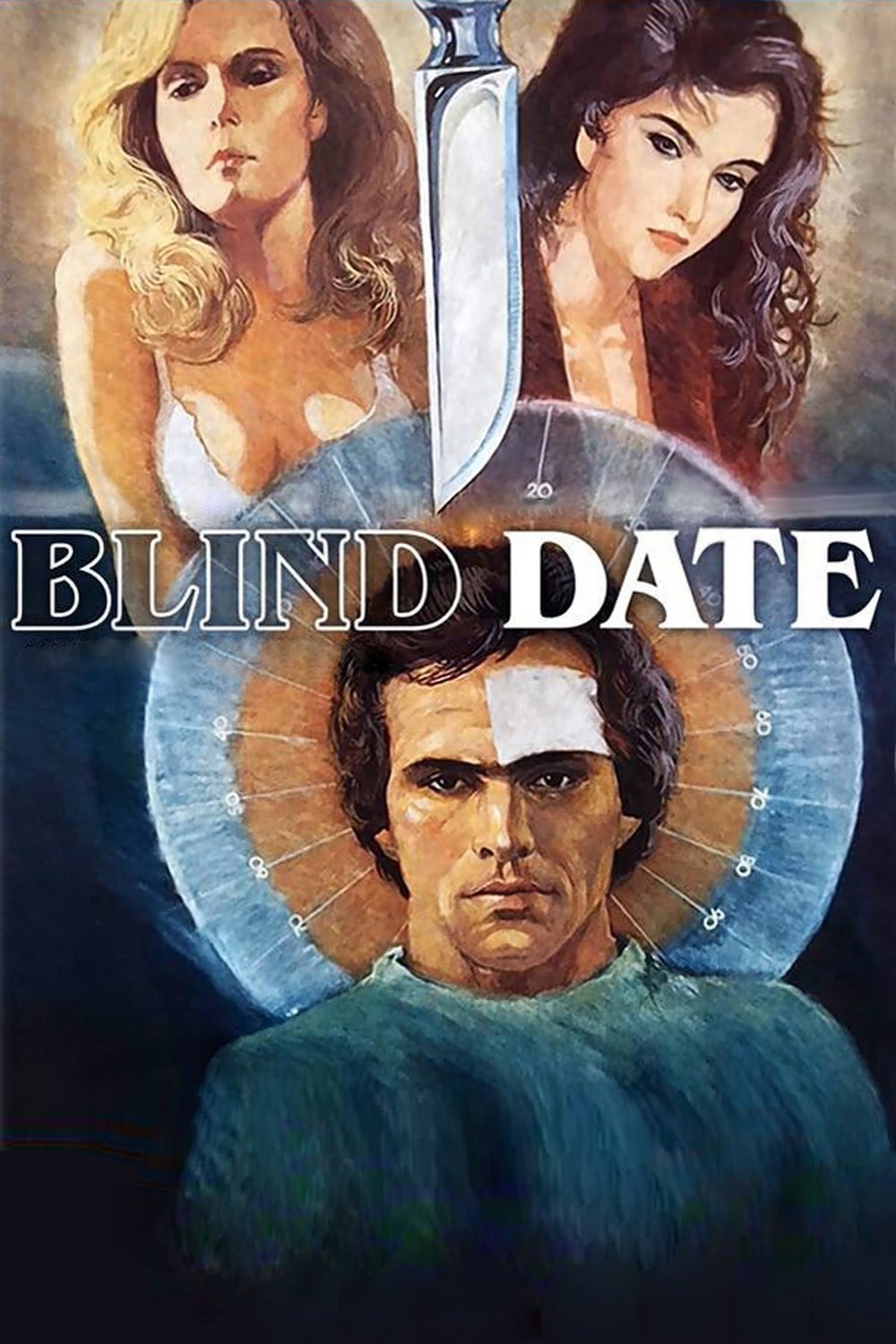
Plot: Blind Date, insofar as it has a plot, is about a thirtysomething American man named Jonathon Ratcliff (Joseph Bottoms) who is working in advertising in Athens, Greece and sleeping with his coworker Claire (Kirstie Alley). He kinda wanders around stalking random pretty women, watching them through a telescope. One time he's caught and chased through the woods and hits his face on a tree branch, which renders him blind, though the condition may be psychosomatic, brought on by seeing a woman he believes to be his former girlfriend at a modeling shoot. Anyway, with the help of Dr. Steiger (Keir Dullea of Black Christmas and 2001: A Space Odyssey), he regains a version of his sight with an experimental procedure that transmits a computer input directly to his optic nerve via a device that is housed inside a Sony Walkman, allowing him to see the world around him in a black-and-white outline. Meanwhile, someone with his own Walkman (just because he likes music, not because he needs it to see) has been murdering women with a scalpel. Eventually, about 25 minutes before the film is over, Ratcliff discovers that this is happening and vows to figure out who it is. Any questions?

Analysis: Now, people love to throw out the phrase "(insert country here) giallo" for any non-Italian slasher that has a modicum of style. But Blind Date truly is a Greek giallo. It is entirely a throwback to that '70s format, far more than what actual Italian filmmakers like Lucio Fulci, Michele Soavi, or Lamberto Bava were pumping out at the time. Down to the fact that it centers an American in a foreign land who becomes embroiled in a murder mystery, the way that the key to the solution is hidden in his own memory, the style-over-substance panache, and the fact that it makes not one single fucking lick of sense. 

It literally doesn't even make sense as a slasher, or at least a functional one. For most of the movie the killings aren't even commented upon. We're meant to assume that Ratcliff is the killer I think, but only because we've certainly seen him being an absolute creep, but nobody else ever really mentions the murders and the town is considerably less than rocked by the presence of a serial killer. Eventually the killer is revealed to be someone who we've seen in wide shots a couple times, in a reveal that is probably supposed to be shocking, but by that point anyone with a rudimentary sense of how to watch gialli has already given up trying to piece together anything that's going on.

Unfortunately, the kills are where the film diverges the most from the giallo format. Not in the misogyny though! The women who are murdered almost never get named or speak a line of dialogue (in fact, one of them is speaking but her lines are muted in favor of creepy music), this movie doing nothing to hide the fact that they are literally just bodies to be cut open rather than characters. Because of this gross undercurrent, I am grateful that the film doesn't revel in gory, over the top kills. However, the fact that pretty much every kill has the same M.O. and then cuts away before anything interesting happens makes those sequences deadly dull to watch.

Really, the entire film is far more dull than something this incoherent and strange has any right to be. This is a film where the lead character is introduced wearing a tan blazer over a T-shirt that reads "I <3 My Dentist." Where the eye doctor only tells him that he can use the computer device for a limit of two hours a day after he's already done the procedure and eliminated any chance of him getting his sight back the proper way. Where the killer stalks the final reel in a Speedo (I for one, am very grateful for this decision)

One misstep is pouring the bulk of Mastorakis' weirdo energy into the truly heinous '80s graphics that render Ratcliff's computerized POV. They may have been high tech at one point, but now the seizure-inducing polygons that fly around this film are truly insufferable. Fortunately, the non-computerized elements, which comprise about 94% of the film, are rather stylish. I would hesitate to call the film "gorgeous," but it certainly is always making aesthetic choices that are pleasurable in the traditionally shot sequences, even for mundane moments that don't scream out for an extra dash of style. It's a film that has atmosphere, and while that may be the only thing it has to offer, it at least prevents it from being the miserable slog it very easily could have been.


Killer: David (James Daughton)
Final Girl: Jonathon Ratcliff (Joseph Bottoms)
Best Kill: David is brandishing his scalpel and his hand is hit with a door, which sends the blade slamming into his neck.
Sign of the Times: I mean, you name another year where the plot hinges entirely on a Sony Walkman and the Atari Game Super Breakout.
Scariest Moment: The first time David begins to slash up a woman with a scalpel and you're like "How far is this scene about to go?"
Weirdest Moment: A bunch of friends rush into the bedroom on Jonathon's birthday to shout "surprise!" while he's in the middle of having sex with Claire.
Champion Dialogue: "Look ma, no eyes!"
Body Count: 6
  1. Woman #1 is scalpeled.
  2. Woman #2 is scalpeled.
  3. Blond Guy has his throat slit with a scalpel.
  4. Woman #3 is scalpeled.
  5. Woman #4 is scalpeled.
  6. David gets his scalpel jammed in his throat.
TL;DR: Blind Date is intriguing and stylish and weird, but ultimately too slow-paced and misogynistic to cross the finish line properly.
Rating: 5/10
Word Count: 985

Tuesday, May 9, 2017

Census Bloodbath: Brae Yourself

For the Scream 101 episode about this film, click here.

Year: 1982
Director: Dario Argento
Cast: Anthony Franciosa, Giuliano Gemma, John Saxon
Run Time: 1 hour 41 minutes
MPAA Rating: R

Although the Italian giallo genre had started to peter out by the time the American slasher boom began in earnest, you can’t keep a good killer down. This deep into the 1980’s, the genre still had a thing or two to say, and the man to say it was Dario Argento, Italy’s premiere purveyor of beautiful murder and inscrutable nonsense. His 1982 offering was Tenebrae (also known as Tenebre for no discernible reason other than the fact that it’s required by law for Italian movies to have a half dozen alternate titles), which more or less automatically became the most interesting movie of the year by virtue of his stylish, idiosyncratic nature.

And his eagerness to expose breasts in ways no human has ever done before.

In Tenebrae, American author Peter Neal (Anthony Franciosa) arrives in Rome with his agent Bullmer (John Saxon of A Nightmare on Elm Street) and his personal assistant Anne (Daria Nicolodi, frequent Argento collaborator and his wife at the time; she also co-wrote Suspiria), to promote his new murder mystery novel, also titled Tenebrae. More or less immediately he is swept up in a real-life murder mystery as various vixens around town begin to be murdered with a straight razor, just like the victims in his book. Can the author solve his own mystery before the killer turns their sights on him?

And how young counts as TOO young for a sexy victim?

Tenebrae is the most typical giallo I’ve seen from Argento. Although he brings his usual flair to the murder setpieces, he indulges in altogether too many tropes of the dormant genre, including the black-gloved killer and a literal giallo novel actually incorporated into the plot. That’s not necessarily a problem. I dig the giallo clichés, but it just feels like his personal style is a little bit muffled here, at least in the way the plot and the basic imagery play out.

However, the same can’t be said for many other aspects of Tenebrae, especially the score, which is an electrical cacophony of beautifully catchy synthwork provided by the reliably frenetic band Goblin. It rivals the Suspiria score for pure operatic lunacy, though at least it’s performed in what are recognizable as “keys and “octaves.”


Argento also lets himself loose in the murder sequences, which find the director settled comfortable into his manic, off-kilter editing patterns. There’s a jagged beauty to his kills, which are executed with clockwork precision and a calculated flair. What is perhaps the most memorable kill scene (a double bill with a lesbian couple being murdered) is prefaced by a gorgeous tracking shot from outside a window, traveling over the roof of the apartment and down the other side. It’s a gloriously pointless shot, but it’s such a triumph of technical execution and sublime stylization that it almost doesn’t matter.

Except it does matter, at least a little bit. Argento’s nasty habit of halting a film dead in its tracks for an unrelated, dishwater dull sequence right when the tension is due to ramp up hits an all-time high here, clogging up multiple key moments with useless interludes.

The man does like to keep us on our toes.

Unfortunately, outside of the gonzo death scenes, the murder mystery plot is pretty rote. Argento falls back on his usual theme of exploring the fluidity of memory by having a character struggle to recall a vital detail of a scene he witnessed. Although this is cinematically interesting, it prevents us from getting a key clue toward the identity of the killer, and a murder mystery you can’t solve yourself isn’t worth the celluloid it’s printed on.

There are only two non-murder sequences that are remotely thrilling, and they both immediately precede a killing. The first is a slick reversal, where a dangerous hobo who is menacing a girl accidentally becomes a witness to her murder at the hands of someone else. The second depicts John Saxon waiting for a friend in a busy plaza. It’s a quiet moment, lazily watching the goings-on about town until increasingly bizarre shots of incredibly mundane tasks ratchet up the tension. These scenes are great, but Tenebrae is hardly scarier than your average stilted giallo.

Probably the most exciting aspect to Tenebrae is how chillingly self-aware it is. Peter Neal is so clearly a stand-in for Argento that he might as well have been played by a mirror. An author skilled a writing murder, Neal faces criticism of misogyny in his work. [SPOILERS The fact that he himself is driven to murder is both a thrilling twist and a bizarre case of cognitive dissonance on the part of Argento, whose life and work is full of these odd little conundrums.]

Overall, I’m glad I sat down with Tenebrae. It is a work of horror art. It just doesn’t show Argento challenging himself, and he’s at his best when he’s his weirdest.

Killer: [Christiano Berti (John Steiner) and Peter Neal (Anthony Franciosa)]
Final Girl: This isn’t really applicable, but Detective Altieri (Carola Stagnero)
Best Kill: It can’t possibly be described. You just have to watch.


Sign of the Times: A woman shoplifts a book, because people actually read in 1982.
Scariest Moment: That hobo thing. We’ve already discussed it.
Weirdest Moment: In a flashback, a beautiful woman presses the back of her head against three guys’ crotches on a beach. A fourth guy slaps her and the others pin him down so she can stick her red heel in his mouth.
Champion Dialogue: “So passes the glory of lesbos.”
Body Count: 12
  1. Shoplifter is choked with paper and has her throat slit.
  2. Lesbian #1 is stabbed with a razor.
  3. Lesbian #2 has her throat slit.
  4. Maria is axed in the stomach.
  5. Christiano is axed in the head.
  6. Heels Lady is stabbed to death in flashback.
  7. Bullmer is stabbed in the gut.
  8. Gianni is garroted.
  9. Jane has her arm chopped off and is axed to death.
  10. Anne is axed in the back of the head.
  11. Detective Germani is axed in the back.
  12. Peter Neal is impaled on a statue.
TL;DR: Tenebrae is a typically stunning giallo from Argento, even if it's a little too generic in its plotting.
Rating: 6/10
Word Count: 1064

Thursday, August 1, 2013

CinemaBeach: Crimson Tide

Twitch of the Death Nerve


Year: 1971
Director: Mario Bava
Cast: Claudine Auger, Luigi Pistilli, Claudio Camaso
Run Time: 1 hour 24 minutes
MPAA Rating: R

A girl with her dress half off is running through a wooded area, stealing glances behind her as she is relentlessly pursued by a psycho killer brandishing a large and exceedingly sharp knife. Is this some late Friday the 13th sequel? A forgotten slasher from the makers of Don’t Go In the Woods or Cheerleader Camp? Not by a long shot. It’s Mario Bava’s 1971 Italian masterpiece, Twitch of the Death Nerve.
A horror film by any other name would taste just as bitter, and it’s a good thing too – this movie holds the record for most release titles ever. It is also known as Bay of Blood, or in Italian Reazione a catena (Chain Reaction) and Ecologia del delitto (The Ecology of Crime), and at one point was dubiously repackaged as The Last House on the Left – Part 2 despite coming out a full year before Wes Craven’s grindhouse debut. TotDN is a vicious and beautiful giallo film from the genre’s most prominent director, so it’s no wonder it was constantly rebranded to try and reach as many audiences as possible.
The movie opens as many gialli of the time tended to – with a brutal murder perpetrated by a mysterious black-gloved killer. In this case the victim is the wheelchair-bound Countess Federica (Isa Miranda) who is hung from a noose holding her at a 45 degree angle above the floor, her wheels spinning frantically then slowly clicking to her stop, matching the beat of her heart.
Although it is already a particularly artistically sound and stylish murder sequence, there is nothing to distinguish it from the pack of its cinematic peers. Until. The unsuspecting black-gloved killer is stabbed in the gut by an unseen assailant as the score soars and the movie proper begins. Not since Janet Leigh’s untimely death in the first act of Psycho had the audience’s expectations for a film been so wildly subverted. The black-gloved killer, a staple of the genre, was dead. Everybody (and there are quite a few bodies on hand here) is a suspect.
The countess’ estate is now up for grabs, and soon her beautiful bayside property is swarmed with greedy friends and relatives. This film is credited for many aspects of the 80′s slasher movement, among them the idea of “the higher the body count, the better,” and the sheer mass of characters in this film is a credit to that theory. In the main cast alone we have the countess’ daughter and her husband, a crooked lawyer and his mistress, a bug collector and his wife who live on the property, and a local fisherman (who is unforgettably introduced in medias biting the head off an octopus). Not to mention the four teenagers who break into a house by the bay for some good old-fashioned party time.
The DNA of later films like Friday the 13th (and especially its sequel) is heavily apparent, especially in the teen scenes. A girl goes skinny dipping alone in the bay. The boys are killed immediately while the girls last longer, being stalked and ultimately killed. Two death scenes are directly lifted by the F13 franchise, namely an axe to the face, and a couple who gets shish kebabed mid-coitus. Also one of the suspects, the sadistic bug collector is vehemently anti-sex.
It’s no question that this film is an early ancestor of everything I hold dear, but it is miles above its progeny. Twitch of the Death Nerve is ethereally beautiful, starting with the exquisitely rendered death scenes. It is very clear that Bava wanted his film to be memorable not only for its brutality but for its artistry. Shocking, vicious, vibrantly colorful, and well-composed, the deaths last much longer in the memory than any of the machinations of the plot. This is also a benefit because the film suffers from the characteristically perplexing storylines of Italian cinema at the time, trading narrative coherence for sensory bombardment.However, blood and guts aren’t the only thing Bava does right visually. The film is full of overwhelmingly beautiful nature shots as we explore the entirety of the bayside property, and there were editing cuts so phenomenal that I gasped the first time I saw them.
Twitch of the Death Nerve is a splatter film with unnecessary nudity, paper-thin characters, and an incomprehensible plot. And Twitch of the Death Nerve is art. There is no horror film (and no film in general, even) that I would more readily bestow that title to.

TL;DR: Twitch of the Death Nerve is the grandaddy of all slasher films. It is bloody, brutal, and ethereally beautiful.
Rating: 8/10
Should I Spend Money On This DVD? If you can find it for cheap. Good luck. No joke, I spent $50 on a grade-A copy of this movie.
Word Count: 825