Sunday, May 17, 2015

The Pitch Is Back

Year: 2015
Director: Elizabeth Banks
Cast: Anna Kendrick, Rebel Wilson, Hailee Steinfeld
Run Time: 1 hour 55 minutes
MPAA Rating: PG-13

Pitch Perfect is an important franchise for me. When the original film opened in 2012, I was a dewy-eyed and apple-cheeked freshman out in the world for the first time. The lively and unexpectedly fresh college comedy was the perfect match for my budding lust for life. Now, the years have passed by and as I face graduation and the rest of my life, Pitch Perfect 2 has arrived to once again mirror my situation.

Just like me, it's a little more tired and a little less sure of itself, but equally eager to please.

And in a slightly more precarious position.

Pitch Perfect picks up three years after the original, with the newcomer Beca (Anna Kendrick) having risen to the lucrative position of leader of the Barden Bellas, the Barden Academy's all-female a cappella team. After Fat Amy (Rebel Wilson) suffers an unfortunate wardrobe malfunction at a presidential gala, the Bellas are suspended from competition because screenwriter Kay Cannon would rather stick her hand in a meat grinder than see a fat woman naked.

Anyway, the one shot the Bellas have to regain their official standing is to win the World's A Capella Competition, to which they have a free pass, being the reigning U.S. champions. However, to accomplish this and beat their German Rivals, Das Sound Machine, they must struggle to rediscover their identity and find their sound, a conflict which also defines Beca's increasingly stressful workload at her secret internship at a music studio. As she suffers from the strain of splitting her focus, the newcomer/legacy student/songwriter/character we introduce so we can have another sequel once we lose Anna Kendrick, Emily (Hailee Steinfeld), feels neglected. Boo hoo.

At least she gets lines. That's more than you can say for about half of the filler Bellas this time around.

Pitch Perfect 2 is a very complicated movie to like. While it was never going to be able to capture the lightning in a bottle of the first film, it does have moments that at least touch the glass. But these scenes, no matter how relatively frequent they may be, can't satisfactorily break through the haze of the film's stupefyingly distasteful humor.

The script's disdain for overweight women was admittedly present in the original film, albeit handled with more grace, but several series mainstays are turned into shrieking harpies of bigotry and new character Flo (Chrissie Fit) is seemingly culled from a first draft of a Song of the South-era Disney film about illegal immigrants. It's bad enough that the "Mexican but Actually Guatemalan" character is treated the way she is by others, but when her every line consists of references to third world diseases, wayward kidnappings, and drug barons, perhaps it's time to rethink your "female empowerment and inclusion" credo.

Add in the wildly overused commentator John (John Michael Higgins) whose "cantankerous old man with 50's values" character is a dead horse that is not only beaten but encased in concrete and sunk into the Hudson, as well as Cynthia Rose (Ester Dean), a once proud lesbian character who has been reduced to a predatory womanizer that sexually harasses her friends because she's so butch and can't control her lady bits, and you have a film that's immensely unpleasant to watch.

About as unpleasant as pillow fights. Have you ever actually had one? Overrated.

Pitch Perfect 2 is essentially an advanced exercise in character assassination, but several manage to survive the carnage. Anna Kendrick returns, as strong as ever, brimming with unforced charm, and her chemistry with the equally committed Rebel Wilson is the strongest returning element. Newcomers David Cross (as a deeply weird a cappella superfan) and Keegan-Michael Key (as Beca's unspeakably self-assured boss) also survive the fray with hardly a scratch, breathing life into the waterlogged lungs of whatever scenes they appear in.

And honestly, some moments are just damn funny, no two ways about it. From the revolving door of guest stars you never knew you wanted to the gags that subvert chick flick clichés with unparalleled ease, there's a lot to really enjoy in Pitch Perfect 2

Unfortunately, the music really isn't as strong this time around, though the song choices are intermittently exciting. The Riff-Off 2.0 is exceptionally disorganized, and a mid-film medley is a glaring mistake, though there are a decent amount of well-heeled production numbers, especially from the slickly precise Das Sound Machine. 

Probably the most flawed performances occur during the Bellas' "Find Our Voice" period. They're supposed to be terrible for narrative purposes, but the producers are keenly aware that they still need to sell singles. As a result, many of these tracks occupy a strange middle space between soullessly generic and halfheartedly creative.

Kind of like Ariana Grande.

And the addition of an original song co-penned by Sia and Sam Smith (with all of the droning, syrupy lyricism that that phrase implies) plants the film securely in an insipid post-Glee territory for far longer than it needs to.

But in spite of its impressive slate of flaws, Pitch Perfect 2 is still lovable.

Kind of like Ariana Grande.

It's a mostly endearing comedy with a hard-won moral about finding yourself post-graduation, and it ain't gonna kill ya. 

TL;DR: Pitch Perfect 2 occupies a dangerous zone in terms of offensive humor and leaden song choices, but is genuinely fun a good portion of the time.
Rating: 6/10
Should I Spend Money On This? If you were a fan of the original, absolutely.
Word Count: 940
Reviews In This Series
Pitch Perfect 2 (Banks, 2015)
Pitch Perfect 3 (Sie, 2017)

Friday, May 15, 2015

Road Rage

Year: 2015
Director: George Miller
Cast: Tom Hardy, Charlize Theron, Nicholas Hoult
Run Time: 2 hours
MPAA Rating: R

Action movies aren't really my thing. I can muster up an appreciation for them, as with most films, but when a new action flick comes out in the theater, I usually just leave it to my friend Zach at Better Clear On Out the Back

And I'm no Mad Max fanboy, either. In fact, I haven't seen any of the original three films in the franchise (though that will be swiftly rectified this summer).

I'm telling you these things so you can properly understand the gravity of my statement when I tell you that Mad Max: Fury Road is the best damn movie of 2015 so far. Hell, I'm going to go ahead and call it right now as the best movie of the summer. 

Unless San Andreas pulls the rug out from under us all. 

Mad Max: Fury Road has a plot. In fact, it's quite involved, taking place in a lush world that's teeming with detail. But the tricky part is distilling it into a couple paragraphs, because so much of it takes place at the fringes of the main action, informing and instilling life into it, but not necessarily playing an active role in the goings on.

I want to make it clear that this is not a detraction. In fact, it's quite the opposite. The true narrative of Mad Max: Fury Road is buried within every detail of the production design, every line of dialogue, and every line in the sand. It is a film that not only assumes that you - the audience member - are intelligent and demands that you engage with it as an active viewer on every single level, but richly rewards you for doing so.

Anyway, the bare bones of the thing is this: Max (Tom Hardy) is a guilt-ridden wanderer through the post-apocalyptic, irradiated desert of what we can assume through franchise pedigree is Australia. Haunted by the ghosts of the people he couldn't save, his only instinct is to survive the barren terrain. The only ample source of water is the Citadel, which is ruled by the diseased despot Immortan Joe (Hugh Keays-Byrne) and his mutated brood.

So, basically it's California in three years.

When the town champion Imperator Furiosa (Charlize Theron) diverts her war machine on what was supposed to be a routine supply run, Immortan Joe realizes that she has absconded with his wives, the enslaved healthy women which he uses for breeding. Max has been captured and used as a human blood bag for Nux (Nicholas Hoult), a member of the sickened, brainwashed slave race known as the Half-Lives. As the nobles of the Citadel pursue Furiosa along with their Half-Life army, Max escapes and reluctantly joins forces with her. She wants to take the girls to the Green Place, a safe zone across the continent, and he just wants to survive, but for the time being they find it mutually beneficial to work together.

I mean, she needs someone to help make sure her super awesome makeup isn't smudged. The ass-kicking she can handle herself.

The most definitive aspect of Fury Road is its outrageous sense of style. Its dominating aesthetic is downright lunacy, pushing so far over the top that it's visible from space. From the bulbous, fleshy creatures inhabiting the Citadel to the wraithlike Half-Lives who run staccato like they're in a Keystone Cops short, the film constantly prods and challenges the traditions and tenets of film costuming and design.

And they ain't afraid to be disgusting.

These delightfully insane characters populate a world of ramshackle glories: souped-up cars with porcupine spikes, massive green towers with waterfalls that flow over the unwashed masses, men dangling on pikes, and just about everything you can imagine. With a healthy sprinkling of things that you can't, which is what separates the geniuses from you or I. And this world is lit with bold, saturated colors that assault the frame with unnatural beauty.

Da ba dee, da ba die.

It's bloody gorgeous, is what it is, and this ludicrous, beautiful, terrible world is the perfect setting for the most unflagging, high octane action flick I've ever seen. Fury Road hits the ground sprinting and only picks up the pace from there, hardly even stopping to introduce its narrative universe, asking you to pick it up from the flecks of shrapnel that fly through the haze of battle.

As Max, Furiosa, and the Breeders storm their way through one massive action setpiece after another, the excitement never dwindles. Some all-action films can get dull and repetitive, but Fury Road knows the game and plays it with admirable skill. Packing handfuls of story, emotion, sacrifice, and distorted dystopian imagery in between every frame, there is more than enough to chew on aside from the truly astounding, ever-escalating practical effects work that dominates the landscape.

Honestly I'm surprised that director George Miller (of the three Mad Max films and most recently - and bafflingly - Happy Feet and its sequel) received the budget that he did to put this film together at such an unrelenting, raucus level, but the fact the Mad Max: Fury Road exists means that somebody is doing something right in Hollywood.

Also whoever designed the flamethrower guitar has an automatic pass to marry me.

As if we needed anything more to like about the film, the acting is across the board superb. Charlize Theron shows no cracks as a dauntless warrior, the villains are uniformly and unequivocally menacing, and Nicholas Hoult utterly inhabits a role as screamingly high octane as the film itself, but the unbeatable standout is Tom Hardy. 

With nothing but a few choice words and a series of animalistic grunts, he paints a detailed and nuanced portrait of a man broken beyond his own humanity. His impressively physical accomplishment completely transforms the actor, ripping him out of any sense of reality and throwing himself directly into the heart of the Mad Max universe. If any performance were to permanently break the barrier between summer blockbusters and Oscar nominations, it's Tom Hardy right here, right now.

The cherry on top of the towering ice cream sundae that is Mad Max: Fury Road is that it's a remarkably feminist and progressive action piece. The large amount of women in the film leave a safe, but enslaved life for the dangers of independence and claim their personhood. One of the Breeders says "We are not things,"and she is absolutely right. The women of Fury Road are an unstoppable force of good, fighting against a world that devalues them.

Also, ableism be damned.

It's a fascinating, energetic, wonderfully realized action film that never loses fuel, and it's spectacularly unlike anything you've ever seen before. Fans of more sit-down, low key dramas are best advised to sit this one out, but I think its unrelenting, explosive charm should appeal to just about anyone with a pulse that needs racing. 

TL;DR: Mad Max: Fury Road is outrageous, high octane, nonstop fun.
Rating: 10/10
Should I Spend Money On This? Yes, unless you really hate exciting movies.
Word Count: 1195
Reviews In This Series
Mad Max (Miller, 1979)
Mad Max 2: The Road Warrior (Miller, 1981)
Mad Max Beyond Thunderdome (Miller & Ogilvie, 1985)
Mad Max: Fury Road (Miller, 2015)

Thursday, May 14, 2015

Do You Ever Feel Like A Plastic Bag?

Year: 1999
Director: Sam Mendes
Cast: Kevin Spacey, Thora Birch, Annette Bening
Run Time: 2 hours 2 minutes
MPAA Rating: R

Happy families are all alike. But unhappy family movies are even more alike.

The meltdown of the nuclear family is perhaps the most commonly explored theme in contemporary American filmmaking. To stand out, one's film must have something more to offer than a mere subversion of the American Dream. After all, nothing is worse than being ordinary.

In its way, American Beauty does accomplish this, mainly by being one of the most technically flawless films to come out of the 1990's. As an example of textbook-precise filmmaking, look no further than Sam Mendes' directorial debut, for which he must have carefully studied every popular filmmaking technique in the industry, tossing in a few creative strokes of his own for good measure.

But a perfect machine only runs perfectly on the right fuel, and in filmmaking this means a proper script. American Beauty's screenplay is far from being an Uwe Boll napkin scribble, but at times it indulges itself in layers of pretention that would make even Richard Kelly weep with jealousy.

Although in a Richard Kelly movie, this bath would be a portal to the sub-universe of forgotten names or something.

American Beauty, as if you weren't already aware, is about Lester Burnham (Kevin Spacey), a middle-aged father who works at a thankless job and lives in a quiet suburban neighborhood with his unsuccessful realtor wife Carolyn (Annette Bening) and his surly teen daughter Jane (Thora Birch). His boring, plodding life begins to change when he develops a crush on his daughter's friend Angela (Mena Suvari). His ichor burning bright, he lets loose and begins pursuing his wildest desires like quitting his job, working out, smoking pot, getting a sports car, and mid-life crisising all the way to the bank.

American Beauty (which is named for a beautiful variety of rose that is prone to rot at the roots - ooh, portentous) is a film all about the strict rules we manage ourselves by in order to maintain our own superficial feelings of success, and what happens when those rules are exposed for the intangible artifice that they are. As Lester breaks free from those bonds, his acting out has a ripple effect, distorting the rules for everyone in his vicinity.

It's interesting, to say the least. Exposing the dark underbelly of suburbia is something that many of my favorite horror films do, and it's a treat to see it play out in a more comedic context. Unfortunately, the far more interesting story that revolves around Lester is frequently impeded upon by a dire subplot, in which Jane strikes up a youthful romance with the neighbor's son Ricky (Wes Bentley), whose every line of dialogue is filled to the brim with Important and Meaningful pseudo-philosophy.

In my notes, I took to calling his character Donnie Dorko.

As Ricky tools around with his camcorder, making Intense, Significant Statements about how plastic bags and dead birds are metaphors for life, Lester's plot falters, devolving temporarily into an absurd sitcom plot  that turns him into a sputtering cartoon figure, while Angela herself vanishes completely for over a third of the running time, sucked into a black hole of self-congratulation. Of all of the insight and commentary on the American family that American Beauty attempts to cram into its two hours, only about 60% is presented in a manner that doesn't make me want to eject bile directly onto a teenager's face.

However, despite a grossly inflated sense of its own importance, American Beauty is a rather remarkable film. Nearly every aspect of its production is a finely tuned instrument of emotional evocation, from the production design on up. Now, it's probably obvious that the color red appears in the film in profusion to reflect the passion and vigor of various characters, but every little detail from the placement of a kitchen island to the leaves on the trees lining the street play a small part of making the film's universe a complete, visual whole.

Likewise, the cinematography is mathematically precise, freely giving and taking power, shifting the dynamics between characters with breathless ease, all compounded with the alternately jangling and peanut butter smooth score. Every moment is picturesque and precise, but where American Beauty truly comes alive is in its fantasy sequences, which are shot with reckless abandon with an absurdly generous wealth of vivacious color, providing instantly iconic imagery left and right.

There's a few unfortunate bits of gummy-looking CGI which only a mother could love, and Mena Suvari's performance degrades every time she is called upon to say another line (though, to be fair, Angela is more of a distillation of virtues than an actual character), but technical flaws are few and far between.

Just like Thora Birch's future movie roles. Zing!

Kevin Spacey and his co-stars are terrific, but the real standout of the film is Annette Bening, whose glacier-like features and perpetually frozen smile begin to crack and thaw under the pressure. She lets us snatch glimpses of the true Carolyn through an impeccable physical and vocal performance.

So, all things considered, American Beauty is a terrifically professional example of creative filmmaking. Its lofty artistic goals are only partially met, and it would be much improved if someone took a scalpel to any scenes that attempt to understand high schoolers, but as a cinematic machine it's a damn Rolls Royce.

As if I could dislike any film that name drops Re-Animator.

TL;DR: American Beauty is a tad pretentious, but it's a well-oiled machine of a film.
Rating: 7/10
Word Count: 941

Tuesday, May 12, 2015

Boogie Nights

Year: 2012
Director: Scott Derrickson
Cast: Ethan Hawke, Juliet Rylance, James Ransone
Run Time: 1 hour 50 minutes
MPAA Rating: R

The horror genre is tough. Hollywood has always and will always follow trends to their breaking point, if my constant hackings through the foliage of the slasher genre have taught us anything. But the problem with this is that the market becomes so inundated with identical flicks (*cough cough Marvel*) that genuinely good movies get forgotten in the shuffle or lose their impact due to their similarity to previous releases.

Today's biggest craze in the horror genre is the paranormal/haunting movie, with the biggest examples being the Paranormal Activity franchise, The Conjuring and its bloodsucking hanger-on Annabelle, and Insidious with its bevy of sequels

Over time, sameness sets into any genre like a rot. But when you consider that three of these films are directed by James Wan and star Patrick Wilson, and that over half of them have been contributed by Blumhouse Productions (who have become the It name for trendy horror), it's reasonable that a project like Sinister, also released by Blumhouse two years following the success of Insidious, would get lost in the swells.

They even use the same chiropractor between shots!

For what it's worth, Sinister didn't try very hard to separate itself from the Insidious routine other than shifting the main focus in the besieged nuclear family from the mother to the father. Inspired! 

The plot goes as follows: true crime author Ellison Oswalt (Ethan Hawke) has moved into a new home with his wife (Juliet Rylance), daughter (Clare Foley), and son (Michael Hall D'Addario). What he hasn't told them is that the house is the site of his latest subject, a family who were hung from the tree in the backyard before the youngest daughter went missing. (Side Note: If you can't figure out the mid-film twist before Ellison does, you are either asleep or watching a different movie.)

In the attic he finds a set of tapes with innocuous-sounding names ("Family Barbecue," "Pool Party," etc.) that depict a series of grotesque family murders from across the country, including the crime scene from his very backyard ("Hanging Out"). It doesn't take long for him to discover a demon known as Bughuul (Nick King) - aka Mr. Boogie because every respectable demon needs a ridiculous name that the local children can call him - resides within the images and haunts him and his family as he attempts to discover the secret behind the mysterious tapes and finish his book, upon which his entire faltering career hinges.

Maybe he's just confused that there are films that exist that weren't directed by Richard Linklater.

Certainly Sinister's plot takes the road most traveled, but that is perhaps the least of its sins. Although the bulk of its scare sequences are cribbed from other paranormal flicks, the film is quite creepy very often, especially whenever Ellison watches a new murder tape, which are grainy, grisly, and by far the most genuinely disturbing original element of the entire film. But the problem is that the film amasses flaws like an Alicia Silverstone character at the mall with her dad's credit card.

As I implied earlier, the central mystery is far too easy to figure out (making it all the more frustrating when Ellison fails to grasp it), and the wife character is inconsistently written, unbelievably gullible, and far too pliable when it comes to letting her children sleep in the bedrooms of murdered children. Not to mention that the nightly scare scenes become repetitive and downright exhausting. 

Seriously, Bughuul's nightly schedule (turn on a film in some unsuspecting part of the house, wait for Ellison to hear the flapping of film that his family is mysteriously numb to, appear in the shadows, repeat) is more rigorous and reliable than the Long Beach bus timetable.

The ending is flabby and runs out of gas long before the supposedly climactic reveal, and a series of useless characters shuffle briefly into the second act, only to provide explanatory but patently useless information far too late for the film to do anything interesting with it. 

In short, Sinister is a film in desperate need of tightening up. At nearly two hours, the film is far too sprawling for its relatively lean story. I suppose it's kind of ironic, considering that the main character spends the bulk of his time editing film footage together. But that irony is easily lost on the viewer as they snooze through the final third of the film.

It's a real shame, because aside from its extensive collection of film-maiming deficiencies, Sinister is really a quite good chiller. Alongside a series of authentic frights and a wonderfully effective comic relief in the form of Ellison's helper, Deputy So & So (James Ransone), it builds an enthralling mythology for its demon that separates it from the pack with thematic and engaging material. But it squanders these ideas by shuttling Bughuul off on other business while we are forced to watch Hawke try his darndest to keep his constant flailings at a film projector entertaining.

All in all, Sinister is decent, but utterly unmemorable, just like director Scott Derrickson's intensely muddled follow-up Deliver Us From Evil. There are enough good elements to prevent it from being a total flop (and I'm genuinely excited for Sinister 2, which seems like it cut the fat considerably), but it's not worth checking out amid the noise and clamor of the thousands of other lookalikes populating the genre at the moment.

TL;DR: Sinister is decently scary, but too generic and sprawling to overcome its flaws.
Rating: 6/10
Word Count: 943
Reviews In This Series
Sinister (Derrickson, 2012)
Sinister 2 (Foy, 2015)

Monday, May 11, 2015

Class Struggles: Bonus Round

Surprise! It turns out that I had other classes along with Russian Cinema! Here's my thoughts on two screenings culled from additional schoolwork.

Gentlemen Prefer Blondes

Year: 1953
Director: Howard Hawks
Cast: Marilyn Monroe, Jane Russell, Charles Coburn
Run Time: 1 hour 31 minutes

Two showgirls, one a romantic and the other a gold digger, take a trip across the ocean.

It was a great treat to be required to watch Gentlemen Prefer Blondes, because I've seen barely enough Marilyn Monroe movies to qualify as a legitimate film blogger or gay man. I loved Some Like It Hot and tolerated The Seven Year Itch, but Gentlemen Prefer Blondes displays the star in full, unadulterated Marilyn mode alongside a less iconic but perhaps even more talented co-lead.

Director Howard Hawks is well-known for his predilection for strong female characters, and in this regard Gentlemen Prefer Blondes is his zenith. Depicting two independent women who value their friendship above their relationships with men wasn't exactly a common theme in 1950's cinema. And despite Monroe's character mostly playing into the expected tropes of a shallow, bubbly gold digger, it is soon revealed that there's more to her than meets the eye.

In addition to treating a stock character as an actual human being, co-star Jane Russell's character is... How can I put this delicately? Unbelievably horny. Her character is a regular Lotharia, making great use of the Olympic team that has joined the duo for the journey across the Atlantic.

As an adaptation of a stage musical, the film's plot and dialogue are fairly set in stone, but the film is so packed with interesting subtext that I'm pretty sure it gave my Film Theory professor an aneurism. It's easily possible to read a dozen different messages about sexuality, gender representation, commodification of women's bodies, and on and on, and that is all thanks to Hawks, who was the master of slipping important themes into otherwise shallow-seeming works, like his sci-fi classic from the same year, The Thing From Another World.

But if I were to go in depth on the cavalcade of theories surrounding Gentlemen Prefer Blondes, this mini-review would be large enough to destroy Tokyo. The bottom line is that, subtext or no, GPB is a slightly daffy but utterly fun 50's musical with a sprightly sense of comedy, inimitable chemistry between its two stars, and two of the best musical numbers committed to celluloid during the decade.


Popular opinion would swerve toward the sumptuous, opulent "Diamonds Are a Girl's Best Friend" number as the film's high-water mark, but Marilyn's sultry crooning meets its match in the razzle dazzle panache of Jane Russell's "Anyone Here For Love?" which melds top notch musical pastiche songwriting with a stunning display of scenery almost entirely created by muscular men's bodies as they work out. Not only is it a treat for the gentlemanly-inclined, it's an inspired and invigorating number that ties in with the film's ruminations on gender and sexuality and propels it out of one of its occasional funks.


For it does have a few. Funks, I mean. As musicals from the time period are wont to do, Gentlemen Prefer Blondes sometimes stops dead in its tracks for some dreadfully dull bit of extended comic business or an archive number that just had to be included. But aside from the occasional dry spot, the film is a gem, worthy of pursuing by any fan of the decade, the bombshell, or musical comedy bonanzas.

Rating: 7/10

The 400 Blows

Year: 1959
Director: François Truffaut
Cast: Jean-Pierre Léaud, Albert Rémy, Claire Maurier
Run Time: 1 hour 39 minutes

Again, I'm going to have to wave my white flag and admit my inferiority as a film major. Out of the supremely influential French New Wave period, I had only seen Jean-Luc Godard's Breathless. I loved Breathless, but up until now I couldn't be sure if I was a fan of French New Wave or if I was just a fan of Breathless. So far the point goes to Godard.

François Truffaut's The 400 Blows is an equally influential New Wave film, but it lacks the kinetic, feverish love for its own creation that I find in Godard's magnum opus. Telling the story of a young boy who turns to petty crime due to a lack of attention from his parents or teachers, it's an interesting treatise on the problems of lower-middle class families, no matter what time period or country you hear from.

But the whole tale is presented in a style a great deal more neorealist than what I would consider New Wave. Despite the artistic merits of the movement's long takes and amateur performances promoting reality and allowing the viewer to actively shift their own focus and analysis, it never really makes for films that are tremendously interesting on a narrative or aesthetic level. The sub-narrative here is pristine, but films of such little incident will be challenging for any but the least casual of audiences.

Lead child actor Jean-Pierre Léaud is a treasure, grounding the film in a delightful earthy performance, but the film's narrative meanderings don't find much to do with him. The 400 Blows is a little too content to merely document reality instead of shaping it, a style which I admit is more suited for a participant other than myself.

I will rightly admit that I hardly have a leg to stand on, considering the fact that I'm listening to John Mayer as I write this, but The 400 Blows is not for me, and if you consider yourself anything but the highest class of viewing audience, it is not for you.

Rating: 6/10

PS: I'm now listening to George Harrison as I post this. Does that change anything? I'm doubtful.
Word Count: 963
Reviews In This Series
Class Struggles: Part One (March 29, 2015)
Class Struggles: Part Two (April 9, 2015)
Class Struggles: Part Three (April 22, 2015)
Class Struggles: Part Four (April 24, 2015)
Class Struggles: Part Five (May 6, 2015)
Class Struggles: Bonus Round (May 11, 2015)

Saturday, May 9, 2015

Beat It, Essay: Few Times I've Been Around That Track

Here's the tricky thing: The essay prompt for my Russian Cinema class was to write a critical paper about a Russian film. Naturally I chose a slasher film. What do I look like, a nerd? 

The subject of my reviewings is 2007's Putevoy obkhodchik aka Trackman. So far so good. The only thing is, this critical piece will be a little more formal and academic than my normal style, so I'm going to attach a truncated review at the end of this essay to cover my normal topics like how cool that gore shot was or how the movie needed more hot dudes.

The Prompt
Write a critique on a Russian film not viewed in class, relating it to Russian films that you've seen as well as your personal film background.

The slasher film is an American tradition, dating all the way back to the 60’s and 70’s with the likes of Alfred Hitchcock’s Psycho and Tobe Hooper’s The Texas Chain Saw Massacre. By the Golden Age of the genre in the 1980’s, audiences couldn’t get enough of the low budget shockers, sending their box office returns through the roof. Naturally, when Russian filmmakers turned from their introspective, usually war-related fare (like Ballad of a Soldier or Prisoner of the Mountains) to attempts at American-style Blockbuster filmmaking (like the superhero action flick Black Lightning), the slasher genre was one of the first to be imitated. Igor Shavlak’s 2007 effort Putevoy Obkhodchik (aka Trackman) is a fairly devoted recreation of the formula, with some distinctly Russian twists.

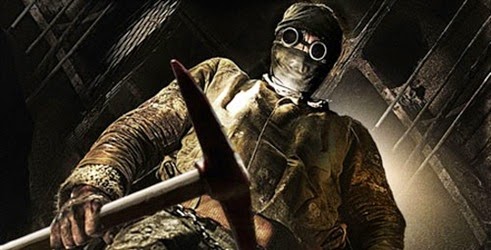
Unfortunately Trackman is not quite as good as other Russian action/thriller efforts or the classic films of the slasher’s heyday, but it is an interesting piece to study in terms of how Russian filmmaking collides with a traditionally American genre format. The basic structure of the plot comes from the 1981 Canadian slasher My Bloody Valentine, which depicts a pickaxe-wielding killer in a miner’s uniform and gas mask stalking his victims through the underground corridors of a mine shaft. This idea is almost exactly recreated for Trackman, with minor changes. 

Instead of a crop of teenagers being stalked, it’s a group of untrustworthy bank robbers and their hostages hiding out in an underground tunnel system and plotting to steal the money from one another, mirroring the social and criminal decadence of 90’s films like Brother and The Thief. Instead of the killer being an enraged miner who narrowly survived a cave-in caused by negligence, he is a presumably mutated product of government cover-ups following the Chernobyl disaster. This character trait not only ties itself in with Russian history, it taps into the folklore surrounding the incident. 


As evidenced by the opening credits, which depict childlike drawings of the Trackman’s violent tendencies, Trackman is an almost mythical figure that taps deep into the subconscious of modern Russian society. In this way, he is implied to be a figure akin to that of Freddy Krueger, the grotesque villain from A Nightmare on Elm Street, whose legend has permeated the mythology of his suburban town to such a degree that the local children have written a jump rope rhyme about him.

This folklore element is crucial to many successful slasher films, including The Burning (in which a horribly burned groundskeeper named Cropsy – based on a New York state legend - stalks a local summer camp), Black Christmas (which utilizes the urban legend about a killer calling from inside the house to chilling effect), and Night of the Demon (which uses the famous North American cryptid Bigfoot as its mythical killer), so by utilizing the trope and reimagining it under a Russian context, Trackman lays a good foundation for itself. By combining the lingering effects of Chernobyl with the typical genre framework, Shavlak managed to create a classic slasher atmosphere with a distinctly Russian flavor. Unfortunately the green director doesn’t find much else to do with his excellent framework, resigning himself to a subpar thriller effort and turning his mythical killer into a hackneyed plot device instead of a being of true, potent evil.


One of the biggest, most egregious flaws of Trackman is its unsteady pacing. Any scene featuring the Trackman himself crackles with tension, but the film mishandles his infrequent scenes, arbitrarily teleporting him around the underground tunnels in an attempt to shock the audience through his sudden disappearances whenever a character whom he is stalking turns to look at him. Unfortunately this has the effect of deflating any tension the film has managed to muster, because any time Trackman threatens to do something interesting, he is whisked away by the unseemly whims of the narrative. 

This style could have been more effective had the killer’s mythical background been explored more thoroughly, but most of the important details regarding his motivations, personality, and even appearance are left to conjecture. The sharp-eyed slasher veteran can piece together the Trackman’s modus operandi (presumably he is so hideously deformed beneath his mask that he kills anybody who looks at him out of shame and fear), but these ideas are never thoroughly explored. 

Most of the film’s other elements of quality suffer from a similar lack of directorial guidance. For example, Trackman has terrific production values (despite not being a co-production like Burnt by the Sun or Mother and Son), but the slick, professional-looking tunnel sets are overlit and beset by a dully limited color palette that leaches out the film’s capacity to scare. Likewise, the budget runs short at the special effects, which look more like stagebound theatrical creations than truly cinematic ones. They don’t completely draw the spectator away from the film’s reality, but it does make some of the more intense scenes difficult to swallow. Together, these lackluster forces combine to create a tensionless horror film, devoid of any real terror.

Similarly, the occasionally great cinematography (which almost always manages to frame the killer in an eerily menacing manner, especially in one sequence where he is glimpsed through the whirling blades of an industrial fan) is marred by an indecent reliance on slow motion. Slow motion sequences are randomly scattered about the film, rarely if ever enhancing a scare. Rather, they pad the run time by forcing the viewer to contemplate one of the hostages walking or smoking a cigarette with almost absurdly lethargic speed. These moments have no motivation within or without the film, and are utterly tiresome. 

In addition, there are an abundance of sequences where the handheld camerawork becomes hyperbolically shaky, almost as if the director of photography intentionally swung the camera back and forth in some sort of apoplectic rage. The film is slightly redeemed by a finale so strange that it slips into the realm of surrealism, but these flaws in the film’s overall production value are difficult to overlook, to say the least.

However, despite its numerous shortcomings, Trackman may just be a growing pain for Russian genre filmmaking, considering that the country’s film industry has never had a booming horror scene. The keener interest in horror films has only developed over the past couple decades, presumably following as a direct result of the fall of the Soviet Union. Not only was the Russian population experiencing a breathtakingly new regime with more lax production codes, it was also beset with the criminal decadence that marked the post-Soviet period of the 90’s. The general populace was terrified of the long-term effects of this social negligence and sought catharsis in the cinema. 


Criminal horror films like 1994’s Mute Witness (which depicts a snuff film crew murdering their victims onscreen and evading the police while pursuing the sole witness), 1990’s City Zero (in which a factory worker discovers a town gone mad following the fall of the Soviet Union – including a secretary who works naked and a series of lunatics who worship the stranger as a rock ‘n roll legend), and 1998’s Of Freaks and Men (which depicts the downfall of Russian society following the rise of capitalism in the form of one pornographer breaking two families apart) used the rampant sex, violence, and rock ‘n roll of the era to shock viewers out of their complacency and provide them with safe, vicarious thrills.

Now that the decadent period has ended, Russian horror filmmakers are Hollywoodizing the horror genre one step at a time with films like the found footage effort Devil’s Pass and the torture film Captivity (both co-productions with the UK and America, respectively), as well as Trackman. Coming as it does at the beginning of the second wave of Russian horror cinema, it is understandable that the film has such a wealth of flaws – nothing like it has ever been attempted on Russian soil before. 

The biggest triumph of Trackman is in laying a foundation for future efforts in Russian horror. If budding filmmakers pick up where Trackman left off (with a folkloric antihero that taps deep into the Russian subconscious) but polish the edges and deepen the character’s mythology, the slasher genre could one day see something truly great come out of the untapped film terrain of Russia.

Trackman (Путевой обходчик / Putevoy obkhodchik)

Year: 2007
Director: Igor Shavlak
Cast: Svetlana Metkina, Dmitriy Orlov, Aleksandr Vysokovskiy
Run Time: 1 hour 20 minutes

OK, I'm gonna give it to you straight because you veteran Popcorn Culture readers are made of sterner stuff than my film professors: Trackman kinda sucks. It's real bad, you guys. The worst part about it though is that it squanders some great potential. Along with the intellectual claptrap you may or may not have read above, the killer has the audacity to use a gun.

The ground rule of slasher filmmaking is to never give your killer a gun. Sure, they're allowed in the grand finale of a slasher film so we can see some cool exploding heads, but the audience showed up for some baroque gore effects, not a goddamn Martin Scorsese movie. Anyway... 

The killer does have an interesting backstory, but literally all of it is conjecture. The only thing Trackman deigns to do with its title character is have him rip out people's eyes, sneak up behind people with a pickaxe, disappear when they turn around, and skulk around random tunnels until he's needed again for a cheap scare. There are Teleporting Killer moments so egregious that I genuinely thought he had mutant powers due to the Chernobyl radiation. He spends the bulk of his time trudging back and forth in empty tunnels, trying to maintain his balance despite the camera's hyperbolically canted angles.

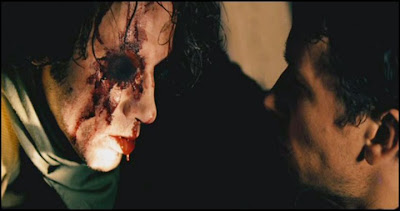
There's one genuinely great scare/gore moment (a POV of the Trackman using a device to steal the ringleader Kostya's eyes - incidentally, Kostya looks a little like Fred Armisen's evil twin so that's fun) and a couple creepy sequences of the Trackman standing in the dark tunnels in front of a flickering light, but the bulk of the film is anemic to the core. The "gouged-out eye" makeup that you can see in the essay above looks less like an eye socket than a chalk eyepatch, and there's not much else of note in the special effects department. That is the showstopper. It's hardly worthy of a suburban haunted house, let alone a feature film.

The finale is pure action nonsense that involves exploding gas canisters and hot-wiring a motorcycle, but at least it's semi-intersting. The rest of the film is content to slap some slow motion on its characters every 12 seconds or so as if the true villain were a student arthouse film that gained sentience and stalked the filmmakers in the editing room.

It's clumsy and it's dull, and it was sheer torture to pull four and a half pages on the topic out of my brain. But I did it and here it is. Marvel at the glory.

Body Count: 5
  1. Splint has his eyes gouged out.
  2. Kostya is pickaxed to death.
  3. Olga is shot to death.
  4. Sergeant Irkut is run over by a slow-moving trolley.
  5. Kirk is shot to death. 
TL;DR: Trackman is a dull, amateur slasher that squanders its generic potential.
Rating: 3/10
Word Count: 2008

Thursday, May 7, 2015

Fleisch Ist Fleisch

Year: 2000
Director: Stefan Ruzowitzky
Cast: Franka Potente, Benno Fürmann, Anna Loos
Run Time: 1 hour 43 minutes
MPAA Rating: R

Once the slasher film left the 80's, it went to a very strange place. It died twice during the decade itself (once in 1983 and once in 1989) then lay dormant, rattling around in Direct to Video Hell until Scream dragged it kicking and screaming from its shallow grave in 1996. Thus was the beginning of the age of postmodern meta humor, take it or leave it. By the turn of the century, it was pretty uncool to be a straightforward slasher film.

In America, that is.

While I would hesitate to call the 2000 German flick Anatomy (aka Anatomie) a pure slasher film, it certainly approaches its material (a hybrid that bridges the gap between slasher and torture porn with a little bit of cult thriller thrown in for taste) with a sense of gravity that the Hollywood slashers had lost in the tide. 

Not that "gravity" means "no exploitation." This is the slasher genre we're talking about.

Pretty understandably, Anatomy is all about the human body: Young college student Paula Henning (Franka Potente of the terrific Run Lola Run) is the top med student in her class. When she is sent to a  special summer program at a prestigious Heidelberg university, she is ready to buckle down and study harder than she ever has. The only problem is, her classmates are less concerned with the bodies on the slabs than they are with each other's.

Her roommate Gretchen (Anna Loos) is a bit of a woman about town, juggling hunky but sensitive RA Hein (Benno Fürmann) and the surprisingly buff nerd Phil (Holger Speckhahn), and her classmate Caspar (Sebastian Blomberg) won't rest until he can rub his weird soul patch all over her. To make her distraction even worse, she discovers that the university may be run by an ancient secret society known as the anti-Hippocrates: a sect which illegally experiments on still-living humans and turns them into plasticine exhibits with a fast-acting preserving agent called Promidal.

You'll never look at the Bodies exhibit the same way again.

Anatomy is, on the surface, one of the most average horror flicks ever conceived. Its pretty, twenty-something cast is dispatched in gruesome ways but the gore is kept offscreen as much as possible, there's a sumptuous smorgasbord of fake scares, and a series of third act reversals spin the film 180 degrees so many times that it gets dizzy and collapses, the killer is still alive, quip, quip, and roll credits. But if you grab your scalpel and forceps and peel back the surface layer, there's some really interesting structures hiding underneath. Let's get to dissecting!

Adrenal System: The film is full of shallow, airbrushed scare sequences, but plenty of the rest is mighty chilling. The film's use of the fictional drug Promidal is perhaps its most effective invention, because it allows for a series of scenes where people fight their own stiffening bodies to try and find a way to survive. Also, the props in the body exhibit are exquisitely manufactured pieces of gorgeous grue, and a library scene in the third act uses the claustrophobic shelves to nail the audience to their seats, redeeming itself for its somewhat anticlimactic act 2 break, which mightily deflates the tension in order to allow Paula to take a train ride and find out a secret about her grandfather, who used to work at the university. Needless to say, it's no big surprise and we could have found that out in a 30 second montage instead of a five minute sequence.

But I digress. There is certainly enough material in Anatomy that works at a gut level to keep it lively and entertaining throughout.

Skeleton: The unequivocal best (and most consistent) elements of the entire film are the production design and the cinematography. The anatomy hall is given an imposing grandeur with slick, faceless metal walls that threaten to engulf everything within them, working with the camera to create immensely clean, precise, flowing images that are almost scientifically perfect.

Just like Hein's bone structure.

Heart: The Germans aren't exactly known for their humorous stylings, but the comic heart of Anatomy is top notch. The interactions between the students provide a warmhearted comic relief, with several preternaturally well balanced one-liners, my favorite of which is, "Do me a favor and let me know the next time you take your clothes off." That one is going straight into my repertoire.

Sex Organs: What the Germans are known for, however, is their unconventional sexuality, which Anatomy delivers in spades. I'll have to check with the film historians on this one, but I'm pretty sure this is the first time any two characters have hooked up on an autopsy table that was just used to dissect a ruptured spleen. I swear, nothing turns on Gretchen and her cronies more than the prospect of some illicit bangers and mash next to a couple dozen goggle-eyed corpses.

On top of its unerringly interesting approach to sex, Anatomy is also remarkably feminist. The Slut character turns out to be the top in her class, the women are fully in control of their sex lives (although the sniveling, hypersensitive men can't exactly handle it), and the film shows nary a single wanton breast, instead focusing on getting its male characters in and out of their shirts as often as possible. In this way it reminded me quite positively of Girls Nite Out, the single best purveyor of man meat in all of slasherdom.

My absolute favorite scene in the film is when a girl finally sleeps with her long-awaited suitor... to pass the time before a meeting.

Go women!

This is the part where I thank Sergio for buying me Anatomy and its sequel to fill out his Amazon cart. (And get him off my back for not mentioning him a lot recently. I guess anonymity isn't as important as I thought. Hi Sergio!)

Brain: Although the third act reveals never entirely makes sense, Anatomy does have a keen brain hiding in its skull cavity. The throbbing undercurrent of the film is of generational discord. Paula wants to be a doctor to prove herself to her famous physician grandfather, ignoring her father's warnings about becoming too concerned with professional success. As she discovers the dark secrets behind the university and the city of Heidelberg, she realizes that the ancient atrocities committed in the town have never truly died away.

As Paula attempts to uncover the past and save lives in the present, she learns that there's no escaping history. The entire film is plagued by the sins of a past generation, mirroring the country itself, which will never be able to shake off the ghost of the Third Reich. It's really rather poetic and it adds a thoughtful, deeper meaning to what otherwise could have been an entirely boilerplate affair.

Grey's Anatomy with more stabbing, if you will.

At the end of the day, nobody is going to be busting out their Anatomy disc at parties or anything, but the film is a decent millennium slasher thrill, and worth checking out for medium-strength fans of the genre.

Champion Dialogue: "Don't worry, those red spots are only pubic lice. You'll be fine!"
Body Count: 7
  1. Patient #1 has his flesh flayed.
  2. David is stabbed with a scalpel.
  3. Phil is stabbed to death.
  4. Gretchen is injected with Promidal and flayed.
  5. Grombek's throat is slit. 
  6. Caspar's Roommate is injected with Promidal.
  7. Hein is electrocuted and stabbed in the heart.
TL:DR: Anatomy is a generic modern slasher thriller, but it has enough heart and soul to make it a thoroughly interesting watch.
Rating: 6/10
Word Count: 1293