Showing posts with label Leslie Mann. Show all posts

Thursday, April 19, 2018

Popcorn Kernels: Q1 Review Purge

On account of the fact that my computer was out of commission all weekend, and I'm not feeling particularly inspired by any of the films I watched therein, let's break tradition and knock out some mini-reviews of three recent 2018 efforts.

Isle of Dogs

Year: 2018
Director: Wes Anderson
Cast: Bryan Cranston, Koyu Rankin, Edward Norton
Run Time: 1 hour 41 minutes
MPAA Rating: PG-13

In the not-too-distant future, all dogs have been exiled to an island off the coast of Japan due to a suspicious outbreak of disease, and one young man takes a fateful flight over the water to rescue his dog with the help of a group of mangy strays.

I was honestly very surprised with how much I enjoyed Wes Anderson's previous animated feature Fantastic Mr. Fox. His fussy, twee aesthetic worked very well with the arch, British storytelling style of Roald Dahl's children's books. Unfortunately, it does not work quite so well with whatever Isle of Dogs is: an uncategorizable, scatterbrained mélange of post-apocalyptic gross-out humor, stunted emotional baggage, and wild misuse of Japanese-influenced design.

I will let other, more qualified, mouths speak on the specific impact of Wes Anderson's choice to set this story in Japan, but I will say one thing. The main character, whose name is Atari (strike one, dude), has a skin tone so yellow that it would a bowl of banana pudding jealous. Not only is it a bizarre, off-putting visual choice, it seems incredibly racially insensitive to boot, which is just... well, not great. This character is the entire lynchpin of the story, forcing you to contend with his questionable stereotyping for the entire run time. It's like if Mickey Rooney was the starring role in Breakfast at Tiffany's.

And whether or not this was Anderson's intention, because it probably was, the human characters on the mainland are underdeveloped in the extreme. I get that the dogs are the whole point of this story and it should focus on them as characters, but the amount of time we're forced to hop back and forth between the drama on the Isle with the cavalcade of stunted personalities who only get two or three minutes of screen time is intensely distracting.

The cast is reminiscent of a Valentine's Day movie, with way too many stars crammed in to give some characters enough time to actually make an impression, especially Scarlett Johansson's show dog Nutmeg and Greta Gerwig's American exchange student Tracy Walker. But these are female characters who are awarded to our male heroes for doing important things, so that's a very important role, y'know? Ugh.

It's hard not to get bogged down in politics, because Isle of Dogs kind of beckons in criticism. But look. It's fine. The dogs are amusing, the fussy sets are engagingly weird and gross, and it's a decent way to occupy 100 minutes. Is it worth sifting through all the morally and socially dubious messaging? Probably not. Just watch Fantastic Mr. Fox again. But I had a decent theater experience with this one, at the end of the day.

Rating: 6/10

Blockers

Year: 2018
Director: Kay Cannon
Cast: Leslie Mann, Ike Barinholtz, John Cena
Run Time: 1 hour 42 minutes
MPAA Rating: R

When three teenage girls make a pact to lose their virginity on prom night, their parents set out to make sure this doesn't happen.

As an ardent fan of the American Pie franchise, I must say that I'm glad the raunchy high school comedy hasn't given up the ghost quite yet. And while Blockers could never be the proper spiritual successor to that franchise due to the fact that the parents squirrel away as much screen time as the kids, it's as close as we're getting in 2018 and I'll take it.

Honestly, I don't mean to complain. I do like the parents. Presumably thanks to a Kay Cannon touch-up, the script isn't as reductive and sex-phobic as the trailer and synopsis made it seem. The parents all have their own warring motivations for preventing their children from having sex, and it stems from character flaws rather than a prudish morality play. Plus, I've long admired John Cena's comic acting (the fact that 2018 allows for a sentence like this to be written, says a great deal about the state of the world that I'm not ready to reflect on) and Ike Barinholtz always deserves a bigger platform. 

Then there's Leslie Mann, who is indispensible here. Her clingy mother routine isn't anything new (we've seen it as recently as Cheryl Hines in the also surprisingly terrific A Bad Moms Christmas), but she gives us some of the films most sterling perfect comic moments, especially a tearful goodbye scene that is a spine-tingling triumph of physical acting.

But still, you can't help but feel robbed of time with the film's three young stars, who shine bright enough to have led this movie all on their lonesome. Kathryn Newton is saddled with the most boring of the characters, but she maintains an easy chemistry with the other two: Gideon Adlon, who leads a sweet, surprisingly-transgressive-for-its-normalcy queer storyline and Geraldine Viswanathan, who is a pure magnetic presence the likes of which I haven't seen in a good long time.

Oh yeah, and the movie is funny too. I almost forgot. It's raunchy without being exploitative, that manages a terrific balancing act of six character arcs that all get their moments to shine. Just like Game Night, it's proof that scripts are actually pretty f**king valuable to comedy movies, Judd Apatow be damned. However, unlike Game Night, it doesn't offer a particularly unique aesthetic. Like most modern comedies, it's lit, shot, and cut well enough that it doesn't get in the way of the timing of the humor, but the energy of Blockers isn't coming from the filmmaking itself. Nevertheless, it's a movie I'd highly recommend, and certainly in the top 5 movies of the year so far, which is not something I thought I'd be saying at all.

Rating: 7/10

Truth or Dare?

Year: 2018
Director: Jeff Wadlow
Cast: Lucy Hale, Tyler Posey, Violett Beane
Run Time: 1 hour 40 minutes
MPAA Rating: PG-13

A group of teens on a Mexican spring break vacation stumble into a possessed game of truth or dare, where if they don't play they die in horrifying ways.

Truth or Dare isn't a film for me, at least demographically. I am a person who ditched class to go see Ouija in theaters, but let's not focus on that right now. And as much as I am a staunch defender of PG-13 horror and the potential that it has, the fact is, it still isn't for me. Would I have loved it if it was R-rated? No, probably not, but it just feels like it's operating at a level that I can't really reach anymore, even though the teens in the audience will probably love it.

There really is a lot to like about Truth or Dare. The characters and their conflicts are simply etched out, but interconnect in meaningful, narratively satisfying ways. The Final Destination-esque machinations of the game itself are delightful to watch unspool, and never ever boring. And Lucy Hale is a smart, capable performer who knows what she's doing with a script.

But the fact remains that, in my eyes, Truth or Dare pulled a lot of its punches. You'll never get on my good side by being progressive enough to include a gay character, but too gunshy to show more than half a second of him kissing a dude before demurely cutting away to something else and never mentioning it again. And then using his closeted sexuality to drum up drama for a dare, but completely excising the scene where's he's forced to come out to his father or die - which would have been the most flat-out horrifying scene in the movie, which is a little starved for genuine terror. At every turn this movie renders the character shallow, making him basically just a piece of set dressing.

While I do like the way the others characters are constructed, a lot of the movie is treated like that kid (who is played by a 32-year-old actor, naturally). The kills are noncommittal, the stakes of the game seem to ebb and flow as the narrative needs them to, and they don't even seem aware of the implications of their white characters stomping around Mexico destroying property and - in an early scene - physically assaulting a local with impunity.

This movie could have been much better. What it is is mostly entertaining, but its potential is so present and obvious that the fact that it didn't capitalize on it is even more frustrating than if it had never been there in the first place.

Rating: 4/10
Word Count: 1470

Thursday, February 18, 2016

How To Succeed In Valentine's Day Box Office (Without Really Trying)

Year: 2016
Director: Christian Ditter
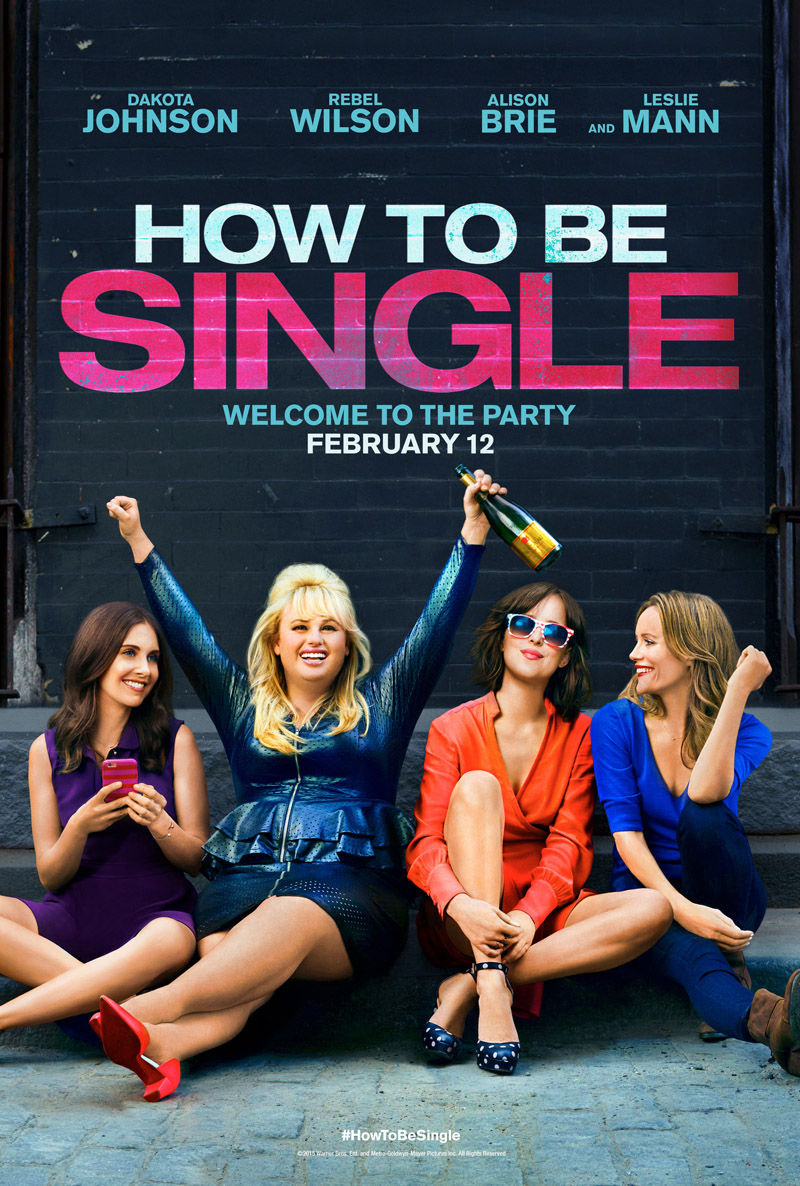
Cast: Dakota Johnson, Rebel Wilson, Leslie Mann
Run Time: 1 hour 50 minutes
MPAA Rating: R

The odds are looking increasingly likely that I’m an idiot. Exhibit A: I watched How to be Single on purpose. To be fair, I had my doubts about its overlong mishmash of a trailer, but one joke in particular really sold me (Of course it’s not in the final cut. Of course.) Plus, in last year’s Valentine smash Fifty Shades of Grey, lead actress Dakota Johnson proved surprisingly adept at wringing intentional laughs from her performance. I was more than pleased that she was given a shot at an actual comedy film and wanted to see how it panned out.

All I can say is that it’s definitely not her fault the movie sucks.

In the grand tradition of classic ensemble comedies like Valentine’s Day and New Year’s Eve, How to be Single follows the stories of four single women in New York City. Only three of them actually seem to be connected in any meaningful way and only three of them (a different set, naturally) actually get solo scenes, but at least Ashton Kutcher isn’t hanging around. Our de facto lead is Alice (Dakota Johnson), who is taking a break from her college sweetheart Josh (Nicholas Braun) to discover who she really is on her own. At her Big City paralegal job that she never really goes to, she meets Robin (Rebel Wilson), a firecracker-about-town who urges her to embrace singlehood and collect dicks like they’re Pokémon cards.

We also, for some reason, follow Alice’s considerably older/ginger sister Meg (Leslie Mann, and the truly staggering difference between their ages might explain why there is exactly zero parental presence in the film), who is an OB-GYN that (gasp) doesn’t want children! The horror! Of course, after about three minutes of thought, she reverses forty years of steadfast philosophy and decides she actually does want kids. Women, am I right? Can’t live with ‘em, can’t write ‘em as well-rounded, independent characters. She decides to get pregnant with a sperm donor, which gets complicated when she falls for the much-younger Ken (Obvious Child’s Jake Lacy), who has been pursuing her like a hawk on Adderall.

And then there’s Lucy (Alison Brie) who lives above a bar owned by Tom (Anders Holm) and uses his WiFi. Other than the fact that the other ladies know Tom and have existed in this same bar before, she is completely unrelated. She launches a neurotic, algorithmic hunt for The One via online dating sites while the consummate bachelor Tom struggles with his inexplicable feelings for her.

Apparently, how to be single is to be in a relationship, which seems off message.

How to be Single lauds itself as a genre-defying romantic comedy, telling the stories you don’t typically hear on Valentine’s Day and busting tropes left and right. To be fair, there are a decent amount of clichés that are subverted, but they’re all jammed into the final 20 minutes when the filmmakers remembered that some time long before the putrid stretch of Hell that was the production of How to be Single, there was actually a point to all of this. But the tropes they focus on are merely superficial ones, like overused lines or certain visual clues, and fairly ineptly presented ones at that. They totally ignore the egregious cacophony of overused tripe that comprises their own script. Their satire is like popping a pimple when they really should be addressing the flesh-eating bacteria

Because boy, is HtbS full of rankling rom-com idiocies. In fact, it relies almost exclusively on them to make the severely disjointed plot in any way comprehensible. Never mind the fact that only a romantic comedy would make such a f**king John Philip Sousa ticker tape big deal out of being single, or that its central philosophy requires a strict, black-and-white view on relationships that only rarely resembles reality. That just comes with the territory. No, we’re talking huge Deep Impact clichés that slam the audience so hard their fillings rattle.

Let’s list off a couple of the hyperbolically frustrating tropes present in How to be Single and see if you get a Bad Rom-Com Bingo:

  • Pregnant women are hormonal, crazed monsters that will literally eat you if you look at them wrong.
  • Casual sex is a Huge Mistake, even when it’s between two consenting adults with a previous sexual history and clearly stated intentions not to be together long-term.
  • Tom is so devoted to being single that he has developed a relationship-repelling system. He rivals even Barney Stinson in being an actual psychopath, depriving them of food and water until they find a way to escape his Bachelor’s Lair.
  • Alice is such a helpless infant that she can’t figure out how to use her TV remote (it’s 2016, just Google it) and takes an entire film to discover that she can sleep in the middle of the bed.
  • Everything is neatly wrapped up with a sitcommy closing narration.
  • The only black woman in the film is a store patron who sassily shouts “Get it, girl!” from offscreen.
  • All of this culminates in a spot of drama so manufactured, it wouldn’t make it past the rough draft of a soap opera episode.

With these amateurs wielding such powerful clichés, it’s no small wonder they didn’t destroy several careers in the process.

In short, HtbS is even more generic than the conventions it’s attempting to subvert. But honestly, that’s just one twig on the raging bonfire of incompetence. The film cuts between the three major storylines at a machine gun pace, leaving the viewer to piece each shattered fragment of a plot together like Humpty Dumpty, a truly mystifying preponderance of handheld camerawork gives the impression that the cinematographer is either doing jumping jacks or constantly on the verge of passing out from boredom, and the parade of Top 40 hits masquerading as a “soundtrack” frequently drowns out the actual dialogue. Oh, and how could I forget the editing so sloppy that it gives us two St. Patrick’s Days in a row? A movie is bad enough if it has one! It’s an unholy mess, scatterbrained and inept.

However… (I am beyond pleased to be using this word, if only to salvage what remains of my psyche) How to be Single isn’t a 100% guaranteed waste of time. I would never recommend that anyone actually sit down to watch it, but there are a solid set of performances that swoop in to save the day. First off, Dakota Johnson really does prove herself here as a reliable comic actress. She isn’t asked to do much more than clammily stammer at reasonably attractive men, but she anchors her role with an engaging charm ands some truly impeccable line readings.

She’s by far the standout, although everybody involved actually does give it a shot. Jake Lacy is sweet and kooky, Leslie Mann and Alison Brie are sufficient to the point that their characters don’t tip over when they’re speaking, and Rebel Wilson just keeps on trucking with her faithful schtick, though her presence is extravagantly pointless.

How to be Single is the That Awkward Moment of 2016: A subpar, plotless vehicle that features a surprisingly solid cast, and which makes an honestly and nearly successful attempt at redeeming the torpid material.

TL;DR: How to be Single is a choppy, scatterbrained mess that at least is supported by a solid female cast.
Rating: 4/10
Word Count: 1251

Saturday, August 1, 2015

It's Hard Out Here For A Pimp

Sharp-eyed readers may have noticed some of the movie posters schizophrenically flickering along the "Coming Soon" section of my blog's sidebar. Rest assured, everything truly is coming soon. "Soon" is an exquisitely relative term chosen for its very nebulousness. But over this summer, between work, the Scream 101 podcast (which I am very proud of), and the inordinate amount of movies that I have been watching, it's just been a struggle to prioritize which reviews to get out first according to the system of extremely complex algorithms I have set in place for myself.

My accountants are hard at work figuring things out and you can prepare for an onslaught of reviews like you've never witnessed before, but in the meantime, please enjoy these two mini-reviews for films that I watched recently, but about which I had only relatively minor thoughts to share.

Hustle & Flow

Year: 2005
Director: Craig Brewer
Cast: Terrence Howard, Taryn Manning, Taraji P. Henson
Run Time: 1 hour 56 minutes 
MPAA Rating: R

A small-town pimp thinks he has what it takes to make it in the hip hop business.

Some movies with that exact plot line are inspiring. Some are treacly and shrill. Most are painfully generic. But a very special few anchor themselves around a protagonist so vehemently, ho-slappingly unlikeable that you actively root against him. Perhaps this isn’t what Hustle & Flow was going for, but that’s at least what makes it interesting.

“Interesting” does not always mean “good,” but Hustle & Flow flirts with the combination when it’s not being nauseatingly misogynistic. Which is most of the time. You see, Mr. Pimp, played by the terrifyingly good Terrence Howard, lives with three of his hos, one of whom is pregnant, one of whom he kicks out on the street with her baby, and all of whom he menaces with precise regularity like the world’s most evil cuckoo clock. And then he turns around and records songs like “It’s Hard Out Here for a Pimp” or “Whoop That Trick” about how these skanks need to understand that he’s actually a super sensitive guy who’s beating them for their own good. As he performs a job that they could easily do themselves. If they even wanted to. Which they don’t.

It’s tough to process the urge to strangle your protagonist with 8-track tape when you’re not watching a horror movie or some other genre actively meant to shock or horrify you. The really disheartening thing about Hustle & Flow is that it doesn’t seem to notice any of this. There’s an awe-inspiring level of cognitive dissonance going on between the Take the Lead/Freedom Writers story that it imagines it’s telling and the GTA XXI: Harlem Shake amorality that actually plays out onscreen. In the film’s most triumphant, romantic moment, a kiss between Howard and Taraji P. Henson, it’s hard not to think, “What, she suddenly forgot that the only reason he’s not forcing her to sleep with a stranger is that because she’s carrying another stranger’s baby so she’s damaged goods?” It’s not exactly Sleepless in Seattle.

As a character study, there is a mild degree of nuance, but the film is far more interested in exploring how the man’s ambitions and talent have led him to believe that he deserves instant success and the consequences of his realization that that’s not exactly how it works. The film’s acknowledgement of reality – that just being a good rapper is only a start to getting big, that there’s a lot of hard, thankless work involved, is its biggest strength.

Its second biggest strength is its setting, which effortlessly evokes the town’s poverty in simple, sad, beautiful details: a splash of garish neon in a rain puddle, water slowly dripping into buckets through the leaky roof of a strip club, and the ever-present, grotesquely un-Hollywood sheen of sweat that glistens on every performer, a la The Fighter or Do the Right Thing. And Howard is admittedly terrific, bolstered by strong, committed performances by his side-hos, Taryn Manning and Taraji P. Henson. But damn, is this film unpleasant to watch.

Rating: 6/10


Knocked Up

Year: 2007
Director: Judd Apatow
Cast: Seth Rogen, Katherine Heigl, Paul Rudd
Run Time: 2 hours, 9 minutes
MPAA Rating: R

An entertainment news presenter accidentally finds herself impregnated by an unemployed pothead.

Speaking of movies by noted misogynist filmmakers starring a pregnant woman and a less than credible romantic lead…

OK, obviously I took a lot of creative license with that description, but surely it hasn’t escaped the notice that in Judd Apatow’s parables of schlubby man-children learning about the splendors of adulthood and heteronormative pair-bonding, the women are vehicles for this transition more often than they are thinking, breathing, flesh-and-blood human beings. That said, Knocked Up is one of his better efforts, thought I believe I can be forgiven for slightly preferring Forgetting Sarah Marshall.

First and foremost, Knocked Up is funny. That’s the important thing, I suppose. However, much like Trainwreck (review pending) and many other flicks in his filmography, he film is funniest when Apatow throws open the floodgates on his massive stable of comic actors, allowing thrilling fringe performances from Jason Segel, Kristen Wiig, Ken Jeong, Adam Scott, Bill Hader, Charlyne Yi, Craig Robinson, and Alan Tudyk to wring laughs from the sidelines. In the midst of such a squall, Heigl and Rogen hardly make any impression at all, finding themselves likewise outshone by co-leads Leslie Mann and Paul Rudd, as the squabbling married couple providing a benchmark for how our unhappy pair shouldn’t strive to be.

In fact, the strongest scenes with any of the leads are when they buddy off into same-sex pairs: Mann with Heigl and Rudd with Rogen. It hobbles this romantic comedy somewhat that its romantic pair is by leaps and bounds its weakest link, also stunting the flow of several of its major story arcs, but there is enough genuinely good material at work here to buoy the movie past any obstacle.

At the end of the day, it’s quippy, poppy, and a lot of fun, and I can’t begrudge it of that. It doesn’t leave me with a strong sense that I truly understand the mechanics of this couple or the reason they decided to keep this baby and raise it together, but damn it, it’s a good enough time that it’s hard to care too much. Nothing a nice, even slicing of fifteen minutes couldn’t fix. Even in the early years, Apatow never knew how to edit himself.

Rating: 7/10
Word Count: 1093