Showing posts with label Albert Brooks. Show all posts

Friday, July 22, 2016

Chew Toy Story

Year: 2016
Director: Yarrow Cheney & Chris Renaud
Cast: Louis C.K., Eric Stonestreet, Kevin Hart
Run Time: 1 hour 27 minutes
MPAA Rating: PG

I have a tenuous relationship with Illumination Entertainment. While I’m down to clown with some Minion mayhem from time to time, I’ve only truly liked one of their movies so far: Despicable Me. Its sequel would have joined the list were it not for the blatant racism and obsessive heteronormativity. And you couldn’t have paid me to go see Hop or The Lorax. I want to like this studio, I really do. I’m ready to see it thrive.

You see, there’s a sea change coming, and this will put Illumination on a path either to greatness or to ruin. We’re living in a post-Minions world. After the Despicable Me spinoff raked in over one billion dollars (that’s far from an exaggeration), these little yellow ragamuffins have become a bona fide cultural phenomenon. Illumination recognizes that they are sitting on what could be this generation’s Mickey Mouse, so they’re lassoing that bronco and seeing how far they can ride it. The Minions now inform the look and feel of the company’s entire output (including their studio logo, which highlights the “MIN  ION” in the company name), even appearing in a comic short preceding Illumination’s latest box office bulldozer, The Secret Life of Pets.

That’s the movie we’re here to talk about, and we shall. In one minute. The commitment to Minion style comedy and animation will make Illumination’s output a more coherent whole, which is definitely a good thing. But there’s an extremely high chance of them flying too close to the sun. What I’m seeing with Pets makes me extremely nervous. But only time will tell.

They’re already used up five of their nine lives, so they’ve got to be careful.

In The Secret Life of Pets, something in your home can secretly speak when you’re not looking! How novel! Those things in particular are pets, and our lead pet is Max (kid favorite Louis C. K.), a dog owned by Katie (Ellie Kemper). When Katie gets a second dog, the enormous mutt Duke (Eric Stonestreet), Max’s jealousy leads them into a fight while on a walk, which gets them captured by animal control. They embark on a long, arduous journey to get home, meeting a tribe of abandoned pets led by the sadistic bunny Snowball (Kevin Hart, who I’m pretty sure is contractually obligated to be in every movie ever made). Meanwhile, a rescue attempt is led by Gidget (Jenny Slate), a neighbor dog with a massive crush on Max.

Will our unlikely pair make it home, having discovered a newfound friendship along the way?!

What the f**k do YOU think?

The Secret Life of Pets relies entirely on one major human personality trait that I lack entirely: an affinity for the animal kingdom. If you’re what is colloquially known as a “dog person,” this movie will magnetically draw your attention and admiration. But it’s the Dane Cook of pet-based movies, observing animal behavior without finding anything to say about it. There could be a very interesting comedy here about how pets operate in a world that wasn’t built for them, but the screenplay seems content to relax in the “dogs sure do love to walk in circles before they lie down, don’t they?” register. This is a movie that required four distinct people to write it, and Lord knows what they did all day. It doesn’t require a Jane Goodall level of research to reach the conclusion that cats like to chase laser dots.

Then again, this movie is lazy in every way, shape, and form, including some ways, shapes, and forms that haven’t even been invented yet. Combining the premise of Toy Story with the plot of Homeward Bound and the characters of Flushed Away, this is a movie that could only have been marketed to children, because anyone over the age of six has already seen it a thousand times before. I understand that I am not in the major demographic for this film, and that’s fine. But if you’re looking for an animated animal movie with a lazy premise, why not go straight to the source and watch Finding Dory again? Don’t waste you or your child’s time with this unbecoming nonentity.

Come to think of it, does anybody with a kid actually read my blog, besides my parents? Hello out there!

I think I laughed twice at The Secret Life of Pets, which is honestly more than I expected, so kudos to them. Kevin Hart’s presence is such a massive roadblock to my personal sense of humor that I’m genuinely delighted I had any fun at all. 

This flick is all over the place, frantically darting down every avenue of comedy it can. The roster includes poop jokes, a pratfall interlude that slams the brakes on the plot so abruptly that you’re tossed from your seat, and deeply weird cribs  from classic films as varied as Grease, The Lost World, and freaking Some Like It Hot. So I was bound to like something in this schizophrenic fantasia of comedy stylings. Pets also carries out the Minions manifesto of being inexplicably violent for a kids’ movie, trotting out some incredibly unkind slapstick and even literally killing off a character in pursuit of a gag.

There’s a surprising amount of death coursing around the edges of this film, but it’s not treated in the gloopy tragic mien of Pixar. In fact, it’s barely acknowledged at all, because Pets ignores the arcs of nearly every major character in its feverish race toward the finish line. It’s such a cursory, tossed-off product trafficking in only the hoariest cof lichĂ©s that it’s vaguely insulting.

So… Welcome back, Illumination! Maybe stick to Minion movies. The Secret Life of Pets is exactly what happens when the sugar rush sophomoric humor of the Minions is undiluted by other tones, then stripped of the retro, stylistic sheen that has always surrounded them. It ain’t pretty, it ain’t memorable, it ain’t anything. I hope and pray that another Despicable Me is right around the corner, because the new age of Illumination is looking unpromisingly like the old age.

TL;DR: The Secret Life of Pets is a boring, lazy movie without much drive.
Rating: 5/10
Word Count: 1054

Monday, June 20, 2016

Just Keep Swimming

Year: 2016
Director: Andrew Stanton & Angus MacLane
Cast: Ellen DeGeneres, Albert Brooks, Ed O'Neill
Run Time: 1 hour 37 minutes
MPAA Rating: PG

So, Pixar. Not something that has been talked about frequently on Popcorn Culture despite its prominence in the blogger’s childhood. Let’s get into it, shall we? The groundbreaking studio that combines digital animation with humor and heart has been in a very weird creative space lately. As every animation studio and their mother have hopped on the computer-generated train (including Pixar’s literal parent, the Disney company), Pixar has been having a harder and harder time keeping their heads above the creative water.

Obviously, with films like Up and Toy Story 3 in their recent repertoire, Pixar hasn’t exactly fallen behind the curve, but for every glittering gem they produce they’ve also been bogged down by patently anonymous entries like Brave and (god help us) The Good Dinosaur, or lesser franchise fare like Cars 2 or Monsters University. Their most recent feature Inside Out has definitely boosted their credibility once more (seriously, let’s just pretend The Good Dinosaur doesn’t exist – it’s easy because I guarantee you haven’t seen it), but in the buildup to Finding Dory it was hard not to be a little nervous.

A thirteen-years-later sequel to one of their most beloved films that also acts as a  spin-off about an endearing sidekick with a one-note personality? That’s like mixing a bowl of plastic explosives using a stick of dynamite. It’s a recipe for disaster. But here we are. It has arrived. It’s in theaters, ripping through the box office like a money-devouring golem. So… How is it?

You’ll find out after this word from our sponsors.

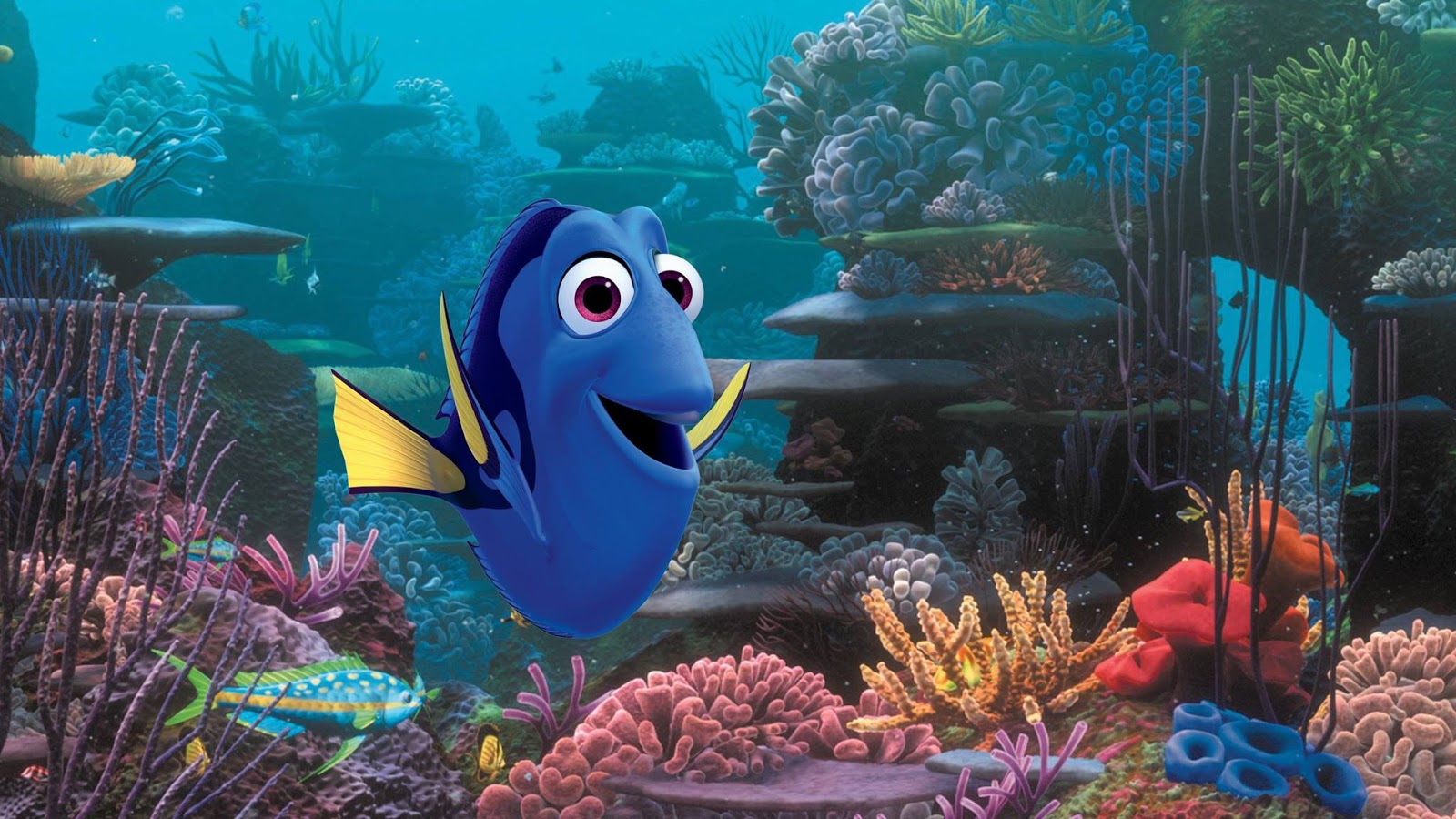
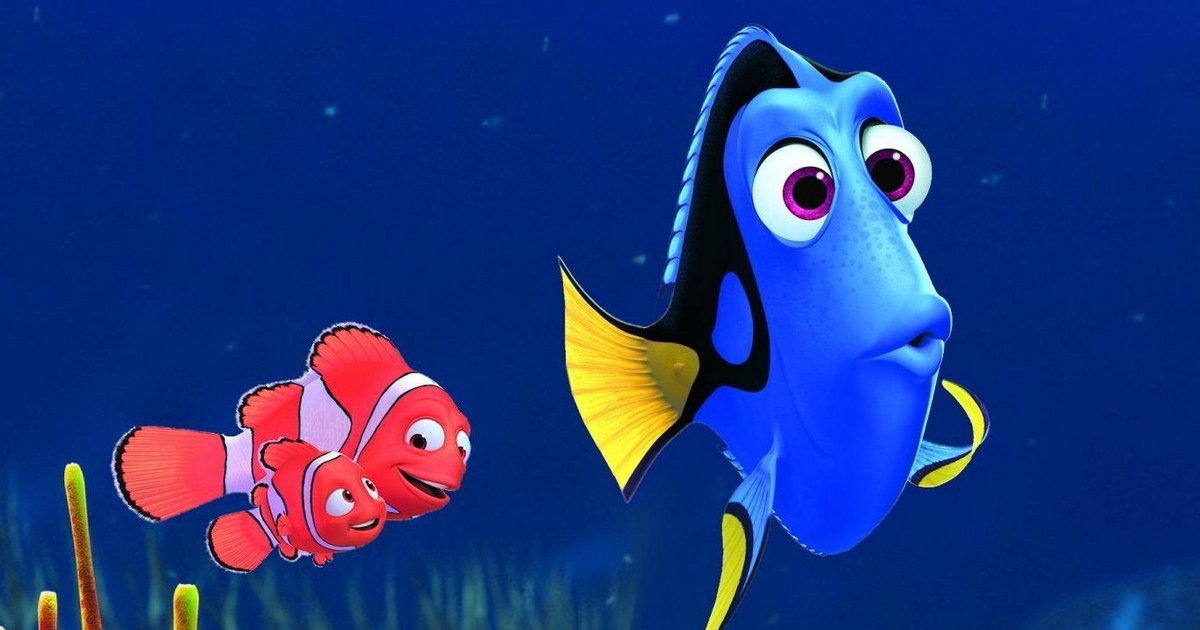
In Finding Dory, Dory (Ellen DeGeneres) is a blue tang suffering from short-term memory loss. After helping the clownfish Marlin (Albert Brooks) find his son Nemo (Hayden Rolence, replacing the original actor, who is like 80 years old by this point), memories begin to surface of her own parents (Diane Keaton & Eugene Levy, who at this point has been an onscreen father to pretty much every living actor). She sets out to find them, but her slippery memory provides a mounting challenge. She, Marlin, and Nemo end up at a marine research institute, a  rehabilitation center/aquarium where Dory was born. The adventure might not be as large-scale as the cross-country trek of Finding Nemo, but travelling between he exhibits is tougher than it sounds when you’re just a lil fish with a spotty memory.

When Dory and the clownfish get separated, she must rely on new and old friends like Destiny (Kaitlin Olson), a nearsighted whale shark, Hank (Ed O’Neill), a grumpy octopus, and – eventually – herself.

There might be other fish in the sea, but none of them are quite like Dory.

As with any review of a Pixar feature, we must begin with a slight interruption to discuss The Short. This short in particular, “Piper,” is such a vast improvement upon last year’s treacly mess “Lava” that just the first frame is enough to bring tears to one’s eyes. Set at a beach, where a baby sand piper is learning how to hunt for food while facing its fear of the ocean, it’s a stunning piece of work. The story is lean, simple, and charming, but the animation is the true standout, an unparalleled achievement in photorealistic digital imaging that consigns all competitors into oblivion. The ocean… The feathering on the birds… The sand! Oh, I could rhapsodize about that perfectly replicated sand for hours. It’s a beautiful piece, capturing the look and feel of reality while delicately blending it with the rounded edges and welcoming cuteness of a cartoon. It’s brilliant and I won’t hear a word against it.

Now, about that pesky movie it’s attached to. Honestly, it’s pretty good. Pixar isn’t knocking on the door of a second Golden Age, but they’re at least not coasting anymore. Finding Dory is playing in the shallows, but it’s having a lot of fun. With its small-scale setting comes small-scale themes (plenty of family movie standbys: the power of friendship and/or family, believing in oneself, all that good stuff) and small-scale characters (the only new character given any depth whatsoever is the surly Hank, who is welded onto an Odd Couple arc older than cinema itself), but it’s still bursting with energy like a 5-year-old who figured out the child locks on the Oreo cupboard.

Perhaps the most significant thing about Finding Dory is that it’s practically immune to sequelitis. Although there are a handful of intensely pandering moments (we get an origin story for the “Just Keep Swimming” song, which is about as patently useless as finding out how Professor X went bald), this movie isn’t just a Finding Nemo greatest hits collection. Returning characters are integrated fairly well into the new story in places where they organically belong. OK, a cameo by the surfer turtles is a little unpleasant, but justified. And the movie never really figures out what to do with Marlin and Nemo until the third act. But we’re thankfully not forced through a gauntlet of grotesqueries, with doppelgänger scenes visiting the vegetarian sharks, the aquarium escapees, the dentist’s daughter, and so on. Finding Dory is well aware of its history and its universe, but it rarely feels the need to repeat itself.

Which is ironic, considering that’s pretty much Dory’s M.O.

So much of Finding Dory is new, and while none of it is quite on the level of the original plot and characters, could it ever be? The new side characters here are bright and fun even if they’re not so engaging, and a pair of lounging sea lions are an excellent substitute for the much-beloved seagulls. And everything that isn’t new is classic Pixar, which ain’t a bad place to be. There’s plenty of humor derived from the anthropomorphic nature of our inhuman leads, depicting in increasingly wacky ways how one might reasonably travel through the various sectors of an aquarium when one isn’t exactly inclined to breathing air.

And then of course, there’s the obligatory part that takes a machete to the heartstrings. The emotional moments in the climax feel a wee bit rote, but any time you’re treated to a flashback of young Dory with her parents, you’re going to wish you had gills, because otherwise you’re going to down in saltwater tears. Baby Dory is so devastatingly adorable and her separation from her parents is so straight-up brutal that the combined cuteness and sadness will overload our system.

I’m pretty sure renting your kid a Pixar movie qualifies as child abuse.

All in all, it’s a cleverly organized, silly movie about overcoming your disabilities and discovering your inner strength. The title Finding Dory isn’t just a franchise tie-in it’s a thematic manifesto. Whether or not it’s a truly great Pixar movie is beside the point. It’s a very good one, and we should be happy it’s around.

TL;DR: Finding Dory is a fun, energetic sequel that stays true to its story even if it's dealing with shallower material than its predecessor.
Rating: 7/10
Word Count: 1190

Sunday, March 8, 2015

Silent But Deadly

Year: 2011
Director: Nicolas Winding Refn
Cast: Ryan Gosling, Carey Mulligan, Bryan Cranston
Run Time: 1 hour 40 minutes
MPAA Rating: R

I'm a terrible film major. I spent so much of my time watching ancient VHS detritus like Sorority House Massacre II or Silent Night, Deadly Night III: Better Watch Out! that I'm frequently out of the loop when it comes to truly "important" cinema, like BirdmanKill Bill, Moonrise Kingdom, or anything that the medium-strength pretentious people around me like to talk about. As a TA, I've graded so many film essays about classics that I've never given proper attention to, so I decided to take a leap with a freshman favorite: Drive*.

Well, Sergio decided for me. But regardless, it happened.

*Other perennial classics with the youngsters include Fight Club, The Dark Knight, Star Wars, and - inexplicably - The Silver Linings Playbook.

I can't really complain, considering that the 80's, Ryan Gosling, and bright colors are three of my favorite things.

Drive tells the story of an unnamed man (Ryan Gosling) who works as a stunt driver in Hollywood and moonlights as a getaway driver. He's a laconic, stylish, mostly emotionless individual who begins to open up once he connects with his neighbor Irene (Carey Mulligan) and her son Benicio (Kaden Leos). After Benicio's father gets out of jail, the Driver finds himself drawn by his affection for Irene and his unsavory job into the seedy underbelly of LA. As he finds himself deeper and deeper in the criminal underworld, he works with his boss/confidant Shannon (Brian Cranston) to attempt to sever ties with Jewish mobster Bernie Rose (Albert Brooks) and his shady partner Nino (Ron Perlman).

As things go from bad to worse, the driver must steel himself for his story's inevitable violent conclusion.

It's like the crime-thriller version of whenever I write about Glee on The Backlot.

Everything about Drive is stripped-down and simple, but relentlessly cool and propulsive, like a race car engine. I think. Maybe. This isn't a car blog, alright? This concept, reflected in every aspect of the filmmaking, finds its greatest home in the soundtrack. The Driver's nighttime world of neon and glowing traffic lights is imbued with ambient mystery by sturdy 80's-inspired synth tracks.

Obviously that kind of thing appeals to me, considering that about 60 percent of my iTunes catalogue is composed of songs so synth-fueled, they would give Simon Le Bon a headache. But Drive's soundtrack choices are just plain cool. The tracks refrain from excess, merely providing a slick, evocative soundscape for the stylized world of the film.

Style. That's the word I keep coming back to and for good reason. Style is driving force of the film (so to speak), liberally applied by the guiding hand of director Nicolas Winding Refn. Though the Danish filmmaker may personally stray into hyperbolic pretention more often than not, his hold over the slippery craft of filmmaking remains firm and assured.

The style is so heightened and superb that, when the going gets gory (and it does, in spades), squeamish viewers will be able to stomach even the worst the film has to offer thanks to the film's carefully crafted division from reality. Though it takes care not to divorce itself so much from the real world that those moments aren't still brutal and repugnant. Thanks, Drive.

So. Style. Slow motion, symmetry, reflection, and color are Refn's tools, and Drive is his sandbox. He arranges and rearranges these elements until they form a perfect, smooth aesthetic that allows the story to course through its veins like a shot of nitro (Is that a car thing? My only experience with racing is Mario Kart.). 

My humblest apologies to Mssrs. Gosling and LoveBug.

On top of is pristine style, Drive has a screenplay that might just be the most mechanically precise work ever created from the human imagination. In fact, I'm not entirely convinced that it wasn't written by a terrifying supercomputer. 

Every single aspect of the film's mise-en-scène supports its central throughline. Whether it's cheers from a radio sports game underscoring a successful getaway attempt, a red light stopping the car at precise emotional beats, an elevator door emphasizing a schism in a relationship, or a kid's cartoon perfectly summarizing the film's theme, Drive's screenplay works like Swiss clockwork. 

Drawing elements from Aesopian fable, Greek drama, and classic American thriller screenwriting, Drive is basically the perfect machine. This effect comes at the expense of some of the film's humanity, but on that front, the film has a secret weapon: Mr. Ryan Gosling.

Although his character practically has fewer lines of dialogue than Jason Voorhees, Gosling imbues him with a strong personality and moral structure, buried deep beneath his calm exterior, like whale song beneath the calm moonlit ocean.

He inspires the poetic side of me, what can I say?

The entire film is filtered through his character, to the point that many key events in scenes are kept largely offscreen, so we can watch his responses to things rather than the things themselves. That might sound counterintuitive, but the man's eyes are so damn expressive that you can feel every blow, every mote of drama that the world has to offer all through his microscopic reactions. The theater kid inside of me wants to knock his block off in a jealous tantrum.

What's even more impressive is that this performance could have been a total wash. In the hands of any other actor, the empty role would just have been filled with a pretty face and a broad shoulder and been completely efficient. But Gosling elevates the character above his material, even if he could have just coasted through on the fact that the first act is essentially just Ryan Gosling uniform porn. I swear, they put him in just about every single fetishized outfit that Tumblr bloggers can imagine. Check it:

Ryan Gosling as Vic Victor, the hard-nosed vigilante cop with a big appetite.

Ryan Gosling as Edge Streetly, the hunky yet humble mechanic.

Ryan Gosling as... OK, no theory is perfect.

It'd be so easy to let that perfectly symmetrical mug control his performance, but Gosling just goes ahead and owns the screen anyway. Something must be said for the other performers, of whom Carey Mulligan is a clear stand-out in a refreshingly un-idealized role, but Gosling's performance overpowers the ample talents of his co-stars, dulling them with his supernova brightness. His screen presence is so riveting that he sucks some of the emulsion right off the negative.

There's some film student humor for ya. Hey, at least I'm getting something out of my final semester in the academic sphere.

Anyway, my only real qualms with the film revolve around its central simplicity. Its aims and its means tend to be straightforward, but some second act wrinkles breach the straightforward nature of the film, introducing a few too many characters, motivations, and extraneous plot points into its Spartan storyline.

Beyond that? Nothing. Drive is a terrific watch, full of handsome men doing terrible things to terrible men and discovering what it means to be a real human being (or, if you listen to the film's most played song, a "real human bean."). And that's nothing to shake a stick shift at.

TL;DR: Drive is a Swiss watch mechanical thriller with a neon, 80's-infused aesthetic.
Rating: 8/10
Word Count: 1229

Friday, January 9, 2015

Under The Dome

Year: 2007
Director: David Silverman
Cast: Dan Castellaneta, Julie Kavner, Nancy Cartwright
Run Time: 1 hour 27 minutes
MPAA Rating: PG-13

This summer I spent eight hours a day five days a week transcribing episodes of The Simpsons for my summer job. All in all, not the worst temp work I've ever done. I mean, it beats folding plaid shifts for Catholic schoolgirls. (Fun Fact: I actually did work at a school uniform retail store the summer before college. Lucky me!) 

Anyway, what all this boils down to is that Sergio and I vowed to watch The Simpsons Movie once my work was done both as a celebration and as a revisitation of an animated classic now that I had the necessary 18-odd years of context. (Fun Fact: The Simpsons is five years older than I am. Less Fun Fact: I learned this in excruciating detail when I was working full time transferring data fields for each of those years.) So we did watch it. Here's how that went.

If the movie was really terrible, I'd have had a funnier caption to this photo.

When a television property becomes a work of cinema, several things happen. First, fanboys and fangirls and fan-non-binary-adaptives rejoice. Second, Twitter pundits complain excessively. Considering that in 2007 Twitter was nowhere near being a widely-embraced fountain of cultural insight (come to think of that, it still isn't), naysayers must have carved their complaints into stone - or whatever it was that passed for social platform in the days before iPhones. Third, and most importantly, the work gains the inherent expansiveness of the cinema format.

It is a challenge and an opportunity when transferring a sitcom into a feature length motion picture, especially an animated one. The jokes and aesthetics of a TV program might work on the small-screen slices of 22 minutes that break up the endless void of commercials. But there's every chance that they could extend past their shelf life when presented on the massive silver screen in a 90-minute, uninterrupted chunk.

There's also a great deal of physical danger involved.

The Simpsons Movie tentatively embraces the larger format and looser morals of the movie houses and it is a marked return to form after a couple of seasons in the dumps, but it only halfway succeeds in being something bigger than itself. The beauty of the show lies in its massive, hyperextended cast of minor characters, about whom I have previously written with rapturous regard. Having a bigger platform should have encouraged the Simpsons veteran filmmakers* to pull out all the stops in a whiz bang extravaganza celebration of the show's legacy, giving as many characters as possible a moment in the limelight.

The Simpsons Movie adamantly refuses to do this, and that is its biggest flaw. It instead resorts to a well-worn storyline (though, after 18 seasons, any possible storyline was already going to have been picked apart by moths in a studio cloakroom long ago): Homer Simpson (Dan Castellaneta) has faults as a husband and father which estrange him from his family until he can learn to overcome his selfishness and stupidity and realize that there are people who depend on him. It's not a bad plot, nor is it a bad film, but the structure requires Homer to venture off on his own, limiting the amount of time we get to spend with beloved personalities, or - come to think of it - inside Springfield itself.

Although they are credited, recurring characters Patty, Selma, and Edna Krabappel are given not a single line of dialogue, and many other perennial favorites are cast aside into crowd scenes or given paltry plot-specific lines before fading into the background once more. Even Milhouse, Bart's best friend, is barely given a passing nod. And I don't even want to speak about poor Martin Prince or Hans Moleman.

If you'll excuse me, I need to take a puff from my NerdRage inhaler. Give me a second.

*Director David Silverman has been with The Simpsons since day one (he directed the pilot episode) and the movie shares literally dozens of writer-producers with the show. 

OK, that's better.

We now return to your regularly scheduled review. Sure, The Simpsons Movie has its flaws, but it's also tremendously funny and rewarding and I haven't even really touched the plot yet. So. When Lake Springfield becomes overly polluted, young Lisa Simpson (Yeardley Smith) assembles a petition to improve Springfield's environment. Things get better until Homer brings home a pig and needs to find somewhere to dump his... waste. 

Needless to say, Homery things happen and the lake ends up even worse than before. Soon after, the EPA - led by corrupt businessman Russ Cargill (Albert Brooks) - lowers a dome over the city to prevent it from polluting the rest of the nation. After a Stephen Kingian amount of time (say, about 20 seconds), the townspeople turn on Homer and mob the Simpsons, who escape through a secret exit and heave ho toward Alaska and a new life. But Marge (Julie Kavner) has serious doubts about Homer's reckless, endangering behavior and Bart (Nancy Cartwright) is beginning to see evangelical neighbor Ned Flanders (Harry Shearer) - pious as a cherry pie though he may be - as a better father figure than the one he's got. 

Lisa's obviously mad about the pollution thing (leading to many an oh-so 2007 joke including a parody of An Inconvenient Truth that has already aged so poorly, one might reasonably begin to worry about the current state of US environmentalism). And Maggie's just along for the ride, she's chill. But before long, Homer alienates his family one too many times and is left alone in the wintry wilderness, tasked with saving his family, Springfield, and himself in the process.

The city of Springfield (played by Hank Azaria) nervously awaits its savior.

Along with these plot beats comes a smattering of some of the best Simpsons material in years, sharply skewering religion, environmentalism, the government, and just about every hot topic on the market (except, notably, Hot Topic). Freed of the standards and practices department for 87 beautiful minutes, The Simpsons Movie embraces the dark side its satirical nature for the first time in many moons. Also returning are the show's classic slapstick comedy (Homer is always funny, but he has rarely been so consistently on point delivering the doltish broad humor that his character does best) and clever sight gags. 

And although its ambitions are far too low in the character department, the film dips its toe in the waters of ribaldry, tossing in humor it never could have gotten away with otherwise. A curse word or two here, a bong and a cartoon penis there... It's no cartoon Big Lebowski, but it's definitely a far cry from prime time at the Fox network.

Along with a wider mean streak, the film gains a deeper aesthetic, with the animation exploring the depth of its cartoonish world, sometimes even flirting with the fabled third dimension. There is some CGI imagery that goes awry, but The Simpsons Movie is largely pristine, with moments that legitimately resemble real world cinematography in a way the show has never attempted in any meaningful way. A shot of the wind blowing outside the dome while Marge sits in the backyard is breathtaking, and there are plenty of spectacular visual moments that follow.

This... is not one of them.

The Simpsons Movie is a strange beast with one foot in the movies and one foot firmly planted network television. It explores and it doesn't explore the implications of transferring from one to the other. It was the spring of hope, it was the winter of despair. But through all the contradictions, it's an entertaining, incisive, droll tale about a family that can make it through anything, and there ain't nothing wrong with that.

TL;DR: The Simpsons Movie can't quite shake off the feeling of being too small, but it's funny and sharp nonetheless.
Rating: 7/10
Word Count: 1329