Showing posts with label Hong Kong. Show all posts

Tuesday, August 18, 2026

Census Bloodbath: Gland Guignol

Note: The English subtitles that were available to me for this Cantonese-language movie were very poorly translated, so take my review with a huge grain of salt. Also, I do not have access to translated credits, so I unfortunately cannot credit actors for their roles. Though it's worth noting that the cast includes Hong Kong Butcher producer Wai-Leung Cheng, Dress Off for Life star Lau Kong, and Hell Has No Boundary stars Ping Ha and Hak-Shun Leung (the latter of whom was also in the extraordinary He Lives by Night).

Year:
1984
Director:
Dan Pan
Cast:
Wai-Leung Cheng, Han Chiang, Ping Ha
Run Time:
1 hour 23 minutes

Plot: Pituitary Hunter follows, perhaps naturally, the police on the hunt for a serial killer who removes the pituitary glands from their victims, presumably to eat them. While the unnamed (in my subtitles, at least) Inspector is hot on the trail of the killer, hospital janitor Dr. Kwok keeps up a secret medical practice out of his apartment. He was trained in China, you see, and he isn't licensed to practice in Hong Kong. This seems like it might give the movie subtext of some kind, and that is an illusion.

Anyway, after he gives an abortion to sex worker Manna Chan, she begins to fall for him. However, as she learns more about the secretive doctor, she begins to suspect that he has something to do with all the pituitary thievery.

Analysis: Hong Kong's Pituitary Hunter has a hell of a title, and I wish that I could report it was also a hell of a movie. And perhaps it almost gets there? There's certainly enough moments in the movie that, were I to describe them, would sound very bonkers and fun on paper. However, this straightforward story is incoherently told from the jump, and once it gets complicated... woo, it's a toughie.

The subtitles I had are certainly to blame for part of my difficulty. The name Dr. Kwok is also incorrectly attributed to Dr. Ng all the way through the first act up until the latter's death. Also the killer is referred to by two different full names in the subtitles and a nurse is consistently misgendered. So that didn't help, but the movie also has fundamental flaws that are ruinous in any language.

First, scene placement is a nightmare. One scene almost never naturally flows into the next. For instance, let me explain opening. A man standing behind a bush eats a dead rabbit, which cuts to family members loudly weeping over an old man's corpse in a hospital. When they follow the gurney into the morgue, a different corpse in a body bag falls on them, which cuts to the opening credits, which play over a young girl doing a dance routine. If this was meant to set anything up, hell if I know what it was. Though the mourners are weeping so loud that they're annoying another patient, which is a very funny The Host-style gag, though nothing else in the movie is really overtly comic like that, so I don't know if they did that on purpose.

Second, this movie is too damn dark. During the nighttime scenes (aka the kills), it is almost impossible to tell who is doing what, to whom, and where. These are pretty important things to know, I'd say.

Speaking of the kills, they're mostly not bad. They're often weirdly elaborate, and the black-gloved killer is sometimes shown in what looks like an awesome porcelain demon mask. There's also a "killer in the backseat" moment that happens right after a couple hooks up in the front seat, which has an added element of creepiness.

Once the story gets cooking, it also finds a few threads of pathos that are ultimately unusual in this type of slasher. [SPOILER ALERT FROM THIS POINT ON] It turns out that Dr. Kwok has a daughter with dwarfism, Siu-Hua, and he is trying to use a blend of human and animal pituitary glands to "cure" her (paragraphs and paragraphs of text at the end of the movie, as far as I can tell with Google Translate, overexplain that this can't actually be done - thanks, credits! I was about to crack open a few skulls, but now I won't bother!). This makes him a good red herring, because it turns out that he only ever wanted the pituitaries from corpses, and the real killer - a bodybuilder with dwarfism who gets two names but is most consistently called Tsang Kwok On - has gone rogue in an attempt to force the doctor to cure his own dwarfism.

It's not a storyline that holds up super well under an anti-ableism lens, obviously, but the movie has sympathy for Kwok, Siu-Hua, and Tsang in spades. In fact, even when Tsang goes off the deep end and threatens to burn a blind old woman alive, he is given a sympathetic and melancholy death scene à la Frankenstein or King Kong or Rodan. However, while there is some good in Pituitary Hunter, all of this adds up to nothing much, since the bad is so bad and the good isn't great to begin with.


Killer: Tsang Kwok On
Final Girl: Manna Chan
Best Kill: The kill itself is kind of a nothingburger, but I admire Tsang Kwok On's idea to get a victim out of the tent she's in by unleashing a bunch of mice into it.
Sign of the Times: In his bodybuilding lair, Tsang Kwok On has some epic posters of Arnold Schwarzenegger and Sylvester Stallone.
Scariest Moment: We watch a nurse lean a group of corpses against a wall, start commanding them like a drill sergeant, and then bite the shoulder of the one who's "disobeying orders."
Weirdest Moment: The police lure an unhoused man out of a sewer tunnel with a duck, which he wants to devour raw, and as he chases it, they drop a metal cage on him.
Champion Dialogue: “Human's pituitary is useful when he is alived."
Body Count: 9; not including Siu-Hua, who may have died from stress during the final confrontation. That's left unclear in the final moments.
  1. Cannibal Nurse dies of fright.
  2. Dr. Ng dies offscreen.
  3. Junkyard Watchman is lifted into the sky in a burning van, which is dropped and then crushed by the crane.
  4. Tent Lady is stabbed.
  5. Car Guy is stabbed from behind.
  6. Lily is stabbed in the back.
  7. Big-Mouth So dies offscreen.
  8. Dr. Kwok is stabbed in the side.
  9. Tsang Kwok On is shot by the police.
TL;DR: Pituitary Hunter is an incoherent movie that has some sparks of life to it, but is mostly confusing and unsatisfying.
Rating: 4/10

Thursday, August 6, 2026

Census Bloodbath: Don't Break Daddy

Note: I don't have access to full, translated credits for this Cantonese-language movie, so unfortunately I can't accurately credit every role.

Year:
1983
Director:
Lee Siu-Wah 
Cast:
Eddie Chan, Olivia Cheng, Git-Leung Chan
Run Time:
1 hour 28 minutes

Plot: The Hong Kong movie Crazy Blood (Feng xie) follows police photographer Wei Ming (Eddie Chan of the delightful He Lives by Night), who is frustrated that his wife Chen Ching Min (Olivia Cheng) is constantly too busy with her job as a social worker to either have sex with him or help him take care of their son, Chia Pu.

Her job eventually introduces too many criminal types into their life, particularly serial arsonist MiMi  and her creepy gymnastics coach boyfriend David. Eventually, Wei Ming's sister So Fong is sexually assaulted by David when she's supposed to be babysitting. Meanwhile, an unsupervised Chia Pu climbs out the window in an attempt to get ice cream and falls to his death. This sends Wei Ming on a violent spiral where he attempts to exact revenge on everyone involved in his son's death, including his wife.

Analysis: You're welcome for making Crazy Blood sound legible in that synopsis. A better title would be Crazy Structure. It starts with the death of MiMi (in an illegibly edited sequence where she's climbing a fence, it gets struck by a car, and she tumbles gently to the asphalt, apparently dead), which is followed by a flashback that lasts for about 50 minutes and had me constantly asking "so is this taking place in the past, or did I not understand the opening scene?" This flashback is not slasher-y even a little bit, and spends most of its time expounding on the thesis that it's super annoying when women have jobs.

Once the movie finally catches up with itself (and makes us watch MiMi's bad death scene again), an entire slasher movie happens in the space of a cut. Suddenly, Chen Ching Min is like "hey, did you know all the girls I've been caring for are dead?" While we do get a couple proper body count kills after that, it's shocking how little this slasher is interested in actually being a slasher.

Of the actual body count kills, 50% of them are falling-related deaths, which also takes a lot of wind out of this movie's sails. In fact, everything was so wonky that I would have taken Crazy Blood off my slasher longlist entirely if not for two scenes.

The first is that David's death scene involves an exquisite kung fu-flavored chase sequence that takes place in multiple rooms of an empty gym. In perfect Hong Kong movie fashion, both Wei Ming and David use every possible bit of gym equipment as improvised weapons, including weights and - at one point - an entire tanning bed. The second is the final sequence (which is also pretty solid) where David is menacing his wife in their apartment, picking up a meat cleaver and finally going full Jack Torrance.

Anyway, I think this movie could learn a thing or two from Death Wish and its rip-offs. If you give a character a kid and you mess with that kid, the audience will get why he's mad. You don't need to spend more than half the movie explaining why he loves the kid. Crazy Blood is so goddamn boring, which is a shame because it features some deeply unhinged moments that would have played better in a more well-structured action-slasher. 

The behavior of the criminal element in the movie makes absolutely no sense, for one thing. This movie exists in a culture beset by Mad Max style cartoon criminals who are giddy hedonists that do hyperbolically evil acts non-stop for the simple pleasure of being outrageous, including trying to light a car on fire while a couple makes out inside it.

Oh, and there's exactly one shot in this movie that is aesthetically pleasing, showing Chen Ching Min staring out the window as seen in a fragmented mirror. Beyond that, though, Crazy Blood doesn't have much to offer, unless you like interminable scenes of people buying ice cream. 

Killer: Wei Ming (Eddie Chan)
Final Girl: Chen Ching Min (Olivia Cheng)
Best Kill: I guess I'd have to say David's death by drowning, but only because it comes at the end of that really cool chase scene.
Sign of the Times: When Chia Pu and Wei Ming watch TV together during one of their many cheesy "daddy-son time" montages, they're watching one of the original 1970s Doraemon episodes.
Scariest Moment: In the final sequence, Wei Ming acts increasingly unhinged while holding a butter knife as his wife prepares dinner.
Weirdest Moment: David and MiMi drive a jeep onto the beach and randomly start trying to run over So Fong, who they've never met. When Chen Ching Min finds out who they are, she casually introduces them to Wei Ming.
Champion Dialogue: “I thought she'd change after being shaved bald."
Body Count: 6

  1. MiMi falls from a fence that she's climbing when it's hit by a truck.
  2. Chia Pu falls to his death offscreen.
  3. Jenny is pushed out a window.
  4. Unnamed Child falls to his death offscreen.
  5. David is drowned in a swimming pool.
  6. Wei Ming is slashed with a box cutter (I think by MiMi, who then succumbs to her injuries).

TL;DR: Crazy Blood is a somewhat enjoyably demented family drama, but it's crap as a slasher.
Rating: 4/10

Tuesday, April 14, 2026

Census Bloodbath: No, Madam

Note: This movie was only available to me in unsubtitled Cantonese, so take my review with a grain of salt.

Year:
1982
Director:
Kuen Yeung
Cast:
Leanne Lau, Derek Tung-Sing Yee, Yueh Hua
Run Time:
1 hour 31 minutes

Plot: Hell Has No Boundary (originally Mo jie/魔界) follows policewoman May Wong Lai-Fun (Leanne Lau), who is possessed by the vengeful spirit of a murdered little girl while on a camping trip. Her new murderous rage, naturally, makes her a better cop, but her boyfriend grows suspicious about the bodies that keep piling up around her as she rises up the ranks.

Analysis: Hell Has No Boundary is an unusually focused Hong Kong slasher, and by that I mean it combines three separate genres rather than 18. What we're looking at here is a slasher film mashed up with a possession film (those two subgenres certainly weren't unfamiliar with one another, even as early as 1982), with a light sprinkling of police procedural on top. It's all fairly straightforward, which allows it to channel early-80s Hong Kong's tendency toward excess directly into the kills and overall horror movie mayhem.

This is a pretty gnarly horror movie, with an imaginative streak a mile wide. The kills, while cheaply rendered and sometimes a little confusing, tend to take place in satisfying multi-stage scare sequences packed with bizarre imagery. By the time act 3 hits, the movie fully immerses its characters into a post-Exorcist, pre-Elm Street nightmare freakout realm that is drenched in bright green lighting and full of well-staged moments where props and environments shift without warning. It's a good time!

The way that the storyline plays out didn't quite rub me the right way all the time, because the possession's tendency to infect others made some of the plot feel too diffuse. However, that doesn't really matter. This is a movie that entirely takes place within the culture and ideology of non-Christian religion (I think Buddhism, given the presence of a swastika in one scene, but I'm no expert), and that makes for an exciting twist on a subgenre that had already been entirely played out less than a decade after the debut of The Exorcist.


Killer: Possessed May Wong Lai-Fun (Leanne Lau)
Final Girl: N/A
Best Kill: May's horny new boss really gets it good. He is ultimately killed by being telekinetically wrapped up with toilet paper (I assume he's smothered?), but first he gets pinched by a crab in his bathtub, an event that I believe is implied to have severed his penis.
Sign of the Times: The movie's opening scene features May doing a Rubik's cube while her boyfriend drives her to the campsite, where they then relax with some delicious 1980s Coke and Sprite cans.
Scariest Moment: As the cops approach the site of a domestic disturbance, a knife protrudes through the door right in front of one of their faces.
Weirdest Moment: May vomits into the toilet, then uses a cup to pour the chunky toilet water over her head and then drink it.
Champion Dialogue: N/A
Body Count: 14; not including May's boyfriend's shadow self, who ultimately perishes when he makes the ultimate sacrifice.
  1. Domestic Disturbance Man is shot.
  2. Office Mean Girl #1 and
  3. Office Mean Girl #2 fall down an elevator shaft.
  4. Bird dies from exposure to evil energy.
  5. Scammy Psychic falls down the stairs.
  6. Prayer Lady has a knife telekinetically thrown through her throat.
  7. New Boss is smothered by being toilet paper.
  8. Flashback Girl is smothered with a pillow.
  9. Naked Refugee is slashed with a sword.
  10. Dagger Friend is shot by the cops.
  11. May has a ceremonial dagger thrown into her and is burned alive.
  12. Nurse is garroted in the shower.
  13. May's Killer is decapitated with a cleaver.
  14. May's Boyfriend stabs himself in the stomach.
TL;DR: Hell Has No Boundary is a pretty neat supernatural slasher import.
Rating: 7/10

Thursday, January 15, 2026

Census Bloodbath: Just Wait Till You Meet The Baker

Note: I do not have access to translated credits for this Cantonese-language slasher, so I am unfortunately unable to accurately credit who played which characters.

Year:
1985
Director:
Kuo-Jen Chung
Cast:
Chiang Huang, Ko-Ai Chiang, Kam-Cheong Cheng
Run Time:
1 hour 30 minutes

Plot: Hong Kong Butcher (AKA Xiang Gang tu fu) follows taxi driver Min, who is also a serial killer. He stalks, kills, and dismembers four female victims. That's it. That's the movie.

Analysis: Hong Kong Butcher is based on the real-life serial killer Lam Kor-wan, who killed four women in the area in 1982. While his murder spree made international headlines at the time, the first of at least two movies to adapt his exploits (the other major adaptation was Dr. Lamb in 1992) failed to garner the same kind of audience as the true story.

I can't say I'm shocked. Hong Kong Butcher was a tough sit for me. Sure, maybe it's the fact that this is the third Hong Kong movie in a row that I've watched which follows an impotent killer targeting sex workers. That would wear on just about anyone, I imagine. But the movie is also totally useless at being a sordid exploration of the underbelly of a major city.

While the contemplative opening credits (which largely follow unhoused people in Hong Kong and the ways that people react to them) seem to imply that there is some sort of reason that the filmmakers chose to tell this story, any pretense of thematic heft is dropped more or less immediately.

Instead, we are treated to endless, droning scenes of Min stalking various women, larded up with more than the recommended daily allowance of scenes where women hail cabs. While Hong Kong Butcher keeps threatening to flesh out the interesting side characters who randomly pop up around the killer, they inevitably wriggle free of the film's grasp after one or two scenes, never to be seen again. 

While some killer-focused movies can thrive by diving deep into the psyche of the central character, Hong Kong Butcher is uniquely disinterested in doing anything of the kind. It just seeks to titillate the audience with brief shots of dead naked women and goreless, underlit kills that defy the laws of physics, biology, and whatever other scientific disciplines happen to be available at the moment.

There is no interiority to this killer, and while that can be scary in and of itself (as in the one effective scene that implies Min has thoughts in his head, when he sits and stares at the ocean while waiting for night to fall), in this case it's just flat. 

There is simply no engine in Hong Kong Butcher. There is no texture to the killer, there is no thrust to the story (Min stalks two different women who he doesn't even kill, and who eventually wander off, presumably to call their agents), and it lacks the chaotic blend of genres that typically marks the Hong Kong slasher (though there is at least one genuinely funny moment where a bored sex worker is counting the minutes until she can be rid of a john).


Killer: Min
Final Girl: N/A
Best Kill: The final kill, of an unnamed student, is a little funny, I guess. Min puts his hand in the general area of her neck and chin, which isn't an action that I would really call "strangling," but she dies from it, so what do I know.
Sign of the Times: One of the victims' sisters wears shiny gold pants when she visits the police station to identify the body.
Scariest Moment: When stalking a potential victim, Ms. Kang, Min sits outside her door, preventing her from leaving.
Weirdest Moment: Min stops to bow at a shrine when he's breaking into a nightclub singer's house.
Champion Dialogue: “Go take a shower, you're stink."
Body Count: 4
  1. Hsia is garroted, maybe with a seatbelt.
  2. Maggie is killed offscreen.
  3. Sleepy Sex Worker is slapped to death.
  4. Student is strangled or something.
TL;DR: Hong Kong Butcher is a tedious slasher that disinterestedly follows a serial killer without much going on internally or externally.
Rating: 3/10

Wednesday, January 14, 2026

Census Bloodbath: Police Horror Story

Year:
1981
Director:
To-Bong Law
Cast:
Bruce Le, Carter Wong, Wai-Man Chan
Run Time:
1 hour 28 minutes

Plot: Cold-Blooded Murder (also known as The Mad Cold-Blooded Murder and, originally, Yuan yin) follows a white-gloved killer (Wai-Man Chan of Dress Off for Life) stalking sex workers in Hong Kong. The unnamed killer's identity and backstory are revealed early on for some reason: he's a man whose wife Hai-Yen (Lily Chan) turned to sex work in order to keep their young family afloat. In the process, she takes up with the wealthy Carl (Johnny Ngan) and demands that he hire some muscle to allow her to get her infant son from her husband. In the process, the baby is crushed by a cabinet. Oops. 

Anyway, the killer's reign of terror (which is mainly limited to a nine-minute montage at the beginning of the movie) makes him a huge bee in the bonnet of the police force. Inspector Robert Wang (Carter Wong) and D.I. Stephen Leung (Lun Chia) are on the case, and they are infrequently helped by Bruce (Bruce Le of Pieces), who is otherwise busy fighting a drug ring in what feels like and in fact may be footage spliced in from a different movie.

Analysis: The most exciting thing about Cold-Blooded Murder is that it is the first (and, to my knowledge, only) time that the slasher genre crossed streams with the Bruceploitation genre. In the wake of the death of Bruce Lee in 1973, filmmakers across East Asia rushed to take advantage of the void in the market, casting Lee lookalikes in a variety of martial arts mockbusters and giving them names like Bruce Li, Lee Bruce, Brute Lee, Bruce Lie, Bruce Lai, Bruce Ly, and Dragon Lee. 

The particular dupe Bruce we're dealing with here is Bruce Le, who was born Wong Kin-lung and starred in at least half a dozen major Bruce mockbusters, including 1978's Enter the Game of Death and 1980's The Clones of Bruce Lee. The trend had more or less wound down by the early 1980s, but without Bruceploitation, there is no Cold-Blooded Murder.

So that's one thing to blame Bruceploitation for. You see, this 1981 Hong Kong movie (which in typical HK style drags in elements from a grab bag of genres including police procedurals, kung fu movies, and Italian gialli) is an absolute mess. While many movies from this place and time manage their tonal shifts with aplomb, this one feels like it's being torn apart from the inside out.

The only unifying theme in any of the three distinct movies making up Cold-Blooded Murder is misogyny. Even more so than Dress Off for Life (which I just covered, and which randomly also stars Wai-Man Chan as the killer, making for a superb double feature), this is a relentless slog. It trudges dolefully between scenes of one-dimensional women being offed, scenes of attempted assault, and jokes about those scenes of attempted assault.

And thanks to those drug dealer scenes having less than nothing to do with the other material, the plot is really confusing and slippery. So there's really not much to cling to other than tedium and misery.

That said, its qualities as a cheesy kung fu movie sometimes provide a light in the dark. It's a cheap, aesthetically uninteresting motion picture for the most part, but the martial arts sequences get better and better as the story goes along, which provides the only sense of momentum that the movie has. I particularly like the one that involves a bucket and the fight that takes place in the crook of a tree.

Its slasher elements fare much worse. There is a full hour or so where it completely forgets that it's a giallo-influenced serial killer thriller, and the meat platter of deaths that opens the movie is bloodless (I'm pretty sure one is literally accompanied by a spray of water), shallow, and perfunctory. I will commend the movie for having the killer use a variety of weapons, but when the kills in which they are implemented are framed offscreen or immediately cut away from, it makes the whole enterprise feel pretty pointless.

There is only one scene that rises above the rest and, thankfully, it's a doozy. We follow Inspector Wang's girlfriend Ann being stalked through the parking garage of her apartment, threatened inside an elevator (where she uses her hairpin to stab the killer's hand), race up and down several stories while trying to outpace the killer (who is using the next elevator over), and finally engaging in a cat-and-mouse game once she gets inside her apartment.

This is the most engaging sequence visually (I'm partial to the recurring shot of the side-by-side elevator panels showing what floor each character is on), and it's the only part where the movie remembers that building and sustaining tension is usually a good thing in a horror movie. Or, rather, a horror scene in a kung fu movie.

So I guess I might lump this in with early '80s titles like The Demon and Lady Stay Dead, which are pretty atrocious but feature awesome third-act chase sequences. It's not exactly good company to be in, but trust me, it could still be a lot worse.


Killer: The Killer (Wai-Man Chan)
Final Girl: Bruce (Bruce Le)
Best Kill: I can't just leave this blank, so I'll choose Ann's strangulation. If only becomes it comes at the end of the one proper slasher chase in the movie.
Sign of the Times: One of the crime scenes involves a blood-splattered Coke bottle with that beautiful 1980s design.
Scariest Moment: Ann's apartment chase is also the only thing that comes even close to evoking the horror genre.
Weirdest Moment: During the final rooftop confrontation with the killer, Bruce is wearing a Playboy T-shirt.
Champion Dialogue: “That madman's really driving us crazy."
Body Count: 10; not including eight additional murders that are mentioned during the police investigation but are not shown.
  1. Woman is stabbed with a hook.
  2. Shower Woman is garroted.
  3. Bed Lady is stabbed with a squarish metal pole thing.
  4. Frilly Nightgown Lady is killed offscreen.
  5. Baby is crushed by a cabinet.
  6. Drug Dealer is shot by the cops.
  7. Ann is strangled.
  8. Carl is thrown off a roof and falls to his death.
  9. Hai-Yen falls with Carl.
  10. Killer is impaled with a pole and kicked off a roof.
TL;DR: Cold-Blooded Murder is a cheap, misogynistic, and scatterbrained Hong Kong slasher.
Rating: 3/10

Sunday, January 11, 2026

Census Bloodbath: Say No To The Dress

Note: I have recently done another thorough audit of the list of 1980s slashers that I use to supply the titles for Census Bloodbath. Every time I do this, the 1980s has somehow produced even more movies since the last time I checked, despite having been over for more than three and a half decades. However, this is a living, breathing document of every possible slasher from the decade, so adding titles to my watchlist, while frustrating, is a necessary part of the process. Even when I'm midway through!

Unfortunately for my sense of accomplishment, 26 of the new titles that I have added to my list come from before 1986, which is the current year that we are working on. I haven't decided yet if I'm going to sprinkle these reviews in as I push forward with 1986, or if I'm just going to watch all the deeply obscure 1980-1985 titles that I have unearthed first. But this is one of them!

Another Note: Although the copy of this movie I watched had (slightly dodgy) English subtitles, I do not have translated credits for this Cantonese-language movie. So I've only credited the one character I'm sure about. That said, I'm pretty sure Michelle Yim and Yue Wong play the female and male protagonists Ping Chung and Wah respectively.

Year:
1984
Director:
Yung-Chang Li
Cast:
Wai-Man Chan, Michelle Yim, Yue Wong
Run Time:
1 hour 27 minutes

Plot: Dress Off for Life (which is the presumably poorly translated title of Hong Kong's Yi tuo qiu shengfollows a former boxer named Chan Kuen (Wai-Man Chan), who is now an impotent recluse. This leads him to attempt to sexually assault various women, then kill them when he can't perform, making the subtext of the slasher film just plain text in a particularly sordid fashion.

On the case are buddy cop duo Mr. Mak and Wah. When dancer Ping Chung witnesses the killer fleeing the scene of a murder one night, he targets her both as a potential threat and an object of desire, dragging her unwillingly into the heart of the police's investigation.

Analysis: It has become more or less accepted wisdom among the slasher set that Canada had an amazingly high batting average when it came to their 1980s slashers. However, Hong Kong is probably a close second in terms of non-American slasher makers. While I haven't yet found an all-out classic at the level of My Bloody Valentine or Happy Birthday to Me, I would go to bat for any number of Hong Kong slashers as hidden gems, including Night Caller, He Lives by Night, and Phantom Killer.

For a bit of the time, it seemed like Dress Off for Life might join their ranks. It has many of the hallmarks of the genre-bending Hong Kong slasher set, including a buddy cop angle, wacky comic relief, and some kung fu fights (including a brawl in a lumberyard that includes one of those classic moments where an opponent holds out his hand and flips his fingers in a "come on" gesture).

However, it also had an unusually strong grip on its slasher elements. While many Hong Kong slashers might be described as police procedurals with slasher movies grafted onto them, this is very much the reverse. In fact, it feels like a pretty direct rip-off of William Lustig's Maniac both in the way it presents its killer (he lives with a bunch of mannequins and sex dolls) and centers him in the narrative.

Unfortunately, Maniac this ain't. The only thing that it has managed to retain from that 1980 movie is its sense of unrelenting, misogynistic nastiness. This is a grimy, brutal, grim film that doesn't have enough meat on its bones for it to feel like a satisfying artistic effort. It's just 87 minutes of being dragged by the hair through a gutter.

Plus, as much as it leans hard on slasher tropes, it can't execute them very well. The kills are mostly offscreen, and exactly half of them involve guns. Essentially, every murder sequence is a violation of the spirit of the slasher in some way. This disappointing element is paired with the fact that many of those scenes begin with an attempted sexual assault that is depicted in exactly the way you worry a 1984 movie might depict it, which just makes the whole experience exhausting.

Dress Off for Life can't avoid some of the genre-hopping that was endemic to Hong Kong movies of the 1980s, so it occasionally livens up enough that it remains mostly watchable. But getting through a movie is vastly different from enjoying it. 

This movie is repetitive (Ping keeps escaping the killer, then he pops up wherever she goes next like clockwork), it cuts away from what could have been its best scene (Wah escaping being tied to a hook that is dragging him toward being eviscerated by a sawmill), and SPOILER ALERT they go ahead and casually kill Ping in front of her son, B, at the very end of the movie without bothering to try and make that moment emotional in any way. END SPOILER ALERT Not a recommend!


Killer: Chan Kuen (Wai-Man Chan)
Final Girl: Officer Wah
Best Kill: There's no competition here, and by that I mean there are no contestants. I guess the dancer Lily's offscreen gun death, while violating two cardinal slasher rules, at least has a buildup that is tense and visceral, in which Chan Kuen covers her head in cloth so she can't see what's coming. So I guess that wins? Gross.
Sign of the Times: I love the makeup on the first victim.


Scariest Moment: A sex doll in Chan Kuen's apartment starts speaking to him and making fun of his impotence.
Weirdest Moment: A dildo comes flying out of a woman's purse when the bus she's on hits a pothole.
Champion Dialogue: “It's lucky that I have finished my piss."
Body Count: 12; not including a woman who is stabbed in an alley and taken away (still breathing) in an ambulance, who we never see again but who presumably survives her injuries.
  1. Carline is stabbed offscreen.
  2. Canal Woman is killed offscreen.
  3. Male Witness is stabbed.
  4. Mr. Mak is shot.
  5. Lily is shot in the head offscreen.
  6. Carjacked Driver is shot offscreen.
  7. Cop #1 is killed offscreen.
  8. Cop #2 is smack about the head with Chan Kuen's arms, which kills him.
  9. Squad Cop is shot.
  10. Chan Kuen's Ex-Wife is killed offscreen (at some point earlier, but she's not discovered until now).
  11. Ping Chung is shot.
  12. Chan Kuen is shot by B.
TL;DR: Dress Off for Life is not unwatchable, but it's a grim slog and one of the least lively slashers to come out of Hong Kong in the 1980s.
Rating: 4/10
Saturday, April 26, 2025

Census Bloodbath: I'm Gonna Show You Where It's Dark, But Have No Fear

Note: The version of this Cantonese-language movie that I was able to watch had an issue where longer subtitles were cut off at either side, which diminished comprehension somewhat, but not to a degree that I feel compromises my ability to review it in any meaningful way.

Year: 1985
Director: Philip Chan
Cast: Melvin Wong, Philip Chan, Patricia Ha
Run Time: 1 hour 33 minutes

Plot: Night Caller (Ping an ye) begins with the brutal murder of model and single mother Jessica (Terry Hu). The only witness is her daughter Edith (not credited in a manner that I can read), who is in shock and has not spoken since the incident. This leads her to be more or less adopted by the detective on the case, James Wong (Melvin Wong of Yes, Madam!), and his wife Kiki (Deborah Sims). Meanwhile, the buttoned-up James and his loose cannon partner Steve Chan (Philip Chan of Hard Boiled, also the director of this here movie) use their investigative skills and, naturally, their kung fu prowess to try and solve the mystery as more bodies begin to pile up.

Analysis: Night Caller has a simply incredible opening sequence. Somebody must have been making a mint off dubbed Dario Argento tapes in Hong Kong in the early 1980s, because just like 1982's He Lives by Night, the introductory kill is giallo as all hell. It's exquisitely crafted from top to bottom, disorienting you with jagged editing as it combines beautiful cinematography and crisp shadows with extraordinarily violent imagery (including an apple being smashed into Jessica's face during her struggle for survival). It is exquisite. It is horrible. It is pure cinema.

Nothing else in Night Caller quite lives up to this sequence, but that's hardly a knock against it. I couldn't imagine improving on that opening. Nor can writer-director-star Philip Chan, evidently, because the buddy cop comedy stuff kicks in more or less instantly after this scene. (Look, it's a Hong Kong movie. If you're not ready for the genre to change every 45 seconds, you're going to have to take two aspirin and go to bed straight away.)

I'm not saying it's a bad buddy cop kung fu comedy romance family drama movie, either. However, it reaches its aesthetic heights in the horror scenes, which also include the scene where James brings Edith back to her dark apartment to try and jog her memory and the movie's second kill (which is also the last proper body count kill, alas). Said second kill can't match the sheer audacity of the opening sequence, but it does involve a man being stabbed and falling from a catwalk, whereupon his corpse dangles upside down from a cable. After having fallen through a box of glitter. A box of glitter that was suspended over a catwalk full of models. On live TV. Y'all, this movie is kind of great.

Anyway, where was I? Oh, yes. The aesthetic value of the movie drops off sharply every time it's not doing a horror scene. And while the inclusion of kung fu fight scenes in a slasher movie should provide a frisson of camp, only one is lit well enough to properly see what's going on. This seems like a peculiar misstep for a kung fu veteran to make, even if working behind the camera was never exactly the thing he was known for.

However, whatever that aspect of Night Caller lacks in camp value is made up for by the killer, Bobby (Siu-Fung Wong), who wanders into the movie at about the halfway mark and simply makes herself known, preventing the movie from adding "whodunit" to its roster of genres. Every time we see Bobby after the "big" reveal, she is wearing a new ludicrous outfit (in one scene, she is simply wearing mud) and psychosexually torturing a shirtless, handcuffed James. Now that's more like it!

I think I like this movie more than I love it, because the extremely tropey buddy cop material is front and center when it really shouldn't be, given how little effort was put into it. However, the horror is effectively horrifying, the comedy is frequently very funny (even during its darkest turns, such as the scene where a woman who discovers a valuable clue suddenly dies of a brain disease before the cops can ask about it), and there is always some inexplicable moment waiting behind every narrative corner (like the gang of punks who squirt ketchup on a restaurant owner's face and try to put his wife's fingers in the toaster).


Killer: Bobby (Siu-Fung Wong)
Final Girl: James Wong (Melvin Wong)
Best Kill: Accept no substitutes for the opening kill of Night Caller.
Sign of the Times: When Bobby's accomplice Mickey (Kei Mai) introduces himself, he starts maniacally singing Toni Basil's "Mickey" (which is honestly the only way to sing it).
Scariest Moment: An off-brand Chuck E. Cheese mascot character who looks like a bedraggled Hills Have Eyes mutant grabs Edith while she's at the arcade.
Weirdest Moment: Mickey performs a scene from Taxi Driver to himself in the mirror while in blackface.
Champion Dialogue: "I'll be back to add a few holes to your ass."
Body Count: 7

  1. Jessica is stabbed 29 times, with the final stab going in the gut before she falls through a window.
  2. Ho Tak is stabbed in the chest.
  3. One-Eyed Neighbor is shot in the head and burned to death offscreen.
  4. Lady Who Finds The Ring dies of brain disease offscreen.
  5. Newbie Cop is shot.
  6. Bobby is shut.
  7. Mickey is drowned in a mud bath.

TL;DR: Night Caller is a little more of a generic cop movie than I wish it was, considering its extraordinary facility at being a Hong Kong giallo.
Rating: 7/10
Word Count: 958

Monday, April 11, 2022

Census Bloodbath: Baby Blues

Year: 1982
Director: Yao-Chi Chen
Cast: Emily Y. Chang, Alan Tam, Sha-Fei Ouyang
Run Time: 1 hour 28 minutes

Plot: Devil Returns follows a young woman named Fang Mei-hsun (Emily Y. Chang) who was attacked by an escaped criminal. Two months later, she has married her fiancé Lo Yu-ching (Alan Tam) and discovers she is pregnant with her attacker's child. When the baby is born, she suspects it of being possessed. A variety of supernatural accidents begin to occur until she gets the baby exorcised and a shadowy figure with a knife begins stalking her home.

Analysis: Like many of the Hong Kong films we've been covering recently as we swing back around and check out the films that slipped past my radar during my first (several) rounds of research, Devil Returns (aka Jing hun feng yu ye) is a real kitchen sink affair. It's tremendously hard to pin down what subgenre this film wants to exist in, as it seems to slide effortlessly between the type of supernatural slice-'n-dice picture that would become much more common post-A Nightmare on Elm Street and a formula slasher so traditional that it literally steals entire scenes from Halloween, including the car horn death, the closet scene, spying the killer out the window, and pounding on a door screaming for it to be opened by a sleeping child.

But also it spends the whole first half of the film riffing on The Omen and Rosemary's Baby while ripping off the score to Suspiria and wholesale stealing the score to The Exorcist, so it takes some getting used to. Eventually I was won over to the film's wavelength, but it takes some time after the slow-paced first act that keeps trying to capture the "women's picture" thrills that made its superior 1982 peer Exposed to Danger so thrilling but bogging it down in a supremely boring and ill-paced execution of the "am I imagining things?" trope. Once things start clicking, they really click though, especially when the film realizes that it can use the trappings of motherhood (the home, the belly, and the baby itself) to spin out terror both metaphorical and entirely immediate.

Part of why the film is so slippery is that it's never clear what the fuck is going on with the killer, and not in a way that makes it a compelling mystery. Is the killer possessing her son? Or is he just wandering around in a Michael Myers jumpsuit? And why are some kills entirely Omen-fueled supernatural mayhem (including a woman whose chest starts spontaneously erupting with blood) while others just involve people being poked with a big knife? There's no consistent M.O. established, so it's hard to grasp the actual stakes involved. I will admit that the film ends on an epigraph that is untranslated, which may have helped explain everything, though certainly not soon enough for it to help the film in the moment.

Luckily, the kill sequences (which are entirely backloaded, because that first half really can't get anything right) are pretty fascinating, and at one point act as a wildly kinetic shot of adrenaline at the exact point where the movie begins to flag the most. The film is also occasionally pretty, particularly in an early scene where Fang Mei-hsun is kidnapped on a rainy street, dropping her umbrella, which is left upside down to forlornly fill with water. And the first half is stuffy but not terribly made, so while it's a bit of a slog to get to the superior second half, it's not the most punishing.


Killer: There's too much going on here to land on calling this entity anything other than what the title suggests: Devil
Final Girl: Fang Mei-hsun (Emily Y. Chang)
Best Kill: The abortion specialist is slashed in the face with a scalpel by a possessed nurse, at which point he begins to be thrown around by a telekinetic force before being defenestrated and falling several stories to his death.
Sign of the Times: There is an extended sequence that takes place at an aerobics class.
Scariest Moment: Devil appears in the hallway watching Mrs. Chou while she cooks, visible through the open door behind her.
Weirdest Moment: Shen Hsiao-ling starts brushing her hair and laughing maniacally.
Champion Dialogue: "Let's have a steak for your health."
Body Count: 5
  1. Doctor is slashed in the face and thrown out the window.
  2. Mrs. Chou is impaled through the back of the neck.
  3. Lin Haui-teh is stabbed in the back though his car seat.
  4. Shen Hsiao-ling is smothered with a shower curtain.
  5. Devil is shot.
TL;DR: Devil Returns is a little slow paced, but it throws caution to the wind in terms of ripping off the best of horror cinema and pouring 18 different subgenres into its bubbling cauldron.
Rating: 6/10
Word Count: 800

Friday, March 18, 2022

Census Bloodbath: Everybody Was Kung Fu Fighting (Capsule Review)

I've been doing the math on how many goddamn slasher movies I have left to cover and how much time I have in my life for writing things I'm not being paid for. Unfortunately, those numbers just aren't adding up, so for the time being Census Bloodbath is converting to this sleeker capsule review style (which will inevitably be almost as long as my regular reviews anyway). This will likely culminate in a bigger, more involved project down the road, but for now I hope you enjoy at least having something to read rather than the barren wasteland of nothing that my blog has been since I started writing for Screen Rant!

Year: 1981
Director: Stanley Sui-Fan Fung
Cast: Wei Pai, Nora Tsang Pui-Kei, Lee Yuen-Wa
Run Time: 1 hour 30 minutes

Plot: Siu Fong (Wei Pai) is the hero of a small village, having protected them some years ago from a wicked gangster. Every woman in town lusts after him, though he only has eyes for Sin Sin (Lee Yuen-Wa). In spite of this, every woman that throws herself at him ends up dead, killed by a mysterious prowler with a skull for a face. Once Sin Sin's sister Fei Fei (JoJo Chan Kei-Kei) goes missing, he must clear his own name and track down the killer, his investigation leading him into combat with the sinister potter Seen Kay (Chung Fat) and the vengeful gangster Kam (Lee Hoi-Sang).

Analysis: This Hong Kong film is a unique beast, grafting the nascent slasher formula onto a more tried-and-true kung fu movie plot involving gangsters and lots of acrobatic punch-kicking accompanied by the sound effect of some poor foley artist slamming two by fours into a sack of beans or whatever. Although the slasher elements are much less well-rendered (there is hardly a drop of blood, though the excavation of a corpse that has been coated in clay and turned into a statue is suitably gruesome), at least the killer is designed to the rafters. The killer's face is shrouded by a black straw hat, but when he tips it up, he reveals - instead of a face - a terra-cotta skull. It's an incredibly imposing bit of costume design that does a lot to add oodles of atmosphere to whatever scene he finds himself in.


The kung fu sequences also embrace the cheesiness of late-era martial arts flicks in a kinetic and exciting manner (especially the scene where the gangsters try to impale Siu Fong on a rolling cart with horizontal spikes), though nobody would go out of their way to call them particularly inspired. The plot itself is really the problem. Even though there are some zany twists and turns, including an underground cavern with a hidden entrance in a coffin, a little person kung fu/pottery master, and a telenovela-esque series of third act reveals, the killer reveal is too obvious and the first two acts spin their wheels maddeningly between too few kills. All in all, this was a fun diversion from the world of American slashing in the early 80's, but this is a "fast forward to the best moments" kind of deal rather than "let's make a bowl of popcorn and sit down with The Phantom Killer."

Killer: Ah Kwai (Cheung Sin-Ming)
Final Girl: Siu Fong (Wei Pai)
Best Kill: It's more of a post-kill extravagance, but one of the victims gets turned into a statue, which is radical as fuck.
Sign of the Times: The fact that a kung fu film decided to spruce up its plot with the slasher formula in the first place.
Scariest Moment: The first time the killer lifts up his head and you see the skull underneath.
Weirdest Moment: The potter beats the shit out of Siu Fong the first time they meet, and then proceeds to be extremely helpful for the rest of the movie.
Champion Dialogue: "Even though my son is ugly, he's still got a girlfriend."
Body Count: 6; not including at least 3 thugs and 2 security guards who are attacked but whose fates are unclear.
    1. Yan-mei is punch-stabbed in the neck.
    2. Madam Suet is punch-stabbed in the gut.
    3. Amah drinks poisoned tea.
    4. Guard is hanged.
    5. Sin Sin is killed offscreen.
    6. Fei Fei is stabbed in the gut.
TL;DR: Phantom Killer isn't a particularly interesting movie as far as its plot goes, but when it comes to the film's signature blend of slasher and kung fu, it's a riot.
Rating: 7/10
Word Count: 745

Friday, March 11, 2022

Census Bloodbath: Big Trouble In Chinatown

Year: 1981
Director: Patrick Tam
Cast: Kuo-Chu Chang, Charlie Chin, Brigitte Lin
Run Time: 1 hour 31 minutes

As our sojourn through the movies I missed in previous Census Bloodbath years continues into 1981, we're swooping back into Hong Kong slashers in a major way. Ai Sha, AKA Love Massacre, was directed by Patrick Tam, an influential figure in the Hong Kong New Wave who was the mentor for international directing superstar Wong Kar-wai. Unfortunately, the copy that's currently available isn't quite up to snuff to allow us to fully appreciate this fact, so please take that into consideration in this review. The print is a bit blown-out, and while it's easy enough to appreciate the color and framing and whatnot, the white subtitles are completely swallowed whenever there is a bright white at the bottom of the screen, which is almost all the time.

Curse a director who knows how to use negative space!

Love Massacre has an oddly complicated continent-hopping plot, which is not aided by the subtitles sometimes falling into a chasm for minutes on end. But what I got out of it is that Joy (Tina Lau) is a melodramatic student living in San Francisco. Her boyfriend Louie (Charlie Chin) wants to move to New York, but the idea of him leaving her causes her to slit her wrists on a very pretty lake. While she's recovering, her brother Chiu Ching (Kuo-Chu Chang) visits from Hong Kong and kindles an extramarital affair with Joy's schoolmate Ivy (Brigitte Lin). After Joy perishes in a car accident, Ivy gets closer to Louie which enrages Chiu Ching, who kills his wife and comes to San Francisco to get up to some stalkin' and slashin'.

When a romance this sizzling is interrupted, you really feel it!

The place where Love Massacre succeeds the most is, for obvious reasons, its general aesthetic. It's a beautiful film, from the opening shots that see a woman walking across sandy dunes, an isolating and alienating shot that sets up the plot quite nicely. He really does pump a lot of energy into using visuals to tell the story, which should seem self-evident when you're discussing a work of cinema, but after 8 million shot-on-video slashers really feels like a breath of fresh air. He uses superimposition quite well as a means of juxtaposition, drawing links between characters while highlighting their major differences at the same time.

There are also scenes that aren't quite so artistically challenging, like the POV shot on a roller coaster, but display an excellent sense for what might be the most fun to point the camera at. Tam also favors white backdrops interrupted by bold blocks of color, best represented by a dazzling museum scene that exists solely for this purpose. 

Behold!

So yes, it's undeniable that the film is pretty to look at. But here's the thing. In general, it's not pretty enough to look at that it obviates the film of its incredible sins both as a slasher film and a melodrama. Hell, there are individual shots in Zoom In: Sex Apartments that are just as, if not more beautiful to gaze upon, so like... it's clearly not that hard to bring these particular visual ideas to life.

The less said about how the script functions as a drama, the better. The characters are given so little semblance of humanity that it's hard to care when they're being murdered, so why should anyone give a shit what they're up to in the meantime? Sadly, the superior filmmaking technique doesn't extend to the murder sequences, so they're extra empty. A filmmaker who is truly committed to making a murder sequence feel brutal and jarring can certainly accomplish that. Look at Angst, or literally anything made by Dario Argento before 1989. These scenes are just an afterthought, clearly thrown in to spice up the proceedings and hop on the bandwagon of the subgenre that was popular enough that American enthusiasts might even venture into watching a subtitled film (indeed, said subgenre is so popular that loser nerds like me are still seeking Love Massacre out 40 years later simply because the film belongs to it).

Love Massacre would certainly benefit from a really nice Blu-Ray transfer, but the bottom line is that the story it's telling is dysfunctional. Plot beats slip by with no clear connection to one another, culminating in a third act that doesn't so much draw the threads together as murder a bunch of the threads so we don't have to think about them anymore. I don't know that I would warn anyone away from the film. There's certainly enough on offer here to place it above the basement-level standard of many slasher films from this period. However, especially in 1981, there are literally almost two dozen films I'd point someone to first before recommending it.

Killer: Fu Chiu Ching (Kuo-Chu Chang)
Final Girl: Ivy (Brigitte Lin)
Sign of the Times: The girls have to find out about overseas occurrences from a newspaper. Ew.
Best Kill: One of Ivy's housemates has her head slammed in a door, which is pretty damn gnarly.
Scariest Moment: Ivy sees Chiu Ching sleeping in a coffin, and he slowly turns his face toward her.
Weirdest Moment: Chiu Ching paints a little kid's entire face purple.
Champion Dialogue: "When did you learn to smoke?"
Body Count: 9; character names will mostly be missing - I'm sure I could parse out who is who with careful study of the egregious subtitles (ie. massive contrast-editing on screenshots), but frankly the names don't matter much because none of the body count characters who die are relevant to the story in any meaningful way.
  1. Joy is killed in a car accident.
  2. Chiu Ching's wife is killed and dismembered offscreen.
  3. Housemate #1 is stabbed to death.
  4. Housemate #2 is strangled and hit with a teapot.
  5. Housemate #3 has her throat slashed.
  6. Housemate #4 is stabbed.
  7. Housemate #5 is drowned in a tub.
  8. Housemate #6 has her head crushed in a door.
  9. Chiu Ching is stabbed.
TL;DR: Love Massacre is reasonably pretty, but not enough to overcome its wan melodrama and tepid slashing.
Rating: 5/10
Word Count: 1028

Monday, August 2, 2021

Census Bloodbath: In The Village, The Peaceful Village

Year: 1983
Director: Ching Wong
Cast: Hon Chi Lai, Pui-Chi Law, Hsi Chang
Run Time: 1 hour 30 minutes

Whenever we get this deep into a particular year of Census Bloodbath, things begin to get a little... obscure. You don't want to know what harrowing corners of the internet I had to hack through with a machete to find today's offering, the forgotten Hong Kong slasher Sketch, also known as Xue zhong xue. This review is going to be structured a little differently because, other than the poster, there are no images from this film available online. So get ready for a big block of text! Multimedia be damned! 

Also, the actors in the film are listed on IMDb, but there are no character listings so I don't know who played who. I was lucky enough to get a subtitled copy of the movie, so I at least have the character names, but I will unfortunately be unable to provide any proper credits.

Anyway, on with the show! Hong Kong actually provided quite a few entries in the slasher movement, typically categorized as "Hong Kong giallo," a title that would certainly apply to the previous year's He Lives by Night, which is more inspired by the works of Dario Argento than the American slasher cycle. Hong Kong had already pumped out a couple entries by 1983 (including Devil Returns, another 1982 film that I didn't originally have access to, and will be circling back around on), so Sketch isn't breaking any new ground. Plus, the plot would be familiar to anyone who has watched any horror film released since about 1961.

Inspector Chin has just moved to a smallish village with his wife Jun. It is implied that either they have lost a child and Chin has just gotten over it sooner, or Jun is generally super-hysterical-lady-crazy from having a uterus and whatnot. Anyway, his first case begins immediately as a series of rapes and murders rocks the community. He and his partner Sgt. Chung Ng investigate, narrowing the suspect list to the two local perverts Snake and Squirt.

However, the killer continues to evade their grasp, and a gang of hooligan teens led by Seng and his overzealous junior enforcer Pig Head terrorize Jun, making the fact that she's also being terrorized by the killer, who she suspects is local psychiatrist Dr. Lin Chin Wei.

At first I was eager to see where this movie would take me, thinking it might go the "women's picture" route that was so common in 1982, much like the delightful Taiwanese slasher Exposed to Danger. Unfortunately, Sketch makes it immediately clear that it has no intention of centering women. The first couple victims are women we meet in the same scene that they are killed, one of whom doesn't even get a name. And even though Jun's psychology is the most interesting to explore, she is pretty much a tertiary character. Indeed, the big third act moment where her survival is in question doesn't even play out onscreen.

No, Sketch thinks we want to spend more time with the cavalcade of terrible men that populate this town. For one thing, Seng's gang gets a dizzying amount of screen time (Pig Head gets an entire character arc - more than Jun!). Their antics are probably meant to be comic relief, but it's hard to get on board with a group of young men who terrorize women in grocery stores, throw a firecracker into the mouth of a parade dragon dancer, and smash all the windows of the inspector's house because they don't like that he got mad when they tried to steal his car. Their antics are shrill and irritating, and they come flooding into your eyes and ears in pretty much every other scene of the movie.

It's a shame they whiff so hard on the characters, because the movie is actually constructed quite well. Well, maybe not the whodunit itself (which does have a twist ending reveal, but doesn't have the energy to make any of the red herrings actually believable), but the filmmaking technique is above reproach. It's not particularly unique or energetic, but it does deliver a healthy dose of atmosphere. The first and final kills in the main body count portion of the movie are zippily edited and pumped full of startling imagery, like a face being jammed into a chickenwire fence or a woman's scream cutting directly to the open mouth of a singer at the party outside, the thing distracting all the people who could otherwise be saving her.

Sketch is certainly always doing something, it's just that those things are only ever rarely serving the whodunit slasher it's trying to be. It's too distracted sketching out the lives of male villagers who don't drive the plot to do anything particularly compelling with its generic premise. It's not a movie I'd call actually "bad," but it certainly wasn't worth scouring the backrooms of cinema history to find it.

Killer: Chi Ken
Final Girl: Jun, I guess, but really Inspector Chin is the only one the movie cares about
Best Kill: The killer goes on a rampage in a surgery room during the film's extended outro and slashes a nurse with a scalpel in the most outright slasher gore moment of the film.
Sign of the Times: Squirt has a cassette tape that is just a lady making sex noises over light jazz.
Scariest Moment: The killer bursts out of the water in front of a woman who is feeding the fish.
Weirdest Moment: Seng draws glasses and a giant smile on his girlfriend's face with lipstick.
Champion Dialogue: "Always last to arrive. Is it true you have bad kidneys?"
Body Count: 8
    1. Dovey is killed offscreen.
    2. Fish Lady is drowned.
    3. Ah Ying is slashed.
    4. Seng is beaten to death.
    5. Dr. Lin is shot.
    6. Nurse is slashed with a scalpel.
    7. Nurse #2 is stabbed with a scalpel.
    8. Chi Ken is shot.
TL;DR: Sketch is a perfectly competent Hong Kong slasher, but its herd of annoying characters are certainly to its detriment.
Rating: 5/10
Word Count: 1016

Tuesday, October 6, 2020

Census Bloodbath: Stocking Stalking


Year:1982
Director: 
Po-Chih Leong
Cast: Sylvia Chang, Eddie Chan, Kent Cheng 
Run Time: 1 hour 27 minutes

There comes a point at the end of every Census Bloodbath year when we're stumbling through the darkest,  dustiest corners of the subgenre and find a foreign movie that is either so obscure or too old to have reliable translation services provided. That is how I ended up viewing the 1982 Hong Kong slasher movie He Lives by Night in unsubtitled Cantonese. Actually, if we're splitting hairs, it was subtitled. It's just that the subtitles were also in Cantonese, which wasn't exactly helpful.

So, as I always like to say but especially with these entries, take my review with a grain of salt. There are certainly nuances I missed by not understanding a single line spoken outside of the opening sequence, which is inexplicably in English. But, as I also always say, it's a slasher movie. It's not hard to understand even without the benefit of a screenplay. I relish these opportunities to experience a film in its purest visual form, unencumbered by the intricacies of dialogue, and He Lives by Night has a lot to dig into.

Exhibit A.

Here's the plot from what I could gather (along with what's available in the IMDb description). After a man (who the synopsis describes as a graphic designer even though he clearly works in the shoe section of a department store) discovers his wife cheating on him with a man dressed as a woman, he murders them both and takes to the streets in drag, stalking any woman he sees wearing white fishnet stockings and strangling her with said stockings. The police chief and his deputy team up with a spunky female radio DJ to attempt to catch the killer.

So, even if it's from a totally different milieu, He Lives by Night joins the grand tradition of slasher movies that depict men who dress as women as psychotic killers, nestled snugly between Dressed to Kill and Sleepaway Camp.

It turns out the true international language is transphobia.

It's a damn shame that He Lives by Night has that albatross hanging around its neck, because its murder setpieces are actually quite spectacular. We hit the ground running, with a woman being menaced in an alley full of sheets that have been hung out to dry, the killer's face appearing through a slash in the fabric (I would accuse this film of ripping of Tenebrae if this one hadn't actually come out first), the initial slashes from a razor causing the woman's blood to blossom against the sheets she gets tangled in while trying to escape. There's a maniacal energy to the scene that recalls early Dario Argento at his most bonkers, and the kills that follow don't lose that spark.

The murders are brutal, protracted, and really use every inch of the space they take place in. They aren't simple shocking gore gags that get in, do their thing, and get out. These scenes have stages. A woman can't simply be strangled. She must be stabbed in the leg, climb up the stairs, be dragged away, kick her foot into a fishtank in a billowing cloud of blood, topple some chairs, and then be strangled. It's daring, electrifying filmmaking that is frankly beautiful to witness. Although being beautiful to witness doesn't prevent them from being incredibly misogynistic, also like early Dario Argento.

We're at least lucky that the filmmakers don't seem particularly interested in exploiting the nude female body, because those grains of salt would form a huge snowdrift at that point, burying the movie entirely.

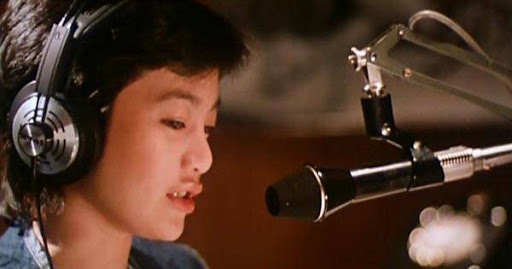
The visual splendor of He Lives by Night isn't limited to the kills, either. In every scene, the camera is gliding and pivoting, a sinewy snaking presence that captures its story in endless, unsettling motion. And the main setpieces are well constructed, creating geographically coherent, whole spaces for the killer to chase folks around in (the finale takes place in the radio studio, a labyrinth of glass and soundproof foam that brought to mind one of the best sequences of Scream 2). 

But before I get too lost in the visual sphere of the movie, I should bring up that the story being brought to life here is wacky as all fuck. It is obvious even without subtitles that this film was conceived as a convivial comedy as well as an effective stalk and slash thriller. While it succeeds on almost all counts as the latter, I think its unbridled gusto at creating the former is what gives the film it's totally unique energy. Perhaps the instinct that has cops running around in their underwear so they can't be impersonated by having their uniforms stolen or the Chief doing a full disco dance in glittery eye makeup in his apartment is the same one that creates such wickedly bizarre but effective moments as the killer chasing the DJ down a hallway by pushing a huge 7UP machine toward her at terrifying speed.

It is broad, it is deliciously weird, it is fiercely problematic, but there is truly nothing else like it. I don't know if all of that coalesces into an explicit recommendation, but I sure had a hell of a lot of fun here.

Killer: The Stocking Killer
Final Girl: The Radio DJ
Best Kill: The opening kill in the alley really is something to behold.
Sign of the Times: At a casino, a man in a Michael Jackson jacket does the robot.
Scariest Moment: When the DJ is hiding in her sound booth, the killer's face lights up on the other side of the glass.
Weirdest Moment: At a restaurant, the cops and the DJ order so many bowls of rice that they form huge skyscrapers of rice on the table.
Champion Dialogue: "Shit bitch!"
Body Count: 7
  1. Casino Woman is strangled with stockings.
  2. Punk Girl is strangled with stockings.
  3. Shopper Girl is strangled with stockings.
  4. Drag Dude has his throat slit.
  5. Wife is strangled with stockings.
  6. Security Guard has sharp brass knuckles slammed into the back of his skull.
  7. Killer falls out a window.
TL;DR: He Lives by Night is problematic like a lot of its slasher brethren, but it's got the deranged energy of early Argento and that serves it well.
Rating: 6/10
Word Count: 1052