Showing posts with label Tobin Bell. Show all posts

Tuesday, December 16, 2014

No Saw Unsung

Year: 2010
Director: Kevin Greutert
Cast: Tobin Bell, Costas Mandylor, Betsy Russell
Run Time: 1 hour 30 minutes
MPAA Rating: R

It is a long-revered tradition in the horror community that the word "final" is about as credible as a used car salesman who moonlights as a lawyer and does construction estimates on the side. Friday the 13th: The Final Chapter was followed by a sequel less than a year later and, in 1993, when New Line decided to call it a day with Jason Goes to Hell: The Final Friday, it seemed to stick. That is, until Jason X, 8 years later. Their 1991 effort Freddy's Dead: The Final Nightmare met a similarly inconclusive fate, chased by Wes Craven's New Nightmare a mere three years later.

So let me tell you that I for one will not bat an eyelash when the inevitable Saw VIII: The Beginning is announced. But for the time being, Saw: The Final Chapter (also known as the anemically chintzy Saw 3D) is the definitive final film in the Saw franchise. For that I thank Lionsgate, because if I'd had to watch even one more of these, I might have had to quit the blogging business forever and pick up a steady job to pay off my massive therapy bills.

Just burying the memory of this go-kart drill is going to take years out of my life.

Saw: The Final Chapter is one of those films that, through sheer insipidity and near perfect crapsmanship, actually make the films that come before it retroactively worse. Because while the Saw films pretty much haven't been good since the second one, I've more or less enjoyed this marathon experience, at least for the insight into the twisted horror game of the 2000's. But with every tired, amoral plot beat in this new film, the last of my goodwill for the franchise shriveled up and vanished in a puff of smoke.

Saw: The Final Chapter opens with a trap that takes place in public in broad daylight, insists that any woman who cheats on her boyfriend deserves to be buzz sawed in half, and has absolutely zero connection with the rest of the plot*. At least the movie clues us in right away that it's going to be a terrible, misogynistic gauntlet of crap, saving us the five minutes or so of attempting to muster up some esteem for the godforsaken thing. 

*There is some (largely inadequate) explanation for this scene available on the IMDb trivia page, presumably taken from the commentary for the film (of which there are two separate tracks on the DVD - lord help the lonely fan who listened to them both), but it involves a timeline, characters, motivations, and backstory that are not even remotely alluded to within the confines of this narrative. Legend has it that this film was originally meant to be two separate films, but after Saw VI tanked in the box office, they merged it into one grand finale, leaving behind this vestigial scene like a gruesome appendix.

It's hard not to view this as a metaphor for what it's like to sit down and watch this film.

There are two main plots to Saw: The Final Chapter. They are neither connected, nor particularly "final", but alas they insist upon happening anyway. The larger portion of the plot revolves around Bobby (Sean Patrick Flanery), a man who claims to be a Jigsaw victim in order to appear on talk shows, sell books, and run a high profile Jigsaw Survivor support group (one member of which is the mom from Part VI who was never actually in any danger and literally just sat in a cage for an hour, so I sense some attention issues). 

Obviously, he is put into a trap emulating the one he claimed to have suffered through so he can take advantage of the full Jigsaw experience. This includes such complementary amenities as 1) excessively complicated murder traps, 2) beleaguered metaphors about hearing, seeing, and speaking evil, and 3) addled scribblings on any available wall space ("Understand your problems," "Verify your self worth through commitment" - because evidently Jigsaw has secret aspirations of being a motivational speaker for local businesses).

Oh, also his publicist, manager, best friend, and wife are killed for good measure. Oh, also this plot ends without a single nod toward connecting it with the B story or explanation about who exactly arranged the trap. Oh, also it has no satisfactory conclusion within itself. Oh, also this movie is the cinematic equivalent of biting a hangnail and accidentally tearing too far.

The second plot largely involves the exploits of Jigsaw compatriot/resident douchenozzle Detective Hoffman (Costas Mandylor) as he tracks down Jigsaw's ex-wife Jill Tuck (Betsy Russell), who recently attempted to kill him via reverse bear trap and is being protected by useless Internal Affairs officer Matt Gibson (Chad Donella) in exchange for information on Hoffman's whereabouts. He's so useless that his repeated efforts to comfort Jill (literally repeated - "You're in a safehouse. Safe house. Safe. House.") are immediately thwarted ("This tape just came in the mail addressed to Jill."). 

Also, Hoffman terrorizes the authorities with infernally simple clues and (drumroll) malicious emails because he is a 14-year-old bully in 2003. He probably also has an email signature that says something like "Hoffman Rules Police Drools Jigsaw 4EVA!!! !!1! Gerard Way is God" followed by a metric ton of sparkly hearts.
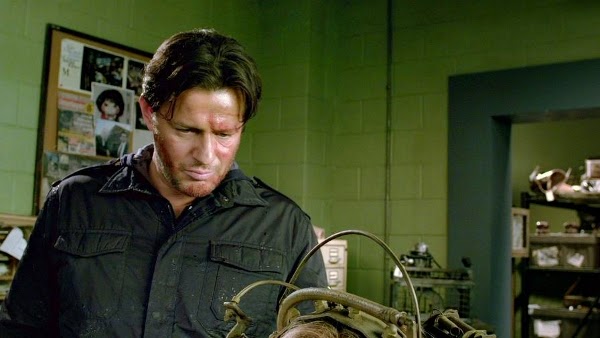
Aw man, they won't know what hit 'em when I send them that chain email. That little girl ghost is totally gonna tear their sh*t up if they don't send it to 50 friends!

It looks like we're in this one for the long haul, so let's take a breather for a moment and appreciate some of the positive elements of the film. The directing style is clean and precise, finally scrubbed clean of the obnoxiously dingy Grimstagram color filters that permeate the franchise. It only took six entries for them to figure out that not every frame positively cries out to be tinted green, so at least they're evolving. I'd prefer for them to be actually improving, but wishing for the sixth sequel in a horror franchise to be a good film is not a productive pastime.

So that's swell. At least they have that in the bag. And I say the following with absolute, positive, 100% unironic praise: the DVD menu is frickin' rad as hell. Seriously. It's simple and effective, capturing the feeling of the films free of the messiness typically involved with this franchise's publicity campaign**. Above the selection menu is a timer counting down from 45 seconds and the scrawled phrase "Make Your Choice." Integrating the fictional world with reality is probably one of my favorite styles of promotion, and it's an elegant, fun way to keep fans enthralled. But this isn't a menu review. This is a movie review. I just wanted to give you guys a brief moment of solace before the true terror begins.

**I would like to take a brief moment to at long last publicly criticize the go-to tagline for the franchise: "If it's Halloween, it must be Saw." Yes, the films debuted every October for seven years, so I get what they're trying to accomplish. But if that's not the most clumsily structured conditional statement in the history of the English language, I weep for the parent of whoever penned it.

Alright, it's time to finish this. Let's finally bust free from the trap that is the Saw franchise.

The gore is slightly more demure than the previous entry, but what it does have to offer is relentlessly pushed on the audience. The camera lingers over gaping maws and ripping flesh like they're juicy burgers in a fast food commercial. At least that means that the franchise is also finally free of the annoyingly hyperactive dubstep hummingbird editing that normally surrounded the gore sequences. Unfortunately it turns out that, without that Saw staple, it just makes everything worse. Is it possible for both options to be the lesser of two evils?

But the non-gory traps are pointless (nearly the entire police force is murdered with what looks like a battle droid), so at the very least the violent ones are well crafted. Although that has never been an issue with this franchise. The utmost care and professionalism is put into making sure the audience feels like they need to vomit for 90 minutes. A couple of them are even over-the-top fun, in the vein of the Hatchet franchise. Unfortunately, the bulk of it is wan torture porn that, by the turn of the decade, was well past its sell-by date. In fact, while forcing myself to sit through the second half of the film (Sergio had long since checked out and was scrolling Tumblr on his phone - what a trouper), I entertained myself by imagining the producers discussing the gore in the concept meeting.
"So, we hear that people really don't like bad things happening to eyes or teeth."
"Alright perfect, let's do that. Now, how can we make this fit in with the overarching storyl-"
"Oh, were you saying something? I just released the movie to theaters, can it wait?"
On top of that, the acting is atypically atrocious. I'm saying it's bad even by the standards of the Saw franchise. Cary Elwes and Tobin Bell turn in their worst performances in the series in about two scenes each - thanks for showing up to work, guys. Chad Donella does little to convince the audience that he's not a twelve-year-old boy on Ritalin masquerading as a secret agent. And where Costas Mandylor had his multitude of faults as a smug, cocky brute, he's even worse as a ragged quasi-terrorist in stubbly survival mode.

Not even the added perk of three dimensions adds any, well, dimension, to the film. There's a couple scenes that are fun through sheer lunacy (a saw is tossed full force into the camera; the puppet Billy enters in a room by smashing through a window in a steel cage - he's like a wooden Liza Minnelli), but most of the effects just involve guts being doggedly thrown at the camera with no vigor or enthusiasm whatsoever.

 No, their real priority was making sure that every scene made the female audience members as uncomfortable as possible.

Which brings me to a brief reflection on the franchise as a whole. Although parts 1 and II favor story over gore, the final five wallow in inflicting squishy grimness onto cardboard characters while Jigsaw pontificates about his harebrained philosophy in flashback. They're deeply misogynistic (Part IV and The Final Chapter both feature traps that punish women who are in abusive relationships because being beaten up by a man is clearly their fault), punishingly grim, and pedantically amoral.

I'll (thankfully) never have the chance to say this again in a review, so I'm gonna lay it all out now: Jigsaw's philosophy is a load of garbage. He smugly claims that he's trying to connect with people's survival instincts by making them mutilate themselves and learn to appreciate life more. But there are several flaws in his theories.

First (And Foremost). Just because Jigsaw decides that somebody sucks doesn't mean that they deserve to get their arm chopped off.

Second. Jigsaw doesn't stick to his word. Although he will take every opportunity to moralize about how "I AM NOT A MURDERER" and "KILLING IS DISTASTEFUL" and how everyone in his "tests" is given the opportunity to survive, a great deal of his traps in the later films involve tertiary characters who have done nothing wrong other than associate with a wrongdoer and are given no opportunity to enact an escape. These people are punished for their nonexistent indiscretions with long, drawn-out torture all in the name of bettering their friend who is, by all accounts, way more of a douche than them.

Third. The murders are too excessive and complicated. Jigsaw and his compatriots are the type who always bring a spring-loaded 45-second-timer reverse bear trap to a knife fight.

Fourth. Jigsaw claims that he's attempting to better the lives of those around him, but his traps are mostly just petty swats at people who screwed him over.

Fifth. Yeah, Jigsaw is definitely a murderer. No two ways about it. 

Just because the guy from Linkin Park has to peel his back away from the seat himself doesn't mean that you're not guilty of gluing it there in the first place.

I have pondered and pondered about just why (oh why) these movies have such a thriving community of fans that even now will troll negative reviews of the films (not that I have firsthand experience or anything), post excessive and poorly written reviews/factoids on IMDb or other online resources, and generally tout the films as the crux of modern horror. 

My current working theory is that the Saw franchise rewards fandom and constant rewatching. Characters, traps, scenes and situations from earlier entries either become important elements later on, have small payoffs in flashbacks or future revelations, or tie together in increasingly twisted ways. So any character that one may be particularly fond of will definitely reappear in some capacity. Or any moment that one enjoys will be reworked and re-envisioned over and over again as the series mythology expands. With each new twist, more information about the world of Jigsaw falls into place, rewarding the people who spend their time on message boards contemplating motivations and connections, penning theories into the wee hours or writing Billy the Puppet fanfiction.

Because goodness knows, with films as tedious and nasty as The Final Chapter, I certainly hope it's not the vulgar gore and pedantic moralism that keeps people coming back. Please.

TL; DR: Saw: The Final Chapter is the worst of a rotten bunch.
Rating: 2/10
Word Count: 2310
Reviews In This Series
Saw (Wan, 2004)
Saw II (Bousman 2005)
Saw III (Bousman, 2006)
Saw IV (Bousman, 2007)
Saw V (Hackl, 2008)
Saw VI (Greutert, 2009)
Saw: The Final Chapter (Greutert, 2010)

Tuesday, November 25, 2014

But Saw, What Light Through Yonder Window Breaks

Year: 2009
Director: Kevin Greutert
Cast: Tobin Bell, Costas Mandylor, Mark Rolston
Run Time: 1 hour 30 minutes
MPAA Rating: R

We're past the point of no return. After this post, there's only one movie left in my marathon of the infamous Saw series. Luckily by this point, the films have established a baseline of "competent but dreary," largely accomplished by keeping crew duties in the family. Seeing as our director this time around is yet another longtime friend of the franchise, editor Kevin Greutert, it would be quite reasonable to assume that Saw VI might be in the same vein as its cohorts.

As it turns out, Saw VI is even better than the baseline. In fact, it's the best film in the franchise since Saw II. Don't take that to mean it isn't pretty darn bad, but it's like finding a Fresca in the middle of a cooler full of Club Soda. I'll take what I can get with the Saw movies.

Now that I'm thinking about it, I don't recall there being an actual saw in the franchise since day one.  It must be the work of those wicked hardware lobbyists.

We pick up almost exactly where the last film left off (after an entirely unrelated and gratuitously grisly trap, as per tradition) - Agent Strahm (Scott Patterson) is crushed to death by a shrinking room as Jigsaw's new protégé Detective Hoffman (Costas Mandylor) laboriously lowers himself into the ground in a box filled with broken glass, smug as a bug. Saw V, everyone.

The next scene is the biggest twist in the entire franchise. You might want to listen to this song while you read the next sentence in order to be adequately prepared for the supreme level of twisting that is about to happen to your mind. Alright, are you ready? The scene that follows is entirely based on character development. For perhaps the first time in six films, a moment plays that isn't coated in grime as we visit Will Easton (Peter Outerbridge) in his fancy high rise office.

Will is the owner of a corrupt health insurance company and employer of the Dog Pit, a team of six highly trained individuals who look for discrepancies in insurance forms and find reasons to terminate contracts with sick patients. While we learn about Will, his work, and his life, the film acquires a slick, bright aesthetic that - for a single shining moment - allows us to forget that we're watching a Saw movie. 

What a gift. We should write thank you letters to Mr. Greutert.

So anyway, traps. The more the merrier, and because there's already been five consecutive movies to one-up, the more there are. Will is abducted and put through a gauntlet of four traps that viscerally depict how the choices he has made with his company have great impact on human lives. A mother (Shauna MacDonald) and her douchey son (Devon Bostick) - who has only two types of lines in the film, either "Acid Facts" or "The F Word." - are trapped in a cage with a vat of hydrofluoric acid above them. And Pamela (Samantha Lemole), a journalist, is trapped in a cage with a video monitor overseeing the other traps. So... That's something. It kinda reminds me of my Saturday nights, actually, what with all the Saw films I've been zipping through lately.

While all this mess is going on, Hoffman works with Agent Erickson (Mark Rolston) and the secretly not dead Agent Perez (Athena Karkanis), attempting to prevent them from discovering his true identity and feeding them clues that Strahm may have been perpetrating the killings. And he has flashbacks to when Amanda (Shawnee Smith) was still alive because why not. Also Jigsaw's ex-wife Jill (Betsy Russell) pops in from time to time to be ambiguously evil and remind us that - for all the bad acting and stilted line deliveries Mandylor and Co. bring to the table, things could be much, much worse.

Seen here in a brief moment of repose before attending the Unskilled Performers Association Convention & Yuletide Ball.

For once, the film has enough good elements in its production to counteract the blistering inanity of the script. Alas, that script thing will never change - although it's commendable that Saw writing duties have only been shared by about four people and change throughout the entire process. With such uniform work behind the camera, the stories may have wooden dialogue and incomprehensible twists, but at least they have consistent internal logic and characters. 

So even if Saw VI contents itself with unmotivated villains, a shrilly preposterous ending and over-explanation of its metaphors using Jigsaw as a mouthpiece ("The blood on your hands will literally represent the blood that's on your hands," he says), even getting him to gaze wistfully into a piranha tank ("Piranha," he says) while remonstrating Will in a flashback, at least it's coming from a place of organic nonsense.

But hey! Good elements! We've watched the "all the cool kids tint the frame" Saw aesthetic go from blue to green to yellow and back to blue, each shade more ugly than the last. But here in Saw VI, we get rooms that are only shadowy and grimy to increase tension when necessary and a much gentler teal color to guide us through. This color offsets the gore, which appears in full, steaming force in the opening scene, though it tones down until the grand finale once the traps get more plot-centric.

And all the plots service a political point, providing some of the only truly analyzable "subtext" in the franchise thus far. Having Jigsaw expound the virtues of healthcare reform while staring at a piranha tank and watching Hilary Clinton on the news may be overdoing it, at least it's doing something.

I swear, this scene feels important, but I can't quite put my finger on it.

Unfortunately, Jigsaw's pedantic MO is pushed extra hard to contrast with the more topical political appeal. Haven't we figured out by now that, despite his claims, Jigsaw is a far from "moral" killer? A good 70% of his traps this round involve at least one person being forced to die for the benefit of another. Sure, that person may be learning one of his soporific "lessons," but the human bait in their traps is afforded no true means of survival.

This flies directly in the face of Jigsaw's philosophy, as repeatedly stated throughout the six films in the franchise, vigorously so in this very film. I shan't mention that his philosophy is inherently flawed (punishing people who don't value their life by murdering them isn't exactly a motivational speech), because without it the Saw films have nothing. But in Saw VI their established logic is spit on again and again, yet nobody seems to notice or care.

Please excuse my fervor, it has been a rough couple weeks. But don't dismiss this as a nerd rant (hashtag) either. The biggest issue with the Saw films as a mainstream tentpole is that the lessons they teach are highly dubious. I'm not saying a torture film will inspire novice serial killers to pick up some iron shackles at the next Home Depot sale, but Saw's incessant moral-peddling encourages easily-plied douchebags to truly believe that this villainous character is righteous. You can toss me all the gore gags and extreme material you want, but that pandering moralism just doesn't sit right with me.

Unfortunately for these six, they'll never sit right ever again.

If the inherent hypocrisy of Jigsaw's ideology isn't apparent in the reprimanding scene where he yells "He's a HUMAN BEING!" at Hoffman after he dumps an unconscious man onto the floor, immediately before attaching him to a machine that will twist his limbs off one by one, then it can't be helped. I'm ready for this to be over.

Anyway, the film really isn't the worst. That's just been building up for a while and I had to blow off some steam before our closing number. Really, if you're picking one Saw film past Part III to watch, you're best off with this one. It's got its share of grotesqueries and idiocies, but at least it has a more intelligent aesthetic and a political core to prevent them from shallowness.

See you all soon!

TL;DR: Saw VI is the best of the back half of the franchise, though you should necessarily take that with a grain of salt.
Rating: 5/10
Word Count: 1411
Reviews In This Series
Saw (Wan, 2004)
Saw II (Bousman, 2005)
Saw III (Bousman, 2006)
Saw IV (Bousman, 2007)
Saw V (Hackl, 2008)
Saw VI (Greutert, 2009)
Saw: The Final Chapter (Greutert, 2010)

Tuesday, November 18, 2014

The Fault, Dear Brutus, Is Not In The Saw, But In Ourselves

Year: 2008
Director: David Hackl
Cast: Scott Patterson, Costas Mandylor, Tobin Bell
Run Time: 1 hour 32 minutes
MPAA Rating: R

Strap yourselves into your metal cuffs, it's time for our fifth Saw marathon review! To begin, let's ignore how easy it is to make "hack" puns on director David Hackl's name and instead focus on how he came to be here. After production designing parts 2-4, he stepped up to the helm after series director Darren Lynn Bousman opted out, presumably in a last ditch attempt to save his soul. 

As so happens with these films, this means no discernible change in quality because 1) it was handed off to another member of the incestuous Saw family who undoubtedly knew what they were getting themselves into, and 2) pretty much all the films suck equally anyway. Essentially the only difference between Saw V and its queasy predecessors is that new production designer Tony Ianni splashes the sets with repellent yellow lights rather than repellent green ones. Oh, how fascinatingly nuanced these Saw films are.

Although the green does return for several cameo appearances to the comfort of absolutely no one.

And though the plots make increasingly less sense if you haven't closely inspected the previous films in the franchise, let's pull out its intestines and display them for the world to see. I would give a spoilers tag, but at this point, we're in too deep. I'm so very tired. So, we have Detective Hoffman (Costas Mandylor), Jigsaw's (Tobin Bell) successor née apprentice, overseeing two very different tests.

The first (and best) involves five people forced to go through a gauntlet of grueling traps in order for them to learn how to work together in spite of their backstory having nothing to do with lack of teamwork. Of course, this is the Saw universe, so these people are venal and awful and destroy each other before they can even shake hands. The second involves Agent Strahm (Scott Patterson) trying to uncover the mystery of who is carrying on Jigsaw's legacy while ignoring the constant tape recordings telling him to leave well enough alone. He finds himself in a series of vile traps and makes the wrong decision exactly always.

All this is intercut with flashbacks that are poorly shunted into place, not aided by the fact that Patterson and Mandylor look exactly the same. At first I was able to distinguish the two bland white men by the fact that the latter used a gravelly Batman voice and the former didn't. But when Strahm performs an emergency tracheotomy on himself (don't ask) and spends the rest of the film barking out his lines like he's coughing up marbles, the last vestige of my sanity is stripped away and I'm forced to give up even trying. 

Especially in the closing climactic fight sequence, it actually improves comprehension if - instead of watching two medium build white stunt doubles swipe at each other - you instead turn the TV off, go take a walk, and never return. There's an important distinction between encouraging an active viewer and drowning that viewer in quicksand. Saw V finally closes the gap.

At least the dastardly Slicker of Evil helps ease the tension from time to time.

It is here in Saw V that the flaws germinating with series writers Patrick Melton and Marcus Dunstan in their previous script flower into full bloom. The characters are irredeemably awful and Jigsaw's MO is inconsistent even by the incredibly lenient standards of the franchise. Despite his constant admonitions of Hoffman's more direct murder style ("Killing is distasteful!"), he is remarkably unwilling to give Strahm even the semblance of a chance of survival. 

I know his "tests" have grown increasingly arcane and dubious, but since when does sending someone in a pig mask to punch a guy who walks through a door count as a trap? And it doesn't seem entirely fair to then shove him into a box that slowly fills with water, completely bereft of instructions. It's one thing (an admittedly bad one) to set people up to learn lessons by mauling themselves, but these new ones are epically juvenile and petty with nary a comprehensible moral in sight. And one of them rips off The Pit and the Pendulum, assuming we're too stupid to notice. I dearly hope we aren't.

Also he claims that his traps "instantly rehabilitate" people. You know, like Amanda, the one survivor of his games, who continued to cut herself then instantly failed the very next test he put her through. Man, this guy has a worse track record than the Dentist from Little Shop of Horrors. At least that guy admitted that he was a sociopath.

And the ever-present clunky dialogue of the franchise rolls in like a square wheel from the very first line. I won't bother ruminating on this for too long, considering that my notes by themselves occupy about 200 words worth of space. But if "It needs blood. Our blood." or "Dr. Gordon, a healer who needs some healing," are the best lines we as a society can produce, we might as well just close the book on cinema as an art form.

If you imagine this cube filled with vodka, you have an accurate representation of the Saw V script's writing process.

Like the previous entries, one of the few saving graces of Saw V is that it's a veritable slop chute of mockery fodder. Why does every villain in existence seem to have an engineering major? How is Strahm extrapolating his clues from empty rooms? Why does one of the men in the gauntlet trap act with both hands simultaneously like he's trapped halfway through a mirror and his body is now forcibly symmetrical? I don't have answers to these questions, but I do have plenty of sardonic wit to pump into any willing ears.

The waterfall of dumb is plentiful, including but not limited to two separate reveals that (gasp) Jigsaw is, in fact, Jigsaw. Not even Charlie Clouser's "Hello Zepp" score (inexplicably rearranged into what sounds like a 74-year-old clergyman's xylophone solo) can save the film from its pure, unadulterated banality.

For fans of the franchise (and - woe is me - they exist), the gore is spicier than ever. Thankfully the frantic dubstep video cutting vanishes with Bousman, but the result is an unflinching gaze upon some immensely sickening grue. It would be supreme folly to suggest that Saw V is indicting our voyeurism of the first four films and punishing us with exactly what the audience was asking for, but I fervently wish this were the case. A cruel, vindictive, but moral Saw V is infinitely philosophically preferable than the wanton, wicked trifle that lies before us.

At least it was better than Saw III, I guess.

TL;DR: Saw V is gruesome, generic, and idiotic, only brought levity by scenes so dumb they transcend the genre of bad cinema.
Rating: 3/10
Word Count: 1159
Reviews In This Series
Saw (Wan, 2004)
Saw II (Bousman, 2005)
Saw III (Bousman, 2006)
Saw IV (Bousman, 2007)
Saw V (Hackl, 2008)
Saw VI (Greutert, 2009)
Saw: The Final Chapter (Greutert, 2010)

Thursday, November 6, 2014

I Fought The Saw And The Saw Won

Year: 2007
Director: Darren Lynn Bousman
Cast: Tobin Bell, Scott Patterson, Costas Mandylor
Run Time: 1 hour 33 minutes
MPAA Rating: R

There's not a lot the Saw movies have to offer to the discerning cinephile, but at the very least they're consistent. In this case consistency means equally mystifying conclusions, ineptly acted characters who are dumber than the wood that comprises their dialogue, and exponentially grimmer gore sequences imprisoned in an irritating aesthetic like bright green amber. But they're consistent just the same.

Director Darren Lynn Bousman returns for his third and final entry in the franchise, the only remaining leading light of the original (more or less - he jumped in on Part II) Saw production team now that writer Leigh Whannell has left the building. Usually when a franchise's recurring writer jumps ship, the whole enterprise begins to slowly sink, but here his loss is felt not one whit, largely because his replacements are just about equally crappy. The more things change, the more things stay the same, or so they say.

[WARNING: THERE ARE MEDIUM SPOILERS FOR EARLIER ENTRIES IN THE FRANCHISE LITTERED AROUND THIS REVIEW.]

Spoiler alert: It's pretty dumb.

The most I can say is that, through some inexplicable twist of fate, Saw IV at least slightly improves upon its shrill and pornographic predecessor. Although this is in no way clear at the beginning, which features an alarmingly grotesque autopsy for no other reason than to quench thirsty gorehounds before the plot even threatens to peek its head around the curtain. I mean, at this point, who else was left in Saw's core audience? 

These are the questions that plague me. By the end of this marathon, I hope to have gained some insight toward an answer. I have a hypothesis that I've been chewing on, but I think I'll save that chestnut until we're a little further down the line.

Anyway, the traps. Because the screenwriters like the "gauntlet" idea of Saw III so much, that trap style continues here as Lt. Daniel Rigg (Lyriq Bent) - who has proven himself to have somewhat of a hero complex that is putting strain on his marriage and health - is put through a series of increasingly baffling tests in which Jigsaw attempts to teach him that not everyone can be saved and, in fact, should be taught to save themselves. Rigg is sent on a sort of grotesque scavenger hunt in which he must ignore victims in perilous traps in order to learn his lesson and save the lives of Detective Eric Matthews (Donnie Wahlberg) and Lt. Mark Hoffman (Costas Mandylor), who are being held captive at an undisclosed location inside - you guessed it - an arcane death trap.

My current working theory is that the sun is green in the Saw universe and that any normally colored scenes are just the result of tatty fluorescents.

While all this is happening, Agents Lindsey Perez (Athena Karkanis) and Peter Strahm (Scott Patterson) are close on Rigg's tail, hoping to stop the Jigsaw killer once and for all and discover just who his mysterious accomplice might be (SPOILER: It's dumb). 

As you may have noticed, once again the Saw series returns to a police procedural format, which is a great boon considering that it allows for more plot than merely a string of bloody traps like the world's worst candy necklace. It also fixes the biggest flaw of Saw III, returning the villain to the shadows instead of keeping him front and center.

The issue is, now that there are three whole movies to cull information from, the mythology of the Saw universe has gotten unwieldy. Like Audrey II in Little Shop of Horrors, the franchise has grown and grown with each dollop of blood, finally becoming a monstrous behemoth threatening to destroy everything in its path. And the first thing in Saw IV's crosshairs is narrative coherence. Old characters and minor recurring details are shoved willy nilly into the plot like a child trying to put a game of Life back into the box.

There are only so many old white dudes gasping in astonishment at other old white dudes one mind can take before it shuts down completely. I mean, I've been watching these films essentially back to back and need to use Sergio as a sounding board to piece together what the hell is actually happening in whatever scene we are watching. And that's not even mentioning the array of perplexing clues that Agent Strahm somehow uses to find Jigsaw's hideout.

The less said about any of this, the better. No one is in the Saw camp for the heady narrative structure.

In this entry, Jigsaw's apparent clairvoyance reaches a peak as he can predict with accuracy which police officers will investigate his case, who stand in what position in any given room, and even - to a T - [who will be in his autopsy room after he dies]. Even worse, his MO is shakier than ever. Despite his repeated and irritating insistence in Part III that he is not a murderer, half the people in his traps are only there to be killed by others. It's still not technically murder by his hand, but the whole point is that people should be able to get out of their own traps. Whatever. It's not my place to question the motivations of a wheezy old sociopathic dickbag. And no, I'm not talking about the screenwriter, don't be mean.

In addition to this, Saw IV pulls out the age-old Hollywood sequel sin of adding unnecessary backstory to the killer by adding an ex-wife, a dead kid, and a weird baby Jigsaw doll into a story that should be as simple as "the dude had cancer, bro."

And the acting - oh, the acting! What would a Saw film be without a slew of kinda-unknowns with less personality than the creepy puppet? Nobody is a bad-good standout this time around, although the worst performances absolutely come from Betsy Russell as Jigsaw's ex-wife (although it's admittedly a challenge to pretend to be in love with someone old enough to be your grandfather - ask any of the Playboy bunnies) and Costas Mandylor, whose name is far more interesting than his befuddling turn as Lt. Hoffman.

Unfortunately, three sequels have been enough to drag even the perennial Tobin Bell down. The prequel-ish flashback material he is given is remarkably unsuited for his talents and this time around Jigsaw just seems drowsy - like a man on too much Dramamine rather than a deluded force of pure evil. And Donnie Wahlberg isn't even given a chance to be bad in perhaps the easiest role of his career - a man who is gagged and bound. Although the few lines he does get to say bring back his beloved character trait of yelling the same thing over and over again ad nauseum

That's dedication right there.

So yeah, Saw IV isn't great. It's slightly better than III in several regards. Including the increased procedural element, the gore is less lovingly pornographic (though it is even more grotesque), the seamless transitions between scenes are beginning to grow on me, and the twist is more clever - although I finally discovered the reason the twists have never really bothered me. 

The score by Charlie Clauser ("Hello Zepp," though I like to call it the Revelation Song) that is reused for each closing sequence is just marvelous. It provides so much drama and import to any scene its attached to that even the dumbest pile of turds imaginable feels like an epically glorious epiphany. "Hello Zepp" could make a dentist telling you that you need a root canal feel like an adventure. You go, Charlie Clauser. Sorry I've never mentioned you before.

One more thing - certain parts of Saw IV are truly hilarious. Whether it's a tastelessly overt metaphor about smashing a clock, a trap set inside a public school classroom, Jigsaw's ex-wife talking about how "everything with [him] was carefully planned," or [the fact that autopsy technicians find a tape inside Jigsaw's stomach], this is prime cannon fodder for audience roasting. A personal favorite moment: a CSI worker is straight up taken out with a spike shot from an unused trap and not a single person notices or even mentions it.

This kind of movie can't go unmocked, so I'd urge anyone who wants to marathon only the best of the Saw franchise to consider tacking this one on to the meager list of "Saw and Saw II" that they've compiled.

Brennan out.

See you next time.

TL;DR: Saw IV is not good, but it is a decided improvement on the previous entry in the franchise.
Rating: 4/10
Word Count: 1448
Reviews In This Series
Saw (Wan, 2004)
Saw II (Bousman, 2005)
Saw III (Bousman, 2006)
Saw IV (Bousman, 2007)
Saw V (Hackl, 2008)
Saw VI (Greutert, 2009)
Saw: The Final Chapter (Greutert, 2010)

Sunday, November 2, 2014

I Saw The Sign

Year: 2006
Director: Darren Lynn Bousman
Cast: Tobin Bell, Shawnee Smith, Angus Macfadyen
Run Time: 1 hour 48 minutes
MPAA Rating: R

Well, Halloween is over, but the sheer amount of movies I watched at the end of October will give us an extra week of celebration as I get through those reviews during this first week of November. Not that it's not Halloween all year over here anyway, but it's still nice and festive. And what better movie to kick off our post-holiday candy buzz than Saw III, the second sequel spawned from James Wan's unexpectedly massive indie hit. 

The franchise was a staple of the October season for nearly an entire decade, a decade in which I avoided the Saw films like chocolate-covered broccoli. I'm currently seeking reparation for that period of my life by marathoning all seven of the godforsaken things. I had a brief hiatus after summer ended because, hey, homework has precedence over torture films. It's a strange world we live in. But I'm back now and better than ever! Unfortunately the Saw films are only getting worse, so it will take all the strength I can muster to sally forth and reach the finish line.

But right now we have Saw III. Still early enough in the franchise that original screenwriter Leigh Whannell is sticking to his duties like a particularly tough strain of mildew. Saw II director Darren Lynn Bousman also reprises his duties here (as he would with the next year's Saw IV - this man put food on the table for three years by finding new ways to tear flesh apart), so if anything, at least the film has a consistent direction with the first and second films. 

That direction is directly into the toilet, but at least it still has its integrity.

This is the only franchise where this image and that word can be paired together without irony.

The film opens with a perfunctory coda following up on the status of Detective Eric Matthews (Donnie Wahlberg) and his partner Kerry (Dina Meyer) - spoiler alert: it involves a lot of blood - but the bulk of the action revolves around two storylines that have heck-all to do with the events of Saw II. So that's fun. Or it would be, if distancing itself from Saw II didn't mean detaching the tether to the last good entry in the franchise.

The plot - and with each subsequent entry the strain on that word goes stronger - revolves around the ailing Jigsaw's (Tobin Bell) final test. His accomplice Amanda (Shawnee Smith) has rigged it so that if his heart rate drops to zero, the kidnapped Dr. Lynn Denlon (Bahar Soomekh) will be destroyed by an explosive device around her neck. Her task is to keep him alive until after the test is complete, the subject in question being Jeff (Angus Macfadyen), a man whose life is fueled by grief and vengeance after his son is killed in a drunk driving accident. Through a series of gory tests he must learn to forgive the people responsible and move on with his life.

Or he could stand around dilly-dallying and being a useless waffle while the few people he actively decides to save die off anyway because he's too much of a stubborn asshole to respect other people's humanity, even though saving them would do little harm to himself. Perhaps you could extrapolate from that marvelously veiled and subtle sentence, but none of the characters in Saw III are particularly likable, especially this dillhole who leaves a trail of unnecessary carnage in his wake like a chainsaw made of sharks.

If only I could find a key to unlock this poor woman who is freezing to death. Like this one in my hand. Oh well, she's probably dead already anyway, it's not like I should bother about hurrying or anything. I'm just a loser who whines about his son while multiple human beings are flayed before my eyes. I hope someday people write blog posts about me to commemorate my heroism.

With such a toxic protagonist, it would be helpful if the film had a moral sticking point anywhere to be seen, but alas this is the third film in a franchise, so it's already crossed the line where the villains have become the main characters. Everybody else in the film is just a poorly acted, amoral sack of meat whose opinions, feelings, and aspirations couldn't matter less. They're just there as soulless fodder for the incredibly pornographic gore sequences (of which this film has so many slots to fill, it even included a surgery scene in amid the trappy festivities) - making this the first in the series to truly tip the scales into that most dour of genres: torture porn.

The traps are clever enough as devices with which to marvel at humanity's ingenuity and capacity for cruelty, but gone are even the tenuous links to character development present in the first two films. In lieu of actual human beings, the Saw aesthetic is honed and weaponized and becomes a character far more nuanced and present than anybody else in the entire film. The grimness sets in like a rot - every light that can possibly be tinged green is poured onto the set in a pile (turning everything the color of mucus that has been urinated on), the dubstep-video editing turns itself all the way up to the Skrillex level, and the production design combines all the best elements from all the highest quality dingy warehouses from the Dingy Warehouse Warehouse. The fact that this is the longest film in the franchise means that this cheery atmosphere is jammed into your skull again and again like a rusty jackhammer.

The filthy, low res video charms the eye with its grain the size of actual grain on the side of a Nebraska highway while the ear is delicately tickled with the splintery wood of Whannell's dialogue. I'd prefer not to think about Jigsaw mentioning that he will "sentence" a judge's soul to hell, so I'll divert attention by mentioning that a second act confrontation (and another in the third) devolves into a repetitive shriek circle not entirely unlike that scene in Rocky Horror where they all shout "Janet! Brad! Rocky! Dr. Scott!" on loop. There's a flashback that unnecessarily re-explains the context of the original Saw in a way that actually makes that film less interesting, a mystery in the first act that is easily solvable by anybody who was awake while watching Saw II, and the villains vacillate between Rube Goldbergian pre-planning and Barney Fifish vacuity. I mean, they actually challenge a doctor to keep a late stage terminal cancer patient alive with not much more than a set of Operation prongs and a handful of aspirin.

And yet their isolated warehouse/medieval torture device budget is alarmingly high.

But hey, it's not all bad. There's always at least one thing to redeem a movie (unless it's The Outing but the less we talk about that film that happier I'll be with my life) and the Saw films were big studio pictures so you can assume at least one professional was hanging out on set, maybe by the crafty table somewhere.

There is exactly one good scare involving a TV screen displaying a camera readout from a jarring angle. Unfortunately it follows a truly execrable mirror scare, but this is 2000's horror. You take the good with the bad. The most consistently valuable element of the film is the performance of both of the villains. Tobin Bell is always reliable as the ragged and angry Jigsaw, but Shawnee Smith really gets a chance to show off her chops with a much meatier role for Amanda. The character is still an obnoxious psycho, but Smith justifies her actions with a solid core of emotion that I'm grateful was there. 

Smith is the film's anchor, preventing it from straying too far from the Saw universe even while it wildly careens in terms of quality. Saw III is never at any point a good movie, but thanks to the increased screen time of the only two talented actors in the entire wretched enterprise, there is a kernel of merit to watching that keeps me at least halfheartedly on the hook for Saw IV. And that's the most I can wring from my motivation, but it will have to be enough.

Saw III, guys.

TL;DR: Saw III is not very good, nosiree-bob.
Rating: 3/10
Word Count: 1415
Reviews In This Series
Saw (Wan, 2004)
Saw II (Bousman, 2005)
Saw III (Bousman, 2006)
Saw IV (Bousman, 2007)
Saw V (Hackl, 2008)
Saw VI (Greutert, 2009)
Saw: The Final Chapter (Greutert, 2010)

Wednesday, July 16, 2014

Fright Flashback: Do You Saw What I Saw?

Welcome to Fright Flashback, where every week until the end of summer we will revisit an older horror film that is in some way a spiritual precursor to an upcoming new release. This week we are anticipating The Purge: Anarchy, a sequel which promises to expand the universe of the small scope / low budget original in the hopes of transforming it into a franchise. In celebration, today's review is Saw II, a 2005 sequel which accomplished exactly that.

Year: 2005
Director: Darren Lynn Bousman
Cast: Donnie Wahlberg, Beverley Mitchell, Franky G
Run Time: 1 hour 33 minutes
MPAA Rating: R

I've gotta say, binge-watching a long gone film franchise without any real foreknowledge of its contents is a magical experience. I'm a big fan of watching a prominent franchise derail itself (as such, I am the only human in recorded history who enjoyed Paranormal Activity 4 on any level), so I'm excited to get through all the Saw films, but so far I've been enjoying myself immensely in a mostly positive manner.

When Lionsgate released James Wan's Saw upon America in 2004, nobody was expecting the one million dollar film to gross a staggering 55 times its budget in domestic sales alone. As any self-respecting production company would do, they upped the budget to four million (still keeping it relatively low - that kind of profit margin doesn't just roll around every day) and rolled out a bigger and badder sequel in the hopes that the fans would just keep pouring money down the chute.

Evidently it worked, because Saw II made 40 million more than Saw's already astronomical box office, kicking off a yearly tradition that would continue on until Saw 3D, the seventh and, as of the time of this writing, final film in the series. I'll be able to have more insight once I reach the end of this marathon, but something tells me that this is one franchise that can't be called extinct yet, merely dormant. 

We in the horror community know that the word "Final" is about as reliable as an airport ETA, and this franchise was still a wishing well of cash by the time it was canned, the last entry having made roughly the cost of Donald Trump's bathroom. But it's been nothing but radio silence for four years. I'm sure Lionsgate is waiting in the shadows, cooking up something dastardly.

I hope to Jigsaw it's not a remake.

Now, it is typical for sequels to popular films to attempt to do the exact same thing... only bigger. This film is no different. In fact it's a dictionary example of the form. Saw II features four times the amount of victims, eight times the locations, and an insurmountably high number times the embarrassingly wooden lines of dialogue. This was in large part thanks to Leigh Whannell's continuation of the script without the guiding presence of frequent collaborator James Wan, but more on that later.

For now, the traps. I would say "plot", but this is a Saw movie. Let's not put on airs. I don't need to be distracted while attempting to reduce this enormously convoluted plot to a bare bones summary. Alright. It's go time. Detective Eric Mathews (Donnie Wahlberg) is a corrupt cop who's estranged from his wife and son because he slept with Allison (Dina Meyer, one of three returning cast members), one of his coworkers and an expert on the Jigsaw case.

He's finally cornered Jigsaw (the indispensible Tobin Bell) in an abandoned steel factory with the help of a SWAT team. Just as everything is going well, they discover a set of monitors watching over the serial killer's newest morality trap. While the police hurry to trace the source of the video, the eight victims must work together to find a way out lest the poison gas being pumped into the house they're in rip them apart from the inside.

These victims are numerous, but only a few are important. There's Amanda (Shawnee Smith), the only woman to have previously survived a Jigsaw game; Daniel (Erik Knudsen), Detective Wahlberg's son; and Xavier (Franky G) a macho and violent drug dealer who puts himself above all others. Jigsaw gives these eight people a tape recorder and several clues toward assuring their survival, some hideously obvious yet ignored by the victims at large, and some staggeringly perplexing that the characters seem to have no problem with.

Saw's internal logic is as free-flowing as the blood.

The rapidly diminishing victims explore the house and find a series of new traps and games that push the limits of their humanity, either to find an exit or to obtain antidotes to the poison coursing through their veins. It was immediately obvious that Saw II would be bloodier than its predecessor, and while the gore is still more subdued than the implications (no studio would want to scare off audiences by being too brutal - gorehounds are abundant, but absolutely a minority), there are plenty of cringe moments, especially those revolving around the ever-present hypodermic needles that contain the medicine.

The traps are still pretty compelling this time around, not yet devolving into the more indecent realms of "torture porn." Oh, it could certainly be considered a member of the genre but at least the gore is servicing a sort of intensity and sense of purpose, raising the stakes of the situation and providing character momentum. Something tells me that those elements will vanish with Whannell, daft screenwriter though he may be (at least at this point in his career).

Sorry man, I liked Insidious.

The greatest flaws of Saw II can be traced back to the script, although the acting is just as terrible as always (except Tobin Bell, the film's saving grace as a defeated and angry cancer patient, a role much expanded from his original purpose as a crackerjack twist ending). Eric has a flashback to something that happened mere minutes before, Jigsaw's plot this time around involves a Joker-esque level of pre-planning and psychic abilities, and there are too many characters this time around to provide an adequate backstory for any of them.

This film is full of potential energy. You can feel a rich story pulsing beneath the surface (one that is hopefully expanded upon in the increasingly intricate network of sequels), but barely any of it comes out on screen. This is likely because the script itself is adapted from an entirely different story written by Darren Lynn Bousman years before and spruced up with Sawisms by Whannell. The resulting film is a Frankenstein monster of sawed-off backstory and dialogue that could build an ark.

I'm saying it's wooden, is what I'm saying.

But despite all its flaws (many of which it shares with the film that came before - so maybe this can just be considered a hallmark of the franchise) and some of the later twists and turns that kept me up at night poking at plotholes and worrying about the inconsistent MO of a fictional serial killer, it's all part of the ride. Saw II is a roller coaster, a gory, tense and cool film that drags you along with it for the entirety of the run time, only exposing its flaws after you've had a chance to sit down afterward and reflect.

Any dead space in the film would have allowed that moment of realization to come much earlier, so it's a great compliment to say that it has no such moment. And even in the wake of the closing credits, realizing its flaws doesn't ruin the film, it merely knocks it down a couple of notches. Saw II is still a great, fun sequel maintaining the themes established by the first Saw and opening up a universe of possibilities for the next.

TL;DR: Saw II is a good and entertaining sequel, but it falls apart at the script level.
Rating: 6/10
Word Count: 1317
Reviews In This Series
Saw (Wan, 2004)
Saw II (Bousman, 2005)
Saw III (Bousman, 2006)
Saw IV (Bousman, 2007)
Saw V (Hackl, 2008)
Saw VI (Greutert, 2009)
Saw: The Final Chapter (Greutert, 2010)