
Year: 2010
Director: Kevin Greutert
Cast: Tobin Bell, Costas Mandylor, Betsy Russell
Run Time: 1 hour 30 minutes
MPAA Rating: R
It is a long-revered tradition in the horror community that the word "final" is about as credible as a used car salesman who moonlights as a lawyer and does construction estimates on the side. Friday the 13th: The Final Chapter was followed by a sequel less than a year later and, in 1993, when New Line decided to call it a day with Jason Goes to Hell: The Final Friday, it seemed to stick. That is, until Jason X, 8 years later. Their 1991 effort Freddy's Dead: The Final Nightmare met a similarly inconclusive fate, chased by Wes Craven's New Nightmare a mere three years later.
So let me tell you that I for one will not bat an eyelash when the inevitable Saw VIII: The Beginning is announced. But for the time being, Saw: The Final Chapter (also known as the anemically chintzy Saw 3D) is the definitive final film in the Saw franchise. For that I thank Lionsgate, because if I'd had to watch even one more of these, I might have had to quit the blogging business forever and pick up a steady job to pay off my massive therapy bills.

Just burying the memory of this go-kart drill is going to take years out of my life.
Saw: The Final Chapter is one of those films that, through sheer insipidity and near perfect crapsmanship, actually make the films that come before it retroactively worse. Because while the Saw films pretty much haven't been good since the second one, I've more or less enjoyed this marathon experience, at least for the insight into the twisted horror game of the 2000's. But with every tired, amoral plot beat in this new film, the last of my goodwill for the franchise shriveled up and vanished in a puff of smoke.
Saw: The Final Chapter opens with a trap that takes place in public in broad daylight, insists that any woman who cheats on her boyfriend deserves to be buzz sawed in half, and has absolutely zero connection with the rest of the plot*. At least the movie clues us in right away that it's going to be a terrible, misogynistic gauntlet of crap, saving us the five minutes or so of attempting to muster up some esteem for the godforsaken thing.
*There is some (largely inadequate) explanation for this scene available on the IMDb trivia page, presumably taken from the commentary for the film (of which there are two separate tracks on the DVD - lord help the lonely fan who listened to them both), but it involves a timeline, characters, motivations, and backstory that are not even remotely alluded to within the confines of this narrative. Legend has it that this film was originally meant to be two separate films, but after Saw VI tanked in the box office, they merged it into one grand finale, leaving behind this vestigial scene like a gruesome appendix.

It's hard not to view this as a metaphor for what it's like to sit down and watch this film.
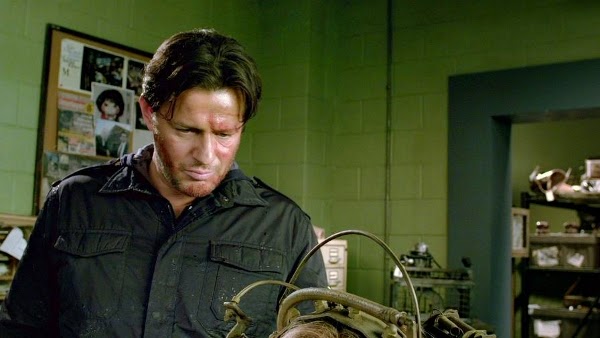
There are two main plots to Saw: The Final Chapter. They are neither connected, nor particularly "final", but alas they insist upon happening anyway. The larger portion of the plot revolves around Bobby (Sean Patrick Flanery), a man who claims to be a Jigsaw victim in order to appear on talk shows, sell books, and run a high profile Jigsaw Survivor support group (one member of which is the mom from Part VI who was never actually in any danger and literally just sat in a cage for an hour, so I sense some attention issues).
Obviously, he is put into a trap emulating the one he claimed to have suffered through so he can take advantage of the full Jigsaw experience. This includes such complementary amenities as 1) excessively complicated murder traps, 2) beleaguered metaphors about hearing, seeing, and speaking evil, and 3) addled scribblings on any available wall space ("Understand your problems," "Verify your self worth through commitment" - because evidently Jigsaw has secret aspirations of being a motivational speaker for local businesses).
Oh, also his publicist, manager, best friend, and wife are killed for good measure. Oh, also this plot ends without a single nod toward connecting it with the B story or explanation about who exactly arranged the trap. Oh, also it has no satisfactory conclusion within itself. Oh, also this movie is the cinematic equivalent of biting a hangnail and accidentally tearing too far.
The second plot largely involves the exploits of Jigsaw compatriot/resident douchenozzle Detective Hoffman (Costas Mandylor) as he tracks down Jigsaw's ex-wife Jill Tuck (Betsy Russell), who recently attempted to kill him via reverse bear trap and is being protected by useless Internal Affairs officer Matt Gibson (Chad Donella) in exchange for information on Hoffman's whereabouts. He's so useless that his repeated efforts to comfort Jill (literally repeated - "You're in a safehouse. Safe house. Safe. House.") are immediately thwarted ("This tape just came in the mail addressed to Jill.").
Also, Hoffman terrorizes the authorities with infernally simple clues and (drumroll) malicious emails because he is a 14-year-old bully in 2003. He probably also has an email signature that says something like "Hoffman Rules Police Drools Jigsaw 4EVA!!! !!1! Gerard Way is God" followed by a metric ton of sparkly hearts.
Aw man, they won't know what hit 'em when I send them that chain email. That little girl ghost is totally gonna tear their sh*t up if they don't send it to 50 friends!
It looks like we're in this one for the long haul, so let's take a breather for a moment and appreciate some of the positive elements of the film. The directing style is clean and precise, finally scrubbed clean of the obnoxiously dingy Grimstagram color filters that permeate the franchise. It only took six entries for them to figure out that not every frame positively cries out to be tinted green, so at least they're evolving. I'd prefer for them to be actually improving, but wishing for the sixth sequel in a horror franchise to be a good film is not a productive pastime.
So that's swell. At least they have that in the bag. And I say the following with absolute, positive, 100% unironic praise: the DVD menu is frickin' rad as hell. Seriously. It's simple and effective, capturing the feeling of the films free of the messiness typically involved with this franchise's publicity campaign**. Above the selection menu is a timer counting down from 45 seconds and the scrawled phrase "Make Your Choice." Integrating the fictional world with reality is probably one of my favorite styles of promotion, and it's an elegant, fun way to keep fans enthralled. But this isn't a menu review. This is a movie review. I just wanted to give you guys a brief moment of solace before the true terror begins.
**I would like to take a brief moment to at long last publicly criticize the go-to tagline for the franchise: "If it's Halloween, it must be Saw." Yes, the films debuted every October for seven years, so I get what they're trying to accomplish. But if that's not the most clumsily structured conditional statement in the history of the English language, I weep for the parent of whoever penned it.

Alright, it's time to finish this. Let's finally bust free from the trap that is the Saw franchise.
The gore is slightly more demure than the previous entry, but what it does have to offer is relentlessly pushed on the audience. The camera lingers over gaping maws and ripping flesh like they're juicy burgers in a fast food commercial. At least that means that the franchise is also finally free of the annoyingly hyperactive dubstep hummingbird editing that normally surrounded the gore sequences. Unfortunately it turns out that, without that Saw staple, it just makes everything worse. Is it possible for both options to be the lesser of two evils?
But the non-gory traps are pointless (nearly the entire police force is murdered with what looks like a battle droid), so at the very least the violent ones are well crafted. Although that has never been an issue with this franchise. The utmost care and professionalism is put into making sure the audience feels like they need to vomit for 90 minutes. A couple of them are even over-the-top fun, in the vein of the Hatchet franchise. Unfortunately, the bulk of it is wan torture porn that, by the turn of the decade, was well past its sell-by date. In fact, while forcing myself to sit through the second half of the film (Sergio had long since checked out and was scrolling Tumblr on his phone - what a trouper), I entertained myself by imagining the producers discussing the gore in the concept meeting.
"So, we hear that people really don't like bad things happening to eyes or teeth."
"Alright perfect, let's do that. Now, how can we make this fit in with the overarching storyl-"
"Oh, were you saying something? I just released the movie to theaters, can it wait?"On top of that, the acting is atypically atrocious. I'm saying it's bad even by the standards of the Saw franchise. Cary Elwes and Tobin Bell turn in their worst performances in the series in about two scenes each - thanks for showing up to work, guys. Chad Donella does little to convince the audience that he's not a twelve-year-old boy on Ritalin masquerading as a secret agent. And where Costas Mandylor had his multitude of faults as a smug, cocky brute, he's even worse as a ragged quasi-terrorist in stubbly survival mode.
Not even the added perk of three dimensions adds any, well, dimension, to the film. There's a couple scenes that are fun through sheer lunacy (a saw is tossed full force into the camera; the puppet Billy enters in a room by smashing through a window in a steel cage - he's like a wooden Liza Minnelli), but most of the effects just involve guts being doggedly thrown at the camera with no vigor or enthusiasm whatsoever.

No, their real priority was making sure that every scene made the female audience members as uncomfortable as possible.
Which brings me to a brief reflection on the franchise as a whole. Although parts 1 and II favor story over gore, the final five wallow in inflicting squishy grimness onto cardboard characters while Jigsaw pontificates about his harebrained philosophy in flashback. They're deeply misogynistic (Part IV and The Final Chapter both feature traps that punish women who are in abusive relationships because being beaten up by a man is clearly their fault), punishingly grim, and pedantically amoral.
I'll (thankfully) never have the chance to say this again in a review, so I'm gonna lay it all out now: Jigsaw's philosophy is a load of garbage. He smugly claims that he's trying to connect with people's survival instincts by making them mutilate themselves and learn to appreciate life more. But there are several flaws in his theories.
First (And Foremost). Just because Jigsaw decides that somebody sucks doesn't mean that they deserve to get their arm chopped off.
Second. Jigsaw doesn't stick to his word. Although he will take every opportunity to moralize about how "I AM NOT A MURDERER" and "KILLING IS DISTASTEFUL" and how everyone in his "tests" is given the opportunity to survive, a great deal of his traps in the later films involve tertiary characters who have done nothing wrong other than associate with a wrongdoer and are given no opportunity to enact an escape. These people are punished for their nonexistent indiscretions with long, drawn-out torture all in the name of bettering their friend who is, by all accounts, way more of a douche than them.
Third. The murders are too excessive and complicated. Jigsaw and his compatriots are the type who always bring a spring-loaded 45-second-timer reverse bear trap to a knife fight.
Fourth. Jigsaw claims that he's attempting to better the lives of those around him, but his traps are mostly just petty swats at people who screwed him over.
Fifth. Yeah, Jigsaw is definitely a murderer. No two ways about it.

Just because the guy from Linkin Park has to peel his back away from the seat himself doesn't mean that you're not guilty of gluing it there in the first place.
I have pondered and pondered about just why (oh why) these movies have such a thriving community of fans that even now will troll negative reviews of the films (not that I have firsthand experience or anything), post excessive and poorly written reviews/factoids on IMDb or other online resources, and generally tout the films as the crux of modern horror.
My current working theory is that the Saw franchise rewards fandom and constant rewatching. Characters, traps, scenes and situations from earlier entries either become important elements later on, have small payoffs in flashbacks or future revelations, or tie together in increasingly twisted ways. So any character that one may be particularly fond of will definitely reappear in some capacity. Or any moment that one enjoys will be reworked and re-envisioned over and over again as the series mythology expands. With each new twist, more information about the world of Jigsaw falls into place, rewarding the people who spend their time on message boards contemplating motivations and connections, penning theories into the wee hours or writing Billy the Puppet fanfiction.
Because goodness knows, with films as tedious and nasty as The Final Chapter, I certainly hope it's not the vulgar gore and pedantic moralism that keeps people coming back. Please.
TL; DR: Saw: The Final Chapter is the worst of a rotten bunch.
Rating: 2/10
Word Count: 2310
Reviews In This Series
Saw (Wan, 2004)
Saw II (Bousman 2005)
Saw III (Bousman, 2006)
Saw IV (Bousman, 2007)
Saw V (Hackl, 2008)
Saw VI (Greutert, 2009)
Saw: The Final Chapter (Greutert, 2010)


