Showing posts with label Leigh Whannell. Show all posts

Tuesday, July 10, 2018

Popcorn Kernels: Q2 Review Purge

In which we run through some mini-reviews of current 2018 films that I either didn't have time or interest to review fully.

Tag


Year: 2018
Director: Jeff Tomsic
Cast: Jeremy Renner, Ed Helms, Jake Johnson
Run Time: 1 hour 40 minutes
MPAA Rating: R

A group of five grown men play the same game of tag every month of May, and they're pulling out all the stops for their final season, interrupting the wedding of the only friend who has never been tagged.

Tag is a hangout comedy through and through, and luckily you mostly do want to hang out with these people, even if they're textbook examples of the white heterosexual man-children that occupy so much space in the comedy arena. It doesn't hurt that one of these people is Jon Hamm, who takes to comedy like a fish to water, and excels in any of the few places that ask him to be funny. Ed Helms is also never a bad personality to spend time with, Jeremy Renner's asshole character is in too little of the movie to make a negative impact, and Jake Johnson's cartoon stoner character isn't as foregrounded as another movie would have made him,

OK, well now that it's laid out like that, maybe I don't want to spend time with these people. Who I do want to spend time with is Isla Fisher as Ed Helms' wife. She occupies the Rose Byrne in Neighbors role here, as the supportive wife who is eighteen times more invested in the antics than her partner, to the point that it's almost psychotic. She steals the movie like she's auditioning for Ocean's 9, with a relaxed confidence that is effortlessly cool and compelling.

Where Tag fails is anytime it tries to apply any sort of dramatic subtext to the goings-on. We don't care about Jeremy Renner's relationship with these people for the same reason that it's troubled: he's never with them. There is no rapport established at any point in the movie, even in the many lame slow motion flashbacks to kids running around like gremlins.

Although his character is no good for drama, Renner does give the movie its best sequences, where it turns into a slapstick action movie. He channels the Robert Downey, Jr. Sherlock Holmes with a perfectly calculated inner monologue that show what an absolute machine he is when it comes to the game of Tag. These sequences are probably a bit too violent for how seriously the movie takes the rest of its characters and their situations (there is a really bad bit where the fakeouts and reality blend in a way that is much too brutal for what the stakes of this game really are), but they're also energetic and fun bright spots in a movie that mostly presents its world in a drab color palette of slate greys and shadow.

It seems like it's trying to be one of those indie comedies that isn't really funny, but an occasional Paul Feig burst of energy emerges to save the day. This doesn't add up to anything particularly special, but I had a decent time watching it, if only to see some fun personalities chill with one another and chatter pleasantly about the good old days.

Rating: 6/10

Upgrade


Year: 2018
Director: Leigh Whannell
Cast: Logan Marshall-Green, Betty Gabriel, Rosco Campbell
Run Time: 1 hour 40 minutes
MPAA Rating: R

A man whose wife has been murdered, leaving him a paraplegic, gets a computer chip installed in his spine that allows him to exact bloody revenge.

Have you heard of the odious movie trope known as "fridging?" The more you're aware of it, the less you'll like the first act of this movie, which uses a dead woman as a kick-off to a man's arc like many an action flick. This is not forgivable by the fact that Upgrade transparently wants to be a sci-fi version of Death Wish, though maybe it's a little more comprehensible why anybody thought that plot line was a good idea in mid-2018. Maybe.

That aside, I liked Upgrade quite a bit. Other than its obvious Death Wish ties, it also seems to be a pre-remake of the upcoming flick Venom, with a murderous symbiote grafted to a Tom Hardy lookalike. It's like an Asylum studios project, only actually fun!

Set in a Blade Runner-esque near future (the fact that this movie only serves to remind you of other movies could have been a liability, but the way it mixes and matches the tropes its pulling does give it a certain madcap playset energy that does it well), Upgrade exists in a beautifully conceived setting. It's not a particularly wide world they have created, but the honeycomb design of most of the futuristic spaces combined with the still-recognizable remnants of our current society that haven't quite been phased out is a triumph of mid-budget production design.

Although the characters are stock archetypes and the plot is predictable as hell, it's still fun to watch this roller coaster ride play out through this world, and the action sequences contained therein are pretty phenomenal. Logan Marshall-Green gets a chance to show off his best Bruce Campbell impression as his body performs incredible stunts, much to the shock of his face. The duality of the two characters inhabiting one body is never forgotten, and his physical performance is terrific, adding a boost to well-choreographed fights that end in ecstatically gruesome gore gags.

Sure, Upgrade isn't the most original or provocative movie that tumbled into theaters this year, but it was a hell of a turn-your-brain-off good time. Leigh Whannell knows how to entertain an audience, and in the summer season that's exactly what the world needs.

Rating: 7/10

The Death of Stalin
Year: 2018
Director: Armando Iannucci
Cast: Steve Buscemi, Simon Russell Beale, Jeffrey Tambor
Run Time: 1 hour 47 minutes
MPAA Rating: R

After the death of Josef Stalin, his political comrades struggle to fill the power vacuum he has left behind, with hilarious [sic] results.

The Death of Stalin is a comedy for fancy people. I like to consider myself a fancy person every now and again (at least in my movie tastes, though that fact that I give equal marks to Breathless and The Texas Chain Saw Massacre probably disqualifies me from the club), but boy was this movie a chore. If you took the most forgotten sketch from Monty Python's Flying Circus and expanded it into a feature film, it would be exactly like this movie. Except funnier.

This is Monty Python through a game of telephone, with characters jostling for attention through a series of comic vignettes that quietly refuse to land. It's a very meat and potatoes comedy, relying on setups and gags that are creaking and musty with age. But that's probably not fair to the movie either, because Charlie Chaplin's Modern Times uses every comic trick in the book and it's still fresh nearly a century later. It just kind of doesn't work, at least for my personal sense of humor, which is obviously extremely subjective.

The thing I think people are having a hard time separating here is the difference between "something smart" and "smart humor." Sure, this movie knows a heck of a lot about Russian politics, but faithfully presenting that throughout multiple extended scenes of murder and torture isn't funny. It just... is. Death of Stalin works better as a low budget History Channel documentary than a comedy, faithfully presenting so many events that it leaches the humor right on out of them in favor of historical footnotes and endless cameos from political figures of the time.

Maybe I'm just an uncultured boor who likes things to be loud and in my face, but this one just wasn't doing for me. And the less said about Jeffrey Tambor's presence, the better.

Rating: 4/10

Deep Blue Sea 2 (For the Scream 101 episode about this title, click here.)

Year: 2018
Director: Darin Scott
Cast: Danielle Savre, Rob Mayes, Michael Beach
Run Time: 1 hour 34 minutes
MPAA Rating: R

A businessman brings a team of experts to an ocean facility where he's experimenting on sharks to create a pill that increases intelligence, and obviously the sharks eat most of those people.

And here is the movie that I'm going to give the same rating as Death of Stalin, even though my enjoyment with it took me about ten million light years further than the former. I contain multitudes, everyone.

I have seen my fair share of direct-to-video, many years later sequels, and I must say, Deep Blue Sea 2 delivered exactly what I was expecting (a pale wisp of the original that acts more as a remake than a bona fide sequel). And yet, there's some spark about it that kept me invested more than usual. I wouldn't go so far to say that it qualifies as a true bad-good epic, but it certainly flirts with being entertaining more often than not, which is more than I can say for a lot of its ilk.

There are certainly a great deal of budgetary limitations that lead to a drab set, subpar acting, and an alarming lack of shark mayhem for long periods. But those limitations also lead to some very special moments, most notably a completely indelible scene where a shark puppet spies on a conversation through a porthole. Also, the one element where the film truly feels like a sequel is by far its best: instead of the giant sharks being the villains this time around, it's a herd of baby mutant sharks that have been let loose in the facility.

These baby sharks are the stuff that B-movie dreams are made of. They're adorable partially because of their low-fi nature, they allow for some creative kill sequences that wouldn't be physically possible with a larger specimen, and they allow this film to have some sort of feeling of generational legacy and passing the baton that gives it the air of a sequel, even if it's really nothing of the sort.

Sure, I could do with a lot fewer scenes of the characters wandering down the same metal hallway and bleating about their divergent philosophies. But for my money (which, mark you, was $1.75 at Redbox, I ain't no big spender), I had a decent time with this one. Recommended to anyone who likes sharks and isn't discerning.

Rating: 4/10

Sicario: Day of the Solado
Year: 2018
Director: Stefano Sollima
Cast: Benicio Del Toro, Josh Brolin, Isabela Moner
Run Time: 2 hours 2 minutes
MPAA Rating: R

American operatives attempt to ignite a cartel war by kidnapping the daughter of a kingpin.

I have no large amount of love for the original Sicario, which is a beautiful but deeply unpleasant experience. But the deeper I got into the cumbersomely titled Day of the Soldado, the more I realized the value of that film. Because this is exactly the movie Sicario could have been if the script wasn't guided by the firm hands of director Denis Villenueve, cinematographer Roger Deakins, composer Jóhann Jóhannsson, and star Emily Blunt.

Replace those people with an Italian TV director, the dude who shot the "Eternal Flame" music video, the cellist from The Revenant, and, well, nobody could replace Emily Blunt, and you have stripped away everything that made Sicario great. Instead of being a slick, tense, visually stunning descent into bleak nihilism, this film is just a shotgun blast of misery that begins to falter in the third act and falls face first in the mud before credits roll.

This film has a lot of problems, but it starts by introducing a wholly unnecessary terrorism element in favor of being "topical" before completely ignoring that plotline to continue their heavy-handed drudgery about the Mexican border (a topic that in the age of Trump is even more unpleasant to engage with, by the way). This allows the movie to reintroduce Josh Brolin's amoral character in a torture scene that reminds you how unsympathetic he is, before forcing you to spend the entire movie with him.

Also returning is Benicio del Toro, whose entire motivation has been corrupted by the need to bring back somebody else from the original film. He at least gets to act across from one of the only two interesting people in the movie, the young and talented Isabela Moner (the other is also a newbie - Elijah Rodriguez as a Mexican-American living in a Texas bordertown).

But the movie is still an endless repetition of shots and elements of the original, but worse. Even the overhead shots of helicopters soaring over the Mexican desert are more boring and ill-framed, and those were literally just shots of objects moving in a straight line. This is a sequel that never should have existed in the first place, and every single thing it does serves to remind you of that fact, especially the two worst elements in the movie: a pair of pulled punches in the third act that convert the film into a half-hearted fist-pumping hero flick, and Catherine Keener as Brolin's boss, totally lost in her nothing of a character. One to miss.

Rating: 3/10
Word Count:
Reviews In This Series
Sicario (Villenueve, 2015)
Sicario: Day of the Soldado (Sollima, 2018)

Wednesday, January 10, 2018

Für Elise

Year: 2018
Director: Adam Robitel
Cast: Lin Shaye, Leigh Whannell, Angus Sampson
Run Time: 1 hour 43 minutes
MPAA Rating: PG-13

How has it already been seven years since the original Insidious? This franchise is already as venerable as Saw was when it reached its pre-2017 conclusion, and that's a cold hard fact I'm just not ready to face. 

Well, more than half a decade in we've reached if not a final film, at least a turning point in this baby brother franchise to The Conjuring: the film that connects the events of prequel Chapter 3 and the original film, completing the arc of Elise Rainier (Lin Shaye's medium character, who went from being the Zelda Rubinstein of the series to helming two horror tentpole features, which is by far the coolest thing about these movies). 

The fact that a 74-year-old character actress is now headlining movies for teens makes me absolutely giddy.

Insidious: The Last Key traces Elise's roots back to her hometown of Five Keys, New Mexico. When a client calls her to investigate a haunting in her own childhood home, she and her sidekicks Tucker (Angus Sampson) and Specs (Leigh Whannell, who returned to pen the script for the fourth time, beating out Saw, which he bailed on after three entries) encounter the demon Keyface (Javier Botet), who is the key to unlocking the secrets of Elise's past.

It's literally impossible to talk about this movie without accidentally making at least 32 key puns.

I initially approached this movie looking for subtext I could use for my new Dread Central column Brennan Went to Film School (first article out January 16th!), and I had my mind blown just a teensy bit. There is a lot of material surging beneath the surface here. While I chose to focus on the feminist Me Too metaphors for sexual assault and whistleblowing, there's also a lot of material about the cycle of abuse and creating your own family. I'm just getting this out of the way now, because I won't really be mentioning these things in my review, as important as they are. You'll just have to wait for my column, folks. It's a goodun.

But as surreptitiously smart as the film is, there's still something a little unsatisfying about the way the story plays out. The plot introduces a lot of threads that are never returned to (the opening quite obviously sets up that Keyface needs to open five doors for some nefarious purpose - and his fingers even have four out of five keys - but instead of having a Thanos-esque collection of keys provide our ticking clock to some grand evil, only one door is ever opened and that plot goes nowhere), some setups with microscopic payoff (they make such a big deal out of Specs having lights on his glasses, and then he never really uses them), and in general it just reeks of cuts and reshoots.

And the intelligence of the screenplay screeches to a halt every time Bruce Davison is onscreen as Elise's younger brother Christian. He is forced through a meat grinder of maudlin, exhausting family drama tropes that simultaneously accomplish the twin feats of deflating the tension and making him look like an idiot horror movie character.

The reason this has happened is that he went to a haunted house to find a whistle he had no reason to believe was actually there. His Mensa membership card is not in the mail.

Also, the real insidious presence that has always been in this franchise is the comic relief from Specs and Tucker, who can sometimes hit the perfect pitch, but mostly feel a little jammed-in and reek of flop sweat. That stench reaches its peak here, where most of the humor is mined from their creepy obsession with Elise's much-younger nieces, who arrive about halfway through the film and are subject to non-stop leering from that point on. It's creepy and it's icky, and it ever so slightly undermines the rest of the actually smart stuff the script has to say.

But... Taking all that into account, there is some pretty effective atmosphere at work here. The Last Key lacks most of the jack-in-the-box jolts that have defined the franchise (save for one scare gag, which utilizes a hoary old trope and flips it on its head in the best possible way), relying on some slow burn creepy imagery to add fuel to that fire. The key image from the trailers - the demonic finger key going into a girl's neck - is obviously incredible, as is the Keyface demon itself (I maintain that Javier Botet is the Lon Cheney of our time, bringing incredible monsters to life and consistently being the best part in films both terrific and mediocre, including [REC], Mama, It, The Conjuring 2, The Other Side of the Door, The Mummy, Alien: Covenant, Crimson Peak, and even The Revenant).

Plus, you can never go wrong with Lin Shaye. In her long career she's been handed a lot of crap, but the woman who can take a one scene role in Amityville: A New Generation and make it a layered portrayal/highlight of the movie has earned a lead role and she crushes it.

And I won't say much about this, but there is a plot twist that will send chills down your spine, blasting into the safe PG-13 world of The Last Key like a window suddenly opened to the burning sunlight. As a popcorn horror movie, it's weaker than the previous entries, but there's still something there that's more than worth seeing, if you're into this sort of thing. And to the tune of $51 million worldwide, it seems that somebody out there definitely is.

TL;DR: Insidious: The Last Key is a little bit underwhelming, but it's smarter than it has any right to be.
Rating: 6/10
Word Count: 977
Reviews In This Series
Insidious (Wan, 2011)
Insidious: Chapter 2 (Wan, 2013)
Insidious: Chapter 3 (Whannell, 2015)
Insidious: The Last Key (Robitel, 2018)

Tuesday, November 10, 2015

The Devil's Playground

Year: 2015
Director:  Jonathan Milott & Cary Murnion
Cast: Elijah Wood, Rainn Wilson, Alison Pill 
Run Time: 1 hour 28 minutes
MPAA Rating: R

By every sense of the word, cinematic zombies are dead. The gargantuan success of The Walking Dead (and all the other sub-Romero shows that have latched onto its influence like remora on a shark) has creative a sucking void in the silver screen. Other than decent but hardly exemplary dribbles of undead revenants in flicks like World War Z or Warm Bodies, the gut muncher craze of the 2000s is dead as a doornail (that’s been shot in the head).

And out of death, rebirth. Spectrevision’s zombie comedy Cooties could hardly be considered a massive release, but certainly releases massive laughs, applying a jolt of electricity to the heart of the languishing subgenre.

Just when you thought you were safe.

If you’ve ever wanted a detailed account of how chicken nuggets are made, you’re in luck. Following a sickeningly detailed opening sequence that will get you swearing off McDonalds with the force of ten Super Size Me’s, young substitute teacher and aspiring horror novelist Clint (Elijah Wood, whose career path is always an adventure) discovers that  nugget-borne virus has affected the students in the school, transforming them into ravenous zombies with a taste for human flesh.

He must band together with the other teachers, including macho gym coach Wade (Rainn Wilson), his girlfriend and Clint’s crush Lucy (Alison Pill), right wing Sarah Palin clone Rebekkah (Nasim Pedrad), socially awkward biology teacher Doug (Leigh Whannell, who also co-wrote the script), and Jack McBrayer character Tracy (Jack McBrayer), as well as the few surviving students, to attempt to beat back the horde and survive the day. So, basically, a regular shift for a substitute teacher.

Ask not for whom the school bell tolls, it tolls for thee.

Whenever one is assessing a horror comedy, it’s always important to get a bead on which genre it favors. It just wouldn’t do to go into Ghostbusters expecting spine-chilling frights (unless you’re six-year-old me, in which case it might just cause some detailed emotional scarring). So I’m going to let you know right now that Cooties is primarily a comedy, trafficking in horror scenarios and carnage, but always more content to tickle your ribs than wrench them out.

The element that separates Cooties from your average horror comedy is that it’s actually pretty damn funny. It’s of a sophomoric and irreverent bent, but if you open your heart broad enough, it’s a ray of sunshine. Only the main characters are developed to any point past a particularly funny SNL sketch, but they provide such consistent humor that it’s hard to complain. In fact, the best moments of the film come from when it just lets the characters be themselves. Their rowdy caricatures match the heightened tone of the film, bouncing off of one another in epically silly displays.

The real strength of Cooties is its cast, most of whom are seasoned comic performers. However, their experience comes from such different mediums (sitcoms, sketch comedy, feature films) that bringing them all together leads to a tangle of unexpected directions. Leigh Whannell is perhaps the standout here, because his character is so deliciously strange (either he saved the best part for himself or he’s growing into his front-of-the-camera talents), but there’s not a sour note in the entire cast. Even Elijah Wood, whose experience lies farthest from the wacky, provides a clueless earnestness and a keen awareness of his character’s buried flaws that he’s a more or less perfect straight man and audience entry point with a few good punchlines of his own.

He’s the one ringer to rule them all.

Although the comedy is the focal point of Cooties, it’s still a pretty terrific film in other respects: We all know by this point that I’m a sucker for a bold color scheme (“You had me at that red wash”) but the block color lighting present in many sequences highlights the childish fantasy aspect of the film with lurid primary colors. At its heart, Cooties is about the generational war between younger adults and children, and these highly saturated hues emphasize how these character are desperately clinging to their juvenile motivations and antics. They’re forced to take responsibility and grow up when the new generation rises up, forcing them to assume more adult roles. And you thought that this was a movie about zombies.

I mean, yeah, it totally is. The gruesome, pigtail ripping, entrail gnawing “suffer the little children” gore setpieces kind of betray that. But Cooties is smart enough to use the Romero approach to its undead revenants, bringing them into a social and political context that elevates the film from its bare bones survival plot.

Isn’t horror fun?

Unfortunately, the effortless entertainment of Cooties has an expiration date. By the time the third act drags itself to the finish line on bloody stumps, much of the film’s high quality has deteriorated, It just plain has no earthly idea how to end, wandering from setpiece to setpiece as it attempts to find the missing link that wraps this whole story up It never does, and the film does end so much as it peters out. It’s like a song fading on its chorus, slowly deflating until it vanishes completely.

During the course of this lamentable excursion, a major thematic throughline (Clint’s horror novel) is abruptly dropped like a Beyoncé album, and the film introduces an unnecessary tertiary character that is both trite and kinda racist. Generic third acts betray a lot of quality horror films, but the chasm between the final twenty minutes and the rest of the film is dizzyingly wide.

However, Cooties pulls through on life support. The sheer exuberance of the first hour makes up for the creative deficit of the final third and it’s short enough not to painfully overstay its welcome. I do wish it closed at a much clearer point, but I’m happy it opened in the first place, delivering us plenty of insight, belly laughs, and irritating children getting what they deserve along the way.

TL;DR: Cooties is an exuberant, fun horror comedy with an unfortunately lame third act.
Rating: 8/10
Word Count: 1040

Sunday, June 7, 2015

Ghost Of Franchises Past

Year: 2015
Director: Leigh Whannell
Cast: Dermot Mulroney, Stefanie Scott, Lin Shaye
Run Time: 1 hour 37 minutes
MPAA Rating: PG-13

James Wan and Leigh Whannell are a kick-ass horror team. Their first joint outing, Saw, changed the horror game of the early 2000's. I may not be a big fan of where that rabbit hole led, but the fact remans that their grubby shocker was one of the best of the business at the turn of the millennium. And their followup, Insidious (Dead Silence? Never heard of it.), is a chilling throwback haunted house tale that brought the fangs back to PG-13 horror and reintroduced the world to horror icon Lin Shaye, paving the way for a series of successful spooky tales like The Conjuring and Sinister.

Now, I was no fan of Insidious: Chapter 2, which I found to be juvenile and hackneyed, but the fact remains that their teamwork still produced a film with a handful of stellar scares and a fascinating visual palette. And God help me, but I do secretly love when horror franchises go a little off the rails.

The thing about Insidious: Chapter 3 is that its the first film in the franchise to cleave the union. With James Wan busy working on bigger, skydivier things, Whannell was left to his own devices, taking on the role of director on top of his screenwriting and acting duties. It's a lot to handle, and he does so admirably, considering. This third entry in the franchise has neither the creative gusto of the first or the brassy, bold aesthetic of the second, but it's a remarkably decent entry in a series unabashedly prone to reinvigorating the hoariest clichés of the genre.

This image could be from literally any movie released this decade. And my money's on Deliver Us From Evil, to tell you the truth.

Inidious 3 takes place several years before the events of the original film, meaning that the cell phones are blockier, the cars are more old-fashioned, and Dermot Mulroney gets starring roles in films. High school student Quinn Brenner (Stefanie Scott) lives with her overwhelmed single father Sean (Dermot Mulroney), who has an important, manly job like Contractor or Foreman or something. She meets with the medium Elise (Lin Shaye) in an attempt to contact her dear, departed mother. Unfortunately, when she reaches out into the spirit world, something else reaches back. 

After she breaks her legs in a car accident following an audition for a renowned theater school, she finds herself being haunted by The Man Who Can't Breathe (Michael Reid MacKay, who also played the Mummy in the prestigious Monster Squad), a mysterious inky black ghost wearing a gas mask that seems to live upstairs and travels through the vents into her room at night. Calling upon the help of Elise and her soon-to-be sidekicks Specs (Leigh Whannell) and Tucker (Angus Sampson), the Brenners must face the most evilest evil ever unleashed.

Which retroactively makes the first two films just that much more confusing - you'd think Elise would know how to handle things by then.

This time, instead of taking cues from Poltergeist like the first films, the plot has a very Exorcist slant. Points for variety I guess. You know: little girl possessed by an entity that may or may not be masquerading as her sickness, single parent watching nervously from the sidelines, and a plot that focuses more on the expert helping her (Elise, being the big franchise link here, gets a much expanded role, including shutting down her business following the grief of her husband's death and threats from an otherworldly force). It's textbook stuff, really.

Insidious: Chapter 3 has its share of flaws but I enjoyed it, so let's keep things positive and get the complaining out now so we can get to the good stuff. First of all, the plot is very dub. That was unavoidable, especially for a film set in the same universe as Insidious 2, in which plot twists were to be found in places that should have been thoroughly checked over 3 decades before. I'm still mad. Nothing in this film is quite so enervating as that, thankfully, but there are still a variety of insoluble problems at the script level.

The beginning is beholden to some claptrap paranormal-babble, which is par for the course, but the simplistic, kindergarten-esque insistence on dark vs light is a little cloying. However, the real issues begin with the third act, which always seems to be the turning point for these films, and Leigh Whannell's weakest link as a writer. The heroes attempt to solve their problem by doing the exact same thing that screwed them up the first time, the only way they're saved is through a Mount Olympus-worth of deus ex machina, we're asked to be shocked by several twists so immensely obvious they can be seen from space, and at one point Lin Shaye inexplicably turns into Ripley from Aliens.

In addition, Dermot Mulroney can't find anything to do with his character, which is a shame considering that he's the thematic and emotional lynchpin of the film,with his fear that he might lose hi daughter to the inevitability of death just like his wife. It's interesting enough in its recitation that he doesn't ruin the film, but the role might as well have been performed by a cardboard cutout of Mel Gibson. Luckily Lin Shaye returns to form, instilling real terror into her broken and fragile Elise, though she trips up occasionally on her more treacly cheerful scenes.

I don't think this woman has played a happy role in her life.

But hey! We can be negative until the cows come home, but we can't milk them with a frown. Or... something. Let's move on to the good stuff. 

Insidious 3 isn't a knock-your-socks-off terror gauntlet, but it's a well-oiled boo machine with a couple lasting frights sprinkled amid the jump scares. There's perhaps nothing more frightening than the one or two truly stellar moments of Insidious 2, but as a whole, it is far more consistent in encapsulating the roller coaster of screams that most modern horror strives to be. The viscous, oily design of The Man Who Can't Breathe is nightmare fuel in its own right, and his intensely terrifying visage amps up even the most feebly generic moments.

The franchise's signature comic relief is also present, in extremely palatable amounts. Leigh Whannell and Angus Sampson have shown a penchant for horror comedy (though, if I were to pick between Insidious and 100 Bloody Acres, it would be the latter any day of the week), and here their work is reliably charming, though it thankfully doesn't overpower the horror.

The Further is perhaps the least appealing returning element, though it does afford the film its only truly spectacular image: a blood red elevator door lost in a chill blue ghost dimension. Why the ghosts would feel the need to use an elevator, especially in their ectoplasmic domain remains unknown. But hey! Insidious: Chapter 3 is decently pretty, pretty scary, and scarily funny, so it's far from a disappointment, all things considered.

TL;DR: Insidious: Chapter 3 is a great addition to its franchise with its cheery dumbness and a variety of effective if cliché scares.
Rating: 6/10
Should I Spend Money On This? Only if you really liked the first one. You do not need to see the second. Don't feel the urge to catch up, I beg you. 
Word Count: 1252
Reviews In This Series
Insidious (Wan, 2010)
Insidious: Chapter 2 (Wan, 2013)
Insidious: Chapter 3 (Whannell, 2015)
Insidious: The Last Key (Robitel, 2018)

Sunday, November 2, 2014

I Saw The Sign

Year: 2006
Director: Darren Lynn Bousman
Cast: Tobin Bell, Shawnee Smith, Angus Macfadyen
Run Time: 1 hour 48 minutes
MPAA Rating: R

Well, Halloween is over, but the sheer amount of movies I watched at the end of October will give us an extra week of celebration as I get through those reviews during this first week of November. Not that it's not Halloween all year over here anyway, but it's still nice and festive. And what better movie to kick off our post-holiday candy buzz than Saw III, the second sequel spawned from James Wan's unexpectedly massive indie hit. 

The franchise was a staple of the October season for nearly an entire decade, a decade in which I avoided the Saw films like chocolate-covered broccoli. I'm currently seeking reparation for that period of my life by marathoning all seven of the godforsaken things. I had a brief hiatus after summer ended because, hey, homework has precedence over torture films. It's a strange world we live in. But I'm back now and better than ever! Unfortunately the Saw films are only getting worse, so it will take all the strength I can muster to sally forth and reach the finish line.

But right now we have Saw III. Still early enough in the franchise that original screenwriter Leigh Whannell is sticking to his duties like a particularly tough strain of mildew. Saw II director Darren Lynn Bousman also reprises his duties here (as he would with the next year's Saw IV - this man put food on the table for three years by finding new ways to tear flesh apart), so if anything, at least the film has a consistent direction with the first and second films. 

That direction is directly into the toilet, but at least it still has its integrity.

This is the only franchise where this image and that word can be paired together without irony.

The film opens with a perfunctory coda following up on the status of Detective Eric Matthews (Donnie Wahlberg) and his partner Kerry (Dina Meyer) - spoiler alert: it involves a lot of blood - but the bulk of the action revolves around two storylines that have heck-all to do with the events of Saw II. So that's fun. Or it would be, if distancing itself from Saw II didn't mean detaching the tether to the last good entry in the franchise.

The plot - and with each subsequent entry the strain on that word goes stronger - revolves around the ailing Jigsaw's (Tobin Bell) final test. His accomplice Amanda (Shawnee Smith) has rigged it so that if his heart rate drops to zero, the kidnapped Dr. Lynn Denlon (Bahar Soomekh) will be destroyed by an explosive device around her neck. Her task is to keep him alive until after the test is complete, the subject in question being Jeff (Angus Macfadyen), a man whose life is fueled by grief and vengeance after his son is killed in a drunk driving accident. Through a series of gory tests he must learn to forgive the people responsible and move on with his life.

Or he could stand around dilly-dallying and being a useless waffle while the few people he actively decides to save die off anyway because he's too much of a stubborn asshole to respect other people's humanity, even though saving them would do little harm to himself. Perhaps you could extrapolate from that marvelously veiled and subtle sentence, but none of the characters in Saw III are particularly likable, especially this dillhole who leaves a trail of unnecessary carnage in his wake like a chainsaw made of sharks.

If only I could find a key to unlock this poor woman who is freezing to death. Like this one in my hand. Oh well, she's probably dead already anyway, it's not like I should bother about hurrying or anything. I'm just a loser who whines about his son while multiple human beings are flayed before my eyes. I hope someday people write blog posts about me to commemorate my heroism.

With such a toxic protagonist, it would be helpful if the film had a moral sticking point anywhere to be seen, but alas this is the third film in a franchise, so it's already crossed the line where the villains have become the main characters. Everybody else in the film is just a poorly acted, amoral sack of meat whose opinions, feelings, and aspirations couldn't matter less. They're just there as soulless fodder for the incredibly pornographic gore sequences (of which this film has so many slots to fill, it even included a surgery scene in amid the trappy festivities) - making this the first in the series to truly tip the scales into that most dour of genres: torture porn.

The traps are clever enough as devices with which to marvel at humanity's ingenuity and capacity for cruelty, but gone are even the tenuous links to character development present in the first two films. In lieu of actual human beings, the Saw aesthetic is honed and weaponized and becomes a character far more nuanced and present than anybody else in the entire film. The grimness sets in like a rot - every light that can possibly be tinged green is poured onto the set in a pile (turning everything the color of mucus that has been urinated on), the dubstep-video editing turns itself all the way up to the Skrillex level, and the production design combines all the best elements from all the highest quality dingy warehouses from the Dingy Warehouse Warehouse. The fact that this is the longest film in the franchise means that this cheery atmosphere is jammed into your skull again and again like a rusty jackhammer.

The filthy, low res video charms the eye with its grain the size of actual grain on the side of a Nebraska highway while the ear is delicately tickled with the splintery wood of Whannell's dialogue. I'd prefer not to think about Jigsaw mentioning that he will "sentence" a judge's soul to hell, so I'll divert attention by mentioning that a second act confrontation (and another in the third) devolves into a repetitive shriek circle not entirely unlike that scene in Rocky Horror where they all shout "Janet! Brad! Rocky! Dr. Scott!" on loop. There's a flashback that unnecessarily re-explains the context of the original Saw in a way that actually makes that film less interesting, a mystery in the first act that is easily solvable by anybody who was awake while watching Saw II, and the villains vacillate between Rube Goldbergian pre-planning and Barney Fifish vacuity. I mean, they actually challenge a doctor to keep a late stage terminal cancer patient alive with not much more than a set of Operation prongs and a handful of aspirin.

And yet their isolated warehouse/medieval torture device budget is alarmingly high.

But hey, it's not all bad. There's always at least one thing to redeem a movie (unless it's The Outing but the less we talk about that film that happier I'll be with my life) and the Saw films were big studio pictures so you can assume at least one professional was hanging out on set, maybe by the crafty table somewhere.

There is exactly one good scare involving a TV screen displaying a camera readout from a jarring angle. Unfortunately it follows a truly execrable mirror scare, but this is 2000's horror. You take the good with the bad. The most consistently valuable element of the film is the performance of both of the villains. Tobin Bell is always reliable as the ragged and angry Jigsaw, but Shawnee Smith really gets a chance to show off her chops with a much meatier role for Amanda. The character is still an obnoxious psycho, but Smith justifies her actions with a solid core of emotion that I'm grateful was there. 

Smith is the film's anchor, preventing it from straying too far from the Saw universe even while it wildly careens in terms of quality. Saw III is never at any point a good movie, but thanks to the increased screen time of the only two talented actors in the entire wretched enterprise, there is a kernel of merit to watching that keeps me at least halfheartedly on the hook for Saw IV. And that's the most I can wring from my motivation, but it will have to be enough.

Saw III, guys.

TL;DR: Saw III is not very good, nosiree-bob.
Rating: 3/10
Word Count: 1415
Reviews In This Series
Saw (Wan, 2004)
Saw II (Bousman, 2005)
Saw III (Bousman, 2006)
Saw IV (Bousman, 2007)
Saw V (Hackl, 2008)
Saw VI (Greutert, 2009)
Saw: The Final Chapter (Greutert, 2010)

Wednesday, July 16, 2014

Fright Flashback: Do You Saw What I Saw?

Welcome to Fright Flashback, where every week until the end of summer we will revisit an older horror film that is in some way a spiritual precursor to an upcoming new release. This week we are anticipating The Purge: Anarchy, a sequel which promises to expand the universe of the small scope / low budget original in the hopes of transforming it into a franchise. In celebration, today's review is Saw II, a 2005 sequel which accomplished exactly that.

Year: 2005
Director: Darren Lynn Bousman
Cast: Donnie Wahlberg, Beverley Mitchell, Franky G
Run Time: 1 hour 33 minutes
MPAA Rating: R

I've gotta say, binge-watching a long gone film franchise without any real foreknowledge of its contents is a magical experience. I'm a big fan of watching a prominent franchise derail itself (as such, I am the only human in recorded history who enjoyed Paranormal Activity 4 on any level), so I'm excited to get through all the Saw films, but so far I've been enjoying myself immensely in a mostly positive manner.

When Lionsgate released James Wan's Saw upon America in 2004, nobody was expecting the one million dollar film to gross a staggering 55 times its budget in domestic sales alone. As any self-respecting production company would do, they upped the budget to four million (still keeping it relatively low - that kind of profit margin doesn't just roll around every day) and rolled out a bigger and badder sequel in the hopes that the fans would just keep pouring money down the chute.

Evidently it worked, because Saw II made 40 million more than Saw's already astronomical box office, kicking off a yearly tradition that would continue on until Saw 3D, the seventh and, as of the time of this writing, final film in the series. I'll be able to have more insight once I reach the end of this marathon, but something tells me that this is one franchise that can't be called extinct yet, merely dormant. 

We in the horror community know that the word "Final" is about as reliable as an airport ETA, and this franchise was still a wishing well of cash by the time it was canned, the last entry having made roughly the cost of Donald Trump's bathroom. But it's been nothing but radio silence for four years. I'm sure Lionsgate is waiting in the shadows, cooking up something dastardly.

I hope to Jigsaw it's not a remake.

Now, it is typical for sequels to popular films to attempt to do the exact same thing... only bigger. This film is no different. In fact it's a dictionary example of the form. Saw II features four times the amount of victims, eight times the locations, and an insurmountably high number times the embarrassingly wooden lines of dialogue. This was in large part thanks to Leigh Whannell's continuation of the script without the guiding presence of frequent collaborator James Wan, but more on that later.

For now, the traps. I would say "plot", but this is a Saw movie. Let's not put on airs. I don't need to be distracted while attempting to reduce this enormously convoluted plot to a bare bones summary. Alright. It's go time. Detective Eric Mathews (Donnie Wahlberg) is a corrupt cop who's estranged from his wife and son because he slept with Allison (Dina Meyer, one of three returning cast members), one of his coworkers and an expert on the Jigsaw case.

He's finally cornered Jigsaw (the indispensible Tobin Bell) in an abandoned steel factory with the help of a SWAT team. Just as everything is going well, they discover a set of monitors watching over the serial killer's newest morality trap. While the police hurry to trace the source of the video, the eight victims must work together to find a way out lest the poison gas being pumped into the house they're in rip them apart from the inside.

These victims are numerous, but only a few are important. There's Amanda (Shawnee Smith), the only woman to have previously survived a Jigsaw game; Daniel (Erik Knudsen), Detective Wahlberg's son; and Xavier (Franky G) a macho and violent drug dealer who puts himself above all others. Jigsaw gives these eight people a tape recorder and several clues toward assuring their survival, some hideously obvious yet ignored by the victims at large, and some staggeringly perplexing that the characters seem to have no problem with.

Saw's internal logic is as free-flowing as the blood.

The rapidly diminishing victims explore the house and find a series of new traps and games that push the limits of their humanity, either to find an exit or to obtain antidotes to the poison coursing through their veins. It was immediately obvious that Saw II would be bloodier than its predecessor, and while the gore is still more subdued than the implications (no studio would want to scare off audiences by being too brutal - gorehounds are abundant, but absolutely a minority), there are plenty of cringe moments, especially those revolving around the ever-present hypodermic needles that contain the medicine.

The traps are still pretty compelling this time around, not yet devolving into the more indecent realms of "torture porn." Oh, it could certainly be considered a member of the genre but at least the gore is servicing a sort of intensity and sense of purpose, raising the stakes of the situation and providing character momentum. Something tells me that those elements will vanish with Whannell, daft screenwriter though he may be (at least at this point in his career).

Sorry man, I liked Insidious.

The greatest flaws of Saw II can be traced back to the script, although the acting is just as terrible as always (except Tobin Bell, the film's saving grace as a defeated and angry cancer patient, a role much expanded from his original purpose as a crackerjack twist ending). Eric has a flashback to something that happened mere minutes before, Jigsaw's plot this time around involves a Joker-esque level of pre-planning and psychic abilities, and there are too many characters this time around to provide an adequate backstory for any of them.

This film is full of potential energy. You can feel a rich story pulsing beneath the surface (one that is hopefully expanded upon in the increasingly intricate network of sequels), but barely any of it comes out on screen. This is likely because the script itself is adapted from an entirely different story written by Darren Lynn Bousman years before and spruced up with Sawisms by Whannell. The resulting film is a Frankenstein monster of sawed-off backstory and dialogue that could build an ark.

I'm saying it's wooden, is what I'm saying.

But despite all its flaws (many of which it shares with the film that came before - so maybe this can just be considered a hallmark of the franchise) and some of the later twists and turns that kept me up at night poking at plotholes and worrying about the inconsistent MO of a fictional serial killer, it's all part of the ride. Saw II is a roller coaster, a gory, tense and cool film that drags you along with it for the entirety of the run time, only exposing its flaws after you've had a chance to sit down afterward and reflect.

Any dead space in the film would have allowed that moment of realization to come much earlier, so it's a great compliment to say that it has no such moment. And even in the wake of the closing credits, realizing its flaws doesn't ruin the film, it merely knocks it down a couple of notches. Saw II is still a great, fun sequel maintaining the themes established by the first Saw and opening up a universe of possibilities for the next.

TL;DR: Saw II is a good and entertaining sequel, but it falls apart at the script level.
Rating: 6/10
Word Count: 1317
Reviews In This Series
Saw (Wan, 2004)
Saw II (Bousman, 2005)
Saw III (Bousman, 2006)
Saw IV (Bousman, 2007)
Saw V (Hackl, 2008)
Saw VI (Greutert, 2009)
Saw: The Final Chapter (Greutert, 2010)

Wednesday, July 9, 2014

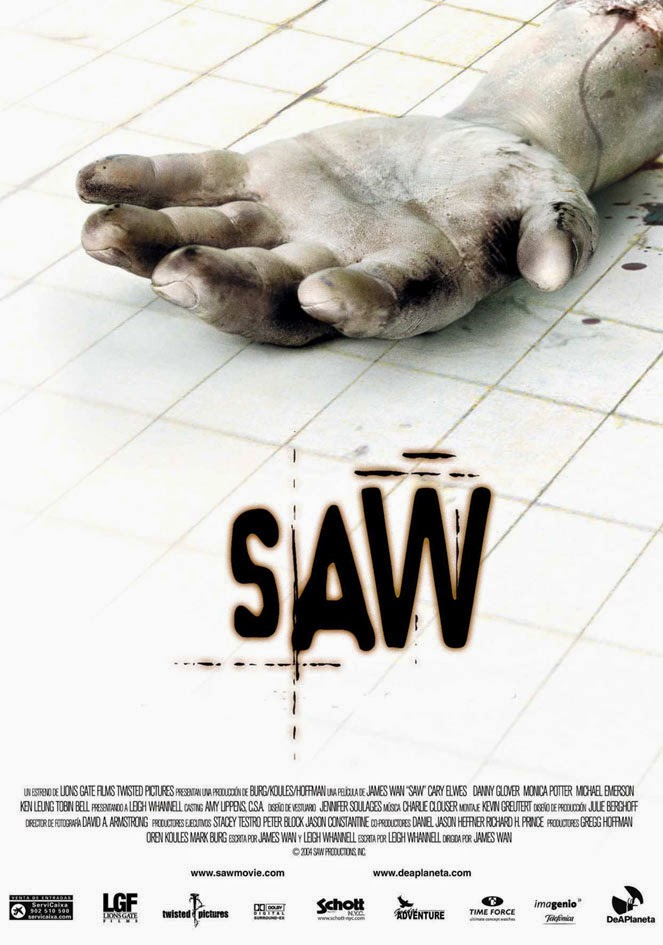
Came, Saw, Conquered

Year: 2004
Director: James Wan
Cast: Cary Elwes, Leigh Whannell, Danny Glover
Run Time: 1 hour 43 minutes
MPAA Rating: R

It's a bit uncouth in the film criticism community to share personal stories along with film reviews, but I've never been particularly couth to begin with, and the story of how I came to Saw is a very important part of my development as a horror fan.

You see, I have long denounced the Saw franchise for moral depravity and pointless gore, parroting an opinion I received in abundance during my formative years, during which there was a new Saw movie dropped on the world's stoop every year like a grisly present from a deranged cat. I learned from 22 Jump Street that there is a principle called "embedding" in which your brain sticks with the first idea it is given about a subject (see, movies are good for something), and that's exactly what I've been doing with this franchise.

Every criticism I leveled against the franchise and genre (moral bankruptcy, outrageous gore, trashy sensibilities) has been leveled against my own beloved genre, the slashers. The hypocrisy was getting so strong Courtney Love could have used it as a nightcap. And I was saying all this about something I'd never even seen and thus inadequately understood. You could say I was the One Million Moms of torture porn. Except actually successful.

But recently I decided to make an effort to turn this "blogging" thing into something more resembling a career. And my obstinate refusal to view the Saw franchise was inhibiting my path to becoming a successful analyzer of the genre for an utterly stupid reason. So no, I'm not throwing my morals away. I'm just realizing how misinformed they were. Over the next couple of weeks I will be visiting the Saw movies for the very first time, finally able to mock them for their real flaws instead of their perceived ones.

It's not like me changing my mind will actually alter the quality of these films, but nevertheless this is what my TV screen will look like for the foreseeable future and - who knows - maybe some surprises are in store.

As (flippin' A) pretty much everybody in the charted landmasses knows by now, the first Saw is actually really good and surprisingly un-gory, at least relative to its reputation. Except for the scene, the film plays more like a mystery thriller than an all access pass to Human Body: The Inside Story.

And on the relatively miniscule budget (about $1.2 million as compared to the sequels' mammoth budgets ranging between $4 million and a heart-stopping - for horror at least - $17 million), it would have been difficult for the green filmmakers to push it any further than they already had, especially with some of the well-known talent they had signed onto the project.

It all starts with a bathroom. Dr. Lawrence Gordon (Cary Elwes) and Adam (Leigh Whannell, the film's writer) wake up in a dingy tiled space, chained to pipes on opposite sides of the room with a corpse lying between them leaking enough blood to feed a low-income family of vampires for a week.

How uncharitable.

Like Cube before it and Nine Dead (among dozens of other clones) after it, Saw's plot hinges on victims with hidden pasts trying desperately to find connections, discover why they're here and who put them there, as well as hide the dirty truths that inevitably play important roles in their predicaments. It's a plot style that has received an enormous workout in the decade following 2004, but Saw's inventive visual style and intricate plotting (to a point) absolutely hold up in a big way.

It turns out that the two men were brought here by the notorious Jigsaw killer (Tobin Bell), a deranged madman who puts his victims - all people he feels are either immoral or not appreciating their lives enough - in elaborate traps forcing them to either go through terrible mutilation and learn a new respect for life or die in a terribly gruesome manner.

If you're one of the two people (it used to be three before this week) who hasn't seen this movie, I'll let the flashbacks throughout the film clue you in on why these two particular men are here (Of course there's copious flashbacks. This film couldn't survive as a one room drama, the flaws in the writing and dialogue would shine too strongly if they weren't diluted across different places and times.).

Although many one-room dramas could be improved with the implementation of a reverse bear trap,

Now it's not perfect. Saw definitely has its fair share of flaws, as tends to happen with lower budget indie films. Or, you know, anything made by humans. Some of the props are a little cheap-looking, especially the chains that bind our heroes. The locations tend to be a little spare, although their dinginess is tied into the tone of the film so it's not necessarily damaging to the film.

What is damaging, and the reason Saw rings a little hollow at times, is the dialogue and the acting. Side character Detective Tapp (Danny Glover) gets a sense of the hamminess present and has fun chewing out lines like "We'll strike under the cover of darkness," but Cary Elwes gets swept away in the current of his arch dialogue and swiftly drowns.

When his accent isn't busy popping its head out like a timid groundhog, he's spitting out lines like one would spit out teeth - with a vague sense of nausea and a hint of pure terror, unable and unwilling to comprehend what's going on. And I'm not speaking about the character. That would actually be a great choice. I'm speaking of Elwes specifically. He seems faintly mystified by this whole "acting" business, perhaps unmoored by the absence of Robin Wright.

When you're out-acted by the man who wrote the film, there's a serious problem. When you're out-acted by not just one but several corpses, perhaps it's time to call it a night.

Well, at least he was trying.

Luckily, Saw has just as many things go right. The visual style is impeccable, especially considering that director James Wan wasn't the supernova presence he is today. With only one feature under his belt, 2000's Stygian, he still had a lot to prove.

The camera work, especially around Adam's youthful and unpredictable character (Dr. Gordon is shot with much more long, careful takes, mirroring his character) is vivid and brisk. Compounded with rapid-fire MTV style editing, it shakes you out of your seat with its dynamic electricity. Especially memorable is series of fast motion scenes in the middle of the film that detail Jigsaw's handiwork in other scenarios.

And though the dialogue is off, the plot itself is dense and engaging with every new piece of information clicking into the old. Perhaps one of the best indications of this style is that every single item in the bathroom proves useful to some degree or another, whether it be the obvious items like the corpse's handgun and cell phone, or the other artifacts discovered among the assorted rubble. It's rather like a game of Myst, a lot of the fun comes from discovering how all the disparate pieces fit together. (Like, say, pieces of a... Jigsaw. BOOM! Metaphor'd!)

Sure, a third act reveal is pretty dumb if you decide to pull at threads, but when you're in the moment everything is gold. And that puppet is hella creepy.

You'd think tricycles wouldn't be scary. You'd be wrong.

So that's that! My very first Saw movie. Hold the applause. All in all, I really enjoyed it and I'm glad to be proven wrong, at least by this installment in what was soon to be a booming franchise. Please don't be too mean to me for taking so darn-tootin' long to do it. I'm here now and that's all that matters. And now I have six more films to complete my education in one of the most important horror series of the past decade.

I hope you'll stick around longer than most of Jigsaw's victims tend to.

TL;DR: Saw suffers from some dialogue and performance issues but is nevertheless a thrilling puzzle.
Rating: 8/10
Word Count: 1376
Reviews In This Series
Saw (Wan, 2004)
Saw II (Bousman, 2005)

Saw III (Bousman, 2006)
Saw IV (Bousman, 2007)
Saw V (Hackl, 2008)
Saw VI (Greutert, 2009)
Saw: The Final Chapter (Greutert, 2010)