Showing posts with label Oscarbait. Show all posts

Wednesday, February 21, 2018

Popcorn Culture: Best Picture Contenders, Vol. 2

I did it! For the first time in my life, I've actually seen every film nominated for Best Picture in a particular year! Am I glad it was this year? Probably not, but at least I can feel accomplished. Here are my mini-reviews for the final two bricks in that wall.

Phantom Thread
Year: 2017
Director: Paul Thomas Anderson
Cast: Vicky Krieps, Daniel Day-Lewis, Lesley Manville 
Run Time: 2 hours 10 minutes
MPAA Rating: R

A meticulous and demanding couture designer meets and seduces a young woman, who becomes his muse and eventually enters a battle of manners and wills in the power struggle between him, her, and his spinster sister.

Phantom Thread is a hard movie to review, because it's so impeccably structured and designed that it's impossible to ignore the skill and craft that went into its creation. But it's at least a little difficult to find a foothold and manifest an active interest in the proceedings, which are appropriately chilly and at arm's length. 

There's hardly a fault in the visual world that Paul Thomas Anderson, costume designer Mark Bridges (who has worked with PTA since his debut, but more importantly worked on Dollman vs. Demonic Toys and Waxwork II: Lost in Time) and production designer Mark Tildesley (who worked on 28 Days Later... and aren't you glad you're reading my commentary, because nobody else would be telling you these important things) have created, which is pristine and precise from top to bottom.

The fun of this movie comes when you place the three actors into this toy box and send them spinning into one another. At first their interactions are as stiff and formal as the scenery, but as they settle into their roles, it quickly becomes clear that this is the ensemble of the year. I don't have a lot of respect for Daniel Day-Lewis' ostentatious style of preparing for a role, but he does do a good job, although he is conspicuously the weakest link in this trio. Krieps is doing tremendously subtle work here that quietly, almost imperceptibly builds toward an incredibly bold set of actions in the final act that you wouldn't have thought her capable of just 90 minutes before. And Manville is incredibly frightening as a woman whose stiff, prim confidence can weather any storm. With these two in the room, Day-Lewis just looks like a child play-acting that he's fancy.

I really did warm to this movie but he third act, but there's no avoiding the fact that at times it's quite dull, progressing from stiff scene to stiff scene at the pace of an arthritic snail. It's probably the artiest art film on the slate, and that just isn't really what gets my engine revved. But if you like angry, horny, twisted comedies of manners, it's worth it to stick around.

Rating: 6/10

Darkest Hour
Year: 2017
Director: Joe Wright
Cast: Gary Oldman, Lily James, Kristin Scott Thomas
Run Time: 2 hours 5 minutes
MPAA Rating: PG-13

Winston Churchill must find the strength to lead England into what seems like an unwinnable war against the Nazis, after he is voted prime minister by a parliament that has no real faith in him.

Darkest Hour has reputation already for being the most flagrantly terrible of the year's Oscar slate, but for my money no film is as actively anti-entertaining as The Post, so this film is safe from my wrath. Unfortunately, it has nothing to offer other than not sucking so hard your fillings dislodge from your teeth. It's the most aggressively average bit of Awards bait in a year full of projects that - good or bad - are all at least unique in some way.

Like all performances the Academy loves to reward, Gary Oldman does nothing to push the craft forward other than drowning himself in prosthetics and shouting as loud as he possibly can without having his fake jowls wobble right off his face. His portrayal of Winston Churchill is a screeching caricature, constantly winking at the history buffs in the audience while conspicuously failing to craft an actual human character.

We're meant to take his abuse of the other characters in the movie as a charming symptom of his passion and eccentric individualism. At least Phantom Thread had the decency to know how twisted its control-freak character was, we're supposed to root for this blowhard. And in the process of this extravagant yelling, every other character is shoved against the wall and flattened to one dimension at best as they act out a grab bag of real life scenarios, including - mysteriously - the decision to evacuate the troops at Dunkirk, which is just a grim reminder that you could have been watching Dunkirk instead of this movie.

The best thing I can say about Darkest Hour is that it's at least shot well. Joe Wright and cinematographer Bruno Delbonnel (who shot the sumptuously gorgeous Harry Potter and the Half-Blood Prince as well as Amélie and Inside Llewyn Davis) have a way of isolating Churchill inside the frame that isn't the least bit subtle, but is far more emotionally satisfying than any scrap of dialogue, for stimulating the audience using visual beauty rather than desperate wheezing.

Rating: 5/10
Word Count: 874

Thursday, January 11, 2018

Tour De Frances

Year: 2017
Director: Martin McDonagh
Cast: Frances McDormand, Woody Harrelson, Sam Rockwell
Run Time: 1 hour 55 minutes
MPAA Rating: R

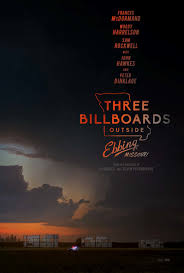
I had been resisting watching Three Billboards outside Ebbing, Missouri, which has been probably the most violently divisive entry in the awards bait canon in a year that's rumbling with controversy. But after it won the Golden Globe, I felt obligated to weigh in, so here are my way-too-late thoughts on the project. Strap in folks, it's gonna be a bumpy ride.

Why couldn't The Greatest Showman have won, so I could just review that again?

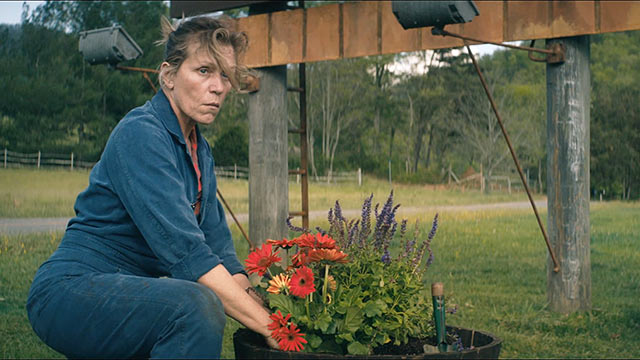
So, here's the plot. It's been seven months since Mildred Hayes' (Frances McDormand) daughter was raped and murdered. Still struggling with how to handle the loss and find closure in the case, she rents out three billboards on the road leading into town blaming the police - and especially the beloved Chief Willoughby (Woody Harrelson), who is struggling with cancer - for not making any headway. This stirs up a lot of backlash from the town and creates a firestorm of conversation and controversy.

Policeman Jason Dixon (Sam Rockwell) - that's literally his name, I don't know what to tell you - is already prone to violent rages so this doesn't bode well for the town's spirit in general. But she also gets different degrees of support and blowback from her grieving son Robbie (Lucas Hedges, who is there with bells on if you have a part in an Oscarbait movie where he gets to do an accent), the "town midget" James (Peter Dinklage), and her abusive ex-husband Charlie (John Hawkes), who is now living with his 19-year-old girlfriend Penelope (Samara Weaving). Mildred meets the blowback of the town with endless tough-mother posturing and kicking dudes in the balls.

Imagine this picture times thirty and you pretty much get it.

It's very tempting to approach this film from a moral perspective instead of a critical one, which has become ever-so common in today's online film culture. And while I would never argue that the faults of the characters (their use of offensive, outdated terms, for one thing) are faults of the movie, Three Billboards is necessarily about the muddiness of morality and redemption. It invites us to consider the morality of these characters as the story's prime currency, and that invitation leaves it vulnerable because those themes are clunky and entirely mishandled.

For one thing, this is a story about sexual assault and violence against women that was written by a man. For another thing, this is a story about racial injustice and police violence that was written by a white man. For a-f**king-nother thing, this is a story where Woody Harrelson's wife is played by a woman who's 21 years younger than him and is forced to stumble through a line about how great his penis is.

And to be frank, a white man writing this story isn't necessarily a liability. It just shouldn't be this white man. Martin McDonagh somehow manages to write a script with a central thesis on racial injustice that features three black characters with speaking roles in a cast of dozens, and two of those speaking roles have fewer words than your average cough drop wrapper. And the foregrounded statements about women fighting against assault are couched in an endlessly repetitive litany of scenes of McDormand dishing out cartoon violence with impunity. It swivels from being gritty and violent to quippy and light in lurching, uneven motions, and never manages to stretch a consistent tone over more than ten minutes at a time.

The one scene where she doesn't have her fist planted firmly up a man's ass.

The plot is messy and irritating, even though the script does find its moments to shine when the humor is isolated enough from the drama to not feel so maudlin and strained. But the actors living out that plot are pretty uniformly terrific. Frances McDormand has already been more than recognized for her work here, but she really is superb, embodying her role in a very physical, top-down performance that doesn't skimp on the little gestures and details. She even redeems some of the dumb mama grizzly scenes, peeling back layer upon layer of the character that isn't present on the page.

Sam Rockwell is doing fine work here too, especially in his most comic dopey moments, but his character is a little too off the rails of actual human behavior that he is forced to fall back on the marble-mouthed mumbling that most actors do when they want to be tough in movies set in the South. Then there's Harrelson and Dinklage being exactly as good as you'd expect (but not much more).

But honestly, if I was in charge of handing out the awards, I'd make sure not to overlook Samara Weaving, who is straight-up brilliant in an unforgiving role, constantly approaching it at a sideways angle you wouldn't expect. She's the only consistently hilarious element of Three Billboards, and that's saying something for a movie that tries very hard to be hilarious.

It is my burden to be blessed with such good taste in actresses.

However, Martin McDonagh the writer is much more successful than Martin McDonagh the director (which is saying something). He mostly just sits back and lets his excellent cast work their magic, not attempting to do anything particularly interesting with the visuals. The man only really comes alive when it's time to shoot the titular billboards, which his camera swoops over and around with pornographic fervor every time they appear.

And thus does Three Billboards spill out across the screen in a tangled mess of misguided morality and wasted talent. I found it hard to hate, but it's too slapdash to recommend. The fact that it won the Golden Globe speaks to what an uneven slate of films we've been presented with this year more than anything else.

TL;DR: Three Billboards outside Ebbing, Missouri is kind of a mess, but it really does boast some noteworthy performances.
Rating: 6/10
Word Count: 1005

Wednesday, December 28, 2016

Pahk The Cah In The Hahvahd Graveyahd

Year: 2016
Director:  Kenneth Lonergan
Cast: Casey Affleck, Michelle Williams, Kyle Chandler
Run Time: 2 hours 17 minutes
MPAA Rating: R

By far the best thing about Manchester by the Sea is Casey Affleck’s SNL monologue describing it: “It’s an incredibly depressing picture. It’s really a downer. I mean, it’s great… It’s a beautiful testament to what we’ll do for our family, to how everyone deserves a second chance, and also to how unbearably sad movies can be. But it’s also great! But sad. And funny! But just, crushingly sad.”

Has there been a movie more obviously teed up for Oscar buzz? I was nervous about sitting down to another film about a deadbeat white dude feeling sorry for himself, but I underestimated Manchester by the Sea by about the same degree pretty much everybody in the world massively overestimated it.

Got some Oscarbait on your hands? Come on down to Popcorn Culture and we’ll trash it for ya, free of charge.

In Manchester by the Sea, Lee Chandler (Casey Affleck) is a deadbeat Bostonian working as a handyman. When his brother Joe (Kyle Chandler) dies, he must move back to the seaside town of Manchester to make the funeral arrangements and see if he’s prepared to be a guardian for his nephew Patrick (Lucas Hedges). Being in town forces him to confront his past, especially his ex-wife Randi (Michelle Williams). Can he overcome his drunken depression and find it in his heart to take care of a teen in need?

We’ll just have to see, but the odds are against him. This IS an Oscar frontrunner after all.

Manchester by the Sea is not a fun movie, as if I needed to tell you that. But it’s also not fun in the way that giving yourself over to a harrowing movie can be cathartic. Despite its reputation for ravaging melodrama, Manchester by the Sea is a rather intimate and small portrait of a character who’s closed off from the world. And watching someone who’s dead inside going through the motions is dull, far removed from the sharp, searing pain of most cinematic tragedies. While many fans felt that the dullness is applied with such pressure it creates a kind of blunt force trauma, I slipped off the slick surface of this one, finding it hard to get a foothold in any remotely engaging character element.

That doesn’t mean you won’t like it. By all accounts, most film viewers differ from Yours Truly (if they didn’t, The Boy Next Door would’ve had a much higher box office take), But for this reviewer, the emotional core of Manchester was too distant to feel any true connection.

Fortunately, that almost doesn’t matter, because what people don’t tell you is that the film is also quite funny. Manchester by the Sea has a similar sense of humor to The Fighter, chucking a handful of aggressive Bostonians into a room together and seeing what sparks fly. Hedges and Affleck have a prickly yet easy chemistry that feels as lived-in as if they’re genuine relatives, but strained by their circumstances and clashing personalities.

Probably like when Ben comes over for dinner.

And yeah sure, there are plenty of Oscar reel showcase moments. Michelle Williams gives a hauntingly broken performance is what is more like a glorified cameo, Hedges shines with his brassy rebellion until a standout breakdown scene of his own, and Gretchen Mol shines in a brief appearance, cementing in the film’s themes of guilt and addiction. Affleck doesn’t really stand out from the pack because his character is purposefully underplayed, but he is the glue that holds the film together nevertheless.

Manchester by the Sea has a lot of strengths, but a strong hook is not one of them. It’s not quite misery porn, not quite comedy, and not quite realism. And it’s certainly not quite great. It has its share of small, memorable moments crafted through subtle physical performances and dialogue, but other times it drowns out its own characters with endlessly repetitive driving scenes and a swooning score, bizarre tangents that make it clock in at two and a half hours long, and a certain lack of grace in the bigger dramatic moments (including a bar fight that elicits a gasp from a crowd of apparently invisible women at a pub filled with men – the sound designer must have had a hot date that night, because that rushed slip-up is punishing.)

Sure, I liked Manchester by the Sea. Its run time flew by and the humor was engaging. But the drama elements are so quiet they’re nearly inaudible. If you respond to movies about loss and broken people, by all means go see it. But otherwise, unless you’re like me and aiming to see all the Best Picture nominees, you could much better spend that time somewhere else.

TL;DR: Manchester by the Sea is overpraised, but it's an engaging, strangely funny, intimate tale of loss and addiction.
Rating: 7/10
Word Count: 829

Wednesday, November 30, 2016

Swimming In Miami

Year: 2016
Director: Barry Jenkins
Cast: Mahershala Ali, Ashton Sanders, Naomie Harris
Run Time: 1 hour 51 minutes
MPAA Rating: R

Gay movies are tough. It’s difficult when your sexual identity is linked to a cornucopia of hot button issues, because the only wide-release gay movies that squeak by are the ones that interact directly with those issues. And you know where movies about social issues invariably end up? The whirling typhoon of overseriousness we call the Oscars. It’s a vicious cycle that has led to the most notable gay movies being the dour Philadelphia, the terrific but dour Brokeback Mountain, the ambiguously sullen Weekend, and f**king I Now Pronounce You Chuck and Larry.

Moonlight is a member of that massively unpleasant genre, coupled with the even more primordially depressing genre of Oscarbait Movies About Black People. So it’s a damn miracle that it ended up being watchable and, in patches, occasionally splendid.

I’ll get through an entire Oscar slate one of these years!

Moonlight is divided into three distinct parts (because you know a movie’s great if it has chapter titles), each depicting a stage in the coming-of-age of Chiron (Alex R. Hibbert as a child, Ashton Sanders as a teen, and Trevante Rhodes as an adult), a young gay man growing up in the mean streets of Miami.

To a lesser extent it is also about the people around him, at least to the degree that they influence the formation of his identity: his mother Paula (the lovely Naomie Harris, giving a performance that will inevitably be called “brave”), the drug dealer Juan (Mahershala Ali), Juan’s girlfriend Teresa (Janelle Monáe, whose transition from “R&B starlet” to “respectable actress” has been terrifyingly, imperceptibly fast), and his best friend Kevin (Jaden Pine, Jharrel Jerome, and American Horror Story: Roanoke’s André Holland).

Sidebar: Trevante Rhodes might hold the world record for Most Impossibly Buff Human Being Who Isn’t The Rock.

Moonlight is one of those movies that’s more fun to discuss than it is to sit through. As a portrait of a boy attempting to form an emotional, compassionate identity in a culture that values toughness and resilience, it’s an alternately warm and devastating character study. And probably the best thing about it is that it’s not explicitly about being gay. Although Chiron’s homosexuality informs every aspect of his stunted identity, it’s about the universal themes of love, self, and human connection. Of course, watching this all play out onscreen is about as exciting as watching an infomercial for socks.

To be fair, my brain doesn’t come equipped with the arthouse gland that allows people to sit through a long-winded parade of human misery and come out declaring it a masterpiece (I prefer short-winded parades with more stage blood). And while Moonlight is more than just misery porn, I find that it struggles to strike a balance between art and realism. 

Most of the film is straight-laced, almost documentarian drama that uses long takes and naturalistic lighting to douse the film in the gritty reality of the Miami ghetto. But it takes random leaps into bold, colorful, almost Italian arthouse cinematography that feel completely disjointed, desperately jockeying for your attention. These movements come too infrequently to be anything other than distracting, and they’re not so gorgeous that the movie couldn’t have gone on without them. Especially in the third, weakest chapter, these intrusions almost feel like the film is mocking us for actually getting into the story.

Take the film’s best scene: A moonlit seaside conversation between two boys that carries oceans of meaning beneath tentative words. It’s stripped-down perfection, using nothing but dialogue and the human face to provoke mounting erotic tension in the audience. Moonlight is at its best when it’s simple, because its delusions of aesthetic grandeur merely remind you that the visual style is mostly less than phenomenal.

Although, who could complain about this shot?

Moonlight is more like a novel than a film, packed with subtext and recurring symbolism that’s a thrill to dissect, but could just has easily have been presented as a text piece rather than a work of cinema. As a story, it’s important and heartfelt. As a film it’s nonessential.

That’s perhaps not very fair to a film that showcases well-etched characters portrayed by a bevy of talented actors and promising newcomers, but it’s so dry you could use it to cure meat. I’m in no way saying that it’s bad. Moonlight is terrific. But it’s not the type of movie I would consider taking a friend to or –Heaven forbid – owning on DVD.

TL;DR: Moonlight is a decent character study that tries way too hard to be Important.
Rating: 7/10
Word Count: 780

Wednesday, February 3, 2016

Globe Theatre


Year: 2015
Director: Tom McCarthy
Cast: Mark Ruffalo, Michael Keaton, Rachel McAdams
Run Time: 2 hours 8 minutes
MPAA Rating: R

For a while, the frontrunner for the Best Picture Oscar was a little film called Spotlight, directed by the guy who made the second most recent crappy Adam Sandler movie. (Whether or not you worked on a slasher, I will dig those skeletons out of your closet.) Seeing as how Oscarbait heavyhitters and Brennan Klein get along about as well as the Brody family and great white sharks, I didn’t immediately rush out to see it.

However, during a harebrained attempt to screen all the nominees before the Academy Awards, I found myself at a late night screening of Spotlight. Lo and behold, it wasn’t as tortuous as I imagined it might be.

Even taking into account my allergy to true stories.

Spotlight is a dramatization of the real life reporters who uncovered the molestation scandal in the Catholic church. Geez, when will Tom McCarthy stop making these light-hearted comedies? Spotlight is the name of the crack investigation team of the Boston Globe, which has just been bought out by the Times, bringing new editor Marty Baron (Live Schreiber) to the table. As a non-Bostonian and therefore non-Catholic, he pretty quickly sniffs out a rat in a recent hushed-up spot of drama in the local church. He decides to shine Spotlight on the case.

Thus three reporters, the work-obsessed Mike Rezendes (Mark Ruffalo), lapsed Catholic Sacha Pfeiffer (Rachel McAdams), and guy who won’t get into the Oscar reel Matt Carroll (Brian d’Arcy James), as well as their editor Robby Robinson (Michael Keaton, who probably feels demoed, because he has the sidekickiest alter ego name ever written) get embroiled in the scandal and soon discover that there is corruption in the church that rises all the way to the top. They seek out victims of molestation and proof of the church’ negligence toward addressing the problem while facing enormous pressure from the church and the community to back off.

But if there’s one thing I learned from just Like Heaven, it’s that Mark Ruffalo doesn’t back off from ANYTHING.

Spotlight really is quite good. It’s a crisp, efficient film with a brisk pace and a quiet charm. I suppose that’s a counterintuitive way to describe a movie with such dark subject matter, but Spotlight goes very far out of its way to defang the material, honing in on the nitty gritty of journalistic investigation rather than the actual horrors behind closed doors. It wants to be a triumphant film rather than a bleak one, and the safe packaging of the scandal might make it a far less urgent and necessary piece, but it’s at least a palatable one.

Palatable is about all Spotlight is, but it does it very well. Other than effectively recreating the overlit hubbub of a newspaper office (you know this is a period piece because newspapers are still hiring), the cinematography only makes the leap into greatness once, during a shot of an interview dominated by a hulking church, which drives home the sense of creeping oppression the film strives to build. The rest is completely adequate, but it matches Spotlight’s true nature: a standard retelling of an important story rather than an essential work of cinema art.

Every element of Spotlight functions like this: bright, strong, and utterly typical. The music is jaunty, inviting, and appropriately somber when the time comes. The editing gets us from scene to scene at a steady clip. The characters are brutally functional, their lives outside of the office painted in brush strokes ten feet wide. It’s as precise and impersonal as clockwork.

Remember analog clocks? That really takes me back.

The most human aspect of Spotlight is, quelle surprise, the performers. Keaton, McAdams, and James perform roughly what is expected of them and Ruffalo gets his opportunity to shout his way into an Oscar nomination, but the real beating heart of Spotlight lies in its peripheral characters. Liev Schreiber manages to humanize a rather stifling archetypical role (the perfect, unflagging voice of reason/mentor) by exposing his nerves and flaws through vocal tics and precise control over his tone, and Stanley Tucci devours a rather meaty role even further on the sidelines. But the real driving force of Spotlight is the ensemble of relative unknowns portraying adult survivors of molestation. Without their commitment and talent, the emotional core of Spotlight would be null and void.

So, Spotlight has plenty of ups and plenty of downs, though the lower threshold of its downs is still pretty high. It’s a clean, safe presentation of a taboo topic and a showcase for performances just begging to be nominated. But does it deserve Best Picture? Oh, hell no.

TL;DR: Spotlight is an efficient and brisk film that never flags, but isn't exactly an artistic masterwork.
Rating: 7/10
Word Count: 816

Thursday, January 21, 2016

Hugh Glass And The Terrible, Horrible, No Good, Very Bad Day

Year: 2015
Director: Alejandro G. Iñárritu
Cast: Leonardo DiCaprio, Tom Hardy, Domhnall Gleeson
Run Time: 2 hours 36 minutes
MPAA Rating: R

It’s Oscar season, so it’s easy to get swept up in the prestige picture fever. But now, more than ever, should be the time to make bold statements. To defy the status quo. To admit that I really didn’t like The Revenant. Like, at all. To be fair, so far the collected works of Alejandro Gonzalez Iñárritu have pretty much confounded me, so it might be possible to pass it off as a genetic thing. This is a filmmaker with whom I have a deep, personal disconnection. So now is the time to remind you that all Popcorn Culture scores (and, let’s admit it, ALL critic scores) are entirely subjective. So feel free to disagree. I’m happy to be a voice for the minority.

Bear with me.

In The Revenant, Hugh Glass (Leonardo DiCaprio) is a scout for a group of 1800’s frontiersmen collecting pelts in the Louisiana Purchase territory. The team is led by Captain Henry (Domhnall Gleeson, and don’t try to pronounce that if you don’t have the appropriate safety gear) and includes Glass’ Native American son Hawk (Forrest Goodluck) and the perilously Southern John Fitzgerald (Tom Hardy). After Glass is quite rudely mauled by a bear, he is left for dead in the wilderness (after like an hour, because Iñárritu missed the lesson in film school that said each page of the script shouldn't last 20 minutes). He is then forced to battle his way across the frozen tundra, fighting for survival despite his injuries, the elements, and roaming bands of vicious savages, not to mention the Frenchmen.

If Leo doesn’t win the Oscar for this, he will literally eat a man.

Now, I may not have liked this movie, but I never said it wasn’t well-realized. The frozen landscapes of Canada and Southern Argentina are photographed with a sinister beauty, displaying an eye for capturing the starkest, most unearthly formations of barren trees and rocks that nature could possibly provide. Emmanuel Lubeski is on hand to knock out some of those famous long takes, most notably in an exquisitely choreographed battle between the natives and the frontiersmen. And speaking of that battle, the special effects in The Revenant are phenomenal, without a doubt the best thing in the film.

You see, The Revenant is a gory, visceral movie, sometimes unbearably brutal in is carnage. The makeup effects that achieve this are spectacularly conceived and – with the small exception of certain shots of the bear – completely seamless. When The Revenant combines these grotesquely realistic kills with its sweeping long takes, it operates at its fullest, most breathtaking capacity.

Also, Leonardo DiCaprio’s performance leaves nothing to complain about. I wouldn’t say I was bowled over, but I would hardly begrudge him the Oscar, especially considering that his only real competition in this year’s weak slate is returning crownee Eddie Redmayne. Leo is asked to carry this movie on his back, and in order to do so he must relinquish his star power and embrace his feral side, which he certainly commits to. It’s a stripped-down, raw performance that might just be the best in his wholly adequate career.

I mean, other than his role in Critters 3, obviously.

Yes, I’m aware I just listed a lot of good things about The Revenant. And that’s why it’s in the awards conversation. It’s not a bad film. But there’s a difference between being well-realized and actually telling a good story. The technical aspects, which are inarguably pristine, are only half the battle. And The Revenant can only be described as a battle, between austere art cinema and Iñárritu’s staggering auteurist pomposity.

For one thing, the film is too goddamn long. If it filled its time with original, essential scenes, it wouldn’t feel like such a slog, but Iñárritu insists on returning over and over again to a bluntly metaphorical dream sequence/flashback that would make even Terrence Malick blush. The film’s theme is constantly repeated via these flashbacks and eventually a broken record voiceover that begins to act like a psychic cheese grater, shaving away every layer of your patience one scrape at a time.

The surreal imagery these sequences insist upon don’t exactly help, especially considering that all but one shot feels just like student filmmaker masturbation. It’s sickeningly ostentatious and it carves a huge chunk out of the effectiveness of the rest of the film’s realism and austerity.

I want Leo fighting the elements, not Tree of Life 2: Full Throttle.

Another problem with the urgency with which impatiently metaphorical imagery seeps into the film is that there’s next to no consistency in how cold it is at any given time. There is a clear progression to Glass’s interaction with the weather, but the film loses track of its visual representation in the midst of plugging in as many shots of sweeping grandeur as possible.

However, all this pales in comparison to the film’s biggest flaw, which is unfortunately my beloved Tom Hardy. He gives his performance in such a ludicrously pronounced Southern accent that it’s nigh-on impossible to understand even fifty percent of what he’s saying. Between this and his Dark Night Rises performance as Bane, I’m not entirely convinced that he’s not doing this on purpose. It’s like watching a foreign film, where the language barrier is so dense that you can’t even tell if it’s a good performance or not. He’s kind of like the anthropomorphic representation of the film itself: a well-meaning effort towards prestige that completely obfuscates its original intentions beneath a thick layer of unintelligible nonsense.

No, I did not like The Revenant. It’s totally OK if you did. There’s a lot there. But from where I’m standing, this is Iñárritu’s second strained, mangled Oscarbait effort in as many years.

TL;DR: The Revenant is an arduous, pretentious watch that is well-realized but not enough to salvage a good story.
Rating: 5/10
Word Count: 1002

Wednesday, September 9, 2015

Do The Harlem Shake

Appropriately enough for my spring cleaning period, two of the films I watched this week are very perfect, equally strange echoes of one another. They both deal with the topic of urban education in Harlem, but one focuses on the plight of the white teacher and was directed by master of horror Wes Craven, and the other focuses on a black teen and was based on the novel Push by Sapphire.

Music of the Heart
Year: 1999
Director: Wes Craven
Cast: Meryl Streep, Angela Bassett, Cloris Leachman
Run Time: 2 hours 4 minutes
MPAA Rating: PG

A newly divorced single mother takes the only job she can get – teaching violin to underprivileged kids in a Harlem elementary school.

Music of the Heart is a very special film. It’s the only film in Wes Craven’s career that isn’t horror or a thriller, and I’m immensely pleased he was given the opportunity to make it, even if he did have to strong-arm the producers by threatening not to make Scream 3 (although a world without Scream 3 isn’t necessarily a bleak prospect). This film is but a taste of the world that could have been if Craven hadn’t been pigeonholed as a horror director by the one-two punch of The Last House on the Left and The Hills Have Eyes. Frankly, as a fan, I can’t say I’m sorry it worked out the way it did, but at least this film proves that the man was capable of expanding his horizons.

Unfortunately, that expansion was channeled into a heartwarming biopic, which might just be my least favorite form of cinema after straight-up snuff films. I would have preferred to bestow this movie with a full-ledged review, as I would with any Craven work, but this genre is just too daunting a prospect for the little ol’ horror nerd that I am. That said, the film itself is pretty decent, though woefully generic in the wake of thematically similar flicks like Freedom Writers, Stand and Deliver, Take the Lead, and even Danny DeVito’s Renaissance Man (a film I secretly love). 

Craven’s horror upbringing is totally buried (save for one instance in which the classic Vertigo shot – where the background seems to stretch into infinity behind a character – is reversed, with profoundly mystifying results), replaced with fluttering birds and warm, rosy lighting. The film spends a great deal of time cycling through an It’s a Small World-type array of every conceivable urban conflict and occasionally goes alarmingly far out of its way to be Meaningful, but as a low-key character study it excels.

Meryl Streep’s Roberta Guaspari is no airbrushed white savior to these Harlem kiddos. She’s a cracked and broken, immensely weak-willed woman with more character flaws than there are heads in Hannibal Lecter’s pantry. She’s not some perfect Barbie doll whose only flaw is Caring Too Much. This ain’t a Hillary Swank picture, and this ain’t that part of a job interview where they ask “what’s your biggest weakness?” There’s no sugar-coating off this rude, brash, selfish, scared, desperate woman who finds her inner strength through the course of a ten-year teaching career (the time jump in the film is startling at first, but it picks up fast).

Streep is excellent, it must be said, though you can figure one can just assume that at this point. Cloris Leachman (as her mother) seems a little lost in the words at points, but she’s hardly in the film long enough to really matter, and she’s bolstered by its supporting cast including a tough-as-nails Angela Bassett, a proudly subtle Gloria Estefan, and the second-creepiest Culkin brother, Kieran. But Streep is the cream of the crop with her unflinching, raw portrayal of a woman on the brink.

Craven’s typical sense of humor is also at play in Music of the Heart, allowing it to flow smoothly without becoming a dour, didactic treatise. There’s perhaps a bit of an overemphasis on full performances of musical pieces, without which the pace would be snappier and the run time blissfully shorter, but the film never stops being fun, which is much to Craven’s credit.

I’m happy such a singular film exists in the great master’s oeuvre. As a genre devotee I can’t say I’ll ever have the urge to watch it again, but Music of the Heart is a dashing and competent piece of filmmaking. What more could I ask for?

Rating: 7/10

Precious
Year: 2009
Director: Lee Daniels
Cast: Gabourey Sidibe, Mo'Nique, Paula Patton
Run Time: 1 hour 50 minutes
MPAA Rating: R

An impoverished, illiterate, overweight Harlem teen attempts to get a basic education while literally everything bad happens to her.

Lee Daniels will not be getting an invitation to my fantasy dinner party. My guess is that he’d more or less immediately start screaming about the hypocrisy of enjoying oneself while there is still turmoil in the Middle East. That said, a personality like that instantly lends itself to Oscarbait filmmaking, and Daniels’ audacious visual style make Precious a tremendously satisfying watch, even if it is never a truly enjoyable one.

For starters, he uses one of the simplest tricks in the book to lay a foundation on which to build his film: a realistic, faux-documentary filming style. Shot largely on handheld cameras that zoom in and out in the middle of shots and occasionally receive an obstructed view of the proceedings, this aesthetic puts the audience right there in Precious’ universe, almost subconsciously implying its authenticity. At intervals, Daniels goes overboard and one gets the impression of being yoked to a catnipped ferret as it runs back and forth around the room, but for the most part it’s not intrusive, in the style popularized by shows like The Office or Parks and Recreation.

With this structure in place, precious builds a mighty empire of daring aesthetic decisions. Many of these revolve around Precious’ fantasies of a better life, the sleek glitziness of which is captured by blissfully still, traditional camerawork. These frequent fantastical intrusions into her daily life can be subtle (a glamorous younger photo of her abusive mother coming to life to coo soft words to her daughter) or alarming (Precious escapes into a staccato fantasy world while being molested by her father – whee…), but they are always aesthetically confident and deeply impactful. These additional touches lessen as the film goes on, but presumably it’s intentional, although the film does lose some of its sparkle from there on out.

Precious is a film dominated by its visual schema, because as a plot there’s almost nothing to it. Something bad happens to Precious, she tries to make a positive change, something worse happens to Precious. Lather, rinse, repeat. The ambiguous ending isn’t nearly as dour as it could have been and – again – the lack of closure is certainly an authorial choice, but this is a film that can’t escape a thick cloud of Importance. It’s certainly an important story to tell, but one absolutely must be in the mood to receive it.

You see, the world where Precious lives, the world where beautiful white people are incessantly pumped into the living room through her TV, is our world, a fact which the film’s entire being endeavors to drive home. In addition to the gritty documentary aesthetic, the actors make great sacrifices to drive the point home. Gabourey Sidibe – hardly a traditional movie star – suffers abuse at the hands of everyone around her, painting Precious as a sort of social turtle, drawing back into herself and speaking almost inaudibly when she feels uncomfortable. Her performance is infinitely varied and certainly breathtaking.

The performers that surround her are likewise tremendously brave, and I don’t mean in the sense that they forgo movie star makeup, though they do. Mo’Nique (who plays Precious’ mother) overcame a childhood of repression to therapeutically portray a gut-wrenching, subtly human, yet startlingly evil role, Paula Patton channels her inner frustrated teacher, and Mariah Carey doesn’t sing a note. That’s true dedication.

Precious is a tough watch, it is a daring tirade, and it is overwhelmingly an actor’s movie. As a showcase for pitch-perfect film technique, it is untouchable, though as a story – even an Important one – it’s a little too unfocused to be truly special.

Rating: 7/10
Word Count: 1377

Tuesday, June 2, 2015

Get These Monkeys Off My Back

As a super important future famous blogger, I've been attempting to up the ante with my movie reviewing over the past year, providing a frankly ridiculous amount of content on the off-chance that somebody wants to read 2,000 words about the splendors of The House on Sorority Row. But loath as I am to admit it, I am a fallible human. And the daunting list of movies I have yet to write about is weighing on me like the Earth's globe on Atlas' back.

What follows is four capsule reviews for films that I've seen over the past month but haven't had the time (or, frankly, the interest level) to fully explore in a broader article. You know, it might actually do me good to explore a shorter form of review writing. Consider this an experiment should I ever become the next Roger Ebert.

Birdman: or (The Unexpected Virtue of Ignorance)

Year: 2014
Director: Alejandro G. Iñárritu
Cast: Michael Keaton, Zach Galifianakis, Edward Norton
Run Time: 1 hour 59 minutes
MPAA Rating: R

A washed-up movie star attempts to revive his career with a Broadway play.

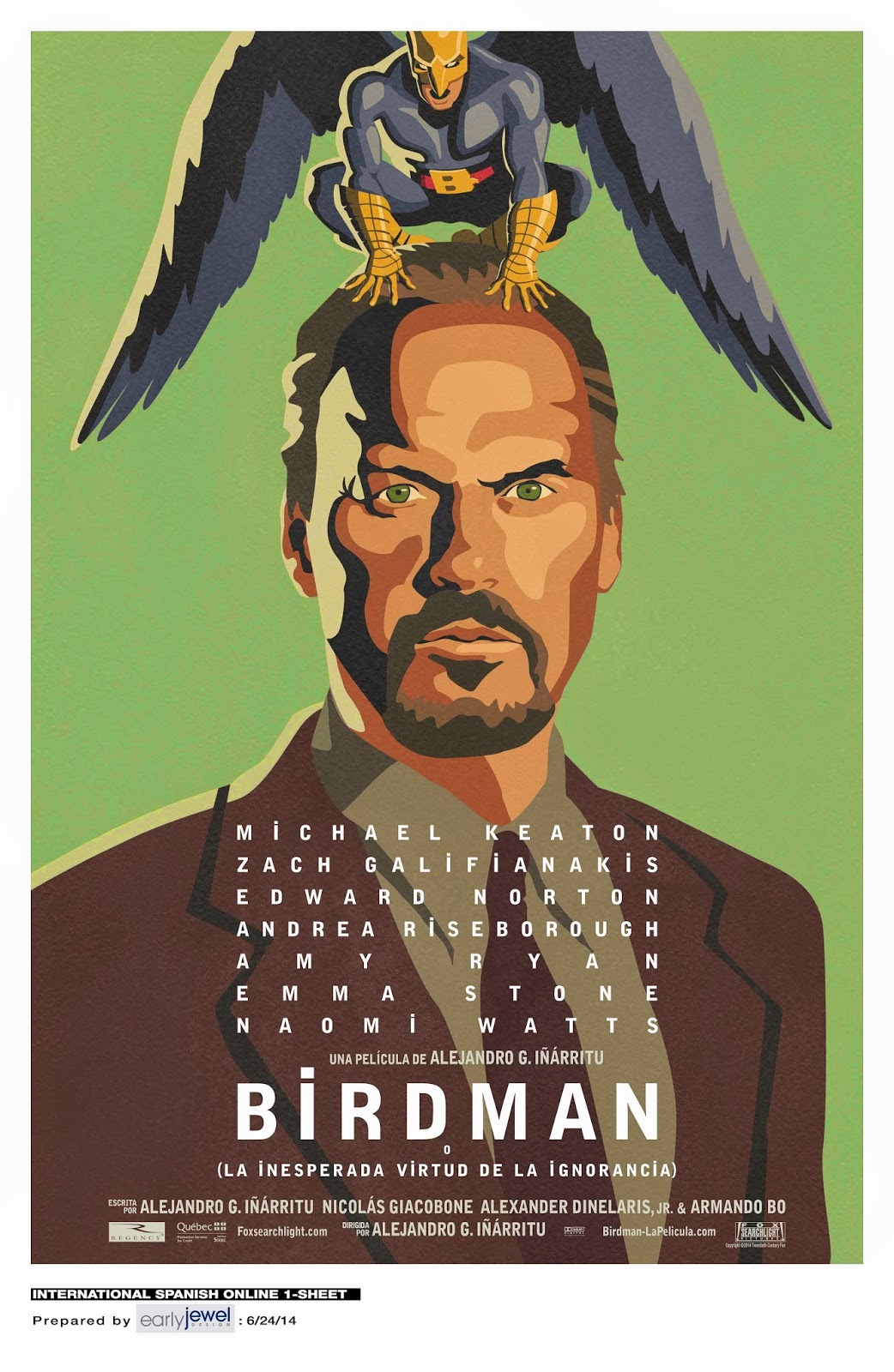
Countless films have worried at the edge between reality and fantasy like a dog with its favorite bone, including two of my very favorite horror films, so Birdman is in good company. But, and I say this without even the faintest whiff of sarcasm: Birdman ain't no Wes Craven's New Nightmare

The cardinal sin of the "comedy" Birdman is that it takes itself far too seriously. Many of its core scenes and conceits are pitched up to a more over-the-top register that would best function as laugh-out-loud comedy, but there's only one single line in the film that is obviously intended to elicit a chuckle. The rest is as dour and self-serious as the rest of the Oscarbait in the worm bucket, and that weighs down the film like an anchor.

There is some interesting material to chew on about how social media is shaping our generation's perception of art and reality, as well as how actors can get so trapped within a famous role that it casts a shadow over their entire lives. This is interesting to film enthusiasts and (more importantly) members of the Academy, but it's remarkably separate from the reality of the average American filmgoer. It absolutely doesn't need to play to the lowest common denominator, but Birdman's sense of what "reality" actually is, is already so mired in artifice that the film loops around itself uselessly like when I try to put the garden hose away.

In the process of all this philosophizing, Birdman loses itself among a pile of heaving, exhausting Important Movie cliches, like the Inexplicable Lesbians, the Real Life Connection, and the All in One Shot gimmick. Slathered with some improperly proportioned magical realism, a variety of subplots that utterly fail to go anywhere at all, and an astonishingly artless ending, Birdman is a frustrating nut to crack.

But when you finally break through to that sweet sweet nut meat (I am writing this very late at night), there's something special in there. Birdman is a film with an impeccable sense of rhythm, a variety of delectable lighting arrangements, and a series of off-the-wall performances pulled from actors who really have no business being in a movie like this. Emma Stone rips a nothing part to pieces with a spiky vulnerability, Zach Galifianakis tones down his usual energy to become a wonderful straight man, and Edward Norton shines as a loose cannon actor with a feeble grip on his own humanity.

And, after all, Michael Keaton has been getting all the awards buzz, so let's not forget to mention him. Although he gave a Brave performance more than he gave a Great one, Keaton carries the movie on his back across the finish line. His imbues his character with a wild-eyed animalism that propels the narrative through its illusion of a single shot without a single hitch or draggy moment. 

For my purposes, it is not a truly remarkable film, at times veering into an immensely irritating one. But for art cinema-inclined viewers, Birdman is one to RedBox before it's too late.

Rating: 6/10


Edge of Tomorrow

Year: 2014
Director: Doug Liman
Cast: Tom Cruise, Emily Blunt, Bill Paxton
Run Time: 1 hour 53 minutes
MPAA Rating: PG-13

An unwittingly drafted soldier finds that, every time he dies in battle, he wakes up the day before only to repeat his misery.

Edge of Tomorrow represents everything that's wrong with Hollywood today. 

By that I mean that it's a fantastic original movie, but it was misrepresented in advertising, brought in only slightly more than half its budget in box office, and was scuttled away to home video with a confusing new title to perish in ignominy.

It's a real shame. An adaptation of the manga All You Need Is Kill, Edge of Tomorrow presents a fun, fresh, sci-fi fueled twist to time loop storytelling, pitting Tom Cruise's eternal movie star glamor (which, as this movie proves, can survive even the weirdest twists and turns of his personal life - hail Xenu) against the endlessly unappreciated high caliber efforts of Emily Bunt. Blunt takes on the most kinetic, action-packed role of her career with aplomb, dragging a loopy sci-fi plot headfirst into gritty, believable reality.

On top of all of this, Edge of Tomorrow is, like, unbelievably funny. I'm serious. The film takes the notion of comic relief and stretches it liberally throughout the entire film like that Bible story with the fish. It's just shy of genuinely being classifiable as a "comedy," but it's a raucous good time all the same. The best part is that the humor bubbles up naturally from the situations and characters instead of being imposed upon the film by some unseen, arbitrary entity like certain of the more dour sequences in Avengers: Age of Ultron.

The endless repetition of plot points that comes with the territory of time travel films is treated with fleet footing, capturing the highlights while always furthering its central story arc. Between the repeated story beats with ever-changing perspectives and the secretly pretty cool alien tentacle CGI, Edge of Tomorrow feels like a particularly difficult video game level and captures the intrinsic joy that comes with solving an intractable problem while simultaneously having a great time shooting bad guys into piles of goo.

But there's something pulsing beneath the surface, too. Both characters are recognizably human and have fully developed arcs. This is something that shouldn't even technically make sense considering that Emily Blunt's character resets at the beginning of each day, but the film is so invested in its storytelling that it works no matter the obstacle.

There are some technical difficulties that derail the film slightly, like an undercooked third act and a severe lack of proper lighting during several key sequences, but Edge of Tomorrow is wicked fun, and worth a watch from anyone who hasn't seen it yet. Which is pretty much everyone, because the world is a terrible, unfair place.

Rating: 8/10


Groundhog Day

Year: 1993
Director: Harold Ramis
Cast: Bill Murray, Andie MacDowell, Chris Elliott
Run Time: 1 hour 41 minutes
MPAA Rating: PG

A curmudgeonly weatherman gets trapped in a time loop and is forced to repeat Groundhog Day endlessly until he becomes a better person.

Two guesses as to how I decided to pick this one.

Groundhog Day is an indisputable classic of the 90's comedy genre, one for which I have an immense amount of esteem and absolutely nothing new to say, so this will be my shortest review yet. Depending on your inclination, you may either cheer or jeer here.

...

Alright, we're back. Set in the small Pennsylvania town of Punxatawney, Groundhog Day is more than just the story of one man finding his inner Samaritan. It's about the clash between the town and the city folk, and the lack of respect for others that the city garners in otherwise good people. 

As Murray's weatherman discovers the better person inside of him, he simultaneously develops a working interest in the lives of those around him. It is these people more than anything who help make him better rather than any supernatural force or deus ex machina. And Bill Murray is at the top of his game, giving his sardonic bastard a likable humanity without letting his brittle exterior of the first act show any chinks in his armor. 

Subtextual undercurrents, Bill Murray being pitch perfect... Throw in a lush, reactive score, an inventive visual schema, and a hard-hitting lesson about the fact that, sometimes, bad things are destined to happen and there's nothing we can do about it, and you've got yourself an unforgettable comedy with real heart.

Oh, and Andie MacDowell is OK, but her accent is ridiculous.

Rating: 8/10

Wild

Year: 2014
Director: Jean-Marc Vallée
Cast: Reese Witherspoon, Laura Dern, Gaby Hoffmann
Run Time: 1 hour 55 minutes
MPAA Rating: R

The true story of Cheryl Strayed, a kind of annoying hipster who decided that hiking the Pacific Crest Trail would solve all of her personal problems.

The next breadcrumb on our trail of Oscarbait leading us out of the 2015 Academy Awards is Wild, the first outing for Reese Witherspoon's new production company, Pacific Standard. I daresay, it's in good company with Birdman because it has several shining glimmers of pure cinema sandwiched in between what ends up being an immensely frustrating, self-indulgent project.

The biggest flaw of Wild is unfortunately inextricably attached to it: the subject matter. Based on the popular memoir Wild: From Lost to Found on the Pacific Crest Trail by Cheryl Strayed, the film necessarily must take on her character and situation at face value. The only problem is that, at all times, Cheryl Strayed can be relied upon to be the most douchey, irksome person in the room.

Now I'm not even referring to her backstory, which involves biblical amounts of heroin and cheating on her husband. That's par for the course in this kind of Find Your Clarity picture. What I'm referring to first and foremost is her habit of quoting famous authors in this manner: "I took the road less traveled, and that has made all the difference." - Robert Frost (and Cheryl Strayed) Like, what. Were you there helping him write his magnum opus, Cheryl? No you weren't. Now stop prancing about like you're so much better than everybody else and crapping all over authors you've never even read. So there.

I'm sorry. I just really despise Cheryl Strayed. At least as portrayed in the film, she is the worst kind of pretentious hipster and could hardly care less about the plight of other people, although her mind-altering journey is ostensibly about coping with the loss of her mother, played by Laura Dern over what adds up to about a minute of screen time. But enough about that.

I will give Wild this: When it makes an effort to be an art film, it really rises to the challenge of creating something visually stimulating. The rhythmic, stream-of-consciousness editing patterns link together disparate images in a reckless collage of life, at least in the patches where they crop up.

And Reese Witherspoon really does a terrific job here, for better or for worse, taking a physical challenge and inhabiting a role that drags her straight out of her comfort zone to expose some really raw, true emotion. She is also essential in providing the film's infrequent undercurrents of humor, which are a welcome presence in the midst of such a straightforward story.

I have my doubts as to whether the conclusion of the story is as clear-cut as screenwriter Nick Hornby seems to think it is, but when it comes amidst such a magnetic performance and easy, beautiful visuals, it's not hard to ignore. All in all, Wild is a plus, but for a great deal of the time it wastes a lot of its energy pushing against that current.

Rating: 6/10
Word Count: 2007