Showing posts with label Laura Dern. Show all posts

Saturday, December 16, 2017

This Is Not Going To Go The Way You Think

Year: 2017
Director: Rian Johnson
Cast: Daisy Ridley, John Boyega, Mark Hamill
Run Time: 1 hours 32 minutes
MPAA Rating: PG-13

Here it is, the reason I've come out of retirement. I decided to stop reviewing current movies shortly after Rogue One, but I've always had a worry gnawing at the back of my mind that that meant I wouldn't be able to weigh in on the next chapter in the Star Wars canon. Well now the veil has been lifted, and he reviewer has been loosed upon the world once more. Let's dive into it, shall we?

Cue applause.

Star Wars Episode VIII: The Last Jedi picks up more or less immediately after the events of The Force Awakens. Rey (Daisy Ridley) is on the galaxy's most absurdly gorgeous island (and the characters keep using the term"galaxy" as if that term encompasses the whole of creation, and it bothered me slightly less than in Guardians of the Galaxy, but still a lot more than it should) to solicit the help of legendary Jedi hermit Luke Skywalker (Mark Hamill) int he fight against the First Order and maybe learn a thing or two about this Force business in the process. Meanwhile, in a very Empire Strikes Back fashion, while Rey has a space-Buddhist adventure into the inner workings of life itself, her friends are fighting for their lives out in space.

A battle between the dwindling Resistance forces - led by General Leia Organa (Carrie Fisher, in her final appearance as the character not played by a horrifying CGI specter) and purple-haired Vice-Admiral Holdo (Laura Dern) - and a First Order fleet - led by the rogue's gallery of Supreme Leader Snoke (Andy Serkis), his apprentice Kylo Ren (Adam Driver), and General Hux (Domhnall Gleeson) - has reached a brief standstill, but things aren't looking hot for the good guys.

While Poe Dameron (Oscar Isaac) chafes against authority due to his insatiable and potentially dangerous drive to be a hero, Stormtrooper ex-pat Finn (John Boyega) teams up with maintenance worker Rose (Kelly Marie Tran, the newest star to be scooped from obscurity to light up screens worldwide) to find a master codebreaker to help them yadda yadda science fiction words. Look, there's a ticking clock and they're trying to save the Resistance and preserve hope for the galaxy.

A whole galaxy! It's, like, really important!

What's most striking about The Last Jedi is how small-scale everything really is. We do visit some spectacular new environments (and one that's mostly just Hoth 2.0), but the bulk of the story takes place within a couple square miles, or whatever the space term is for that. That's not in and of itself a bad thing (the original Star Wars only has a couple settings it switches between), but I think the reason I felt claustrophobic is that the main battle is stuck in a holding pattern that sucks out every bit of narrative tension like an industrial vacuum. It kind of prevents any sort of real action, and all the participants are content to just kind of sit and wait for the important characters to figure things out, while sitting around discussing their differing philosophies over tea.

OK, I may have exaggerated a bit, but really not by that much, and that's probably the biggest flaw in a movie riddled with flaws. To be fair, it's also riddled with triumphs, but The Last Jedi is audacious, conceptually and visually, and that bold ambition comes with a willingness to take risks and stumble that The Force Awakens was not willing to indulge. And that's probably why the latter was a whole lot better as a popcorn spectacle when all is said and done.

The Last Jedi is full of these contradictions, which is why it has been so hard for any reviewer to wrap their head around it. It very clearly has a better director, and Rian Johnson (of Brick and Looper) delivers images of such pure, magnetic beauty that it's impossible to dislike the movie as a whole. From the set design (a Resistance bomber ship in an early scene is an impeccably crafted space with lived-in functionality) to the costume design (a new set of storm troopers that are basically blood red samurai) to the space warfare (one key moment is literally breathtaking; every process in your body will briefly stop to appreciate the sheer beauty), The Last Jedi is a sublimely accomplished visual work. But as a story, it falls apart like a ham shank left in the crock pot for too long.

Maybe I shouldn't be writing this review right before lunch.

For a movie with such a generous run time, the story fails to find room to develop most of its dramatic beats, shoehorning in scenes of grand import that weren't properly established and thus have the impact of a handful of cotton balls being thrown at your face. It doesn't help that the dialogue in these scenes is brutally clunky, and relies on aspects of the Force and Jedi lore that have never made an appearance in the film canon and frankly made no sense to begin with. Fans of the extended Star Wars mythos may find a lot to dig into here, but as someone who has never found the struggles of the Jedi and their philosophies anything but hokey, it's hard to find any emotional stakes in the proceedings.

I suppose this is just a symptom of a problem Star Wars has always had. The divide between the Dark Side and the Light is written as the malleable, porous line that can be crossed all too easily if you're not careful. But basically every one of the franchise's villains is a scarred, sneering mustache-twirler in all black, obliterating whatever shades of grey the plot wants you to imagine there might be. So whenever a character struggles with being pulled toward the dark, it's hard to see what could possibly be so tempting about it.

Seriously, who's looking at this guy and thinking, "He looks like he'd be a good boss."

Honestly, there are moments here that are just lame. In addition to what it pretty objectively objectively the most idiotic scene to ever grace a Star Wars picture (you'll know it when you f**king see it), there are a handful of sequences that exist exclusively as fanservice, and they're exhausting to suffer through.

Looking at all these flaws, I should honestly be infuriated by this movie, but I'm not. There's the trouble with The Last Jedi. What's good is so damn good, and even if more than a good half of the movie was dull and overwrought (the actual number is probably closer to 35%), it would be enough to shift the scales toward a positive score.

For one thing, the wacky humor that has secretly always been present in the Star Wars franchise is back in full force, and although anything Poe does is ripped straight from the mouth of Star-Lord and frankly doesn't work all that well, there's a sense of kiddie matinee fun that runs through the whole thing. The biggest and maybe not best example of this is the Porgs, this episode's answer to the Ewoks. They're these cute little rodents that only exist for comic relief, and I'm deeply upset by how much I loved them.

I KNOW this only exists to sell plushies, but damn it it's working.

OK, the Porgs are bound to be divisive, but they really are a sterling example of the register The Last Jedi shoots for, and  more often than not hits on the mark. For instance, BB-8 continues to be the best new character in the franchise, and his every exploit continues to bring me unending joy (He's also allowed to get a little bloodthirsty when push comes to shove, and it's rad as hell).

Another good thing (there are more than I've been letting on, because the bad things can be so loud) is Rose, an entirely charming new character who might feel more at home in a spin-off like Rogue One but really holds her own against the more established ensemble. I don't know where they plucked her from, but they need to keep returning to that well.

Plus, when The Last Jedi goes big it goes big. The action sequences are pretty stellar, and occasionally even surprisingly gory (at a "family-friendly" Indiana Jones level, not a The Prowler level, just in case you were worried), and the universe-building is as weird and charming as the franchise fans should have come to expect. 

In short, it's a water cooler popcorn movie that's definitely worth your time, even though it has some massive holes to patch up come Episode IX. This is a step down, but it's not quite a stumble. Even though with a worse director it certainly would have been. 

TL;DR: Star Wars Episode VIII: The Last Jedi is a beautiful, stunning popcorn adventure with some really wonky storytelling over a terribly indulgent run time.
Rating: 7/10
Word Count: 1504
Reviews In This Series
Star Wars (Lucas, 1977)
Star Wars Episode V: The Empire Strikes Back (Kershner, 1980)
Star Wars Episode VI: Return of the Jedi (Marquand, 1983)
Star Wars Episode VII: The Force Awakens (Abrams, 2015)
Rogue One: A Star Wars Story (Edwards, 2016)
Star Wars Episode VIII: The Last Jedi (Johnson, 2017)
Solo: A Star Wars Story (Howard, 2018)

Wednesday, July 1, 2015

Life Finds A Way

Year: 1993
Director: Steven Spielberg
Cast: Sam Neill, Laura Dern, Jeff Goldblum
Run Time: 2 hours 7 minutes
MPAA Rating: PG-13

This review is an epic adventure two years in the making. You see, back when I was first starting my blog in 2013, it was right around the time that Jurassic Park was re-released in theaters in 3D. During that time, I was still using my training wheels. I was still transitioning from my cruddy, Tumblr-based format, and it would be a couple months before I made the kamikaze commitment to pen a review of every movie I watched.

Unfortunately, a lot fell through the cracks, though it did lead to some very strange and insightful articles that are far from disappointing. Anyway, this all comes back to me sitting in that dark theater, re-experiencing Jurassic Park for the first time since childhood on the big screen. All big, puffed-up talk about Spielberg and popcorn blockbusters and the rise of the film school generation aside, that is the kind of experience that you can’t fail to be profoundly affected by. You wanna know why? I’m just gonna say it, professionalism be damned: Jurassic Park is freaking awesome. And I’m sorry I didn’t find the time to review this back then.

Yes, it has a brain in its head, yes, it’s marvelously composed and shot, and yes, the computer imagery is revolutionary, but before we get down to brass tacks, let’s take a moment to step back and look at the big picture that those tacks are pinning up.

Jurassic Park is freaking awesome.

Of course, Jurassic Park has the audacity to open straight onto its very worst scene: A tragically silly raptor attack littered with an uncomfortable profusion of extreme close-ups of mouths. But the effect of that front-loading means that it’s only uphill from there, and between this scene and the film’s grand finale, that slope is like Mount Frickin’ Everest.

When the movie settles down into its plot proper, we learn several things. John Hammond (Richard Attenborough) is a man with a dream. And a bank account that would make Donald Trump weep tears of liquid gold. His life’s ambition is to create an unforgettable theme park populated with live, cloned dinosaurs on the South American island Isla Nubar. When his investors demand a thorough inspection of the site before opening it to the public, they call in prominent mathematician Ian Malcolm (Jeff Goldblum). 

For his defense, Hammond brings in famed archaeologist Alan Grant (Sam Neill) and his wife/girlfriend/general long-term commitment person, the paleobotanist Ellie Sattler (Laura Dern). To his dismay, his guests don’t want to play on his elaborately-designed rides, rather preferring to marvel at the science behind the cloning and discuss just how dubious an idea it is to toss kids onto an island with a herd of hungry velociraptors.

Right on cue, Hammond’s grandchildren – Tim (Joseph Mazzello) and Lex Murphy (Ariana Richards) arrive. Together with the inspection team, they set out on a jeep tour of the park that goes horribly wrong when a bit of subterfuge by disgruntled employee Dennis Nedrey (wayne Knight – Hello, Newman) causes the gates to malfunction, setting the ravenous dinos on the rampage. Dr. Grant finds himself stranded with the kids and, in the process of escorting the little buggers across the island, begins to shake his firm resolve against ever having one, because Steven Spielberg.

Also, Laura Dern could teach Bryce Dallas Howard a thing or two about sensible footwear in survival situations.

At its core, Jurassic Park is an astounding act of creation. Combining top dollar animatronic effects supervised by SFX superstar Stan Winston with an extremely clever, tastefully discreet use of nascent CGI technology, Jurassic Park brings prehistoric mayhem to impossible life. Computer graphics were about as sophisticated as a Nintendo game back in 1993, but by using them to augment brilliant practical effects and disguising the biggest deficiencies beneath the cover of night, the film holds up mind-bogglingly well. The dinosaurs here have weight and autonomy bestowed upon them thanks to the tender, loving care of the filmmakers, making Jurassic World’s collection of pixels look like a kids’ cartoon. 

Jurassic Park is ultimately a celebration of what technology can achieve* when it’s applied with some good, old-fashioned elbow grease. And that’s the thing about the film that makes it such an enduring classic: Yes, it’s an enormous popcorn spectacle, but the showstopping effects are generously ladled over what is already a terrifically solid film qua films.

*Ironically, the story is staunchly anti-science, but that’s more Michael Crichton’s fault than anything.

I would say that the movie would be just as good without the dinosaurs, but even I know that would be going at least a smidge too far.

Beneath the wondrous layer of dino mayhem, Jurassic Park is an appallingly clever film. The subtext (which is largely about chaos theory and how any manmade attempts to alter the course of nature are bound to go horribly wrong) manifests itself in a variety of subtle, layered ways, many of which are achieved with the help of ace cinematographer Dean Cundey (who also did Halloween and everything else that matters). In moments like a computerized DNA pattern being projected onto the rough, scaly skin of a hunting velociraptor, or the billowing “when Dinosaurs Ruled the Earth” banner that flutters from above a roaring T-Rex, Jurassic Park is both rapturously beautiful and visually inventive.

And this rampant creativity doesn’t just stop at frame composition. The film’s action sequences are among the best ever committed to celluloid, ranging from the unbearably tense (the raptors in the kitchen), the heroically cool (the jeep crashing down the cliff face), and the intoxicatingly intense (the kids fighting to keep the jeep’s glass ceiling between them and the T-Rex’s slavering jaws). All this cinematic carnage is peppered with instantly iconic shots that any movie producer would sell their left lung just to have one of, pushed over the edge with bombastic glee by John Williams’ brassy, epic score.

After all this time, we’re still trying to break through the glass ceiling.

Now here’s the part where the imperfections hiding in the shadows come out to pounce now that our guard is down. This was a film made in the early 90’s after all, and the only unquestionably perfect thing to come out of that entire period is me. As such, Jurassic Park hails from the early days of home computers, in which thriller directors found endless captivation in lavishly depicting people clicking through blocky filed systems.

But there’s one thing that betrays the film’s 1993 vintage above all else…

Hold onto your butts.

That’s right, Samuel L. Jackson is cast as the resident computer nerd. Pulp Fiction was a year away, so nobody could quite figure out what to do with him. This is mystifying, but it’s also a good segue into the acting, another unfortunate victim of the stranglehold of the 90’s. Along with a slate of malnourished characters that are more broad strokes than nuance, there are wild peaks and valleys in the film's overall performance quality. Attenborough, Dern, and – shockingly – Knight make it through without a scratch, but Sam Neill is a little too puffed-up, the kids are a little too shrill and wheedling, and I hate to admit it, but I’ve never uh… been um- a huge fan of –uh… Jeff Goldblum.

I appreciate that his acting style emulates the natural processes and rhythms by which actual real people formulate their speech. I really do. But if I had a nickel for every godforsaken syllable he uses to infinitely prolong his (admittedly well-crafted) dialogue, I’d make more than his entire salary. Plus residuals.

But aside from these slight speed bumps, Jurassic Park is and will always remain an indefatigable classic of popcorn cinema. It’s a superbly crafted work of art with a beating human heart hidden beneath its shining, high-tech exterior. And, after my next entry in this marathon, we’ll find out once and for all if quality blockbusters do move in herds.

TL;DR: Jurassic Park is an epic, delightful popcorn adventure.
Rating: 9/10
Word Count: 1359
Reviews In This Series
Jurassic Park (Spielberg, 1993)
The Lost World: Jurassic Park (Spielberg, 1997)
Jurassic Park III (Johnston, 2001)
Jurassic World (Trevorrow, 2015)
Jurassic World: Fallen Kingdom (Bayona, 2018)

Wednesday, June 24, 2015

Fright Flashback: Bear Sequels

Welcome back to Fright Flashback, where every week until the end of summer we will visit an older horror film that is in some way a spiritual precursor to an upcoming new release. This week we are anticipating Ted 2, a followup to the largely un-unpleasant talking bear movie with Seth MacFarlane. In celebration, we'll be revisiting Grizzly II: The Concert, the fabled sequel to the 70's classic Grizzly, which might not technically exist.

Year: 1983
Director: André Szöts
Cast: Steve Inwood, Deborah Raffin, John Rhys-Davies
Run Time: 1 hour 37 minutes
MPAA Rating: PG-13

Grizzly II: The Concert (AKA any combination of Predator, Concert, or Grizzly) just might be the strangest film I've ever had the sick pleasure of unearthing. As if being a B-horror picture about an out-of-control grizzly mama attacking a national park which is hosting a massive New Wave concert wasn't enough, the film had to go ahead and never get finished. The executive producer disappeared with the funds before the animatronic bear effects could be worked out and thus Grizzly II (which according to the impossibly vague nature of legend, was either filmed in 1983, 1985, or 1987) entered the apocryphal netherworld which holds an unfair amount of irresistible magnetism over the horror fandom.

It might have totally been forgotten had a dodgy workprint of the film not resurfaced in 2007. It's a mostly finished cut of the film that uses an entire Michael Jackson album as temp music, includes a good half dozen full musical performances (several of which are performed by the mildly notorious British one hit wonder girl group Toto Coelo - performing every song but their one hit wonder), features *$&%ing Laura Dern, Charlie Sheen, and George Clooney as horny campers, and only contains about three shots of an actual bear. 

Oh, and the final scene collapses into a complicated mash of half-cut dailies, in which people repeat actions three times in a row, the director audibly shouts "Cut!," and a bear hunter is impaled on a spike, comes back to life, then runs around a bit before getting impaled on the spike again. Naturally, the pop culturally-concentrated, utterly bonkers Grizzly II: The Concert is the perfect candidate for hardcore cult adoration.

For those with a sick interest in following this whole mess, the entire workprint is available online here.

For those who don't find short short/neon fanny pack-clad rock stars to be enticing, feel free to skip the film and follow me directly into the fray.

The plot, insofar as Grizzly II has one (and in fact it - startlingly - has several) goes as follows. A poacher kills the cub of a vicious grizzly bear who goes on a rampage in a national park some 40 miles from the site of a massive "rock" concert headed by Charlie (Dick Anthony Williams), sponsored by money grubbing park owner Eileene Draygon (Louise Fletcher), whose name sounds like she belongs better in a Game of Thrones episode, and defended by Nick Hollister (Steve Inwood), the security manager and perpetrator of the world's most intense Grizzly Adams beard.

Nick's daughter Chrissie (Deborah Foreman of April Fool's Day) is also on hand to fall in love with a "ruggedly" handsome "rock" star and generally be of no use to the plot. She doesn't even get eaten. She just kind of vanishes three-quarters of the way through the film. 

Nick becomes obsessed with defending the concert from the rampaging bear for obvious reasons, but Draygon refuses to let him ruin the show (and her chance to obtain status and political influence - she has invited the local senator), so she forces him to deal with it on his own. He enlists the help of Samantha Owens (Deborah Raffin), the park's director of bear management, which is apparently a thing, and Bouchard (John Rhys-Davies AKA freaking Sallah from Indiana Jones and Gimli from Lord of the Rings, what the hell), a French-Canadian lunatic who dresses and talks like a Native American because he hates bears because one of them killed his family. Or something.

But how could you hate a cuddly face like this?

Grizzly II is bad. Obviously. But it's bad in such a strange way that it's rendered totally distinct. Sure, it's got your usual B-movie crap like a giant puppet bear paw smacking dudes around, the forest cycling between day and night about every one and a half scenes, and the usual bad dialogue and terrible acting (especially from Rhys-Davies, who really should know better). But there's also an ineffable, almost whimsical quality to the bulk of the film's badness.

Grizzly II is a film in which a group of poachers can't figure out their character names and end up calling each other "Drew" for a whole scene.

Grizzly II is a film in which the Bear POV shots depict the bear breathing (like Darth Vader, inexplicably) and roaring simultaneously.

Grizzly II is a film in which the bear hunter Bouchard is introduced in two consecutive scenes, each of which contradicts the other.

Grizzly II is a film which sees fit to have said bear hunter sing a full, improvised song which ends in him hoarsely grunting the words "HA! HA! HA!"

Grizzly II is a film in which, during an ongoing performance by the rock star (whose name I never could quite make out), cuts to that very same rock star lifting a barbell backstage and screaming, then cuts back to him still singing the song.

It's pure crap, but it's about as inimitably enjoyable as pure crap can be. It's not quite as engaging as the bad-good movies that I truly love, like The Room or the Friday the 13th sequels, and it's not a movie you should watch under any circumstances. But if someone is holding a gun to your head, it's entirely possible to have a good time sitting through this.

Also, George Clooney and Laura Dern get busy in a sleeping bag, so there's that.

Everything that isn't admirably atrocious in Grizzly II is equally inexplicable, whether it's the Rasta wanderer known only as Dealer, a broken lamp causing a forest fire politely in the background, or Bouchard's introduction, in which he lifts a tree across a road for no reason. And everything that isn't that is so egregiously 80's that it might as well have come from an entirely different universe from our own.

Characters quietly do calisthenics to "Beat It," discuss their peanut diets, parade about in checkered bleached hair, and perform entire musical numbers in glittering suits of armor. It's almost like a teen culture documentary with some bits about bears attached.

Only bearly.

The genuine best thing about Grizzly II is that its surprisingly committed to attempting something truly significant in its character moments. These are spread infinitely thinly among the poorly shot, underlit bear attacks and the full blown, cheesy musical numbers that are wanly displayed with no affectation at all, but they are patently present. Every single thematic thread shrivels and dies an unceremonious death, of course, but in the process, it introduces ideas about preserving the environment, human nature, and learning that we have influence over others that might lead them down a negative path if we're not careful.

It's trying, and that's commendable enough. And, honestly, if that final scene ever made it into an actual useable form, there could be a truly exciting action setpiece buried in there, as rampant fireworks explode over a bear battle full of bloody impalements and crashing construction equipment.

At the end of the day Grizzly II: The Concert is still a woefully terrible movie. But during the course of its 97 minutes (which should really be cut down to 80, but I think we're beyond minor considerations like that at this point), it's a magnetically strange curiosity and an extremely special example of the lost apocrypha of film history.

TL;DR: Grizzly II: The Concert is a beautiful, terrible, wild ride through the back channels of 80's cinema.
Rating: 3/10
Word Count: 1335

Tuesday, June 2, 2015

Get These Monkeys Off My Back

As a super important future famous blogger, I've been attempting to up the ante with my movie reviewing over the past year, providing a frankly ridiculous amount of content on the off-chance that somebody wants to read 2,000 words about the splendors of The House on Sorority Row. But loath as I am to admit it, I am a fallible human. And the daunting list of movies I have yet to write about is weighing on me like the Earth's globe on Atlas' back.

What follows is four capsule reviews for films that I've seen over the past month but haven't had the time (or, frankly, the interest level) to fully explore in a broader article. You know, it might actually do me good to explore a shorter form of review writing. Consider this an experiment should I ever become the next Roger Ebert.

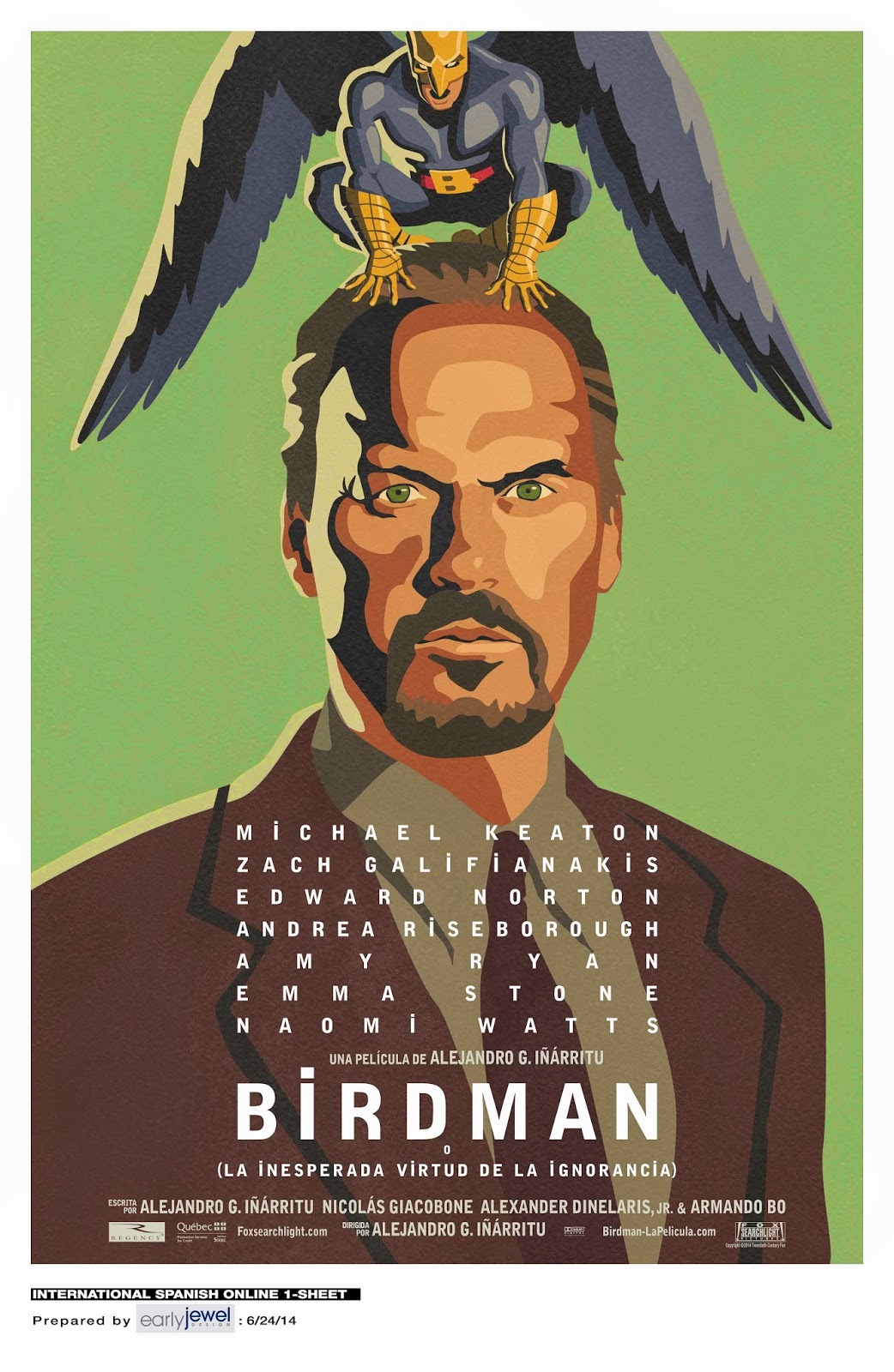
Birdman: or (The Unexpected Virtue of Ignorance)

Year: 2014
Director: Alejandro G. Iñárritu
Cast: Michael Keaton, Zach Galifianakis, Edward Norton
Run Time: 1 hour 59 minutes
MPAA Rating: R

A washed-up movie star attempts to revive his career with a Broadway play.

Countless films have worried at the edge between reality and fantasy like a dog with its favorite bone, including two of my very favorite horror films, so Birdman is in good company. But, and I say this without even the faintest whiff of sarcasm: Birdman ain't no Wes Craven's New Nightmare

The cardinal sin of the "comedy" Birdman is that it takes itself far too seriously. Many of its core scenes and conceits are pitched up to a more over-the-top register that would best function as laugh-out-loud comedy, but there's only one single line in the film that is obviously intended to elicit a chuckle. The rest is as dour and self-serious as the rest of the Oscarbait in the worm bucket, and that weighs down the film like an anchor.

There is some interesting material to chew on about how social media is shaping our generation's perception of art and reality, as well as how actors can get so trapped within a famous role that it casts a shadow over their entire lives. This is interesting to film enthusiasts and (more importantly) members of the Academy, but it's remarkably separate from the reality of the average American filmgoer. It absolutely doesn't need to play to the lowest common denominator, but Birdman's sense of what "reality" actually is, is already so mired in artifice that the film loops around itself uselessly like when I try to put the garden hose away.

In the process of all this philosophizing, Birdman loses itself among a pile of heaving, exhausting Important Movie cliches, like the Inexplicable Lesbians, the Real Life Connection, and the All in One Shot gimmick. Slathered with some improperly proportioned magical realism, a variety of subplots that utterly fail to go anywhere at all, and an astonishingly artless ending, Birdman is a frustrating nut to crack.

But when you finally break through to that sweet sweet nut meat (I am writing this very late at night), there's something special in there. Birdman is a film with an impeccable sense of rhythm, a variety of delectable lighting arrangements, and a series of off-the-wall performances pulled from actors who really have no business being in a movie like this. Emma Stone rips a nothing part to pieces with a spiky vulnerability, Zach Galifianakis tones down his usual energy to become a wonderful straight man, and Edward Norton shines as a loose cannon actor with a feeble grip on his own humanity.

And, after all, Michael Keaton has been getting all the awards buzz, so let's not forget to mention him. Although he gave a Brave performance more than he gave a Great one, Keaton carries the movie on his back across the finish line. His imbues his character with a wild-eyed animalism that propels the narrative through its illusion of a single shot without a single hitch or draggy moment. 

For my purposes, it is not a truly remarkable film, at times veering into an immensely irritating one. But for art cinema-inclined viewers, Birdman is one to RedBox before it's too late.

Rating: 6/10


Edge of Tomorrow

Year: 2014
Director: Doug Liman
Cast: Tom Cruise, Emily Blunt, Bill Paxton
Run Time: 1 hour 53 minutes
MPAA Rating: PG-13

An unwittingly drafted soldier finds that, every time he dies in battle, he wakes up the day before only to repeat his misery.

Edge of Tomorrow represents everything that's wrong with Hollywood today. 

By that I mean that it's a fantastic original movie, but it was misrepresented in advertising, brought in only slightly more than half its budget in box office, and was scuttled away to home video with a confusing new title to perish in ignominy.

It's a real shame. An adaptation of the manga All You Need Is Kill, Edge of Tomorrow presents a fun, fresh, sci-fi fueled twist to time loop storytelling, pitting Tom Cruise's eternal movie star glamor (which, as this movie proves, can survive even the weirdest twists and turns of his personal life - hail Xenu) against the endlessly unappreciated high caliber efforts of Emily Bunt. Blunt takes on the most kinetic, action-packed role of her career with aplomb, dragging a loopy sci-fi plot headfirst into gritty, believable reality.

On top of all of this, Edge of Tomorrow is, like, unbelievably funny. I'm serious. The film takes the notion of comic relief and stretches it liberally throughout the entire film like that Bible story with the fish. It's just shy of genuinely being classifiable as a "comedy," but it's a raucous good time all the same. The best part is that the humor bubbles up naturally from the situations and characters instead of being imposed upon the film by some unseen, arbitrary entity like certain of the more dour sequences in Avengers: Age of Ultron.

The endless repetition of plot points that comes with the territory of time travel films is treated with fleet footing, capturing the highlights while always furthering its central story arc. Between the repeated story beats with ever-changing perspectives and the secretly pretty cool alien tentacle CGI, Edge of Tomorrow feels like a particularly difficult video game level and captures the intrinsic joy that comes with solving an intractable problem while simultaneously having a great time shooting bad guys into piles of goo.

But there's something pulsing beneath the surface, too. Both characters are recognizably human and have fully developed arcs. This is something that shouldn't even technically make sense considering that Emily Blunt's character resets at the beginning of each day, but the film is so invested in its storytelling that it works no matter the obstacle.

There are some technical difficulties that derail the film slightly, like an undercooked third act and a severe lack of proper lighting during several key sequences, but Edge of Tomorrow is wicked fun, and worth a watch from anyone who hasn't seen it yet. Which is pretty much everyone, because the world is a terrible, unfair place.

Rating: 8/10


Groundhog Day

Year: 1993
Director: Harold Ramis
Cast: Bill Murray, Andie MacDowell, Chris Elliott
Run Time: 1 hour 41 minutes
MPAA Rating: PG

A curmudgeonly weatherman gets trapped in a time loop and is forced to repeat Groundhog Day endlessly until he becomes a better person.

Two guesses as to how I decided to pick this one.

Groundhog Day is an indisputable classic of the 90's comedy genre, one for which I have an immense amount of esteem and absolutely nothing new to say, so this will be my shortest review yet. Depending on your inclination, you may either cheer or jeer here.

...

Alright, we're back. Set in the small Pennsylvania town of Punxatawney, Groundhog Day is more than just the story of one man finding his inner Samaritan. It's about the clash between the town and the city folk, and the lack of respect for others that the city garners in otherwise good people. 

As Murray's weatherman discovers the better person inside of him, he simultaneously develops a working interest in the lives of those around him. It is these people more than anything who help make him better rather than any supernatural force or deus ex machina. And Bill Murray is at the top of his game, giving his sardonic bastard a likable humanity without letting his brittle exterior of the first act show any chinks in his armor. 

Subtextual undercurrents, Bill Murray being pitch perfect... Throw in a lush, reactive score, an inventive visual schema, and a hard-hitting lesson about the fact that, sometimes, bad things are destined to happen and there's nothing we can do about it, and you've got yourself an unforgettable comedy with real heart.

Oh, and Andie MacDowell is OK, but her accent is ridiculous.

Rating: 8/10

Wild

Year: 2014
Director: Jean-Marc Vallée
Cast: Reese Witherspoon, Laura Dern, Gaby Hoffmann
Run Time: 1 hour 55 minutes
MPAA Rating: R

The true story of Cheryl Strayed, a kind of annoying hipster who decided that hiking the Pacific Crest Trail would solve all of her personal problems.

The next breadcrumb on our trail of Oscarbait leading us out of the 2015 Academy Awards is Wild, the first outing for Reese Witherspoon's new production company, Pacific Standard. I daresay, it's in good company with Birdman because it has several shining glimmers of pure cinema sandwiched in between what ends up being an immensely frustrating, self-indulgent project.

The biggest flaw of Wild is unfortunately inextricably attached to it: the subject matter. Based on the popular memoir Wild: From Lost to Found on the Pacific Crest Trail by Cheryl Strayed, the film necessarily must take on her character and situation at face value. The only problem is that, at all times, Cheryl Strayed can be relied upon to be the most douchey, irksome person in the room.

Now I'm not even referring to her backstory, which involves biblical amounts of heroin and cheating on her husband. That's par for the course in this kind of Find Your Clarity picture. What I'm referring to first and foremost is her habit of quoting famous authors in this manner: "I took the road less traveled, and that has made all the difference." - Robert Frost (and Cheryl Strayed) Like, what. Were you there helping him write his magnum opus, Cheryl? No you weren't. Now stop prancing about like you're so much better than everybody else and crapping all over authors you've never even read. So there.

I'm sorry. I just really despise Cheryl Strayed. At least as portrayed in the film, she is the worst kind of pretentious hipster and could hardly care less about the plight of other people, although her mind-altering journey is ostensibly about coping with the loss of her mother, played by Laura Dern over what adds up to about a minute of screen time. But enough about that.

I will give Wild this: When it makes an effort to be an art film, it really rises to the challenge of creating something visually stimulating. The rhythmic, stream-of-consciousness editing patterns link together disparate images in a reckless collage of life, at least in the patches where they crop up.

And Reese Witherspoon really does a terrific job here, for better or for worse, taking a physical challenge and inhabiting a role that drags her straight out of her comfort zone to expose some really raw, true emotion. She is also essential in providing the film's infrequent undercurrents of humor, which are a welcome presence in the midst of such a straightforward story.

I have my doubts as to whether the conclusion of the story is as clear-cut as screenwriter Nick Hornby seems to think it is, but when it comes amidst such a magnetic performance and easy, beautiful visuals, it's not hard to ignore. All in all, Wild is a plus, but for a great deal of the time it wastes a lot of its energy pushing against that current.

Rating: 6/10
Word Count: 2007