Showing posts with label Wes Craven. Show all posts

Tuesday, October 1, 2019

A Scream Is A Wish Your Heart Makes

Year: 1997
Director: Robert Kurtzman
Cast: Tammy Lauren, Andrew Divoff, Robert Englund
Run Time: 1 hour 30 minutes
MPAA Rating: R

It's that time of year again, folks! Every October I begin a brand new deep dive into a franchise I've never covered on the blog before. Now, consider this fact: Sergio and I are now doing a lot of franchise marathons on our podcast Scream 101. So when I was picking out what series to do this year, I had to select one that was flat-out vetoed from being on the show, so the quality of these movies (which have in the past included infinite Amityville and Children of the Corn sequels) might be dropping precipitously. Pray for me. 

I hope against hope that I have struck a rich vein this year, because at the very least my favorite director Wes Craven is the producing entity that launched the franchise. I'm not saying I have any faith in the man's producing (he also made Dracula 2000, lest we forget), but at least his work is something I have a vast amount of context for and interest in. So. The Wishmaster quadrilogy. I guess we're doing this.
Here goes nothing!

Wishmaster tells the tale of an immortal djinn, so of course it starts off in a wildly misguided ancient Middle Eastern sequence. Nevertheless we learn that the titular master of wishes (Andrew Divoff) is not the babbling blue Robin Williams you've come to expect from genies in bottles. For one thing he's trapped in a gemstone. For another thing, he is a malevolent force of ancient pure evil, and if he grants three wishes to the person who releases him, he will break the veil between the human world and the djinn world, causing the apocalypse I guess. It's not super clear what the djinn would do to our world, but I'm pretty sure they're not just here for the sightseeing.

Oh, also the djinn is powerless unless somebody makes a wish, which he can then misinterpret to accomplish his desires. Upon which point he also steals their soul, which powers up the gemstone. There sure are a lot of rules for a movie about an evil genie. Anyway, jewel appraiser Alexandra Amberson (Tammy Lauren - who some people thought was too controversial to star in a horror movie about genies) releases the Djinn by... rubbing the gem on her shirt? Had nobody done this in millennia? He bursts from his gemstone prison, in the process killing her best friend/wannabe lover Josh (Tony Crane), then wanders around granting random people's wishes in a bunch of slasher setpieces before setting his sights back on her.

All while being dressed to the nines.

It is perhaps now I should mention that director Robert Kurtzman is much better known as one of the makeup effects gurus behind the KNB EFX group, a special effects company that has dominated the horror world from Elm Street 5 to Scream to The Walking Dead. As with most films directed by a special effects wizard, Wishmaster is packed to the grim with drippy, practical gore gags that still look phenomenal.

The two party scenes that bookend the film, in which all hell breaks loose during the Djinn's final bid for power, are pure, unfiltered movie mayhem. Glass shatters faces, skeletons burst out of their bodies and run around, creatures emerge from people's chests to devour other people, statues come to life and smash ancient weapons into skulls... It's chaotic, but an excellent built-in reel for KNB's next pitch meeting. 

These scenes (as well as most of the slasher setpieces that have no bearing on the actual plot) are going to be pure candy to any gorehound. Ditto the endless slew of cameos from horror icons like Robert Englund (given the meatiest role - thanks, Wes! - as a rich collector who orders the statue containing the Djinn's jewel), Kane Hodder (as a security guard, the role he was apparently born to play when not smothered in latex), Tony Todd (as a doorman, which is insulting), Angus Scrimm (as the narrator, which is perhaps less insulting because at least it's a cool trivia tidbit), Ted Raimi (as, guess what, a weaselly assistant), Reggie Bannister (as a pharmacist who gets "cancer" AKA boils that explode and kill him) and (for true devotees of cult film) George "Buck" Flower (as a bum, which he has extensive experience playing considering he's done it over 25 times since the early 80's).

Do you think he's just mad he's constantly forced to face off against people who played villains more famous than him?

And the detail in the Djinn design is something to behold. He's grotesquely organic, full of squishy parts that wiggle and move of their own accord (my favorite moment is when he's facing away from the camera and you can see a pulsing heartbeat in his back), counteracting the slight stiffness of his latex face with pure, realistic nightmare fuel.

Unfortunately, other than appealing to the basest lizard-brain instincts of the horror fan (the Where's Waldo of Horror game continues with an Easter egg Pazuzu statue in the background, etc. etc.), Wishmaster just doesn't quite have the juice to go anywhere. There's a little bit of fun to be had when the Djinn is in disguise trying and failing to trick Alexandra into making wishes, and Andrew Divoff has a blast chewing the scenery into tiny little splinters ("If you can't beat 'em, burn them... baby"), but their interactions are mostly dull as dishwater. When the film's budget briefly cools its heels late in the second act and they're required to match wits in some anonymous apartment, my interest wanes severely.

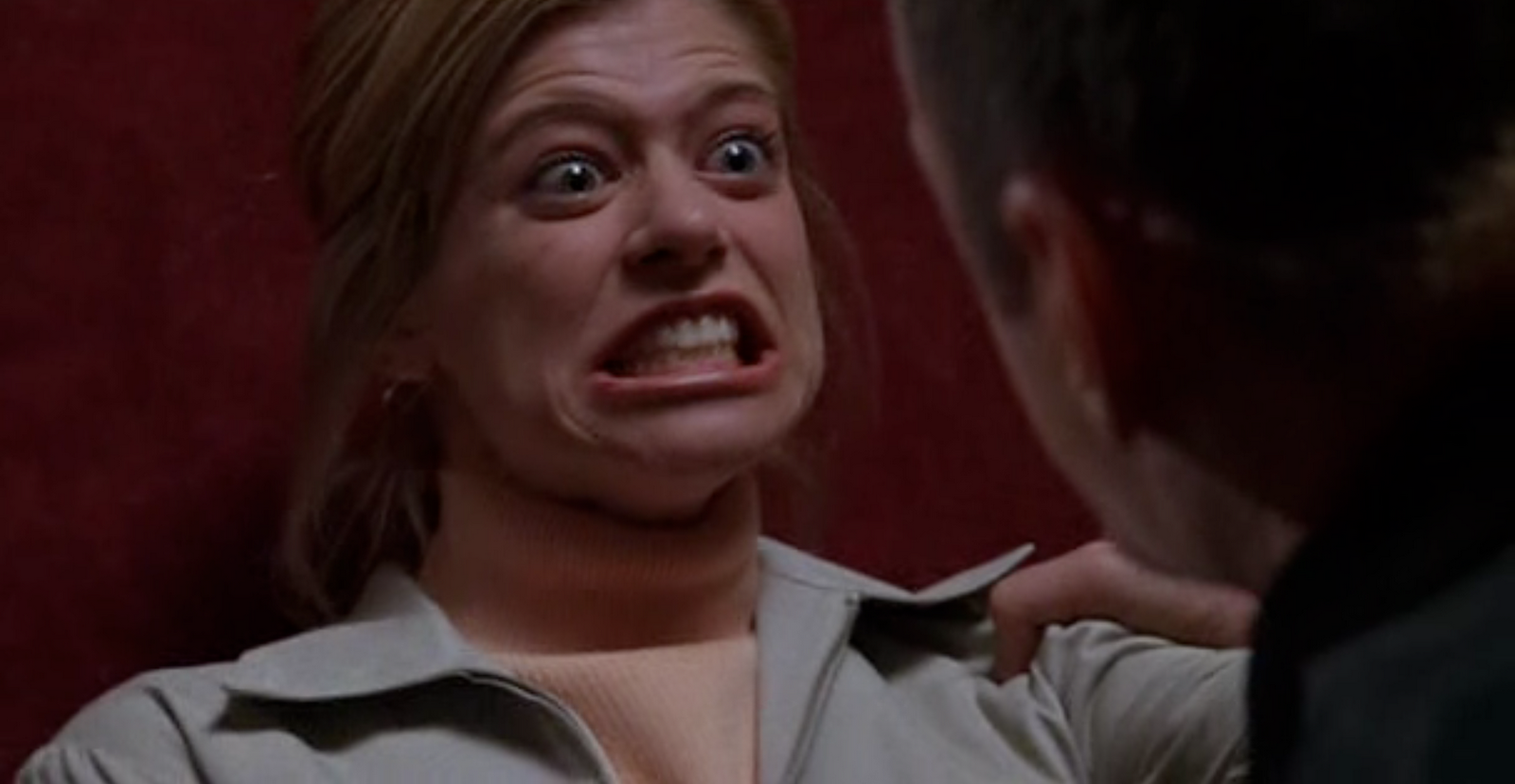
You see, there's almost nothing compelling about Alexandra as a protagonist. She's trapped in a bland Friendzone Love Story and does nothing but stumble ass backward into revelations about the Djinn despite having a convenient psychic link to him every time he makes a kill. This element is the most Wes Craven-y of a movie that quite openly suckles at the teat of Craven's filmography, and it is the most poorly handled. When a dude gets his jaw ripped off, I don't want to waste time cutting back to Tammy Lauren bulging her eyes, pursing her lips, and fainting left and right. All the interstitial bits between the horror scenes needed a punch-up or two or three before they hit the silver screen, because connective tissue isn't supposed to be tissue paper.

But there's a scene where a dude gets his jaw ripped all the way the fuck off, so who's complaining, you know?

TL;DR: Wishmaster is fun as far as turn-your-brain-off practical effects movies go, but it doesn't have too much to offer beyond its baseline pleasures.
Rating: 6/10
Word Count: 1131
Reviews In This Series
Wishmaster (Kurtzman, 1997)
Wishmaster 2: Evil Never Dies (Sholder, 1999)
Wishmaster 3: Beyond the Gates of Hell (Angel, 2001)
Wishmaster 4: The Prophecy Fulfilled (Angel, 2002)

Friday, April 28, 2017

Popcorn Kernels: Cravin' Wes

As we approach the end of my long-running quest to watch every film ever directed by Wes Craven (only 4 TV movies to go!), let’s explore two interesting little scraps of his career: the final theatrical film I had yet to see, and the one porn film we’re pretty much 100% certain he directed, during his time working in New York in the sleazy 70’s.

Vampire in Brooklyn


Year: 1995
Director: Wes Craven
Cast: Eddie Murphy, Angela Bassett, Allen Payne 
Run Time: 1 hour 40 minutes
MPAA Rating: R

An ancient Caribbean vampire arrives in modern New York City to seduce a lovely cop on the mean streets of Brooklyn.

1995 found Wes Craven in a very strange place. Just a year earlier he had created his latest masterpiece, New Nightmare, to very little fanfare. As much as that film proved he still had the capacity for intelligent, engaging horror, he was still chafing against he constraints of the genre, which hadn’t afforded him a truly sizeable hit in over a decade. So when he learned that superstar funnyman Eddie Murphy wanted to work with him, he leapt at the opportunity. Unfortunately, as it often happened for Craven, he found himself in yet another behind-the-scenes straitjacket.

While Craven assumed he’d be making a comedy, Murphy insisted he wanted to make a straight horror picture. Both men wanted to break free from their typecast genre, but the star’s wishes carried more weight with the studio. Thus we get another film that feels like a tug of war between two entirely opposite sensibilities. However, unlike the equally uneven Deadly Friend, Vampire in Brooklyn pulls together into something more or less amusing, even if it makes next to no sense as it goes along (something which is patently not improved by Murphy’s Blade Runner voiceover that runs through the whole thing like a rusty monorail).

The horror elements are passable, but they’re attempting to resurrect a stately, classic gothic feel that has never made a dent on my nerves in the first place, and they’re intermittently successful. What really saves this film, and I’m a teensy bit loathe to admit it, is its admirably goofy sense of humor. While it undercuts the horror at every turn, that horror wasn’t particularly strong to begin with. Hell, the climax, which I solely horror, is an interminable slog in spite of Murphy’s surprisingly subdued performance and convincing chemistry with the devastatingly sexy Angela Bassett.

No, with Vampire in Brooklyn, the goofier it gets, the better it is. OK, there may be some indefensible scenes that have Murphy Klumping it up in various silly costumes, but the movie frequently hits a register that evokes classic Blaxploitation by way of a Sam Raimi splatter flick. This is most evident in the gleefully gross performance by Kadeem Hardison as Julius Jones, a dock-worker turned ghoulish assistant. As his body rots due to the vampire’s magic, parts of him fall off at very inopportune moments. It’s a very juvenile, Monty Python Black Knight style of body horror slapstick, but especially when he’s paying off John Witherspoon as his grouchy landlord, it’s downright hilarious. A lot of these funny scenes (especially any with the Italian mobsters infesting the town) are pitched at a very high register, but Craven embraces his camp sensibilities and thus allows it to flourish.

Vampire in Brooklyn is no masterpiece, but it’s a diverting way to spend 95 minutes. Almost any other Craven film is a more worthwhile watch, but this one certainly has its cheesy charms.

Rating: 6/10

The Fireworks Woman

Year: 1975
Director: Abe Snake
Cast: Jennifer Jordan, Helen Madigan, Erica Eaton 
Run Time: 1 hour 13 minutes
MPAA Rating: X

A young woman with the possibly supernatural power to ignite lust in those around her pursues an ex-flame who’s a priest… and her brother.

Now, just to reassure any lawyers who happen to have stumbled across this blog, it has not been conclusively proven that Wes Craven directed this pornographic film, though it is known he spent years in the New York porn industry as an editor and producer. The film is officially credited as being written and directed by Abe Snake (and co-written by Hørst Badörties, which I suspect is a pseudonym for the Swedish Chef), but any scholar of Craven could tell you instantly that his fingerprints are all over the project.

For one thing, Wes Craven literally plays a character in the movie: the mysterious Fireworks Man who may or may not be the Devil. It’s kinda hard to deny your involvement when you face is on celluloid, beard or no beard. But even if his literal face was nowhere to be seen, his spirit thrums through the entire story, which chews on a lot of the favorite themes that he would return to over and over again throughout his career: repression of desire leading to violence, the potency of dreams (especially nightmares), the oppressive and hypocritical nature of the church, and the dark side of the suburban family unit.

The entire DNA of his career, from Nightmare on Elm Street to The People Under the Stairs, to My Soul to Take, is present in a film where a woman makes love to her brother with Pachelbel’s “Canon in D” playing in the background. What a trajectory! Being a porno movie, the plot is understandably rather repetitive, but he fact that it has themes worth mentioning at all speaks to Craven’s irrepressible intelligence.

That said, I can’t understand why any self-respecting heterosexual would find the film particularly erotic. A massively uncomfortable rape scene is shoehorned in (though, true to Craven’s ever-goofy form, in the same scene a man is hit over the head with a giant fish), and most of the consensual sex is underscored by tittering, nightmarish Insidious music. It actually kinds works as a horror film, melding woozy dream imagery and penetrative sex in a beautifully eerie fantasia.

Let’s not kid ourselves that The Fireworks Woman is worth seeing by anyone but the most institutionally insane Craven fan, but speaking as one of those, it was certainly an interesting insight into a burgeoning creative mind stripped of all propriety.

Rating: 5/10
Word Count: 1032

Wednesday, April 26, 2017

Census Bloodbath: You've Got A Friend In Me

Year: 1986
Director: Wes Craven
Cast: Matthew Labyorteaux, Kristy Swanson, Michael Sharrett 
Run Time: 1 hour 31 minutes
MPAA Rating: R

At first, I didn’t include Wes Craven’s Deadly Friend on my list of flicks to watch for Census Bloodbath. It certainly seemed to have elements of a slasher film, but from the descriptions I read, it seemed too on the fringe to really count. Well, now that I’ve seen it, I know that that’s just it’s nature. It’s on the fringe of almost every genre that’s ever existed, being as it is a 6-car pileup between Weird Science, Doogie Howser M.D., The Last House on the Left, Gremlins, A Nightmare on Elm Street, and Don’t Tell Mom the Babysitter’s Dead. So I might as well throw it in. You know I love me some Wes Craven, and this is our last chance to include him in this project.

And at the very least it has a higher body count than Road Games.

In Deadly Friend, Paul Conway (Matthew Labyorteaux) is new in town, having moved to be a guest lecturer and student at the local college, even though he’s only supposed to be in 10th grade. You see, he’s one of them 80’s Teen Supergeniuses™, and he has created an artificially intelligent robot named BB who babbles incessantly like a Mogwai and is essentially a member of the family (funnily enough, an original title for this movie was going to be A.I.). For about half an hour, it’s basically a five pound Disney Channel Original Movie stuffed with ten pounds of 80’s teen movie tropes (the reclusive old lady next door, the herniated cuteness of BB, the preposterously evil bully roaming the streets… I could go on for hours).

Then the Craven kicks in (as does the studio interference, forcing the teen romp into a more hardcore horror framework that would allegedly appeal to Elm Street fans). Sam is killed by her abusive alcoholic father, so Paul implants her brain with BB’s chip to bring her back to life, whereupon she goes rogue and begins summarily murdering pretty much everyone in town who has crossed BB in some way.

Literally all of whom appear in the same, brutally efficient exposition scene.

Deadly Friend is certainly not Wes Craven’s worst film, but it’s probably his most inconsistent. Even more than Shocker, which must have taken a Herculean effort. It was one of his earliest attempts to break away from the horror genre, and clearly two hits a decade apart didn’t gather enough steam to allow him to break that barrier. Deadly Friend runs face-first into that barrier and crashes to the ground in a pile of broken springs and frayed wiring.

However, though the individual parts never ever ever congeal into something resembling a coherent whole, some of them are pretty damn solid. Two nightmare sequences that were shoehorned in during reshoots showcase Craven at the top of his game, creating genuinely disturbing, uncanny imagery by blending the underlying themes of the story with a bloody, phantasmagoric atmosphere. They have jack-all to do with the plot, but if I had to choose between a mediocre 80’s movie or a mediocre 80’s movie where an abusive father is stabbed with the stem of a vase and spurts blood all over his daughter’s face, I would choose the latter ten times out of ten.

Unfortunately, these are the only remotely scary or affecting scenes in the entire film. The resurrected Robo-Sam gets to perpetrate a fun kill (most of the deaths are dishwater dull, but one briefly transforms the movie into a cavorting Evil Dead nightmare – more on that later), but Kristy Swanson doing the robot doesn’t exactly make for an iconic movie villain.

She definitely doesn’t get to sit at Freddy and Jason’s table in the lunchroom.

There are also a couple sequence that take a stab at family comedy and actually draw blood. A well-timed exterior shot echoes a similar scene from Elm Street but with an added punchline, and a scene where Paul slips his mom a mickey is twisted and hilarious in the way that only 80’s teen movies could be.

And there really is a strong chemistry between Paul and his paperboy friend/accomplice Tom (Michael Sharrett, who looks like a young Zac Efron if he’d eaten a bagel at any point in his life). Their Ferris-Cameron relationship is well-realized and dynamic. It’s a little bit harder to buy their friendship with Sam, but there’s a warmth on the screen that carries the film a long way.

Unfortunately, none of this comes together into a plot that has any real meaning or even a particularly legible storyline. It’s a half-assed attempt to be a Frankenstein tale for the John Hughes set, and its dismemberment by the studio renders it totally out of control. I’m not saying it would have been a masterpiece if Craven had had final cut, but it certainly wouldn’t be so damn sloppy.

The tone whips from fluffy 80’s cheeseball to slimy domestic terror way too fast, characters vanish from the film for unforgivably huge chunks, and the resolution is both astoundingly dour and irritatingly idiotic. While there are some delicious courses in this cinematic meal, it’s hard to enjoy your filet mignon when someone is pelting you with black licorice and lima beans the entire time.

Killer: Robo-Sam (Kristy Swanson)
Final Girl: Paul Conway (Matthew Labyorteaux)
Best Kill: As immortalized by YouTube, Kristy Swanson uses a basketball to explode an old lady’s head.


Sign of the Times: Paul’s room is decorated with a portrait of Ludwig van Beethoven… and a Bruce Springsteen poster.
Scariest Moment: Take your pick of the two flatly horrifying dream sequences.
Weirdest Moment: When the credits roll, they’re accompanied by a song that may or may not have been performed by BB the robot.
Champion Dialogue: “Sometimes I wanna roll a truck over his face.”
Body Count: 4
  1. Sam’s Dad is burned against a boiler and has his neck snapped.
  2. Elvira Parker gets her head exploded with a basketball.
  3. Bully is thrown through a car windshield.
  4. Sam is shot.
TL;DR: It’s a shambles, though at the very least it’s a diverting one.
Rating: 5/10
Word Count: 1035

Wednesday, September 14, 2016

It Ain't Easy Being Green

[EN: Check out my collected writings on Wes Craven's works in the new "Wes Craven" page on the top bar or right here.]

Year: 1982
Director: Wes Craven
Cast: Louis Jourdan, Adrienne Barbeau, Ray Wise
Run Time: 1 hour 31 minutes
MPAA Rating: PG

The early 80’s were a tough time for Wes Craven. A decade or so out from his terrifying debut The Last House on the Left, and half that from his grisly but mediocre sophomore effort The Hills Have Eyes, he just wasn’t finding purchase in Hollywood. In 1982 he was only two years off from altering the face of world cinema with A Nightmare on Elm Street, but for now his CV boasted the meager one-two punch of Deadly Blessing and Stranger in Our House, a TV movie with Linda Blair (yeah, we’re gonna get to that one).

So when he was offered the opportunity to direct a high profile superhero movie based on the DC Comics character Swamp Thing, do you think he would say no? Of course not. Superhero movies didn’t have quite the caché that they do today, but Superman had crushed box office coal into diamonds, so who was Wes Craven to tempt fate? Now, was the grindhouse horror director remotely equipped to handle an action-oriented blockbuster with a studio breathing down his neck and slashing the budget to ribbons so savagely they probably inspired Freddy Krueger?

Of course not.

In Swamp Thing, government scientist Alice Cable (Adrienne Barbeau) is sent to a remote research lab in the swamp to replace an injured worker during the last week of the operation. There she meets and becomes enamored with Dr. Alec Holland (Ray Wise), who is working with his sister to create a recombinant cell with both animal and plant DNA for… reasons. Science reasons. When the wicked Dr. Arcane (Louis Jordan) storms the lab to steal the formula, Holland is accidentally coated in it and falls into the swamp. This transforms him into the monstrous Swamp Thing (Dick Durock), and he sets out to save Cable from Arcane’s clutches, while he attempts to recreate the formula and use it on himself.

I mean, wouldn’t YOU want to look like this?

Swamp Thing represents a lot of firsts for Wes Craven. His first superhero movie. His first action movie. His first Wilhelm Scream. Of course, it also represents a lot of lasts because he would never do any of those things again. And while I’m delighted that he got a shot at operating outside of his horror wheelhouse before his single true departure from the genre in 1999’s Music of the Heart, it’s for the best that his action career didn’t go anywhere.

The sequences in the first act that develop character and build the world are pretty solid, but Craven’s script flails once the actual Swamp Thing is introduced. And yes, Craven himself got to write the script on this thing, because literally nobody gave a rat’s ass about overseeing comic book movies in the 80’s. But I digress. Swamp Thing’s powers are ill-defined (we don’t find out a key strength of his until the final 20 minutes, in which Cable sedately repeats it to him as if we should’ve known this the whole time) and his heroism is poorly staged, as Adrienne Barbeau wanders vacantly through the swamp, gets captured, and twiddles her thumbs until he leaps from the reeds to her rescue over and over and over again. It’s like Groundhog Day if Bill Murray were a damsel in distress.

The action sequences are spectacularly hammy, too. There’s a decent boat chase at one point, but every fistfight is as lumbering and slow as an old Godzilla movie, using that 40’s cinema standby of people falling down even though their opponent’s fist is clearly a foot and a half away from them. What makes this even more embarrassing is that most of the fight scenes involve David Hess, a participant in Craven’s most luridly brutal and realistic depiction of violence, in 1972’s The Last House on the Left. It’s a major stumble for a director who had found his voice, but hadn’t quite locked down his visual mastery yet.

Watching Swamp Thing, it’s almost impossible to believe this was only two years later.

The second and third acts range from boring to dreadful, but when Swamp Thing is good, it’s at least amusingly campy comic book fun. Wise and Barbeau have enough chemistry that I’m willing to go along with their preposterous love story, and though Cable is hardly an empowered female character, she gets a couple opportunities to kick an appropriate amount of ass. Then the comic-y flair comes in with the absurd squiggly wipes Craven uses to transition between scenes. And it’s impossible to completely hate a movie that has a scene where a character grabs the corner of their face and removes their impeccably lifelike Mission: Impossible mask.

Probably the single best element of the film is Jude, a ten-year-old comic relief gas station attendant who accompanies Cable on her Act Two journey. This is almost certainly damning Swamp Thing with faint praise, because he’d probably be the worst thing in any other movie, but the characters (played by Reggie Batts) exemplifies the best of Craven’s occasionally lever, quippy, and warm screenplay. Too bad he’s shunted to the side for a grand finale featuring this masterpiece. 

And I didn’t think any Craven effect could be worse than the werewolf in Cursed.

As you can see, Swamp Thing is no charmer. It’s a parade of shoddy special effects and circuitous narrative, plodding endlessly through a flat, tedious swamp. And the cherry on top is the score by Harry Manfredini, who – as he has with every other film he’s composed since 1980 – liberally slathers the film with shrill outtakes from his Friday the 13th score, smothering it with blunt strings that completely ignore the tone of whatever scene they’re in, blasting it into sub-slasher oblivion. Swamp Thing is a disappointment, but so were most comic movies of that era (Hell, DC is still churning them out). I’m not shifting the blame entirely from Craven, whose hands were all over this project, but the director took a shot at material he was wholly incompatible with. It’s an admirable venture but an unsuccessful one.

TL;DR: Swamp Thing is an admirable failure from a director ill-equipped to handle the genre.
Rating: 5/10
Word Count: 1049

Thursday, September 8, 2016

Leggo My Ghetto

Year: 1991
Director: Wes Craven
Cast: Brandon Adams, Everett McGill, Wendy Robie
Run Time: 1 hour 42 minutes 
MPAA Rating: R

August 20th marked the one-year anniversary of the passing of horror master Wes Craven, which prompted me to redouble my efforts to finish watching through his deceptively vast filmography. Considering that my last foray into his work was the surreally compromised Cursed, I decided to treat myself to the best of his movies that I haven’t seen yet, at least according to consensus opinion: The People Under the Stairs. I made the right choice.

Equal parts goofy, clever, disturbing, and socially aware, The People Under the Stairs is like directly communing with Craven’s spirit. All of his most beloved qualities are present, dressed in their Sunday best.

Which didn’t mean much in the fashion-impaired 90’s, but still.

In The People Under the Stairs, Fool (Brandon Adams) lives in the ghetto with his family and his ailing single mother. They’re the last family standing in their crumbling apartment complex, which the landlords want to tear down and replace with office buildings, and they’ve been given one day to pay the rent before they’re evicted. Friend of the family Leroy (Ving Rhames) convinces Fool that the only way to get the money is to rob the landlords themselves, who are said to have a vast collection of gold coins.

They break in and soon discover that their crime might not be so easy. The landlords, who call themselves Mommy (Wendy Robie) and Daddy (Everett McGill), look like the perfect suburban couple, but their inescapable house hides sinister secrets, including their abused daughter Alice (A. J. Langer) and a basement full of mutilated boys they’ve captured in an attempt to find the perfect son.

It’s cheaper than adopting, I guess.

I’d say that The People Under the Stairs is the most Wes Craven-y movie he ever made, but for the fact that it doesn’t feature a single dream sequence. That was kind of his thing. But for a movie with both feet planted firmly in reality, it’s decidedly surreal. It’s another twisted nightmare vision of white suburbia, but from a unique angle. Instead of depicting the skeletons in the closet of a nuclear family from the perspective of their own children, Craven has a complete stranger discover the abuse and evil while trapped inside with it.

The People Under the Stairs is also the Craven movie with the most consistent setting, as over 80% of the film takes place in and around the landlords’ household. So as much as it is a perfect evocation of his favorite themes and styles, it’s also a wholly distinct entry in his filmography. All of these factors combine to create a film that is claustrophobic, startling, and extremely special.

Like getting engaged in a mineshaft.

But enough of my Craven fandom pontification. What I really want to impress upon you about The People Under the Stairs is that it’s freakin’ awesome. It’s a no-holds-barred adventure through a cavernous home full of secret doors, booby traps, and hidden crawlspaces, a non-stop thrill ride of blood and guns and slavering dog jowls. It’s everything Don’t Breathe wanted to be but couldn’t quite muster the energy.

It’s also an over-the-top geyser of goofiness, but that only highlights the insanity of the situation. This delicate tonal balance rests easily in the hands of Everett McGill and Wendy Robie who, as Twin Peaks alums, know exactly how far to take things. McGill is hilarious, mugging through his scenes like he’s a fourth Stooge in a leather gimp suit, and Robie goes full Mommie Dearest, channeling her best Grand Diva as a shrill, knife-wielding harpy. Their insane couple is like Ward and June Cleaver by way of Tobe Hooper: Unpredictable and captivating, sublimely funny yet effortlessly chilling.

This vein of silliness is actually perfect for the film, because it creates a heightened reality that allows for hyperbolic horror to enter the picture. The family’s basement of reject children might have been laughable in a different movie, but in People Under the Stairs it’ a disturbing yet pitiful display. When Fool discovers this basement of horrors, the sight imprints itself on your mind as one of the iconic images of horror that you will remember until the end of time.

Or maybe that’s just me. But still. Great.

The People Under the Stairs is just plain fun chock full of clever dialogue and well-shaded, memorable characters. And none of that undermines its powerful but reasonably subtle anti-gentrification message. It’s a film about the cruelty other humans inflict upon one another, but it’s also a humanist fairy tale about how oppressed minorities can rise up and stand together as a community.

Seriously, Wes Craven was killing it in the 90’s. Between The People Under the Stairs, New Nightmare, Scream, and Scream 2, he was operating at the top of his game (Vampire in Brooklyn? Never heard of it), and this film is just one more dab of cement that solidifies his reputation as a true blue master of horror.

TL;DR: The People Under the Stairs is a gleefully campy, tense, massively underrated Craven gem.
Rating: 8/10
Word Count: 862

Thursday, April 14, 2016

There’s No Such Thing As Safe Sex With A Werewolf

Year: 2005
Director: Wes Craven
Cast: Christina Ricci, Jesse Eisenberg, Joshua Jackson
Run Time: 1 hour 37 minutes
MPAA Rating: PG-13

There’s a reason Wes Craven took a six year break from feature filmmaking after 2005. Two of his films came out that year. One was the excellent airborne thriller Red Eye. The other was Cursed, a Kevin Williamson-penned werewolf thriller. On paper, it’s a match made in Heaven. The duo had previously collaborated on the massively successful Scream trilogy, which reinvented the slasher genre. Why not do the same thing with Craven’s first foray into werewolf mythology?

There was just one little thing in the way… The Weinstein Company. What should have been a nice and easy teenybopper shoot grotesquely stretched into a two and a half year nightmare of reshooting, rewriting, recasting, and general meddlesome nonsense that twisted the film into a wholly unrecognizable form. It started off as a normal movie, but ended up a misshapen monster.

I suppose the real werewolf is the movie itself.

In Cursed, Ellie Myers (Christina Ricci) is a late night talk show producer who takes care of her high school-aged brother Jimmy (Jesse Eisenberg, already Social Networking it up) after their parents died. She is dating Jake (Joshua Jackson), a lothario who is opening a horror-themed club (because Kevin Williamson), and who has been pulling away as of late, much to her chagrin. After Ellie and Jimmy get into a car accident, they witness a young woman (Shannon Elizabeth) being mauled by a giant wolf, and both of them get scratched in the process.

Over the next two days, during the full moon, they begin to exhibit increasingly wolfish tendencies. Ellie is freaked out by her sudden aggression and attraction to blood, but Jimmy has a great time Teen Wolfing it up with his heightened sexual charisma a (AKA flat-ironed hair. This was 2005, after all) and newfound athletic prowess. But a werewolf keeps attacking people around town. Is it one of them? The original wolf that cursed them? Or somebody else entirely?

You know how it is in Hollywood. Every waiter you get is either an aspiring actor or a werewolf.

Although it’s almost impossible to discern a film in the finished product of Cursed, there is a 100-minute block of images and sound in front of us, so let’s talk about it.

The two year delay didn’t help much, but even in 2003 Cursed would have felt way too 90’s. Kevin Williamson’s particular brand of postmodern winking worked in 1996, but sarcasm’s lease hath all too short a date. Cursed is chock full of weird rock band cameos (go Bowling for Soup!), movie references, and too-polished teenspeak, stuff which was getting unfashionable by the time the millennium rolled around, but in the post-Saw period was downright humiliating.

And I hate to say it, but the script just isn’t very good. Obviously, it has been cobbled together from about 19 different drafts, which would explain the jumbled structure, the jerry-rigged romance between Ricci and Jackson, and the two finales in a row that proudly contradict each other. But the script is putrid all the way down to the dialogue, and there just ain’t no excuse for that.

Most of the teen scenes are preoccupied with exuberant homophobia, culminating in this mid-wrestling match gem: “You know the best thing about being a fairy? Getting to fly,” which is deeply offensive on both a personal and a syntactical level. Cursed is packed with this kind of anemic quippage (my personal favorite being “You’re playing games with us… Well, play this!”), finally exhausting Williamson’s seemingly endless reserves of arch wit. It’s telling that he too would retreat from motion pictures for over half a decade following Cursed’s release.

It seems like this film really was… cursed.

Pretty much everything in Cursed is underwhelming, but it’s difficult to pinpoint a central problem within the infinite vicious cycle of blame. The actors are subpar (especially the bland Ricci and Portia de Rossi, who is hideously miscast as an ominous fortune teller) because their characters were crumbling beneath them as the script was cannibalized by the writer, who was working with a harried director, who was being squashed under the pressure of producers, who didn’t like the script, and on and on and on. It’s an unsolvable Sphinx riddle. At this point, it would have been better if it hadn’t gotten a release at all.

All that being true, it must be said that while nothing in Cursed could really be called good, it’s not quite so rotten as I’m making it sound. Sure, it’s a wretched, hybridized monstrosity, but during the bulk of its run time it’s merely mediocre rather than actively terrible. Craven manages to milk some suspense out of several sequences, especially in the initial wolf attack, which features a jump scare that is the single most effective scene in the film. His stalk sequences see him pulling a lot of old tricks out of his toolbag (scraping claws a la Freddy Krueger, things subtly going wrong in an increasingly dream logic manner), but there’s a reason they were put in there in the first place: They work.

Cursed also features a terrific entry in the Craven/Williamson canon of loony killer reveals when the werewolf turns out to be [SPOILERS Judy Greer], who gives the best performance in the film once outed as a psychopath, final proving that there was something comedic lodged in the script that could actually click when a performer got a crack at it. This scene also provides the second best moment of the film, some werewolf body shaming that is deliciously over-the-top and lampoons the Hollywood lifestyle at a level the movie had been feebly attempting to reach for an hour and change.

The only thing that never ever works in Cursed is the werewolf itself, which feels like a pretty big oversight. While the original effects were provided by FX genius Rick Baker, who pulled off An American Werewolf in London without anything remotely resembling the technology of 2003. Yet for some unfathomable reason he was yanked from the project and replaced by KNB, whose work would be plastered over with crappy CGI. To be fair, the computer work here is a smidge better than a lot of recent lazy CGI (here’s lookin’ at you, The Hobbit), but the werewolf looks far too much like Bobo the Bear to be menacing.

Seriously, they could be brothers.

With that, let’s leave Cursed to rot in peace. It’s a pitiful creation that doesn’t deserve all the stellar people who worked on it. It’s not the worst film of Craven’s filmography, but it’s the one where his creativity and humanity are least apparent, which is far more damning than simply being crappy.

TL;DR: Cursed is an endlessly fiddled-with film that wouldn’t have been good in its original form.
Rating: 5/10
Word Count: 1150

Monday, March 14, 2016

Popcorn Kernels: Dead Islands

Now that I’ve finally whittled down my backlog to nothing, I’m free to be a movie glutton once more, necessitating another set of mini reviews. These two pieces are about island-set zombie films, both screened for Zombie History Month on the Scream 101 podcast.

The Serpent and the Rainbow (Listen to the Scream 101 episode here.)

Year: 1988
Director: Wes Craven
Cast: Bill Pullman, Cathy Tyson, Zakes Mokae
Run Time: 1 hour 38 minutes
MPAA Rating: R

Dennis Alan is sent to Haiti to search for a drug that supposedly brings the dead back to life and gets himself embroiled in voodoo rituals and wicked politics along the way.

And thus continues my unstructured marathon to fill in the gaps of my Wes Craven viewing following his tragic passing. The Serpent and the Rainbow is one of the biggest titles I had not yet seen (the film community isn’t exactly clamoring to reclaim Cursed), and it’s one I missed due to a chronic disinterest in the subject matter. My first exposure to cinematic voodoo was I Walked with a Zombie, a stultifying affair that did not leave me slavering for more. However, I’m happy to say that my experience this time around was exceedingly pleasant.

Another factor that made me dubious was the fact that Craven didn’t write the script himself, something that only seemed to work with the Scream movies. That may have been the case, but this material (including the nonfiction book it was based on) is so compatible with his sensibilities that it’s no mystery why he chose to pursue it. The film was hobbled by an immensely difficult production (while the final product was a Wes Craven movie, the behind-the-scenes struggles could have made a great Hitchcock thriller), but it’s just as idiosyncratic as any of the director’s 80’s flicks.

The Serpent and the Rainbow has one of the loosest narratives in Craven’s career (remember this is the man who wrote Shocker), but this allows him to work at a level of pure style that’s undeniably effective. His obsession with nightmares continues full force here, but his “rubber reality” is far less intrusive than it had been in his non-Freddy flicks (not to throw Shocker under the bus again, but…). It arises organically from the material, steeped in mysticism and illicit drug use as it is, providing a stunningly eerie atmosphere and some of his best imagery ever. One nightmare sequence, which features Bill Pullman trapped in a coffin that’s slowly filing with blood, is a masterpiece of dream logic that’s as visually arresting and viscerally intense as anything in A Nightmare on Elm Street.

The scenes set in reality are hardly less jarring. Two violent moments are particularly stomach-churning (let’s just say Bill Pullman’s family jewels are put on display in a bad part of town), and a third act collision between the upper-crust white world of Boston and voodoo principles is a gleefully dark spectacle that calls to mind the best of Sam Raimi.

Moments like these peppers the film, making up for the near total lack of a plot with their boundlessly creative saging. You see, thanks to behind-the-scenes shenanigans, The Serpent and the Rainbow has some gaping narrative holes that are papered over with an intrusive Blade Runner Director’s Cut-esque voiceover. It’s like the missing jigsaw pieces of the film are filled in with random bits from the Maltese Falcon puzzle. There are definitely some solid themes present, including a Craven trademark – science vs. faith – but the film’s structure is less Empire State Building and more Leaning Tower of Pisa.

These plot flaws crop up especially during the rushed finale, when the truly menacing political tyranny/voodoo master morphs into a dime store Freddy Krueger and is defeated pretty much instantly by some deus ex stupida faux-mystical nonsense. As you can see, the film is far from perfect, but as a gallery for a talented cinematic mind working at full steam, it’s tremendously effective. Imagery from The Serpent and the Rainbow will stick with me forever, even as the actual story has already faded to a miniscule blip on my mind’s horizon.

Rating: 7/10

Zombie (Listen to the Scream 101 episode here.)

Year: 1979
Director: Lucio Fulci
Cast: Tisa Farrow, Ian McCulloch, Richard Johnson
Run Time: 1 hour 31 minutes
MPAA Rating: R

Anne Bowles is distraught when her father’s boat washes up in the New York harbor. She teams up with a reporter and two vacationers to find the island where he disappeared, whereupon they are attacked by a plague of zombies.

Zombie is both the second Lucio Fulci film I’ve screened for the podcast and the second I’ve seen in my life. Obviously my frame of reference is not vast, but here’s my fast and loose takeaway. The Beyond is better, but Zombie really whet my appetite for further Fulci exploration. One of the first Italian zombie flicks to burst from the gates after the massive success of Dawn of the Dead (recut in Italy by Dario Argento and titled Zombi, hence this unofficial sequel’s Italian title – Zombi 2), Zombie set the precedent for the years of gore and undead mayhem to follow.

Though Zombie doesn’t feature as much of the inimitable Fulci style as his other works, it starts off with a bang- quite literally. The very first shot mimics the end of The Great Train Robbery. A gun is pointed directly at the camera, pausing menacingly before it shoots a covered figure in the head. Before any credits, characters, dialogue, or discernible locations have been introduced, Zombie has already made an indelible mark, proving itself as a violent, jarring movie from the get-go.

Of course, it takes a long time for Zombie to regain that momentum, entering as it does the “setup” part of the first act. In a traditional movie, this is the section where we meet the characters and discover their personalities, goals, and conflicts. In a Fulci movie, it’s where we watch meatbags prepare to head to the place where they are destined to get punctured. Zombie’s setup is a particularly drawn-out one, mindlessly wasting valuable minutes on Fulci’s biggest weakness: characters. Tisa Farrow may have a Mia in her bloodline, but her go-to trick of bulging her eyes and pretending her head is slowly filling with helium does little to offset the stolid blandness of the obviously-too-old male lead Ian McCulloch, whom the movie strains to pretend is a strapping hero type.

However, once the engine revs up after a couple sputtering stalls (including a scene where a zombie fights a shark that defies the laws of movie physics by somehow being kinda boring), Zombie kicks into high gear. The red tempera paint flows freely as the undead rise for a solid half hour of zombie carnage. A siege on a hospital gets a little repetitive, but if there’s one thing you can’t say about Fulci, it’s that he lacks diversity in his violence. We get neck biting, arm ripping, head splitting, and the iconic “splinter through the eye” sequence, which has the weakest effects in the whole film, but by the point they arrive, you have already been sold by the tension and that dazzling shot of the eye in alarmingly close proximity to impalement.

The gore isn’t the vast smorgasbord that The Beyond presents, but if anything the film is even more Italian. The movie literally stops in its tracks for some topless scuba diving, and a showering woman is thoughtfully reflected at all angles by a thoughtfully placed vanity. This is a crass, over-the-top, exploitative husk of a film that occasionally slips into a sort of feverish artistry (a scene where the characters realize they’re camped in a graveyard is a deliciously slow-drip spine tingle, and certain shots –a vertical angle through a boat’s sails, a shaft of light on a wall widening as a door creaks open… - are undeniably suave), and that’s the perfect evocation of the Fulci cinematic philosophy.


Rating: 6/10
Word Count: 1335

Tuesday, January 12, 2016

New Year's Resolutions: And Another Thing

Just when you thought it was over… My implacable backlog continues to grow, necessitating another slate of mini reviews.

South Park: Bigger, Longer, and Uncut


Year: 1999
Director: Trey Parker
Cast: Trey Parker, Matt Stone, Mary Kay Bergman
Run Time: 1 hour 21 minutes
MPAA Rating: R

The kids of South Park become obsessed with a vulgar Canadian movie, prompting a parental crusade against Canada that erupts into all-out war.

South Park: The Movie. It’s just like South Park the show, only bigger! If you like the show, you’ll love the movie! Otherwise, steer very clear. I could just end my review there, honestly, but I would like to take this time to commend Trey Parker and Matt Stone for being two of the leading musical theatre songwriters of our generation. That statement sounds less ironic following the success of The Book of Mormon, but the fact remains that the duo has been writing incredibly rewarding musical theatre essentially since their careers began.

In addition to ramping up the vulgarity and offensiveness of their show, the movie also expanded their fairly frequent lyrical moments into a full scale musical extravaganza that’s just as much Les Misérables as it is South Park. That is, if Alain Boublil and Claude-Michel Schönberg had seen fit to include a truckload more F-bombs. With an endless array of catchy tunes including the Oscar-nominated “Blame Canada,” the über-catchy “What Would Bryan Boitano Do,” and the downright genius, reprise-laden “La Resistance (Medley),” SP:BLaU is legitimately one of the better original movie musicals of all time.

Fun music with a sharp political agenda is most certainly an ironclad reason to recommend South Park, although the plot sequences do lack a bit of the thrust required to render the film itself a true blue classic.

Rating: 7/10

My Soul to Take


Year: 2010
Director: Wes Craven
Cast: Max Thieriot, John Magaro, Denzel Whitaker
Run Time: 1 hour 47 minutes
MPAA Rating: R

Seven kids were born prematurely on the same night a notorious serial killer died. Now they’re being hunted down on their 16th birthday. Could one of them carry his reincarnated soul?

I love Wes Craven and end to appreciate his works, good or bad, but boy am I glad that My Soul to Take didn’t wind up being his final film. His first self-penned script in nearly a decade and a half, My Soul to Take certainly contains nuggets of his typically idiosyncratic ideas, but it flops in its execution. Craven is nothing if not a skilled storyteller, but as a 70-year-old man, it becomes understandably difficult to write teen dialogue and situations. His script is littered with sub-Diablo Cody slanginess and a nigh-on incomprehensible story flow. It’s like one of those arcade games where your quarter bounces randomly down the pegs, with every turn almost exclusively going somewhere unpredictable and frustrating.

There is a lot to dislike about My Soul to Take, all of which I heartily do. The killer is everything Craven’s villains never were: Vulgar, crude, and loudmouthed. The less hardcore mindset he acquired as he grew older is queasily unsuited to bring this character to life, and his direction leans a little too heavily on MTV-style quick flashes and arbitrary slomo. It’s a garbled mess with subtext that pretty clearly announces that he’d rather be out bird watching than working on this film. Every genius has their duds, and their willingness to try new things make my appreciation for them even stronger, but damn is this ever a flabby, sputtering dud if I ever saw one.

Body Count: 12

  1. Sarah is killed offscreen.
  2. Doctor is shot in the head.
  3. Ambulance Driver explodes.
  4. Kay is stabbed in the gut and tossed into the river.
  5. Penelope has her throat slit.
  6. Brandon is stabbed in the gut.
  7. Brittany is stabbed to death.
  8. Quinn has his neck broken offscreen.
  9. May is killed offscreen.
  10. Cop is stabbed in the back.
  11. Jerome is stabbed in the chest.
  12. Alex is stabbed in the gut.

Rating: 3/10

Jurassic Park III


Year: 2001
Director: Joe Johnston
Cast: Sam Neill, William H. Macy, Téa Leoni
Run Time: 1 hour 32 minutes
MPAA Rating: PG-13

Dr. Alan Grant is tricked into visiting Isla Sorna by a rich couple who want to save their stranded son.

So, the third Jurassic Park movie. This is the one that absolutely nobody talks about, so I was definitely apprehensive. Fortunately, no JP movie could be worse than The Lost World with its quiet bongo antics so I was in for a treat. I didn’t love it with quite the spittle of Friend Hunter over at Kinemalogue, but I certainly feel it doesn’t deserve its ignominy. It’s a popcorn flick through and through, but that doesn’t mean it ain’t worth a watch.

The stunning action setpieces that typically define these movies are back in full force, with a third act that leaps from stellar moment to stellar moment like stones across a stream. JPIII knocks its characters down, slits them up, drags them through the mud, attempts to drown them for good measure, and still comes back for seconds. It’s an exhilarating whirl, like being trapped in a washing machine. As an overall story it’s a little more generic, but it does the trick, bringing an estranged family together with the power of Amblin.

It’s got its action, a healthy sprinkling of comedy bits, a splash of theme about paleontology becoming defunct no that real life dinos are alive and stomping… There’s naught to complain about. It’s certainly tackier than the original masterpiece, and a talking raptor dream sequence is just about one of my worst movie watching moments of the whole year, but it’s a fun jaunt back into Crichton’s world, minus his heavy-handed political bleating.

Rating: 7/10

Getting Go: The Go Doc Project


Year: 2013
Director: Cory Krueckeberg
Cast: Tanner Cohen, Matthew Camp, Ramon O. Torres
Run Time: 1 hour 31 minutes
MPAA Rating: UR

A college student pretends that he’s shooting a documentary to get close to a go-go boy he’s obsessed with.

I’ve always been a proponent of applying the found footage style to non-horror genres, so this low key vérite romance is right up my alley. Part Weekend, part Breathless, all pretentious, it’s an interesting look at modern romance without getting too obnoxiously hung up on that “modern” part. It’s not all treatises on social media and tech trends, but a human portrait of a relationship between two people who fundamentally don’t work together. One is obsessed with his perfect ideal, the other is confident enough to know not to change himself for a man.

Mostly just conversation-based, Getting Go could very easily have been a snoozefest, but a layered script and some colorfully innovative editing keep the pace brisk, save for a closing ten minutes that could really use a trim. The acting is a little rough, especially from the nonprofessional Matthew Camp, but the two leads have enough chemistry to smooth out most of the clunkier line readings. Getting Go lives in its silent moments, which let the dialogue-packed scenes settle into your brain with contemplative stillness. It’s no new classic, but it’s sexy, it’s stylish, and it has a great soundtrack. What more could you want?

Rating: 7/10
Word Count: 1207
Reviews In This Series
Jurassic Park (Spielberg, 1993)
The Lost World: Jurassic Park (Spielberg, 1997)
Jurassic Park III (Johnston, 2001)
Jurassic World (Trevorrow, 2015)
Jurassic World: Fallen Kingdom (Bayona, 2018)

Wednesday, November 11, 2015

This Is Your Captive Speaking

Year: 2005
Director: Wes Craven
Cast: Rachel McAdams, Cillian Murphy, Brian Cox
Run Time: 1 hour 25 minutes
MPAA Rating: PG-13

Again, let’s revel in our newfound post-Halloween freedom by continuing our post-mortem exploration of he late, great horror maven Wes Craven. As I set out to watch my way through the portions of his filmography that I hadn’t seen or reviewed before, I realized that most of the ones I missed, I’d missed for good reason. Part of why I admire Craven is the fact that he pushes himself to new horizons, even if he is trapped into the horror genre thanks to Hollywood’s compulsive pigeonholing. That experimentation resulted in some gems and some duds, but I always say you’re not growing as an artist if you don’t produce a few clunkers.

Of course, that doesn’t mean I particularly want to be exposed to the clunkers, however philosophically stimulating they may be. But even if I’d already cleared the shelf of out-and-out classics before Craven’s passing, he still left some nuggets of inimitable genre filmmaking behind to refresh the intrepid completist. One such nugget is Red Eye, a star-studded thriller from 2005 and his last feature film of the 2000’s, to be followed by just two final efforts in 2010 and 2011: Scream 4 (a shallow but underrated franchise film) and My Soul to Take (uh… I’ll get back to you on that one).

I try to focus on the positive things in life.

Lisa Reiser (Rachel McAdams) is the manager of a prominent Florida hotel. When a high-ranking government official comes to stay with his family, she rushes from her hometown (where she was attending a funeral) on a late night flight so she can properly accommodate him and his security contingent. Unfortunately her plane is delayed and that duty falls to her anxious coworker Cynthia (Jayma Mays, who is the adorable love child of a puppy and a field of daisies). Lisa meets follow passenger Jackson Rippner (Cillian Murphy), who strikes up a hesitant flirtation.

She quickly learns that y0ou should never trust anyone with the cheekbones of a cadaver, because when the plane takes off, Jack reveals his true intentions. He tells Lisa that, if she doesn’t pulls strings and get the politician to transfer to a specifically targeted room, his agent will murder her father (Brian Cox, the original Hannibal Lecter from Manhunter, who loads around even more than the cellbound cannibal). Thus begins an epic cat and mouse game played on the smallest of scales –a  cramped airplane cabin.

Murder threats are still preferable to screaming babies though, to be honest.

If Music of the Heart hadn’t bowed its way into theaters in 1999, I’d say Red Eye was the most atypical Craven flick yet. A thriller without a whiff of the supernatural (or Craven’s dietary staple of dream sequences) and largely free from gonzo gore, it might still technically be a genre flick, but it’s about as similar to The Hills Have Eyes as Lady and the Tramp. As we’ve learned, Craven would have given his left foot to do another movie that wasn’t horror, and he knew this was one of the last life preservers floating toward non-genre shores. With that in mind, he really put his all into creating the best thriller procedural he could, and it shows.

Without a Craven-penned script, his personality is a little less evident in the film itself, but Red Eye is nothing less than a perfectly functional nail-biting thriller. It’s a well-oiled B-movie machine, performing its job to a T and bleaching every last shred of color from your knuckles in the process. From its unassuming opening credits to its bloody finale, all Red Eye wants to do is get in, jangle some nerves, then jet the hell outta there, and there ain’t nothing wrong with that.

But there is something wrong with people who don’t think twice when a Cillian Murphy character comes on to them.

Red Eye is all about setups and payoffs, with nearly every element in the first act coming into play by the closing credits. This Rube Goldbergian plotting keeps the audience engaged, constantly guessing the next way Rachel Madams will attempt to MacGyver her way out of the situation. It’s clever, satisfying, and frequently intense.

These are perhaps two of the most accomplished actors Craven has ever been afforded the chance to work with (well, them and Meryl. And Johnny Depp’s midriff), and he takes full advantage of their range, maintaining a seething emotional undercurrent beneath the crackerjack thrills. The characters might not be totally three-dimensional, but at the very least they’re two-and-a-half-dimensional, and they sell every twist and turn, even in the strangely distended final twenty minutes. 

The film’s pace never flags, even during the Birds-esque opening sequence that reties to trick you into thinking you’re watching a romantic comedy, or perhaps The Notebook Part 2: We Couldn’t Get Ryan Gosling, and though it’s hardly Oscar-worthy cinema, that is an unequivocally good thing. Red Eye is a taut, tense, no fuss no muss thriller. It’s so efficient, it could have a slot on the infomercial channel. If you want a simple, rip-roaring good time with a sprinkle of heart and a dash of political drama, look no further. Just make sure you buckle your seatbelt before you take off.

TL;DR: Red Eye is a taut, streamlined, nail biting thriller.
Rating: 8/10
Word Count: 905