Showing posts with label Bill Murray. Show all posts

Thursday, April 19, 2018

Popcorn Kernels: Q1 Review Purge

On account of the fact that my computer was out of commission all weekend, and I'm not feeling particularly inspired by any of the films I watched therein, let's break tradition and knock out some mini-reviews of three recent 2018 efforts.

Isle of Dogs

Year: 2018
Director: Wes Anderson
Cast: Bryan Cranston, Koyu Rankin, Edward Norton
Run Time: 1 hour 41 minutes
MPAA Rating: PG-13

In the not-too-distant future, all dogs have been exiled to an island off the coast of Japan due to a suspicious outbreak of disease, and one young man takes a fateful flight over the water to rescue his dog with the help of a group of mangy strays.

I was honestly very surprised with how much I enjoyed Wes Anderson's previous animated feature Fantastic Mr. Fox. His fussy, twee aesthetic worked very well with the arch, British storytelling style of Roald Dahl's children's books. Unfortunately, it does not work quite so well with whatever Isle of Dogs is: an uncategorizable, scatterbrained mélange of post-apocalyptic gross-out humor, stunted emotional baggage, and wild misuse of Japanese-influenced design.

I will let other, more qualified, mouths speak on the specific impact of Wes Anderson's choice to set this story in Japan, but I will say one thing. The main character, whose name is Atari (strike one, dude), has a skin tone so yellow that it would a bowl of banana pudding jealous. Not only is it a bizarre, off-putting visual choice, it seems incredibly racially insensitive to boot, which is just... well, not great. This character is the entire lynchpin of the story, forcing you to contend with his questionable stereotyping for the entire run time. It's like if Mickey Rooney was the starring role in Breakfast at Tiffany's.

And whether or not this was Anderson's intention, because it probably was, the human characters on the mainland are underdeveloped in the extreme. I get that the dogs are the whole point of this story and it should focus on them as characters, but the amount of time we're forced to hop back and forth between the drama on the Isle with the cavalcade of stunted personalities who only get two or three minutes of screen time is intensely distracting.

The cast is reminiscent of a Valentine's Day movie, with way too many stars crammed in to give some characters enough time to actually make an impression, especially Scarlett Johansson's show dog Nutmeg and Greta Gerwig's American exchange student Tracy Walker. But these are female characters who are awarded to our male heroes for doing important things, so that's a very important role, y'know? Ugh.

It's hard not to get bogged down in politics, because Isle of Dogs kind of beckons in criticism. But look. It's fine. The dogs are amusing, the fussy sets are engagingly weird and gross, and it's a decent way to occupy 100 minutes. Is it worth sifting through all the morally and socially dubious messaging? Probably not. Just watch Fantastic Mr. Fox again. But I had a decent theater experience with this one, at the end of the day.

Rating: 6/10

Blockers

Year: 2018
Director: Kay Cannon
Cast: Leslie Mann, Ike Barinholtz, John Cena
Run Time: 1 hour 42 minutes
MPAA Rating: R

When three teenage girls make a pact to lose their virginity on prom night, their parents set out to make sure this doesn't happen.

As an ardent fan of the American Pie franchise, I must say that I'm glad the raunchy high school comedy hasn't given up the ghost quite yet. And while Blockers could never be the proper spiritual successor to that franchise due to the fact that the parents squirrel away as much screen time as the kids, it's as close as we're getting in 2018 and I'll take it.

Honestly, I don't mean to complain. I do like the parents. Presumably thanks to a Kay Cannon touch-up, the script isn't as reductive and sex-phobic as the trailer and synopsis made it seem. The parents all have their own warring motivations for preventing their children from having sex, and it stems from character flaws rather than a prudish morality play. Plus, I've long admired John Cena's comic acting (the fact that 2018 allows for a sentence like this to be written, says a great deal about the state of the world that I'm not ready to reflect on) and Ike Barinholtz always deserves a bigger platform. 

Then there's Leslie Mann, who is indispensible here. Her clingy mother routine isn't anything new (we've seen it as recently as Cheryl Hines in the also surprisingly terrific A Bad Moms Christmas), but she gives us some of the films most sterling perfect comic moments, especially a tearful goodbye scene that is a spine-tingling triumph of physical acting.

But still, you can't help but feel robbed of time with the film's three young stars, who shine bright enough to have led this movie all on their lonesome. Kathryn Newton is saddled with the most boring of the characters, but she maintains an easy chemistry with the other two: Gideon Adlon, who leads a sweet, surprisingly-transgressive-for-its-normalcy queer storyline and Geraldine Viswanathan, who is a pure magnetic presence the likes of which I haven't seen in a good long time.

Oh yeah, and the movie is funny too. I almost forgot. It's raunchy without being exploitative, that manages a terrific balancing act of six character arcs that all get their moments to shine. Just like Game Night, it's proof that scripts are actually pretty f**king valuable to comedy movies, Judd Apatow be damned. However, unlike Game Night, it doesn't offer a particularly unique aesthetic. Like most modern comedies, it's lit, shot, and cut well enough that it doesn't get in the way of the timing of the humor, but the energy of Blockers isn't coming from the filmmaking itself. Nevertheless, it's a movie I'd highly recommend, and certainly in the top 5 movies of the year so far, which is not something I thought I'd be saying at all.

Rating: 7/10

Truth or Dare?

Year: 2018
Director: Jeff Wadlow
Cast: Lucy Hale, Tyler Posey, Violett Beane
Run Time: 1 hour 40 minutes
MPAA Rating: PG-13

A group of teens on a Mexican spring break vacation stumble into a possessed game of truth or dare, where if they don't play they die in horrifying ways.

Truth or Dare isn't a film for me, at least demographically. I am a person who ditched class to go see Ouija in theaters, but let's not focus on that right now. And as much as I am a staunch defender of PG-13 horror and the potential that it has, the fact is, it still isn't for me. Would I have loved it if it was R-rated? No, probably not, but it just feels like it's operating at a level that I can't really reach anymore, even though the teens in the audience will probably love it.

There really is a lot to like about Truth or Dare. The characters and their conflicts are simply etched out, but interconnect in meaningful, narratively satisfying ways. The Final Destination-esque machinations of the game itself are delightful to watch unspool, and never ever boring. And Lucy Hale is a smart, capable performer who knows what she's doing with a script.

But the fact remains that, in my eyes, Truth or Dare pulled a lot of its punches. You'll never get on my good side by being progressive enough to include a gay character, but too gunshy to show more than half a second of him kissing a dude before demurely cutting away to something else and never mentioning it again. And then using his closeted sexuality to drum up drama for a dare, but completely excising the scene where's he's forced to come out to his father or die - which would have been the most flat-out horrifying scene in the movie, which is a little starved for genuine terror. At every turn this movie renders the character shallow, making him basically just a piece of set dressing.

While I do like the way the others characters are constructed, a lot of the movie is treated like that kid (who is played by a 32-year-old actor, naturally). The kills are noncommittal, the stakes of the game seem to ebb and flow as the narrative needs them to, and they don't even seem aware of the implications of their white characters stomping around Mexico destroying property and - in an early scene - physically assaulting a local with impunity.

This movie could have been much better. What it is is mostly entertaining, but its potential is so present and obvious that the fact that it didn't capitalize on it is even more frustrating than if it had never been there in the first place.

Rating: 4/10
Word Count: 1470

Monday, June 27, 2016

Popcorn Kernels: Who You Gonna Call?

When the remake of Ghostbusters is nigh, what else is there to do than catch up on a zeitgeist franchise of the sort we just don't seem to have anymore?

Ghostbusters (For our Scream 101 episode about this very film, click here.)


Year: 1984
Director: Ivan Reitman
Cast: Bill Murray, Dan Aykroyd, Sigourney Weaver 
Run Time: 1 hour 45 minutes
MPAA Rating: PG

A trio of out-of-work paranormal scientists open a business busting ghosts, only to stumble upon an ancient demon bent on ending the world inside from of their client’s fridges.

It’s impossible to approach a review of Ghostbusters without a great deal of baggage. You can try to check as much of it as possible, but you’re at the very least still stuck with your carry-on. The obscenely popular horror comedy was so ingrained into the hearts and minds of those who were growing up or even alive in the 80’s, the remnants of Ghostbusters have drifted down from generation to generation like a Jungian cultural memory. 

I could make “don’t cross the streams” jokes long before I was old enough for my parents to even consider renting me Ghostbusters. And if you can show me any American alive today who does have at least a rudimentary working knowledge of the Stay-Puft Marshmallow Man, I will show you an amnesiac. My spell check even knows that "Ghostbusters" is a word. Ghostbusters is an innate, primordial piece of cinema, and that’s the reason that the backlash against the remake has reached such shrieking, ludicrous heights.

That is to say, Ghostbusters adopts such a revered position in the pop culture idiom, it’s difficult to walk up to that hallowed door and nail your Theses there for all to see. But what can a lowly blogger do but try to say true to himself? Here goes: Ghostbusters has flaws. Deep-seated, crippling flaws that loudly announce themselves while the world plugs its ears. Does that mean it’s not a good comedy film? Hell no! In fact, it’s a great comedy film. But as a holistic narrative piece, it can occasionally be a bit of a shambles.

Born as it is from the minds of extremely talented sketch comedians, the deliciously high concept of Ghostbusters (underemployed scientists become a modern, macabre twist on New York exterminators) is populated by a handful of wacky, paper-thin characters not suited for the long-term scrutiny of a feature film. More a collection of (admittedly funny) tics and mannerisms than fully rounded personalities, it’s extremely challenging to get a sense of what makes them tick and how the dynamics of their relationships operate. 

Comedy is a genre uniquely suited to contain these types of characters (and Bill Murray, Harold Ramis, and Rick Moranis especially have the chops to pull it off), but there’s just no excuse for a character like Winston Zeddmore (played by Ernie Hudson), who shows up halfway through the film, integrates himself into the group offscreen, says and does next to nothing that can be perceived as funny on the visual or aural spectrum, and then is arbitrarily handed the climax’s closing line. This guy is a non-entity, there’s no discernible reason for his presence in the film (other than the fact that the casting director probably looked around at lunch and realized there was not a single black person on set), and he doesn’t even have the decency to make us laugh. The producers really should send Mr. Hudson a fruit basket or something, because he is well and truly f**ked by this film.

Similarly vexing is Sigourney Weaver’s Dana, who gets plenty to do when she’s possessed by the demonic Zool, but it hardly more than set decoration in human form. Ghostbusters is haunted by this kind of half-finished feeling (and in fact there are some effects shots that literally weren’t completed by the deadline), with a heavy sprinkling of sedate hang-out scenes, a ghost BJ scene clearly shoehorned in for… personal reasons, and an altogether too easy climax.

But even a half-finished Ghostbusters is an incredible one. The state-of-the-art effects are designed with the gleeful creativity of a fairy tale yet are just dangerous enough to earn the horror half of that horror-comedy hyphenate. And there’s no denying that this cast assembled some of the brightest comic minds of the 1980’s, delivering an endless conveyor belt of quotable dialogue with some of the keenest, most off-kilter readings in the business. Ghostbusters is a tremendously funny movie and yes, that really is the only thing that matters.

Rating: 7/10

Ghostbusters II


Year: 1989
Director: Ivan Reitman
Cast: Bill Murray, Dan Aykroyd, Sigourney Weaver
Run Time: 1 hour 48 minutes
MPAA Rating: PG

The now defunct Ghostbusters must reunite when an underground river of ectoplasm and an ancient Sumerian spirit threaten to destroy New York.

Ghostbusters II is kind of a miracle sequel, if only for the fact that it managed to reteam the director, writers, and entire cast (down to the bit parts) five years down the road after the original became a massive hit, spawning an empire of merchandise, imitators, and a cartoon series. For that fact alone, we must thank Ghostbusters II, but bringing back that crew brought back their particular set of problems, with a handful of new ones for flavor.

For starters, despite expanded screentime for both, Ernie Hudson and Sigourney Weaver are still treated like tagalong little siblings that the movie just doesn’t have time to deal with right now. We see Hudson in the opening, where we’re shown what the former Ghostbusters are up to, but in the climactic first act trial scene that predicates their reformation, he vanishes in a puff of ectoplasm. He continues this Houdini act throughout Ghostbusters II, reappearing only when it would look cool for there to be four beams of light instead of three. 

And Sigourney Weaver is yoked to a particularly unforgiving role: divorced single mother/damsel in distress. All she’s asked to do is coo at a baby, waltz about in a towel, and be just strong enough that she can resist Venkman’s advances until she is broken in like a horse. It sucks to be an actress in an 80’s comedy, don’t it? She is trapped in this insipid part, which commits the egregious sequel sin of breaking her up with Bill Murray just so we can see their inexplicable romance blossom yet again in the exact same pattern. Whee…

And then there’s Rick Moranis. His performance in Ghostbusters is perhaps my favorite of the bunch, and he continues to excel here. But his character is shoehorned in so poorly that he hangs from the film like a throbbing goiter, a constant reminder that what you’re watching is entirely pointless, a ramshackle artifice created only to capitalize on the brand of a lifetime.

Naturally, the third act also has the same problems, depicting a generic evil threat with no discernible stakes that’s defeated in about 2.5 seconds flat. And the film has the audacity to tack on a nauseating “power of positive thinking” vibe to the whole thing. At least the desperate Stay-Puft substitute (an animated Statue of Liberty stomping its way through the street of New York) is achieved with some tremendously convincing special effects.

In fact, all the effects here are particularly well-rendered. Five years of technological development and time to actually complete the work does wonders for Ghostbusters II. Although the ghosts are much safer and more Henson-esque this time around (thanks to the overwhelming popularity of the Ghostbusters cartoon), there are actually multiple ghosts busted in this movie, wreaking convincing havoc about town with lavish detail. In this respect and this respect only, Ghostbusters II is a vast improvement over the original.

But, like I said before, the whole point of Ghostbusters is to make us laugh, and this sequel doesn’t quite cut mustard. Although Murray and Ramis still punch up their material with effortlessly kooky line readings and franchise newcomer Peter MacNicol is delightfully camp as an improbably accented museum curator, the script just isn’t up to snuff. It falls back on too much weak slapstick (especially where the river of slime is involved), awkward improv, and ill-thought-out plotting. It’s a very messy film that has little reason to exist, and while there’s still a spark of what the original has to offer, it’s not really worth your time.

Rating: 5/10
Word Count: 1397
Reviews In This Series
Ghostbusters (Reitman, 1984)
Ghostbusters II (Reitman, 1989)
Ghostbusters (Feig, 2016)

Tuesday, June 2, 2015

Get These Monkeys Off My Back

As a super important future famous blogger, I've been attempting to up the ante with my movie reviewing over the past year, providing a frankly ridiculous amount of content on the off-chance that somebody wants to read 2,000 words about the splendors of The House on Sorority Row. But loath as I am to admit it, I am a fallible human. And the daunting list of movies I have yet to write about is weighing on me like the Earth's globe on Atlas' back.

What follows is four capsule reviews for films that I've seen over the past month but haven't had the time (or, frankly, the interest level) to fully explore in a broader article. You know, it might actually do me good to explore a shorter form of review writing. Consider this an experiment should I ever become the next Roger Ebert.

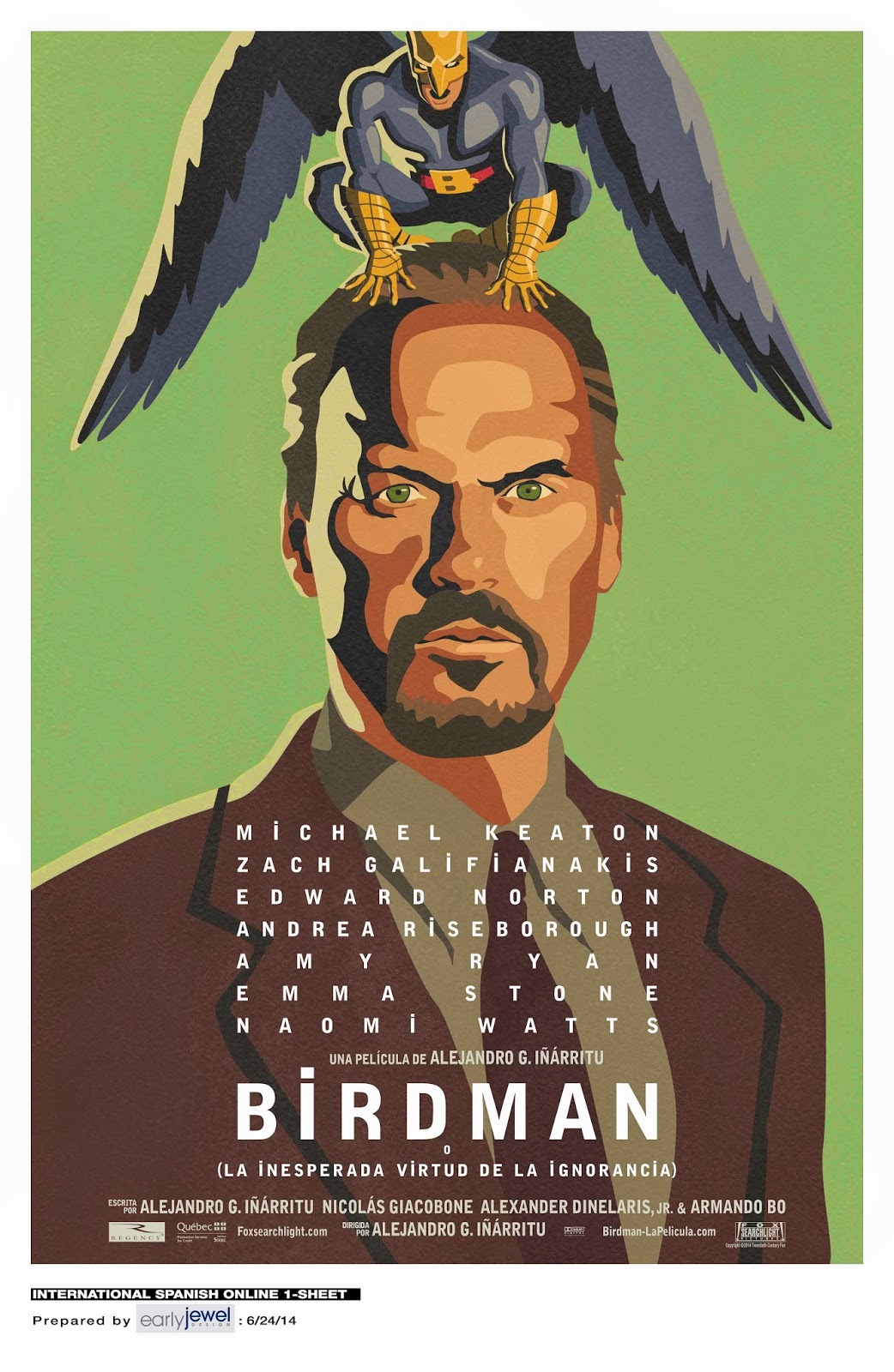
Birdman: or (The Unexpected Virtue of Ignorance)

Year: 2014
Director: Alejandro G. Iñárritu
Cast: Michael Keaton, Zach Galifianakis, Edward Norton
Run Time: 1 hour 59 minutes
MPAA Rating: R

A washed-up movie star attempts to revive his career with a Broadway play.

Countless films have worried at the edge between reality and fantasy like a dog with its favorite bone, including two of my very favorite horror films, so Birdman is in good company. But, and I say this without even the faintest whiff of sarcasm: Birdman ain't no Wes Craven's New Nightmare

The cardinal sin of the "comedy" Birdman is that it takes itself far too seriously. Many of its core scenes and conceits are pitched up to a more over-the-top register that would best function as laugh-out-loud comedy, but there's only one single line in the film that is obviously intended to elicit a chuckle. The rest is as dour and self-serious as the rest of the Oscarbait in the worm bucket, and that weighs down the film like an anchor.

There is some interesting material to chew on about how social media is shaping our generation's perception of art and reality, as well as how actors can get so trapped within a famous role that it casts a shadow over their entire lives. This is interesting to film enthusiasts and (more importantly) members of the Academy, but it's remarkably separate from the reality of the average American filmgoer. It absolutely doesn't need to play to the lowest common denominator, but Birdman's sense of what "reality" actually is, is already so mired in artifice that the film loops around itself uselessly like when I try to put the garden hose away.

In the process of all this philosophizing, Birdman loses itself among a pile of heaving, exhausting Important Movie cliches, like the Inexplicable Lesbians, the Real Life Connection, and the All in One Shot gimmick. Slathered with some improperly proportioned magical realism, a variety of subplots that utterly fail to go anywhere at all, and an astonishingly artless ending, Birdman is a frustrating nut to crack.

But when you finally break through to that sweet sweet nut meat (I am writing this very late at night), there's something special in there. Birdman is a film with an impeccable sense of rhythm, a variety of delectable lighting arrangements, and a series of off-the-wall performances pulled from actors who really have no business being in a movie like this. Emma Stone rips a nothing part to pieces with a spiky vulnerability, Zach Galifianakis tones down his usual energy to become a wonderful straight man, and Edward Norton shines as a loose cannon actor with a feeble grip on his own humanity.

And, after all, Michael Keaton has been getting all the awards buzz, so let's not forget to mention him. Although he gave a Brave performance more than he gave a Great one, Keaton carries the movie on his back across the finish line. His imbues his character with a wild-eyed animalism that propels the narrative through its illusion of a single shot without a single hitch or draggy moment. 

For my purposes, it is not a truly remarkable film, at times veering into an immensely irritating one. But for art cinema-inclined viewers, Birdman is one to RedBox before it's too late.

Rating: 6/10


Edge of Tomorrow

Year: 2014
Director: Doug Liman
Cast: Tom Cruise, Emily Blunt, Bill Paxton
Run Time: 1 hour 53 minutes
MPAA Rating: PG-13

An unwittingly drafted soldier finds that, every time he dies in battle, he wakes up the day before only to repeat his misery.

Edge of Tomorrow represents everything that's wrong with Hollywood today. 

By that I mean that it's a fantastic original movie, but it was misrepresented in advertising, brought in only slightly more than half its budget in box office, and was scuttled away to home video with a confusing new title to perish in ignominy.

It's a real shame. An adaptation of the manga All You Need Is Kill, Edge of Tomorrow presents a fun, fresh, sci-fi fueled twist to time loop storytelling, pitting Tom Cruise's eternal movie star glamor (which, as this movie proves, can survive even the weirdest twists and turns of his personal life - hail Xenu) against the endlessly unappreciated high caliber efforts of Emily Bunt. Blunt takes on the most kinetic, action-packed role of her career with aplomb, dragging a loopy sci-fi plot headfirst into gritty, believable reality.

On top of all of this, Edge of Tomorrow is, like, unbelievably funny. I'm serious. The film takes the notion of comic relief and stretches it liberally throughout the entire film like that Bible story with the fish. It's just shy of genuinely being classifiable as a "comedy," but it's a raucous good time all the same. The best part is that the humor bubbles up naturally from the situations and characters instead of being imposed upon the film by some unseen, arbitrary entity like certain of the more dour sequences in Avengers: Age of Ultron.

The endless repetition of plot points that comes with the territory of time travel films is treated with fleet footing, capturing the highlights while always furthering its central story arc. Between the repeated story beats with ever-changing perspectives and the secretly pretty cool alien tentacle CGI, Edge of Tomorrow feels like a particularly difficult video game level and captures the intrinsic joy that comes with solving an intractable problem while simultaneously having a great time shooting bad guys into piles of goo.

But there's something pulsing beneath the surface, too. Both characters are recognizably human and have fully developed arcs. This is something that shouldn't even technically make sense considering that Emily Blunt's character resets at the beginning of each day, but the film is so invested in its storytelling that it works no matter the obstacle.

There are some technical difficulties that derail the film slightly, like an undercooked third act and a severe lack of proper lighting during several key sequences, but Edge of Tomorrow is wicked fun, and worth a watch from anyone who hasn't seen it yet. Which is pretty much everyone, because the world is a terrible, unfair place.

Rating: 8/10


Groundhog Day

Year: 1993
Director: Harold Ramis
Cast: Bill Murray, Andie MacDowell, Chris Elliott
Run Time: 1 hour 41 minutes
MPAA Rating: PG

A curmudgeonly weatherman gets trapped in a time loop and is forced to repeat Groundhog Day endlessly until he becomes a better person.

Two guesses as to how I decided to pick this one.

Groundhog Day is an indisputable classic of the 90's comedy genre, one for which I have an immense amount of esteem and absolutely nothing new to say, so this will be my shortest review yet. Depending on your inclination, you may either cheer or jeer here.

...

Alright, we're back. Set in the small Pennsylvania town of Punxatawney, Groundhog Day is more than just the story of one man finding his inner Samaritan. It's about the clash between the town and the city folk, and the lack of respect for others that the city garners in otherwise good people. 

As Murray's weatherman discovers the better person inside of him, he simultaneously develops a working interest in the lives of those around him. It is these people more than anything who help make him better rather than any supernatural force or deus ex machina. And Bill Murray is at the top of his game, giving his sardonic bastard a likable humanity without letting his brittle exterior of the first act show any chinks in his armor. 

Subtextual undercurrents, Bill Murray being pitch perfect... Throw in a lush, reactive score, an inventive visual schema, and a hard-hitting lesson about the fact that, sometimes, bad things are destined to happen and there's nothing we can do about it, and you've got yourself an unforgettable comedy with real heart.

Oh, and Andie MacDowell is OK, but her accent is ridiculous.

Rating: 8/10

Wild

Year: 2014
Director: Jean-Marc Vallée
Cast: Reese Witherspoon, Laura Dern, Gaby Hoffmann
Run Time: 1 hour 55 minutes
MPAA Rating: R

The true story of Cheryl Strayed, a kind of annoying hipster who decided that hiking the Pacific Crest Trail would solve all of her personal problems.

The next breadcrumb on our trail of Oscarbait leading us out of the 2015 Academy Awards is Wild, the first outing for Reese Witherspoon's new production company, Pacific Standard. I daresay, it's in good company with Birdman because it has several shining glimmers of pure cinema sandwiched in between what ends up being an immensely frustrating, self-indulgent project.

The biggest flaw of Wild is unfortunately inextricably attached to it: the subject matter. Based on the popular memoir Wild: From Lost to Found on the Pacific Crest Trail by Cheryl Strayed, the film necessarily must take on her character and situation at face value. The only problem is that, at all times, Cheryl Strayed can be relied upon to be the most douchey, irksome person in the room.

Now I'm not even referring to her backstory, which involves biblical amounts of heroin and cheating on her husband. That's par for the course in this kind of Find Your Clarity picture. What I'm referring to first and foremost is her habit of quoting famous authors in this manner: "I took the road less traveled, and that has made all the difference." - Robert Frost (and Cheryl Strayed) Like, what. Were you there helping him write his magnum opus, Cheryl? No you weren't. Now stop prancing about like you're so much better than everybody else and crapping all over authors you've never even read. So there.

I'm sorry. I just really despise Cheryl Strayed. At least as portrayed in the film, she is the worst kind of pretentious hipster and could hardly care less about the plight of other people, although her mind-altering journey is ostensibly about coping with the loss of her mother, played by Laura Dern over what adds up to about a minute of screen time. But enough about that.

I will give Wild this: When it makes an effort to be an art film, it really rises to the challenge of creating something visually stimulating. The rhythmic, stream-of-consciousness editing patterns link together disparate images in a reckless collage of life, at least in the patches where they crop up.

And Reese Witherspoon really does a terrific job here, for better or for worse, taking a physical challenge and inhabiting a role that drags her straight out of her comfort zone to expose some really raw, true emotion. She is also essential in providing the film's infrequent undercurrents of humor, which are a welcome presence in the midst of such a straightforward story.

I have my doubts as to whether the conclusion of the story is as clear-cut as screenwriter Nick Hornby seems to think it is, but when it comes amidst such a magnetic performance and easy, beautiful visuals, it's not hard to ignore. All in all, Wild is a plus, but for a great deal of the time it wastes a lot of its energy pushing against that current.

Rating: 6/10
Word Count: 2007

Monday, December 30, 2013

December Cleanup

I'm trying, I'm really trying to get my slate clean before the new year. I'd love to begin 2014 without any pending reviews to write, free to watch movies and write as I please. But as it happens, in the idleness of Winter Break, I've been watching far too many movies to keep up with. I am but a mere mortal. So, as per monthly custom, it is time to purge some of the less relevant films I've seen this month in a spate of mini reviews. Here goes nothing!

House

Year: 1986
Director: Steve Miner
Cast: William Katt, Kay Lenz, George Wendt
Run Time: 1 hour 33 minutes
MPAA Rating: R

Our first target is 1986's House, not to be confused with the 1977 Japanese fever dream House (Hausu), or the 8 seasons television medical drama House, M. D., or the 2008 Michael Madsen thriller House. Or really any of those other movies that are exponentially better than this one.

From producer Sean S. Cunningham (Friday the 13th) and director Steve Miner (Friday the 13th: Part 2 and Friday the 13th Part 3: 3D), House is an alleged horror comedy in the vein of campy gore classics like Raimi's The Evil Dead or Gordon's From Beyond and Re-Animator. What those three movies share is a singleminded dedication to gleefully over the top gore and high camp in spite of the limitations of their poor budgets. Helmed by devoted and enthusiastic auteurs, these films looked cheap but made up for it with cleverness and fun.

House is nothing like those movies. Despite having directed one of my favorite slasher films, Sean Cunninggham has been a passionless hack ever since his early days in the soft core porn scene. While Steve Miner has proven himself to be a capable director with the actually pretty good Part 2 and Halloween: H20 (and, weirdly enough, the pilot episode of Dawson's Creek), there's not a lot he can do with the material he is provided.

House is yet another 80's cult classic where its reputation (largely derived from its sequel - House II: The Second Story) vastly exceeds its quality. Starring Norm from Cheers and William Katt aka The Greatest American Hero, House is a dull oddity about a struggling horror writer who is trying to write a memoir of his Vietnam experience in a house owned by his recently deceased aunt which turns out to be haunted.

In the grand tradition of cheesy B-horror, this film attempts to plumb a much deeper thematic vein than your average horror flick (namely the post-war reassimilation of veterans). Unlike its brethren, it is an unusually shallow and pointless exploration of such. There is some joy to be found in the monster in the closet and the gonzAno closing scene, but most of it is stifled with pacing as stiff as a corpse's joints.

There is a surprising deficit of actual comedy and the whole affair feels much longer than 90 minutes. It's plagued by a common 80's horror ailment - Fadeout Disease - and despite some of its more gleefully campy charms, it is better to let sleeping ghosts lie in this case.

Rating: 4/10

Caddyshack

Year: 1980
Director: Harold Ramis
Cast: Chevy Chase, Rodney Dangerfield, Bill Murray
Run Time: 1 hour 38 minutes
MPAA Rating: R

It is interesting that a comedy at least nominally about the young caddies at a golf course should focus so heavily on its older male characters, but as it is it's an interesting combination of upper class caricatures heavily intermixed with copious teen nudity and revelry.

A classic comedy that doesn't play quite as well today, Caddyshack is still a clever and charmingly batty look at life behind the scenes at a country club. Cast with a whole pack of comedy greats in their prime, classic line deliveries zing left and right.

The filmmaking of Caddyshack isn't the best thing in the world. In fact, it's quite grainy and washed out for a studio comedy of its time. It seems like something that could have been produced in the 50's, although this isn't necessarily a problem and lends a kind of wholesome feel-good atmosphere.

And though the script is well done, the teen antics pale in comparison to the veterans of the craft who are made of much sterner stuff. Allowing Murray, Chase, and Dangerfield a chance to run the show instead of placing protagonist duties on the young shoulders of Michael O'Keefe would have allowed the film more room to breathe and avoid the hijinks overwhelming the script.

Rating: 6/10
Word Count: 764