Showing posts with label Emily Blunt. Show all posts

Tuesday, August 21, 2018

Reviewing Jane: The Person, Be It Gentleman Or Lady, Who Has Not Pleasure In A Good Novel, Must Be Intolerably Stupid

In which we review (almost) every film adapted from or inspired by the works of Jane Austen, as I read through her extended bibliography for the first time.

Year: 2007
Director: Robin Swicord
Cast: Emily Blunt, Hugh Dancy, Amy Brenneman
Run Time: 1 hour 46 minutes
MPAA Rating: PG-13

The menopausal rom-com Book Club hit theaters earlier this year to the delight of almost nobody, but one positive to its release is that it had me thinking about reigniting my dormant Jane Austen marathon, which slumbered a bit during my summer of slashing. Honestly, it's an excellent way of transitioning back between the two, because once again we revisit an older title that is in some way thematically linked to a new film. This time it's The Jane Austen Book Club, another film about how the literature that women in a book club choose to read bleeds out into their personal lives. Only this time it's a lot less elderly raunch and a lot more illegal activity with minors.

And wigs so bad they qualify as a capital offense.

In the Jane Austen Book Club, a group of friends who have no reason to hang out with one another and seem to actively hate each other most of the time start a book club. About Jane Austen. And wouldn't you know it, but their lives are kind of similar to Austen's novels. Sort of. At least, Jane Austen's novels as interpreted by a high school senior who skimmed her Wikipedia entry.

Each of the main characters leads discussion on a novel, which shockingly ties into their own storylines: 

Prudie (Emily Blunt) is a clumsily-named high school teacher who is nursing a crush on a student (Kevin Zegers) and ignoring her useless husband Dean (Marc Blucas, of the least-liked season of Buffy the Vampire Slayer), but might just find a way to rekindle their romance á là Persuasion.

Bernadette (Kathy Baker) is six times divorced and the mother of the group, just like Pride and Prejudice I guess.

Sylvia (Amy Brenneman) is a librarian who is separated from her terrible husband Daniel (Jimmy Smits), and much like her book Mansfield Park, she... marries her cousin? OK, I honestly don't see the connection in this one.

Allegra (Maggie Grace) is Sylvia's lesbian daughter, an impulsive girl who lets her heart lead her like Marianne in Sense and Sensibility

Jocelyn (Maria Bello) is a happily single dog breeder who acts like Samantha Jones on downers. When she meets clueless tech wunderkind Grigg (Hugh Dancy), she tries time and again to set him up with Sylvia, not noticing that they're perfect together. This one actually has a lot in common with Emma, so good on them. Also Grigg is a sexy idiot like Catherine Morland in Northanger Abbey.

This movie has an unmotivated pan all the way down to his crotch, which is in and of itself an argument for why more women should direct movies.

As I've already intimated, the screenplay for The Jane Austen Book Club is... not the best. Not only is it a jumbled mess that favors the worst, flattest characters in terms of screen time, it is replete with terrible Oscar monologues where a character sits someone down and tells them their entire backstory in one fell swoop. It's crudely constructed pabulum that whips up conflict out of nothing and always ends each segment with someone storming out of book club.

This quotidian style of drama might have been actually evocative of the storytelling of Jane Austen if the movie didn't insist on being ever so slightly edgy, in that way that pushes the envelope exactly zero point one degrees. It pulls its punches so radically that the lesbian character fades away like a ghost, the toxic heteronormative relationships patch themselves up presumably to the detriment of everyone, and Prudie's hideously inappropriate crush is treated like an actual viable option for her to pursue. The latter storyline is just sick when presented this way, and has no place in the middle of everyone else's more grounded subplot.

Emily Blunt the actress is doing a serviceable job bringing this cartoon character to life, but she's hardly the standout in a cast of people just barely making an impression, lost in a whirlwind of empty bloviating dialogue and Brits forcing American accents.

"I loike sci-fi, just liek a regglar Amairican!"

At least the movie is a drama, because the brief attempt at humor produced the ear-splitting pun "A Nightmare on Northanger Abbey Street," so the movie could have been much worse if it attempted to be funny all the way through.

The one thing I will say about the film is that, unlike Book Club, the characters actually do sit down for in-depth discussions of the books. I like the fact that the film assumes its audience is literary enough to understand references to Fanny Price and Captain Wentworth, and allows its characters to be intelligent and engage with the material. Maybe that doesn't make for a good script, but it's actually authentic, a quality that this movie desperately lacks at most turns.

TL;DR: The Jane Austen Book Club is a messy, joylessly plotty film that's much too full of itself.
Rating: 3/10
Word Count: 872
Other Films Based on Jane Austen in General
Becoming Jane (Jarrold, 2007)
Miss Austen Regrets (Lovering, 2007)
The Jane Austen Book Club (Swicord, 2007)
Austenland (Hess, 2013)

Tuesday, April 10, 2018

Silent As The Grave

Year: 2018
Director: John Krasinski
Cast: Emily Blunt, John Krasinski, Millicent Simmonds 
Run Time: 1 hour 30 minutes
MPAA Rating: PG-13

A Quiet Place might seem like a unique entry in the horror genre, but there's a lot of precedent for it in the Blumhouse Productions canon. They've already played with huge swaths of silence dominating the sound design in the Mike Flanagan home invasion thriller Hush, and they've already given a shot at the horror genre to a former comedian director with last year's explosively successful Get Out. But why not let others in on the fun? Platinum Dunes and Paramount have had a phenomenally successful opening weekend, and let's not begrudge them of earning that off the back of a movie that isn't lowest-common-denominator garbage.

Pictured: the weekend box office once A Quiet Place hit theaters.

In A Quiet Place, which was co-written, directed, and performed by The Office star John Krasinski, the world has been overrun by hideous demon monsters that in a matter of months turned the entire Earth into a post-apocalyptic wasteland. These monsters are blind, and they hunt by sound, so the tiny remainder of the population is forced into hiding, being as quiet as possible in order to survive.

We follow the survival story of the Abbott family: a beardy, overprotective father (Krasinski), a pregnant mother (Emily Blunt, his real life wife, and this sure must have been fun for them to make), a deaf daughter (Millicent Simmonds), and a nervous, wimpy son (Noah Jupe). They get names in the credits but we don't ever hear them in the movie, so why bother?

All you need to know about him is that he is Jim and he does NOT know how to shush.

A Quiet Place is essentially a silent film: basically without any scrap of dialogue other than American Sign Language, only with all the lush sound design you'd typically expect from a monster movie. It's a fun experiment, and there's a lot to recommend it. 

First and foremost is obviously the aforementioned soundscape, which builds quivering tension through absolute silence. And when loud noises come cracking across your ears, it's not just to accentuate a jump scare. The sounds are scary not because of what they are, but what they mean. You might jolt because of the noise, but the fact that the sound is the very thing that immediately exposes the characters to danger doesn't allow you to relax, like any other horror movie shock gag. The way A Quiet Place sustains tension in its monster sequences is completely beyond reproach, constantly adding layer after layer of visual and aural complication to some immensely intense moments.

Plus, there are a handful of pretty stunning visual elements to accent this sound. Krasinski's use of red light (either from the emergency bulbs strung across their property or various other sources) bathes the frame in jagged streaks of color that crack open the aesthetic of the movie and give you something completely new and sleek to marvel at. These are the moments where the filmmaking really comes alive, because otherwise its presentation is pretty standard.

And, of course, you can't ignore the monsters. They're handled in exactly the right way. You get brief glimpses of them early on that make them even more terrifying because you can't quite make out their exact shape except that they're big and spindly and not friendly. But when you eventually see more of them, you can appreciate the fact that their design is still f**king uncanny and frightening. There are a couple extreme close-ups that are a little dodgy, but that's maybe ten seconds out of many many minutes of monster-fied terror.

But, in a way, isn't the true monster the fact that John Krasinski hasn't had a leading movie role until now?

Speaking of Krasinski, he has assembled a cast here that completely works. You're not gonna be blown away by any particular showcase moment (except for maybe one scene of Emily Blunt actually using her voice, with a hoarseness that belies years of disuse and neglect of her vocal cords), but they're all effective at drawing you into the terror, especially the kids who have no right being as good as they are.

Unfortunately, the characters themselves don't entirely serve the performers bringing them to life. The world of A Quiet Place is captivating and unique, but these archetypes are nothing we haven't seen before in a million post-apocalyptic movies or hell, even family dramas. They're rough sketches of human beings that are meant to draw up emotion because of what they represent rather than what they are, and the fact that they lean on pretty rigidly structured gender roles isn't really the format to get me on their side. Also the fact that there are an alarming amount of parallels to the characterizations in Signs are really not designed for my particular brand of entertainment.

This fact also doesn't help the slow pace of the first act, where we spend the most time with these people going about their daily lives. Their personalities are so empty and basic that their interactions aren't particularly engaging, and the way Krasinski chooses to linger in certain setup scenes can feel a little punishing.

But hey, it does It Comes at Night way better than that movie ever did, so that's a big plus in my book. I'll take a generic but effective horror movie any day. I feel like I was promised a new classic and I didn't get that, but what A Quiet Place is is still pretty neat. I've been parading around convinced that it was a Blumhouse picture for a good couple months now, and I was shocked to realize that I was wrong, because it feels exactly like their model: cheap, simple, and not always remarkable, but usually solid and reliable as popcorn entertainment. I hate being wrong, but that's really not a bad thing, I daresay.

TL;DR: A Quiet Place is a fun experimental horror flick that's a teensy bit more run-of-the-mill than I wanted it to be.
Rating: 7/10
Word Count: 1020

Friday, October 7, 2016

Arrow In The Head: Training Day

Year: 2016
Director: Tate Taylor
Cast: Emily Blunt, Haley Bennett, Rebecca Ferguson 
Run Time: 1 hour 52 minutes
MPAA Rating: R

Read my full review at Arrow in the Head.

Additional Notes: Would you bet a million dollars that the soundtrack and score of The Girl on the Train is packed full of train sound effects? That’s a very safe bet, I can assure you. Just like its soundscape, director Tate Taylor’s first full-blown thriller is a wee bit overwrought. It’s so excited to make choo choo noises that it doesn’t really plumb the obvious metaphor at the center of the story: about women who want to escape their lives and the different things the train represents to them.

A lot of really valuable elements are left by the wayside, which makes the film wind up a little disappointing. And I don’t even want to talk about one scene’s flagrant abuse of the 180 degree line! The cast is solid, even the comedy actors Allison Janney and Lisa Kudrow, who sell their small parts with aplomb. Maybe I should just stop complaining and enjoy it for what it is: a muddled, but enjoyable mystery.

TL:DR: The Girl on the Train is a decent, if befuddled thriller.
Rating: 6/10
Word Count: 1004

Saturday, October 31, 2015

South Of The Border

Happy Halloween! This may not have been the treat you were expecting from a horror blog, but despite my postponed horror ambitions, I had to get something out for you guys. I love you all. Have a spooky day!

Year: 2015
Director: Dennis Villeneuve
Cast: Emily Blunt, Josh Brolin, Benicio Del Toro
Run Time: 2 hours 1 minute
MPAA Rating: R

When Sergio took me to see Sicario, he said it was this year’s Gone Girl (in that it took him by surprise and earned his #1 slot for the year). He had no idea how right he was. Sicario is this year’s Gone Girl, because it has received unanimous adulation from critics and audiences alike, yet – while I recognize its skill and quality – I personally can’t seem to get purchase on it.

Though my bladder survived Sicario, so it already comes off better in my esteem.

Here’s the sitch: Kate Macer (Emily Blunt) is a by-the-book FBI operative fighting the war on drugs. After a mission that succeeded in its goals but ended in tragedy, she is asked to join a special task force helmed by the too-casual Matt Graver (Josh Brolin). She agrees out of a sense of duty and a personal drive to end drug trafficking from across the Mexican border, but when she discovers that one of the team members is Alejandro (Benicio del Toro), a grizzled former prosecutor for a Colombian cartel, she’s not so sure.

She quickly discovers that the team’s methods are more than a little shady, involving illicit border crossing, public shootouts, and plain old torture. Thus begins her journey of being righteously indignant while watching bad things happen around her and eventually to her. Does she change? Sort of.

Does she bang Jon Bernthal? I wish.

While Sicario’s political agenda is clear, I can’t help but feel as if I’m bing kept at arm’s distance from the characters. Yes, it exposes the realities of when bad people do bad things to one another and good people get caught in the middle. The film shines when it depicts loss of innocence, on either side of the border. But the questions the film really wants us to ask just aren’t present beneath the boilerplate Badass with a Vendetta material.

It just feels like an action picture with a slightly elevated scope of geopolitical context, which is totally fine. Benicio del Toro successfully portrays a man emptied out by crimes of greed and vice, but as a character he functions more like The Shape from Halloween – an archetypical figure of pure symbolic force. There’s not exactly an opening to climb on into his psyche. And Emily Blunt (who, by the way, between this and Edge of Tomorrow, needs to star in every action flick from now on) skillfully portrays the heartbreak of a woman who has always played it safe discovering how dangerous the world can be. But she too is a cypher, and as skilled a Blunt is, she can’t break through the flatness of the page to construct a character who is genuinely worth caring about beyond her natural charisma.

But you know what genre works perfectly with flat, overfamiliar characters? Action! Sicario’s intense sequences might not all be guns-a-blazing high octane material, but they’re brutal and real, refusing to allow the catharsis of film violence and shoving your face right in the muck. The film opens on one such scene, and they never do lose their impact even as they get pared down to more intimate levels as the plot progresses.

Think of it as a reverse Mad Max.

Although many elements aren’t quite there for me personally, the one pristine banner I can stand behind is the cinematography. A climactic sequence is captured with real thermal and night vision cameras, alternating seamlessly between traditional and guerrilla shooting techniques to create an expansive visual universe that underscores the gritty realism of the plot. Sicario is also populated with cold, detached aerial shots that glide across city and desert alike as though it were John Carpenter’s barren tundra from The Thing.

You know what? I think Sicario is just trying to be a John Carpenter movie. Deliberate pacing, a buried political agenda, stunning yet chilly camerawork…

All it’s missing is the sense of fun.

Sicario is an intriguing piece, that’s for certain. It attempts to a – and clearly does – reach an audience with a harrowing emotional journey, yet the characters it puts through its paces are clean Etch-a-Sketches, ready to be twirled according to the personality and political temperament of whoever happens to be watching. It’s a beautiful vase, a sleek but empty vessel ready to be filled with your own thoughts and feelings. There ain’t nothing wrong with that. I just feel like that prevents certain Brennans from wholly accessing the film.

Check it out if you’re so inclined and/or want a very good reason never to do drugs. It’s like an anti-tourism commercial for Juarez. Directed by John Carpenter.

TL;DR: Sicario is a slick but empty action thriller with a massive political agenda.
Rating: 7/10
Word Count: 848
Reviews In This Series
Sicario (Villenueve, 2015)
Sicario: Day of the Soldado (Sollima, 2018)

Tuesday, June 2, 2015

Get These Monkeys Off My Back

As a super important future famous blogger, I've been attempting to up the ante with my movie reviewing over the past year, providing a frankly ridiculous amount of content on the off-chance that somebody wants to read 2,000 words about the splendors of The House on Sorority Row. But loath as I am to admit it, I am a fallible human. And the daunting list of movies I have yet to write about is weighing on me like the Earth's globe on Atlas' back.

What follows is four capsule reviews for films that I've seen over the past month but haven't had the time (or, frankly, the interest level) to fully explore in a broader article. You know, it might actually do me good to explore a shorter form of review writing. Consider this an experiment should I ever become the next Roger Ebert.

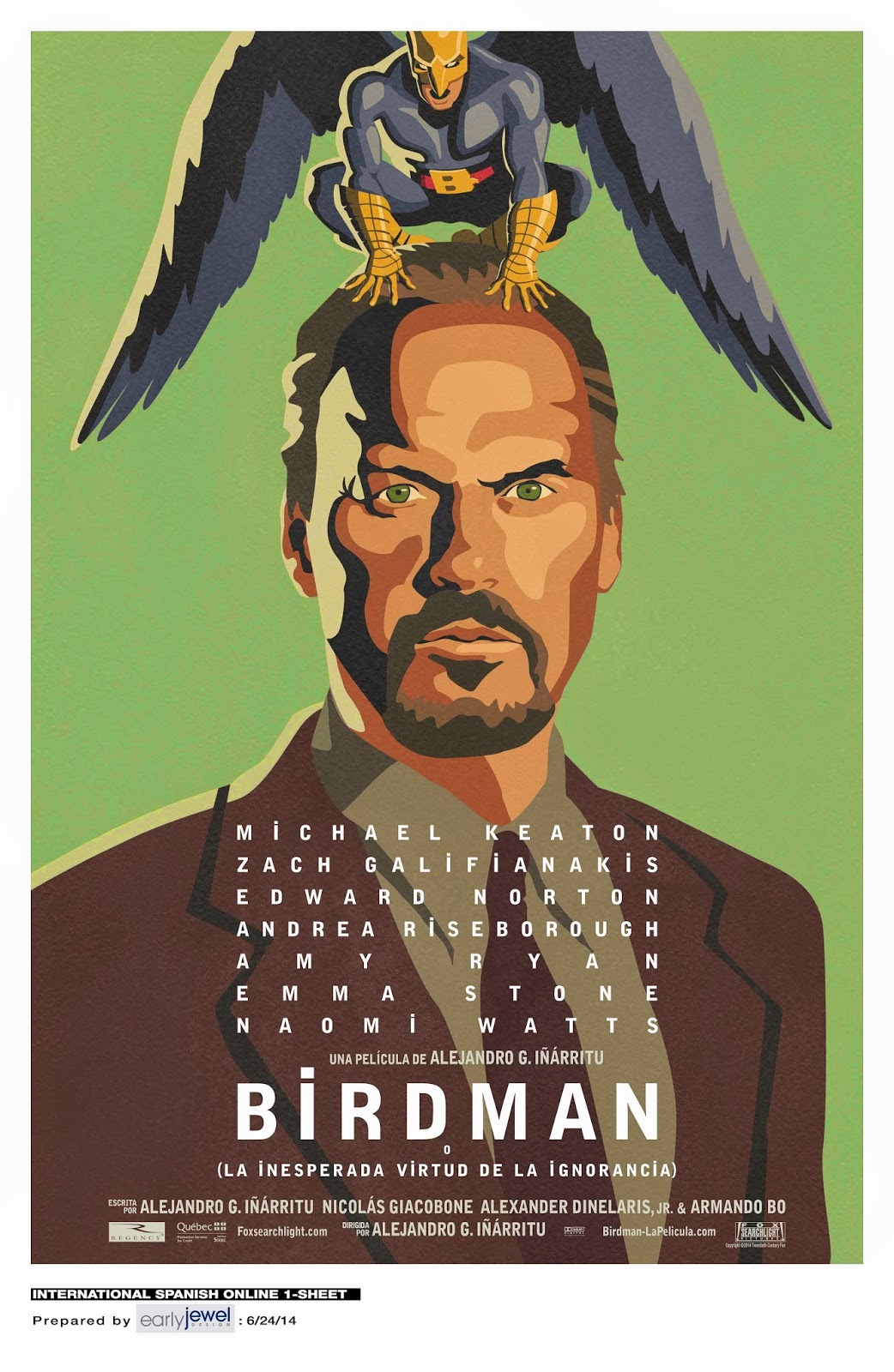
Birdman: or (The Unexpected Virtue of Ignorance)

Year: 2014
Director: Alejandro G. Iñárritu
Cast: Michael Keaton, Zach Galifianakis, Edward Norton
Run Time: 1 hour 59 minutes
MPAA Rating: R

A washed-up movie star attempts to revive his career with a Broadway play.

Countless films have worried at the edge between reality and fantasy like a dog with its favorite bone, including two of my very favorite horror films, so Birdman is in good company. But, and I say this without even the faintest whiff of sarcasm: Birdman ain't no Wes Craven's New Nightmare

The cardinal sin of the "comedy" Birdman is that it takes itself far too seriously. Many of its core scenes and conceits are pitched up to a more over-the-top register that would best function as laugh-out-loud comedy, but there's only one single line in the film that is obviously intended to elicit a chuckle. The rest is as dour and self-serious as the rest of the Oscarbait in the worm bucket, and that weighs down the film like an anchor.

There is some interesting material to chew on about how social media is shaping our generation's perception of art and reality, as well as how actors can get so trapped within a famous role that it casts a shadow over their entire lives. This is interesting to film enthusiasts and (more importantly) members of the Academy, but it's remarkably separate from the reality of the average American filmgoer. It absolutely doesn't need to play to the lowest common denominator, but Birdman's sense of what "reality" actually is, is already so mired in artifice that the film loops around itself uselessly like when I try to put the garden hose away.

In the process of all this philosophizing, Birdman loses itself among a pile of heaving, exhausting Important Movie cliches, like the Inexplicable Lesbians, the Real Life Connection, and the All in One Shot gimmick. Slathered with some improperly proportioned magical realism, a variety of subplots that utterly fail to go anywhere at all, and an astonishingly artless ending, Birdman is a frustrating nut to crack.

But when you finally break through to that sweet sweet nut meat (I am writing this very late at night), there's something special in there. Birdman is a film with an impeccable sense of rhythm, a variety of delectable lighting arrangements, and a series of off-the-wall performances pulled from actors who really have no business being in a movie like this. Emma Stone rips a nothing part to pieces with a spiky vulnerability, Zach Galifianakis tones down his usual energy to become a wonderful straight man, and Edward Norton shines as a loose cannon actor with a feeble grip on his own humanity.

And, after all, Michael Keaton has been getting all the awards buzz, so let's not forget to mention him. Although he gave a Brave performance more than he gave a Great one, Keaton carries the movie on his back across the finish line. His imbues his character with a wild-eyed animalism that propels the narrative through its illusion of a single shot without a single hitch or draggy moment. 

For my purposes, it is not a truly remarkable film, at times veering into an immensely irritating one. But for art cinema-inclined viewers, Birdman is one to RedBox before it's too late.

Rating: 6/10


Edge of Tomorrow

Year: 2014
Director: Doug Liman
Cast: Tom Cruise, Emily Blunt, Bill Paxton
Run Time: 1 hour 53 minutes
MPAA Rating: PG-13

An unwittingly drafted soldier finds that, every time he dies in battle, he wakes up the day before only to repeat his misery.

Edge of Tomorrow represents everything that's wrong with Hollywood today. 

By that I mean that it's a fantastic original movie, but it was misrepresented in advertising, brought in only slightly more than half its budget in box office, and was scuttled away to home video with a confusing new title to perish in ignominy.

It's a real shame. An adaptation of the manga All You Need Is Kill, Edge of Tomorrow presents a fun, fresh, sci-fi fueled twist to time loop storytelling, pitting Tom Cruise's eternal movie star glamor (which, as this movie proves, can survive even the weirdest twists and turns of his personal life - hail Xenu) against the endlessly unappreciated high caliber efforts of Emily Bunt. Blunt takes on the most kinetic, action-packed role of her career with aplomb, dragging a loopy sci-fi plot headfirst into gritty, believable reality.

On top of all of this, Edge of Tomorrow is, like, unbelievably funny. I'm serious. The film takes the notion of comic relief and stretches it liberally throughout the entire film like that Bible story with the fish. It's just shy of genuinely being classifiable as a "comedy," but it's a raucous good time all the same. The best part is that the humor bubbles up naturally from the situations and characters instead of being imposed upon the film by some unseen, arbitrary entity like certain of the more dour sequences in Avengers: Age of Ultron.

The endless repetition of plot points that comes with the territory of time travel films is treated with fleet footing, capturing the highlights while always furthering its central story arc. Between the repeated story beats with ever-changing perspectives and the secretly pretty cool alien tentacle CGI, Edge of Tomorrow feels like a particularly difficult video game level and captures the intrinsic joy that comes with solving an intractable problem while simultaneously having a great time shooting bad guys into piles of goo.

But there's something pulsing beneath the surface, too. Both characters are recognizably human and have fully developed arcs. This is something that shouldn't even technically make sense considering that Emily Blunt's character resets at the beginning of each day, but the film is so invested in its storytelling that it works no matter the obstacle.

There are some technical difficulties that derail the film slightly, like an undercooked third act and a severe lack of proper lighting during several key sequences, but Edge of Tomorrow is wicked fun, and worth a watch from anyone who hasn't seen it yet. Which is pretty much everyone, because the world is a terrible, unfair place.

Rating: 8/10


Groundhog Day

Year: 1993
Director: Harold Ramis
Cast: Bill Murray, Andie MacDowell, Chris Elliott
Run Time: 1 hour 41 minutes
MPAA Rating: PG

A curmudgeonly weatherman gets trapped in a time loop and is forced to repeat Groundhog Day endlessly until he becomes a better person.

Two guesses as to how I decided to pick this one.

Groundhog Day is an indisputable classic of the 90's comedy genre, one for which I have an immense amount of esteem and absolutely nothing new to say, so this will be my shortest review yet. Depending on your inclination, you may either cheer or jeer here.

...

Alright, we're back. Set in the small Pennsylvania town of Punxatawney, Groundhog Day is more than just the story of one man finding his inner Samaritan. It's about the clash between the town and the city folk, and the lack of respect for others that the city garners in otherwise good people. 

As Murray's weatherman discovers the better person inside of him, he simultaneously develops a working interest in the lives of those around him. It is these people more than anything who help make him better rather than any supernatural force or deus ex machina. And Bill Murray is at the top of his game, giving his sardonic bastard a likable humanity without letting his brittle exterior of the first act show any chinks in his armor. 

Subtextual undercurrents, Bill Murray being pitch perfect... Throw in a lush, reactive score, an inventive visual schema, and a hard-hitting lesson about the fact that, sometimes, bad things are destined to happen and there's nothing we can do about it, and you've got yourself an unforgettable comedy with real heart.

Oh, and Andie MacDowell is OK, but her accent is ridiculous.

Rating: 8/10

Wild

Year: 2014
Director: Jean-Marc Vallée
Cast: Reese Witherspoon, Laura Dern, Gaby Hoffmann
Run Time: 1 hour 55 minutes
MPAA Rating: R

The true story of Cheryl Strayed, a kind of annoying hipster who decided that hiking the Pacific Crest Trail would solve all of her personal problems.

The next breadcrumb on our trail of Oscarbait leading us out of the 2015 Academy Awards is Wild, the first outing for Reese Witherspoon's new production company, Pacific Standard. I daresay, it's in good company with Birdman because it has several shining glimmers of pure cinema sandwiched in between what ends up being an immensely frustrating, self-indulgent project.

The biggest flaw of Wild is unfortunately inextricably attached to it: the subject matter. Based on the popular memoir Wild: From Lost to Found on the Pacific Crest Trail by Cheryl Strayed, the film necessarily must take on her character and situation at face value. The only problem is that, at all times, Cheryl Strayed can be relied upon to be the most douchey, irksome person in the room.

Now I'm not even referring to her backstory, which involves biblical amounts of heroin and cheating on her husband. That's par for the course in this kind of Find Your Clarity picture. What I'm referring to first and foremost is her habit of quoting famous authors in this manner: "I took the road less traveled, and that has made all the difference." - Robert Frost (and Cheryl Strayed) Like, what. Were you there helping him write his magnum opus, Cheryl? No you weren't. Now stop prancing about like you're so much better than everybody else and crapping all over authors you've never even read. So there.

I'm sorry. I just really despise Cheryl Strayed. At least as portrayed in the film, she is the worst kind of pretentious hipster and could hardly care less about the plight of other people, although her mind-altering journey is ostensibly about coping with the loss of her mother, played by Laura Dern over what adds up to about a minute of screen time. But enough about that.

I will give Wild this: When it makes an effort to be an art film, it really rises to the challenge of creating something visually stimulating. The rhythmic, stream-of-consciousness editing patterns link together disparate images in a reckless collage of life, at least in the patches where they crop up.

And Reese Witherspoon really does a terrific job here, for better or for worse, taking a physical challenge and inhabiting a role that drags her straight out of her comfort zone to expose some really raw, true emotion. She is also essential in providing the film's infrequent undercurrents of humor, which are a welcome presence in the midst of such a straightforward story.

I have my doubts as to whether the conclusion of the story is as clear-cut as screenwriter Nick Hornby seems to think it is, but when it comes amidst such a magnetic performance and easy, beautiful visuals, it's not hard to ignore. All in all, Wild is a plus, but for a great deal of the time it wastes a lot of its energy pushing against that current.

Rating: 6/10
Word Count: 2007

Tuesday, February 10, 2015

Grim Fairy Tales

Year: 2014
Director: Rob Marshall
Cast: Meryl Streep, Anna Kendrick, James Corden
Run Time: 2 hours 5 minutes
MPAA Rating: PG

The transition from stage to screen is not an easy one. Musicals rely on the energy of the audience, so pre-packaging a living and breathing live show into one endlessly reusable piece is a tricky endeavor. Sometimes it's a successfully thrilling conversion (Little Shop of Horrors, Hedwig and the Angry Inch), sometimes it's downright repugnant (Bye Bye Birdie, The Phantom of the Opera), and sometimes it's a magnificently slapdash spectacle of glitter and misguided cameos (Rock of Ages, Mamma Mia!). Into the Woods, adapted from Steven Sondheim's 1986 stage show, is a little bit of all three, though it survives on the strength of one of the most effective celebrity casts in recent memory.

I'm definitely not being biased by Chris Pine's hair. Definitely.

Into the Woods combines several different fairy tales into one dark, cohesive tapestry about coming of age, parenthood, exploring the world outside one's humdrum life, and learning to accept responsibility. The cast of familiar characters includes Cinderella (Anna Kendrick) and Prince Charming (Chris Pine), who meet at a ball under magical circumstances against the wishes of an Evil Stepmother (Christine Baranski); Jack (Daniel Huttlestone of Les Misérables) and his Beanstalk of Opportunity; Little Red Riding Hood (Lilla Crawford), who encounters a Wolf (Johnny Depp) on the way to her grandmother's house; and Rapunzel (Mackenzie Mauzy), trapped up in her tower patiently waiting to let her hair down for the right Prince (Billy Magnussen).

When a childless Baker (James Corden) and his Wife (Emily Blunt) learn of a curse placed upon their household by the Witch (Meryl Streep) next door, they set off on an adventure to find four magical objects to reverse the spell before three nights pass. On their journey, they split up and regroup and encounter various other characters making their merry way through the woods. It's basically one of those chase scenes from Scooby Doo, with characters popping in and out of closets and running into one another all across the forest.

Also like Scooby Doo, there's a creepy live action dog.

As a medium for showcasing the syncopated rhythms and delicate wordplay of Sondheim's compositions with crispness and clarity, Into the Woods is an unequivocal success. Although the cast is star-studded, many of them have previously proven themselves as vocal talents in films or on the Great White Way: Meryl Streep and Christine Baranski in Mamma Mia!, Anna Kendrick in Pitch Perfect, Lilla Crawford in Annie... And Johnny Depp? Well, he really isn't in very much of the film.

And the newcomers are of a piece startlingly suited for the challenge. Emily Blunt has a clear, chirpy voice that isn't tested by overly-challenging pieces, and Chris Pine has a rich, dreamy baritone that really needs to be taken advantage of in larger roles. Or at least televised karaoke pajama parties.

The film shines brightest during its first half, during which the fairy tales are enacted in fairly traditional, but uniquely overlapping nature. The cheerful chaos of the characters' various collisions is upbeat and energetic, mixed with some highly theatrical (and occasionally suspension of disbelief-shattering) lighting, staging, and costume design, especially in the otherwise unprepossessing Wolf sequence.

I mean, it's hard to make the Little Red tale look drab. *coughcoughAmandaSeyfried*

The actors feel most comfortable when they're embracing the "Whee! It's a musical!" aspect of these scenes. Not that any of them are untalented in other registers, but fairy tale characters rely on broad stereotypes and tonally the performers can find their match with ease. Chris Pine is dashing, Anna Kendrick is woebegone, Lilla Crawford is brash and outgoing. Wham bam, thank you ma'am. 

The sheer amount of fun they must be having just pours from the screen. Every one of the film's best sequences comes from this pure joy: the sprawling and fantastical opening number, Cinderella's spritely dash from the Prince, Little Red's encounter with the Baker, and the dashing, hilarious, campy idiocy of "Agony," the Princes' duet and the unimpeachable high-water mark of the entire show.

I suppose I would be remiss if I neglected to mention Meryl Streep's Oscar-nominated performance as the Witch, but there's not much there to talk about. Streep is a treasure, of course, but her old crone is not much more than an over-the-top, crack-addled spinster. To be fair, that's what the role calls for, but she's not exactly punishing herself to find the core of her character. But she has a superb belt and knocks all of her songs out of the park and that's more than I could ever ask for.

A superb belt, yes, but a superb dress and wig, too.

However, once the film makes a drastic tonal shift into the darker side of the fairy tale universe, the film loses its mooring. The performers strain to find purpose and the music dries up, becoming both less frequent and more self-serious. It is here that the Disneyfication of the show takes full effect as the film shies away from the original show's more morbid plot points.

The third act drags like an anchor as the company tones down the death, sex, and violence, removes some key scenes entirely, and plods on through to its now unmotivated conclusion. Frankly, the final third is an unholy mess, pushing a stone over the film's well of lively buoyancy and letting it die an ignominious subterranean death.

The film strains to reach the finish line and sputters, coughs, and dies three feet from the ribbon. The finale song, cut down to a wanly fading overdubbed monstrosity, is more like a funeral knell than a full-circle denouement. 

But all in all, the film ain't half bad. If you can stomach the unappetizing finale, Into the Woods is worth your time, especially if you've never expereinced the joy of seeing the show staged live. Despite its watered-down ambitions, it really is the next best thing. The cast is remarkably game to bring the songs to life, the setting is charmingly serene, and the music will be playing in your head all week. Maybe just take a nap when you hit the 90-minute mark.

TL;DR: Into the Woods is a lively fun musical that is brought down by a tampered-with finale.
Rating: 7/10
Word Count: 1058