Showing posts with label Natasha Lyonne. Show all posts

Monday, December 5, 2016

Drove My Chevy To The Levy

Year: 1999
Director: Paul Weitz
Cast: Jason Biggs, Chris Klein, Thomas Ian Nicholas
Run Time: 1 hour 35 minutes
MPAA Rating: R

Howdy, folks! Now that Harry Potter and Halloween are safely out of the way, it’s time to begin yet another vaguely defined Popcorn Culture marathon! That’s right, we’re pulling another topic out of left field and embarking on a mostly chronological journey through the cinematic oeuvre of one Seann William Scott, a comic actor who I actually really like and who deserves a closer look.

Mostly, I just want to see what the hell Bulletproof Monk is all about.

Today, we’ll join our dear SWS where his path first crossed with Hollywood: his feature film debut in 1999’s American Pie. The ne plus ultra of high school sex comedies, American Pie follows the exploits of hapless everyteen Jim (Jason Biggs) and his best buddies Kevin (Thomas Ian Nicholas), the blandest human being this side of Topher Grace, Finch (Eddie Kaye Thomas), a weirdo who fancies himself mature and sophisticated, and Oz(Chris Klein), a loveable lacrosse player/gentle giant.

After a raucous party in the home of their douchetastic friend Stifler (Sean W. Scott, as he is credited for the first and only time), they make a pact to lose their virginities by prom night, which is in three weeks’ time. Raunchy hijinks ensue as the boys set their sights on the girls who will hopefully help them become men: Jim on the naughty Eastern European exchange student Nadia (Shannon Elizabeth), Kevin on his terrible girlfriend Vickie (Tara Reid), Oz on lovely choir girl heather (Mena Suvari), and Finch on the school’s entire female population.

Get in line, ladies…

American Pie is The Odyssey for horny young men. Four high schoolers embark on a grand journey, have many incredible adventures, and arrive at their destination only to find that things have changes irrevocably, in their world and within themselves. Only instead of retrieving golden fleeces, they’re having sex with pies and live-streaming girls changing on a late-90’s webcam that really isn’t that much worse than Skype today. But I digress. What I’m saying is that American Pie has a vignette-driven plot that all services the higher throughline of young men realizing that the vaginas they so desperately want to have sex with are attached to women, and maybe those women are more valuable and interesting than they’re giving them credit for.

Now, I’m not saying American Pie is a feminist tract. The character of Nadia is a soulless automaton/breast dispensary that obliterates that idea like an A-bomb.

Although it’s more like a double-D bomb, am I right fellas? High five!

The story is only ever in service to the thoughts and desires of the young men at the center, but it must be said that a lot of the female characters are uncommonly fleshed-out for this kind of film, especially Heather, Vickie, and Vickie’s BFF Jessica (Natasha Lyonne). They’re not depicted as Rubik’s cubes that need to be solved in order to unlock access to boobs, they’re actual characters, even if they still mostly fit into teen movie archetypes. And Alyson Hannigan’s band geek Michelle’s rapacious sexuality is used as a shock gag here, but it eventually becomes a part of a layered, fairly realistic female high school character as the franchise goes on.

And that’s one of the things about American Pie that makes it so remarkable. Its characters are actually recognizable high schoolers. They’re not fast-talking, hyperintelligent Kevin Williamson creations. And they’re not airbrushed 90210 studs and vixens. They’re awkward, sweaty horndogs that quote nerdy kung fu movies and who want to be adults, but aren’t quite sure exactly what that means. Even Oz, as a jock, is a fumbling, insecure young man still growing into his body and his athleticism. These characters feel like real people you’d see in the halls by your locker, and that’s why their exploits are so captivating. They’re grounded in reality so they’re allowed to go absolutely bugnuts with the sexual misadventures.

Also, Michelle is possibly the best character in cinema history.

But I’ve spent so long diving deep into analysis, I bet you’ve almost forgotten this is a movie about dick jokes. Very good dick jokes, but still. American Pie is a movie that has a comical reaction shot from a monkey, so it’s not exactly Kurosawa. Another reason the jokes and situations land so well is that they’re delivered by some truly committed actors (other than Thomas Ian Nicholas, who seems to be in a perpetual daze, pretty much everybody else is bringing their A-game) like Eugene Levy, who is superb as Jim’s awkward father who attempts to appear sexually open while simultaneously maintaining his buttoned-up Ward Cleaver image.

And I suppose I would be remiss if I didn’t mention Seann William Scott in this marathon dedicated to him. Stifler is only ever a one-note character, but his sideline status allows SWS to go cartoonishly big and have a lot of fun. This was his first feature film outing, so the performance is a little rough around the edges, but you can already feel his confidence and charisma bursting through the screen.

Bottom line, I like American Pie a lot. But on this viewing, I couldn’t help but notice the seams of its low budget. First off, the movie’s title looks like it was slapped on in Windows Movie Maker, but there are also a handful of scenes that are a little underlit or otherwise technically flawed. But beyond that, it’s just a delightful teen comedy that I adore from the bottom of my heart.

TL;DR: American Pie is a delightful, reasonably realistic, raunchy teen comedy.
Rating: 8/10
Word Count: 948
Reviews In This Series
American Pie (Weitz, 1999)
American Pie 2 (Rogers, 2001)
American Wedding (Dylan, 2003)
American Reunion (Hurwitz & Schlossberg, 2012)

Tuesday, June 28, 2016

Help, I've Fallen In Love And I Can't Get Up!

Year: 2016
Director: Michael Showalter
Cast: Sally Field, Max Greenfield, Tyne Daly 
Run Time: 1 hour 35 minutes
MPAA Rating: R

I’m pretty familiar with the work of Michael Showalter in the context of his partnership with David Wain, which produced the cult classic, all-over-the-place, summer camp comedy Wet Hot American Summer, the grotesquely underrated rom-com parody They Came Together, and the dull, overstuffed Netflix series Wet Hot American Summer: First Day of Camp. While I mostly adore their work, it has always been plagued by unsightly flaws and a certain lack of focus. So I was intrigued by Hello, My Name is Doris, which was directed and co-written by Showalter without Wain’s influence. When he’s separated from the herd, what comic qualities does Showalter possess?

Well, the focus seems to be his at the very least.

In Hello, My Name is Doris, Doris (Sally Field) is a quirky older woman working at an anonymous cubicle job. After her mother passes away, she is forced to face her hoarding habits by her brother and his money-grubbing wife, who wants to sell the house Doris and her mother lived in. Things start to look up hen she meets the new guy at work: John (Max Greenfield), a pretty young thang who she fantasizes about constantly.

After some light Internet fraud and Facebook stalking with the help of her BFF Roz’s (Tyne Daly) granddaughter Vivian (Isabella Acres), she befriends John and hits it off with his hipster friends, who dig her weird outfits and quirky worldview. These experiences give her a new lease on life, but is she a fool for pursuing John, or is there something there?

Will he see the heart of gold beneath the visor?

The thing about Hello, My Name is Doris is that it’s a dismayingly generic paint-by-numbers romantic comedy. As much as I adore the fact that this is a movie that admits that people over 60 have romantic struggles, human emotions, and – most importantly – sex drives, the alternative protagonist here doesn’t prevent the movie from plugging her into a been-there done-that formula. Apparently David Wain is the out-there goofball of the team, because the film is as steadfastly mundane as it’s possible to be.

I swear, this film hits so many romantic comedy tropes, you could black out a chick flick cliché bingo card in 20 minutes flat. We get the sassy best friend who exists to cause a brief pit stop of drama at the end of the second act, the precocious teen helper monkey, a Manic Pixie Dream Guy who unwittingly helps the lead work out her personal issues with romance and her lifestyle… Doris is not a comedy pioneer, just a sad woman in a situation we’ve seen a billion times, even if the film fudges the specifics to be a little more kooky.

The reason this boring plot works on any level is unequivocally Sally Field. Not only does she bring her substantial acting chops to the film’s handful of dramatic scenes (which would be unjustified and melodramatic if she weren’t there to ground them in something authentic and human), she’s clearly having a good time in the role. Her obvious enthusiasm for this stereotypical part that she’ll probably never be given another opportunity to play makes Hello, My Name is Doris a sparkling soap bubble, a fun romp down a well-trod path.

And, truth be told, I probably own this outfit.

Probably, the part of Hello, My Name is Doris that brings the most to the table (other than Sally Field) is its skewering of hipster culture. Perfectly personified by fun. and bleachers’ Jack Antonoff (who’s dating Lena Dunham, which might be the most hipster thing you can do) as the ingeniously pretentious electro musician Baby Goya, the hyper-trendy modern subculture is depicted as a terrifying horde of über-progressive fashionaistas who speak like they just stepped out of a Lewis Carroll poem. The film doesn’t find too much to say about the group, but it utilizes some of their arch ridiculousness to provide a modern edge to the comedy that blends well with Doris’ search for something new, vibrant, and maybe a little bit scary.

And then there’s Natasha Lyonne, Kumail Nanjiani, and Rich Sommer as Doris’ self-involved, venal Greek chorus of coworkers, who combine their comic talents into a whirling vortex of yuppie nonsense. They’re not in the movie nearly as frequently as they should be, but they help ump the comedy along when the plot flags, which happens altogether too frequently.

You see, despite a solid cast and some decently funny observational humor, Hello, My Name is Doris can barely justify its existence. The thin plot gets exhausted by the hour mark, and though the film leaves a good impression by closing on a dynamic high note, there are large portions that are – quite frankly – deeply uninteresting. So far, I’m not on Team Showalter on this one, though I dig the work his casting director is doing.

TL;DR: Hello, My Name is Doris is a sweet, well-acted, but deeply unoriginal romance.
Rating: 6/10
Word Count: 849

Wednesday, June 12, 2013

Archive: November 21, 2012

Some Mini-Reviews


Considering the fact that it’s hard enough to find time to watch movies in my busy college schedule, finding time to write about them is definitely a challenge. So, while I will be as up to date and thorough as possible on reviews of movies that are currently in the theaters, sometimes I watch movies that nobody else really cares about, and shouldn’t necessarily elicit a full review. So as often as possible, I’ll keep you up to date on the less important movies I’ve seen recently (because my own film education is far from finished) in a series of mini-reviews.
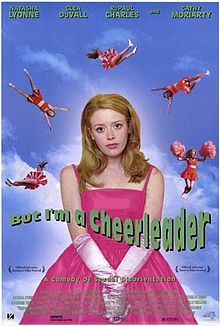
Year: 1999
Director: Jamie Babbit
Cast: Natasha Lyonne, Clea DuVall, Michelle Williams
Run Time: 1 hour 25 minutes
MPAA Rating: R
This film is one of a numerous group of tossaway gay comedies that think they can get away with subpar production on the merit of catering to LGBT audiences.
The thing is, it can. Let’s face it, we’re not exactly seeing Hollywood churn out slick gay comedies by the bushel. While there are certainly some stellar gay movies, cheapie indie comedies are the LGBT cinephile community’s bread and butter.
And this film is certainly a saccharine-sweet example of the genre. The film follows Megan (Lyonne), the titular cheerleader, who is confronted by her parents and friends and sent to an “Ex-gay” camp for teenagers, even though she insists she isn’t a lesbian.
Not a Spoiler Alert: She is.
She falls for the resident bad girl, Graham (Clea DuVall) and they struggle to find themselves in the most poisonous environment for any new lesbian relationship. What follows is 80-something minutes of tender, well-meaning, if not particularly stellar comedy.
Lyonne’s acting is laughably vacant. My friend Shannon put it best: “They could not have picked a straighter actress to play Megan.” Despite not once having me believe that she actually ever had sexual feelings for women, she and DuVall managed to have a spark (chemistry which is owed in its entirety to DuVall’s sturdy performance, without a doubt the best in the movie).
Also featuring appearances by RuPaul and Mink Stole (who always manages to find herself in these things), the movie is solid overall with garish production design and snarky conservative satire. It delivers an optimistic message to gay youths everywhere, but isn’t particularly worth seeing if you happen to be (ew) straight.
Rating: 5/10
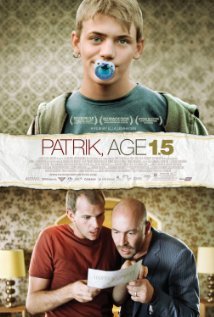
Year: 2008
Director: Ella Lemhagen
Cast: Gustaf Skarsgård, Torkel Petersson, Tom Ljungman
Run Time: 1 hour 43 minutes
MPAA Rating: R
On a whim the other night, I decided to forgo homework and watch a movie on Netflix. I happened upon Patrik Age 1.5 (or Patrik 1,5), a Swedish film about a gay couple that adopts a 1 1/2 year old child, who due to a clerical error, turns out to be a rebellious, homophobic 15-year-old.
…This week has been a pretty gay week for me, all things considered. 
Anyway, I expected this film to be another throwaway gay comedy, something like a Swedish Big Daddy, a family farce of opposites. What I was given was a riveting (albeit predictable) drama that had quite a set of teeth. Everything is not well in Scandinavia.
Patrik’s (Ljungman) arrival in the lives of Sven (Petersson) and Göran (Skarsgård) turns them completely upside-down. Göran can see the good in his surprise son, but Sven can’t see past the kid’s criminal history and the disagreement drives them apart, especially considering that Sven was iffy on the concept of having kids in the first place.
The couple navigates the rough waters of adoption and neighborhood prejudice and delivers a powerful story of modern LGBT relations (partially undermined by the fact that the Swedish word for “homo” sounds hilariously like “bug.”).
The plot moves along in a pretty standard way, but the interplay between Göran and Patrik is impossible to resist. The actors have impeccable (and completely, thankfully, nonsexual) chemistry, and the result is… incredible.
The gay issues don’t actually take the forefront of the plot, and the story focuses on the family drama, and the paternal relationship between a lonely Göran and his new, at first unwilling, son.
I’ve always said that I appreciate gay films that don’t make too big a deal about being gay (because how else will true equality be achieved?), and this film delivered. The fact that it’s in Swedish also is a huge draw, because foreign languages fascinate me utterly.
I would highly recommend it to anyone who cares about people. At all.
Rating: 8/10
Word Count: 791