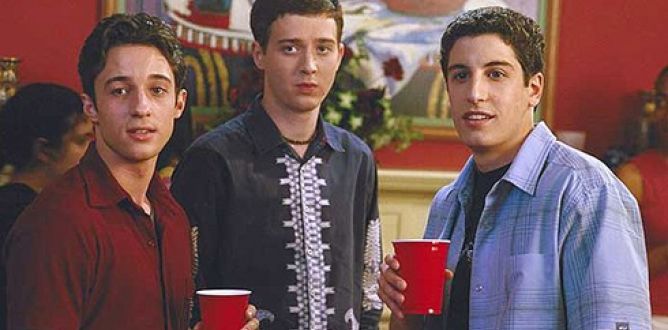
Showing posts with label Thomas Ian Nicholas. Show all posts

Tuesday, December 27, 2016

This'll Be The Day That I Pie

Year: 2012
Director: Jon Hurwitz & Hayden Schlossberg
Cast: Jason Biggs, Alyson Hannigan, Seann William Scott 
Run Time: 1 hour 53 minutes
MPAA Rating: R

Well, here we are. I may have skipped way ahead in our Seann William Scott marathon, but of course that was only a pretense to allow me to watch the American Pie movies again. So that brings us to American Reunion, the fourth and probably final film in the franchise, coming a long 9 years after American Wedding. Let’s see if this Pie has gotten stale.

Pro-tip: if a pie has been sitting on a windowsill for a decade, maybe don’t eat it.

In American Reunion, the denizens of East Great Falls return home for their not-quite ten year high school reunion. Jim (Jason Biggs) and Michelle (Alyson Hannigan) now have a two-year-old son; Oz (Chris Klein) is back from the dead and a B-list sportscaster/celebrity dance show contestant who’s dating sexy nymphette Mia (Katrina Bowden); Finch (Eddie Kaye Thomas) has arrived with an array of globetrotting tales; and Kevin (Thomas Ian Nicholas) is just happy to be included. They plan to spend a nice, quiet weekend catching up before the reunion. Enter Stifler (Seann William Scott). Frustrated by his job as a temp, he wants to have a wild, crazy weekend just like they did back in high school.

Thus our aged foursome is tempted away from their wives and boring jobs by various women and the rekindling of old flames. Oz and Kevin run into their exes Heather (Mena Suvari) and Terrible Vickie (Tara Reid), who is terrible, Finch woos band geek-cum-sexy barmaid Selena (Dania Ramirez), and Jim must resist the advances of Kara (Ali Cobrin), the lithe now-eighteen-year-old he used to babysit.

And thus they continue to act like they’ve never seen boobs before in their entire lives.

Remember that thing I said about the first American Pie where the women were actually fleshed-out, sexually autonomous characters? Well, apparently the law of diminishing returns also applies to quasi-feminism in raunchy movie franchises. The rule of thumb still holds true in that an American Pie film’s quality is directly proportional to the screentime of Alyson Hannigan’s Michelle, and Reunion takes after American Wedding in the misuse of that iconic character. Once again she is crammed into the role of “Wife,” the woman who must be kept unaware of the boys’ sexual misadventures, as if she wouldn’t have been right in there with them.

And frankly, most of the other female characters don’t even make sense. I get it when Terrible Vickie is terrible, because she’s terrible, but why the hell would Heather get mad upon seeing Oz macking on his live-in girlfriend? Why would Kara have any sexual interest in Jim (no offense, but c’mon), especially with such rapacious determination? And why does Michelle threaten to pack up and move in with her grandmother the second Jim commits a sexual misunderstanding, something that has become – like – a full time career for him at this point? I think this all boils down to the biggest problem with the later films in this franchise: These adults are still written like teenagers.

Obviously adults can get into sexual hijinks, probably even more so than your average high school student. But the motivations here are so childish and crudely motivated, they make way less sense when transplanted from the locker-filled halls of Long Beach Poly to a family cul de sac.

Yeah, I’m still not convinced that we’re in Michigan. Better luck next time, fellas. Oh wait…

At least American Reunion has reassembled its core cast (including cameos from Natasha Lyonne, Shannon Elizabeth, Chris Owen, and a slightly expanded part for a finally famous John Cho, who appeared in all 3 American Pies before hitting it big with Harold & Kumar), so it feels more like a legitimate continuation than the stunted Wedding. And you can rarely go wrong with Seann William Scott’s Stifler, the only character whose actions make any sense as he yearns for the glory days of his teen years. His mugging overreactions and faux charm still hold some juice, once again bringing most of the best laughs by the bucketful.

And American Reunion is funny. At least enough to justify its own existence. The bright colorful characters of the original film have become shabby and patched (especially Eugene Levy as Jim’s Dad, who they can not find a use for here, shoving him into a shopworn dress-up montage that stops the movie cold), but the situations they find themselves in are still reasonably diverting. And this is the first film in the entire dick-obsessed franchise to actually show a penis – if only for a second – so I applaud its audacity at the very least.

Unfortunately though, for the most part American Reunion is just a retread of the lackluster American Wedding (although there are fewer gay jokes, thank heavens), only with Neon Trees on the soundtrack instead of Sum 41. This one-two punch is good enough not to totally sink my esteem for the franchise (those first two are just too good), but I don’t think I’d mind if this was the last slice of Pie. There’s no reason to revisit these characters in their current, destitute state.

TL;DR: American Reunion is a decent years-later followup, though it copies the problems of its immediate predecessor.
Rating: 6/10
Word Count: 898
Reviews In This Series
American Pie (Weitz, 1999)
American Pie 2 (Rogers, 2001)
American Wedding (Dylan, 2003)
American Pie Presents: Band Camp (Rash, 2005)
American Pie Presents: The Naked Mile (Nussbaum, 2006)
American Pie Presents: Beta House (Waller, 2007)
American Pie Presents: The Book of Love (Putch, 2009)
American Reunion (Hurwitz & Schlossberg, 2012)

Friday, December 16, 2016

Them Good Ole Boys

Year: 2003
Director: Jesse Dylan
Cast: Jason Biggs, Alyson Hannigan, Seann William Scott 
Run Time: 1 hour 36 minutes
MPAA Rating: R

After the bigger, better, jam-packed magnum opus that was American Pie 2, the franchise had no place to go but down. Reducing the cast by at least half and hanging its hat on the hoariest of “waning sitcom” tropes, thus was American Wedding born unto the world in 2003, four years after the world was first exposed to the sexual appeal of baked goods.

I’m surprised it took us so long to notice.

In American Wedding, hapless everyteen Jim Levenstein (Jason Biggs) has now become a hapless everycollegegraduate and is engaged to his girlfriend, the nymphomaniac band geek Michelle Flaherty (Alyson Hannigan). To help give her the perfect wedding, Jim enlists the help of his friends, Finch (Eddie Kaye Thomas), the high culture weirdo, and Kevin (Thomas Ian Nicholas), who settles comfortably into his destined role as the wallpaper, appearing only to offer vague platitudes and advice, then blandly keen about an offscreen girlfriend. Where’s Oz, you may ask, on this most important of occasions? Well apparently Oz is a figment of your imagination or possibly was a ghost the whole time, because this movie presents not a single scrap of evidence he ever existed.

So, hijinks. Michelle doesn’t want to invite Stifler (Seann William Scott) to the wedding, but Jim is coerced into it. All of Jim’s attempts to impress Michelle’s parents (Fred Willard and Deborah Rush) go hilariously awry. Stifler pretends to be a nice guy and Finch pretends to be a douche in a desperate war for the affections of Michelle’s hot sister Cadence (January Jons). Everything comes to a head as they arrive at the preposterously expensive venue that is described as “up North” from Michigan but is somehow adjacent to an ocean.

Pretty sure you’re not gonna get this view within driving distance.

A trio of rowdy bros get in the way of their earnest friend’s wedding preparations while an anxious fiancée waits in the wings… now, where have I heard that one before? Well, most recently in The Hangover, but this plot trope has been endlessly repeated in comedies since the beginning of linear time. It is trite yet pleasant, overfamiliar yet with the potential for more, but there is one thing it is not: an American Pie plot.

Sure, it provides plenty of opportunities for the old foursome (R.I.P. Oz) to engage in some sexy shenanigans, but the reckless spirit of the franchise is shackled to a set of schmaltzy plot beats and character archetypes that fit with the franchise like square genitals into a round pie. Nevermind the fact that all these characters are far too young and poor to afford the extravagant nuptials the format requires (the only one of them who obviously has a job is f**king Stifler) it yanked away Michelle, the best character in the franchise, cramming her into the role of the disappointed high society fiancée and hobbling her potential to provide the kind of shocking, anarchistic humor she’s known for.

Jim doesn’t fare much better. Although his character’s history is a much better fit for the “dopey schlub who constantly disappoints the prudish parents through a variety of wacky misunderstanding” role, he ceases to be interesting with all his googoo monologues about romance. The only indication that this movie was actually aware of its characters is the personality swap between Finch and Stifler, a joke which relies on the viewer’s knowledge and appreciation of the previous two films.

Luckily, I possess those things in spades.

As a result of this wildly keeling narrative, American Wedding becomes, almost by default, Stifler’s movie. He’s the only character not locked into position, so he’s free to have an arc, and it’s on the strength of Seann William Scott that this movie survives at all. Although his early scenes are overwritten and he flounders as the character has to force his way into a narrative that actively rejects him, he quickly gets the hang of things and delivers a set of solid gags that are some of the most disgusting and ribald in Pie history, all while handling his character’s first real emotional breakthrough. This is where he really proves his worth to the franchise, progressing beyond a one-note characterization into an actual protagonist.

Stifler is by far the funniest character here, for the first time ever, thanks to some sharp line deliveries, and it’s good he’s around because the movie flatlines whenever he’s offscreen. There is a great deal of bloat to American Wedding, with too many scenes spilling over the sides as Jim struggles to win the affections of easily suggestible idiots. These antics are far from interesting, and the faint homophobia that ran through all early-2000’s raunchy comedies bores directly into the core of the humor and spreads through the movie like a poison.

It is redeemed by some solid dialogue and the surprisingly buoyant farce that arises when Jim must attempt to hide evidence of his bachelor party, but for the most part the film is just gross and forgettable, which is something I would never have said about the first two films no matter how wild they got.

Maybe the franchise was fatigued three films in, or maybe it’s not as funny to watch actual adults hyperventilate about the possibility of seeing boobs. At any rate, American Wedding is a totally fine comedy, but it has certainly lost that sparkle that made the originals so damn iconic.

TL;DR: American Wedding is a reduced-fat reiteration that's fun enough but doesn't capture the lightning in a bottle of the first two films.
Rating: 6/10
Word Count: 949
Reviews In This Series
American Pie (Weitz, 1999)
American Pie 2 (Rogers, 2001)
American Wedding (Dylan, 2003)
American Pie Presents: Band Camp (Rash, 2005)
American Pie Presents: The Naked Mile (Nussbaum, 2006)
American Pie Presents: Beta House (Waller, 2007)
American Pie Presents: The Book of Love (Putch, 2009)
American Reunion (Hurwitz & Schlossberg, 2012)

Thursday, December 15, 2016

The Levy Wasn't Dry

Year: 2001
Director: J. B. Rogers
Cast: Jason Biggs, Seann William Scott, Shannon Elizabeth
Run Time: 1 hour 48 minutes 
MPAA Rating: R

1999’s American Pie was a box office smash, making stars of (to varying degrees) Jason Biggs, Seann William Scott, and Shannon Elizabeth, and giving Eugene Levy his Leslie Nielsen-esque career realignment. It’s no surprise that it got a sequel with triple the budget, but it is a surprise that American Pie 2 turned out to be the Terminator 2 of teen sex comedies, taking a low budget surprise hit original and ramping it up even bigger and better.

Quick sidebar: Not to get TOO neurotic about a solid comparison, but I do have my doubts that T2 is, as consensus suggests, a better film than The Terminator. I have a soft spot in my heart for he scrappy little sci-fi thriller, but this is all moot considering that both those films are masterpieces and any relative quality is higher or lower by a fraction of a percent. OK. We now return to the review already in progress.

In American Pie 2, everyone’s favorite horny quintet is back from college for the summer! The police are actually doing their job and shutting down house parties, so the boys rent a mansion by the lake for the summer which they can afford by getting jobs as house painters because life was great before the housing market collapsed. Anyway, they all have different goals for their summer, which will come to a head with a huge party at the end of break, although it would be mighty generous to refer to this collection of sex-up daydreams as a “plot.”

Jim (Jason Biggs) wants to hook up with hot exchange student Nadia (Shannon Elizabeth) who is returning at the end of summer, but he still has only had sex once – and terribly, by all accounts – so he enlists band geek Michelle (Alyson Hannigan) – a counselor at a nearby camp – to give him some tips. Finch (Eddie Kaye Thomas) wants to learn the art of tantra so he can experience a new universe of pleasure when he is reunited with Stifler’s Mom (Jennifer Coolidge). Oz (Chris Klein) just wants a minute alone so he can have phone sex with his girlfriend Heather (Mena Suvari), who is studying abroad. Kevin (Thomas Ian Nicholas) continues to be as exciting as a bowl of cold oatmeal, trying to figure out how to be Just Friends with his terrible ex Vickie (Tara Reid). And Stifler (Seann William Scott) just wants to get drunk, have sex, and let the good times roll.

And the filmmakers want to convince us that this is Michigan and not Long Beach, but I ain’t buying it.

I said this movie was the T2 of the franchise and I’m sticking to it. Although it’s even more of a hang-out movie than the meandering original, its sexual hijinks are of a higher caliber, and the one solid throughline (thanks to Jim once again) is the most emotionally satisfying in a franchise with oddly tender wrap-ups, furthering the relationship between Jim and Michelle in an organic, natural way that still allows for wackily shocking sexual misconduct.

And that’s the thing about American Pie 2. Where the original showed naturalistic high school characters, the sequel does the exact same thing, just transplanting them a year into the future. The non-Alyson Hannigan women are much more underserved this time around (Nadia is still just a stick figure with boobs drawn on, Vickie is still terrible, and Heather is piped in occasionally from what I assume is the set of The Musketeer – making stars of your cast makes it difficult to keep them around, so they’re very slightly forgiven) and the gender politics are shakier (though, just like in Dude, Where’s My Car?, the vague undercurrent of homophobia somehow leads Seann William Scott directly into a gay kiss scene, so you won’t catch me complaining – it’s also far less prevalent and aggressive here), but they’re believable college freshmen, trying to act like adults because they’re not in high school anymore, but realizing they still don’t really understand what that entails.

The summer after freshman year was exactly when I started this blog, and I think any rereading of my 2013 material would tell you I can definitely relate.

Where American Pie 2 shows its most massive improvement is the comedy itself, which is much more confident and willing to take risks. The sexual scenarios are turned up to 11, like any good sequel, but they also take the opportunity to diversify the humor, stirring in some equally sophomoric but well-realized slapstick, a couple jokes that arise from sharp dialogue rather than just spoken punchlines to visual gags, and a handful of hijinks that aren’t sex-related at all, making the sexy ones carry an extra punch because the movie has time to breathe.

Also, an American Pie movie’s success is directly proportional to Alyson Hannigan’s screentime, and this iteration of Michelle is the best the franchise would ever see. She’s allowed to develop an actually human angle to the character, keeping the shock gags (which are even brassier –figuratively and literally) but grounding them in something genuine and layered.

The score itself is also much better, descending into spy movie pastiche, noir slinkiness, and cannibalizing any great genre it can to further service the comedy. It’s an unrelentingly fun movie that even survives a grotesquely bloated run time that could sink many a lesser film. Could it do with fewer montages set to Michelle Branch songs? Sure. But in my eyes, American Pie 2 is the perfect evocation of the franchise’s ethos and spirit.

TL;DR: American Pie 2 is an improvement on what was already a raunchy masterwork.
Rating: 9/10
Word Count: 968
Reviews In This Series
American Pie (Weitz, 1999)
American Pie 2 (Rogers, 2001)
American Wedding (Dylan, 2003)
American Reunion (Hurwitz & Schlossberg, 2012)

Monday, December 5, 2016

Drove My Chevy To The Levy

Year: 1999
Director: Paul Weitz
Cast: Jason Biggs, Chris Klein, Thomas Ian Nicholas
Run Time: 1 hour 35 minutes
MPAA Rating: R

Howdy, folks! Now that Harry Potter and Halloween are safely out of the way, it’s time to begin yet another vaguely defined Popcorn Culture marathon! That’s right, we’re pulling another topic out of left field and embarking on a mostly chronological journey through the cinematic oeuvre of one Seann William Scott, a comic actor who I actually really like and who deserves a closer look.

Mostly, I just want to see what the hell Bulletproof Monk is all about.

Today, we’ll join our dear SWS where his path first crossed with Hollywood: his feature film debut in 1999’s American Pie. The ne plus ultra of high school sex comedies, American Pie follows the exploits of hapless everyteen Jim (Jason Biggs) and his best buddies Kevin (Thomas Ian Nicholas), the blandest human being this side of Topher Grace, Finch (Eddie Kaye Thomas), a weirdo who fancies himself mature and sophisticated, and Oz(Chris Klein), a loveable lacrosse player/gentle giant.

After a raucous party in the home of their douchetastic friend Stifler (Sean W. Scott, as he is credited for the first and only time), they make a pact to lose their virginities by prom night, which is in three weeks’ time. Raunchy hijinks ensue as the boys set their sights on the girls who will hopefully help them become men: Jim on the naughty Eastern European exchange student Nadia (Shannon Elizabeth), Kevin on his terrible girlfriend Vickie (Tara Reid), Oz on lovely choir girl heather (Mena Suvari), and Finch on the school’s entire female population.

Get in line, ladies…

American Pie is The Odyssey for horny young men. Four high schoolers embark on a grand journey, have many incredible adventures, and arrive at their destination only to find that things have changes irrevocably, in their world and within themselves. Only instead of retrieving golden fleeces, they’re having sex with pies and live-streaming girls changing on a late-90’s webcam that really isn’t that much worse than Skype today. But I digress. What I’m saying is that American Pie has a vignette-driven plot that all services the higher throughline of young men realizing that the vaginas they so desperately want to have sex with are attached to women, and maybe those women are more valuable and interesting than they’re giving them credit for.

Now, I’m not saying American Pie is a feminist tract. The character of Nadia is a soulless automaton/breast dispensary that obliterates that idea like an A-bomb.

Although it’s more like a double-D bomb, am I right fellas? High five!

The story is only ever in service to the thoughts and desires of the young men at the center, but it must be said that a lot of the female characters are uncommonly fleshed-out for this kind of film, especially Heather, Vickie, and Vickie’s BFF Jessica (Natasha Lyonne). They’re not depicted as Rubik’s cubes that need to be solved in order to unlock access to boobs, they’re actual characters, even if they still mostly fit into teen movie archetypes. And Alyson Hannigan’s band geek Michelle’s rapacious sexuality is used as a shock gag here, but it eventually becomes a part of a layered, fairly realistic female high school character as the franchise goes on.

And that’s one of the things about American Pie that makes it so remarkable. Its characters are actually recognizable high schoolers. They’re not fast-talking, hyperintelligent Kevin Williamson creations. And they’re not airbrushed 90210 studs and vixens. They’re awkward, sweaty horndogs that quote nerdy kung fu movies and who want to be adults, but aren’t quite sure exactly what that means. Even Oz, as a jock, is a fumbling, insecure young man still growing into his body and his athleticism. These characters feel like real people you’d see in the halls by your locker, and that’s why their exploits are so captivating. They’re grounded in reality so they’re allowed to go absolutely bugnuts with the sexual misadventures.

Also, Michelle is possibly the best character in cinema history.

But I’ve spent so long diving deep into analysis, I bet you’ve almost forgotten this is a movie about dick jokes. Very good dick jokes, but still. American Pie is a movie that has a comical reaction shot from a monkey, so it’s not exactly Kurosawa. Another reason the jokes and situations land so well is that they’re delivered by some truly committed actors (other than Thomas Ian Nicholas, who seems to be in a perpetual daze, pretty much everybody else is bringing their A-game) like Eugene Levy, who is superb as Jim’s awkward father who attempts to appear sexually open while simultaneously maintaining his buttoned-up Ward Cleaver image.

And I suppose I would be remiss if I didn’t mention Seann William Scott in this marathon dedicated to him. Stifler is only ever a one-note character, but his sideline status allows SWS to go cartoonishly big and have a lot of fun. This was his first feature film outing, so the performance is a little rough around the edges, but you can already feel his confidence and charisma bursting through the screen.

Bottom line, I like American Pie a lot. But on this viewing, I couldn’t help but notice the seams of its low budget. First off, the movie’s title looks like it was slapped on in Windows Movie Maker, but there are also a handful of scenes that are a little underlit or otherwise technically flawed. But beyond that, it’s just a delightful teen comedy that I adore from the bottom of my heart.

TL;DR: American Pie is a delightful, reasonably realistic, raunchy teen comedy.
Rating: 8/10
Word Count: 948
Reviews In This Series
American Pie (Weitz, 1999)
American Pie 2 (Rogers, 2001)
American Wedding (Dylan, 2003)
American Reunion (Hurwitz & Schlossberg, 2012)

Thursday, October 22, 2015

Dangertainment

Year: 2002
Director: Rick Rosenthal
Cast: Busta Rhymes, Bianca Kajlich, Jamie Lee Curtis
Run Time: 1 hour 34 minutes
MPAA Rating: R

It’s been a wild and rocky ride through the world of Haddonfield’s Finest, but here in the safe haven of 2002, we arrive at the final Halloween picture (Rob Zombie? Never heard of him). Though the back half of the franchise pretty much stinks like Michael Myers’ jumpsuit (He might have the scratch to spruce up his mask every time, but has anyone ever seen him launder his Lucky Murder Overalls?). Halloween H20 was a beautiful fresh start for the series, leaving the air clear for a follow-up to glide smoothly in.

Of course, that’s not what happened. This is one of my franchise marathons, after all. Things can always get worse. Halloween: Resurrection cannonballed in, gnarled and spitting, after four long years of radio silence. It’s far from the worst of the franchise (I lied – I’ve heard of Rob Zombie and those remakes are trundling down the trash chute right at us), but it’s a massive step down from the oasis of H20 in the barren Halloween desert.

Please take a moment to pay respect to that killer pun.

Halloween: Resurrection took one look at the calendar and thought, “What can I do to make sure that nobody ever forgets I was made in 2002?” The answer is this: The plot centers around Freddie Harris (Busta Rhymes), the host of a spooktacular reality TV web series known as Dangertainment. This Halloween, he will be sending a host of sexy college students with webcams into the notorious Myers house to see if they can find evidence of the serial killer’s upbringing. The film’s understanding of psychology begins and ends at a single paragraph clipped from a Carl Jung book, so an intimately detailed portrait it ain’t.

The Meat he packs into the house includes Jen (Katee Sackhoff of Oculus), a fame whore with the energy of a rabid chipmunk; Rudy (Sean Patrick Thomas), a chef in training who thinks that Michael’s rage stems from a poor diet – who invited this guy?; Sara (Bianca Kajlich), a good student who is in an online relationship with Deckard (Ryan Merriman of Final Destination 3 and The Ring Two), a freshman who sneaks away from a party to watch her show; Jim (Luke Kirby), a horny music major; Donna (Daisy McCrackin), a pretentious asshole who thinks she’s smarter than everyone else because she read that Jung paragraph; and Bill (Thomas Ian Nicholas, Kevin from American Pie), who might actually be hornier than his hapless Pie character,

Naturally, Michael Myers (Brad Loree) arrives for his close-up, fresh from finally offing Laurie Strode (Jamie Lee Curtis, who wanted to make sure that she wouldn’t be asked back for any more sequels). His one mission in life complete, he does what any recent retiree would do – immediately attempt to recapture the glory days.

I suppose a model train set is out of the question.

Halloween: Resurrection is the cinematic equivalent of the absurdly confident freshman who just took a PSYCH 101 class and gleefully analyses their friends from on high. It’s clearly an attempt to dredge up some latent themes from the original Halloween about how the boogeyman represents the darkness inside all of us. However, this topic loses some of its luster when addressed by annoying clods who correct each other’s grammar, scoff at phallic imagery before being penetrated by sharp objects, and have the sheer pedantic audacity to call Michael Myers the “great white shark of our unconscious.”

However, I have been forever inoculated against annoying characters thanks to Tina from Halloween 5. Though Resurrection’s slate of characters is universally obnoxious, they’re hardly more obnoxious than all of us under 30 were back in 2002. The real beauty (if you can call it that) of Halloween: Resurrection is that it’s an unabashed time capsule of the strangest, most embarrassing trends and behaviors of the new millennium. Many film fans find dated movies to be abhorrent, but my secret joy lies in exploring the unearthed rends of a decade not too far removed from our own, yet as distant from the context of 2015 as Mars.

Thus, in my eyes, Halloween: resurrection is a totally adequate stupid slasher. There’s no part of the film that could conceivably be called “good,” but nearly every minute is a haphazard good time.

Kind of like a Ryan Murphy show.

OK, we all know Halloween: Resurrection is crappy. But as a self-professed kinda sorta fan, I feel that it is my duty to start with some positive comments before we rummage through the barrel of well-worm mockery. First and foremost, the mask is actually sort of decent. Or, at least it’s kept in shadow enough that it’s given the opportunity to be creepy. It’s the best Michael Myers couture since Halloween II, at any rate. My favorite element of the mask is that, when it emerges from the darkness, it looks angry. Now obviously that flies in the face of the idea that he is a faceless force of evil, but I feel like on this side of the Thorn trilogy, we’re a smidge past the point of fussing over subtextual minutiae.

And one should never underestimate the value of an evenly parsed-out platter of Meat. We meet our core three one at a time before we’re dumped in with the rest, so we’re given a moment to breathe and get a bead on who’s who. I don’t particularly want to get to know any of these paper-thin archetypes from Aristotle’s thesis on Irritating Drama, but I appreciate the fact that we’re given the opportunity.

Finally, as dated as the film’s premise and technology might be, it has some fun with it. Director Rick Rosenthal (returning from Halloween II, having helmed the classic The Birds II: Land’s End in the meantime) still doesn’t quite know how to frame a shot when he’s not quoting John Carpenter (as a matter of fact, he doesn’t quite know how to frame a shot when he is quoting John carpenter), but there are some clever editing moments involving the POV of the webcams, especially when they’re attached to teen corpses or rolling down the stairs on a severed head. 

Plus, the presence of Deckard and an increasing crowd of partygoers watching the show allows us to be a part of the game, getting real time audience reactions as the horror ensues. This all culminates in a sequence where Deckard must act as Sara’s eyes because only he can see where Michael is hiding in the house thanks to the cameras. It’s not exactly fraught with tension, but it squeezes some blood from the stone that the franchise had become.

Oh, and there’s a handful of pretty cool kill sequences that are baroquely gooey in the classic slasher tradition, including a blood tracheotomy that hearkens back to 1960’s Peeping Tom.

Rosenthal’s motto is “If it ain’t broke, steal it.”

I do recognize that a film that requires this much defending isn’t exactly Wizard of Oz, but Halloween: Resurrection is just fun. Spectacularly dumb fun, but fun just the same. There’s a lot to hate in the film and many scores of people have found it, but at least for me it’s all part of the ineffable experience. Sure, the actual webcam footage is pixelated enough to abrade your corneas, the Final Girl is next to useless, and a climactic scene involves young Rudy throwing fennel in Michael’s eyes. But it wants so badly to entertain and I for one feel that it does.

Resurrection’s piece de resistance (and an accurate gauge of if this movie is for you) is without a doubt Busta Rhymes. He is far from a good actor, but his singularly arresting energy is far more compelling than the herd of halter tops that surround him. His performance style follows two steps incessantly and unfailingly: 1) Cock head at a physically impossible angle that makes people fear for your health, and 2) Just keep talking until you get to something that feels like the line you were supposed to say.

His copious monologuing puts even the loquacious Dr. Loomis to shame. And although Donald Pleasance has chewed up mountains majesty of purple dialogue, I’m not sure even he would relish calling Michael Myers a “killer shark with baggy-ass overalls.” Busta just lets loose and goes for it, performing every act with supreme commitment, whether it be wooing Tyra Banks (who is in this, did I mention that?), kung fu kicking the Boogeyman, or merely sitting on his couch at home. His performance is pure, magnetic lunacy, a perfect centerpiece for this unflappably deranged sequel.

Whatever. I like Halloween: Resurrection. Sue me.

Killer: Michael Myers (Brad Loree)
Final Girl: Sara (Bianca Kajlich)
Best Kill: Jim’s head is crushed and he cries tears of blood.
Sign of the Times: Deckard meets Sarah through a Yahoo! Chat room and they keep in contact using their Palm pilots.
Scariest Moment: Sara has to climb down the stairs over Bill’s dead body.
Weirdest Moment: Busta Rhymes does kung fu alone in his apartment.


Champion Dialogue: "Screwing a music major would be tantamount to lesbianism.”
Body Count: 10; not including the decapitated “paramedic” shown in H20 flashback footage.
  1. Security Guard is decapitated.
  2. Willy has his throat slit.
  3. Laurie Strode is stabbed in the back and falls to her death.
  4. Charlie is stabbed in the throat with a tripod.
  5. Bill is stabbed in the head.
  6. Donna is impaled on an iron spike.
  7. Jen is decapitated.
  8. Jim has his head crushed. 
  9. Rudy is triple stabbed and pinned to a door.
  10. Nora is stabbed and hung offscreen.
TL;DR: Halloween: Resurrection is an immensely stupid but vastly entertaining time capsule.
Rating: 6/10
Word Count: 1634
Reviews In This Series
Halloween (Carpenter, 1978)
Halloween II (Rosenthal, 1981)
Halloween: Resurrection (Rosenthal, 2002)
Halloween (Zombie, 2007)
Halloween II (Zombie, 2009)
Halloween (Green, 2018)
Halloween Kills (Green, 2021)