Showing posts with label Helena Bonham Carter. Show all posts

Tuesday, July 28, 2015

Through The Fire And Flames

Year: 2007
Director: David Yates
Cast: Daniel Radcliffe, Emma Watson, Rupert Grint
Run Time: 2 hours 18 minutes
MPAA Rating: PG-13

The first four Harry Potter movies are like distant relatives overstaying their welcome during the Christmas holidays. They devour the full stock of your pantry (i.e. any working British actor above “street mime” caliber), they keep you up with their excessive snoring (or rather their brobdingnagian run times), and to your consternation, they just keep coming back every year without fail.  They are all jagged, ungainly narrative detritus usually brought back from the brink of stultifying despair on the strength of a veritable army of veteran adult performers and production designers so untouchably brilliant that they could literally murder someone, make their ribcage into a lampshade, and it would be so beautiful that nobody would find any problem with it.

When last we left our heroes, it was with 2005’s Goblet of Fire, the last stage of Harry Potter’s “childish” phase. That entry was marked by a particularly devout slash and burn approach when it came to the story, leaving the film a smoldering rubble with only Ralph Fiennes standing triumphant amid the flames. But after all that painful slogging, David Yates stepped up to the plates, and like its titular bird, Harry Potter and the Order of the Phoenix rose from the ashes of the franchise, heralding a new dawn for us all.

Plus, it’s the shortest film of the series. Rejoice!

Harry Potter and the Order of the Phoenix, in case you yourself are a book and haven’t grown self-aware enough to discover the concept of reading, is about the fifteen-year-old wizard Harry Potter (Daniel Radcliffe). At the end of last term, he saw the Dark Lord Voldemort (Ralph Fiennes) rise again, but the paranoid Minister of Magic Cornelius Fudge (Robert Hardy) believes that his claims are false, brought on by the promptings of the avaricious headmaster of Hogwarts School of Witchcraft and Wizardry, Albus Dumbledore (Michael Gambon). This is patently untrue, of course, but he appoints the syrupy and officious Professor Umbridge (Imelda Staunton) to the post of Defense Against the Dark Arts to ensure the Ministry’s hold over Hogwarts while he continues his smear campaign on Potter and Dumbledore from the outside.

Torn between the inordinate responsibility he feels toward the Order of the Phoenix (a secret society leading the charge against Voldemort – to which his godfather Sirius Black (Gary Oldman) belongs), the very adult bureaucratic and political pressures of the Ministry, the surge of teenage hormones and exam stress that lead to infighting with his best friends Ron (Rupert Grint) and Hermione (Emma Watson), and the sudden urges to storm off and listen to Simple Plan alone in his room, Harry is going to have a very rough year.

Being 15 is just a barrel of dicks, isn’t it?

So a hawk- or particularly talented pigeon-eyed viewer may ask, how exactly does one accomplish the Herculean feat of adapting the doorstopper Order of the Phoenix into the shortest movie of the franchise? And that includes the two films that tackled only half the final book apiece, thank you very much. Screenwriter Michael Goldenberg might tell you this or that about writing while standing up or the miraculous powers of lime extract, but the answer is very simple: He actually cared about telling a coherent story that doesn’t rely on a thousand page children’s book to fill in the alarmingly huge gaps that could (and frequently did) fit a grown man.

Mind you, the storytelling of Phoenix is not airtight. Several of its marbles roll irrevocably out of bounds, most notably with the character of Tonks (Natalia Tena) who may well have been a large chocolate gateau for all the purpose she serves the film. But when narrative corners are cut (and with source material as extensive as this, it requires more cutting than a Flock of Seagulls reunion tour), Goldenberg uses pre-established elements (like alternate characters or story beats) to bridge the gaps instead of just skipping past the difficult bits like the faulty record needle of the previous four films.

In addition to the first generally coherent script of the franchise, Order of the Phoenix also boasts a remarkably adept visual schema courtesy of cinematographer Slawomir Idziak. As I said before, the films have always had nut-busting production design (a tradition continued here with Stuart Craig’s glittering obsidian Ministry of Magic and the defined yet somehow infinite complexities of the Room of Requirement), but only Goblet of Fire’s encroaching gloom came close to resembling a unifying aesthetic. Here, the knobbly yet prim structure and stolid lighting of Umbridge and her domain contrast sharply with the heavy shadows, vivid blues, and bright slashes of light that define the clutter of Harry’s reality. This helps emphasize the central conflict of the film, between the Ministry’s careful restructuring of the media narrative and the grim reality they’re hoping to conceal from the world at large as well as themselves.

Perhaps my favorite detail of the film, Phoenix in a microcosm, is the mirror in the Room of Requirement, where Harry and his friends secretly practice defensive spells under the nose of the Ministry. Over the course of the film, the mirror begins to fill up with newspaper clippings and photographs depicting the missing and the dead as Voldemort and his Death Eaters continue their wicked work in the shadows. This collection is never explicitly mentioned in the dialogue, but it fleshes out the dangerous and terrifying world that lies in wait outside the walls of the school. It’s subtle, powerful, and entirely visual, and a big part of why Phoenix is the best Potter yet.

Plus, Daniel Radcliffe was 18 at this point and beginning his conversion into a fully weaponized cute person.

So, have we had just about enough of Film Major Brennan for one article? Let’s just tuck him away again until he can wax poetic about slasher sound cues where he can’t hurt anybody. Because Order of the Phoenix is also a remarkably fun movie. It’s dark, brooding, and deals with mature themes, yes, but it’s also a school rebellion flick. There are moments that capture that summer camp rush of subversive mischief, finally giving the caretaker Filch (David Bradley) something genuinely amusing to do, and allowing the ensemble – especially Neville Longbottom (Matthew Lewis) and newcomer Luna Lovegood (the incomparably dizzy Evanna Lynch) – to truly inhabit their roles and create a living tapestry to support Harry and his exploits.

The acting is likewise much improved, especially after the discouraging Goblet, which almost led to a series of costly psychotherapy sessions. Emma Watson’s eyebrows still clearly long to be set loose in the untamed wilderness, but as a whole, the trio at the core are improving markedly as they age, and the adult performers are back on track as the fossil fuel that keeps the engine running smoothly.

Alan Rickman and Maggie Smith carry on as always, because they are untouchable denizens of Mount Olympus, Michael Gambon has finally settled into his wizened peak as the powerful but ancient headmaster, and Ralph Fiennes returns with his excellent, bored Drawl of Evil, but two newcomers steal the show. Helena Bonham Carter’s performance as the insane prison escapee Bellatrix Lestrange is like an exploding nail gun, pure menacing power, and Imelda Staunton provides a perfectly pitched, sickeningly sweet performance reminiscent of a genius pantomime villain. You boo and you hiss when she comes on and you love to hate her, but the depths of her wickedness turn your stomach, especially in the showstopping detention scene. 

It’s saying something when Emma McFreaking Thompson turns in the worst performance of your entire adult cast, I’ll just leave it at that.

Please note that I don’t say these things lightly. I’m literally sitting next to a VHS copy of Dead Again as we speak.

However, for all the massive improvements Phoenix amasses upon its predecessors, it’s still weighed down by certain demining flaws. The purely anonymous score by Nicholas Hooper would be damaging enough, but when it shades into out-and-out lyrical rock songs, the film dives directly into the nearest dumpster. And the climactic battle sequence that closes the film alternates between electrifying thriller imagery (and some truly impressive visual effects, especially between Dumbledore and Voldemort) and wimpy light shows hardly more arresting than a game of laser tag. It too frequently slides into camp territory to sell its emotional climax, which it then immediately forgets about anyway. Also there’s a shot where it looks like Voldemort is doing jazz hands.

Let’s just say it’s a bit of a bumpy landing. But it’s the least turbulent Potter thus far, and I could see myself rewatching this one without wanting to stick a fork in an electric eel, so three cheers for Order of the Phoenix!

TL;DR: Harry Potter and the Order of the Phoenix is a fun, flashy, aesthetically precise film.
Rating: 7/10
Word Count: 1497
Reviews In This Series
Harry Potter and the Sorcerer's Stone (Columbus, 2001)
Harry Potter and the Chamber of Secrets (Columbus, 2002)
Harry Potter and the Prisoner of Azkaban (Cuarón, 2004)
Harry Potter and the Goblet of Fire (Newell, 2005)
Harry Potter and the Order of the Phoenix (Yates, 2007)
Harry Potter and the Half-Blood Prince (Yates, 2009)

Wednesday, June 12, 2013

Archive: December 29, 2012

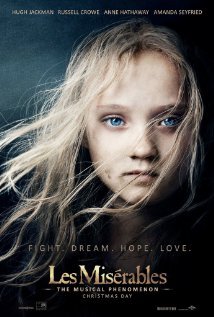
Les Misérables


Year: 2012
Director: Tom Hooper
Cast: Hugh Jackman, Russell Crowe, Anne Hathaway
Run Time: 2 hours, 37 minutes
MPAA Rating: PG-13
The December 25th release of Les Misérables made for a not so merry Christmas. Popcorn and tears covered theater floors in equal proportions.
From the beginning, this movie had several strikes against it in terms of the modern audience:
  1. It is a musical.
  2. It is a musical about the French Revolution.
  3. It is a musical about the French Revolution in which all but 10-odd lines or so are sung.
  4. It is over two hours long.
  5. It was released on a holiday.
In spite of this, Les Mis made a ludicrous amount of money. On Christmas Day alone, it earned 18.2 million dollars.
That’s 8 million more than Rent made in its first weekend.
That’s 9 times the opening gross of Chicago, 6 times more than Little Shop of Horrors, and twice as much as Sweeney Todd.
That’s twice as much money as Once made in its entire run.
The theater I work at had to open another screening room just to accommodate the influx of ticket buyers.
So the question we need to ask is, in terms of quality, did this movie truly earn its box office?
The answer is yes.
You guys, Les Misérables is friggin’ incredible.
Yes, it is over-the-top, bombastic, and occasionally full-of-itself. But you know what? It’s a musical. Those qualities might kill a normal movie, but only serve to enhance the spectacle that provides the lifeblood of this narrative.
[Warning, spoilers ahead. While the idea of “spoilers” doesn’t really apply to Les Mis, because it’s more about the performances than the narrative, if you want to remain in the dark about who lives and dies, I advise you skip past the next few paragraphs to the picture of the adorable bunny.]
For those of you who don’t know, the story (based on the Victor Hugo novel of the same name) follows ex-convict Jean Valjean (Hugh Jackman) across three decades of his life. Essentially, the movie is divided into chapters, the first of which follows him after his release from a 19-year sentence (his crime: stealing a loaf of bread). A local preacher shows him how to be an honest man, and Valjean escapes parole to become the mayor of a small French town. The police Inspector Javert (Russell Crowe) devotes himself to tracking Valjean down in the name of justice.
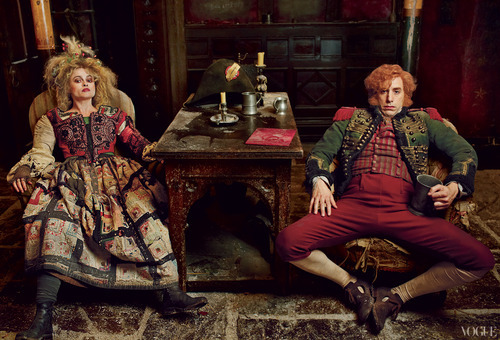
The second chapter focuses on Fantine (Anne Hathaway), a factory worker who was turned out onto the street for bearing an illegitimate child. Her daughter Cosette (Isabelle Allen) is in the care of two conniving innkeepers, Mssr. and Madame Thénardier (Sacha Baron Cohen and Helena Bonham Carter) who demand more and more money from her. To pay off her debt, Fantine turns to selling her hair and teeth and eventually turns to prostitution. Her pride broken, she eventually succumbs to a severe case of Death (It’s a musical. These things just kind of happen.). Valjean, now the mayor, vows to take care of her daughter and retrieves her from the Thénardiers (after paying quite a hefty sum). Javert discovers Valjean’s true identity and tries to stop him but he escapes and is once more on the run, little Cosette in tow.
The third chapter (which one could alternatively think of as the Second Act) revolves around the rebellion in Paris. A bunch of college-aged men, chief among which are Marius (Eddie Redmayne) and Enjolras (Aaron Tveit, a personal hero of mine), are preparing to fight against the king and the unfair justice system. Valjean has retired to a small home on the outskirts of the city with a now teenage Cosette (Amanda Seyfried). In an effort to prevent her from knowing his true identity as well as escaping capture, he has become a recluse and quite an over-protective parent. One day in the Parisian markets, Valjean is discovered by the Thénardiers as they try to scam him for money. Javert is called in, and Valjean rushes home to pack his things and skip town, much to the dismay of Cosette, who has met and instantly fallen in love with Marius. 
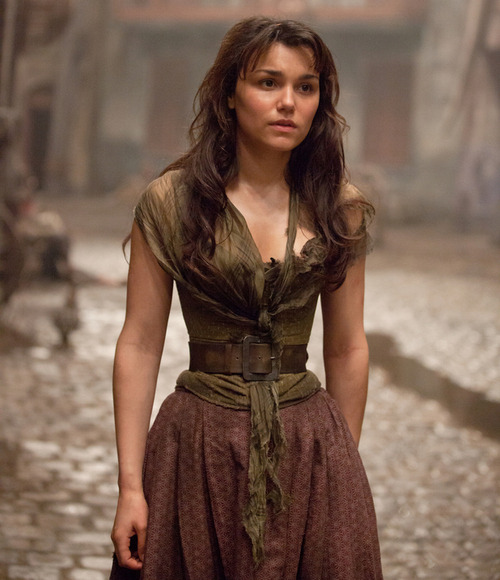
Marius enlists the help of his friend Éponine (Samantha Barks), the daughter of the Thénardiers, to track down Cosette. She does so, although she is madly in love with him. He abandons his rebel brothers to try and find her, but upon learning that she is being taken across the sea, he is heartbroken and returns to fight. The battle begins at a barricade blocking off a side street. Javert, dressed as a Parisian, seeks to undermine them but is discovered and tied up to be dealt with later. The rebels are joined by Éponine, dressed as a man, and Valjean, who shows Javert mercy and secretly sets him free, much to Javert’s dismay.
The battle begins and the casualties soar. Éponine sacrifices herself for Marius and dies in his arms, finally revealing her love. Marius is wounded, and his unconscious body is dragged into the sewers by Valjean, who once again encounters Javert. Javert, ever devoted to his concept of justice, attempts to capture Valjean, but is convinced to let him through, saving Marius’s life. Although he has done a good deed, he is conflicted by his duty to justice and the fact that Valjean spared his life and ends up hurling himself off a bridge.
The rebels fall, the revolution fails, and Marius and Cosette are reunited in the wake of tragedy. On their wedding day, Valjean can no longer bear to hold his secret over Cosette and runs off to a monastery. He doesn’t want Cosette to know his true identity, and has left, finally realizing it is how he can best protect her from ever being in danger. However, Marius and Cosette track him down and are there to comfort him as he dies of Being Old and finally rejoins Fantine in the afterlife as trumpets blare and the voice of the revolution lives on in the memories of all that have sacrificed themselves for it.
Now. That’s quite a lot to swallow. And that is a bare bones summary. Now you understand why this movie has such an expansive run time.
OK spoilers crew, we’re safe now.
The story of Les Misérables is tragic and beautiful (sorry to tantalize you spoiler-fearing guys) and the filmmakers mostly manage to capture the grandiosity of it all, especially in the ensemble numbers (Look DownAt the End of the DayRed and BlackOne Day More, and the Epilogue).
Now let’s talk about the Grand Experiment. Singing live in camera is something that has never been attempted on this scale before and it overwhelmingly, undeniably, works.
This method allows the actors much more freedom to emote and feel the music and produces some absolutely incomparable performances. Anne Hathaway’s I Dreamed a Dream is, and I have no doubt in my mind about saying this, the absolute best performance of that song that has ever been sung. Eddie Redmayne’s Empty Chairs At Empty Tables and Hugh Jackman’s performance of Valjean’s Soliloquy are also standouts of the craft.
My God you guys, what an absolute success.
Now I’m sure you’ve heard people deriding Russell Crowe’s voice and it’s true that he cheats on the octaves occasionally and his voice is certainly less polished than the other performers but let me tell you it totally works for the character of Javert, an overly upright servant of the law.
Personally, I was more bothered by Redmayne’s voice. While he can certainly sing and I’ve already raved about his performance of Empty Chairs at Empty Tables, overall he kind of sounded like he had a frog in his throat the entire time and it irritated me more often than  not.
Also to those of you who doubted Amanda Seyfried, she hits some spectacular high notes. And if you absolutely can’t stand her, don’t worry, she’s really not in that much of the movie.
The film also features two astoundingly well-rounded performances from child actors, which is decidedly uncommon.
I’d have to say my biggest qualm going into the film was about Baron Cohen and Bonham Carter’s presence, but they nailed it. The Thénardiers are the comic relief of Les Mis, and they are given a lot to work with. I’m normally irritated with Sacha Baron Cohen beyond all reason, but his performance was absolutely organic and natural, not at all distracting from the overall narrative.
So far, I’ve had very little negative to say about the movie, so I think it’s time to raise my biggest complaint: the camera work.
The cameraman clearly adored extreme close-ups, which have their place in a film, but they were so overwhelmingly featured that sometimes the film felt claustrophobic, and once a solo number started, the camera would fix itself in place and resolutely refused to move.
I Dreamed a Dream was this. For three minutes. I’d have loved to see more dynamic cinematography, but I suppose it’s not too much of a sin to let this performance speak for itself.
In closing, Les Misérables is a huge film with huge ambition and almost entirely across the board achieves what it sets out to do. A caveat, it’s definitely a movie that you have to be in the right mood for, and if you prefer comedies, run in the opposite direction as quickly as you can. But even if you don’t like musicals, I urge you to try this one out. It’s manly, it’s  about criminals and war. The operatic style with little dialogue and the in camera vocal work are both unique in the world of film musicals and it’s definitely worth it to see for that as well.
Odds and ends: DAT WAIST
TL;DR: Les Misérables is a film of epic proportions featuring heart-wrenching performances, stellar vocals, and a complex and subtle story about the true meaning of justice, virtue, love, and dreams.
Rating: 9/10
Side Bar: This long-winded article contains 1,704 words, which is about 0.3% of Victor Hugo’s 1,500 page novel. Try that on for size.
Word Count: 1749