Showing posts with label Musicals. Show all posts

Sunday, July 22, 2018

How Could I Resist Ya?

Year: 2018
Director: Ol Parker
Cast: Lily James, Amanda Seyfried, Cher
Run Time: 1 hour 54 minutes
MPAA Rating: PG-13

I don't wanna talk about things we've gone through, but as a reviewer it's kind of my obligation. The 2008 Mamma Mia! is a frankly disastrous film adaptation of a shallow but fun stage musical based on the songs of Swedish disco supergroup ABBA. Nevertheless I love it, for reasons almost entirely separate from the movie itself. And I couldn't help but be excited for its ten-years-later sequel, for the twin reasons that it's a movie that should never have existed (the type of thing I'm unduly fascinated by) and that I love the ABBA discography, and going deeper into it is far more rewarding than just skimming off the top of ABBA Gold like the last film did (for more of my thoughts on that, check out my first contribution to one of my favorite film sites: Alternate Ending). Also Cher. But I could have never predicted what I actually got, and I'm all the more dazzled by that. Let's jump in.

Because if there's one thing that's incredibly safe and comfortable to do in those outfits, it's jumping.

That history book on the shelf is always repeating itself, which is how we got this belated sequel in the first place, but the notes of Here We Go Again's plot are still somewhat unfamiliar for this particular glittery universe. We meet up again with Sophie Sheridan (Amanda Seyfried) on the eve of the grand re-opening of her mother's hotel on the Greek island of Kalokairi. It has been a year since Donna Sheridan (Meryl Streep) has passed, of causes unknown (though the random screengrab of her white-knuckling a glass of wine that's hanging on the wall might offer some clues), and she and one of her three dads Sam (Pierce Brosnan) are still heartbroken over it.

Those happy days, they seemed so hard to find, but never fear! Our old pals are back to play, including Sophie's beau Sky (Dominic Cooper), her other two dads Harry (Colin Firth) and Bill (Stellan SkarsgÄrd), and her mother's glee team Rosie (Julie Walters) and Tanya (Christine Baranski). Joining them are Andy Garcia as the hotel manager Fernando (gee, I wonder when that'll turn out to be important) and Cher as Sophie's absentee grandmother Ruby. As Sophie tries to navigate into the newest stage of her life, she finds that her story is mirroring that of her mother's way back when in 1979, as played out by Lily James alongside younger versions of Rosie (Alexa Davies) and Tanya (Jessica Keenan Wynn) as she flirts with and beds future dads Bill (Josh Dylan), Sam (Jeremy Irvine), and Harry (Hugh Skinner).

Although it's possible she didn't know they were three separate people, because they all look more or less exactly the same.

It was like shooting a sitting duck to make a Mamma Mia! movie that I'd actually enjoy, whether it was incredible, terrible, or anything in between. But the absolutely terrific thing about Here We Go Again is that it edges up against incredible, at least on the admittedly very adjusted scale that comes from being in continuity with Mamma Mia!

Having the time of your life is obviously the movie's biggest priority, and there are certain aspects in which the movie fails as a whole in its efforts to achieve this. For one thing, the narrative is completely inert. Sure it has more thrust and structure than the previous entry, but that's like saying you have more character drama than a Transformers movie. It's not exactly an achievement. Most of the movie, at least in the present day scenes, is just about people sitting around waiting for a party (which I could relate to, having gotten to the theater an hour early). And the flashback sequences are slavish retreads of the exact material implied by dialogue and lyrics from the original (the "walk along the Seine" line from "Our Last Summer" even gets a totally superfluous nod). And yet, the way the film connects Sophie's experience with her mother's miraculously achieves a sort of tenderness and genuine emotion of which I would have previously thought this franchise completely incapable.

But I won't feel blue like I always do, because this movie has so much more to offer than a mere story. For one thing, it has a director who actually seems to know how movies are made. The first time the camera moved in a scene, I almost jolted out of my seat, because that never happens in the original. Mamma Mia! just plunks down on a tripod and lets its cast of high wattage stars do their karaoke. In Here We Go Again, Ol Parker's camera roves around the set, snatching glamorous and sometimes even glorious images from the tumult of turquoise and glitter. It's entirely refreshing and allows the manic energy of the material to be captured in a way that actually highlights and accentuates its key components rather than sitting back from the material and letting its gaudiness shine through.

The picture clear, everything seems so easy to Parker, who crafts a musical theatre spectacle like his life depends on it. It helps that he doesn't have to rely on the A-listers who wander in and out of the present day portion like they're in one of the Netflix seasons of Arrested Development. He has the freedom to keep them around as their schedules allow, toss them a few bones here and there (thankfully, not too many are caught by Pierce Brosnan, who has not taken singing lessons in the intervening decade), and focus his best on the young, relatively unknown cast in the 1979 sequences. Because their characters are attached to the famous people, he knows audiences will still care, and his casting could focus on actual talent and not star wattage. And they sure are (mostly) talented! Some of the boys sing a little too emphatically, like they're worried they'll be fired if you miss a single syllable, but the production numbers (especially "Waterloo" and "Why Did It Have to be Me?") are lovely little trifles with grand choreography that utilize every little element of the setting and create imaginative dreamscapes that remind one of the best of classic movie musicals.

Although, as much as I love the song "When I Kissed the Teacher," what compelled them to include such a track in 2018 is still a mystery to me.

Would you laugh at me if I said I cared for Lily James' outfits more than most human beings? Costume designer Michele Clapton knows how to make the human body look cinematic, and Lily James is the perfect canvas for some of the best movie costumes of the decade, perfectly flowy and retro yet effortlessly modern and stylish at the same time. But I digress. This is a musical, let's talk about some more music! Here We Go Again resists temptation to repeat too much of the original soundtrack (of the canonical songs that appear in the actual film and not the credits, we just get "Mamma Mia," "Dancing Queen," an expanded "I Have a Dream," and a blissfully brief reprise of "S.O.S." with the rest of the songs being relegated to the instrumental score during dialogue scenes), and pulls some truly special, unexpected tracks like "Andante, Andante" and "Angel Eyes," two songs I love so much I could't help but thrill with delight.

All my sense had gone away, but I can still admit that there are certain... flaws in more than just the plot. There's still a bit of abrupt song introductions and flat singing (Brosnan and Cooper being the worst perpetrators), Seyfried is sleepwalking so hard you can practically see the drool, and Cher is a lot of things but she's not particularly convincing, as much as I love the fact that she's here at all. And it's a little hard to ignore the fact that they seem to have forgotten that Colin Firth's character is gay (the biggest mention of his character's sexuality is secreted away in an end credits stinger), and that the glitz and glamor of this musical about rich tourists ignores the economic plight of the Greek people they use as props (the film has one scene about fishermen being out of work, and it's used as an excuse to get a character a boat). I'm not saying they're bad for not mentioning it, I'm saying they shouldn't have introduced the concept in the first place if they were going for full musical theater fantasia, because it introduces a bit of a rankling cognitive dissonance.

But the destination makes it worth the while, because - especially in the second half - Here We Go Again is actually genuinely funny as well as entertaining spectacle. The script is much stronger this time around, building gags and character dynamics out of the thin air that was the original characters. Plus, Baranski and Walters (and their younger counterparts) are given some material that's actually quite dirty instead of innuendo so subtle that Christian Grey would even be scratching his head. So, let's add this all together. Terrific, non-obvious ABBA songs, actually talented cast members, solid humor, a director with a head on his shoulders, colors that pop, and a heartfelt emotional throughline? Are you sure this is a Mamma Mia! movie?

Knowing me, knowing you, it's the best they can do.

TL;DR: Mamma Mia! Here We Go Again is surprisingly tender and terrific.
Rating: 8/10
Word Count: 1591
Reviews In This Series
Mamma Mia! (Lloyd, 2008)
Mamma Mia! Here We Go Again (Parker, 2018)

Thursday, December 21, 2017

The Boy From Oz

Year: 2017
Director: Michael Gracey
Cast: Hugh Jackman, Michelle Williams, Zac Efron
Run Time: 1 hour 45 minutes
MPAA Rating: PG

You guys, the Mamma Mia 2 trailer premiered before The Greatest Showman, and if that movie isn't the most exciting slice of glitter pie that cinema has to offer in the coming year, then I'll eat my bedazzled hat. I can't wait to hear what obscure ABBA songs they're forced to pick and see how many clunky lines they can shove into Cher's mouth. The fact that a two and a half minute trailer for a movie that will almost certainly be a beautiful disaster excited me more than The Greatest Showman should probably say something, but this review still isn't a negative one. Let's jump into it!

Hey Hugh Jackman, it's nice to see you without mutton chops.

The Greatest Showman is a highly fictionalized (read: lies, all lies) telling of the life of P. T. Barnum (Hugh Jackman), which has opted to take his life full of exploiting "freaks" and enslaving animals and turn it into a wholesome movie about one man's dream to bring happiness to all people in spite of the haters. And here I thought The Disaster Artist was going to be the most thoroughly sanitized whitewashing of a real person's horrifying tendencies I saw in theaters this year.

Anyway, whatever. It's a movie musical. We don't get enough of them for me to go around boycotting any of them, and since when have movies actually been good with biographical material? So Barnum is struggling to make ends meet for his born-into-privilige-but-unwaveringly-supportive wife Charity (Michelle Williams) and their two ruthlessly adorable daughters. Through a bizarre combination of white savior-itis and feeling on the fringes of society, he decides to create the circus, a spectacular show of derring-do that highlights the outcasts of society including a little person dubbed Tom Thumb (Sam Humphrey), a bearded lady (Keala Settle), a brother-sister duo of African-American acrobats (Zendaya and Yahya Abdul-Mateen II), what seems to be Kate McKinnon in ghost makeup, and basically the entire cast of Newsies with either wigs or goop on their faces.

Seriously, these freaks are hot as f**k.

I don't want to be a bummer, so I'm gonna start with the worst thing about The Greatest Showman and work my way up into what I secretly kinda love about it. Here goes: The plot is totally boring. Anytime we're forced to spend any prolonged time with Barnum and his drama (or Michelle Williams, who is totally wasted in one of the most reductive, passive female roles in years), it begins to slide back into being a sludgy, nuance-free biopic, and nobody wants that.

Honestly, these parts can get really dreary. They feint toward depicting Barnum as a lying, thieving scumbag but aren't willing to commit to that interpretation, and the constant pulling back leaves a lurching feeling in your stomach. And the scenes at the circus aren't much better, almost entirely forgetting to explore the inner lives of the circus performers who form the central theme of accepting yourself for who you are. There is a halfhearted stab at the idea that being black makes you just as Other as being a dogboy in America in the 1800's, but this is not a political movie. It's not really an anything movie, jamming a square peg of reality into the round hole of upbeat musical mayhem. 

There hasn't been a tone so ill-suited to biographical material since the sitcom Heil Honey, I'm Home!

But one good thing about The Greatest Showman is that it speeds though its plotty bits in strokes as broad as Fifth Avenue. Sure, that prevents engagement with any of the characters but who needs that, this is a musical extravaganza! Now, the music itself is... fine. Songwriters Pasek and Paul have proven themselves to be very capable at crafting catchy pop Broadway numbers (they wrote lyrics for La La Land, provided the best song to Trolls, and had a recent stage hit with Dear Evan Hansen - the former and the latter presumably being the reason this movie finally got the green light after seven years), and they provide the same service here.

None of the songs are incredibly memorable, matching the hollowly inspirational themes of the plot with rousing riffs on Rihanna, Mumford & Sons, and other pop subgenres that are invariably upbeat. The litany of interchangeable, on-the-nose "believe in yourself" lyrics can be a little numbing until they throw in a bit of variety late in Act 2. Plus there's a supposed opera number is hilariously off base, but god I've missed musicals. There's no genre more suited for frothy, nutrient-free material, and here's the thing: the choreography is not to be missed.

Yeah, there's a reason I still seem excited about this movie after all that complaining.

The framing, movement, and design of the production numbers is sublime. The choreography, which in no way represent what the actual circus looks like but who cares, is a tremendously athletic, physical approach to dance that I haven't seen in quite some time. It's electrifying, blending perfectly with the percussive, in-your-face foley work that pulls elements from all around the scene into the musical sphere. Every frame comes alive with color and light in a way that's just busy enough to not drip into Moulin Rouge excess while still featuring the painterly backdrops and fantastically unreal settings that turn 1800's New York into a lurid fairy tale.

The dancers rush full bore into dazzling feats, to the point that I was worried that Michelle Williams' double was gonna have her head whipped right off, but there's also a gloriously unsubtle approach that revels in just how Big the emotions of the songs are. Possibly my favorite moment takes place on a rooftop where rows and rows bedsheets are invariably hung out to dry (the beds in the Barnum household must be numerous and bare), where Barnum and Charity pull off a gravity-defying reverse dip into the air, the movement of her dress perfectly matched by the flapping of the sheets in the wind.

Almost every sequence is knock-your-socks-off spectacle, but the number "Rewrite the Stars," although the song feels the most like a reject from Smash season 2, features incredible trapeze work and the Efron/Jackman duet "The Other Side" has a minute and a half of beautiful, minuscule choreography that takes place while Barnum is just sitting at a barstool. Big or small, The Greatest Showman paints a tapestry of music and feeling that's well worth your time.

Jackman obviously is a massively talented theater performer, and it's nice to see him actually have fun in a big screen musical, but the standout here is probably Broadway diva Keala Settle, a big personality with an even bigger voice. Plus Zac Efron can move, and he even sings OK! (I think he took lessons between High School Musical 1 and 2). Everyone and/or their doubles is actually massively talented, and it's a pure pleasure to see them make their magic, sugary spectacle. Even if you have to suffer through the rest of the movie to get to it.

TL;DR: The Greatest Showman is a terribly bland approach to the material, but the production numbers are unspeakably gorgeous, and it's not like there was any other reason to go see it anyway.
Rating: 7/10
Word Count: 1235

Saturday, September 6, 2014

Beware! Beware! Her Flashing Eyes, Her Floating Hair!

Year: 1980
Director: Robert Greenwald
Cast: Olivia Newton-John, Gene Kelly, Michael Beck
Run Time: 1 hour 36 minutes
MPAA Rating: PG

I love the 80's. I love Olivia Newton-John. I love Gene Kelly. I love ELO. I love glitter. I love camp. I love watching other people roller skate. I love bright colors. I love terrible outfits. I love terrible movies. But I also love reversals. I hate Xanadu.

It's just not fair. The 1980 Newton-John vehicle (for Kelly's career it was less a vehicle than a hearse) is the perfect synchronization of just about every element that makes me love a film. So I feel personally affronted when those ingredients synthesize into such a messily boring film as the roller disco flop Xanadu.

An accurate representation of the number of people who manage to stay awake by the end of Xanadu.

Let's get the story over with quick, so nobody falls under the impression that this is a bad-good movie worth seeing. Kira (Olivia Newton-John) is a muse, one of the nine daughters of Zeus whose duty is to provide inspiration for struggling artists. Sonny Malone (Michael Beck) is a man, a washed-up painter who has recently returned to his creativity-assassin of a job - recreating album covers in large scale prints. Danny McGuire (Gene Kelly) is another man, an ex-clarinetist who longs for the glory days of big band music and who pretends that he gels with the storyline in any meaningful way.

After meeting her several times over the course of a week and discovering her on his newest album cover, Sonny learns that Kira has been sent to inspire him and Danny to work together and create a new club in the heart of the city. I'll give you a nickel if you can guess the name of the club. But Kira falls in love with Sonny along the way, despite the fact that she is set to return to her neon-tinged home dimension upon the completion of the project and that he is a bland, irritating, moppet-headed cipher with no autonomy, no money, and no personality.

You know what? Screw Sonny. She should have ended up with Gene Kelly.

This simple story kicks in only at the beginning and the end of the film, much like bookends. But whereas bookends are used to house important compendiums of the world's knowledge and foremost literary minds, these plot nuggets are used to sandwich a whole bunch of roller skating to fitfully lip-synced ELO and/or Newton-John songs. It is up to you to determine the relative importance of these two tasks, but take it from me that your money would be better spent on the bookends.

Or honing your irony skills to satisfactorily explain why this print is hanging on your wall.

Xanadu is an exercise in frustration, frequently setting up dominoes that would indicate a fun, glitzy romp, then encasing them in cement so they can never be properly knocked down. Allow me to take you on a macabre tour of some should-be camp classic scenes that are ruined for one godforsaken reason or another.
  • Kira and her sisters are born out of a DayGlo mural: A mural comes to fabulous life, spitting out women drenched in neon auras like a log ride. Who then dance uneasily to an ELO song, not even bothering to pretend that they're singing it. The choreography by Kenny Ortega wouldn't be out of place in a yogurt commercial, demanding no effort from the dancers and receiving it in abundance.
  • Gene Kelly and Olivia Newton-John share a tap number: Gene Kelly was still a master of the craft of dance, but by 1980 his body and soul were beginning to wear, and the steps were mostly borrowed from his older, better films. Throw in two uniformly terrible performances (Gene Kelly bumbles his way through the role like he bumbled onto the set by accident - which may or may not be true, considering that he only took the job because the set was close to his house; Olivia Newton-John does nothing to inflate a flatly written role, instead plastering a daffy, dizzy smile over everything like a Band-Aid) and you have a sublimely disappointing sequence.
  • Sonny and Danny conjure up an imaginary battle between a big band jazz club and an 80's rock mosh pit: The two bands combine to perform in a delirious mash-up explosion of styles, but this is only at the tail end of an exhausting, incalculably long and pointless scene where the two different bands play drab, generic, awful pop. The resulting effect is something like putting the movie (and the audience) in a Spanish Inquisition torture device, punishingly stretching Xanadu to feature length.
We are also saddled with an interminable and extraneous animated sequence and about 92 scenes of Sonny roller skating while unrelated ELO songs play in the background just to remind us that they worked on this movie. The fact that they seem to actively flaunt their involvement in Xanadu is a testament to the purity and overwhelming power of... the drug market in the late 70's.

There are only two good scenes in the entire film, and neither of them live up to the lofty expectations, given the film's status as a cult classic. One, in which Kira roller blades around an empty warehouse while flirting with Sonny and shifting in and out of corporeal reality is reliably strange and arresting, though it suffers from the film's budget. The other is the (almost) showstopping (almost) final number "Xanadu," which is the only good song to come out of the entire affair, though the performance of said number is just about as lackluster as everything else in the preceding 80-something minutes.

Is it too much to ask for a little pizzaz in my roller skating fantasy numbers?

It's too low budget to achieve anything more than a vaguely glitzy series of sets composed almost entirely of cheap lighting effects in dark rooms. The framing is frequently alienating, usually forcefully shifting focus from the central figure by accidentally obscuring them with something far more interesting, like a dancer being spun on a ring by her neck.

Even when the framing isn't ruining a shot, the composition and coverage work double time to pick up the slack, like a bleating ballad that is shot absolutely static for five minutes, only deigning to subtly zoom in on Newton-John's face on occasion as if to prove to themselves that the camera was still actually on. By the end of the film, even the dancers look bored - as if instead of using a metronome, director Robert Greenwald (whose career has taken a far less dismal and bleak turn - he now directs documentaries about the drone wars) sat there reading War and Peace aloud.

One of the only good things about the film is that they let Newton-John use her native Australian accent. Hearing a non-American accent in a Hollywood film is nothing to spit upon and that at least maintains auditory interest during the long, long, long wait for the closing number. But everywhere it can, Xanadu sucks the air out of itself like an auto-cannibalizing glittery vampire, reducing itself to a mewling, quivering wreck of a movie.

TL;DR: Xanadu is underbaked, boring drivel when it should be a high-fashion camp classic.
Rating: 2/10
Word Count: 1225

Wednesday, June 12, 2013

Archive: December 29, 2012

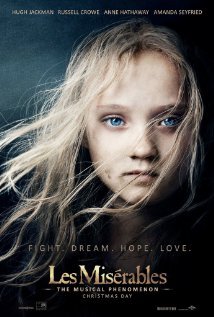
Les Misérables


Year: 2012
Director: Tom Hooper
Cast: Hugh Jackman, Russell Crowe, Anne Hathaway
Run Time: 2 hours, 37 minutes
MPAA Rating: PG-13
The December 25th release of Les MisĂ©rables made for a not so merry Christmas. Popcorn and tears covered theater floors in equal proportions.
From the beginning, this movie had several strikes against it in terms of the modern audience:
  1. It is a musical.
  2. It is a musical about the French Revolution.
  3. It is a musical about the French Revolution in which all but 10-odd lines or so are sung.
  4. It is over two hours long.
  5. It was released on a holiday.
In spite of this, Les Mis made a ludicrous amount of money. On Christmas Day alone, it earned 18.2 million dollars.
That’s 8 million more than Rent made in its first weekend.
That’s 9 times the opening gross of Chicago, 6 times more than Little Shop of Horrors, and twice as much as Sweeney Todd.
That’s twice as much money as Once made in its entire run.
The theater I work at had to open another screening room just to accommodate the influx of ticket buyers.
So the question we need to ask is, in terms of quality, did this movie truly earn its box office?
The answer is yes.
You guys, Les MisĂ©rables is friggin’ incredible.
Yes, it is over-the-top, bombastic, and occasionally full-of-itself. But you know what? It’s a musical. Those qualities might kill a normal movie, but only serve to enhance the spectacle that provides the lifeblood of this narrative.
[Warning, spoilers ahead. While the idea of “spoilers” doesn’t really apply to Les Mis, because it’s more about the performances than the narrative, if you want to remain in the dark about who lives and dies, I advise you skip past the next few paragraphs to the picture of the adorable bunny.]
For those of you who don’t know, the story (based on the Victor Hugo novel of the same name) follows ex-convict Jean Valjean (Hugh Jackman) across three decades of his life. Essentially, the movie is divided into chapters, the first of which follows him after his release from a 19-year sentence (his crime: stealing a loaf of bread). A local preacher shows him how to be an honest man, and Valjean escapes parole to become the mayor of a small French town. The police Inspector Javert (Russell Crowe) devotes himself to tracking Valjean down in the name of justice.
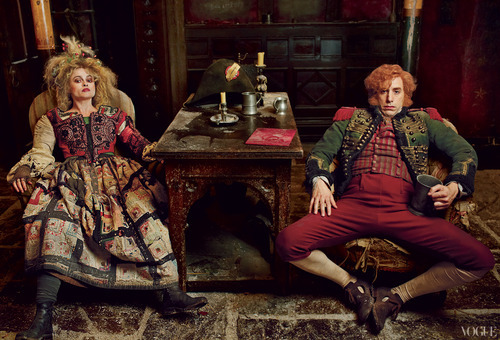
The second chapter focuses on Fantine (Anne Hathaway), a factory worker who was turned out onto the street for bearing an illegitimate child. Her daughter Cosette (Isabelle Allen) is in the care of two conniving innkeepers, Mssr. and Madame ThĂ©nardier (Sacha Baron Cohen and Helena Bonham Carter) who demand more and more money from her. To pay off her debt, Fantine turns to selling her hair and teeth and eventually turns to prostitution. Her pride broken, she eventually succumbs to a severe case of Death (It’s a musical. These things just kind of happen.). Valjean, now the mayor, vows to take care of her daughter and retrieves her from the ThĂ©nardiers (after paying quite a hefty sum). Javert discovers Valjean’s true identity and tries to stop him but he escapes and is once more on the run, little Cosette in tow.
The third chapter (which one could alternatively think of as the Second Act) revolves around the rebellion in Paris. A bunch of college-aged men, chief among which are Marius (Eddie Redmayne) and Enjolras (Aaron Tveit, a personal hero of mine), are preparing to fight against the king and the unfair justice system. Valjean has retired to a small home on the outskirts of the city with a now teenage Cosette (Amanda Seyfried). In an effort to prevent her from knowing his true identity as well as escaping capture, he has become a recluse and quite an over-protective parent. One day in the Parisian markets, Valjean is discovered by the ThĂ©nardiers as they try to scam him for money. Javert is called in, and Valjean rushes home to pack his things and skip town, much to the dismay of Cosette, who has met and instantly fallen in love with Marius. 
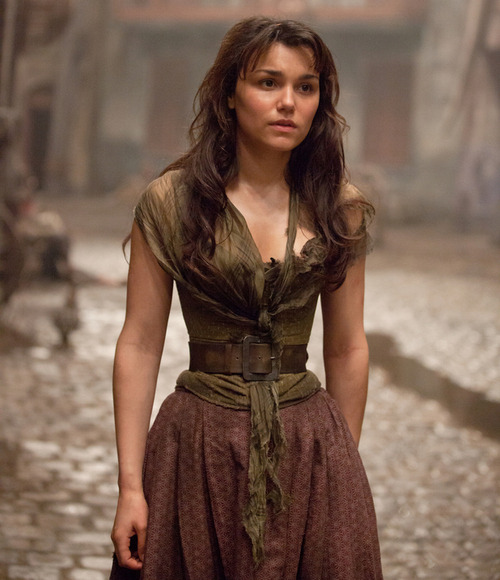
Marius enlists the help of his friend Éponine (Samantha Barks), the daughter of the ThĂ©nardiers, to track down Cosette. She does so, although she is madly in love with him. He abandons his rebel brothers to try and find her, but upon learning that she is being taken across the sea, he is heartbroken and returns to fight. The battle begins at a barricade blocking off a side street. Javert, dressed as a Parisian, seeks to undermine them but is discovered and tied up to be dealt with later. The rebels are joined by Éponine, dressed as a man, and Valjean, who shows Javert mercy and secretly sets him free, much to Javert’s dismay.
The battle begins and the casualties soar. Éponine sacrifices herself for Marius and dies in his arms, finally revealing her love. Marius is wounded, and his unconscious body is dragged into the sewers by Valjean, who once again encounters Javert. Javert, ever devoted to his concept of justice, attempts to capture Valjean, but is convinced to let him through, saving Marius’s life. Although he has done a good deed, he is conflicted by his duty to justice and the fact that Valjean spared his life and ends up hurling himself off a bridge.
The rebels fall, the revolution fails, and Marius and Cosette are reunited in the wake of tragedy. On their wedding day, Valjean can no longer bear to hold his secret over Cosette and runs off to a monastery. He doesn’t want Cosette to know his true identity, and has left, finally realizing it is how he can best protect her from ever being in danger. However, Marius and Cosette track him down and are there to comfort him as he dies of Being Old and finally rejoins Fantine in the afterlife as trumpets blare and the voice of the revolution lives on in the memories of all that have sacrificed themselves for it.
Now. That’s quite a lot to swallow. And that is a bare bones summary. Now you understand why this movie has such an expansive run time.
OK spoilers crew, we’re safe now.
The story of Les MisĂ©rables is tragic and beautiful (sorry to tantalize you spoiler-fearing guys) and the filmmakers mostly manage to capture the grandiosity of it all, especially in the ensemble numbers (Look DownAt the End of the DayRed and BlackOne Day More, and the Epilogue).
Now let’s talk about the Grand Experiment. Singing live in camera is something that has never been attempted on this scale before and it overwhelmingly, undeniably, works.
This method allows the actors much more freedom to emote and feel the music and produces some absolutely incomparable performances. Anne Hathaway’s I Dreamed a Dream is, and I have no doubt in my mind about saying this, the absolute best performance of that song that has ever been sung. Eddie Redmayne’s Empty Chairs At Empty Tables and Hugh Jackman’s performance of Valjean’s Soliloquy are also standouts of the craft.
My God you guys, what an absolute success.
Now I’m sure you’ve heard people deriding Russell Crowe’s voice and it’s true that he cheats on the octaves occasionally and his voice is certainly less polished than the other performers but let me tell you it totally works for the character of Javert, an overly upright servant of the law.
Personally, I was more bothered by Redmayne’s voice. While he can certainly sing and I’ve already raved about his performance of Empty Chairs at Empty Tables, overall he kind of sounded like he had a frog in his throat the entire time and it irritated me more often than  not.
Also to those of you who doubted Amanda Seyfried, she hits some spectacular high notes. And if you absolutely can’t stand her, don’t worry, she’s really not in that much of the movie.
The film also features two astoundingly well-rounded performances from child actors, which is decidedly uncommon.
I’d have to say my biggest qualm going into the film was about Baron Cohen and Bonham Carter’s presence, but they nailed it. The ThĂ©nardiers are the comic relief of Les Mis, and they are given a lot to work with. I’m normally irritated with Sacha Baron Cohen beyond all reason, but his performance was absolutely organic and natural, not at all distracting from the overall narrative.
So far, I’ve had very little negative to say about the movie, so I think it’s time to raise my biggest complaint: the camera work.
The cameraman clearly adored extreme close-ups, which have their place in a film, but they were so overwhelmingly featured that sometimes the film felt claustrophobic, and once a solo number started, the camera would fix itself in place and resolutely refused to move.
I Dreamed a Dream was this. For three minutes. I’d have loved to see more dynamic cinematography, but I suppose it’s not too much of a sin to let this performance speak for itself.
In closing, Les MisĂ©rables is a huge film with huge ambition and almost entirely across the board achieves what it sets out to do. A caveat, it’s definitely a movie that you have to be in the right mood for, and if you prefer comedies, run in the opposite direction as quickly as you can. But even if you don’t like musicals, I urge you to try this one out. It’s manly, it’s  about criminals and war. The operatic style with little dialogue and the in camera vocal work are both unique in the world of film musicals and it’s definitely worth it to see for that as well.
Odds and ends: DAT WAIST
TL;DR: Les MisĂ©rables is a film of epic proportions featuring heart-wrenching performances, stellar vocals, and a complex and subtle story about the true meaning of justice, virtue, love, and dreams.
Rating: 9/10
Side Bar: This long-winded article contains 1,704 words, which is about 0.3% of Victor Hugo’s 1,500 page novel. Try that on for size.
Word Count: 1749