Showing posts with label Anne Hathaway. Show all posts

Thursday, August 6, 2020

Reviewing Jane: I Often Think It Odd That It Should Be So Dull

 In which we review (almost) every film adapted from or inspired by the works of Jane Austen.

Year: 2007
Director: Julian Jarrold
Cast: Anne Hathaway, James McAvoy, Julie Walters 
Run Time: 2 hours
MPAA Rating: PG

If you took the opportunity to read my review for the dutiful downer Miss Austen Regrets, you may have noticed the many comments sniping at literary biopic motion pictures for generally being intolerably stupid. In truth that was largely aimed at Shakespeare in Love. I hadn't seen Becoming Jane since high school so I was willing to assume that my opinion formed at that time would hold no weight, because not only have I come a long way in my approach to analyzing the worth of cinema, I understand infinitely more about Austen and the breadth of her work than I did at the time. Astonishingly, I think I have now become the first person in human history to agree with an opinion I held in high school.

Hold onto your hats, folks.

Becoming Jane is the story of, astonishingly, a young Jane Austen (Anne Hathaway). She is one of those modern women plunked down in the past that we like to position as protagonists in historical dramas, rebelling against gender boundaries and holding fast to her belief that she can contribute more to the world as an author than as some rich man's wife. There is indeed a rich man around to test that theory, the nephew of local fancypants Lady Gresham (Maggie Smith), who she refuses despite the encouragement of her mom (Julie Walters) and dad (James Cromwell). Her heart belongs to another, the uncouth boxer and judge's nephew Tom LeFroy (James McAvoy), even though - would you believe it - she at first finds him prideful and perhaps develops a bit of a prejudice against him.

The course of true love never did run smooth, and it's famous fact that Jane Austen died without ever marrying, but just maybe this youthful romance will inspire her to write six of the most famous books about love of all time.

Starting with Pride & Prejudice, because this movie spits in the face of her publishing history.

Yes, this is one of those incredibly crass movies that posits that all an author has to do to create a literary masterwork is to write down the exact events that are happening in their lives and change the names. So even though it's based on her actual life (extremely loosely, I might have mentioned), we should approach this as an adaptation of one of her novels because it literally is, all the way down to the Lady Catherine de Bourgh of it all.

The core of a Jane Austen novel is the effortless blending of biting satirical observations of the landed gentry with earnest, effective romantic drama. Becoming Jane has neither. As an evocation of Austen's comic gift, Miss Austen Regrets is leaps and bounds ahead of Becoming Jane - and that movie saw fit to have their Jane just wander around quoting all of the best lines of dialogue she had already written. The Austen of Becoming Jane is certainly headstrong and willing to defend the use of irony in her writing, but she almost never indulges herself in it, preferring to hide in corners and cry wherever possible.

And as a romance, Becoming Jane leans entirely on our desire to see the pretty white people make out. They put almost no work into depicting why LeFroy and Austen might actually be interested in one another, they just kind of quietly transition from hate to love offscreen. And sure, they are an aesthetically pleasing couple, but in action it's a little hard to take Hathaway's barely-there British accent too seriously.

Those lips weren't made for accents, they were made for smooching!

I probably shouldn't have expected a multi-faceted study of domestic life and a lady's perspective on romance from a movie that doesn't see fit to have its female lead character speak a significant line of dialogue until about fifteen minutes in, so I guess that's what I get. 

Taken solely as a historical costume drama, Becoming Jane is wholly acceptable, with plenty of beautiful compositions of the bucolic British countryside blooming with a timeless elegance. Although if we're speaking literally, the costumes themselves aren't quite that interesting, damn those prim Regency-era frocks. The only exceptions to the rule of "plain earth tones, let's not make a fuss" are Tom LeFroy's elegant coats and Lady Gresham's voluminous outfits that are ready-made for drag performances.

I've now seen Becoming Jane twice in my life and I have absolutely no desire to ever see it a third. This coming from someone who's halfway through a volume of Jane Austen's letters to her sister Cassandra (also a character in the movie, but so minor as to not actually deserve a mention), which are mostly just descriptions of travel and who was at what balls.

TL;DR: Becoming Jane is a disappointing effort at capturing the wit and wisdom of one of history's greatest authors.
Rating: 4/10
Word Count: 846
Other Films Based on Jane Austen in General
Becoming Jane (Jarrold, 2007)
Miss Austen Regrets (Lovering, 2007)
Austenland (Hess, 2013)

Wednesday, June 12, 2013

Archive: December 29, 2012

Les Misérables


Year: 2012
Director: Tom Hooper
Cast: Hugh Jackman, Russell Crowe, Anne Hathaway
Run Time: 2 hours, 37 minutes
MPAA Rating: PG-13
The December 25th release of Les Misérables made for a not so merry Christmas. Popcorn and tears covered theater floors in equal proportions.
From the beginning, this movie had several strikes against it in terms of the modern audience:
  1. It is a musical.
  2. It is a musical about the French Revolution.
  3. It is a musical about the French Revolution in which all but 10-odd lines or so are sung.
  4. It is over two hours long.
  5. It was released on a holiday.
In spite of this, Les Mis made a ludicrous amount of money. On Christmas Day alone, it earned 18.2 million dollars.
That’s 8 million more than Rent made in its first weekend.
That’s 9 times the opening gross of Chicago, 6 times more than Little Shop of Horrors, and twice as much as Sweeney Todd.
That’s twice as much money as Once made in its entire run.
The theater I work at had to open another screening room just to accommodate the influx of ticket buyers.
So the question we need to ask is, in terms of quality, did this movie truly earn its box office?
The answer is yes.
You guys, Les Misérables is friggin’ incredible.
Yes, it is over-the-top, bombastic, and occasionally full-of-itself. But you know what? It’s a musical. Those qualities might kill a normal movie, but only serve to enhance the spectacle that provides the lifeblood of this narrative.
[Warning, spoilers ahead. While the idea of “spoilers” doesn’t really apply to Les Mis, because it’s more about the performances than the narrative, if you want to remain in the dark about who lives and dies, I advise you skip past the next few paragraphs to the picture of the adorable bunny.]
For those of you who don’t know, the story (based on the Victor Hugo novel of the same name) follows ex-convict Jean Valjean (Hugh Jackman) across three decades of his life. Essentially, the movie is divided into chapters, the first of which follows him after his release from a 19-year sentence (his crime: stealing a loaf of bread). A local preacher shows him how to be an honest man, and Valjean escapes parole to become the mayor of a small French town. The police Inspector Javert (Russell Crowe) devotes himself to tracking Valjean down in the name of justice.
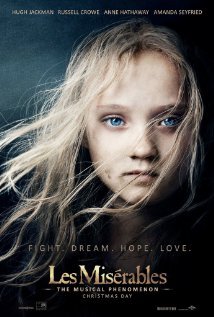
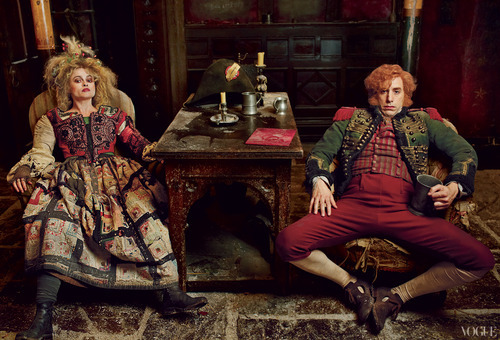
The second chapter focuses on Fantine (Anne Hathaway), a factory worker who was turned out onto the street for bearing an illegitimate child. Her daughter Cosette (Isabelle Allen) is in the care of two conniving innkeepers, Mssr. and Madame Thénardier (Sacha Baron Cohen and Helena Bonham Carter) who demand more and more money from her. To pay off her debt, Fantine turns to selling her hair and teeth and eventually turns to prostitution. Her pride broken, she eventually succumbs to a severe case of Death (It’s a musical. These things just kind of happen.). Valjean, now the mayor, vows to take care of her daughter and retrieves her from the Thénardiers (after paying quite a hefty sum). Javert discovers Valjean’s true identity and tries to stop him but he escapes and is once more on the run, little Cosette in tow.
The third chapter (which one could alternatively think of as the Second Act) revolves around the rebellion in Paris. A bunch of college-aged men, chief among which are Marius (Eddie Redmayne) and Enjolras (Aaron Tveit, a personal hero of mine), are preparing to fight against the king and the unfair justice system. Valjean has retired to a small home on the outskirts of the city with a now teenage Cosette (Amanda Seyfried). In an effort to prevent her from knowing his true identity as well as escaping capture, he has become a recluse and quite an over-protective parent. One day in the Parisian markets, Valjean is discovered by the Thénardiers as they try to scam him for money. Javert is called in, and Valjean rushes home to pack his things and skip town, much to the dismay of Cosette, who has met and instantly fallen in love with Marius. 
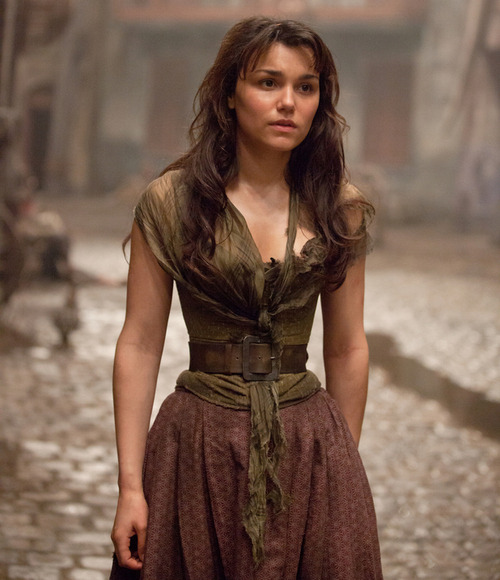
Marius enlists the help of his friend Éponine (Samantha Barks), the daughter of the Thénardiers, to track down Cosette. She does so, although she is madly in love with him. He abandons his rebel brothers to try and find her, but upon learning that she is being taken across the sea, he is heartbroken and returns to fight. The battle begins at a barricade blocking off a side street. Javert, dressed as a Parisian, seeks to undermine them but is discovered and tied up to be dealt with later. The rebels are joined by Éponine, dressed as a man, and Valjean, who shows Javert mercy and secretly sets him free, much to Javert’s dismay.
The battle begins and the casualties soar. Éponine sacrifices herself for Marius and dies in his arms, finally revealing her love. Marius is wounded, and his unconscious body is dragged into the sewers by Valjean, who once again encounters Javert. Javert, ever devoted to his concept of justice, attempts to capture Valjean, but is convinced to let him through, saving Marius’s life. Although he has done a good deed, he is conflicted by his duty to justice and the fact that Valjean spared his life and ends up hurling himself off a bridge.
The rebels fall, the revolution fails, and Marius and Cosette are reunited in the wake of tragedy. On their wedding day, Valjean can no longer bear to hold his secret over Cosette and runs off to a monastery. He doesn’t want Cosette to know his true identity, and has left, finally realizing it is how he can best protect her from ever being in danger. However, Marius and Cosette track him down and are there to comfort him as he dies of Being Old and finally rejoins Fantine in the afterlife as trumpets blare and the voice of the revolution lives on in the memories of all that have sacrificed themselves for it.
Now. That’s quite a lot to swallow. And that is a bare bones summary. Now you understand why this movie has such an expansive run time.
OK spoilers crew, we’re safe now.
The story of Les Misérables is tragic and beautiful (sorry to tantalize you spoiler-fearing guys) and the filmmakers mostly manage to capture the grandiosity of it all, especially in the ensemble numbers (Look DownAt the End of the DayRed and BlackOne Day More, and the Epilogue).
Now let’s talk about the Grand Experiment. Singing live in camera is something that has never been attempted on this scale before and it overwhelmingly, undeniably, works.
This method allows the actors much more freedom to emote and feel the music and produces some absolutely incomparable performances. Anne Hathaway’s I Dreamed a Dream is, and I have no doubt in my mind about saying this, the absolute best performance of that song that has ever been sung. Eddie Redmayne’s Empty Chairs At Empty Tables and Hugh Jackman’s performance of Valjean’s Soliloquy are also standouts of the craft.
My God you guys, what an absolute success.
Now I’m sure you’ve heard people deriding Russell Crowe’s voice and it’s true that he cheats on the octaves occasionally and his voice is certainly less polished than the other performers but let me tell you it totally works for the character of Javert, an overly upright servant of the law.
Personally, I was more bothered by Redmayne’s voice. While he can certainly sing and I’ve already raved about his performance of Empty Chairs at Empty Tables, overall he kind of sounded like he had a frog in his throat the entire time and it irritated me more often than  not.
Also to those of you who doubted Amanda Seyfried, she hits some spectacular high notes. And if you absolutely can’t stand her, don’t worry, she’s really not in that much of the movie.
The film also features two astoundingly well-rounded performances from child actors, which is decidedly uncommon.
I’d have to say my biggest qualm going into the film was about Baron Cohen and Bonham Carter’s presence, but they nailed it. The Thénardiers are the comic relief of Les Mis, and they are given a lot to work with. I’m normally irritated with Sacha Baron Cohen beyond all reason, but his performance was absolutely organic and natural, not at all distracting from the overall narrative.
So far, I’ve had very little negative to say about the movie, so I think it’s time to raise my biggest complaint: the camera work.
The cameraman clearly adored extreme close-ups, which have their place in a film, but they were so overwhelmingly featured that sometimes the film felt claustrophobic, and once a solo number started, the camera would fix itself in place and resolutely refused to move.
I Dreamed a Dream was this. For three minutes. I’d have loved to see more dynamic cinematography, but I suppose it’s not too much of a sin to let this performance speak for itself.
In closing, Les Misérables is a huge film with huge ambition and almost entirely across the board achieves what it sets out to do. A caveat, it’s definitely a movie that you have to be in the right mood for, and if you prefer comedies, run in the opposite direction as quickly as you can. But even if you don’t like musicals, I urge you to try this one out. It’s manly, it’s  about criminals and war. The operatic style with little dialogue and the in camera vocal work are both unique in the world of film musicals and it’s definitely worth it to see for that as well.
Odds and ends: DAT WAIST
TL;DR: Les Misérables is a film of epic proportions featuring heart-wrenching performances, stellar vocals, and a complex and subtle story about the true meaning of justice, virtue, love, and dreams.
Rating: 9/10
Side Bar: This long-winded article contains 1,704 words, which is about 0.3% of Victor Hugo’s 1,500 page novel. Try that on for size.
Word Count: 1749