Showing posts with label David Yates. Show all posts

Tuesday, December 4, 2018

Popcorn Kernels: Mother Of Sighs

Some quick reviews of 2018 movies I've been catching up on, now that I have to wait until discount day to pay money for them instead of just swiping MoviePass like a shopping montage in an 80's movie.

Fantastic Beasts: The Crimes of Grindelwald

Year: 2018
Director: David Yates
Cast: Eddie Redmayne, Katherine Waterston, Johnny Depp
Run Time: 2 hours 14 minutes
MPAA Rating: PG-13

Newt Scamander & Co. have a series of adventures while the evil wizard Grindelwald gathers his forces, and maybe they'll do something interesting in the next one.

Now, nobody is pretending that any spinoff franchise could ever be as huge a phenomenon as Harry Potter. Even though the films in that franchise could be pretty patchy, there's no denying their huge cultural impact, pushed into the stratosphere by the world-rending book series they were based on. I'm not asking Fantastic Beasts or its mush-mouth titled sequel to be anything close to that. I am asking for it to have the slightest vestige of quality, however. Unfortunately, you can't always get what you want.

From the title on down, Fantastic Beasts: The Crimes of Grindelwald is a miscalculation of biblical proportions. It's visually illegible, constantly plastering plasticky CGI across its choppily edited, mud-colored frame, but that's nothing compared to how illegible the script is. Its incoherent attempts at fan service (they shoehorn in every Harry Potter figure who might conceivably have been alive at the time, but their comings and goings blend in with the sheer mass of new characters we meet who get lost in dead-end plot lines or appear without warning as if they've been here the entire time) tumble over a plot that not only forgets to include very many magical creatures, but also bungles every single lead character from the previous movie, even though it made egregiously major retcons to include two of them in the first place.

The plot gets so unnecessarily complicated that a character literally has to sit us down for ten full minutes to give a flashback-aided presentation about what the hell we've even been watching this whole time, right before a climax that introduces about a half dozen different conflicts that haven't had a scrap of setup.

Rowling can't even resist doubling down on the single worst aspect of the single film: the reveal that the Americans call Muggles No-Maj's. As in, they have no magic. I like the idea that different wizarding communities have different slang terms just like the real world, but it's probably the laziest fake word I've ever heard in a world in which fake words are literally the backbone. Enter Grindelwald, which introduces other terms like the French "non-magique" and the term "can't-spells."  Is she just trolling me at this point? By film 5 in this franchise (yeah, that's the plan, but we'll see if they get there after this trainwreck), are we going to learn that the Australian wizards call them "have-to-throw-shrimp-on-the-barbies-cuz-they-bad-at-wandz"?

Any way you slice it, it's just a mess. Everything good about the first film, which was only OK to begin with, had been left to rot. The fun frolicking with magical creatures is present in small pockets of the film, but it all feels very Looney Tunes and it actively fails to gel with the movie's bizarre choice to focus on the brewing conflict that seems to be leading to Magic World War I. And Eddie Redmayne, who was a charming presence in the first film, is giving a performance that forgets most of his quirks and tics in favor of a stern locked jaw and staring off into space. The plot never really makes a space for him (the plot is much more focused on Dumbledore - who is barely in the film - and Grindelwald - who is in far too much of the film, and spends too much time bragging that he knows something we don't, which when revealed turns out to be a very lame thing), and he's content to just be the wallpaper anyway.

There are quite a few Harry Potter movies that I don't like very much, but I never expected to hate one of these. Well, there's a first time for everything.

Rating: 2/10

Suspiria
Year: 2018
Director: Luca Guadagnino
Cast: Dakota Johnson, Tilda Swinton, Mia Goth
Run Time: 2 hours 32 minutes
MPAA Rating: R

A young woman joins a modern dance school in 1977 Germany that may or may not be definitely run by witches.

One way to put me instantly on your movie's bad side is to split it into chapters. Suspiria announces right away that it's going to have six acts, which means I'll constantly be checking in and going "we're still only on act two? Why isn't this movie over yet!" My impatience aside, Suspiria really revels in how drawn-out the whole process is. Two and a half hours of Suspiria is waaaay too much Suspiria. The original is 92 minutes long, the perfect amount of time to be completely rattled and shaken up before the film dumps you on the cold concrete.

However, horror films often can't sustain tension for much longer than that, not that this Suspiria seems particularly concerned with building tension anyway. It's another exercise in style like the previous film (to that end, I do think Guadagnino was the best choice to fill Argento's shoes), and in these elements it works pretty damn well. The set design is impressively austere and the cinematography wickedly echoes the original film by being its complete aesthetic opposite, entirely on purpose. And my favorite element here is the jagged sound design, which layers dialogue from other scenes over odd shots where it doesn't seem to belong, evoking the ethereal and odd sound dubbing of older Italian filmmaking. But where Argento's Suspiria served form at the expense of function, Guadagnino liberally ladles his style over a six-course meal of plot that makes the table groan under its weight.

The most obvious misstep here is the inclusion of the political turmoil in 1977 Germany, as if the location and time period of the original actually had a single thing to do with anything. It's a choice that paints Guadagnino into a corner and this material only ever feels clumsily shoehorned in. Less so the stuff about dealing with the lingering specter of the Holocaust, but it still intersects with the main thrust of the movie so little that you only ever feel like you're being dragged away from where the real action is.

As for this action, it does provoke a stirring of horror or two over its time. There's plenty of exquisite match cutting here that utilizes modern dance as an aggressive, muscular framework for some disgusting imagery that owes everything to precise editing and impressive visual effects. And the eventual climax of the film is a colorful orgy of terror that does make sitting through the entire thing worth it, but while you're in the middle of the sitting part, the movie really does do its best to put you right to sleep.

Rating: 5/10

Searching
Year: 2018
Director: Aneesh Chaganty
Cast: John Cho, Debra Messing, Joseph Lee
Run Time: 1 hour 42 minutes
MPAA Rating: PG-13

A desperate father uses his computer to solve the mystery of his daughter's disappearance.

I missed Searching in theaters because of the aforementioned Great MoviePass Implosion of 2018, but I also wasn't feeling too motivated to go check it out because of a pretty petty reason. People were staring awestruck at this movie because it shows a whole story over a computer screen. As if Unfriended wasn't sitting right there, having done the exact same thing four years ago. And that wasn't even the first, because we have The Den, and presumably some other film that The Den was ripping off. Nothing is original, my friends. I'm just rankled that the discourse ignored the teenybopper horror film because that's what discourse likes to do.

And when it comes down to brass tacks, that teenybopper horror film is much more honest with its conceit. Searching is a fun movie with a gripping plot, but it's also a cheater. We cut between multiple screens (including just a straight-up TV), we get video footage of John Cho at all times because he leaves FaceTime open like a crazy person, we have actual non-diegetic music plastered over the big moments, and we get close-ups of all the important material onscreen because audiences can't be trusted to pay attention. Unfriended may be a sillier movie, but it's true to its format and I want to make sure it gets that respect.

That said, it's not like Searching is bad. On the contrary, it's a quite delightful little film. It's a muscular, pared-down thriller that - like most thrillers - stumbles a bit in its third act, but takes you on a wild roller coaster ride just the same. It also utilizes real social media and apps like Venmo, Facebook, Tumblr, and the like in a way that isn't just product placement like a Ralph Breaks the Internet, but rather a reminder that this is the fabric of what a teenager does all day. It highlights just how much of our lives are splayed out across the Internet for any enterprising viewer to piece together, and it's an excellent, chilling reminder of just how public most of our lives have become.

Unfortunately, as a two-hander between John Cho and Debra Messing, it's less than thrilling. Cho is good here, as he is pretty much anywhere, but neither quite has the presence or gravitas to sell the ridiculous twists that come swinging for the fences in the later portions of the film. But at any rate, they're absorbing enough that you do forget entirely that you're just watching a computer screen, and that's a recipe for a fun night on the couch with Redbox, even if it's not going to change your life.

Rating: 7/10
Word Count: 1658
Reviews In This Series
Suspiria (Argento, 1977)
Suspiria (Guadgnino, 2018)

Fantastic Beasts and Where to Find Them (Yates, 2016)
Fantastic Beasts: The Crimes of Grindelwald (Yates, 2018)

Tuesday, November 22, 2016

Care Of Magical Creatures

Year: 2016
Director: David Yates
Cast: Eddie Redmayne, Katherine Waterston, Alison Sudol
Run Time: 2 hours 13 minutes
MPAA Rating: PG-13

Of course the Harry Potter franchise wasn’t dead. Did you think J. K. Rowling would abandon her money geyser to keep writing Robert Galbraith mysteries in quiet cafés forever? I’m just glad the franchise is actually moving in a different direction instead of showing yet another wave of students carve their way through a mountain of Hogwarts homework assignments (The Cursed Child was quite enough, thank you).

I was apprehensive when I learned that the new film would in some way be based on the Hogwarts textbook Fantastic Beasts and Where to Find Them, but as a literate human being in my age bracket, I was obligated to check it out.

At least she didn’t pick Quidditch Through the Ages, thank Merlin.

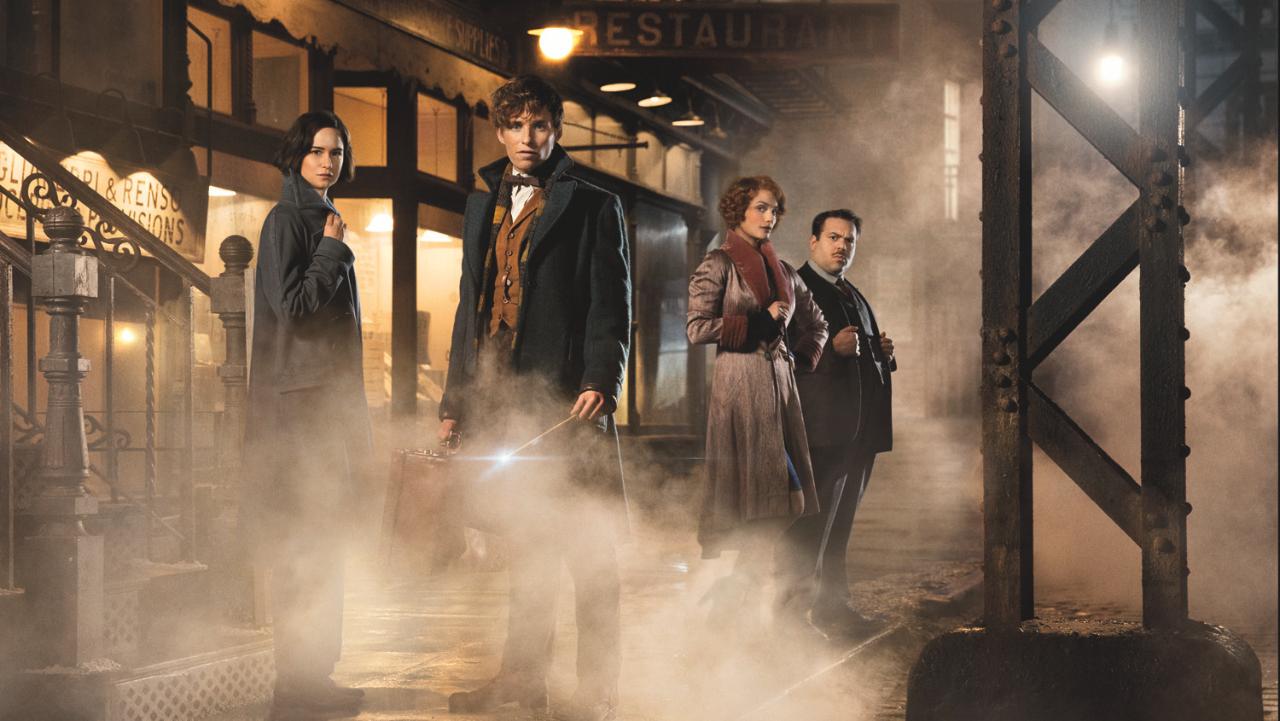
In Fantastic Beasts and Where to Find Them, magical creature researcher and advocate Newt Scamander (Eddie Redmayne) arrives in New York City in 1926, carrying a case that contains all the creatures he has been studying (it’s much bigger on the inside). After a mix-up at the bank, Muggle factory worker Kowalski (Dan Fogler) accidentally sets loose a couple of the creatures and gets tangled up in a frantic chase to recapture them with Newt and ex-Auror Tina (Katherine Waterston, and if you don’t know what an Auror is, good luck).

Meanwhile, am mysterious dark force has been wreaking havoc upon the city, causing local No-Maj’s (as the Americans call Muggles – get it?  “no magic” – because apparently Rowling forgot how to name things) to become suspicious about magical activity. With the dark wizard Grindelwald still at large, the Magical Congress of the United States of America (which, when the acronym is pronounced, only sounds like “Yakuza” to my delight) feat that this new Salem movement may provoke an all-out war. President Seraphina Piquery (Carmen Ejogo) and Director of Magical Security Percival Graves (Colin Farrell) suspect that one of Scamander’s beasts is responsible, despite his fervent assertions that they’re harmless. So, he’s also tasked to figure out what actually IS causing this mayhem while he avoids the long arm of the magical law.

What a day!

In fact, Fantastic Beasts is even better than just a change of pace. It’s a light, fun fantasy adventure that erases the dour tone of the last few Harry Potter films, returning us to a world of whimsy and wonder… Mostly. The central conflict of this film, which is thankfully treated more like a B-plot, is prone to rather sudden shifts in tone that don’t suit the movie one whit. One minute we’re pirouetting in a sanctuary for teleporting ducks, and the next Ezra Miller shows up playing a terminally maudlin child that looks like he stepped off the set of a Tim Burton film, but acts like he was written by Charles Dickens on a bad day.

These sequences range from the bizarrely overwrought (a little girl plays hopscotch while chanting a rhyme about witch murder) to the actively bad (there’s a bit of business about a presidential election that seems to be setting up a despotic villain – topical – but randomly vanishes halfway through), so the marriage of these two tones is fraught with tension. These sections are also marked by the absolute worst of James Newton Howard’s generic score, which quotes Saw in the weirdest way possible. Again, luckily the move seems to recognize that this portion of the plot is junk, so it shoves it offscreen as roughly and as often as possible.

Pay no attention to the subplot behind the curtain.

But if you excise that chunk of the movie from your brain, the rest is –in a word – fantastic. Mostly. OK, it’s not perfect, but it’s a breezy bit of popcorn fun that is much needed in this horrifying time we’re living in.

The creature effects range from solid (an instantly plushy-able niffler) to iffy (they never have been able to get house elves entirely right), but they’re all triumphs of colorful, fantastical design. And, amusingly, the single worst CGI creature in the whole thing is a lion. Like, just a straight-up, real-ass lion fro the Central Park Zoo, which really puts everything else in perspective. Where the effects really shine is in creating a living, breathing 1920’s New York City that serves as the perfect nostalgic backdrop for the overflowing magical mayhem of this timeless tale.

It’s thanks to this setting that Fantastic Beasts thrives. Placing a grand tale of wizardry and mystical creatures smack dab in the middle of one of the busiest cities in the world is an ingenious juxtaposition that makes the film pulse with lively, jaunty energy. Although some of the humor tips toward the juvenile (Oh my, a man couldn’t possibly deal with talking about tampons! Gee whiz, that dude is much too fat to fit into a suitcase designed to transport enormous magical creatures! Ho ho! What fun!), it sparkles with a joie de vivre that can’t be denied.

And despite being a transparent marketing plot, there’s not a snowball’s chance in Hell that you won’t exit the theater loving the niffler.

But I’ve been neglecting the human element here, which is uncommonly strong. Redmayne is an excellent addition to Rowling’s wizarding world, providing an exquisitely strange energy to his role. But the real standout here is relative unknown Dan Fogler, whose Muggle bravado (I refuse to call him a No-Maj, because apparently this is how little the Brits think of us) is aced with a sublime cluelessness and whip-smart comic timing. I also couldn’t leave out the Marilyn Monroe-esque beauty Queenie (Alison Sudol), who hides some sharp anarchistic edges beneath her airy façade. Katherine Waterston is the least of our heroes because her role is a bit of a cypher, but she grounds the silliness of her motley crew. It’s a perfect mixture of the funny and the unreal.

So Fantastic Beasts and Where to Find Them has its fair share of flaws (not the least of which is how it makes my fingers cramp up whenever I have to type that full title), but it’s a return to form for spotty Potter director David Yates. It’s not quite at the level of his magnum opus The Half-Blood Prince, but that five-year break certainly put a pep in his step. My advice? Go see Fantastic Beasts. Wipe your slate clean of expectations, and have yourself a plain old-fashioned good time.

TL;DR: Fantastic Beasts and Where to Find Them is a fun, light fantasy adventure that overcomes its shaky tone.
Rating: 7/10
Word Count: 1107
Reviews In This Series
Fantastic Beasts and Where to Find Them (Yates, 2016)
Fantastic Beasts: The Crimes of Grindelwald (Yates, 2018)
Tuesday, November 8, 2016

The End Of An Era

And so we reach the belated, belabored end of our Harry Potter marathon. In this review, I shall package the Yates-directed Deathly Hallows Part 1 and Part 2 as a single film, much as the studio should have done. I will split up my analysis and scores because they are, ultimately, very different films, but neither deserves something as grandiose as a full-length piece.

[EN: The grand conclusion to this marathon came much later than I anticipated, so now instead of a finale for the world of Harry Potter, let’s consider this review a warm-up for the impending release of Fantastic Beasts and Where to Find Them and its battalion of premature sequels.]

Harry Potter and the Deathly Hallows, in case you have been frozen in carbonite for the last 20 years and missed this phenomenon completely, tells the story of seventeen-year-old wizard Harry Potter (Daniel Radcliffe). Harry embarks upon an epic camping trip with his friends Ron (Rupert Grint) and Hermione (Emma Watson), attempting to hunt down and destroy the remaining Horcurxes of Lord Voldemort (Ralph Fiennes), the mystical objects that contain his shattered soul. Once they’re destroyed, he will no longer be immortal and he can be defeated. This all culminates in a massive battle at Hogwarts, with the forces of Good and Evil fighting for the fate of the wizarding world.

Part 1
Year: 2010
Director: David Yates
Cast: Daniel Radcliffe, Emma Watson, Rupert Grint
Run Time: 2 hours 26 minutes
MPAA Rating: PG-13

You know that cool part of the plot summary about massive battles and good struggling to triumph over evil? That’s not in this one. Deathly Hallows Part 1 devotes the bulk of its time to that most portentous of occasions: wizard camping. While the subject matter is hardly enthralling, promising director David Yates (who directed the two previous, increasingly delightful, films, the best two in the franchise up to that point) does next to nothing with it, and thus Deathly Hallows Part 1 sinks back into the dull muck of the Harry Potter rank and file.

Other than a mysterious penchant for capturing its leading men shirtless on film (science will never satisfactorily explain preteen girls’ illicit fascination with scrawny British kids), Deathly Hallows’ aesthetic has very little going for it. It’s drab and unremarkable, and its two best sequences are the ones that seem to actively yearn to be any other movie than the one it is. The first is an animated sequence that illustrates the titular folk tale (yes, the title references a made-up folk tale, and would you be surprised if I told you the plot was waaaay too bogged down with explorations of wizarding mythology?). The second is a sequence featuring a magical snake that feels like it was transplanted directly from some halfway decent B-horror film. These peculiar flights of fancy briefly enliven the film before it drops once more into its monotonous slump.

Don’t get me wrong, it’s not particularly dreadful, and it’s certainly not as wooden and creaky as one Mr. Columbus’ contributions to the franchise. It’s just sort of there. Occasionally a well-choreographed action scene will rear its head, but it’s largely just a peaky mash of conversations in tents, strained teen melodrama, and befuddlingly complex world-building. And even with the remarkably disproportionate run time it’s given, it manages to bungle simple things like actually introducing characters who only readers of the books will fully understand. It’s a lackluster, inauspicious beginning to an end.

Rating: 6/10

Part 2
Year: 2010
Director: David Yates
Cast: Daniel Radcliffe, Emma Watson, Rupert Grint
Run Time: 2 hours 10 minutes
MPAA Rating: PG-13

I always remember Deathly Hallows Part 2 as being the one where things actually happen. Now that I’m coming to it without the breathless anticipation of a lifetime of Harry Potter fandom, I’ve realized that, while this is accurate, the massive swaths of plot regurgitated by the film really don’t hold much meaning.

Deathly Hallows was already a weaker entry in the book series, bogged down by appendixfuls of lore, side quests, and revelations about the history of its characters. It’s J. K. Rowling’s Silmarillion, not necessarily the climactic showdown we’d been waiting for, at least until the very end. Where the film goes wrong is in following that narrative to the letter. If they had been forced to condense this material into just one movie, this could have been avoided, but huge chunks of Part 2 are devoted to endless bone-dry exposition.

The pacing is shot to tatters, and such a large part of the inflated run time is devoted to exactly recreating the worst parts of the book that Yates can barely squeeze in the massive roster of characters who live and die in the climactic Battle of Hogwarts. It sucks all emotion from the film like a Dementor’s Kiss, asking us to weep over the death of characters who only appear for seconds onscreen before their lifeless corpses are draped dramatically across the frame.

Of course, die-hard fans know exactly who these characters are and how they got here, but taken as a piece of cinema it’s nigh-on incomprehensible. The bulk of the film is taken up with a massive battle that is admittedly a worthy spectacle of flash-bang special effects and indiscriminate mayhem, but the character work for everyone but Harry is so disjointed that not a single death holds the remotest bit of impact and a series of action movie quips fall to the floor with resounding thuds.

The dourness and arch mythmaking of Deathly Hallows completely leaches out the subtle imagery and beauty Yates brought to Half-Blood Prince, leaving us with a mess of desaturated, cluttered visuals that rival only Chris Columbus’s as the worst in the series.

Deathly Hallows Part 2 is a whirlwind roller coaster of a film that keeps the same, fantasy movie thrills coming, but it’s yet another bungle in a beloved film franchise that I’ve come to realize only has two or three genuinely great movies to its name.

Rating: 6/10
Word Count: 1006
Reviews In This Series
Harry Potter and the Deathly Hallows: Part 1 (Yates, 2010)
Harry Potter and the Deathly Hallows: Part 2 (Yates, 2011)

Tuesday, July 28, 2015

Through The Fire And Flames

Year: 2007
Director: David Yates
Cast: Daniel Radcliffe, Emma Watson, Rupert Grint
Run Time: 2 hours 18 minutes
MPAA Rating: PG-13

The first four Harry Potter movies are like distant relatives overstaying their welcome during the Christmas holidays. They devour the full stock of your pantry (i.e. any working British actor above “street mime” caliber), they keep you up with their excessive snoring (or rather their brobdingnagian run times), and to your consternation, they just keep coming back every year without fail.  They are all jagged, ungainly narrative detritus usually brought back from the brink of stultifying despair on the strength of a veritable army of veteran adult performers and production designers so untouchably brilliant that they could literally murder someone, make their ribcage into a lampshade, and it would be so beautiful that nobody would find any problem with it.

When last we left our heroes, it was with 2005’s Goblet of Fire, the last stage of Harry Potter’s “childish” phase. That entry was marked by a particularly devout slash and burn approach when it came to the story, leaving the film a smoldering rubble with only Ralph Fiennes standing triumphant amid the flames. But after all that painful slogging, David Yates stepped up to the plates, and like its titular bird, Harry Potter and the Order of the Phoenix rose from the ashes of the franchise, heralding a new dawn for us all.

Plus, it’s the shortest film of the series. Rejoice!

Harry Potter and the Order of the Phoenix, in case you yourself are a book and haven’t grown self-aware enough to discover the concept of reading, is about the fifteen-year-old wizard Harry Potter (Daniel Radcliffe). At the end of last term, he saw the Dark Lord Voldemort (Ralph Fiennes) rise again, but the paranoid Minister of Magic Cornelius Fudge (Robert Hardy) believes that his claims are false, brought on by the promptings of the avaricious headmaster of Hogwarts School of Witchcraft and Wizardry, Albus Dumbledore (Michael Gambon). This is patently untrue, of course, but he appoints the syrupy and officious Professor Umbridge (Imelda Staunton) to the post of Defense Against the Dark Arts to ensure the Ministry’s hold over Hogwarts while he continues his smear campaign on Potter and Dumbledore from the outside.

Torn between the inordinate responsibility he feels toward the Order of the Phoenix (a secret society leading the charge against Voldemort – to which his godfather Sirius Black (Gary Oldman) belongs), the very adult bureaucratic and political pressures of the Ministry, the surge of teenage hormones and exam stress that lead to infighting with his best friends Ron (Rupert Grint) and Hermione (Emma Watson), and the sudden urges to storm off and listen to Simple Plan alone in his room, Harry is going to have a very rough year.

Being 15 is just a barrel of dicks, isn’t it?

So a hawk- or particularly talented pigeon-eyed viewer may ask, how exactly does one accomplish the Herculean feat of adapting the doorstopper Order of the Phoenix into the shortest movie of the franchise? And that includes the two films that tackled only half the final book apiece, thank you very much. Screenwriter Michael Goldenberg might tell you this or that about writing while standing up or the miraculous powers of lime extract, but the answer is very simple: He actually cared about telling a coherent story that doesn’t rely on a thousand page children’s book to fill in the alarmingly huge gaps that could (and frequently did) fit a grown man.

Mind you, the storytelling of Phoenix is not airtight. Several of its marbles roll irrevocably out of bounds, most notably with the character of Tonks (Natalia Tena) who may well have been a large chocolate gateau for all the purpose she serves the film. But when narrative corners are cut (and with source material as extensive as this, it requires more cutting than a Flock of Seagulls reunion tour), Goldenberg uses pre-established elements (like alternate characters or story beats) to bridge the gaps instead of just skipping past the difficult bits like the faulty record needle of the previous four films.

In addition to the first generally coherent script of the franchise, Order of the Phoenix also boasts a remarkably adept visual schema courtesy of cinematographer Slawomir Idziak. As I said before, the films have always had nut-busting production design (a tradition continued here with Stuart Craig’s glittering obsidian Ministry of Magic and the defined yet somehow infinite complexities of the Room of Requirement), but only Goblet of Fire’s encroaching gloom came close to resembling a unifying aesthetic. Here, the knobbly yet prim structure and stolid lighting of Umbridge and her domain contrast sharply with the heavy shadows, vivid blues, and bright slashes of light that define the clutter of Harry’s reality. This helps emphasize the central conflict of the film, between the Ministry’s careful restructuring of the media narrative and the grim reality they’re hoping to conceal from the world at large as well as themselves.

Perhaps my favorite detail of the film, Phoenix in a microcosm, is the mirror in the Room of Requirement, where Harry and his friends secretly practice defensive spells under the nose of the Ministry. Over the course of the film, the mirror begins to fill up with newspaper clippings and photographs depicting the missing and the dead as Voldemort and his Death Eaters continue their wicked work in the shadows. This collection is never explicitly mentioned in the dialogue, but it fleshes out the dangerous and terrifying world that lies in wait outside the walls of the school. It’s subtle, powerful, and entirely visual, and a big part of why Phoenix is the best Potter yet.

Plus, Daniel Radcliffe was 18 at this point and beginning his conversion into a fully weaponized cute person.

So, have we had just about enough of Film Major Brennan for one article? Let’s just tuck him away again until he can wax poetic about slasher sound cues where he can’t hurt anybody. Because Order of the Phoenix is also a remarkably fun movie. It’s dark, brooding, and deals with mature themes, yes, but it’s also a school rebellion flick. There are moments that capture that summer camp rush of subversive mischief, finally giving the caretaker Filch (David Bradley) something genuinely amusing to do, and allowing the ensemble – especially Neville Longbottom (Matthew Lewis) and newcomer Luna Lovegood (the incomparably dizzy Evanna Lynch) – to truly inhabit their roles and create a living tapestry to support Harry and his exploits.

The acting is likewise much improved, especially after the discouraging Goblet, which almost led to a series of costly psychotherapy sessions. Emma Watson’s eyebrows still clearly long to be set loose in the untamed wilderness, but as a whole, the trio at the core are improving markedly as they age, and the adult performers are back on track as the fossil fuel that keeps the engine running smoothly.

Alan Rickman and Maggie Smith carry on as always, because they are untouchable denizens of Mount Olympus, Michael Gambon has finally settled into his wizened peak as the powerful but ancient headmaster, and Ralph Fiennes returns with his excellent, bored Drawl of Evil, but two newcomers steal the show. Helena Bonham Carter’s performance as the insane prison escapee Bellatrix Lestrange is like an exploding nail gun, pure menacing power, and Imelda Staunton provides a perfectly pitched, sickeningly sweet performance reminiscent of a genius pantomime villain. You boo and you hiss when she comes on and you love to hate her, but the depths of her wickedness turn your stomach, especially in the showstopping detention scene. 

It’s saying something when Emma McFreaking Thompson turns in the worst performance of your entire adult cast, I’ll just leave it at that.

Please note that I don’t say these things lightly. I’m literally sitting next to a VHS copy of Dead Again as we speak.

However, for all the massive improvements Phoenix amasses upon its predecessors, it’s still weighed down by certain demining flaws. The purely anonymous score by Nicholas Hooper would be damaging enough, but when it shades into out-and-out lyrical rock songs, the film dives directly into the nearest dumpster. And the climactic battle sequence that closes the film alternates between electrifying thriller imagery (and some truly impressive visual effects, especially between Dumbledore and Voldemort) and wimpy light shows hardly more arresting than a game of laser tag. It too frequently slides into camp territory to sell its emotional climax, which it then immediately forgets about anyway. Also there’s a shot where it looks like Voldemort is doing jazz hands.

Let’s just say it’s a bit of a bumpy landing. But it’s the least turbulent Potter thus far, and I could see myself rewatching this one without wanting to stick a fork in an electric eel, so three cheers for Order of the Phoenix!

TL;DR: Harry Potter and the Order of the Phoenix is a fun, flashy, aesthetically precise film.
Rating: 7/10
Word Count: 1497
Reviews In This Series
Harry Potter and the Sorcerer's Stone (Columbus, 2001)
Harry Potter and the Chamber of Secrets (Columbus, 2002)
Harry Potter and the Prisoner of Azkaban (Cuarón, 2004)
Harry Potter and the Goblet of Fire (Newell, 2005)
Harry Potter and the Order of the Phoenix (Yates, 2007)
Harry Potter and the Half-Blood Prince (Yates, 2009)