Showing posts with label Steven Spielberg. Show all posts

Friday, March 30, 2018

(Don't You) Forget About The 80's

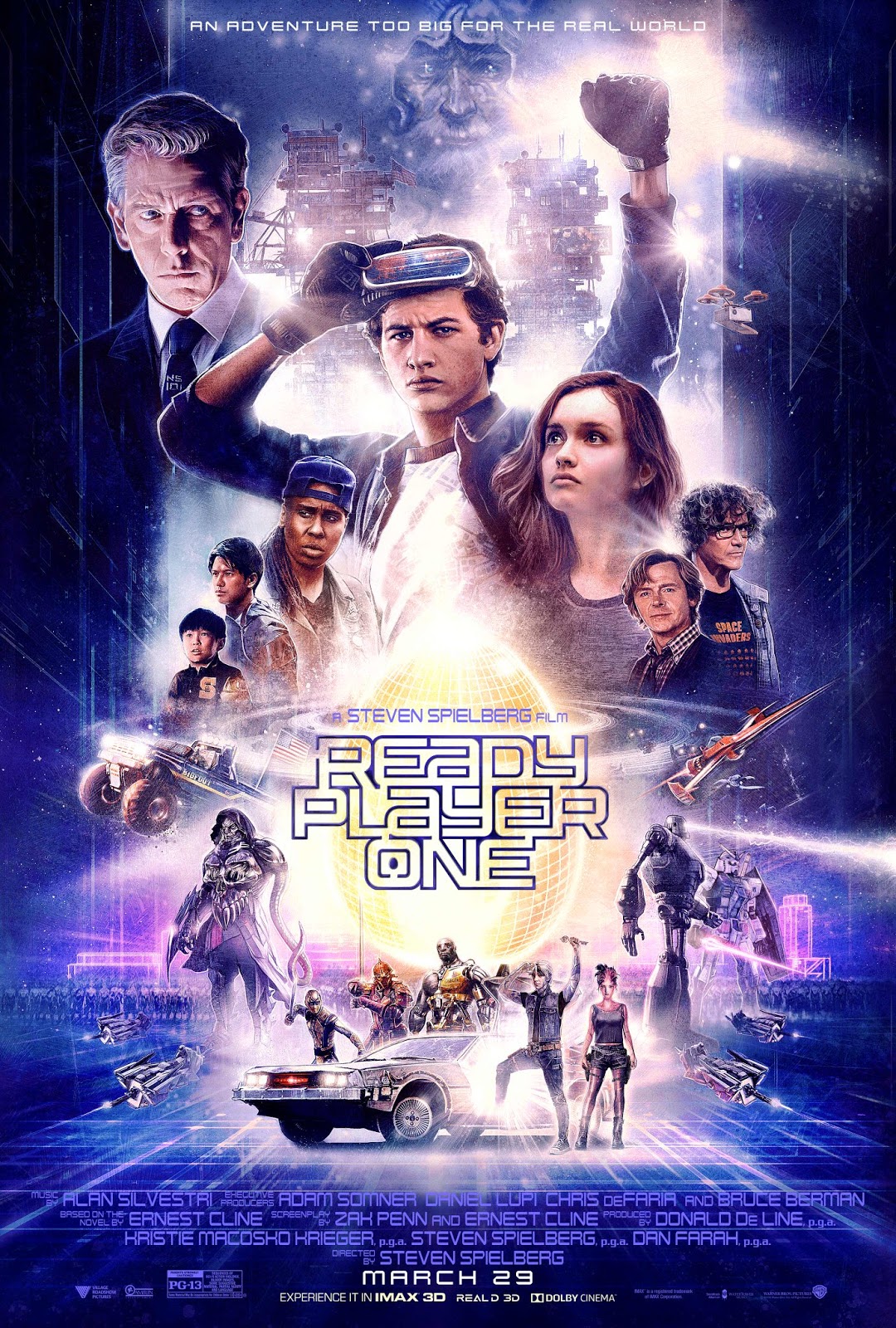
Year: 2018
Director: Steven Spielberg
Cast: Tye Sheridan, Olivia Cooke, Ben Mendelsohn
Run Time: 2 hours 20 minutes
MPAA Rating: PG-13

Of all the properties that exist out there in this wide world of ours, Ready Player One was probably the one most begging for the Steven Spielberg treatment. A parade of nostalgia triggers for people who grew up in the 80's, who could be a better match than the man who shepherded so many of those childhoods with his visionary blockbusters? Unfortunately, that man doesn't exist anymore. Who we got is the guy who made The Post and Lincoln and The BFG. And I didn't want to do this to you, but let me remind you that Bridge of Spies is a thing that happened.

Now can you relate to people who want to escape their own reality?

In Ready Player One, we meet our hero Wade Watts (Tye Sheridan) in a futuristic Columbus, Ohio trailer park in the gently dystopian future of 2045. Famines and poverty have caused many people to want to shrink back from the real world, so they've become obsessed with the virtual reality open-world game of the OASIS. When the game's creator Jim Halliday (Mark Rylance) dies, he reveals that has he created an Easter Egg hunt, where the first person to find all three of the keys he has hidden throughout the OASIS will become the sole proprietor of the entire game.

This business model clearly has some glaring flaws, the biggest being the fact that the wicked company IOI has hired expert drones, led by Nolan Sorrento (Ben Mendelsohn), to crack the codes as quickly and efficiently as possible and thus own the biggest tech resource on the planet. But only the true fanboys and girls know enough about Halliday's past and his favorite old movies and video games to be able to get to the heart of the hunt. As the two factions get closer and closer to the finish line, Wade, under his online alias Parzival, must team up with other players, including his crush Art3mis (Olivia Cooke), his best friend Aech (Lena Waithe, a casting decision the movie doesn't want you to know at first, but the marketing has already blown to ribbons), and the prominent Japanese players Daito (Win Morisaki) and Sho (Philip Zhao).

And the true key to the heart of America, pop culture references. 

It's no use beating around the bush. The novel Ready Player One, by Ernest Cline (the screenwriter behind the execrable Star Wars-fellating road comedy Fanboys), is hot garbage. It's an incoherent, blithering mass of pop culture references that is mostly just a list of obscure anime and John Hughes movies masquerading as an adventure plot. It's an insufferable piece that beats the drum of nostalgia so fiercely that it rips right through the very fabric of art.

Ready Player One the movie is a massive improvement, because it almost completely throws away everything the book was working with. Some of this is due to necessity: you can't turn this crap into a movie. And you can't keep a plot moving when every challenge involves sitting down and playing an Atari game for hours. Other improvements are the invention of the filmmakers, like the fact that the egg hunt relies on the players being able to dig into Halliday's past and uncover more about his character, rather than random 80's detritus like his top 10 favorite music cues from Tron or whatever.

I can't say there were a lot of decisions in the making of either the book or the movie that were truly great, but that character exploration is certainly one of them. I'm not sure I'm loving what Mark Rylance is putting down with his performance here (it's very nebbish and Mark Zuckerberg-y, with a certain scatterbrained, naïve charm, but it slips into feeling like a monologue from Dexter's Laboratory a little too often for my liking - although the way this illustrates the difference between the real life version of him and his in-game avatar is truly special), but converting Halliday into an actual character - rather than a Willy Wonka who makes Monty Python references instead of chocolate bars - was a genius move.

That hairpiece not so much, but you can't have everything.

One area however where the film truly fails is the character of Art3mis. It shouldn't have been hard to make her not a Manic Pixie Virtual Reality Girl, but they actually made her role even more reductive and pointless. More reductive and pointless than something in an Ernest Cline novel. Let that sink in. Whereas in the book she was just as knowledgable about 80's trivia as the rest of the egg hunters, to the point that she was incredibly famous in the OASIS (a girl who knows pop culture? I'm quivering already), here she only exists to gasp with delight whenever Wade explains things to her, then reward herself to him as the ultimate prize.

Her position as ego-booster to this nerdy dweeb is demonstrated in this unwatchable scene where he throws on a Bee Gee's track and she grins, complimenting him on being "old school." Girl, this is the OASIS! People give lectures on the biographies of Atari programmers and treat Buckaroo Banzai like it's a cornerstone of world cinema. Everything is old school!

If only any of the people making this movie had an actual woman to consult with.

But enough about characters. This movie is meant to be a visual spectacle, and I guess that's what it is. The unreality of the OASIS prevents the CGI technicians from having to go out of their way to make things seem realistic, which is both a blessing and a curse. It allows things to become stylized in an interesting way (the OASIS' interface and item screens are actually pretty intuitive and fun extrapolations from modern gameplay), but it too frequently becomes a maelstrom of unintelligible pixels flying around in muddy clumps of mottled color. Also, I'm not really even sure what Steven Spielberg had to do on set, because a good 75% of the movie is literally just a cartoon. This explains why he was able to make an entire The Post while this film was still in production.

The only time where the visuals truly come alive and work within the story's pop culture milieu to create something unique and spectacular is a scene that turns The Shining into an interactive minigame, delightfully combining old film stock with 3D CGI in an impressive feat of creativity that easily trumps the analogous moment in the book.

Unfortunately, aside from that scene, not a lot in Ready Player One is anything more than basically watchable. The run time never feels punishing thankfully, but you don't feel fully swept up into the world of the film. Maybe it's the endless, frustrating expository dialogue. Maybe it's the lame plot points involving Post-It notes. Maybe it's the odious cameo from an autopilot T. J. Miller. Maybe its Alan Silvestri's shallow John Williams impression on the soundtrack. But there's a lot here that just doesn't click.

Ready Player One might be a massive improvement on the source material, but that novel was so dire that even taking leaps and bounds above it leaves you in a very average, unimpressive place. That said, it's still the best movie Spielberg has turned out in years, unless The BFG was a secret masterpiece, because I surely haven't gotten around to seeing that one.

TL;DR: Ready Player One is a gleaming popcorn movie, but it can't escape the deep, deadly flaws of its source material.
Rating: 6/10
Word Count: 1275

Monday, February 5, 2018

Popcorn Kernels: Best Picture Contenders, Vol. 1

In which I once again attempt to sit through all the nominees for Best Picture, knowing full well that the presence of Darkest Hour shall surely prevent me from accomplishing this goal. Here are two of those efforts.

The Post
Year: 2017
Director: Steven Spielberg
Cast: Meryl Streep, Tom Hanks, Bob Odenkirk
Run Time: 1 hour 56 minutes
MPAA Rating: PG-13

When the Washington Post gets ahold of the Pentagon Papers, which expose a decade of government secrets, they must decide whether or not to publish them, which could potentially shut down the paper and send them to jail.

Look, I admitted that Spotlight was good, even though it's preposterous that it won Best Picture. And I dislike the state of the country as much as any reasonable American. But as timely as The Post is, it will never feel like anything other than Spotlight 2 (and in fact, it was co-written by one of the co-writers of Spotlight, if it wasn't already watered down enough for you). And as much as director Steven Spielberg has proven time and again he's a genius, we all have our bad days. The Post is such a huge waste of everyone's time and effort that it's not even funny.

Not that it was meant to be funny. The film finds Spielberg in intensely sober-minded Oscarbait mode, with only one scene (the best scene in the movie, involving a little girl selling lemonade) providing a moment of levity in this grandiose, self-important, completely arid awards season trifle.

The Post has a cruelly inflated sense of its own relevance, tying the problems of the past to current affairs in the most blunt, obvious way possible. Look, I'm all for arguments in favor of the free press, but they don't have to be couched in a series of artless, implacable zooms while characters monologue about how important the themes of the movie are. It hardly pretends to be dialogue, it's just one long essay mummifying an admittedly important historical event.

It's honestly rather clumsy, constantly framing Meryl Streep in drifts of men to pointedly remind you that she's not in a woman's space, all while the dialogue revolves around her being a woman in a man's space. It's very pointedly a message movie, and while shots like that can work - I'm thinking of Clarice Starling in the elevator at Quantico in Silence of the Lambs - it's forced down your throat so hard you start gagging before the fifteen minute mark.

It's just kind of a generally lousy movie, bookended by its worst scenes (a shoehorned-in Saving Private Ryan moment in Vietnam and a hilariously terrible Marvel-esque coda involving the world's worst Richard Nixon impersonator frantically waving his arms like a caffeinated mime and not even attempting to time his movements to the actual Nixon recording posing as dialogue) and endlessly unspooling trite, uninspired dialogue in between ("That picture makes me sad," exclaims Sarah Paulson, hopelessly drowning in a nothing role).

There's just no feeling involved here, it's all lecturing. And considering that The Post contains two of the world's most charismatic movie stars, it's astonishing how this could have even been accomplished. Meryl Streep is fine, as always, but she's snoozing through a role she could play with both hands and feet tied behind her back. And Tom Hanks is acting SO. HARD. But no matter how much he rakishly props his leg up on desks or undoes his sleeves, he's straining through an inexplicable old timey radio host accent that just drips with insincerity.

The Post was never going to be a great movie. It could only have ever been a acceptably Important prestige picture. But the way it fails its actors and the audience so substantially is frankly shocking. The music (John Williams, again visibly bored) seems to actively rebel against the tone of the film, the script is begging for attention yet barely there, and the coterie of strong performers (including, randomly, a handful of comic actors like Zach Woods and David Cross) is given nothing to do but be conduits for a firehose stream of flop sweat. One to miss.

Rating: 4/10

Dunkirk
Year: 2017
Director: Christopher Nolan
Cast: Fionn Whitehead, Tom Hardy, Mark Rylance
Run Time: 1 hour 46 minutes
MPAA Rating: PG-13

We follow a fighter pilot, a civilian ship, and some ground troops through the effort to rescue the British military from the beach at Dunkirk during World War II.

Dunkirk is about as boldly experimental as a big budget blockbuster can get. But the thing is, experimentation leads to failure about half the time. Not that Dunkirk is a failure; what it gets right outweighs what it gets wrong, but its open risk-taking comes with some very odd choices that don't quite work.

For one thing, take the peculiar dilation of time that occurs over the course of the film. One story elapses over a week, one over a day, and one over an hour. The film cuts between these stories simultaneously, and they overlap at certain key moments. But the way they are presented doesn't really allow for any more insight or intrigue than if they had just been shown chronologically. And the landing of a fighter plane is dragged out over the course of what feels like half an hour of excruciatingly long screen time, milked for all it's worth in the film's biggest patch of jingoistic militarism.

Luckily, that doesn't seem to be the prevailing sentiment over the rest of the film. Dunkirk is a film that is above all else about the terror and constant, oppressive violence of war (despite the conspicuously pulled punches of its PG-13 rating), doled out by an omnipresent enemy that is literally never shown, except in the form of bomber planes that whistle by periodically. It eschews character arcs and even dialogue at times (especially in the sequences on the beach, it plays out more like a silent film, which fortunately prevents Harry Styles from screwing anything up) in favor of this all-important, nerve-rattling atmosphere.

And there is absolutely no denying that this is an utterly gorgeous motion picture. Between what are probably some of the best airplane action sequences ever filmed, Nolan provides us bleakly stunning, expansive vistas that blast your corneas with the sheer wideness of devastation and desolation on this beach. The single distracting thing about the visuals is that - at least on the home video release, I can't speak to the theatrical - it has been decided that the aspect ratios switch between the footage shot on 70mm and 65mm. The black bars constantly blotting out the huge screen-filling vistas are hugely distracting and an entirely odd choice.

Much more thoroughly satisfying is the soundscape, which is as harsh and alarming as you would expect any good war picture to be, slashed through with Hans Zimmer's droning, atonal, staccato score that ratchets up the tension to an unbearable degree.

It's a good thing that Dunkirk is so visually and aurally stunning and goes all in on those elements, because most of the dialogue sequences are the worst parts of the movie. Whether its generals dumping piles of exposition on the top of your head or Mark Rylance spouting nothing but affectless patriotic quotes for the better part of an hour, these scenes are generally worth much less of your time than the tense beach sequences - especially a scene where bullets begin to blast through the hull of a ship where stowaway soldiers are waiting for high tide.

I'm not usually a fan of war movies, and I wouldn't say I'd ever want to watch this again, but I'm glad I saw it in the first place. If you've already seen Lady Bird, Get Out, and The Shape of Water, this should certainly be next on your Oscars checklist.

Rating: 7/10
Word Count: 1306

Tuesday, July 4, 2017

My, What Big Teeth You Have

For the Scream 101 podcast episode about this film, click here.

Year: 1975
Director: Steven Spielberg
Cast: Roy Scheider, Robert Shaw, Richard Dreyfuss
Run Time: 2 hours 4 minutes
MPAA Rating: PG

It’s Independence Day! For someone who dislikes hot dogs, medically can’t view fireworks, and has no discernible patriotic spirit, there’s no better way to celebrate the occasion than by kicking off a marathon of the Jaws quadrilogy! As per usual on this here blog, there’s no specific time frame for the next couple reviews, but keep your ear to the ground!

The other three Jaws flicks are but a drop in the bucket of the 1975 Steven Spielberg flick’s legacy, which includes Piranha, Alien, about half of Italy’s cinematic output between 1976 and 1983, and – oh yeah – the entire concept of blockbuster filmmaking as we know it. That’s a lot to hang on a little movie adapted from a Peter Benchley pulp novel about a giant fish. But, like its titular Great White, Jaws is strong enough to carry the weight.

That is, when it’s actually working.

Jaws starts off as an oceanbound slasher movie and sticks in that vein for a lot longer than people give it credit for (though in 1975, people wouldn’t exactly have had the parlance to recognize it as such, having only Psycho, Texas Chain Saw, and the Canadian import Black Christmas to look to). Off the coast of Amity Island, a skinny dipping co-ed (Susan Backlinie) becomes a midnight snack for a mysterious unseen creature heralded by John Williams’ twitchy minimalist title theme. The island’s police chief, Martin Brody (Roy Scheider) wants to close the beaches immediately, but the town’s cocksure mayor (Murray Hamilton) insists that they remain open for the Fourth of July weekend – Amity’s biggest tourist season.

Thus the aquatic beast – a gargantuan Great White shark – is allowed the opportunity to feast on a three course meal of unsuspecting Amity-ites. After enough is very thoroughly proven to be enough, Brody takes to the seas with the sardonic oceanographer Matt Hooper (Richard Dreyfuss) and the grizzled sea captain/cartoon character Quint (Robert Shaw) to attempt to defeat the beast once and for all.

Or at least until they box office starts skyrocketing and they ship in another one.

Jaws made me jump. During an underwater investigation scene, I – a jaded horror veteran – was freaked out by a movie that’s over 40 years old. Honestly, I should end the review right there, that’s recommendation enough. But I have standards to uphold and so we press on.

For its first hour, Jaws is a perfect thriller machine. Spielberg’s tendencies toward the maudlin actually blend rather well with the 70’s grindhouse vein the film inhabits more than it lets on. Not only is a little boy devoured by a shark, but we get a deeply perfect shot of the masses scrambling out of the water, exiting the frame until just one bereaved mother is left on the sand. His short, sharp shocks are immediately followed by languid moments of emotion that grind your nose into how grim and grubby the situation is.

This all culminates in the most grindhousey ending possible: cutting to credits almost the very second the threat is defeated; and therein lies the problem with the second half of the movie. While the first half lives and dies on the colorful residents of Amity and their even more colorful demises, Jaws’ second hour is a pared-down potboiler focusing in on our three heroes. All that energy and tension now lies on the shoulders of a cartoon character, one of blockbuster cinema’s most boring protagonists (yeah I said it, sue me), and an admittedly great comic relief character attempting to fill the gaping void between the two.

You did what you could, Hoops.

Frankly, the third act is a bit of a slog, bouncing between solid action sequences and aimless filler for an exhausting stretch of time. For what it’s worth, you really do feel like you’ve been sitting on a boat for a day and a half. And I understand that many people enjoy every last minute of the film, and I am loathe to take that away from them. For me, it just falls a teensy bit flat.

Of course no amount of complaining could possibly take away from Jaws’ titanic and earned reputation. It’s a remarkably well-crafted thriller with showstopping effects (when they worked) and chilling implications of danger when they didn’t. Other than the unwise decision to hang the back half on the characters they did, there’s not a hole in Jaws’ construction, from the dialogue right on down to the music. 

And John Williams is in rare form here, composing a relatively restrained theme that transposes his typical bombast into a tightly controlled minimalist crescendo. While nothing else in the score remotely matches the majesty of the title theme, it’s such a tremendous piece of work that it’s hard to mind.

Jaws isn’t Spielberg’s best. It’s not Williams’ best. It’s nobody’s best. But it’s a magnificent creature produced by a team of incredible talents with supreme mastery of their craft. It’s a delight to watch even all these years later, and it has heartily earned its gargantuan status.

TL;DR: Jaws is a well-constructed thriller with a weak third act that doesn't quite sink its massive heft.
Rating: 8/10
Word Count: 897
Reviews In This Series
Jaws (Spielberg, 1975)
Jaws 2 (Szwarc, 1978)
Jaws 3-D (Alves, 1983)
Jaws: The Revenge (Sargent, 1987)

Tuesday, January 17, 2017

Popcorn Kernels: Q4 2016 Review Purge, Vol. 2

It’s time to clear out more cobwebs from the ol’ backlog of 2016, to create a clean slate ready for Oscar season! So here are some reviews of flicks I watched in December 2016 that weren’t quite so vital to write about in full.

Rare Exports: A Christmas Tale


Year: 2010
Director: Jalmari Helander
Cast: Jorma Tommila, Peeter Jakobi, Onni Tommila
Run Time: 1 hour 24 minutes
MPAA Rating: R

In a secluded Finish mountain village, a young boy must stop the evil original Santa Claus from being unleashed upon his friends by a nearby mountaintop dig.

I love me some Christmas horror. There’s something about subverting all the manufactured Hallmark cheeriness of the season that appeals to me, and it helps that I genuinely love the holiday itself. But I genuinely wasn’t prepared for Rare Exports, a Finnish Christmas fairy tale with an unusually somber tone. It’s a stab at Guillermo del Toro-esque weight and spectacle that doesn’t seem fitting of the down-and-dirty genre that brought us Jack Frost and Santa’s Slay.

That tone is what allows it to stand out from the crowd, as well as its focus on a type of rural mountain community not normally seen in Hollywood cinema. The realism with which it presents the struggles of the townsfolk, which are getting tougher around Christmastime even without the invasion of a killer Santa, is outstanding. But the unfortunate fact is that these things are exactly what prevent it from being a particularly great Christmas horror film. The intent is spectacular, but the execution is rather lackluster, holding off on horror for a pretty dull 45 minutes of setup and throttling the film’s chances for entertainment with an overserious tone.

Fortunately, when the horror does kick in, it centers on a truly uncanny image that overcomes the abrasive protagonists (who accidentally trap what they believe to be an employee of the dig site and almost instantly decide to prod him with sticks and hold him hostage – delightful!), the jumps in logic, and the rather silly denouement. That image is of a silent, naked old man who crouches in the shadows, unmoving. It’s a sight that chills the spine enough that it doesn’t thaw until the credits roll.

And, to be fair, the silly finale is a tremendous bit of fun that leads to a charming concluding punchline. It just doesn’t necessarily feel like a natural extension of the almost neorealist goings-on that propel the first half of the movie. Visually speaking, Rare Exports is well made (especially a wonderful bit of business with the recurring image of an advent calendar), and the actors are decent, but the tone and the pacing are just a little too wonky to wholeheartedly recommend.

Rare Exports won’t be entering my Christmas season rotation, but it’s at least an interesting curio that I don’t regret watching. It’s a slice of sub-del Toro fairy tale fruitcake with an uncanny confidence in its own construction.

Rating: 6/10

The Color Purple


Year: 1985
Director: Steven Spielberg
Cast: Danny Glover, Whoopi Goldberg, Oprah Winfrey
Run Time: 2 hours 34 minutes
MPAA Rating: PG

In the South in the early 1900’s, Celie is married off to an abusive husband and relies on the strength of the women in her life to survive.

You couldn’t pay me to even pretend I care more about Steven Spielberg’s serious movies. I’m a Jurassic Park and Indiana Jones kind of guy. I’ve never seen Lincoln or Schindler’s List and I’m happy to let it remain that way. However, attached as I am to a certain drama-loving individual, recently I was given the choice to sit through The Color Purple or face a life of loneliness and regret. I chose the former, and thus was I introduced to Spielberg’s very first foray into the world of prestige drama.

And while the length of this film is indefensible (I could cut at least half an hour without batting an eye), spending time with these characters really did help th efilm grow on me. It doesn’t hurt that this is still a Spielberg movie, so as miserable as the characters’ lives frequently are, it never descends into the ultragrim territory of, say, Precious. And damn, is he a fun director.

The Color Purple might be maudlin as all hell, especially in its third act (a joyful reunion is pockmarked by a woman wearing an enormous flowing cape, for crying out loud), but visually speaking the man knows exactly what he’s doing. Whether it be the way he uses silhouette to portray Celie’s journey and self-identity, the recurring motif that links the sky with freedom, or the decision to stage its grandest scene of female empowerment around a dinner table, it’s clear that a great deal of thought, skill, and care went into this production.

Plus, the story (based on the Alice Walker novel of the same name) is a delicate and earnest tale about women that is still one of the more powerful narratives about female connection and empowerment out there. Although most of the people Celie meets throughout her life start out as enemies or rivals, they slowly realize they share a bond of sisterhood that can never be taken away from them or defined by the male (and white)-dominated society they’re trapped in. It’s wonderful stuff, despite some of Spielberg’s more cartoonish additions (a bar fight scene with Oprah looks like it was lifted straight out of Looney Tunes). Whoopi Goldberg gives an indelible debut performance, giving you intimate access to Celie’s thoughts and feeling using just her marvelously expressive face, the story is uplifting but doesn’t shy away from cold reality, and it’s good enough to forgive that grotesquely bloated run time. If that’s not a mark of true quality, I don’t know what is.

Rating: 7/10

Headhunters


Year: 2011
Director: Morten Tyldum
Cast: Aksel Hennie, Synnøve Macody Lund, Nikolaj Coster-Waldau
Run Time: 1 hour 40 minutes
MPAA Rating: R

An art thief/corporate recruiter must escape from an implacable assassin.

I should probably expand my scope a little before I make this assertion, but as far as I can tell, I love Norwegian movies. From films like Cold Prey or Dead Snow, it seems like the entire country has been gobbling up American genre films for decades until deciding in a snap that they can make some themselves. And they’re better. I can now expand this theory from sci-fi/horror to the action/thriller genre as well. Passengers director Morten Tyldum’s adaption of Jo Nesbø’s best-selling novel Headhunters is – put simply – a high-octane treat.

Although it’s a simple, snappy little crime thriller, it benefits from its European flavor. First of all, the lead isn’t preposterously handsome and debonair. He’s a regular Joe (or Jo) who just happens to be very good at stealing art. His lack of perfection makes his predicament seem that much more dangerous, because you’re not so certain that he can Jason Statham his way out of trouble. Plus, there’s a certain blasé attitude toward nudity and violence that makes the whole thing feel more visceral and human. While the filmmaking itself is very polished, the people and circumstances are not, giving it an edge that it wields like a razor-sharp blade.

I can’t say that I have much in particular to write about Headhunters, because it’s an elemental – almost primal – narrative, except to say that it’s a well-oiled machine. Every genre element is in the perfect position to keep your heart pumping along to its electric rhythm. It’s an exciting, harrowing, twisty, frequently gross tale of the lengths one man will go for survival. It has a James Bondian attitude toward women, which is always unfortunate, but it is what it is. And what it is is very captivating.

Rating: 7/10
Word Count: 1298

Monday, October 24, 2016

Popcorn Kernels: There's A First Time For Everything

In this collection of mini-reviews, we cover two films discussed during the month of October on Scream 101 season 2: First films from famous directors that happen to be horror films.

Duel (For our Scream 101 episode about this film, click here.)

Year: 1971
Director: Steven Spielberg
Cast: Dennis Weaver, Jacqueline Scott, Eddie Firestone
Run Time: 1 hour 30 minutes
MPAA Rating: PG

A businessman on a road trip is pursued by a mysterious tanker truck that wants to kill him.

If there’s anybody who should be retroactively expected to deliver a killer first film, it’s blockbuster titan Steven Spielberg. But, unfortunately, he was shackled with a TV movie budget and an impossibly short time frame, so the result is… spectacular. Yeah, Spielberg delivers big on Duel, a debut so preternaturally good that it would take a couple of years before he it that level again (with f**king Jaws. This guy doesn’t mess around.)

Duel, based on a short story by horror master Richard Matheson, does fall into some of the pitfalls of 70’s filmmaking and especially TV moviemaking, like a certain languid pace in its few offroad scenes and a kind of despicable voiceover that rudely intrudes on too few occasions to not be vexing every time. But I’m going to go out on a limb and say that Duel is maybe the most perfect adaptation of a short story ever filmed.

I’m not saying it’s the best movie based on a short story (Candyman, Brokeback Mountain, The Birds, and From Beyond are certainly in the competition). Though it’s probably still in the Top 10, what I’m saying is that, as a direct conversion from page to screen, Duel best captures the spirit of reading a short story. The characters and plot are simple, driven by a single instinct: survival. The story isn’t beefed up with elaborate backstories or random diversions; it’s just a taut, pared-down thriller that crackles at the base of your spine.

As the kind of faceless evil that would frequently haunt screens in the 70’s and 80’s, the truck is superb. Cutting a jagged shape across the dusty horizon of the American highway, it belches smoke and grins with jagged, license plate teeth (an excellently subtle bit of production design – suggesting the truck has kept trophies from its previous victims). And there’s a reason I say “truck” and not “man.” The faceless driver might as well not exist. He’s a tool bent to the will of Pure Evil, something that is never explained or revealed, merely understood as a force of crushing death.

Spielberg captures this chase in a pounding staccato rhythm with his endless coverage flashing between mirrors, dials, gauges, and the road to keep the tension buzzing. Star Dennis Weaver also contributes tremendously, hamming just enough that we believe in the heightened reality of his character. It’s a terrible challenge as an actor to deliver a legible performance with nobody to play off of, especially when they’re mostly confined to a single location, but he pulls it off with aplomb.

Duel is an auspicious beginning for an auspicious director, and it’s a miracle that Spielberg managed to stay this hungry and passionate about his film projects as he did. Duel is a winner, no contest.

Rating: 8/10

Piranha II: The Spawning (For our Scream 101 episode about this film, click here.)


Year: 1981
Director: James Cameron
Cast: Tricia O'Neil, Steve Marachuk, Lance Henriksen
Run Time: 1 hour 24 minutes
MPAA Rating: R

A scuba instructor and a policeman must save a seaside resort from a swam of genetically enhanced flying piranha.

If there’s anybody who should be retroactively expected to deliver a killer first film, it’s box office demigod James Cameron. But unfortunately he was saddled with a microscopic budget and a troubled production, so the results are… pretty deplorable.

To be fair, James Cameron was kicked off Piranha II: The Spawning after about a week or so and silentyl replaced by Italian schlock-meister Ovidio G. Assonitis (maybe he wasn’t credited because he didn’t want people to make fun of his last name). So we can’t blame him for everything we’re seeing, but there’s no denying he had his hands on parts of this film, and 100 percent of it sucks, so statistically speaking, he probably didn’t do a great job in his first go-round. But he followed this up with The Terminator, so I don’t care if his debut was Ass Munchers from Planet X, it was worth it.

And Piranha II: The Spawning isn’t, like, the worst thing that has ever happened. It’s a dunderheaded B-movie with a truly bananas monster (flying piranhas that can survive on land and burst out of people’s rotting corpses, but mostly just look like puppets tossed by some P.A. from offscreen), which is right up my alley, even if it doesn’t capture the sublime campiness and rip-roaring pace that marks the best of them.

In the first and third acts, there are a handful of scenes and character that belong in the bad Movie Hall of Fame (a sunbathing cougar and two topless female pirates are particular standouts), but the movie utterly fails to make anything of them. Most of the characters we meet in Act One don’t even die! We’re left with a second act slog tough plodding military intrigue before things pick up again with a fatal grunion run and the film’s single best scene: Lance Henriksen, who has been searching for his stranded son’s boat via helicopter, finds him and leaps out of the aircraft, letting it hit the water and explode behind him. You know, Coast Guard standard operating procedure.

But too much of the film is too dull to recommend watching it as anything other than as series of two minute YouTube clips. Piranha II’s complete lack of atmosphere smothers it in its sleep. It’s very Italian: A Jaws rip-off that tries vigorously hard not to be exciting except for its random leaps into absurdity. Endless stock footage, repeating effects shots, and buckets of dire conversation weight this unworthy sequel down and it quickly drowns.

A truly dazzling concept does not a good movie make, or even a bad-good movie make. I wish Piranha II did more to earn its best moments, but alas. This fish is fried.

Rating: 4/10
Word Count: 1051

Tuesday, July 7, 2015

They Don't Move In Herds

Year: 1997
Director: Steven Spielberg
Cast: Jeff Goldblum, Julianne Moore, Vince Vaughn
Run Time: 2 hours 9 minutes
MPAA Rating: PG -13

In between the release of Steven Spielberg’s Jurassic Park in 1993 and The Lost World: Jurassic Park in 1997, two very important things happened: 1) Jurassic Park became the highest grossing film worldwide, and 2) Schindler’s List. Both of these explain, in turn, exactly why The Lost World exists and why it’s not so great.

Much like Scream 3, which I also happened to review recently, The Lost World is a sequel helmed by an auteur that had, quite frankly, checked out. Spielberg had already mentally moved on to his, arty, Important phase and was only directing the film out of a beleaguered sense of commitment to the fact that – if the franchise had to be screwed up, it might as well be by him.

It’s the popcorn movie version of senioritis.

The Lost World is helmed by returning screw-up Ian Malcolm (Jeff Goldblum), the rock star mathematician – an oxymoron which could only exist in a Crichton novel. In a scene that’s clunkily written and contradictorily sequelly in the most threadbare, irritating way possible, he learns from the defamed billionaire John Hammond (a palpably bored Richard Attenborough) that not only is there another island of dinosaurs (on which the monstrous creatures have roamed free for four years, only recently revealing themselves by attacking a young Camilla Belle in a desperate attempt to prevent her from remaking When a Stranger Calls), but his girlfriend Sarah Harding (Julianne Moore) is already there, part of a crack team that Hammond has put together to study these creatures in the wild.

When Malcolm joins the team along with Nick Van Owen (Vince Vaughn) and Dead Guy (Dino Meat), he only does so to rescue Sarah and get the hell out of there. Unbeknownst to him, his daughter Kelly (Vanessa Lee Chester) has snuck along for the ride because she feels neglected. The lesson here is the becoming an Important Filmmaker does not make the daddy issues go away.

Once on the island, Ian and the team discover that Hammond’s company InGen, which has been taken over by his nephew Peter Ludlow (Arliss Howard), is leading a safari team to capture the animals and take them to the mainland and create a zoo, because that idea worked so well the first time. So it’s Good Science vs. Bad Capitalism until Big Scary Monsters get pissed and start eating everything that moves, leading the groups to band together in an attempt to escape the island intact.

Also, Sarah is studying the parenting habits of T-Rexes because dinosaurs can have daddy issues too.

The Lost World is to Jurassic Park as a paper cut is to an axe wound. It’s much shallower, less visually interesting, and you can make a big deal about it if you feel like it, but it’s just not the same. It’s an utterly flat film. Where the original comes alive and crackles with tension at nearly every second past the hour mark, The Lost World squelches along, reading a newspaper, pausing only at intervals to look up and remember that it’s supposed to be doing something and ramp up the tension once more.

The film is wracked with a profound sense of weariness, going through the motions without ever challenging itself to be something more than a routine popcorn pic, save for two sequences. One of these sequences I have the profound and annoying pleasure of being able to name drop: My father was the film’s liaison from Fleetwood, the company which provided the mobile home that hangs off the cliff in the only truly memorable scene. So you’re welcome. Without him the film would have nothing to recommend itself save a raptor attack so short it could buy ad time on the Super Bowl without breaking the bank.

Industry jokes always kill in these reviews, you’re welcome.

Of course, John Williams has the audacity to score all of this – even the pulse-pounding, genuinely thrilling RV sequence – with some hideously limp, sanctimoniously light bongo music. It is perhaps the single worst tune the man has ever composed, and I’m counting any particularly on-key flatulence. What the film hasn’t already torn to shreds in terms of tension, characters (Ian Malcolm’s behavioral traits are put in a blender and almost completely rearranged for this film), and logic (Did I not mention that they bring a T-Rex to San Diego? Well, they bring a T-Rex to San Diego), are blasted into smithereens by this woeful, dreadful score and flushed straight down the U-bend.

With that out of my system, it must be said that, for all my complaining, this film is only truly bad by the high standards set by Jurassic Park. Except for that John Williams score. Screw that John Williams score and the whimsical island mule it rode in on. It’s a disappointment that The Lost World is nothing more than a popcorn movie, but it’s reasonably diverting and at the very least, it’s not as woefully idiotic as Jurassic World.

Again the film is well shot (this time by long-time Spielberg compatriot/best friend bracelet-sharer Janusz Kaminski), with well placed shafts of lights delicately playing amidst the dusky forest. Again the dinosaurs are well realized, though none have the sheer weight and terror provided by pre-Schindler Spielberg’s keen direction. Only the effects on the raptors are in any way improved from Stan Winston’s master class in animatronics.

And finally we get some goddamn stegosauruses!

The thing about The Lost World is that it’s outrageously uneven, which is why this lumpy review is jerking from place to place like a scooter on a gravel driveway. There’s a dollop of cheery humor here, a dash of undercooked gore there… It’s like Spielberg got out the Jurassic Park mix packets and was busy whisking the ingredients together in the bowl when he noticed the he’d accidentally thrown away the box with the instructions on it.

There’s some jabs at a theme in the beginning (Malcolm is only a good boyfriend/father when he can make dramatic gestures, not in the everyday things) that get completely lost by the finale (a T-Rex visits a swimming pool!), the acting is largely decent but totally forgettable (Moore hasn’t quite yet settled into her talents, and Chester is at least more palatable than the Murphy siblings), and the action is shallow but present.

The most I can say about The Lost World is that it’s there, and I don’t begrudge it of that. It’s an absolutely workable film and sometimes that’s all a film is. It’s not awful. It’s not great. It’s not Spielberg, that’s for darn sure. And that’s why it’s so painful to watch, despite its blandly pleasant qualities. The loss of what could have been is so plainly, palpably there, throbbing behind the screen.

Oh well, at least they never made any more of these.

Ah. Damn.

TL;DR: The Lost World: Jurassic Park is a disappointment after the high standards set by the first film.
Rating: 6/10
Word Count: 1185
Reviews In This Series
Jurassic Park (Spielberg, 1993)
The Lost World: Jurassic Park (Spielberg, 1997)
Jurassic Park III (Johnston, 2001)
Jurassic World (Trevorrow, 2015)
Jurassic World: Fallen Kingdom (Bayona, 2018)

Wednesday, May 20, 2015

Fright Flashback: They're Here

It's that time of year again! While you're getting out the sunblock and your big floppy hat, please give a warm summer welcome to Fright Flashback! Every week I will be reviewing an old horror movie that shares a theme, cast/crew member, or genre with the week's big release: a sort of spiritual predecessor. Again, very special thanks to Tim Brayton at Antagony and Ecstasy for the idea I more or less shamelessly ripped off and modified. I stand on the shoulders of giants, what can I say? It's comfortable there.

This week's new release is the long-delayed remake of just about the only horror classic left on the chopping block: Poltergeist. In celebration, we are heading back to 1982 to appraise the original property.

Year: 1982
Director: Paul Blart: Mall Cop
Cast: JoBeth Williams, Craig T. Nelson, Heather O'Rourke
Run Time: 1 hour 54 minutes
MPAA Rating: PG

I haven't seen the original Poltergeist since I was a child, and there is perhaps no better condition in which to view it. As one grows older, one gains a more mature appreciation for the deeper themes present in what is a truly remarkable movie, but the level on which Poltergeist works best is in its pure spectacle, and the childlike wonder and appreciation for the terrors that lurk in the dark shadows of the suburban idyll.

Also, frankly, children have a higher tolerance for chintzy 80's special effects.

There has long been contention about the directorial authorship of Poltergeist, and I would be remiss by not at least nodding toward the controversy. Though the credited director is Tobe Hooper of The Texas Chain Saw Massacre and, one year previously, The Funhouse, reportedly the bulk of his work was performed by producer Steven Spielberg during a break on his own film, E. T. (both films came out within a week of each other - what a time to be alive, am I right?). 

Honestly, my money is on heavy Spielberg involvement, but it's rather beside the point. We'll never know the true answer, and the fact is that both of them were there, resulting in an indisputable classic of the genre. What more is there to say?

Just let sleeping clowns lie.

Poltergeist's plot is a simple one, albeit dressed up with some rather detailed theological accoutrements. The Freelings are a middle class family who live in one of the identical houses of the Cuesta Verde suburb of an unnamed California town. Father Steve (Craig T. Nelson) is a realtor responsible for selling a good half of the properties in the district, mother Diane (JoBeth Williams) is young and loving, but softly frustrated with her responsibilities as a parent.

Having had her first daughter, Dana (Dominique Dunne), at the tender age of 16, her youth has been compromised. Robbie (Oilver Robins), the only boy, and Carol Anne (Heather O'Rourke), the youngest, don't exactly subtract from her strain. The conflict of Poltergeist reflects the conflict inside Diane: despite making every effort at achieving the trappings of domestic bliss, something is insidiously, indelibly wrong with the whole affair.

The very nooks and crannies of the Freelings' familiar abode become a hotbed of paranormal activity when a ghostly presence asserts itself through the static on the television (Remember when TV actually ended? I don't.). At first, the disturbances are harmless, almost playful, but they quickly crescendo into a nightmarish conglomeration of terrors, culminating in Carol Anne's being spirited away into another realm. With the help of the paranormal crack team of Dr. Lesh (Beatrice Straight) and her associates, as well as a third act showstopper appearance by the advanced medium Tangina (Zelda Rubinstein), the family attempts to reclaim their lost child from the unknowable menace.

The housing market was really rough in the early 80's.

First and foremost, Poltergeist is a rapturous showcase for MGM's state-of-the-art special effects. Second, it is a lovingly detailed character drama about the American family. Third, it is a down-home shocker chockablock with instantly iconic moments.

Let's begin with the first, especially because that most cherished element is perhaps the weakest of the film. I don't mean to say that the ample special effects are anything but spectacular. They are, but if we're going to be completely honest, most of them have aged about as well as the Flock of Seagulls haircut. 

It's easy enough to still find tension in these moments thanks to the emotional heft of the characters and storyline, but the film devotes a great deal of time to curdled milk visual effects that remain charmingly cheesy but dangerously challenge the truth and reality at the core of its narrative.

Sometimes it feels a little like an Eldritch Horror-themed high school prom.

That's all well and good, but if you dig a little deeper under the topsoil of shiny chrome ghoulies, Poltergeist has an impenetrably solid thematic bedrock. The entire first act serves to deliver the ultimate experience in suburban bliss, only to tear it down time and time again for the remainder of the film. In its ineffably phantasmagorical way, it peels back the facade of the American Dream to reveal that, in fact, all is not good in the neighborhood.

The trappings of suburban bliss become conduits for hellish monstrosities: chairs, dolls, closets, televisions, and even the very landscape surrounding the house. And yet the family unit remains strong. No, Speilberg and Co. are not warring against the nuclear family - his many many films during this era would disprove that immediately - but rather the Reagan-era greed and materialism that led them to this moment in this place surrounded by these suburban trappings (obtained to the detriment of the graveyard that once stood on that very ground, forcibly evicted by a mercenary realty company*).

Behold: The Suburban Nightmare!

Not only is this fascinating, it's downright terrifying. As I said before, the special effects have long since lost their luster as anything other than a sideshow amusement, but the film so firmly believes in its world that its easy to get caught up in the undertow. 

JoBeth Williams especially sells the hell out of even the most Novelty Barn-looking effects, dragging the film into raw, unadulterated reality with an unfiltered performance of pure strength. Craig T. Nelson can't quite match her (his eyes are remarkably uninvolved in whatever he seems to be doing or saying), but as the useless patriarchal figure he does the trick.

And don't even get me started on Zelda Rubinstein, whose exorbitant weirdness sets the film ablaze with a new inferno after its pace starts to flag a bit in the third act, during which we must sit through an alarming amount of philosobabble. It is in this quadrant of the film where it hits the peak of its strangeness, but her unrestrained performance breathes life into a scene that, when you think about it, is literally just a small woman throwing tennis balls at a strobe light. 

Honestly, the simplicity of the finale ignites the imagination rather than exhausting the eyes, providing the perfect backdrop for the film's emotional climax.

But I digress. I was speaking about acting, and I would be remiss if I neglected to mention Heather O'Rourke. Although her untimely death at age 11 casts an eerie pall over the entire performance, she deserves immense credit for what she was able to deliver without the shadow of tragedy. Simultaneously angelic and uncanny, her performance crystallizes the tension of the film with a thoroughly engaging, disturbing, immensely adorable charm. It's hard to explain rationally, and it may just be a credit to whatever director happened to be coaching her, but it's a performance that you feel in your gut, not your brain.

I'm a little in awe of how mystifyingly unsettling she is, and what happened to her is a damn shame.

But for all that Poltergeist is genuinely frightening, it also packs a keen sense of fun. Another tally mark in the "Spielberg" column, the film is like an amusement park adventure ride, with an unflagging levity weaved throughout the horror. Jerry Goldsmith's score compounds this tone tremendously, with a leeringly creepy spin on childhood nursery rhymes that tilts unexpectedly into open-faced childlike wonder.

I have some personal qualms about the overlong ending, which plays off like a laundry list of VFX sequences that were conceived in the brainstorming process but were forgotten until the end of production and haphazardly shoved in one after the other like shiny playthings in a toddler's toy box. 

It also doesn't help that nearly every single one of these effects are by far the best (and most credible) of the entire film (a personal favorite being the elongating hallway). And all of them take place after the conclusion of the film's climactic sequence.

But honestly, any faults with Poltergeist, no matter how large, are mere nitpicks. There are enough that I hesitate to instantly proclaim its masterpiece status, but as a whole the film is an unutterable classic of the form, and I would scarcely dare to impeach that.

*Side Note: It is explicitly noted in the film that the house is not built on an ancient Indian burial ground. That little tidbit seems to have slipped away on the wind.

TL;DR: Poltergeist is a lavish, effects-filled thrill ride, but its most important value is as a treatise on the hazards and fears behind American suburbia.
Rating: 8/10
Word Count: 1568
Reviews In This Series
Poltergeist (Hooper, 1982)
Poltergeist II: The Other Side (Gibson, 1986)
Poltergeist III (Sherman, 1988)
Poltergeist (Kenan, 2015)