Showing posts with label Essays. Show all posts

Saturday, May 9, 2015

Beat It, Essay: Few Times I've Been Around That Track

Here's the tricky thing: The essay prompt for my Russian Cinema class was to write a critical paper about a Russian film. Naturally I chose a slasher film. What do I look like, a nerd? 

The subject of my reviewings is 2007's Putevoy obkhodchik aka Trackman. So far so good. The only thing is, this critical piece will be a little more formal and academic than my normal style, so I'm going to attach a truncated review at the end of this essay to cover my normal topics like how cool that gore shot was or how the movie needed more hot dudes.

The Prompt
Write a critique on a Russian film not viewed in class, relating it to Russian films that you've seen as well as your personal film background.
The slasher film is an American tradition, dating all the way back to the 60’s and 70’s with the likes of Alfred Hitchcock’s Psycho and Tobe Hooper’s The Texas Chain Saw Massacre. By the Golden Age of the genre in the 1980’s, audiences couldn’t get enough of the low budget shockers, sending their box office returns through the roof. Naturally, when Russian filmmakers turned from their introspective, usually war-related fare (like Ballad of a Soldier or Prisoner of the Mountains) to attempts at American-style Blockbuster filmmaking (like the superhero action flick Black Lightning), the slasher genre was one of the first to be imitated. Igor Shavlak’s 2007 effort Putevoy Obkhodchik (aka Trackman) is a fairly devoted recreation of the formula, with some distinctly Russian twists.

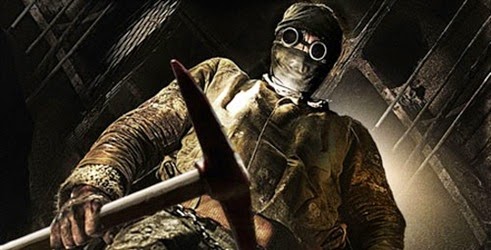
Unfortunately Trackman is not quite as good as other Russian action/thriller efforts or the classic films of the slasher’s heyday, but it is an interesting piece to study in terms of how Russian filmmaking collides with a traditionally American genre format. The basic structure of the plot comes from the 1981 Canadian slasher My Bloody Valentine, which depicts a pickaxe-wielding killer in a miner’s uniform and gas mask stalking his victims through the underground corridors of a mine shaft. This idea is almost exactly recreated for Trackman, with minor changes. 

Instead of a crop of teenagers being stalked, it’s a group of untrustworthy bank robbers and their hostages hiding out in an underground tunnel system and plotting to steal the money from one another, mirroring the social and criminal decadence of 90’s films like Brother and The Thief. Instead of the killer being an enraged miner who narrowly survived a cave-in caused by negligence, he is a presumably mutated product of government cover-ups following the Chernobyl disaster. This character trait not only ties itself in with Russian history, it taps into the folklore surrounding the incident. 


As evidenced by the opening credits, which depict childlike drawings of the Trackman’s violent tendencies, Trackman is an almost mythical figure that taps deep into the subconscious of modern Russian society. In this way, he is implied to be a figure akin to that of Freddy Krueger, the grotesque villain from A Nightmare on Elm Street, whose legend has permeated the mythology of his suburban town to such a degree that the local children have written a jump rope rhyme about him.

This folklore element is crucial to many successful slasher films, including The Burning (in which a horribly burned groundskeeper named Cropsy – based on a New York state legend - stalks a local summer camp), Black Christmas (which utilizes the urban legend about a killer calling from inside the house to chilling effect), and Night of the Demon (which uses the famous North American cryptid Bigfoot as its mythical killer), so by utilizing the trope and reimagining it under a Russian context, Trackman lays a good foundation for itself. By combining the lingering effects of Chernobyl with the typical genre framework, Shavlak managed to create a classic slasher atmosphere with a distinctly Russian flavor. Unfortunately the green director doesn’t find much else to do with his excellent framework, resigning himself to a subpar thriller effort and turning his mythical killer into a hackneyed plot device instead of a being of true, potent evil.


One of the biggest, most egregious flaws of Trackman is its unsteady pacing. Any scene featuring the Trackman himself crackles with tension, but the film mishandles his infrequent scenes, arbitrarily teleporting him around the underground tunnels in an attempt to shock the audience through his sudden disappearances whenever a character whom he is stalking turns to look at him. Unfortunately this has the effect of deflating any tension the film has managed to muster, because any time Trackman threatens to do something interesting, he is whisked away by the unseemly whims of the narrative. 

This style could have been more effective had the killer’s mythical background been explored more thoroughly, but most of the important details regarding his motivations, personality, and even appearance are left to conjecture. The sharp-eyed slasher veteran can piece together the Trackman’s modus operandi (presumably he is so hideously deformed beneath his mask that he kills anybody who looks at him out of shame and fear), but these ideas are never thoroughly explored. 

Most of the film’s other elements of quality suffer from a similar lack of directorial guidance. For example, Trackman has terrific production values (despite not being a co-production like Burnt by the Sun or Mother and Son), but the slick, professional-looking tunnel sets are overlit and beset by a dully limited color palette that leaches out the film’s capacity to scare. Likewise, the budget runs short at the special effects, which look more like stagebound theatrical creations than truly cinematic ones. They don’t completely draw the spectator away from the film’s reality, but it does make some of the more intense scenes difficult to swallow. Together, these lackluster forces combine to create a tensionless horror film, devoid of any real terror.


Similarly, the occasionally great cinematography (which almost always manages to frame the killer in an eerily menacing manner, especially in one sequence where he is glimpsed through the whirling blades of an industrial fan) is marred by an indecent reliance on slow motion. Slow motion sequences are randomly scattered about the film, rarely if ever enhancing a scare. Rather, they pad the run time by forcing the viewer to contemplate one of the hostages walking or smoking a cigarette with almost absurdly lethargic speed. These moments have no motivation within or without the film, and are utterly tiresome. 

In addition, there are an abundance of sequences where the handheld camerawork becomes hyperbolically shaky, almost as if the director of photography intentionally swung the camera back and forth in some sort of apoplectic rage. The film is slightly redeemed by a finale so strange that it slips into the realm of surrealism, but these flaws in the film’s overall production value are difficult to overlook, to say the least.

However, despite its numerous shortcomings, Trackman may just be a growing pain for Russian genre filmmaking, considering that the country’s film industry has never had a booming horror scene. The keener interest in horror films has only developed over the past couple decades, presumably following as a direct result of the fall of the Soviet Union. Not only was the Russian population experiencing a breathtakingly new regime with more lax production codes, it was also beset with the criminal decadence that marked the post-Soviet period of the 90’s. The general populace was terrified of the long-term effects of this social negligence and sought catharsis in the cinema. 


Criminal horror films like 1994’s Mute Witness (which depicts a snuff film crew murdering their victims onscreen and evading the police while pursuing the sole witness), 1990’s City Zero (in which a factory worker discovers a town gone mad following the fall of the Soviet Union – including a secretary who works naked and a series of lunatics who worship the stranger as a rock ‘n roll legend), and 1998’s Of Freaks and Men (which depicts the downfall of Russian society following the rise of capitalism in the form of one pornographer breaking two families apart) used the rampant sex, violence, and rock ‘n roll of the era to shock viewers out of their complacency and provide them with safe, vicarious thrills.

Now that the decadent period has ended, Russian horror filmmakers are Hollywoodizing the horror genre one step at a time with films like the found footage effort Devil’s Pass and the torture film Captivity (both co-productions with the UK and America, respectively), as well as Trackman. Coming as it does at the beginning of the second wave of Russian horror cinema, it is understandable that the film has such a wealth of flaws – nothing like it has ever been attempted on Russian soil before. 

The biggest triumph of Trackman is in laying a foundation for future efforts in Russian horror. If budding filmmakers pick up where Trackman left off (with a folkloric antihero that taps deep into the Russian subconscious) but polish the edges and deepen the character’s mythology, the slasher genre could one day see something truly great come out of the untapped film terrain of Russia.

Trackman (Путевой обходчик / Putevoy obkhodchik)

Year: 2007
Director: Igor Shavlak
Cast: Svetlana Metkina, Dmitriy Orlov, Aleksandr Vysokovskiy
Run Time: 1 hour 20 minutes

OK, I'm gonna give it to you straight because you veteran Popcorn Culture readers are made of sterner stuff than my film professors: Trackman kinda sucks. It's real bad, you guys. The worst part about it though is that it squanders some great potential. Along with the intellectual claptrap you may or may not have read above, the killer has the audacity to use a gun.

The ground rule of slasher filmmaking is to never give your killer a gun. Sure, they're allowed in the grand finale of a slasher film so we can see some cool exploding heads, but the audience showed up for some baroque gore effects, not a goddamn Martin Scorsese movie. Anyway... 

The killer does have an interesting backstory, but literally all of it is conjecture. The only thing Trackman deigns to do with its title character is have him rip out people's eyes, sneak up behind people with a pickaxe, disappear when they turn around, and skulk around random tunnels until he's needed again for a cheap scare. There are Teleporting Killer moments so egregious that I genuinely thought he had mutant powers due to the Chernobyl radiation. He spends the bulk of his time trudging back and forth in empty tunnels, trying to maintain his balance despite the camera's hyperbolically canted angles.

There's one genuinely great scare/gore moment (a POV of the Trackman using a device to steal the ringleader Kostya's eyes - incidentally, Kostya looks a little like Fred Armisen's evil twin so that's fun) and a couple creepy sequences of the Trackman standing in the dark tunnels in front of a flickering light, but the bulk of the film is anemic to the core. The "gouged-out eye" makeup that you can see in the essay above looks less like an eye socket than a chalk eyepatch, and there's not much else of note in the special effects department. That is the showstopper. It's hardly worthy of a suburban haunted house, let alone a feature film.

The finale is pure action nonsense that involves exploding gas canisters and hot-wiring a motorcycle, but at least it's semi-intersting. The rest of the film is content to slap some slow motion on its characters every 12 seconds or so as if the true villain were a student arthouse film that gained sentience and stalked the filmmakers in the editing room.

It's clumsy and it's dull, and it was sheer torture to pull four and a half pages on the topic out of my brain. But I did it and here it is. Marvel at the glory.

Body Count: 5
  1. Splint has his eyes gouged out.
  2. Kostya is pickaxed to death.
  3. Olga is shot to death.
  4. Sergeant Irkut is run over by a slow-moving trolley.
  5. Kirk is shot to death. 
TL;DR: Trackman is a dull, amateur slasher that squanders its generic potential.
Rating: 3/10
Word Count: 2008

Sunday, March 1, 2015

Beat It, Essay: Why Should I Try To Resist?

Happy March, everybody! I didn't post nearly as much as I was hoping too in February, largely because of my commitments at The Backlot and the crushing burden that is my final semester of schoolwork. Believe you me, I have a devastating avalanche of reviews I'm preparing for you, it's just hard to write blog posts when you're already writing papers and articles all day. The human brain can only take so much, the Brennan brain even less so. I am a fragile puppy dog who needs his beauty sleep.

Anyway, lucky for me, I have chosen a major which allows my schoolwork to double as content, so please enjoy my latest essay, which I wrote for my Classical Film Theory class!

The Prompt
Choose two of the four theorists you've read so far and explain what you think their assessment would be of Under the Skin.

Early film theorists developed the rules and philosophies of cinema in a time when the art was in its formative stages. The black and white, silent works that occupied the minds of many theorists are a thing of the past, and cinema has developed beyond the scope of their opinions on the nascent technology. However, their philosophies on the nature of storytelling and the artistic qualities of film remain essential in the discussion of modern cinema, especially when applied to fringe genre or experimental films that push the envelope, like Jonathan Glazer’s Under the Skin.

Although not every facet of their writings may apply today, theorists like Béla Balázs and Hugo Münsterberg would have had a lot to say about the state of 21st century filmmaking, and it’s important to use their theories as a sounding board for narrative and aesthetic criticism of current films that challenge the nature of the craft. While Balázs and Münsterberg would have undoubtedly mixed opinions about a film like Under the Skin, portions of their theories work in tandem to prove that, despite its radical nature, the film taps into the inherent qualities of the art and harnesses the potential of cinema to create a unique, outsider perspective on humanity.


Hugo Münsterberg in particular would have severe doubts about Under the Skin from the very beginning. Aside from the fact that he considers color and sound to be superfluous because they don’t activate a new level of the mind, his tendency toward realism would bias him against the film’s more experimental moments. Because the film is so distinctly non-narrative, comprised largely of improvised conversations displayed in no particular order, he would have qualms about the film’s value, considering his opposition to arbitrary choices driving a narrative and his predilection for films that tell a clear-cut story.

However, this view ignores the central tenet of his theory; that a movie is made in the mind of its spectator, mirroring mental events – or emotions - as it overcomes and organizes the outside world. In fact, in his work The Photoplay: A Psychological Study, he clearly states that, “To picture emotions must be the central aim of the photoplay.” (48) Far more than any narrative or structural considerations, Under the Skin excels at curating emotion. Although the central character is an impassive observer travelling through the messy human world, the deliberate muting of emotions that should be manifestly present (and would be in any other narrative) incites heightened emotion in the viewing audience.

The best example of this concept in practice is the scene on the beach, in which a dog, a woman, and her husband all drown in quick succession, leaving behind a crying baby on a rocky Scottish beach. The alien protagonist observes these events from the sidelines, but it forms barely a background hum in her perceptions, as her focus is on a lonely diver whom she intends to ensnare. The backgrounding of this evocative, life-altering event gives it muted importance in the narrative, but creates shrill alarm bells in the minds of the audience. They perceive this occurrence as brutal and powerful, but the scene’s conscious removal of emotion creates discord within the viewer, heightening their distressed reaction to a fever pitch.


Münsterberg’s own words lend credence to his potential support of this method of storytelling: “The photoplay tells us a human story by overcoming the forms of the outer world, namely space, time, and causality, and by adjusting the events to the forms of the inner world, namely attention, memory, imagination, and emotion… [These events] reach complete isolation from the practical world through the perfect unity of plot and pictorial appearance.” (74, 82) If there’s one thing that can be said about Under the Skin, it is that it successfully isolates itself from any aspect of the real world, through its eccentric small town Scotland setting, its ice cold protagonist, and its challenging, experimental visual schema.

Under the Skin’s violence, eroticism, realism of setting and dialogue, and lack of causality likewise find a friend within his theoretical works, although its ambiguity doesn’t allow the film to come full circle and satisfy the energies it creates in the audience. This is purposeful on the part of the filmmakers, intending to leave the audience with a lasting, indelible sense of unease, but Münsterberg would not have been pleased. He may have never fully supported the film because its ambiguous narrative and thematic structure clashes with his fervent belief in filmic unity, although it does satisfy his prime concern of depicting the inner emotional workings of the mind rather than simply representing real events.


Balázs, on the other hand, would have an almost entirely opposite reaction. The fundamentals of his theory perfectly mesh with the film, but his esteem would be undone by opinions located at the fringes of his work. He would adore the film as an adaptation of an inferior literary work transformed into a work of high cinema, and appreciate its delicate use of its material to draw attention to unnoticed details of the human experience.

Its close-ups take on the perspective of an alien presence, watching the minute interactions of human beings as if they were entirely unknown, especially in the scenes where the woman is driving around the streets closely observing the male passersby, eventually shifting to the females as she comes into her own identity. This perspective is key to Balázs theory on close-ups, which he explained in his Theory of the Film by saying, “The close-up shows your shadow on the wall with which you have lived all your life and which you scarcely knew.” (55)


The soundscape, in which sounds are either muffled through the van’s glass as if it’s driving underwater or speech is shrill and garbled, powerfully attacking the senses but not transmitting meaning, also acts as a sonic close-up. One particularly memorable moment is when the woman is swept up in a crowd of women heading to a dance club. Their happy chatter is rendered unrecognizable by a sort of aural blurring effect that renders the recognizable, pleasant sounds as harsh and unfamiliar. 

This is a concept that would have delighted Balázs immensely, considering that he was one of the only early theorists to welcome to presence of sound in film. In fact, he wrote fervently on this topic, saying, “Only when the sound film will have resolved noise into its elements, segregated individual, intimate voices, and made them speak to us separately in vocal, acoustic close-up; when these isolated detail-sounds will be collated again in purposeful order by sound montage, then will the sound film have become a new art.” (198-199)

The sound design, use of close-ups, and presence in an outlying genre would have made Under the Skin a film of incredible interest to Balázs, but the stricter tenets of his philosophy jar against the experimental, ambiguous nature of the film. While he believed that distortion and transformation of reality was necessary because “only by means of unaccustomed and unexpected method produced by striking set-ups can old, familiar and therefore never seen things hit our eye with new impressions,” (93) he also believed that this distortion should function to advance and support a structured, orderly plot.


Under the Skin has no truly recognizable plot structure to speak of, existing only in moments of human life glimpsed from behind a pane of glass or moments of human death and despair in the dark, terrible void of the woman’s lair. The plot, insofar as there is one, is languorous and obtuse, refusing to adhere to recognizable structures. And many moments, especially the colorful kaleidoscopic view following the first victim’s consumption and the lengthy opening scene in which a series of syllables is spoken over the image of an eye, have very little concrete narrative value whatsoever.

Balázs would object to this very much, having said that “distortion… must always be distortion of something. If that something is no longer present in the picture then the meaning and significance of the distortion is also gone.” (102) He would consider moments this experimental to be a “degenerative phenomenon of bourgeois art… like visions seen with closed eyes.” (108, 179) 

Although this inhuman style of filmmaking deliberately and effectively displays humanity through a cold and unusual lens, the style is just far too unnatural for either Balázs or Münsterberg to truly be capable of appreciating. But despite their potential ardent dislike for Under the Skin, their theories support the film’s validity as a piece of cinematic art in many startling and timeless ways. Although cinema technology has advanced far beyond the scope of their imagination, their central tenets continue to hold true throughout the ages, because even as the materials of film advance, the ancient techniques of storytelling and evocation of emotion remain eternal.
Word Count: 1613
Works Cited
Balázs, Béla. Theory of the Film; (character and Growth of a New Art). Trans. Edith Bone. London: Dobson, 1952. Print.
Münsterberg, Hugo. The Photoplay: A Psychological Study. New York: D. Appleton, 1916. Print.

Saturday, December 6, 2014

Beat It, Essay: The Comeback Of The Comeback

Like I said before, finals are a killer. And once I vanquish them, a veritable waterfall of terrific content is going to cascade over you all. But luckily for me, some of my work can double as blog posts, seeing as how I'm required to write insightful and analytical essays. Which is pretty much what I do every day over here. Anyway! Here's my newest essay for my Broadcasting class, exploring HBO's terrific show The Comeback.

The Prompt
Analyze one television show from the post-classical network period of modern television in order to illustrate how the show reflects the social, cultural, industrial, and historical moment of its production.
 The Comeback of The Comeback: False Reality and the Duplicity of Celebrity


Ever since the inception of the pay cable network HBO, the company has sought to air counterprogramming to traditional network TV. During its early years in the 1970’s, this meant airing programs like first-run movies, sporting events, and comedy specials to counterbalance the traditional television styles and genres of the classical network system. However, after competition began to increase, HBO shifted from a utility brand to an identity brand and began producing its own programming. These original television shows took the format of traditional genres like the sitcom or the hour-long drama, but continued the spirit of counterprogramming, typically using their recognizable style to comment on and satirize the state of current network television.

Shows like The Larry Sanders Show and Curb Your Enthusiasm tossed vicious barbs in the direction of late night talk shows and sitcoms, but 2005’s The Comeback is perhaps one of HBO’s most acerbic and biting programs, using its first season and its currently airing second season to take jabs at the rise of reality television. The Comeback wickedly satirizes the artifice of early reality programs and – in turn – the manipulation of image employed by celebrities both toward the public and themselves, using the arc of an aging sitcom actress’ journey to depict the changing tides of popular media.


From its very first episode, The Comeback sets its sights on the new Renaissance of reality TV, a genre that rose to prominence with 2000’s Survivor and 1999’s Big Brother. These shows were inexpensive and widely popular, depicting real people and actual events, but viewed through a cleverly edited lens to create heightened drama (Hilmes 398). The Comeback, presented as the raw footage of a reality show starring Valerie Cherish – played by Lisa Kudrow of Friends fame – an aging sitcom star who is looking to get back into the limelight, immediately presents an argument against the reality of “reality.” By blurring the lines between reality and fiction with its realistic presentation and a character mirroring Kudrow’s own career, The Comeback cleverly highlights the artifice of the shows it imitates (Williamson 109).

By presenting the unedited footage of what will eventually become a reality program, The Comeback depicts just how boring and ordinary Valerie Cherish’s life proves to be. She has petty arguments with her husband, goes shopping for linens, and has muted, human responses to even the good things in her life. In fact, in the first episode – “The Comeback” - Jane, the show’s producer, asks Valerie to play up her reaction to getting a part in the sitcom Room and Bored, saying “I just think that your reality can be more excited.”

This strategic manipulation of Valerie’s true self is the only way to have the show be exciting and get heard above the noise of its dozens of peers. In the episode “Valerie Demands Dignity,” Charla, another reality show star, astutely tells Valerie that “This is reality TV! You have to make it happen!” Although Valerie never reaches true understanding of this fact, the producers and editors of her show create something out of nothing, transforming Valerie’s quiet, unexceptional life into a dramatic roller coaster of a narrative. By presenting the show to us in this particular “behind-the-scenes” format, HBO and the creators of The Comeback thoroughly deride the unreality of reality programmers and those who are foolhardy enough to star in them.


In addition to depicting the artificiality of the program itself, The Comeback indicts the false face of its very own central figure. Valerie Cherish, though the apparent protagonist of both The Comeback and “The Comeback,” the reality show-within-a-show, is a deeply flawed, emotionally stunted woman who seeks to control every visible aspect of her life. Years of living in the spotlight have warped her mentality, causing the face she shows to the cameras and her true face to collide. She has built an artificial world for herself, shielding herself from the messiness of life behind a false, cheery personality.

The persona that Valerie Cherish displays is not her reality, but rather the expression of who she dearly wants to be. Her false self is determined, optimistic, and generous. She bakes cookies for the writers, gives gifts to the cast, and personally thanks everyone involved in creating the show. In the episode “Valerie Stands Up for Aunt Sassy,” she even states that “I’m the one who buys gifts for all the crew. That’s who I am.”

Valerie insists that her expressed personality is a reflection of her true self, but the reality TV camera reveals the chinks in her armor. Under close scrutiny, it becomes apparent that nearly every single aspect of her personality is specifically gauged to address one selfish need or another. She bakes cookies for the writers so she will get a storyline to herself and gives gifts to the cast because she wants to be well-liked. The camera lingers over her initial reluctance to perform any open-hearted task and captures the precise moments that her genial mask is affixed over her true face.

Simultaneously, the reality camera reveals the grim artificiality of her personality and the stark truth of her average life. This multi-layered approach taken by The Comeback highlights both the flaws in the making of reality television and those of the people who desperately wish to be seen on them. In combination with one another, both elements negate all potential for true “reality,” as The Comeback points out, making it the most spirited reversal of television tropes on the HBO counterprogramming lineup.


In addition to its startlingly up-front indictment of reality programming, The Comeback’s multi-layered satire has a thriving undercurrent depicting the fall of the sitcom in the face of the new wave of reality TV. The figure of Valerie Cherish, a former sitcom darling who is rapidly aging out of the industry, represents this transition (Poster 162). She attempts to run her show “with dignity” and manipulate her image in the manner of a 90’s sitcom, constantly butting heads with the young producer who knows that dignity is exactly what current audiences will not want to see.

The Comeback ceaselessly seeks new ways to highlight the age gap between Valerie and her young co-stars. She tries to get one of them to do the robot onstage, sings a series of songs none of them have ever heard of, and is constantly faced with ire from the writers, who provide dialogue for her character that ages her even further, making her seem like an ancient, sexless grandmother. As Valerie herself says in “Valerie Relaxes in Palm Springs,” “That’s Hollywood for you. Anyone over 22 – mandatory hip replacement.”

Valerie’s struggle quite obviously mirrors the waning popularity of the traditional sitcom format. In the mid-2000’s, in response to the rise of “quality television” like Lost and Mad Men, sitcoms had already begun shifting to a more elegant and refined single-camera format, losing the laugh track along the way. The multi-camera, live audience world that Valerie once knew and ruled was now being viewed as a symbol of tacky excess. The old sitcoms were now seen as something to be derided and dumped from the schedule, as evidenced by the network’s manhandling of Room and Bored. The producers frequently interfered by adding new crowd-pleasing elements and – in one key moment – shutting down the entire production to retool during the middle of its very first season in response to low ratings.

In the new world of television where reality is king, the industry has no place for traditional formats or entertainment veterans. The popular stars of the age weren’t even celebrities at all, merely real people with big personalities who arrived on the national stage practically overnight. This world is the one in which Valerie Cherish – and her supposed comeback – languish. Her age and her refusal to bend the morals of her rigidly artificial personality set her apart from the oncoming generation.

Without The Comeback, she has nothing, but she desperately clings to the old-format Room and Bored, viewing that as her true return to the spotlight. But, as her director wisely states in “Valerie Bonds with the Cast,” “Why are you worrying about [Room and Bored]? This is not your show. [The Comeback]’s your show. This show is the car that takes you to that show.” Valerie never truly realizes the truth of this statement, as she is so focused on clinging so desperately to the television that she knows. But through clever editing and a series of dramatic challenges, The Comeback is a success, inadvertently providing her with the very success she thought she was going to achieve through her traditional means.


To Valerie Cherish and to HBO, The Comeback is many things. It’s a shattering portrayal of the duplicity of reality TV and the realities of celebrity as well as a tragic tale of an outdated model of entertainment slowly drowning beneath the currents of a new format. The Comeback is also counterprogramming at its finest, stripping away the veneers of TV’s tropes and genres to take a good look at the life and lies pulsing underneath. Although HBO would shortly thereafter send The Comeback to an early grave, the show remains one of its most important and astute criticisms of today’s entertainment environment, using its tragic central figure to track the changing trends and attitudes of modern media for the first – and certainly best – time.


Word Count: 1677
Works Cited
Hilmes, Michele. Only Connect: A Cultural History of Broadcasting in the United States. 4th ed. Belmont, CA: Wadsworth/Thomson Learning, 2007. 397-399. Print.
Poster, Mark. "Swan's Way: Care of Self in the Hyperreal." Configurations 15.2 (2007): 151-75. Print.
Williamson, Lisa. “Challenging Sitcom Conventions: From The Larry Sanders Show to The Comeback.” It’s Not TV: Watching HBO in the Post-Television Era. Ed. Marc Leverette, Brian L. Ott, and Cara Louise Buckley. New York, NY: Routledge, 2008. 108-122. Print.

Wednesday, October 8, 2014

Beat It, Essay: Munster? I Hardly Know 'Er!

Hello everybody! It's that time of year again! The cogs of the Starbucks brand grind merrily along, lubricated by the tears of students preparing to face their midterms. As a film student I rarely get tested so for me, that means a rapid-fire barrage of projects and essays, which are arguably more challenging. I, for one, had fun, and would like to present you with my most recent essay on one of television's most unforgettable families - The Munsters!

The Prompt
Analyze one television show from the early or classical network periods of television in order to illustrate how the show reflects the social, cultural, industrial, and historical moment of its production.
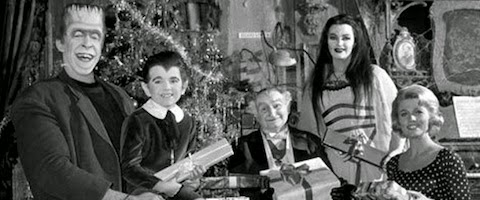
 The Monstrous Other – The Munsters and Suburban Racism in the 1960’s


Since the very beginnings of broadcasting, the sitcom has been ever-present. Because of the familial nature of the genre, sitcoms have always been an avenue for female stars, of which there was a massive flux in the years leading up to the development to television as we know it. These women would play the matriarchs of “typical” suburban middle class white families, nurturing and kind, sometimes ambitious but always merrily sustaining her place - in the home, raising her kids and supporting her husband while he brings home the bacon. According to author Lynn Spigel, this depiction of home life in 1950’s sitcoms represented a “consensus ideology, promising practical benefits like security and stability to people who had witnessed the shocks and social dislocations of the previous two decades (Make Room for TV 2).”

However, due to the country’s economic turmoil (requiring women to take jobs outside the home) and large immigrant population (many American families were non-white and working class, especially in the cities), the media’s reflection of the “average” American family was largely fanciful. Although the standards and practices of television in the 1960’s were still largely conservative, by the middle of the decade, the television climate began to change. First came the hillbilly hurricane, a glut of shows depicting clashes between urban and rural families), which was soon followed by the advent of  “fantastic sitcoms,” which used “magical, alien, prehistoric, or ghoulish spin[s] on the American family” to combat and lightly satirize this idealistic perspective (Hilmes 222).

Perhaps the most incisive of these early satires (including Bewitched, I Dream of Jeannie, and The Addams Family) is The Munsters, in which the titular family is comprised of variations on classic Universal monsters. Taking great influence from gothic horror, Herman the patriarch is a Frankensteinian creation, and his wife Lily, son Eddie, and father-in-law are vampires. Only Marilyn, their blonde and beautiful adopted niece, looks anything like the typical member of a sitcom family.


The break from reality that provides the central concept of The Munsters allows the show to poke fun at many cultural and suburban conventions indirectly without igniting fervor in the censors (Spigel, “Fantastic Family” 205-235), the most prominent of these undertones being the unsavory race relations of modern suburbia. Many of the issues the Munsters face in their day-to-day lives stem from the refusal of their neighbors (and society at large) to accept the differences in their customs, attitudes, and especially appearances, a struggle many non-white families faced during the tail end of the Civil Rights movement.

In fact, in an early episode – “My Fair Munster” – a neighbor remarks that “this was such a nice neighborhood until they moved in,” quite obviously drawing a parallel between the Munsters and racial minorities. The Munsters stand in for the unknown Other, merely trying to live their lives while constantly being on the receiving end of societal attacks. These offensives can be subtle, like Marilyn’s boyfriend’s elegant parents rejecting her when they meet her “weirdo” family in “Munster Masquerade.” In spite of her all-American demeanor, these bourgeois sophisticates can’t look past the surface level shocks provided by her monstrous-looking, yet well-meaning and polite family.

And it doesn’t end there. Some of the challenges the Munsters face can be quite harsh, including Herman almost being attacked and arrested for “terrorizing” a park during his nightly strolls in “A Walk on the Mild Side” and narrowly avoiding being murdered by fraudulent film producers hoping to collect his insurance policy in “Movie Star Munster.” Though the plots are fanciful and unrealistic, the Munsters and minority families are united by the universal scorn they unwittingly receive, as well as the instant fear and suspicion incited in society merely by the color of their skin. Whether it be brown or black or green, American suburbia yearns to scrub out any color that isn’t pure, glittering, “traditional” white.


An additional satirical dimension directly related to this societal attitude is that of class. Typically, suburban and especially urban minorities were viewed by the middle and upper class white families as a sort of lower caste - the working class, uncultured poor. Many immigrant families were penniless thanks to an unforgiving system, but even those minorities that could afford to move into the suburbs and live the “ideal” life were automatically downgraded in esteem thanks to the color of their skin.

The Munsters responds to this societal discord with fervor, depicting nearly every single authority figure in the town as either a bumbling buffoon or a conservative bigot. From the inept and crude gas company man in “Pike’s Pique” to the clownish doctors in “Rock a Bye Munster” and “Low-Cal Munster,” those who typically perform “superior” duties are viciously skewered by the show’s piercing satire. 


On the other hand, the other minorities which society at large also looked down upon tended to sympathize with the plight of the Munsters. Whether it be a group of hippies inviting the Munsters to sing along with them in “Far Out Munster,” a gypsy man overlooking Lily’s appearance to hire her for a job reading palms in “Herman’s Rival,” or teenagers welcoming Herman’s strange look and offbeat musical style, putting him on the top of the charts in “Will Success Spoil Herman Munster?,” the family always finds friends in societally “low” places. 

Because The Munsters utilizes the Other family as its focal point and puts society on the outside, it exposes the animosity and stupidity of white culture at the time, painting them as the “bad guys” in a way that a more straightforward race relations television show could not possibly have portrayed with impunity (Hunzer 4).

In fact, this normalization of the Other is perhaps the single most important cultural impact of The Munsters and its fantastic sitcom counterparts. Although the Munsters may look strange, have bizarre customs (Lucy and Ricky weren’t exactly sleeping in coffins), and eat strange foods (lizard casserole and vulture egg omelets are some of Lily’s beloved recipes), they’re no different from any sitcom family.

They have a kind and loving mother, a bumbling father who worries about paying the bills, two kids, and a dog. In fact, in the episode “Family Portrait,” computer demographic analysis places them on a magazine cover as the “American Average Family of the Year.” They never seek to cause trouble, merely to live out their idyllic lives in peace and happiness. The trouble they do face is always brought to them from outside, from those who can’t see past their fear of the surface level repellence of the Other to understand the warmth and kindness inside the Munsters.


Audiences immediately understand how wonderful the Munsters truly are because the stories are told from their perspective. The subtleties of the discussion of race mechanics and bigotry in modern America that pulses beneath the show are recognized almost subliminally through the vantage point of this hilarious bunch. Again, this satirical intent could never have been accomplished through directly portraying a minority family. Thanks to the inherent racism of suburban, middle-class viewing audiences, ratings would have plummeted, rendering the show an abject failure.

But by allowing the viewers an access point through the wildly popular and well-understood medium of classic monsters, The Munsters brought its social commentary to the mainstream, becoming a massive success. In fact, the show was the 18th highest rated television program in the 1964-1965 season, alongside such similarly satirical programming as The Beverly Hillbillies, Bewitched, The Andy Griffith Show, and Petticoat Junction

Together with these types of programs, The Munsters began to pave the way for a new style of media and a new way of telling stories. Television as we know it couldn’t have been possible without the contributions of this show and many others during the massive tide change of the 1960’s as minority classes struggled to break into a culture primed to ignore and even despise them. Although American media and culture still has a long way to go to be truly accepting and diverse, without the brave and subtle efforts of the showrunners during the transitory period of the 1960’s, we as a nation may very well have been set back several years, maybe even decades.

The prominence of the television sitcom allowed positive messages to be spread to the American populace through subtle, almost counter-intuitive channels, utilizing a format that promoted conservative values and middle class consumerism to further the efforts of hundreds of varied communities struggling to earn a name for themselves. The Munsters and the fantastic sitcoms of this period are often overlooked in modern academia, but their massive influence speaks volumes by itself. The gentle satire of shows like The Munsters paved the way for much more proactive movements, all through the simplicity of the most traditional unit of all – the American family.

Works Cited
Hilmes, Michele. Only Connect: A Cultural History of Broadcasting in the United States. 4th ed. Belmont, CA: Wadsworth/Thomson Learning, 2007. 222-223. Print.
Hunzer, Kathleen. "Move over Cleavers, the Munsters Are in Town: Redefining the American Family and the Marginalized Other." Constructions of the Human Conference: Space, Time, and Culture. Lehigh University. 1-5. Web. 1 Oct. 2014.
Spigel, Lynn. Make Room for TV: Television and the Family Ideal in Postwar America. Chicago: U of Chicago, 1992. 2. Print.
Spigel, Lynn, Constance Penley, Elisabeth Lyon, and Janet Bergstrom. "From Domestic Space to Outer Space: The 1960s Fantastic Family Sit-com." Close Encounters: Film, Feminism, and Science Fiction. Minneapolis: U of Minnesota, 1991. 205-235. Print.
Word Count: 1697

Thursday, May 1, 2014

Beat It, Essay: Music Of The Night HE Came Home

Phew! I survived the A to Z Challenge! Now we can return to regularly scheduled programming and I can survive finals week without a post every single day. But never fear, I won't forget about posting, I'll just stick to my regular average of one every two days or so until summer begins and my schedule clears up again.

But for now why not check out what's going on in finals week! Here's my final essay for my Music in Film class!

The Prompt
Discuss the role of music in a single film created in 1970 or after.


In 1978, the horror genre saw a great sea change with the release of John Carpenter’s low budget fright flick Halloween. Prior to its innovative approach to the genre, few films (like Jaws or The Exorcist) broke through the mire of pale Psycho knockoffs that had been permeating the market. But this fablistic tale of a purely good babysitter played by Jamie Lee Curtis defending her charges against Michael Myers, a faceless boogeyman, sent a shiver down audience spines, aided in no small part by Carpenter’s self-composed minimalist score.

Three major themes dominate the score for Halloween and all of them serve a unifying purpose – to highlight the nature of Michael Myers’ evil. This is an important endeavor because he is no mere slasher villain. In fact, slasher films didn’t even exist yet in the shape they would after Halloween’s influence. Michael Myers was a signifier of pure unstoppable evil, a force utterly divorced from humanity. The blank white mask he wore helped to signify this, stripping him of any defining features, but the music is what really drove that point home.


The first and most common theme in the film is the Halloween Theme, an unrelenting and shrill synth composition comprised of a ten beat pattern (1-2-3, 1-2-3, 1-2, 1-2) repeated endlessly. Accompanied by a series of low tones to create an ominous mood, this theme sets the stage, evoking feelings of an autumnal Illinois night with its repetitive but nostalgic tune and consistent tempo while the more ominous undertones provide another layer; a feeling of being watched by some dark evil lurking in the shadows.


The second theme is Laurie’s theme, the musical cue that ties in most clearly with the fablistic tone of the film. The idea of Halloween is not that it tells a story of a realistic serial killer and his realistic victims, but rather a much grander display of the struggle between good and evil. This is reflected in Laurie’s theme, which opens with a lilting, almost whimsical melody using two alternating high notes to suggest her purity and inherent goodness. However, it doesn’t take long for the low, ominous notes to encroach upon her theme once more. After all, this film is about her battle with pure evil, the nature of which is ubiquitous and unrelenting.


The third theme is the Shape Theme. The Shape is the name given to Michael Myers in the credits and in the script, further dehumanizing him and turning him from sympathetic madman to an instrument of pure evil. His theme provides a similar effect. A large majority of the theme is a single low note repeated in staccato intervals. The harshness of this theme reflects the thought inside Michael Myers’ head and the pure visceral evil that fuels them. Persistent, dark, and terrifying, the focus on one single note of evil provides clues to the killer’s “motive,” implying that he moves with singular purpose to stalk his prey, the sweet young symbol of good whom he happened upon by accident while visiting his old home.

The entire score is composed on a synthesizer because of budget necessity, but sometimes such limitations are all a great artist needs to fully explore the limitations of their craft and create something delightfully new and dazzlingly creative. Because of his lack of an orchestra, John Carpenter was forced to think simpler, creating an immensely complex soundscape out of only a few musical colors and tones. The heavy use of leitmotif in Halloween is derived from this limitation and that, more than anything, is what makes the thematic material drill into the audience’s subconscious.

The music trains audience members to react in certain ways to certain situations, creating a musical atmosphere where the introduction of a single note can change the tone of a scene and keep viewers on their toes. The genius of the music does drive heavily from the cues themselves, but the tone lives and dies on their placement in the film. Carpenter plays the audience like a fiddle, using abrupt shifts to music or silence to create tension and a sense of imbalance.


Carpenter’s Halloween score became legendary more or less immediately with only about six notes dominating a majority of the score and that is what separates the geniuses from you or I. He realized that the tone and cue placement were essential to the horrific qualities of the film and its score more than the compositions themselves. They of course played a big part in the creation of the atmosphere, but Carpenter proved that films don’t need wall-to-wall original music with only a few repeating motifs. An even more jarring and unnerving effect could be created with only a small pool of cues to choose from, driving them into the minds of the viewers like a jackhammer.

Carpenter’s work on the film was so influential that his score was pilfered for years to spice up lesser slasher films like The Boogeyman or He Knows You’re Alone and large quotations of the score were directly incorporated into the finale of Wes Craven’s postmodern masterpiece Scream in the mid-90’s. The Eurodance scene in clubs across the pond would never be the same after this film, nor would be the entire slate of horror films for the next decade and a half. And it didn’t take miles and miles of dutifully composed pages. It didn’t take hundreds of unique instruments played by a herd of professionals. It didn’t take a lush postromantic style. All it took was a Shape.
Word Count: 1018