Showing posts with label TV. Show all posts

Sunday, September 13, 2020

Reviewing Jane: I Shall Be Miserable If I Have Not An Excellent Library


Year: 1995
Director: Simon Langton
Cast: Jennifer Ehle, Colin Firth, Crispin Bonham-Carter
Run Time: 5 hours 27 minutes

Now now, you didn't think that watching every single available motion picture based on Jane Austen would end the marathon, did you? I've steered clear of series, web series, and miniseries adaptations because I do value my time somewhat, as hard as that may be to believe. But I couldn't leave this marathon dormant without exploring the reason almost everything we've covered even exists: the 1995 BBC miniseries Pride and Prejudice

The miniseries, which ran for six episodes between September and October 1995, became an instant worldwide phenomenon, selling out the entire run of 12,000 video sets within two hours, going on to sell an additional 58,000 by the end of the week despite the fact that, in the words of a BBC spokeswoman, "viewers [were] able to tape the episodes at home for free." Jane Austen has always existed in the popular consciousness (certainly if this wasn't the case, we wouldn't have had a lush production of Sense and Sensibility, a modern teen adaptation of Emma, and a considerably less lush mounting of Persuasion hit that very same year), but if all the material before and during 1995 was the foundation, Pride and Prejudice was the fucking massive skyscraper bursting out of it.

Speaking of massive skyscrapers, we couldn't have panned down, Mr. Langton?

Yeah yeah, the plot of Pride and Prejudice. Let's not waste too much time on this. Lizzy Bennet (Jennifer Ehle) has a gaggle of unmarried sisters, Jane the eldest (Susannah Harker) falls in love with new rich neighbor Mr. Bingley (Crispin Bonham-Carter), whose best friend Mr. Darcy (Colin Firth, who would go on to play another Mr. Darcy in Bridget Jones' Diary, one of the aforementioned many films that owe their very existence to this miniseries) is kinda mean to her. They fall in love eventually because fixing a man is the ultimate romantic fantasy!

Also yes, Crispin Bonham-Carter is related to Helena Bonham-Carter (they're third cousins), because there are only like five families in England.

We have a lot more ground to cover than usual, so let's get cracking. I'll be reviewing the series as a whole rather than as individual episodes, because they were all directed by the same man and also because the way the story is sliced into sixths seems pretty arbitrary. The benefit of this structure is getting to spend a lot more time with the cast of characters, most of whom are splendidly performed. 

One person you'll wish you has spent less time with is Mrs. Bennet (Alison Steadman), whose cartoonish pantomime buffoonery does get a little grating by the finale despite being a pretty accurate depiction of the character as written. But the other cartoon character of the piece, the sniveling reverend Mr. Collins (David Bamber) is by far the best iteration of that particular role I've seen. And trust me, I've seen many. Timothy Spall owes his entire career to this greasy, conniving, skin-crawling performance. 

And obviously I should go no further without talking about Colin Firth. I'll admit I'm not a devotee to any particular iteration of Darcy (in fact the only Austen hero I give a particular rat's ass about is Colonel Brandon in Sense and Sensibility because I ship him and Elinor real hard), because the men in these stories are uninteresting pretty objects to be presented to the heroine once she has completed a romantic journey (Jane Austen, my feminist queen!). But Firth really nails the "standing in corners brooding" angle something fierce.

Unfortunately, I think the biggest liability in the cast is Lizzy Bennet herself. Nothing against Jennifer Ehle's skills. In fact, I think she imbues her Lizzy with the most real, tangible wit I've seen in any iteration. You can see the cogs turning in her mind when she's about to crack wise. But she has a certain movie star stiffness that drags you out of the story, which recalls Greer Garson's portrayal in the 1940 Pride and Prejudice. She has the advantage on Garson that she's not a clear decade and a half older than her character, but you wouldn't know that by the way she carries herself. Ehle is giving a Movie Star performance, all glittering eyes and catlike poise and best sides turned to the camera just so. You can see the artifice in her acting, and while that works in certain circumstances, those circumstances do not include a period piece that demands a kind of realism from its leads (if not its side characters) to properly ground them in the Regency era.

See that face she's giving? I hope you like it, because you're about to see a LOT of it.

Another benefit of the miniseries format is that the screenwriter is not obliged to cut all the comedy bits in favor of heaving romance. Finally we have someone who looked at the novel and said, "why not both?" And this Pride and Prejudice is quite genuinely funny, despite everything implied by stiff, starched BBC sets and costumes. 

The romance, on the other hand, does unfortunately suffer a smidge from some truly dreadful 90's TV moments. Episode 4 in particular is very ill-used by goofy-ass cross-dissolves to flashbacks of scenes we just saw and alarmingly clunky superimposed shots of Darcy's face. And while I appreciate its attempts at jazzing up the many scenes of characters reading letters, the way that characters react in perfect timing with the voiceover reading the letter is more disconcerting than compelling.

But what Pride and Prejudice needs to get right, it does: have two beautiful people eye-fucking over a pianoforte. So really, who could complain?

TL;DR: Pride and Prejudice is delightful with fleet pacing despite having the longest run time of any Austen project we've covered, even the Bollywood ones.
Rating: 7/10
Word Count: 980
Other Films Based on Pride and Prejudice
Pride and Prejudice (Leonard, 1940)
Pride and Prejudice (miniseries - Langton, 1995)
Bridget Jones's Diary (Maguire, 2001)
Pride & Prejudice: A Latter-Day Comedy (Black, 2003)
Bride & Prejudice (Chadha, 2004)
Pride and Prejudice (Wright, 2005)
Unleashing Mr. Darcy (Winning, 2016)
Pride and Prejudice and Zombies (Steers, 2016)
Before the Fall (Geisler, 2016)
Marrying Mr. Darcy (Monroe, 2018)
Christmas at Pemberley (Theys, 2018)
Pride, Prejudice, and Mistletoe (McBrearty, 2018)
Pride & Prejudice: Atlanta (Baraka, 2019)

Saturday, December 6, 2014

Beat It, Essay: The Comeback Of The Comeback

Like I said before, finals are a killer. And once I vanquish them, a veritable waterfall of terrific content is going to cascade over you all. But luckily for me, some of my work can double as blog posts, seeing as how I'm required to write insightful and analytical essays. Which is pretty much what I do every day over here. Anyway! Here's my newest essay for my Broadcasting class, exploring HBO's terrific show The Comeback.

The Prompt
Analyze one television show from the post-classical network period of modern television in order to illustrate how the show reflects the social, cultural, industrial, and historical moment of its production.
 The Comeback of The Comeback: False Reality and the Duplicity of Celebrity


Ever since the inception of the pay cable network HBO, the company has sought to air counterprogramming to traditional network TV. During its early years in the 1970’s, this meant airing programs like first-run movies, sporting events, and comedy specials to counterbalance the traditional television styles and genres of the classical network system. However, after competition began to increase, HBO shifted from a utility brand to an identity brand and began producing its own programming. These original television shows took the format of traditional genres like the sitcom or the hour-long drama, but continued the spirit of counterprogramming, typically using their recognizable style to comment on and satirize the state of current network television.

Shows like The Larry Sanders Show and Curb Your Enthusiasm tossed vicious barbs in the direction of late night talk shows and sitcoms, but 2005’s The Comeback is perhaps one of HBO’s most acerbic and biting programs, using its first season and its currently airing second season to take jabs at the rise of reality television. The Comeback wickedly satirizes the artifice of early reality programs and – in turn – the manipulation of image employed by celebrities both toward the public and themselves, using the arc of an aging sitcom actress’ journey to depict the changing tides of popular media.


From its very first episode, The Comeback sets its sights on the new Renaissance of reality TV, a genre that rose to prominence with 2000’s Survivor and 1999’s Big Brother. These shows were inexpensive and widely popular, depicting real people and actual events, but viewed through a cleverly edited lens to create heightened drama (Hilmes 398). The Comeback, presented as the raw footage of a reality show starring Valerie Cherish – played by Lisa Kudrow of Friends fame – an aging sitcom star who is looking to get back into the limelight, immediately presents an argument against the reality of “reality.” By blurring the lines between reality and fiction with its realistic presentation and a character mirroring Kudrow’s own career, The Comeback cleverly highlights the artifice of the shows it imitates (Williamson 109).

By presenting the unedited footage of what will eventually become a reality program, The Comeback depicts just how boring and ordinary Valerie Cherish’s life proves to be. She has petty arguments with her husband, goes shopping for linens, and has muted, human responses to even the good things in her life. In fact, in the first episode – “The Comeback” - Jane, the show’s producer, asks Valerie to play up her reaction to getting a part in the sitcom Room and Bored, saying “I just think that your reality can be more excited.”

This strategic manipulation of Valerie’s true self is the only way to have the show be exciting and get heard above the noise of its dozens of peers. In the episode “Valerie Demands Dignity,” Charla, another reality show star, astutely tells Valerie that “This is reality TV! You have to make it happen!” Although Valerie never reaches true understanding of this fact, the producers and editors of her show create something out of nothing, transforming Valerie’s quiet, unexceptional life into a dramatic roller coaster of a narrative. By presenting the show to us in this particular “behind-the-scenes” format, HBO and the creators of The Comeback thoroughly deride the unreality of reality programmers and those who are foolhardy enough to star in them.


In addition to depicting the artificiality of the program itself, The Comeback indicts the false face of its very own central figure. Valerie Cherish, though the apparent protagonist of both The Comeback and “The Comeback,” the reality show-within-a-show, is a deeply flawed, emotionally stunted woman who seeks to control every visible aspect of her life. Years of living in the spotlight have warped her mentality, causing the face she shows to the cameras and her true face to collide. She has built an artificial world for herself, shielding herself from the messiness of life behind a false, cheery personality.

The persona that Valerie Cherish displays is not her reality, but rather the expression of who she dearly wants to be. Her false self is determined, optimistic, and generous. She bakes cookies for the writers, gives gifts to the cast, and personally thanks everyone involved in creating the show. In the episode “Valerie Stands Up for Aunt Sassy,” she even states that “I’m the one who buys gifts for all the crew. That’s who I am.”

Valerie insists that her expressed personality is a reflection of her true self, but the reality TV camera reveals the chinks in her armor. Under close scrutiny, it becomes apparent that nearly every single aspect of her personality is specifically gauged to address one selfish need or another. She bakes cookies for the writers so she will get a storyline to herself and gives gifts to the cast because she wants to be well-liked. The camera lingers over her initial reluctance to perform any open-hearted task and captures the precise moments that her genial mask is affixed over her true face.

Simultaneously, the reality camera reveals the grim artificiality of her personality and the stark truth of her average life. This multi-layered approach taken by The Comeback highlights both the flaws in the making of reality television and those of the people who desperately wish to be seen on them. In combination with one another, both elements negate all potential for true “reality,” as The Comeback points out, making it the most spirited reversal of television tropes on the HBO counterprogramming lineup.


In addition to its startlingly up-front indictment of reality programming, The Comeback’s multi-layered satire has a thriving undercurrent depicting the fall of the sitcom in the face of the new wave of reality TV. The figure of Valerie Cherish, a former sitcom darling who is rapidly aging out of the industry, represents this transition (Poster 162). She attempts to run her show “with dignity” and manipulate her image in the manner of a 90’s sitcom, constantly butting heads with the young producer who knows that dignity is exactly what current audiences will not want to see.

The Comeback ceaselessly seeks new ways to highlight the age gap between Valerie and her young co-stars. She tries to get one of them to do the robot onstage, sings a series of songs none of them have ever heard of, and is constantly faced with ire from the writers, who provide dialogue for her character that ages her even further, making her seem like an ancient, sexless grandmother. As Valerie herself says in “Valerie Relaxes in Palm Springs,” “That’s Hollywood for you. Anyone over 22 – mandatory hip replacement.”

Valerie’s struggle quite obviously mirrors the waning popularity of the traditional sitcom format. In the mid-2000’s, in response to the rise of “quality television” like Lost and Mad Men, sitcoms had already begun shifting to a more elegant and refined single-camera format, losing the laugh track along the way. The multi-camera, live audience world that Valerie once knew and ruled was now being viewed as a symbol of tacky excess. The old sitcoms were now seen as something to be derided and dumped from the schedule, as evidenced by the network’s manhandling of Room and Bored. The producers frequently interfered by adding new crowd-pleasing elements and – in one key moment – shutting down the entire production to retool during the middle of its very first season in response to low ratings.

In the new world of television where reality is king, the industry has no place for traditional formats or entertainment veterans. The popular stars of the age weren’t even celebrities at all, merely real people with big personalities who arrived on the national stage practically overnight. This world is the one in which Valerie Cherish – and her supposed comeback – languish. Her age and her refusal to bend the morals of her rigidly artificial personality set her apart from the oncoming generation.

Without The Comeback, she has nothing, but she desperately clings to the old-format Room and Bored, viewing that as her true return to the spotlight. But, as her director wisely states in “Valerie Bonds with the Cast,” “Why are you worrying about [Room and Bored]? This is not your show. [The Comeback]’s your show. This show is the car that takes you to that show.” Valerie never truly realizes the truth of this statement, as she is so focused on clinging so desperately to the television that she knows. But through clever editing and a series of dramatic challenges, The Comeback is a success, inadvertently providing her with the very success she thought she was going to achieve through her traditional means.


To Valerie Cherish and to HBO, The Comeback is many things. It’s a shattering portrayal of the duplicity of reality TV and the realities of celebrity as well as a tragic tale of an outdated model of entertainment slowly drowning beneath the currents of a new format. The Comeback is also counterprogramming at its finest, stripping away the veneers of TV’s tropes and genres to take a good look at the life and lies pulsing underneath. Although HBO would shortly thereafter send The Comeback to an early grave, the show remains one of its most important and astute criticisms of today’s entertainment environment, using its tragic central figure to track the changing trends and attitudes of modern media for the first – and certainly best – time.


Word Count: 1677
Works Cited
Hilmes, Michele. Only Connect: A Cultural History of Broadcasting in the United States. 4th ed. Belmont, CA: Wadsworth/Thomson Learning, 2007. 397-399. Print.
Poster, Mark. "Swan's Way: Care of Self in the Hyperreal." Configurations 15.2 (2007): 151-75. Print.
Williamson, Lisa. “Challenging Sitcom Conventions: From The Larry Sanders Show to The Comeback.” It’s Not TV: Watching HBO in the Post-Television Era. Ed. Marc Leverette, Brian L. Ott, and Cara Louise Buckley. New York, NY: Routledge, 2008. 108-122. Print.

Wednesday, October 8, 2014

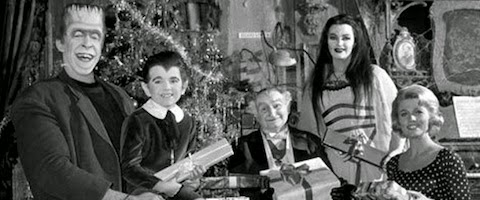
Beat It, Essay: Munster? I Hardly Know 'Er!

Hello everybody! It's that time of year again! The cogs of the Starbucks brand grind merrily along, lubricated by the tears of students preparing to face their midterms. As a film student I rarely get tested so for me, that means a rapid-fire barrage of projects and essays, which are arguably more challenging. I, for one, had fun, and would like to present you with my most recent essay on one of television's most unforgettable families - The Munsters!

The Prompt
Analyze one television show from the early or classical network periods of television in order to illustrate how the show reflects the social, cultural, industrial, and historical moment of its production.
 The Monstrous Other – The Munsters and Suburban Racism in the 1960’s


Since the very beginnings of broadcasting, the sitcom has been ever-present. Because of the familial nature of the genre, sitcoms have always been an avenue for female stars, of which there was a massive flux in the years leading up to the development to television as we know it. These women would play the matriarchs of “typical” suburban middle class white families, nurturing and kind, sometimes ambitious but always merrily sustaining her place - in the home, raising her kids and supporting her husband while he brings home the bacon. According to author Lynn Spigel, this depiction of home life in 1950’s sitcoms represented a “consensus ideology, promising practical benefits like security and stability to people who had witnessed the shocks and social dislocations of the previous two decades (Make Room for TV 2).”

However, due to the country’s economic turmoil (requiring women to take jobs outside the home) and large immigrant population (many American families were non-white and working class, especially in the cities), the media’s reflection of the “average” American family was largely fanciful. Although the standards and practices of television in the 1960’s were still largely conservative, by the middle of the decade, the television climate began to change. First came the hillbilly hurricane, a glut of shows depicting clashes between urban and rural families), which was soon followed by the advent of  “fantastic sitcoms,” which used “magical, alien, prehistoric, or ghoulish spin[s] on the American family” to combat and lightly satirize this idealistic perspective (Hilmes 222).

Perhaps the most incisive of these early satires (including Bewitched, I Dream of Jeannie, and The Addams Family) is The Munsters, in which the titular family is comprised of variations on classic Universal monsters. Taking great influence from gothic horror, Herman the patriarch is a Frankensteinian creation, and his wife Lily, son Eddie, and father-in-law are vampires. Only Marilyn, their blonde and beautiful adopted niece, looks anything like the typical member of a sitcom family.


The break from reality that provides the central concept of The Munsters allows the show to poke fun at many cultural and suburban conventions indirectly without igniting fervor in the censors (Spigel, “Fantastic Family” 205-235), the most prominent of these undertones being the unsavory race relations of modern suburbia. Many of the issues the Munsters face in their day-to-day lives stem from the refusal of their neighbors (and society at large) to accept the differences in their customs, attitudes, and especially appearances, a struggle many non-white families faced during the tail end of the Civil Rights movement.

In fact, in an early episode – “My Fair Munster” – a neighbor remarks that “this was such a nice neighborhood until they moved in,” quite obviously drawing a parallel between the Munsters and racial minorities. The Munsters stand in for the unknown Other, merely trying to live their lives while constantly being on the receiving end of societal attacks. These offensives can be subtle, like Marilyn’s boyfriend’s elegant parents rejecting her when they meet her “weirdo” family in “Munster Masquerade.” In spite of her all-American demeanor, these bourgeois sophisticates can’t look past the surface level shocks provided by her monstrous-looking, yet well-meaning and polite family.

And it doesn’t end there. Some of the challenges the Munsters face can be quite harsh, including Herman almost being attacked and arrested for “terrorizing” a park during his nightly strolls in “A Walk on the Mild Side” and narrowly avoiding being murdered by fraudulent film producers hoping to collect his insurance policy in “Movie Star Munster.” Though the plots are fanciful and unrealistic, the Munsters and minority families are united by the universal scorn they unwittingly receive, as well as the instant fear and suspicion incited in society merely by the color of their skin. Whether it be brown or black or green, American suburbia yearns to scrub out any color that isn’t pure, glittering, “traditional” white.


An additional satirical dimension directly related to this societal attitude is that of class. Typically, suburban and especially urban minorities were viewed by the middle and upper class white families as a sort of lower caste - the working class, uncultured poor. Many immigrant families were penniless thanks to an unforgiving system, but even those minorities that could afford to move into the suburbs and live the “ideal” life were automatically downgraded in esteem thanks to the color of their skin.

The Munsters responds to this societal discord with fervor, depicting nearly every single authority figure in the town as either a bumbling buffoon or a conservative bigot. From the inept and crude gas company man in “Pike’s Pique” to the clownish doctors in “Rock a Bye Munster” and “Low-Cal Munster,” those who typically perform “superior” duties are viciously skewered by the show’s piercing satire. 


On the other hand, the other minorities which society at large also looked down upon tended to sympathize with the plight of the Munsters. Whether it be a group of hippies inviting the Munsters to sing along with them in “Far Out Munster,” a gypsy man overlooking Lily’s appearance to hire her for a job reading palms in “Herman’s Rival,” or teenagers welcoming Herman’s strange look and offbeat musical style, putting him on the top of the charts in “Will Success Spoil Herman Munster?,” the family always finds friends in societally “low” places. 

Because The Munsters utilizes the Other family as its focal point and puts society on the outside, it exposes the animosity and stupidity of white culture at the time, painting them as the “bad guys” in a way that a more straightforward race relations television show could not possibly have portrayed with impunity (Hunzer 4).

In fact, this normalization of the Other is perhaps the single most important cultural impact of The Munsters and its fantastic sitcom counterparts. Although the Munsters may look strange, have bizarre customs (Lucy and Ricky weren’t exactly sleeping in coffins), and eat strange foods (lizard casserole and vulture egg omelets are some of Lily’s beloved recipes), they’re no different from any sitcom family.

They have a kind and loving mother, a bumbling father who worries about paying the bills, two kids, and a dog. In fact, in the episode “Family Portrait,” computer demographic analysis places them on a magazine cover as the “American Average Family of the Year.” They never seek to cause trouble, merely to live out their idyllic lives in peace and happiness. The trouble they do face is always brought to them from outside, from those who can’t see past their fear of the surface level repellence of the Other to understand the warmth and kindness inside the Munsters.


Audiences immediately understand how wonderful the Munsters truly are because the stories are told from their perspective. The subtleties of the discussion of race mechanics and bigotry in modern America that pulses beneath the show are recognized almost subliminally through the vantage point of this hilarious bunch. Again, this satirical intent could never have been accomplished through directly portraying a minority family. Thanks to the inherent racism of suburban, middle-class viewing audiences, ratings would have plummeted, rendering the show an abject failure.

But by allowing the viewers an access point through the wildly popular and well-understood medium of classic monsters, The Munsters brought its social commentary to the mainstream, becoming a massive success. In fact, the show was the 18th highest rated television program in the 1964-1965 season, alongside such similarly satirical programming as The Beverly Hillbillies, Bewitched, The Andy Griffith Show, and Petticoat Junction

Together with these types of programs, The Munsters began to pave the way for a new style of media and a new way of telling stories. Television as we know it couldn’t have been possible without the contributions of this show and many others during the massive tide change of the 1960’s as minority classes struggled to break into a culture primed to ignore and even despise them. Although American media and culture still has a long way to go to be truly accepting and diverse, without the brave and subtle efforts of the showrunners during the transitory period of the 1960’s, we as a nation may very well have been set back several years, maybe even decades.

The prominence of the television sitcom allowed positive messages to be spread to the American populace through subtle, almost counter-intuitive channels, utilizing a format that promoted conservative values and middle class consumerism to further the efforts of hundreds of varied communities struggling to earn a name for themselves. The Munsters and the fantastic sitcoms of this period are often overlooked in modern academia, but their massive influence speaks volumes by itself. The gentle satire of shows like The Munsters paved the way for much more proactive movements, all through the simplicity of the most traditional unit of all – the American family.

Works Cited
Hilmes, Michele. Only Connect: A Cultural History of Broadcasting in the United States. 4th ed. Belmont, CA: Wadsworth/Thomson Learning, 2007. 222-223. Print.
Hunzer, Kathleen. "Move over Cleavers, the Munsters Are in Town: Redefining the American Family and the Marginalized Other." Constructions of the Human Conference: Space, Time, and Culture. Lehigh University. 1-5. Web. 1 Oct. 2014.
Spigel, Lynn. Make Room for TV: Television and the Family Ideal in Postwar America. Chicago: U of Chicago, 1992. 2. Print.
Spigel, Lynn, Constance Penley, Elisabeth Lyon, and Janet Bergstrom. "From Domestic Space to Outer Space: The 1960s Fantastic Family Sit-com." Close Encounters: Film, Feminism, and Science Fiction. Minneapolis: U of Minnesota, 1991. 205-235. Print.
Word Count: 1697

Saturday, September 13, 2014

Simpsons And Daughters

Today is a very special day in the lives of Sergio and I. Tonight we are attending the Fireworks Finale at the Hollywood Bowl celebrating the 25th Anniversary of The Simpsons, a show which he has held a lifelong adoration for and that I have been working exclusively with for the past few months.

When watching The Simpsons is your job (I'm super cool, I know), it's easy to view the task as a daunting and tedious affair, especially after a commute about the size of four episodes. But the show is an enduring zeitgeist hit for a reason and it's hard for me and my coworkers not to be giggling at our desks. For that reason, and in honor of the show tonight, I'd like to dedicate today's post to the show that has defined the last quarter of the century.

And now that I'm far more knowledgable about the inner workings of The Simpsons than I ever dreamed or hoped I would be, I'd like to put that knowledge to the test with

Ten Underappreciated Simpsons Characters

Sure, everybody knows Milhouse and Krusty the Clown. You don't even need to watch the show to know those characters - they've become part of the lexicon. But the Simpsonverse is brimming with exciting characters that have appeared many times throughout the show's 25 year run, but don't get quite as much credit for it as characters like Ned Flanders, Nelson Muntz, or Apu Nahasapeemapetilon. Let's take a moment to celebrate these stoic individuals.

#10 Drederick Tatum


Voiced By: Hank Azaria
Appearances: 23
Quote: "Hello, yeah, how you doin', I'd like to order two gazelles, an impala, and throw in a couple wildebeests. Oh, and a two-liter bottle of diet cherry cola. You just have one-liter bottles? Okay, cancel the whole order."

Drederick Tatum is Springfield's answer to Mike Tyson, a professional boxer and hardened criminal to boot. But Drederick has so much intimidating power, he never feels the need to use it, instead preferring to live his elegant lifestyle and/or eat Jello in peace while others bend over backwards to stay out of his way. His delicate whisper of a voice and his erudite manner of speech, combined with his brutal skill in the ring make Drederick a fascinating character. So much so that he appears on this list despite appearing in far fewer episodes than anybody else.

#9 Sherri and Terri Mackleberry


Voiced By: Russi Taylor
Appearances: 42
Quote: "Remember. The one you pick may not be the one you get."

Sherri and Terri are generally just used as background characters to populate the school scenes, but they have much more personality than their peers, like Richard or Database or Lewis. Are you saying "Who?" Exactly. A lot of my favorite humor comes from the duality of these two characters as they either interact as one being or exhibit creepy twin characteristics. I suppose its easy to see why considering my pedigree as a horror fan, but I'm always drawn to the sinister, dark, and creepy side of Simpsons humor. Of which, luckily, there's an abundance.

#8 Troy McClure


Voiced By: Phil Hartman
Appearances: 32
Quote: "Hello, Selma Bouvier? It's Troy McClure. You may remember me from such dates as last night's dinner..."

Troy McClure is a parody of the industry, an eternally washed-up actor who appears in instructional videos largely to remind people that he, as a matter of fact, did have a thriving career once and hey, wouldn't they like to buy a DVD or two? Of all of Phil Hartman's desperate, money-grubbing roles (including derelict lawyer Lionel Hutz), Troy McClure is the funniest, hiding his flop sweat beneath a deep voice and a handsome face.

#7 Squeaky-Voiced Teen


Voiced By: Dan Castellaneta
Appearances: 58
Quote: "I gotta go sort tortillas. Corn, flour, corn, corn, no gluten, corn, two stuck together?! Oh, now I gotta fill out a form."

The Squeaky-Voiced Teen has never been given a name, but he is a fixture in the Springfield community, having worked just about every crappy customer service job imaginable. You may wish that you, like the Simpsons, never aged beyond your current state, but one of the hazards of eternal youth is that you have 25 years of summer jobs to get through. Squeaky-Voiced Teen is a weak spirit, constantly pushed around in jobs that he has no passion for, and only The Simpsons can render that kind of dynamic completely hilarious. But believe me it is.

#6 Selma Bouvier


Voiced By: Julie Kavner
Appearances: 111
Quote: "Always a bridesmaid, only occasionally a bride."

Although Patty is her identical twin, Selma is by far my favorite of Marge's sisters. Fearless and grumpy, Selma charges her way through any given situation with chutzpah and bitter sarcasm. Although she could do to treat Homer a little nicer, her one-liners can't be beat. And her tough as nails attitude is what won over her sixth and final husband, the illustrious mafioso Fat Tony. Although it didn't work out (does it ever?), Selma Bouvier-Terwilliger-Hutz-McClure-Discothèque-Simpson-D'Amico continues to face the world as she always does - with gruff disgust.

#5 Snake Jailbird


Voiced By: Hank Azaria
Appearances: 63
Quote: "I am so going to enjoy pooping on their carpet."

Snake is just about the only criminal in town, so why is he so likable? With his valley girl accent, his unique, almost coworker-like relationship with captor Chief Wiggum and victim Apu, and his general agreeableness make him unique in the felon community. Also his hair is superb.

#4 Jasper Beardly


Voiced By: Harry Shearer
Appearances: 41
Quote: "All I brought is a dime. I didn't know there'd be pornography."

Jasper is Grampa's gruff best friend, and a constant acerbic presence in the community. His humor derives from his deadpan deliveries and unimpressed personality. But when he tries, Jasper can be really sweet, like when he brings Grampa along on a trip to Capital City so he won't be lonely. The Springfield Retirement Castle wouldn't be the same without him.

#3 Sideshow Mel


Voiced By: Dan Castellaneta
Appearances: 116
Quote: "Applause is an addiction. Like heroin. Or checking your email."

Everybody's favorite non sequitur character would probably be Ralph, the weird little son of Chief Wiggum, but I myself am rather partial to Krusty's sidekick Sideshow Mel. A wacky quasi-caveman who speaks like a Shakespearean actor, Mel is typically the first member of any crowd to react to the antics of the Simpsons, always in an erudite manner, but with a layer of absurdity as large as his hair.

#2 Martin Prince


Voiced By: Russi Taylor
Appearances: 141
Quote: "I'm not gay! I'm nothing yet!"

Martin's a huge nerd, an endlessly amiable classmate, and a coded homosexual in the vein of Arrestd Development's Tobias Fünke. His boundless enthusiasm for life and knowledge is infectious and he is prone to outbursts of intellectual fervor that get him on the bad side of the local bullies more often then not. But this little charmer is never going to stop and that's why I love him. He's impenetrably warmhearted and though he may only have one line in any given episode, it's always sure to be a corker.

#1 Hans Moleman


Voiced By: Dan Castellaneta
Appearances: 77
Quote: "My name is Hans. Drinking has ruined my life. I'm 31 years old."

Hans Moleman is the one character that consistently keeps me rolling in the aisles. A withered old man with a weak temperament, Moleman always finds himself in sticky situations, whether it be a car crash, a bad date, or not being extroverted enough to mention that he is still alive at his own funeral. He accepts the weight of the world with a sigh as life constantly provides him with new challenges. His begrudging acceptance of the state of things as terrible as they are is a constant crackup. Characters that have terrible things happen to them are a staple of the genre (Oh no, Mr. Bill!), but hands down Moleman is one of the classics of the form, and an alarmingly underappreciated one at that.


So what do y'all think? Are you happy I mentioned a favorite? Sad I skipped someone? Please let me know in the comments!  And have a nice day! I know I will.
Word Count: 1379

Saturday, August 23, 2014

On The Move

Hello everyone. I'm sure you're wondering why I've gathered you all here today.

Well, you may have noticed (but hopefully not) that my posting this month has been a little sporadic. That would be because I have been frantically searching for an apartment and spending all my free time bleeding onto applications instead of watching movies or (ha!) writing about them. But now things are settling down and I'm moving into the new place and there's only one thing on my mind.

Television has lied to me.

You see, TV shows love to tell stories about people struggling to make a living. It's relatable and the audiences eat it up. The only problem is, especially for a network sitcom, there needs to actually be enough space in the fake apartments to fit a four-camera crew. Anyone who has attempted to make a living in the city could tell you that your average apartment could hardly fit a camera battery let alone anything else.

So it's understandable why the sets would need to be bigger than actual real life apartments that people could afford. More room for crew, more room for antics. But this leads to a series of woefully unrealistic expectations once you set out in the real world, in which people with no discernible income live in ornate pleasure palaces. And thus begins our list for the day:

Five Unrealistic Apartment Expectations From TV

#5 Holliston


Location: Holliston, MA

Holliston is a show that I recently got into, and I definitely recommend it for horror fans. It's basically a crappy sitcom, just pumped full of horror trivia, guest stars, and strange elements - like Twisted Sister's Dee Snider as the boss of Joe Lynch and Adam Green (two indie horror directors who play younger versions of themselves).

In traditional sitcom fashion, Adam and Joe can't pay their bills and frequently throw away rent envelopes without opening them to pretend that they never got them. Yet they are somehow still allowed to live in an apartment large enough to fit Gwar's Oderus Urungus in the closet.

I told you it was a weird show.

Not only that, but they also have 1) a bathroom large enough to fit a standing bathtub and 2) a standing bathtub.

Maybe things are just different in Massachusetts. 

#4 New Girl


Location: Los Angeles, CA

OK, canonically I guess I can't get mad because the rent for this apartment is largely paid by Schmidt, who is a high-powered... bank person, or whatever. I'm not sure that's ever made clear - in true sitcom fashion. But his job involves wearing suits and talking about files so you know he makes a ton of money.

But I still find it patently ridiculous that this is the abode of Jess - a frequently unemployed schoolteacher - and Nick Miller, who - and I quote - "has the credit score of a homeless ghost." These two humans do not deserve the elegant bathroom they receive. I hope they appreciate the glory that is their apartment.

It even has urinals! It's like paradise.

And I find it hard to believe that an apartment containing four single(ish) twenty-somethings in Los Angeles has enough room for Zooey Deschanel to do her quirky schtick to her full range of motion.

My apartment only has space for about 1 1/2 loopy twirls.

#3 Friends


Location: New York City, NY

Here's another completely ridiculous apartment, but at least it has somewhat of an explanation. The apartment was owned by Monica's grandmother for many years and thanks to rent control - and a little fudging on the lease - she and Rachel (then Phoebe, then Chandler, then Joey, etc.) can live there with ease.

Rent control or not, the idea that six entire people can relax comfortably inside a New York City apartment is sillier than ketchup on Oreos.

And I could decorate the Taj Mahal with Monica's interior design budget. But hey, one million dollars per episode ain't too shabby.

Neither is this to-die-for attached balcony.

#2 Don't Trust the B---- in Apartment 23


Location: New York City, NY

Here's where things really start to get tough. No rent control here, just an unemployed con artist / professional drunk and a bright-eyed, bushy-tailed, underemployed waitress. In a lavishly furnished two bedroom.

And another standing bathtub! I swear, I'm gonna blow a gasket.

I'm pretty sure slipping bills out of your one night stands' wallets isn't enough to sustain a property that size. At least she's friends with James Van Der Beek. He can slip them a check when things get too rocky. Which, because this is a sitcom, is always.

The apartment needed to be large to fit all his handsomeness.

#1 Glee


Location: Bushwick, NY

Ah, the Bushwick loft. The crown jewel of this post. When Kurt and Rachel move to New York, they take up residence in this massive industrial space large enough to ride bikes in.

Her being a waitress and him being a... clothes wearer?

We all know by now (five seasons in) that Glee isn't exactly a go-to reference guide for realism in television, but this living space makes me want to cry bulging green tears of envy. This fantasy New York provides two broke college students with a space large enough to hold Rachel's temper tantrums...

Just one night of her righteous anger could power a third world country for three weeks.

And regularly host full-scale dance numbers.

It makes me want to puke.

If that's how New York real estate actually is, I'm buying my ticket yesterday.

Bonus Unrealistic Dorm Expectation: Buffy the Vampire Slayer


Location: Sunnydale, CA

I know it's a UC and they have more money than my cash-strapped CSU, but let's face it. No dorms are good dorms. I have it on good word that the dorms at UCI might as well be oiled because they're packed in like sardines.

But then there's this.

People might tell you the Initiative is the reason people don't like Season 4, but I don't buy it. It's one-hundred percent displaced college angst and jealousy.

There's enough room not to be forced to shove a furniture piece under the cork board. This is no earthly institution.
Word Count: 1029

Saturday, May 10, 2014

Words With Friends

Now that we've discussed the best of the best of Phoebe's songs, why don't we move on over to the professional musicians? Musicians and bands were clambering to get their songs onto the sitcom superhit so the Friends soundtrack was constantly full of high caliber rock stars. Here are ten of my personal favorites.

Some of them were played in the background during parties and some were featured more prominently in the plot, but all of them hold a special place in my heart. Even some of the ones that are sickeningly 90's.

The Top 10 Songs in Friends


#10 "Every Word Means No" Smash Mouth


Episode: "The One Where Ross Moves In" (S5:E7)

Remember when I was talking about songs that are sickeningly 90's? Well, you should because it was about twelve seconds ago. (If you just skipped past the beginning to get straight to the list, I can respect that. I do that with Cracked articles all the time.) Well, this is the one! This song played at a party, just like many songs featured on the official Friends soundtrack, but it's the only one that ever caught my attention through its sheer cheeseball awesomeness.

#9 "Let Me Blow Ya Mind" Eve


Episode: "The One with the Stripper" (S8:E8)

During one hypothetical conversation with my friends, we all decided on official stripper songs. I of course chose this one because of my long term relationship with this show. I didn't even have to think about it. The beat is just so slinky and smooth, it's hard not to enjoy it. Even with Monica's narration.

#8 "Tainted Love" Soft Cell


Episode: "The One Where the Stripper Cries" (S10:E11)

I obviously love this episode for Danny DeVito's performance as the only stripper who was available on short notice for Phoebe's bachelor party, but it also features one of the best one hit wonders of the 80's, a genre I'm preternaturally fond of. It's also the perfect underscore for the patently ridiculous performance with its bouncy New Wave synth beats.

#7 "Sky Blue and Black" Jackson Browne


Episode: "The Pilot" (S1:E1)

It's time to get serious over here. This song is just plain beautiful. And it didn't take more than a single episode for Friends to announce its incredible musical taste. Much like Scrubs after it, the music of the show served to define the decade almost as much as the show itself would.

#6 "Trouble With Boys" Loreta


Episode: "The One with the Routine" (S6:E10)

It helps that Monica and Ross's dance routine is just the best musical sitcom moment ever, but the song underscoring it is half the battle. It's next to impossible to find this song anymore but it's certainly one of the few buried gems of the 90's worth unearthing.

#5 "Believe" Cher


Episode: "The One with Chandler's Dad" (S7:E22)

I will always love this song no matter what anybody says. I just find it fascinating that the musical artist to introduce Autotune to popular music wasn't T-Pain or Lil Wayne or any of those hippity hoppity guys, but rather Cher, the reigning empress of pop for so many decades. The fact that this song was the introduction to Chandler's father's drag show was just the cherry on top.

#4 "Delta Dawn" Tanya Tucker


Episode: "The One Where Monica Sings" (S9:E13)

There are always a few musical moments in a TV show that will just stick to me instantaneously and never leave my brain until I've purchased the song on iTunes. "Delta Dawn" is one of them. Although the scene itself is funny and Monica's voice isn't even close to the best, this yearning country ballad struck my heart like a bolt out of a clear bright dawn.

#3 "Here, There, and Everywhere" The Beatles


Episode: "The One with Phoebe's Wedding" (S10:E12)

Season Ten was a surprisingly solid run of episodes for a series ender. Although finales will always break out the big guns, usually the season preceding them will be thin and stale, having run out of ideas long ago. Not so with Friends. Phoebe's wedding is one of the most tender moment in the entire show and the steel drum arrangement of a Beatles classic that accompanies Phoebe as she walks down the aisle is a big part of that.

#2 "I'll Be There For You" The Rembrandts


Episode: ALL OF THEM

Do I even need to say anything about this song? This song ignited a new generation of comedy and blasted The Rembrandts into the stratosphere, making them the one hittiest one hit wonder in the country. But for one decade their song could be heard weekly in living rooms across America, people clapping along at all the right times.

#1 "Angel of the Morning" Chrissie Hynde


Episode: "The One with the Baby on the Bus" (S2:E6)

This is the song that got me into music. I first started experience music as a personal phenomenon during the same summer that I tore through every episode of Friends and the first three songs on my iPod were "A Thousand Miles" by Vanessa Carlton, "Closer to Fine" by the Indigo Girls, and "Angel of the Morning," a beautiful and pained ballad that struck me to my very core. The first and only live performance on Friends, I'm glad they never followed it up because nothing could have compared to Chrissie's magic performance.
Word Count: 905