Showing posts with label Emma. Show all posts

Sunday, July 5, 2020

Reviewing Jane: Without Music, Life Would Be A Blank To Me

In which we review (almost) every film adapted from or inspired by the works of Jane Austen.

Year: 2010
Director: Rajshree Ojha
Cast: Sonam Kapoor, Abhay Deol, Amrita Puri
Run Time: 2 hours 6 minutes

Bollywood and Jane Austen are a match made in heaven. A modern culture with strict class divides that retains some focus on arranging marriages, and a romantic comedy art form that expresses this culture which spends a large amount of time focusing on dance? Yeah, it's no surprise Hindi cinema and Austen's novels found each other. Our first experience with this intersection was the sublime Bride & Prejudice (which, to be fair, was an English film with an Indian director and cast that is more inspired by Bollywood than strictly belonging to it, but an excellent example nonetheless).

Today we alight upon Aisha, an adaptation of Emma. I approached it cautiously, because it is a fool's errand to assume any movie will be as good as Bride & Prejudice, let alone merely because they share the same country of origin.

Smart move, Brennan.

Aisha tells the story of - you guessed it - Aisha (Sonam Kapoor), a layabout rich daddy's girl from Delhi who struts the shops with her best friend Pinky (Ira Dubey). When charity case Shefali (Amrita Puri) arrives in Delhi from her home in a neighboring village, Aisha decides to make her over and fix her up with confectionary heir Randhir (Cyrus Sahukar). Of course this goes horribly awry, and Aisha finds herself scolded as ever by family friend Arjun (Abhay Deol), with whom she has a very antagonistic relationship that may or may not blossom into love, no spoilers.

JK, it totally does.

Anyway, first, Aisha must find herself entangled even further in the love lives of her friends, becoming especially complicated when the handsome Dhruv (Arunoday Singh) comes to town.

Additionally, for the Austen scholars out there, while Dhruv is pretty clearly our analogue for Frank Churchill, once more the character of Jane Fairfax seems to have been removed, this time replaced with the general idea of the city of Mumbai. Poor Jane Fairfax.

Emma is a particularly challenging novel to bring to the screen, so it's a very pleasant surprise that we've already gotten two masterpieces from it (1995's Clueless and Autumn de Wilde's Emma. from earlier this year, though it feels a lifetime ago). So I'm not exactly disappointed that Aisha is terminally mediocre. It's better than being actively painful to watch, cough cough Gwyneth Paltrow. 

In fact, it's almost annoying that nothing in the movie is particularly bad. If it had been, it might at least have made more of an impression on me. OK, the score is pretty bad, with its overreliance on saccharine Looney Tunes marimbas to really nail in that this. is. a. COMEDY. But beyond that, it's just plain plain. It doesn't help that I could recite the plot of Emma in my sleep at this point, but maybe that's not even an unfair bias because this movie nakedly cribs from Clueless more than the actual source text (see: the scene where they're on the couch fighting over the remote, the scene where she is left stranded in an unsafe neighborhood and needs to be picked up, the fact that she has a best friend/sidekick in the first place, etc. etc. etc.). The one place where it strays from the template of either work is the scene that gives Shefali a bit more grit in standing up for herself than any Harriet analogue has ever been given.

But whatever text it's using, it relies on it too much to make the romance click. Aisha gives a heartfelt speech in the end detailing all the ways Arjun has helped her in her life, bringing up a heap of examples that haven't been depicted or even hinted at in the film. We know they're meant to be together because of the source material, rather than the pair of them actually having any chemistry.

I have nothing against the performances in particular, it's just that Aisha is particularly obsessed with keeping its leads separate from one another, even for an Austen tale.

But here's the thing. A theory I have developed over the course of reviewing over two dozen Austen adaptations is that the obligatory big dance scene is the key to whether or not a film has any drive to craft a valuable cinematic experience rather than just blow Austen's story up onscreen and go through the motions with little thought to making a film object that's interesting in any way. Seeing as how dance is key to the language of Bollywood filmmaking, I thought this would be a home run. And it is, briefly. Oh so briefly. 

Aisha and her friends visit a club that turns into a sexy, chaotic, colorful Hindi tango where partner-switching mayhem leaves Aisha alone in a twirling maelstrom of bodies. Through motion and music, the dynamics between the characters are brought to light, in the manner of the best Austen adaptations. Unfortunately, every other musical moment leaves a lot to be desired, so it recklessly dilutes the power of this moment. 

The other music is presented lackadaisically, plastered over endless music video montages that do nothing to further the story (one of them is a particularly craven three minute L'OrĂ©al ad), and the ever-important finale number that graces even most music-free Bollywood flicks is, to be frank, abysmal. It's flatly choreographed, shot and edited in a confusing flurry, and is plastered over with a poorly mixed song that's largely a cappella, leaving the poor actors to flounder, attempting to dance cheerily over a track that literally doesn't even have a beat. 

Let's call this an exception to my theory. Most Austen films only have one opportunity to present us with dance, and live or die on that opportunity. Here we are given a cool half dozen, and one successful scene doesn't lift up the tiresome mass of the rest. Such is the way with the movie as a whole. Altogether most of the ideas here aren't terrible, they just aren't aiming high enough. They might clear the low bar to exist as a mildly enjoyable Austen adaptation, but they graze the bar with their foot and faceplant right into the mat in the process.

TL;DR: Aisha does the bare minimum to exist as either a Jane Austen adaptation or a Bollywood romantic comedy.
Rating: 5/10
Word Count: 1076
Other Films Based on Emma
Clueless (Heckerling, 1995)
Emma (McGrath, 1996)
Emma (Lawrence, 1996)
Aisha (Ojha, 2010)
Emma. (de Wilde, 2020)

Thursday, March 5, 2020

Reviewing Jane: It's Such A Happiness When Good People Get Together

In which we review (almost) every film adapted from or inspired by the works of Jane Austen.

Year: 2020
Director: Autumn de Wilde
Cast: Anya Taylor-Joy, Johnny Flynn, Bill Nighy
Run Time: 2 hours 5 minutes
MPAA Rating: PG

"Do we need another adaptation of Jane Austen's Emma?" cried the dozens of people who even heard this movie was coming out. Even though it's a title that hasn't really been dusted off this decade (even by the Austen-hungry Hallmark crew), I understand the perceived fatigue. The triple punch of adaptations that started with Amy Heckerling's Clueless, followed by Gwyneth Paltrow and Kate Beckinsale's turns at bat, sprinted across screens in a span of just 16 months between 1995 and 1996. That's a whole lot of Emma.

But Autumn de Wilde's Emma. has come along anyway, to prove that the answer to that question is a vigorous yes.

I didn't even need the movie to prove this to me, because the Gwyneth and Kate adaptations SUCKED, so we've never had a straight period adaptation of the story that's remotely worthwhile. But I respect Autumn De Wilde's flex regardless.

If you missed the 90's, here's the gist of the plot. Handsome, rich, and spoiled Emma Woodhouse (Anya Taylor-Joy) lives in luxurious solitude with her hypochondriac father (Bill Nighy). She strokes her ego by matchmaking her friends about town, and when a young rube of unknown birth named Harriet Smith (Mia Goth) she seizes upon the opportunity to make her into a fine young gentlewoman and foist her on any man that's around, blithely unaware that the men would generally rather eat dirt than marry her.

All throughout a variety of romantic misadventures that involve a revolving door of alabaster British character actors I can't be bothered to tell apart (sorry Callum Turner and Josh O'Connor), Emma is admonished by old family friend Mr. Knightley (Johnny Flynn), the only person who ever seems to find fault with her. Naturally they fall in love.

Trust me when I say that her marrying someone who literally held her as a baby is one of the least creepy romantic matches in the Jane Austen universe.

I have a lot of very nice things to say about Emma. but I should probably start with what you can tell from the screenshots I've already used. This movie is gorgeous, darling. Every second of this film looks like a watercolor that could be hung in a museum, with luscious pastels smeared across every flat surface, outfits, and even the sky. It's like an Easter candle melted all over Regency England's tablecloth. It takes the fussy diorama sets of your run-of-the-mill Masterpiece adaptations and pushes them to the extreme, filling every corner of the frame with delicately piled pastries, colorful gewgaws, and the like.

Bear witness.

But all of this doesn't mean that Emma. is stiff and emotionally unavailable; far from it. The rigid grandeur of the sets serves as a vicious juxtaposition to the ridiculous antics of the rich fools contained within them. De Wilde and screenwriter Eleanor Catton have strung up a marvelous high wire act of tone here, delivering a sketch of messy humanity despite its extreme, almost cartoonish stylization. And in the process, they've captured Austen's tone better than any other period adaptation.  Her stories are emotionally resonant, sure, but the characters that populate them are daffy satirical caricatures of the upper classes.

These filmmakers get it, and I'm so thankful somebody finally has. They have stacked layers and layers upon the script here, bringing the novel to life perhaps even more than the novel itself was capable of. The first layer they start with is one I don't think I've ever seen in a period-set Austen adaptation: rich people fucking suck. They enforce a class system that limits the prospects of other people, just because they get to be at the top. They employ and ignore a veritable army of servants (this film, more than any other, depicts the sheer, overwhelming mass of staff required to make these people's lives possible). And they're used to getting everything they want, which is why it's so hard for Emma when the matches she tries to force keep falling through.

Starting in a place that acknowledges the fact that the characters (including the protagonist and her father) are grotesque and despicable allows for the film to mine the material for every ounce of acid-tongued, sour sarcasm it can produce. They aren't here to make Emma likable. That was the whole point of the novel: Austen set out to "take a heroine whom no one but myself will much like," because it's way more interesting to watch a heroine overcome a massive flaw and earn her true love rather than some pure, milquetoast waif suffering until she's rewarded with a handsome prince.

Embracing the black comedy is a hugely important decision in making this Emma work, and it pays off in the form of the funniest straight Austen adaptation by a long shot. The actors are all game, especially Nighy, Taylor-Joy (whose clipped haughtiness is best displayed in a scene you can see in the trailer, where she opens the window of her carriage to a tiresome neighbor with a languorous flick of a finger), and Miranda Hart as the aforementioned tiresome neighbor. Hart could easily have been a one-note cartoon character, and she still would have been terrifically entertaining. But later she gets to deliver a scene of so much heartbreaking pathos that it provides the fuel for the emotional climax of the entire two hour film.

And now I finally have her name reinforced in my memory enough to stop calling her Friend from Spy!

Allowing the film to be funny and the characters to have foibles also does wonders in translating the humanity of these characters to modern day cinemagoers. These are not fossils locked in amber whose motivations and reactions can only be understood from a remove. They are messy, engaging, people who live and breathe and feel, whether they're frolicking around having fun with a pack of schoolgirls or wracked with weeping sobs over a year of terrible decisions. Even if you know nothing about the period, you know exactly what these people are feeling because they're allowed to be real.

This is well served by the film's choices about nudity and violence. Obviously it's very mild; they're not doing a gritty reboot here. But there are two scenes early on that display casual non-eroticized nudity and one scene involving a nosebleed in the climax that make the characters literally vulnerable. They're showing that underneath their endless layers of petticoats and gentility there still lies flesh, blood, and a beating heart.

One thing I especially love about the emotional capacity of this film is what it does with the character of Harriet. She's portrayed rightly as a suffering fool, but this is the first adaptation I've seen that fully allows her to be angry with Emma and the way she has toyed with her life like a bored cat. Even in the novel, Harriet's reaction to the final straw that severs their friendship is muted and elliptically delivered. But here, we get to sit in it and really dig into the chaos that Emma has sown among the people in her life. 

OK before I yammer on even more: Yes, everything in this movie is good and you should go see it as soon as you get the chance. Literally the only thing preventing me from embracing this as the best Austen I've ever seen is my overfamiliarity with the material. So allow me a couple years to sit on this and revisit, and we can reconvene during our Best of the 2020's conversation.

TL;DR: Emma. is a delightfully acerbic and beautiful adaptation that would do Jane Austen proud.
Rating: 9/10
Word Count: 1309
Other Films Based on Emma
Clueless (Heckerling, 1995)
Emma (McGrath, 1996)
Emma (Lawrence, 1996)
Aisha (Ojha, 2010)
Emma. (de Wilde, 2020)

Monday, August 26, 2019

Reviewing Jane: Indeed, I Am Very Sorry To Be Right In This Instance

In which we review every film adapted from or inspired by the works of Jane Austen.

Year: 1996
Director: Diarmuid Lawrence
Cast: Kate Beckinsale, Bernard Hepton, Mark Strong 
Run Time: 1 hour 47 minutes

I really do think Emma is Jane Austen's best heroine. She has the least to lose, so she is the most comfortable in her own skin and makes her decisions based on completely different criteria than your Harriet Smiths or your Catherine Morlands. This allows her to tread further, make more dire mistakes, and achieve more growth as a result. Clueless gets this. But of the two non-modernized adaptations of Emma to arrive just the following year, I certainly wasn't expecting the TV movie to be the one to get it right.

And I was correct. It didn't.

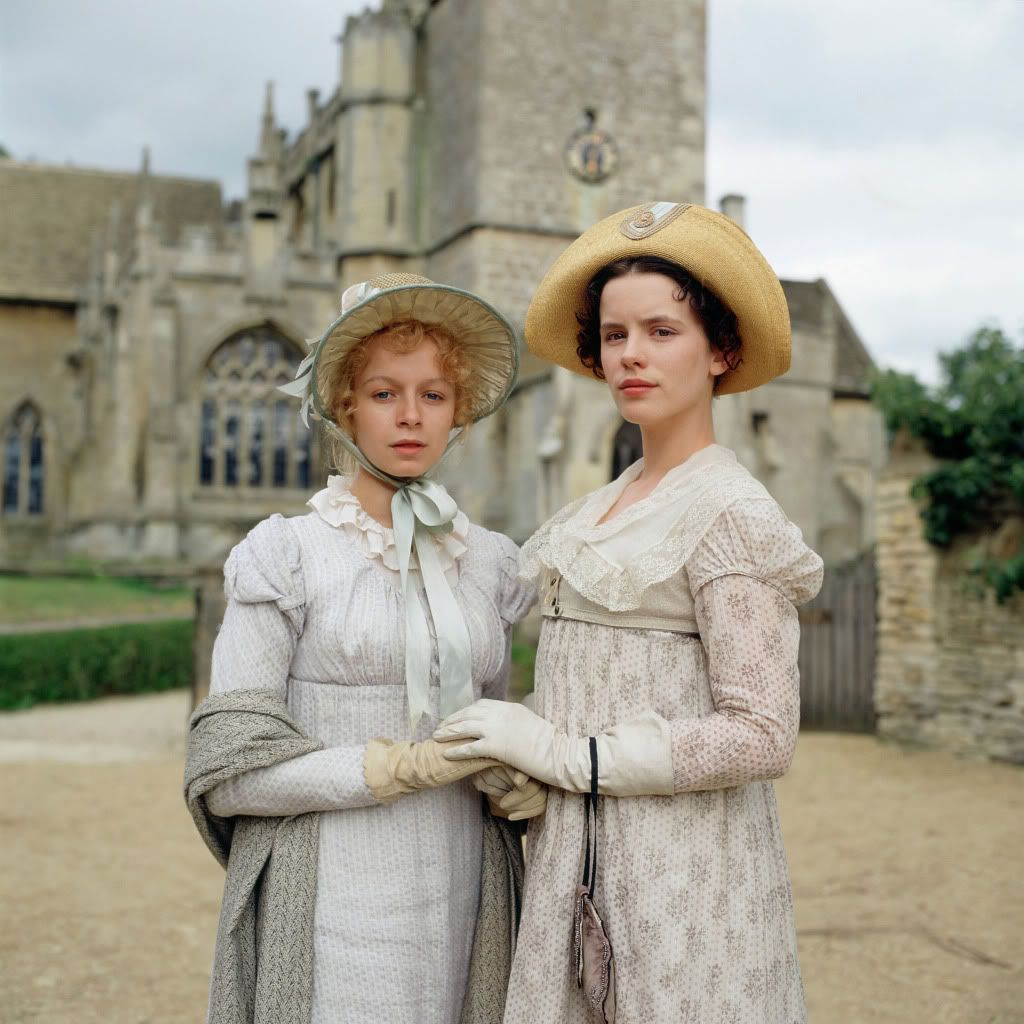
I really don't even see why I bother synopsizing the plots of these, so let's make it quick. After making the mysterious decision to open on a chicken thief raiding the grounds of Hartfield (setting up a bookend sequence at the very end, very poorly), we meet Emma Woodhouse (Kate Beckinsale, the only reason this adaptation has made the slightest impression on the culture at large), a rich young woman who has grown rather bored with her small town life and seeks to manipulate the other young people around her into falling in love, especially her docile simpleton of a friend Harriet Smith (Samantha Morton). She does this despite the admonishments of her brother-in-law Mr. Knightley (Mark Strong, the only other famous Brit to escape this project), who of course she eventually falls in love with.

Also Mark Strong (right) is an attractive man, so kudos to the stylist who managed to make him look so thoroughly unappealing.

I could end this review in a single sentence, because that's how little thought apparently went into the proceedings here. Though I shall soldier on as much as I can, because I owe myself a little venting after suffering through the thing. This Emma is yet another dull as dishwater Austen adaptation for British television, boasting all the creative vivacity and spark of a hot sausage. Literally just listening to the audiobook is a more engaging experience, the visuals are that deeply generic.

Emma suffers from the common mistaken assumption that Jane Austen's works are Serious Literature and thus must have all the air sucked out of them at once. While the humor of the novel isn't quite as present as her other works (or, at least, it's a little more repetitive and tiresome), it's still meant to be a satirical comedy about dating. Instead, as the British are wont to do, they have given us yet another stonefaced slog filled with wall-to-wall Goofuses posing as leading men.

Or maybe it's just that nobody can pull off Regency fashions. Come to think of it, they were probably created to discourage sex as much as possible, which would explain a lot.

Thankfully, the film does have a single creative bone in its body. Though it's certainly not enough, it at least provides relief from the crushing doldrums in brief little flashes. First and foremost are the fantasy sequences in which Emma imagines the happy results from her matchmaking. These are very reminiscent of the daydreams in the 1987 Northanger Abbey, and they break up the narrative quite nicely with a little burst of color and visual verve.

And I always say that the best measure of a Jane Austen adaptation's worth is if it can do something with its obligatory dance sequence that's more than just flatly showing people dance (think the other ballgoers vanishing in Pride & Prejudice to highlight Lizzie and Darcy's intimacy). True to form, Emma misses the mark, but it does at the very least make an attempt. There is an exchange of eyes in between choreographed moves that really allows the viewer to take stock of where each character is emotionally in relation to one another. It's a simple but effective tool, and I commend it for at least doing something, even if it wasn't enough for me to give the film a wholehearted recommendation.

I've suffered through a lot of stodgy, boring Jane Austen material in my time, and Emma is at least not the worst of them. That's about all I can say in its favor though. But until next time, all we can say is thank goodness Amy Heckerling was there in 1995 to save this novel from complete cinematic ignominy. Maybe one day we'll get a straight adaptation that's worth its salt, but today is not that day. Nor was 1996, for that matter.

TL;DR: Emma is plain as porridge, an incredibly listless adaptation of a work I admire rather a lot.
Rating: 5/10
Word Count: 794
Other Films Based on Emma
Clueless (Heckerling, 1995)
Emma (McGrath, 1996)
Emma (Lawrence, 1996)
Aisha (Ojha, 2010)
Emma. (de Wilde, 2020)

Thursday, May 10, 2018

Reviewing Jane: If I Loved You Less, I Might Be Able To Talk About It More

In which we review (almost) every film adapted from or inspired by the works of Jane Austen, as I read through her extended bibliography for the first time. This review is a massive expansion of a frankly terrible mini-review I wrote back in November 2013.


Year: 1995
Director: Amy Heckerling
Cast: Alicia Silverstone, Stacey Dash, Brittany Murphy
Run Time: 1 hour 37 minutes
MPAA Rating: PG-13

Jane Austen's work as a whole is almost perfectly designed to be translated into a high school setting. The rigid class strata, overwhelming obsession with pairing off into romantic couples, and razor-sharp sarcasm of her novels is if anything more suited to the modern teen movie than the period piece. It's such an obvious thing to do that it took a genius to recognize it, and that genius was none other than Amy Heckerling, one of the only commercially successful female filmmakers to come out of the 80's (her debut Fast Times at Ridgemont High was a massively profitable, zeitgeist-defining hit).

When approached to write a high school movie, Heckerling reflected back on the novel Emma, which she remembered enjoying at that age. And thus, by combining a centuries-old plot structure with modern teen fashion and lingo, Clueless was born, jamming yet another massively profitable, zeitgeist-defining hit into that C.V. just for good measure.

It was a movie so iconic, it convinced Stacey Dash she could go ahead and keep on pretending that the world loves her and her every thought.

So, here we go. A decade before Mean Girls, Cher Horowitz (Alicia Silverstone) rules the campus with her matching plaid ensembles and boxy cell phone. Along with her friend Dionne (Stacey Dash), she matchmakes her way into better grades by keeping her depressed debate teacher happy, and she's more than willing to use her talents to mold crude new girl Tai (Brittany Murphy) into the perfect popular princess.

Together they navigate a tangled web of love involving the popular boy Elton (Jeremy Sisto), the loser stoner Travis (Breckin Meyer), the ostentatiously retro Christian (Justin Walker), Dionne's lusty boyfriend Murray (Donald Faison), and Cher's preachy, college-aged stepbrother Josh (Paul Rudd). If Cher hadn't meddled, it would probably be a lot less complicated, but also a lot less fun!

And thanks to her, the rest of the world who HADN'T seen Halloween 6 got to meet Paul Rudd.

The ways that Emma's plot corresponds to the beats of Clueless are frankly remarkable. Sure, it's all slathered with a heaping helping of dated hairstyles, slang, pop tunes, and brown lipstick that only increase the film's hilarity as time goes by, but there are certain scenes that are practically verbatim (especially the scene where Cher is insulted she wasn't invited to a party she didn't particularly want to go to, or where Tai decides to burn her last remembrances of Elton).

This is why it absolutely works as a comedy, because that's the exact element it isolates from Jane Austen's romance of manners and manors. I have constantly been frustrated by the way that the straight Austen adaptations rub out her idiosyncratic sarcasm as if it were a dirty thing to be ignored in the face of literary merit. But Clueless is the exact opposite, removing everything but the humorous character dynamics much to its benefit.

Of course, it does also naturally inherit one of Emma's flaws: Tai (just like her character analogue Harriet Smith) holds a major role, but shrinks into the background come the third act and is given a tossed-off conclusion without really completing an arc of any kind. But that's a small price to pay for one of the purest adaptations of Austen's tone we've ever gotten.

Somehow, I think she would approve.

Clueless is hilarious at all times, but it's perhaps most hilarious if you've ever lived in Los Angeles. Regional humor always gets me, but Amy Heckerling manages to toe a very delicate line between referencing very specific places and feelings, yet still making it universal. The iconic learner's permit freeway scene and the followup line "Getting off the freeway makes you realize how important life is," are freaking hysterical if you grew up terrified of navigating the labyrinthine L.A. freeway system, but yet they also strike at a truth that will resonate with anyone who's lived through high school. The way teenage emotions are so vivid and bold that they can make mountains out of the tiniest, most mundane molehills is effortlessly encapsulated in this funny, relatable, endearingly earnest line.

Heckerling may have been the one to strike gold here, but Alicia Silverstone is an all-important piece of this puzzle. One of the toughest things about reading Emma is watching the main character make so many mistakes. She's a supremely flawed heroine: venal, self-impressed, and wearingly meddlesome. That is what makes her interesting as a protagonist, but you don't always want to spend time with her. Silverstone finds the perfect balance here, knowing full well that Cher is an airheaded twit but humanizing her just enough that you can see her potential to be an actual good person and are always willing to follow her into the depths of her comically terrible decisions.

The rest of the ensemble is generally strong too, of course (only Stacey Dash is a major miss; her one approach to line reading is "shrill and catty"), but Silverstone is obviously the Queen Bee. Clueless just wouldn't work without her, and Clueless works tremendously well. In the terrifyingly vast landscape of 90's teen movies, this is one that truly deserves its status on the A-list, and that's not nostalgia speaking. I was one year old when this movie came out, so the fact that it still strikes a chord speaks to its generous and loving approach to the teen human condition.

TL;DR: Clueless is a delectable teen comedy only made better by its literary source material.
Rating: 8/10
Word Count: 984
Other Films Based on Emma
Clueless (Heckerling, 1995)
Emma (McGrath, 1996)
Emma (Lawrence, 1996)
Aisha (Ojha, 2010)
Emma. (de Wilde, 2020)

Tuesday, May 1, 2018

Reviewing Jane: I Do Suspect That She Is Not Really Necessary To My Happiness

In which we review (almost) every film adapted from or inspired by the works of Jane Austen, as I read through her extended bibliography for the first time.

Year: 1996
Director: Douglas McGrath
Cast: Gwyneth Paltrow, Toni Collette, Alan Cumming
Run Time: 2 hours 1 minute
MPAA Rating: PG

The last novel published during Jane Austen's lifetime was Emma, and it is respected by many critics as her best work. The book presents a flawed heroine making constant mistakes in judgment until she finally improves herself enough to stumble ass-backwards into a relationship she miraculously hasn't managed to ruin. It's a fun, flirty story and it makes perfect sense why high school movie dynamo Amy Heckerling decided to update it into a little movie called Clueless (more on that later) in 1995.

What makes less sense is why the powers that be decided that the world deserved another adaptation of Emma just a year later, but considering that it's the most prominent straight adaptation of the source material, why not start with this one?

Pictured: Toni Collette looking at the call sheet and realizing that she's not gonna get to meet Alicia Silverstone.

So, the plot of Emma. Gosh, this section really does feel futile when we're talking about centuries-old, world renowned literature, dunnit? We'll go fast, don't worry. Emma Woodhouse (Gwyneth Paltrow) is a rich young woman with no designs to marry but plenty of designs to matchmake her friend Harriet Smith (Toni Collette) into relationships with men who are entirely too good for her, including the local revered Mr. Elton (Alan Cumming) and the son-in-law of her former governess Frank Churchill (Ewan McGregor).

All the while, she is endlessly harangued by her moralizing brother-in-law Mr. Knightley (Jeremy Northam), and of course they fall in love because that's just how gender politics worked in the Regency era.

Pictured: Romance!

When you're adapting Jane Austen, there is pretty much one of three ways you can go about it. The first is the Clueless route, translating the novel into a modern story. The second is to highlight the period-based character comedy that Austen always wove into her stories, much like the 1940 adaptation of Pride and Prejudice. The third is to completely ignore that essential aspect of Austen's work, assuming that because it's old it must be "important," and presenting it with po-faced seriousness.

To be fair, Emma does indulge in a little bit of the second, but if we're going to stick this in a category, it's the latter all the way. Here we're treated to two hours of stuffy, bone-dry material posturing as British and genteel even though its director and lead are American. The acting, at least from the non-leads, is very Masterpiece Theater, but not even at the level of Northanger Abbey, which actually was a Masterpiece production, because that movie at least hired actually talented, actually British people.

Although, I must say, Gwyneth Paltrow at least isn't bad here. I'm not here to defend any American's fake British accent, but I drew great delight her two-faced approach to the townspeople she deems beneath her - which is compounded by an internal monologue that didn't appear quite enough for me to remember that this was a thing the movie was doing and thus was tremendously confusing, but still funny.

And as much as nobody here seems aware that Jane Austen is a comedy writer, there are genuinely funny moments that sneak through from time to time. A montage of Emma trying not to think about Mr. Knightley is actually funny and cinematically engaging, the only time both of those elements combine in the film, which generally has very little use for either of them.

It's mostly just lifestyle porn destined for a future Pinterest board.

Unfortunately, for the most part, Emma can't help but be that dreaded word: boring. The film is also inept in a few major ways that prevent it from accomplishing anything more. First, the staging is completely bananas, shoehorning random activities into every dialogue scene, staging moments while people do things like set up for a barn dance, shoot arrows, or pick strawberries. It should feel nice to get some fresh air away from the drawing-room bound drama that Austen usually works with, but the sheer abundance of random hustle and bustle is intensely distracting.

But even more distracting is the fact that this movie just isn't shot very well. The lighting designer seems to have a blind spot, that blind spot being the entire foreground. The second any character steps toward the camera, a shadow falls over them like an alien craft is passing overhead. And the lighting in Emma's mansion is even more whack, sending rectangles of light shooting off in random directions to highlight exactly the objects in the room that aren't key to understanding the scene.

It's bad, people. I don't know who let this happen on such a major Hollywood scale, but they shouldn't be allowed near human eyes. But that's the only thing in the movie that's legitimately, actively terrible. Everything else is just bland and unremarkable. The best that I can say about Emma is that it's true to the source material, but beyond that it has absolutely nothing to offer. It's like listening to an audiobook starring Gwyneth Paltrow, and if you're into that that's totally fine. It's just not really adding anything to the world of Jane Austen, so it's a good one to skip if you're not as inclined to be thorough as I am.

TL;DR: Emma is a perfectly fine literary adaptation, but one just wishes it didn't take itself quite so seriously.
Rating: 5/10
Word Count: 944
Other Films Based on Emma
Clueless (Heckerling, 1995)
Emma (McGrath, 1996)
Emma (Lawrence, 1996)
Aisha (Ojha, 2010)
Emma. (de Wilde, 2020)