Showing posts with label Kate Beckinsale. Show all posts

Monday, August 26, 2019

Reviewing Jane: Indeed, I Am Very Sorry To Be Right In This Instance

In which we review every film adapted from or inspired by the works of Jane Austen.

Year: 1996
Director: Diarmuid Lawrence
Cast: Kate Beckinsale, Bernard Hepton, Mark Strong 
Run Time: 1 hour 47 minutes

I really do think Emma is Jane Austen's best heroine. She has the least to lose, so she is the most comfortable in her own skin and makes her decisions based on completely different criteria than your Harriet Smiths or your Catherine Morlands. This allows her to tread further, make more dire mistakes, and achieve more growth as a result. Clueless gets this. But of the two non-modernized adaptations of Emma to arrive just the following year, I certainly wasn't expecting the TV movie to be the one to get it right.
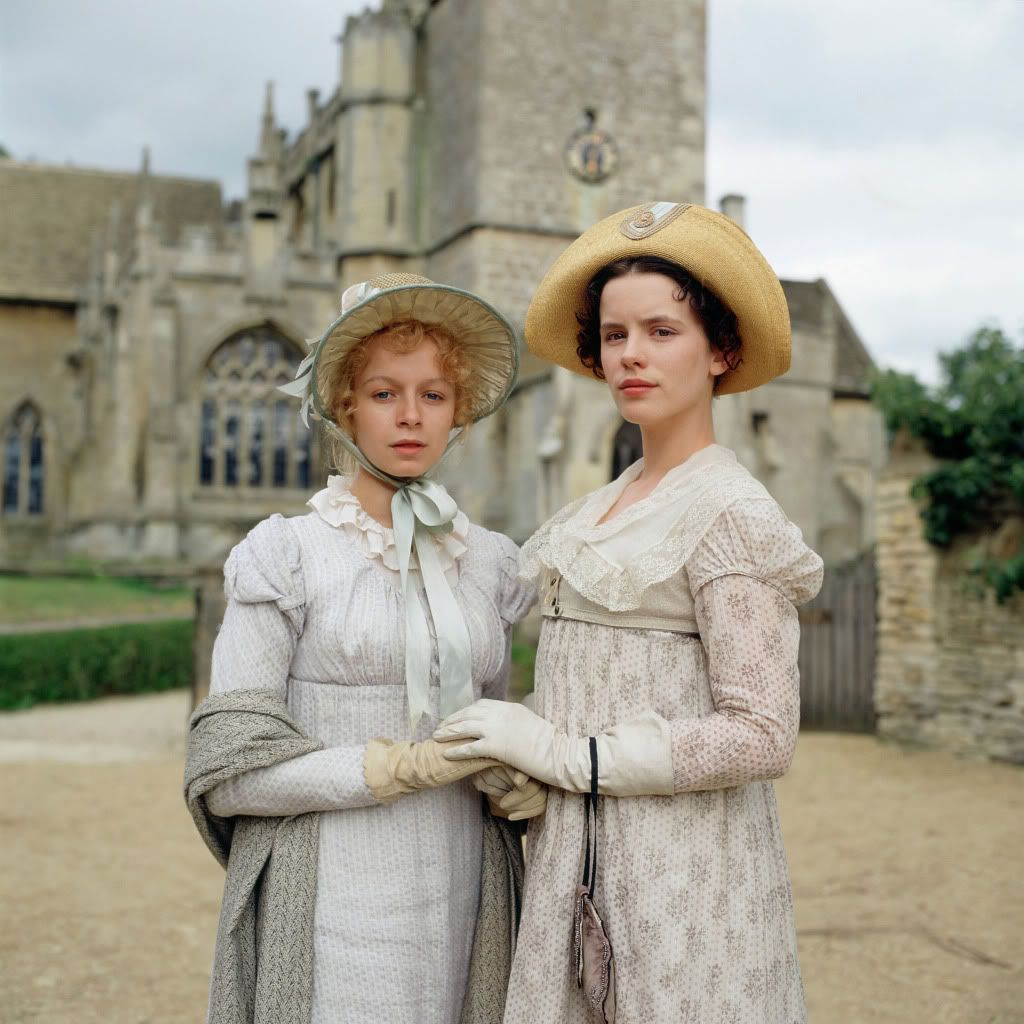
And I was correct. It didn't.

I really don't even see why I bother synopsizing the plots of these, so let's make it quick. After making the mysterious decision to open on a chicken thief raiding the grounds of Hartfield (setting up a bookend sequence at the very end, very poorly), we meet Emma Woodhouse (Kate Beckinsale, the only reason this adaptation has made the slightest impression on the culture at large), a rich young woman who has grown rather bored with her small town life and seeks to manipulate the other young people around her into falling in love, especially her docile simpleton of a friend Harriet Smith (Samantha Morton). She does this despite the admonishments of her brother-in-law Mr. Knightley (Mark Strong, the only other famous Brit to escape this project), who of course she eventually falls in love with.

Also Mark Strong (right) is an attractive man, so kudos to the stylist who managed to make him look so thoroughly unappealing.

I could end this review in a single sentence, because that's how little thought apparently went into the proceedings here. Though I shall soldier on as much as I can, because I owe myself a little venting after suffering through the thing. This Emma is yet another dull as dishwater Austen adaptation for British television, boasting all the creative vivacity and spark of a hot sausage. Literally just listening to the audiobook is a more engaging experience, the visuals are that deeply generic.

Emma suffers from the common mistaken assumption that Jane Austen's works are Serious Literature and thus must have all the air sucked out of them at once. While the humor of the novel isn't quite as present as her other works (or, at least, it's a little more repetitive and tiresome), it's still meant to be a satirical comedy about dating. Instead, as the British are wont to do, they have given us yet another stonefaced slog filled with wall-to-wall Goofuses posing as leading men.

Or maybe it's just that nobody can pull off Regency fashions. Come to think of it, they were probably created to discourage sex as much as possible, which would explain a lot.

Thankfully, the film does have a single creative bone in its body. Though it's certainly not enough, it at least provides relief from the crushing doldrums in brief little flashes. First and foremost are the fantasy sequences in which Emma imagines the happy results from her matchmaking. These are very reminiscent of the daydreams in the 1987 Northanger Abbey, and they break up the narrative quite nicely with a little burst of color and visual verve.

And I always say that the best measure of a Jane Austen adaptation's worth is if it can do something with its obligatory dance sequence that's more than just flatly showing people dance (think the other ballgoers vanishing in Pride & Prejudice to highlight Lizzie and Darcy's intimacy). True to form, Emma misses the mark, but it does at the very least make an attempt. There is an exchange of eyes in between choreographed moves that really allows the viewer to take stock of where each character is emotionally in relation to one another. It's a simple but effective tool, and I commend it for at least doing something, even if it wasn't enough for me to give the film a wholehearted recommendation.

I've suffered through a lot of stodgy, boring Jane Austen material in my time, and Emma is at least not the worst of them. That's about all I can say in its favor though. But until next time, all we can say is thank goodness Amy Heckerling was there in 1995 to save this novel from complete cinematic ignominy. Maybe one day we'll get a straight adaptation that's worth its salt, but today is not that day. Nor was 1996, for that matter.

TL;DR: Emma is plain as porridge, an incredibly listless adaptation of a work I admire rather a lot.
Rating: 5/10
Word Count: 794
Other Films Based on Emma
Clueless (Heckerling, 1995)
Emma (McGrath, 1996)
Emma (Lawrence, 1996)
Aisha (Ojha, 2010)
Emma. (de Wilde, 2020)

Wednesday, April 4, 2018

Reviewing Jane: Facts Are Such Horrid Things!

In which we review (almost) every film adapted from or inspired by the works of Jane Austen, as I read through her extended bibliography for the first time.

Year: 2016
Director: Whit Stillman
Cast: Kate Beckinsale, Chloë Sevigny, Xavier Samuel
Run Time: 1 hour 30 minutes
MPAA Rating: PG

The thing about Jane Austen is that she only wrote six novels. That doesn't provide a lot of material for the endless adaptation machine, even given the way Pride and Prejudice greases the gears. So the only thing shocking about the fact that filmmakers began to dig through her assorted unpublished short works was that it took until 2016 for it to happen.

Love & Friendship, from director Whit Stillman (who directed 1990's Metropolitan, a loose adaptation of Mansfield Park that will arrive on the pages of this here blog sooner than later), was adapted from Austen's 50-page novella "Lady Susan," written by Austen most likely in her early 20's, shortly before she began drafting what would become her first published novel: Sense and Sensibility. One other thing about "Lady Susan": It's f**king awesome.

It's like RuPaul's Drag Race crossed with Breaking Bad and I'm not the slightest bit kidding.

I'm fairly convinced that Jane Austen is the inventor of the female antihero, because Lady Susan (Kate Beckinsale) is one badass broad. A widow of some ill-repute who has just finished seducing the married Lord Manwaring (Lochlann O'Mearáin, who I do believe is Irish) away from his wife (Jennifer Murray) with no intention of returning his affections, she decides to shake the spot and take up residence at Churchill, the country residence of her former sister-in-law Catherine Vernon (Emma Greenwell, who is familiar with Austen work considering she played Caroline Bingley in Pride and Prejudice and Zombies) and her husband Charles (Justin Edwards).

Her plans to seduce Catherine's rich, handsome, and stupid brother Reginald De Courcy (Xavier Samuel) are challenged by the unexpected appearance of her neglected daughter Frederica (Morfydd Clark, who was also in Pride and Prejudice and Zombies as Georgiana Darcy), Frederica's foolish and unwanted suitor Sir James Martin (Tom Bennett), and Mr. Johnson (Stephen Fry), the interfering husband of Susan's best friend and confidante Alicia (Chloë Sevigny). Like all Jane Austen works, the cast list is longer than a slasher movie, but trust me this all makes sense.

All you need to know for now is that Lady Susan orchestrates some Heath Ledger Joker levels of manipulation and subterfuge to get what she wants, any way she can.

That's why her hair is so big. It's full of secrets.

As much as I do enjoy the plot of "Lady Susan," probably the biggest challenge in adapting it is that the novella was epistolary: presenting the plot in the form of a series of letters sent between various characters. Love & Friendship can't entirely shake the constraints of that form of storytelling, and the way it finds ways to unite characters who are separated by distance (especially Mrs. Johnson and Lady Susan, who almost never speak face to face in the source material) are sometimes jarring and distracting, taking time away from the main thrust of the plot. 

However, Love & Friendship also does its best to embrace that epistolary format, and a scene where a husband is reading a letter aloud to his wife, the words appearing on the screen as he speaks them, is one of the most delightful of the film. There's a certain sense of formal daring to a lot of this movie, actually, at least in most of its early moments. For one thing, the characters are all introduced with their own title card, with a pithy descriptor introducing their function to the plot, which is a hell of a lot of fun. This playful meta humor doesn't travel very far past the opening thirty minutes, but it's strong enough that you're still thinking about it when the credits roll.

Beyond that, the filmmaking isn't particularly stunning, save for the way it spins a remarkably small budget into some sumptuous gowns, drawing rooms, and hats that never cease to bring joy.

Honestly, the criminally insane hats are one of the main reasons I'm doing this marathon.

Fortunately for any filmmaker without a lot of money, the crux of any Jane Austen adaptation is the dialogue and the actors, and both of these are perfectly prepared in Love & Friendship. Kate Beckinsale obviously gets the best, most bitingly sardonic lines as she outmaneuvers the dozen pawns in her game of love and lust, but the ensemble she is surrounded with is certainly up to snuff. The clear standout is Tom Bennett, who takes his character as written and tears him right off the page, bringing him to life with a clamoring of clipped Britishisms and awkward mumbles that will have you giggling so hard you can barely breathe.

The cast is a well-oiled machine, talking past one another at a swift rate that sweeps you up in their emotional interplay. The only two dark spots are Chloë Sevigny, who has trouble justifying her American accent and presence in general (the character is just a sounding board for Lady Susan and a vehicle for narrative drama who doesn't have much agency herself) in scenes that were already a bit wobbly, and Jenn Murray who is certainly funny but whose hysterical jilted wife schtick is far too shrill and hyperbolic for the genteel comedy-of-manners tone that the film has built up around it.

Austen is funny but she's QUIET, my dear.

But in spite of its occasional flaws, Love & Friendship is still one of the best, truest Austen adaptations out there. No Austen movie is a faithful resurrection of the author without an enormous dollop of biting, satirical humor, and this movie is a chock-full barrel of literary laffs. And there's one thing I've started to notice in these Austen adaptations. Obviously, dancing and balls appear in some form or another in all of her works, but if a film can lift up the obligatory dance number to something other than people fumbling around in period costume to fulfill a requirement, I count it as a success.

Take the dance sequence in Pride and Prejudice, which beautifully isolates Lizzy and Darcy by removing everyone else in the room during a moment of true connection. That's the high-water mark by which I measure these things, but Love & Friendship comes pretty damn close with a line dance that dizzyingly highlights the confused passing-along of lovers and friends that has happened since Lady Susan came into their lives. It's almost a ballet of Midsummer Night's Dream, cementing in a dozen lovesick character dynamics with just two minutes of physical movement.

So Love & Friendship might not be the best of these out there, but it's certainly top-tier Austen. It's fizzy and engaging, with a highly satisfying portrayal of one of her best characters holding court at the center of everything. What's not to like?

TL;DR: Love & Friendship is a funny, charming bit of Jane Austen apocrypha.
Rating: 7/10
Word Count: 1283