Showing posts with label CSULB. Show all posts

Monday, May 11, 2015

Class Struggles: Bonus Round

Surprise! It turns out that I had other classes along with Russian Cinema! Here's my thoughts on two screenings culled from additional schoolwork.

Gentlemen Prefer Blondes

Year: 1953
Director: Howard Hawks
Cast: Marilyn Monroe, Jane Russell, Charles Coburn
Run Time: 1 hour 31 minutes

Two showgirls, one a romantic and the other a gold digger, take a trip across the ocean.

It was a great treat to be required to watch Gentlemen Prefer Blondes, because I've seen barely enough Marilyn Monroe movies to qualify as a legitimate film blogger or gay man. I loved Some Like It Hot and tolerated The Seven Year Itch, but Gentlemen Prefer Blondes displays the star in full, unadulterated Marilyn mode alongside a less iconic but perhaps even more talented co-lead.

Director Howard Hawks is well-known for his predilection for strong female characters, and in this regard Gentlemen Prefer Blondes is his zenith. Depicting two independent women who value their friendship above their relationships with men wasn't exactly a common theme in 1950's cinema. And despite Monroe's character mostly playing into the expected tropes of a shallow, bubbly gold digger, it is soon revealed that there's more to her than meets the eye.

In addition to treating a stock character as an actual human being, co-star Jane Russell's character is... How can I put this delicately? Unbelievably horny. Her character is a regular Lotharia, making great use of the Olympic team that has joined the duo for the journey across the Atlantic.

As an adaptation of a stage musical, the film's plot and dialogue are fairly set in stone, but the film is so packed with interesting subtext that I'm pretty sure it gave my Film Theory professor an aneurism. It's easily possible to read a dozen different messages about sexuality, gender representation, commodification of women's bodies, and on and on, and that is all thanks to Hawks, who was the master of slipping important themes into otherwise shallow-seeming works, like his sci-fi classic from the same year, The Thing From Another World.

But if I were to go in depth on the cavalcade of theories surrounding Gentlemen Prefer Blondes, this mini-review would be large enough to destroy Tokyo. The bottom line is that, subtext or no, GPB is a slightly daffy but utterly fun 50's musical with a sprightly sense of comedy, inimitable chemistry between its two stars, and two of the best musical numbers committed to celluloid during the decade.


Popular opinion would swerve toward the sumptuous, opulent "Diamonds Are a Girl's Best Friend" number as the film's high-water mark, but Marilyn's sultry crooning meets its match in the razzle dazzle panache of Jane Russell's "Anyone Here For Love?" which melds top notch musical pastiche songwriting with a stunning display of scenery almost entirely created by muscular men's bodies as they work out. Not only is it a treat for the gentlemanly-inclined, it's an inspired and invigorating number that ties in with the film's ruminations on gender and sexuality and propels it out of one of its occasional funks.


For it does have a few. Funks, I mean. As musicals from the time period are wont to do, Gentlemen Prefer Blondes sometimes stops dead in its tracks for some dreadfully dull bit of extended comic business or an archive number that just had to be included. But aside from the occasional dry spot, the film is a gem, worthy of pursuing by any fan of the decade, the bombshell, or musical comedy bonanzas.

Rating: 7/10

The 400 Blows

Year: 1959
Director: François Truffaut
Cast: Jean-Pierre Léaud, Albert Rémy, Claire Maurier
Run Time: 1 hour 39 minutes

Again, I'm going to have to wave my white flag and admit my inferiority as a film major. Out of the supremely influential French New Wave period, I had only seen Jean-Luc Godard's Breathless. I loved Breathless, but up until now I couldn't be sure if I was a fan of French New Wave or if I was just a fan of Breathless. So far the point goes to Godard.

François Truffaut's The 400 Blows is an equally influential New Wave film, but it lacks the kinetic, feverish love for its own creation that I find in Godard's magnum opus. Telling the story of a young boy who turns to petty crime due to a lack of attention from his parents or teachers, it's an interesting treatise on the problems of lower-middle class families, no matter what time period or country you hear from.

But the whole tale is presented in a style a great deal more neorealist than what I would consider New Wave. Despite the artistic merits of the movement's long takes and amateur performances promoting reality and allowing the viewer to actively shift their own focus and analysis, it never really makes for films that are tremendously interesting on a narrative or aesthetic level. The sub-narrative here is pristine, but films of such little incident will be challenging for any but the least casual of audiences.

Lead child actor Jean-Pierre Léaud is a treasure, grounding the film in a delightful earthy performance, but the film's narrative meanderings don't find much to do with him. The 400 Blows is a little too content to merely document reality instead of shaping it, a style which I admit is more suited for a participant other than myself.

I will rightly admit that I hardly have a leg to stand on, considering the fact that I'm listening to John Mayer as I write this, but The 400 Blows is not for me, and if you consider yourself anything but the highest class of viewing audience, it is not for you.

Rating: 6/10

PS: I'm now listening to George Harrison as I post this. Does that change anything? I'm doubtful.
Word Count: 963
Reviews In This Series
Class Struggles: Part One (March 29, 2015)
Class Struggles: Part Two (April 9, 2015)
Class Struggles: Part Three (April 22, 2015)
Class Struggles: Part Four (April 24, 2015)
Class Struggles: Part Five (May 6, 2015)
Class Struggles: Bonus Round (May 11, 2015)

Saturday, May 9, 2015

Beat It, Essay: Few Times I've Been Around That Track

Here's the tricky thing: The essay prompt for my Russian Cinema class was to write a critical paper about a Russian film. Naturally I chose a slasher film. What do I look like, a nerd? 

The subject of my reviewings is 2007's Putevoy obkhodchik aka Trackman. So far so good. The only thing is, this critical piece will be a little more formal and academic than my normal style, so I'm going to attach a truncated review at the end of this essay to cover my normal topics like how cool that gore shot was or how the movie needed more hot dudes.

The Prompt
Write a critique on a Russian film not viewed in class, relating it to Russian films that you've seen as well as your personal film background.

The slasher film is an American tradition, dating all the way back to the 60’s and 70’s with the likes of Alfred Hitchcock’s Psycho and Tobe Hooper’s The Texas Chain Saw Massacre. By the Golden Age of the genre in the 1980’s, audiences couldn’t get enough of the low budget shockers, sending their box office returns through the roof. Naturally, when Russian filmmakers turned from their introspective, usually war-related fare (like Ballad of a Soldier or Prisoner of the Mountains) to attempts at American-style Blockbuster filmmaking (like the superhero action flick Black Lightning), the slasher genre was one of the first to be imitated. Igor Shavlak’s 2007 effort Putevoy Obkhodchik (aka Trackman) is a fairly devoted recreation of the formula, with some distinctly Russian twists.

Unfortunately Trackman is not quite as good as other Russian action/thriller efforts or the classic films of the slasher’s heyday, but it is an interesting piece to study in terms of how Russian filmmaking collides with a traditionally American genre format. The basic structure of the plot comes from the 1981 Canadian slasher My Bloody Valentine, which depicts a pickaxe-wielding killer in a miner’s uniform and gas mask stalking his victims through the underground corridors of a mine shaft. This idea is almost exactly recreated for Trackman, with minor changes. 

Instead of a crop of teenagers being stalked, it’s a group of untrustworthy bank robbers and their hostages hiding out in an underground tunnel system and plotting to steal the money from one another, mirroring the social and criminal decadence of 90’s films like Brother and The Thief. Instead of the killer being an enraged miner who narrowly survived a cave-in caused by negligence, he is a presumably mutated product of government cover-ups following the Chernobyl disaster. This character trait not only ties itself in with Russian history, it taps into the folklore surrounding the incident. 


As evidenced by the opening credits, which depict childlike drawings of the Trackman’s violent tendencies, Trackman is an almost mythical figure that taps deep into the subconscious of modern Russian society. In this way, he is implied to be a figure akin to that of Freddy Krueger, the grotesque villain from A Nightmare on Elm Street, whose legend has permeated the mythology of his suburban town to such a degree that the local children have written a jump rope rhyme about him.

This folklore element is crucial to many successful slasher films, including The Burning (in which a horribly burned groundskeeper named Cropsy – based on a New York state legend - stalks a local summer camp), Black Christmas (which utilizes the urban legend about a killer calling from inside the house to chilling effect), and Night of the Demon (which uses the famous North American cryptid Bigfoot as its mythical killer), so by utilizing the trope and reimagining it under a Russian context, Trackman lays a good foundation for itself. By combining the lingering effects of Chernobyl with the typical genre framework, Shavlak managed to create a classic slasher atmosphere with a distinctly Russian flavor. Unfortunately the green director doesn’t find much else to do with his excellent framework, resigning himself to a subpar thriller effort and turning his mythical killer into a hackneyed plot device instead of a being of true, potent evil.


One of the biggest, most egregious flaws of Trackman is its unsteady pacing. Any scene featuring the Trackman himself crackles with tension, but the film mishandles his infrequent scenes, arbitrarily teleporting him around the underground tunnels in an attempt to shock the audience through his sudden disappearances whenever a character whom he is stalking turns to look at him. Unfortunately this has the effect of deflating any tension the film has managed to muster, because any time Trackman threatens to do something interesting, he is whisked away by the unseemly whims of the narrative. 

This style could have been more effective had the killer’s mythical background been explored more thoroughly, but most of the important details regarding his motivations, personality, and even appearance are left to conjecture. The sharp-eyed slasher veteran can piece together the Trackman’s modus operandi (presumably he is so hideously deformed beneath his mask that he kills anybody who looks at him out of shame and fear), but these ideas are never thoroughly explored. 

Most of the film’s other elements of quality suffer from a similar lack of directorial guidance. For example, Trackman has terrific production values (despite not being a co-production like Burnt by the Sun or Mother and Son), but the slick, professional-looking tunnel sets are overlit and beset by a dully limited color palette that leaches out the film’s capacity to scare. Likewise, the budget runs short at the special effects, which look more like stagebound theatrical creations than truly cinematic ones. They don’t completely draw the spectator away from the film’s reality, but it does make some of the more intense scenes difficult to swallow. Together, these lackluster forces combine to create a tensionless horror film, devoid of any real terror.

Similarly, the occasionally great cinematography (which almost always manages to frame the killer in an eerily menacing manner, especially in one sequence where he is glimpsed through the whirling blades of an industrial fan) is marred by an indecent reliance on slow motion. Slow motion sequences are randomly scattered about the film, rarely if ever enhancing a scare. Rather, they pad the run time by forcing the viewer to contemplate one of the hostages walking or smoking a cigarette with almost absurdly lethargic speed. These moments have no motivation within or without the film, and are utterly tiresome. 

In addition, there are an abundance of sequences where the handheld camerawork becomes hyperbolically shaky, almost as if the director of photography intentionally swung the camera back and forth in some sort of apoplectic rage. The film is slightly redeemed by a finale so strange that it slips into the realm of surrealism, but these flaws in the film’s overall production value are difficult to overlook, to say the least.

However, despite its numerous shortcomings, Trackman may just be a growing pain for Russian genre filmmaking, considering that the country’s film industry has never had a booming horror scene. The keener interest in horror films has only developed over the past couple decades, presumably following as a direct result of the fall of the Soviet Union. Not only was the Russian population experiencing a breathtakingly new regime with more lax production codes, it was also beset with the criminal decadence that marked the post-Soviet period of the 90’s. The general populace was terrified of the long-term effects of this social negligence and sought catharsis in the cinema. 


Criminal horror films like 1994’s Mute Witness (which depicts a snuff film crew murdering their victims onscreen and evading the police while pursuing the sole witness), 1990’s City Zero (in which a factory worker discovers a town gone mad following the fall of the Soviet Union – including a secretary who works naked and a series of lunatics who worship the stranger as a rock ‘n roll legend), and 1998’s Of Freaks and Men (which depicts the downfall of Russian society following the rise of capitalism in the form of one pornographer breaking two families apart) used the rampant sex, violence, and rock ‘n roll of the era to shock viewers out of their complacency and provide them with safe, vicarious thrills.

Now that the decadent period has ended, Russian horror filmmakers are Hollywoodizing the horror genre one step at a time with films like the found footage effort Devil’s Pass and the torture film Captivity (both co-productions with the UK and America, respectively), as well as Trackman. Coming as it does at the beginning of the second wave of Russian horror cinema, it is understandable that the film has such a wealth of flaws – nothing like it has ever been attempted on Russian soil before. 

The biggest triumph of Trackman is in laying a foundation for future efforts in Russian horror. If budding filmmakers pick up where Trackman left off (with a folkloric antihero that taps deep into the Russian subconscious) but polish the edges and deepen the character’s mythology, the slasher genre could one day see something truly great come out of the untapped film terrain of Russia.

Trackman (Путевой обходчик / Putevoy obkhodchik)

Year: 2007
Director: Igor Shavlak
Cast: Svetlana Metkina, Dmitriy Orlov, Aleksandr Vysokovskiy
Run Time: 1 hour 20 minutes

OK, I'm gonna give it to you straight because you veteran Popcorn Culture readers are made of sterner stuff than my film professors: Trackman kinda sucks. It's real bad, you guys. The worst part about it though is that it squanders some great potential. Along with the intellectual claptrap you may or may not have read above, the killer has the audacity to use a gun.

The ground rule of slasher filmmaking is to never give your killer a gun. Sure, they're allowed in the grand finale of a slasher film so we can see some cool exploding heads, but the audience showed up for some baroque gore effects, not a goddamn Martin Scorsese movie. Anyway... 

The killer does have an interesting backstory, but literally all of it is conjecture. The only thing Trackman deigns to do with its title character is have him rip out people's eyes, sneak up behind people with a pickaxe, disappear when they turn around, and skulk around random tunnels until he's needed again for a cheap scare. There are Teleporting Killer moments so egregious that I genuinely thought he had mutant powers due to the Chernobyl radiation. He spends the bulk of his time trudging back and forth in empty tunnels, trying to maintain his balance despite the camera's hyperbolically canted angles.

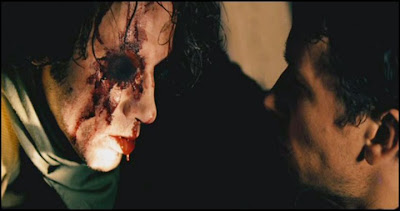
There's one genuinely great scare/gore moment (a POV of the Trackman using a device to steal the ringleader Kostya's eyes - incidentally, Kostya looks a little like Fred Armisen's evil twin so that's fun) and a couple creepy sequences of the Trackman standing in the dark tunnels in front of a flickering light, but the bulk of the film is anemic to the core. The "gouged-out eye" makeup that you can see in the essay above looks less like an eye socket than a chalk eyepatch, and there's not much else of note in the special effects department. That is the showstopper. It's hardly worthy of a suburban haunted house, let alone a feature film.

The finale is pure action nonsense that involves exploding gas canisters and hot-wiring a motorcycle, but at least it's semi-intersting. The rest of the film is content to slap some slow motion on its characters every 12 seconds or so as if the true villain were a student arthouse film that gained sentience and stalked the filmmakers in the editing room.

It's clumsy and it's dull, and it was sheer torture to pull four and a half pages on the topic out of my brain. But I did it and here it is. Marvel at the glory.

Body Count: 5
  1. Splint has his eyes gouged out.
  2. Kostya is pickaxed to death.
  3. Olga is shot to death.
  4. Sergeant Irkut is run over by a slow-moving trolley.
  5. Kirk is shot to death. 
TL;DR: Trackman is a dull, amateur slasher that squanders its generic potential.
Rating: 3/10
Word Count: 2008

Wednesday, May 6, 2015

Class Struggles: Part Five

As I try to find a place to sit in the library during Finals Week, I am reminded of the plight of the Russian people. Here are the final films from my Russian Cinema repertoire!

The Return (Возвращение / Vozvrashcheniye)


Year: 2003
Director: Andrey Zvyagintsev
Cast: Vladimir Garin, Ivan Dobronravov, Konstantin Lavronenko
Run Time: 1 hour 45 minutes

Two young boys go on a fishing trip with their father, who has mysteriously returned after a twelve year absence.

The missing father figure is a common theme in Russian cinema, especially following the death of Stalin, when the country labored under the far kinder but less focused rule of Khrushchev and barreled into the criminal decadence of the 90's after the fall of the Soviet Union. Russia was a country without a guiding light and the filmmaking of the time was highly reactionary to that feeling of loss.

The biggest strength of The Return is its exploration of two different responses to a firm father figure. While the older brother worships at the feet of his stern, possibly criminal father, the younger son never trusts him and actively rebels against his attempts at asserting authority. There are some brief feints at a plot around the fringes of The Return's narrative, implying the father's criminal leanings without actually explicating them, but for the most part the film is laser focused on this relationship and the consequences of its sudden appearance.

This is all fine and dandy, but the fact remains that the motions of the film are hidden deep away within its structure in that oh so arthouse way. At times it's oblique to the point of obscuring its message, which is understandable considering that it is director Andrey Zvyagintsev's (of Leviathan) directorial debut. Like many first-time directors, he tells an intensely personal story in a uniquely stylized way, but doesn't quite manage to clinch the details.

As power shifts begin to shake up the relationships between the brothers and their father, a surprise ending (that could only be considered a surprise to someone who has never even looked at the poster of a foreign arthouse film) tosses all that into utter chaos. The Return has a slick visual style and a tenacious, single-minded pacing that marches on with unflagging, unpitying force, but ultimately its subtext is as cold and grey as its overwhelmingly bleak aesthetic.

Rating: 6/10

Black Lightning (Чёрная Молния / Chornaya Molniya)

Year: 2009
Director: Dmitriy Kiselev & Aleksandr Voytinskiy
Cast: Grigoriy Dobrygin, Ekaterina Vilkova, Viktor Verzhbitskiy
Run Time: 1 hour 42 minutes

Dima, a broke college student, discovers a flying car and uses it to fight crime.

Now this is what I'm talking about! 2009's Black Lightning (produced by Abraham Lincoln: Vampire Hunter's Timur Bekmambetov) is an unabashed attempt at glomming onto some of that sweet sweet superhero box office nectar. It's a rollicking technological action film: half James Bond, half Spider-Man, and all high octane, effects-packed sugar rush.

Black Lightning is about as generic as they come, plot-wise: A young college student wants a Mercedes to impress the new girl at school, but all his parents can afford is an old Volga (A Russian-built car that, according to his dad, Putin used to drive. So there's that.). At first he's ashamed, but soon he realizes that the car is a byproduct of an old Soviet experiment and, as a result, it can fly. He uses this to make money as the fastest flower delivery boy in Moscow, but after the preventable death of his Uncle Ben father, he begins using it to fight crime. 

While this is going on, his professor, who moonlights as a supervillain, attempts to steal the car's nano-engine (or something equally ridiculous sounding) to power a drill to mine the diamonds beneath the city (which would destroy it in the process). This leads into a climactic battle sequence between a flying, weaponized Mercedes and Black Lightning's trusty old Volga with the fate of the universe (and the love of a girl who's almost supernaturally plied by material goods) hanging in the balance.

Sure, that plot has been done a million times before in movies with ten times the budget of Black Lightning, but what the American blockbusters don't have is its zany enthusiasm and astonishingly earnest commitment to the material. Black Lightning is high camp as Dima uses his car's unbelievably sturdy hood ornament to pick up muggers, knock falling icicles away from civilians, and perform various other heroic tasks that are now imbued with a comic energy unbeknownst to the self-serious action flicks churned out by Hollywood studios.

It's just as fun as any comic book movie in the past decade, and its chintzy charms are innumerable. On top of its camp value, it has a strong if unsubtle thematic throughline about the choice between helping others and serving oneself, with a uniquely un-American focus on the collective vs. material goods that feels like a garden variety superhero moral, but comes with a whiff of Russia's historical philosophies.

The CGI in Black Lightning is bonkers, at times hardly better than a particularly good Myst game, but they are used sparingly in combination with practical effects in a way that hardly takes one out of the movie at all. Everything in the film is used in tandem to heighten the bizarre reality of its characters and circumstances, giving the audience a blast of a good time.

Rating: 8/10


Closing Thoughts: This adventure through the cinema landscape of Russia has been a really interesting learning experience. When I think of foreign cinema I think France, Japan, Korea, Bollywood, and maybe even South Africa, but I never considered before this that many other countries could have such a teeming, variable, and valuable output. Especially Russia, which hasn't exactly been a welcoming environment for the generally liberal-leaning art of the cinema.

I'm aware that what we've been watching is generally the best of the best (except for Mother and Son, damn it to hell), so it might not be an accurate representation of the country's filmmaking as a whole, but it's an eye-opening experience to dive full force into a rich, textured world of film that I was hardly aware existed. Generally every film provided a unique historical perspective, whether it be film history or... history history, and many of them were reliably entertaining.

For those who are much to busy to thoroughly read through my Russian Cinema backlogs, my firmest recommendations are Ballad of a Soldier (if you're in a reflective wartime mood, which pretty much sums up all of Russian cinema), The Steamroller and the Violin (if you're ready to really put on your thinking cap and study a film), and Black Lightning (if you're ready to have a damn good time without being encouraged to think about anything at all).

Also: Black Lightning's Grigoriy Dobrygin was cute in 2009, but he grew up nice


Горячая чертовски
Word Count: 1148
Reviews In This Series
Class Struggles: Part One (March 29, 2015)
Class Struggles: Part Two (April 9, 2015)
Class Struggles: Part Three (April 22, 2015)
Class Struggles: Part Four (April 24, 2015)
Class Struggles: Part Five (May 6, 2015)
Class Struggles: Bonus Round (May 11, 2015)

Friday, April 24, 2015

Class Struggles: Part Four

Welcome back, comrades. My days in higher education are numbered. Let's not mince words. Here's some more reviews from my Russian Cinema class!

Brother (Брат / Brat)

Year: 1997
Director: Aleksey Balabanov
Cast: Sergei Bodrov Jr., Viktor Sukhorukov, Svetlana Pismichenko
Run Time: 1 hour 39 minutes

A young man goes to visit his older brother in Leningrad and becomes embroiled in the mob-run city's crime wave during the decadent post-Soviet Union era.

Russia, for all its faults, is one of the most interesting modern countries. While we all have our spats and geoglobal conflicts and whatnot, our most major historic incidents remain where they are - in the past. Meanwhile, over in Russia, their cornerstone event - the dissolution of the Soviet Union - happened in the same year as Bill & Ted's Bogus Journey.

The country is still finding its footing after that massive shift, and while I can't say that where they currently are is my favorite place, civilian life has calmed down somewhat since the years following the fall. The post-Soviet 90's were a time of rampant crime, incompetent police, and gang rule in which violence and hedonism reigned supreme. 1997's Brother showcases that era through the eyes of Danila Bagrov (Sergei Bodrov, Jr.), an aimless young man who has just returned from his stint in the military.

Danila is sent to live with his brother in Leningrad, where he gets caught up in his crime ring, quickly rising up the ranks and fighting against the mob attempting to capture him. Scored by the biggest rock band of the day, Danila assassinates gangsters, sleeps with married women, and hangs out with his homeless friends in an old cemetery. Although he maintains his personal moral code, always keeping his promises and not killing good people, he can't resist the tempting pull of the criminal underworld.

The film is a contemplative action thriller, filled to the brim with ruminations on the state of 1990's Russia. The homeless living in the cemetery is no coincidence. Nor the lighting that constantly threatens to pull Danila into the darkness. Nor the power shift where Danila - the younger generation - takes the power while his brother - the older - falls crumbling beneath the boots of the mob.

It's quite an interesting film, and it amassed a considerable cult following. With its story of a young country breaking itself in and a young man finding his way through the muck of it all, embracing his desires while remaining inherently good, it's easy to imagine the film's appeal. It's like the Donnie Darko or The Graduate of the Russian youth generation, though it's a damn sight better than the former.

My biggest issue with the film is its thinness. The production design is necessarily limited due to its budget, but its remarkably weak, especially in the scenes of the crime den, which look like they were shot in a local YMCA. And the entire movie is wracked with Fade Out Disease, killing the pacing at the end of each and every individual scene with yet another interminably long fade to black. But beyond that, it's a fun film and worth checking out for any crime drama enthusiast.

IMPORTANT UPDATE: Sergei Bodrov, Jr. is still the cutest.


Rating: 7/10

Mother and Son (Мать и сын / Mat i syn)

Year: 1997
Director: Aleksandr Sokurov
Cast: Aleksei Ananishnov, Gudrun Geyer
Run Time: 1 hour 13 minutes

A man faces mortality twofold as he comforts his ailing mother while she passes from this world to the next, in the process boring the audience to death.

I'm going to be straight up here. Mother and Son is one of the worst films I've ever seen in my entire life. The abundance of ten star reviews on IMDb is baffling to me, though I will admit the film probably has a lot more resonance for people who have watched a loved one slowly fall ill. So if this is the case for you, skip reading this or forgive my flagrant disregard for the emotional content of the movie, because I'm gonna tell you right now, the structure is crap.

Mother and Son is more like a series of screensavers than a film. While a son helps his ailing mother eat, drink, and walk around their secluded forest home, the camera lingers on vast expanses of open nature for minutes at a time while literally nothing happens. At one point, the son pops out to grab a photo album and the camera holds static on the mother lying on a bench for a full two minutes. It is ponderously dull.

Some would argue that the pacing of this film mimics the slowing down of life as it fades away. I would argue that this is the film that you're forced to watch in purgatory to pay penance for your sins. There's next to no music or dialogue, the picture is muddier than the road to DTV Hell, and there are only two scenes with a meaningful rumination on mortality and one generation passing on to the next. All the rest of the script (which could be written on a doilie), is composed of lines like "Do you want a snack?"

All there is over the film's 73 minutes is a series of tedious, monotonous scenes of the pair wandering through the forest, sometimes walking out of the frame 45 seconds before it cuts away. I think there's about twelve shots in the whole movie. It's not like watching paint dry. It's like watching Pangea divide. One to miss.

Rating: 2/10
Word Count: 920
Reviews In This Series
Class Struggles: Part One (March 29, 2015)
Class Struggles: Part Two (April 9, 2015)
Class Struggles: Part Three (April 22, 2015)
Class Struggles: Part Four (April 24, 2015)
Class Struggles: Part Five (May 6, 2015)
Class Struggles: Bonus Round (May 11, 2015)

Wednesday, April 22, 2015

Class Struggles: Part Three

In exactly a month, I will be an alumnus of California State University, Long Beach. That's a terrifying thought. Let's drown it in some more mini-reviews from my Russian Cinema class!

The Diamond Arm (Бриллиантовая рука / Brilliantovaya ruka)

Year: 1969
Director: Leonid Gayday
Cast: Yuriy Nikulin, Nina Grebeshkova, Andrey Mironov
Run Time: 1 hour 40 minutes

An unsuspecting civilian on vacation becomes part of an elaborate criminal scheme when a misunderstanding leaves him with a cast on his arm full of smuggled jewels.

On my syllabus, the film The Diamond Arm was described as a "Soviet eccentric comedy," so you can imagine my excitement trying to picture what that could possibly mean. Evidently, what this spells out to is a barrelful of slapstick with a pinch of musical theater, soaked in flailing, constant attempts to jab laffs from the audience. It might only be intermittently successful, but let's remember that I am perhaps not the prime audience for a slapstick Soviet comedy from the late 60's.

Although The Diamond Arm spreads itself very thin through its attempts to cram as many comic scenarios as possible into its 100 minutes, it still has some historically stimulating underpinnings about the corruptive Western influence and placing one's trust in the police. Soviet Russia was a less unstable place to live following the death of Josef Stalin in 1953, but it was still Soviet Russia and the propagandistic elements of films from this period are evergreen and interesting to mine for cultural film buffs.

Aside from these slight political elements, The Diamond Arm is comfortable in its rhythms as a fish-out-of-water espionage thriller, the likes of Get Smart or The Pink Panther. There are a smattering of decent jokes, the high water mark of which might be when the suave villain flips his hair, hitting his head in the process. It's no sophisticated repartee to will make you chuff over your cigar, but it's amusing in that primitive sort of way that people don't want to admit they enjoy.

Overall, the biggest issue with the film is that it takes frequent pit stops that halt the pacing dead in its tracks. One of the film's most egregious moments is an arbitrarily inserted musical number (one of several) on the deck of a boat that does less than nothing to serve the plot or its characters. In fact, I'm pretty sure I came out of that scene with less understanding of what the film was about. Another long stretch at a seaside fashion show is interminably dull.

Although, it might be hypocritical for me to complain about these interludes, because one such moment introduced me to the Russian tune "A Song About Hares," which I am immensely grateful for. It's catchy! I dare you not to dance after pressing play. Just make sure not to bend your knees!


Rating: 6/10


Prisoner of the Mountains (Кавказский пленник / Kavkazskiy plennik)

Year: 1996
Director: Sergei Bodrov
Cast: Oleg Menshikov, Sergei Bodrov Jr., Susanna Mekhraliyeva
Run Time: 1 hour 39 minutes

Two Russian soldiers are held prisoner by a Chechen villager who wants to trade them for his captured son.

The Russians do love their war films. As a country torn by many battles and revolutions, perhaps it's important to them to revisit and re-evaluate their sacrifices time and time again. And if the post-1950's films I've seen thus far in class are an accurate indicator of the general military climate, they seem to find it wanting.

1996's Prisoner of the Mountains joins Ballad of a Soldier as one of the defining Russian films about the futility and senseless violence of war. The film focuses almost exclusively on the character dynamics on two soldiers with opposite perspectives on their enlistment. The older soldier embraces his duties, but the younger draftee prefers peaceful interactions, and grows to understand the plight of the "enemies" that have captured them. These characters are brought to life by a talented veteran actor and a fresh-faced ingenue, both giving honest, genre-defining performances.

As these two stubborn minds battle it out, the film hammers out its philosophy in the spaces between their words: War causes everybody to suffer, and the delineation between Good Guy and Bad Guy isn't so clear once you get a closer look. As a series of delicate metaphors drift their ways to and fro, the soldiers struggle to balance their need for escape with their fondness for their captors, who for all intents and purposes may soon be their executioners.

It's a film about fighting against traditional worldviews and breaking the cycle of violence, and the inevitable destruction that a wartime mentality will bring upon all who subscribe to it, and everyone they love. Again, nobody ever said Russian Cinema was cheerful. 

But despite a downbeat ending (which I shan't spoil here), Prisoner of the Mountains is an uplifting take on humanity's capacity to love in the face of a massive, crushing threat to its well-being. As often as it emphasizes the wanton destruction of the military, it also embraces our capacity to learn to understand one another. It's a slow burn, but a highly recommended watch.

Also, Sergei Bodrov, Jr. is hella cute. You ain't seen the last of him.


Rating: 7/10
Word Count: 869
Reviews In This Series
Class Struggles: Part One (March 29, 2015)
Class Struggles: Part Two (April 9, 2015)
Class Struggles: Part Three (April 22, 2015)
Class Struggles: Part Four (April 24, 2015)
Class Struggles: Part Five (May 6, 2015)
Class Struggles: Bonus Round (May 11, 2015)

Thursday, April 9, 2015

Class Struggles: Part Two

I suppose that I should be thankful for my film classes, because they expose me to cleaverless films that I might otherwise have never seen. Come with me on a journey back to my Russian cinema class, as I explore what might prove to be two of my favorite Russian films ever, though there's honestly not much competition in that regard so far.

Ballad of a Soldier (Баллада о солдате / Ballada o soldate)


Year: 1959
Director: Grigoriy Chukhray
Cast: Vladimir Ivashov, Zhanna Prokhorenko, Antonina Maksimova
Run Time: 1 hour 28 minutes

A young war hero is given a brief vacation, and he touches hearts on the road back to his mother's house.

The Russians love to make films about war. Whether it was the pro-Bolshevik Revolution propaganda films of the Stalinist period, the "up and at 'em" World War II pictures, or the more somber, naturalistic period pieces that followed the post-Stalin Thaw, no topic has been more thoroughly explored by the cinema of a nation. Unless you count France's love affair with black and white cigarette smoke.

1959's Ballad of a Soldier is one of those Thaw period films, created during the time in which the Russian people were given a chance to reflect honestly and earnestly on the impact the war had on their nation. The paranoid iron thumb of Mssr. Stalin was gone, and filmmakers tentatively poked their heads out of the sand to explore that persnickety value known as Truth.

Through the escapades of one lucky enlistee on his brief journey home, Ballad of a Soldier tells the story of an ailing nation. Pvt. Alyosha, played by the adorable Vladimir Ivashov, spends his entire trip back helping others, to the point where he sacrifices all but one minute of time with his mother in service of his fellow countrymen. On his travels he meets an injured veteran who's afraid his wife will leave him, a woman who has shacked up with another man while her fiancé is on the front, a Ukrainian family put in harm's way thanks to Stalin's relocation programs, and a young girl with whom he falls in love, all over the course of three days.

He lives a life over that long weekend, exploring the consequences of the war in every nook and cranny of the country, touching hearts and changing lives, kissing his mother on the cheek, and returning to the front, never to be heard from again. This film is all about the future potential that was wrested from the young men who were sent into the fray, and it is profoundly affecting. While Alyosha's mother pines for her lost child and her unfixed roof (standing in for the broader sense of Mother Russia, left in disarray), so do we, acknowledging the loss of a life meant to be lived, converted into just another fallen soldier.

Nobody ever said Russian cinema was cheerful.

Rating: 8/10

The Steamroller and the Violin (Каток и скрипка / Katok i skripka)

Year: 1961
Director: Andrei Tarkovsky
Cast: Igor Fomchenko, Vladimir Zamanskiy, Marina Adzhubei
Run Time: 46 minutes

A young violin player and a construction worker strike up an unlikely friendship.

Andrei Tarkovsky is a filmmaker best known for his habit of hiding encoded messages in his films which the audience must then analyze and decode. The Steamroller and the Violin is his very first film (in fact, it's his film school thesis), so it's not quite so complex as all that, but it's still a tremendously valuable watch for anybody even remotely interested in the history of Russian cinema.

Exposing the hidden class system that fueled Soviet Russia, the film details a privileged and bullied boy's attempts to make a friend, which are squashed by his mother who doesn't want him consorting with Those people. At a brisk 46 minutes, it can't really be about much more than it, can it? But it uses its time wisely, painting an image of two people's lives with elegance and grace, without pushing them to adhere to any sort of rigid plot. It's like a more focused form of Italian Neorealism.

As the boy and the construction worker make their way around town, their interactions are filtered through reflections, reflections, everywhere. Whether it's in a puddle of water or the dozens of inexplicable mirrors that pepper the production design, the film constantly reflects on itself and its own meaning in a manner that's simultaneously student film heavy-handed and professionally precise.

The most unforgettable element of The Steamroller and the Violin is its inimitable style. It's earthy and worn, but packed with sophisticated double meaning, especially in its most playful moment - when the boy and the man become separated with a building between them in the process of being demolished. It's meaningful, skilled, and charming despite its relatively clumsy subtext, and proves beyond a shadow of a doubt that this is a filmmaker to watch out for. Well, to have watched out for.

The only question that remains is... If Tarkovsky can do it the first time out of the gate, why are all American student films so damn bad?

Rating: 7/10
Word Count: 849
Reviews In This Series
Class Struggles: Part One (March 29, 2015)
Class Struggles: Part Two (April 9, 2015)
Class Struggles: Part Three (April 22, 2015)
Class Struggles: Part Four (April 24, 2015)
Class Struggles: Part Five (May 6, 2015)
Class Struggles: Bonus Round (May 11, 2015)

Sunday, March 29, 2015

Class Struggles: Part One

I'm graduating this semester, so that means I'm stuck with all the classes I put off in earlier years in order to take cool horror classes that let me watch From Beyond and get academic drool all over Wes Craven. The one class I was looking forward to was French cinema, but lo and behold the Fates would not allow it, and the only foreign film class I could get in my schedule was Russian.

As it turns out, this was a happy accident because hardly any country with a relatively thriving cinematic output has had a more tumultuous and fascinating history than the Soviet Union U.S.S.R. Russian Federation. As a result, their cinema is twisted, strange, and uniquely compelling for any aspiring film historian. Here's some mini reviews of the first two films I've had the deranged pleasure of watching.

Battleship Potemkin (Броненосец Потемкин / Bronenosets Po'tyomkin)


Year: 1925
Director: Sergei Eisenstein
Cast: Aleksandr Antonov, Vladimir Barsky, Grigori Aleksandrov
Run Time: 1 hour 6 minutes

The crew of a battleship mutinies, leading to a rebellion against tsarist forces in the nearby town of Odessa.

To start off the class with a rip-roarin' good time, the first thing we screened was Battleship Potemkin, Sergei Eisenstein's classic silent film depicting an early Bolshevik rebellion in 1905, twenty years earlier.

You don't often see me reviewing silent films on here, largely because the style of the medium is almost completely divorced from modern cinema and the evolution of film criticism that I represent. But Potemkin has been named one of the three most influential films in world cinema for a reason. It is my hope that I can balance an explanation of how it functions as a classical masterpiece of the form and why it's OK if you don't like it all that much.

I hope you'll all bear with me if I toss some film theory at ya right quick. Eisenstein was an early pioneer of the montage theory of cinema. Montage (no, not the Rocky training sequence kind) was an approach to understanding cinema through the power of editing. An early notable experiment juxtaposed a neutral-faced man with different images, like a bowl of soup, or a young child. Reportedly, the audience commended the man's acting, applauding the hungry look he gave at the soup and the caring look with which he gazed at the child. In reality, this effect was created through the context of the images, for the man's face didn't actually change a lick.

Now you can believe in this theory or not. I personally have some doubts about that particular experiment, but nonetheless Battleship Potemkin was used as a testing ground for some high level early theories about the dialogue of cinema and how the juxtaposition of images functioned to create an emotional response.

On that level, it is a damn masterpiece, a perfect textbook example of all the best ways to use the system. Intellectual metaphors abound, whether it be the relatively simple boiling soup that represents the bubbling rage of the working class or the maggot-infested meat that stands more obliquely for the rotten state of tsarism. And entire books could be written about the famous Odessa steps sequence, and I'm sure several have.

But the fact remains that the silent film era is often too distant from our own to be truly recognizable as entertainment. On top of this, Battleship Potemkin's heavy propaganda elements render it a bit too po-faced and serious to be worth a visit if you're looking from any other perspective than film analyst or historian.

The communistic focus on a collective body of working class people rather than a set of protagonists is likewise alienating for a modern audience. So, while the film is structurally and cinematically possibly the best single silent film of the 1920's, its density overpowers its magnetism. If you're in an academic mood, I recommend Battleship Potemkin above all else, but it is not a film to sit through for pleasure.

Rating: 6/10


Circus (Цирк / Tsirk)


Year: 1936
Director: Grigori Aleksandrov & Isidor Simkov
Cast: Lyubov Orlova, Evgeniya Melnikova, Vladimir Volodin
Run Time: 1 hour 30 minutes

A down-on-her luck American circus performer in Moscow wants to keep her illegitimate black child a secret so she isn't deported.

Circus is a curious beast. A staunchly Stalinist propaganda film disguised as a wacky slapstick comedy about the circus, it's one of the most interesting pieces of film ephemera loosed from the back gums of the 1930's.

Comedy is another of those things that sometimes doesn't carry over quite as well from the black-and-white era. And when you consider that this film exemplifies what people in the Soviet Union found funny, it carries over even less. They weren't, shall we say, the most mirthful of people. 

Yet Circus is another interesting curio. It displays a gaudy fantasy world, but any active audience member  can reverse engineer the illusion to reveal some twisted truths about the time it was created.

Between the wacky misunderstandings, the Charlie Chaplin impersonator, and the warbly Betty Boop musical performances (can you tell that the American films had snuck their way over the border?) lies a story about Russia as a post-racial nirvana where people from all over the world could live in harmony. However, the "all around the world" song that closes the film avoids letting the Jewish man sing, and the demure sidestepping of those pesky Purges piques historical interest.

Propaganda is some of the most excitingly factual cinema out there, if you know where to look. If you take a peek in the corners and behind the curtains, there's a world of secrets waiting to be uncovered. 

Also, the strained excesses of the film's desperate bid for veracity provide some excellent camp value, especially in the closing number "Song of the Motherland." The overall comedy might be a stale imitation of the American greats, but nothing beats the smarmy villain who wants to drag our heroine back to Evil Capitalist America - a man who looks like a cross between Adolf Hitler and Dracula, who has the ability to disappear in a puff of smoke.

You can't make this stuff up.

Rating: 6/10
Word Count: 1033
Reviews In This Series
Class Struggles: Part One (March 29, 2015)
Class Struggles: Part Two (April 9, 2015)
Class Struggles: Part Three (April 22, 2015)
Class Struggles: Part Four (April 24, 2015)