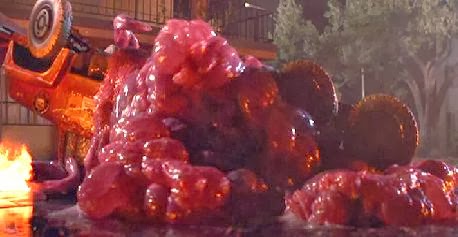
Showing posts with label Blob. Show all posts

Friday, October 25, 2013

Beat It, Essay: Blob Me Gently

Welcome to my first official academic post of the semester! Most of my classes this time around are technical, so I haven't gotten a chance yet to wow you guys with my unparalleled wordsmithy. But the time is nigh! As I have mentioned (repeatedly - there's a three part feature on this already), I am taking a class called American Film Genres: The Horror Film, which as you may have guessed is focused on the history of horror.

This class has been fascinating as a horror buff. I've gotten a chance to really delve into the sociopolitical backgrounds and implications of horror films spanning from German Expressionism in the 1920's to the Universal Monster Movies of the 30's to the Val Lewton RKO Unit of the 40's and so on as we progress our way chronologically through time and terror.

As midterms season draws near, our first essay has been assigned and I have never been more excited to write a paper in my life. Seeing as I spend basically every day writing about horror films, it wasn't really much of a stretch.

So here's my second official academic paper about a horror film (the first being my Scream essay for my Media Aesthetics class last semester)! I hope you are all as pumped as I am! You're probably not, but here it is anyway!

(I've added in pictures to keep y'all entertained.)

*drumroll*

The Prompt
A) Compare and contrast The Blob from 1958 with the 1972 Beware! The Blob and the 1988 remake, The Blob. Which works better and why, and what does each film tell us about the time they were made?
B) Using two of your favorite sci-fi/horror films, cite five elements necessary for a great sci-fi/horror film and discuss each in detail. Which works better and why?
Horror, more than any other genre, reflects the cultural mores and societal issues of the time and place it is born from. Nothing describes a people better than what they're afraid of, and since the very beginning of cinema itself we have been using horror films as catharsis to face our fears in a safe and adrenaline-fueled (and endorphin-releasing) environment.

Horror is cheap, easy to make, and usually a guaranteed return on investment so it's no surprise that studios pump out horror franchises with great efficiency. By the time of writing in 2013, the world has seen 12 Friday the 13th movies, 9 Nightmare on Elm Streets, 10 Halloweens, 5 Exorcists, 4 Psychos, and 7 Saws. As the years progress, the villains and plots must adjust themselves to properly resonate  with modern audiences, resulting in some tremendously fascinating sociological insights.

One of the most absorbing (pun absolutely intended) franchises is the three part Blob series, with each of the films being released more than a decade apart. Much can change in ten years, and each film shapeshifts into something totally new and mired in the advents of new American cultures.


The original The Blob in 1958 was released during a time of national complacency. World War II was over, the depression had ended, televisions were readily available, and people flocked to the cookie cutter suburbs with their nuclear families, content to be exactly like one another. As the rock 'n roll Baby Boomer youth culture emerged, many older Americans (a minority in the population for the first time) felt that their way of life was being challenged.

At first glance, The Blob is a typically 50's horror film. It's more silly than scary (Because who wants to be scared anymore? The horrors of the war are still in the back of everybody's minds.) and has an overt fascination with the dangers of outer space. The world was at peace (more than it had been recently, anyway) and since the at home threats had been reduced, people began to fear the night skies and their unknowable power.

When a mysterious asteroid carrying a ravenous gelatinous beast crashes into the forest nearby, the citizens of Downington, PA must overcome their fear and distrust of teenagers to work together and eliminate the threat. Their sheltered suburban lifestyles have met an even greater challenge and the adults slowly begin to realize that maybe the young men and women they've been so afraid of are, in fact, on their side.

In this film, the blob is an agent for social change, a common enemy to unite against. Yes, it may be a silly monster in a dumb sci-fi/horror hybrid picture. But when Steve McQueen and Aneta Corsaut struggle to be heard in a community that has long since given up on them, it resonated deep within the hearts of the young audiences who were just trying to find their voices in a world that persecuted anything Different.


1972's Beware! The Blob is easily the worst of the franchise. It's a cheap film that embraces the camp humor of the original to a severe degree, merrily crossing the line between silly and scary that the original was so precariously balanced on. Shot like an exploitation film on thin sets with flat lighting with what appears to be an even lower budget, Beware! The Blob is the only film in the franchise where the amorphous being absolutely does not feel like a credible threat.

This overly goofy and resolutely unfunny tone absolutely destroys the film (in which a sample of the blob is taken from the Arctic and accidentally unfrozen to wreak havoc on a small town) as a work of horror cinema, but there are still elements of interest here that could only ever have existed in America in the 1970's.

In a film so haphazardly made it is perhaps not fair to apply this level of analysis, but it is hard to ignore the salon scene. It is a brief, three minute chunk completely divorced from the rest of the characters or events in the film in which a young hippie asks a male hair stylist for a haircut. As the man begins to shampoo his hair, the boy begins to groan with pleasure.

"We'll have to moisten you a little bit." "Hey that feels good. You are good." "And you are dirty." "Oh yeah." "You do grow a great deal." "I think you're purring."

No, I didn't accidentally grab a DVD from the adult section at the video store. This is a scene smack dab in the middle of Beware! The Blob in which it is almost impossible to see anything but two men having implied intercourse and then being devoured by a metaphor for their own semen, as a punishment for their "sins."

In the 70's, gay culture was finding its first real foothold, and the "traditional" American way of life was being threatened once again by these queer newcomers. In similar (but less emphatic) scenes, the blob also attacks hippies and a bizarre overweight man with a heavy Eastern European accent. The rampant homophobia, xenophobia, and conservative fears of the burgeoning hippie movement are reflected here in the town's police force.

The sheriff and his deputies completely ignore the protagonists' warnings when the blob is attacking hippies or foreigners or gays, but when the wholesome townsfolk at the bowling alley are endangered, they spring into action. In this manner, Beware! The Blob is almost the polar opposite of its precursor, depicting a world that's more threatened by societal change than the alien menace.


The 1988 remake, also titled The Blob, brings the franchise back to its roots with another high quality camp classic, this time heavily informed by the slasher movie trend that had been going strong in American cinemas since the release of Friday the 13th in 1980. A practical effects bonanza, The Blob successfully wrings whatever amount of tension it can from its remarkably silly premise.

The most major change from the original is the nature of the blob itself. Instead of an alien being, the monster is a government experiment gone wrong. This film's palpable fear of the government certainly wouldn't have been so credible in the days before Watergate, a fact which would immediately mire it in time if the rest of the film (and Kevin Dillon's hair) hadn't already done so.

By 1988, the Baby Boomers had children of their own and the tables had turned. The new youth culture was enacting social change left and right, quite ironically scaring them to no end. The decade that saw the rise of punk, slasher films filled with nudity and buckets of blood, androgynous musical role models galore, and the growing appeal of teen rebellion fueled by John Hughes also saw a lot of terrified parents.

The female protagonist of The Blob isn't fighting to have the adults listen to her. She's fighting to get anyone to listen to her. She's fighting the homogenization of suburban society and embracing the idea that young people can enact real change in the world.

The blob in this case represents her biggest fear as townspeople are literally homogenized into one giant quivering mass. This theme is hit heavily in the first act as her vanilla jock boyfriend (and Steve McQueen stand-in) is messily devoured by the creature before the audience can even blink. She trades him up for a motorcycle-riding, leather clad love interest and saves the day by daring to be different and refusing to follow the rules set down for her by her parents and the government.

While Steve McQueen and his posse are struggling to find a foothold in the world of their parents, Kevin Dillon and his girl reject the notion entirely.


Thus, all three films synthesize the three main ingredients (the enormous man-eating blob, youth culture, and the rejection faced by people who are different) in three completely unique ways in the context of three totally different genres (sci-fi romp, cheapie exploitation film, and slasher movie).

The film that works the best is, by a hair, the 1988 Blob, because it has the ability to draw parallels between the old youth culture of the 1950's and the new youth culture of the 1980's, something which would have been frankly impossible in the original. By drawing the themes of the original into the context of late 80's culture and smashing them into a brand new slasher movie framework, The Blob 1988 shows that they are universal.

Young people will always be struggling to find a voice in a world that's afraid of being left behind. That, at its core, is what The Blob is about. Not alien monsters devouring people. Not the evils of gelatin. The timeless story of The Blob is at once eternally relevant and intensely human.


That, at its core, is what sci-fi and horror are all about. While horror shows us the fears and social issues of today, sci-fi shows us where those issues might take us tomorrow. When combined, those two ideas can provide immensely intelligent and hard-hitting commentary. Unfortunately, true sci-fi/horror hybrids are few and far between. Alien and The Thing come immediately to mind, but other than that, there is a paucity of films in the subgenre.

Most of the other horror films that dabble in sci-fi elements are campy little microbudget pictures, but that doesn't mean they're inconsequential. Look at The Blob, for instance. Nobody would place it in the same pantheon as Ridley Scott or John Carpenter's masterworks but it and its remake nevertheless have sharp and perceptive minds hidden beneath their goofy shells.

Campy films are often forgotten by critics but receive huge cult followings due to the brain buried in the cheese. Two such films (and two of my favorites of the genre) are the tenth Friday the 13th film, Jason X and the 1984 cult classic Night of the Comet.

Jason X brings our hockey masked villain to the farther reaches of outer space on a training ship for young students, where he defrosts after centuries of cryogenic sleep and begins the cycle of blood anew. Night of the Comet's titular entity blasts across the sky turning anyone who isn't in a solid steel shelter to dust, reducing the population to ribbons and leaving the rest to battle radioactive subhuman monsters.

These are fun films, certainly, but both have surprisingly positive things to bring to the genre, much like The Blob and its cohorts. It's not as easy to marry camp and clever as I'm making it seem though. To properly do so, a film must contain these five necessary elements.
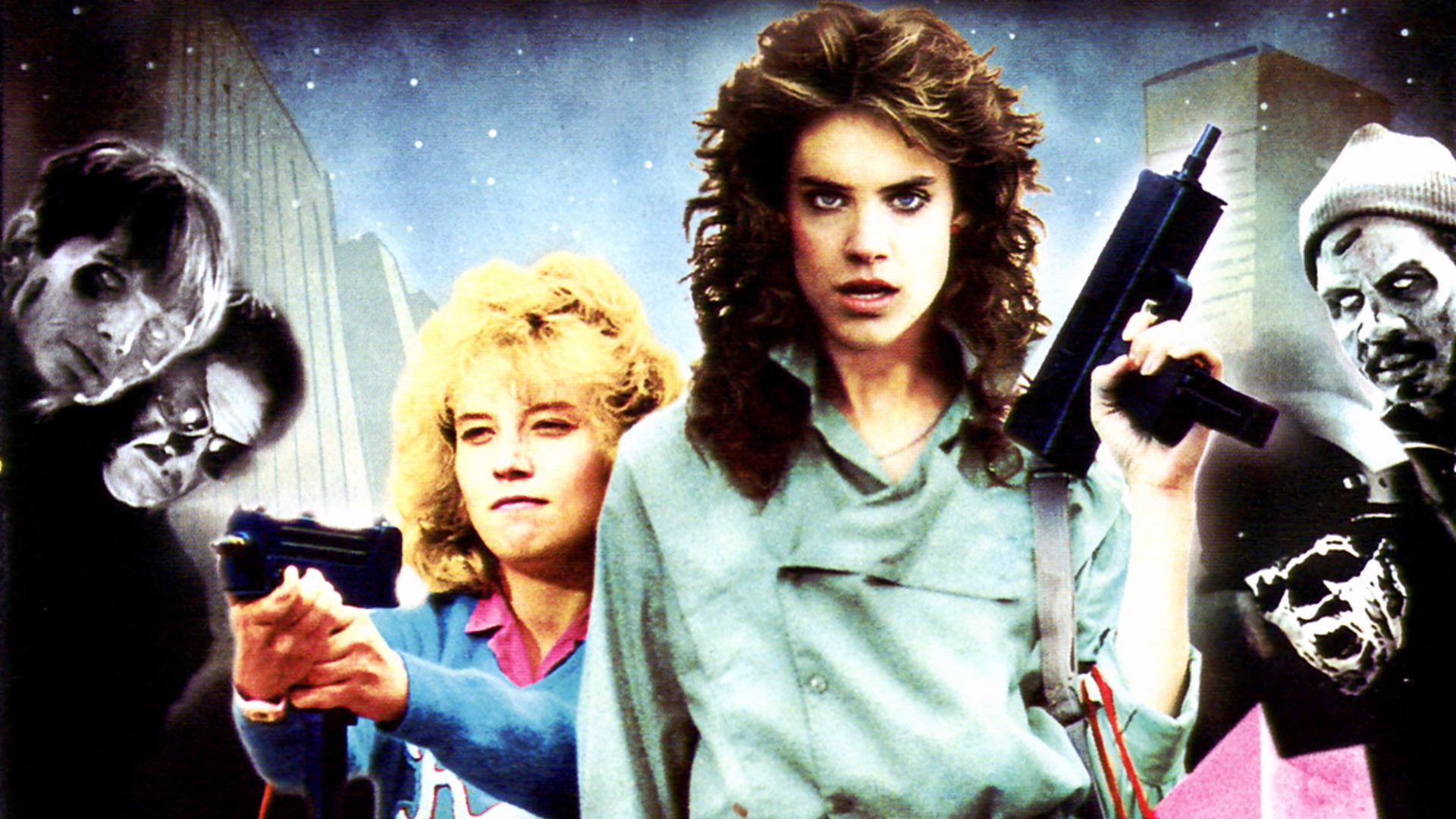

First, a good sci-fi/horror film should have a solid commitment to camp. For a movie with a budget as low as some of these flicks can be, it doesn't pay to take oneself seriously. It's important for filmmakers to work within the restraints they have to avoid releasing a film that's merely unintentionally terrible drivel. And a film that embraces camp can deliver its message successfully to a much larger cult audience than it would be able to otherwise.

The campy hook for Jason X is obvious: "Jason's in space!" But the film is also full of tongue in cheek dialogue, cyborgs toting pistols in both fists, and a Cyborg Jason built by nanobots. Night of the Comet masters the craft with action heroines straight out of the cheerleading squad at the local high school. Valley girls, boom boxes, and bloodthirsty monsters are the perfect setup for a classic.


The second necessary element is having something to say about modern times. If a film that is both sci-fi and horror can't find anything useful to say, it has no right being put into theaters. Both genres are so intimately connected with the pulse of modern society that it's almost impossible not to have some amount of sociological import.

Night of the Comet works in a similar vein as 1988's The Blob when the teenage protagonists discover a top secret underground bunker populated with government scientists who predicted the catastrophe but saw fit not to inform the public for their own personal gain. The government was a major antagonistic presence in the United States at the time, and many such films (including John Carpenter's They Live) have similar themes. Jason X works in the same register. The professors in charge of the Starship Apache decide to defrost Jason's perfectly preserved corpse so they can sell him off to the highest bidder, inadvertently dooming the entire crew.


Third, a perfect sci-fi/horror film must have a fundamentally unfathomable villain. Because there is, in fact, a horror element to these films, the primary antagonist must be something completely alien to the audience and characters alike. People are afraid of the unknown, and working within a sci-fi framework allows for a lot of freedom in creating a supremely unnatural villain, much like the blob itself - there is nothing on Earth like it.

Jason X has Jason, a hulking beast that resides in the shell of what used to be a man. He has long since died multiple times but keeps coming back to kill again, driven by mysterious forces of pure evil. And Night of the Comet never adequately explains its monstrous creatures, insinuating that the power of the comet is something that we'll never be able to understand.


The fourth important element is evidence of a world beyond what we see onscreen. For a sci-fi universe to be whole, it can't have just developed within the very limited space in which the primary story takes place. Whatever technological advancements or new discoveries we see onscreen have affected various cultures differently across the globe and encountered hundreds of permutations depending on a variety of contexts. The film doesn't have to show this in its entirety, but the implication that there is a broader universe beyond the capsule of the plot is a must.

In Jason X, the sinister cartel in charge of the student ship is never fully explained, merely seen briefly and sporadically mentioned, implying that there is a much larger governmental and economic structure in place that we only get glimpses of. In Night of the Comet, we see only what happens to LA. The comet has afflicted the entire Earth and there are presumably thousands of different stories that could be told across the globe of the different ways the survivors deal with their desolation.


The fifth and final element is the element of surprise. Each new sci-fi film, horror or not, needs to have something new to bring to the table. Whether its a new technology or merely a new use for a previous idea, in order to have any real agency, it needs to be something audiences haven't already seen a million times before.

Jason Voorhees is something audiences have seen a million times before. But blowing him up and using medical nanobots to secure him to a metal exoskeleton is a completely new idea. A desolate and abandoned city is old hat, but throwing in mutant creatures and a couple valley girls spices it up.


While both films do an admirable job with these five elements, Night of the Comet is the obvious standout of the two. With an impeccable blend of superficial high school humor and abject horror that would later be mirrored in the cult TV hit Buffy the Vampire Slayer, the film is consistently clever and sprightly.

But a final act that witnesses the ultimate grotesqueries of human behavior as portrayed by an underground scientist cult sends Night of the Comet into the stratosphere as a work of camp cinema. With razor-edged satirical wit, the film dissects the issues inherent with its protagonists and antagonists alike.

Perhaps these films will never reach mainstream acceptance as works of art, but that may be for the best. If Night of the Comet, Jason X, and The Blobs received immediate acceptance, they wouldn't have paved the way for all the films like them that are in circulation today. Camp, sci-fi, and horror are very important tools in our cinematic exploration of the human condition and the fact that these films have always been underdogs give them their raw power.

All hail The Blob.

UPDATE: I got an A-! I think I was a little too loquacious, I ran way over the page limit. But hey! I'll take it.
Word Count: 3041

Tuesday, October 22, 2013

Armed Blobbery

Year: 1972
Director: Larry Hagman
Cast: Robert Walker Jr., Gwynne Gilford, Richard Stahl
Run Time: 1 hour 31 minutes
MPAA Rating: GP

Let's get this out of the way: I love the Blob. But Beware! The Blob is a balls to the wall just plain terrible movie with almost no redeeming qualities. The sort of thing that was made for a miniscule budget because just about anything could make a couple bucks in those days.

All this can be exemplified by one anecdote: Director Larry Hagman (famous for playing J. R. in the hit TV show Dallas) was next door neighbors with the original film's director. After commenting that he'd never actually seen it, they screened the director's personal copy of the film and Hagman decided he wanted a Blob of his own.

This was a TV actor, mind you. Not an actual director.

And that's how we ended up with a Blob movie that somehow manages to out-cheese the opening credits of the original which, remember, contained this song. In what seems to be a straightfaced presentation with no intentional camp value, the opening credits (accompanied by a song that sounds like an ice cream truck on PCP) are... Well, just look for yourself.


Did you see a cat lying in a meadow? So did I. And so did every single person working on the film, none of whom evidently considered that maybe their horror film about an amorphous blob devouring a small town shouldn't open with a kitten lying in a meadow.

The 70's, man.

Anyway, when last we left our Blob, he had been frozen solid by Steve McQueen and his band of fire extinguishers and airlifted to the Arctic. The film opens with a First Twelve Minutes Couple that would be downright slashery if the genre had actually been invented yet, the male half of which (Godfrey Cambridge) has just returned from laying pipe at the North Pole (?). His pipe laying supervisors allowed him to bring back a sample of a mysterious substance they found which he now keeps in his freezer like a regular person.

Guess what happens next.

The Blob (you guessed it) defrosts and resumes his ravenous beasting ways, devouring the man, his wife (Marlene Clark), and their adorable kitten (who actually was a character in the film, which surprised me to no end). 

Champion Dialogue #1: "You are a total dingaling."

I'm just gonna throw those in there from time to time.

The Blob goes on to devour hippies, bowling alley patrons, a weirdly sexual barber, and bumbling comic relief cops and blaxploitation characters that apparently migrated from the set of Foxy Brown Goes to the Movies. All on sets that look like bad pornos with their thin walls, shallow lighting, and unmistakable aura of having once been a gymnasium.

Most of the time, the Blob is played by a pink gel held in front of the bottom half of the camera (although in the shots where is actually has to move, it does so a sight better than the original film - the only compliment you'll hear me giving in this review) and for the first time the idea that having a Blob as a main villain is fundamentally unscary hit me like a ton of bricks.

It has all the makings of a cult classic: kittens, bad actors, kooky setpieces, a silly monster. If only it wasn't so stupefyingly boring. Oh it has its moments, but for most of the running time, I just sat there slack jawed, daring myself not to fall asleep.

Champion Dialogue #2: "Is that motivation for you? Does that activate your glands?"

Maybe the kitten represents the fragility of youth when faced with a complex and unknowable world.

The film is comprised of nothing but bad 70's haircuts and narrative problems. Not the least of which is that in the opening scene, The Blob is playing on TV. Is this a news report? Is there an actual movie of The Blob, meaning that it's fictional? In that case, how did it get to the Arctic? These are all questions the filmmakers don't care to answer, if they're even aware of them in the slightest.

Technical problems abound as well. Permeated by the ever classic juddering camera that is a favorite of low budget horror pictures, this one also gets a remarkably unsophisticated zoom that looks like a toddler was chewing on the camera.

Champion Dialogue #3: "I don't cut hair. I sculpt it. You want a hair sculpt?"

And then there are the points where you just have to throw your hands in the air and say "Why am I watching a hippie get a haircut?" Or cringe into yourself when a girl holding a birthday cake looks directly into the camera and shouts "HAPPY BIRTHDAY!" and then walks over to the actual birthday boy who is somewhere behind her.

It's really easy to see why nobody ever talks about this film.

Champion Dialogue #4: "Hey, let's go to your place and get an avocado sandwich, huh?"

It's resolutely unfunny despite the massive spate of comic relief characters. It's xenophobic. It's homophobic. It's hippiephobic. And it has absolutely no reason to exist.

It is redeemed somewhat by the more ridiculous scenes in the way that syphilis is redeemed by having a funny name. These are such unforgettable moments as the time a chicken lays an egg into the Blob or the weird obsession the leading man has with avocado sandwiches. Or the fact that one of the supporting characters is dressed as a gorilla literally the entire time.

So it's not a total bust like, say, an adaptation of The Notebook where every character is played by Arnold Schwarzenegger (which, actually, I'd pay to see), but dear God does it try awfully hard to be the worst film I've ever seen.

Also, this is the only film in the franchise to say the word "blob" aloud and it absolutely does not earn it.

Champion Dialogue # 5: "I like bacon."

This is what happens to your brain when you watch this movie.

TL;DR: Beware! The Blob is a disgrace to the grand name of Blob, but has some miniscule campy value.
Rating: 2/10
Word Count: 1039
Reviews In This Series
The Blob (Yeaworth Jr./Doughton Jr, 1958)
Beware! The Blob (Hagman, 1972)
The Blob (Russell, 1988)

Thursday, October 17, 2013

Blob Me Blind

Year: 1988
Director: Chuck Russell
Cast: Kevin Dillon, Shawnee Smith, Donovan Leitch
Run Time: 1 hour 35 minutes
MPAA Rating: R

You can never have enough Blob.

This is an opinion held by many, as evidenced by the popularity of Blobfest, a yearly convention in Phoenixville, Pennsylvania that has been going strong since 1958, the year the original film came out. The festivities include four double features (one half of which is always The Blob), 1950s Makeover and Costume contests, special guests, a Fire Extinguisher Parade, and the Friday Night Run Out, where the entire audience runs out of the Colonial Theatre, the location the Blob attacked at the end of the film.

That was all one sentence.

Anyway, it's nice to be reaffirmed in my love for the Blob, the topic I have chosen for my essay in my Horror Genre class. To complete this five page essay (which will shortly become available to you on this blog, should you wish to read an actual academic analysis of a dumb movie about a Blob that eats people), part of the assignment is to watch the sequel (Beware! The Blob) and the 1988 remake.

Since I was already planning on doing that anyway, it was an obvious choice of essay topics.

And since B!tB is stuck in the mail somewhere, I decided to begin with the remake, released exactly 30 years after the original Steve McQueen film.

Things have changed since then (although making a pile of silicone look like it's rolling around is still just as hard as before, evidently). Visual effects have improved tenfold. Horror has risen to prominence as the genre to beat. The beginning of the decade saw the invention of the slasher film.

That last development more than anything else is what informs The Blob of the 80's. This film is about one topless scene away from being a Census Bloodbath entry.

There's a Final Girl, a couple making out in a car and getting Blobbed, a man bursting from the shadows brandishing an axe, not to mention that half of it takes place in the woods. This is no accident. The movie showing in the cinema in the climactic scene is one of the most spot on parodies of the genre I've ever seen. Also, let's not forget about Chuck Russell, whose previous directing gig was none other than A Nightmare on Elm Street 3: Dream Warriors (The Blob also shares screenwriter Frank Darabont with that lovely late era slasher film).

Coming so late in the 80's, there was no way the new Blob could be anything other than a slasher riff. That's what was selling and had been selling for a decade at that point. If that makes it sound stale, trust me it absolutely isn't. Yes, it's a slasher framework but how many "teens in the woods" movies choose a ravenous gelatinous monster as their villain?

As a preeminent slasher scholar, I can tell you: Not a lot. 

Meg (Shawnee Smith of the first three Saw movies) is a sweet young cheerleader from the struggling off-season ski town of Arborville, California. Although the town's economy is troubled, she still has something to cheer about - cute jock Paul Taylor (Donovan Leitch of the Brad Pitt slasher abortion Cutting Class) has just asked her out on a date! Gee whiz! A great deal of time in the first act is spent on teen hijinks (including a bizarre reworking of this ancient joke) in a barely disguised Meet the Meat sequence.

There's Scott (Ricky Paull Goldin), Paul's douchey best friend (his best analogue is Ted from Friday the 13th: The Final Chapter, and I'll bet my life's savings that the Blobmakers have seen that film); Brian Flagg (Kevin Dillon, who has made something of a name for himself with Entourage), the leather clad motorcycle rebel; the town weirdo Reverend Meeker (Del Close); Diner owner Fran (Candy Clark); and her suitor, Sherriff Geller (Jeffrey DeMunn, perhaps best known as Dale from The Walking Dead. This won't be the last time he'll pop up somewhere you least expect it - he'll appear in Christmas Evil, one of our upcoming Census Bloodbath features).

This is a remake after all, so although most of these characters are original, it's obvious that Meg and Paul are the stand-ins for teenybopper heroes Aneta Coursaut and Steve McQueen. Oh, also a meteor crashes to Earth containing a ravenous Blob. That too.

(SPOILERS IN THIS PARAGRAPH) The movie follows the original for a while with the couple driving a Blob-afflicted old man to the doctor. Then the movie tips its hand when it freaking kills Paul dead in just about the most violent manner possible. We just got Psycho'd hard, guys. Our young hero has joined Marion Crane and Casey Becker in the special Heaven for top billed characters who die before the 45 minute mark. Now that the movie has thrown a wrench in the works, Brian Flagg steps up to the plate, teaming up with Meg to help save the town, but the movie has already proved how far it's willing to go - anything can happen.

He never lived to see the advent of the selfie. It's hard to tell if this is a bad thing.

It also proves how far gore effects have come in the last 30 years. This is still massively tawdry and cheap stuff, mind you. It's no The Thing, but The Blob is exactly everything a 50's style sci-fi horror flick transplanted into the late 80's should be - tremendous fun with a gonzo flair for increasingly outrageous gore setpieces.

A man gets his arm ripped off as the rest of him dissolves in the Blob, a diner worker is pulled into a sink drain, a woman in a telephone booth is completely engulfed. Faces melt, bones are crushed, and the Blob gushes around with gusto, squealing and thrashing and crushing townspeople with its enormous tentacles (a new and appreciated addition - this feels so much like all the best parts of a cheesy black and white monster movie).

The final third of the film has some commentary on the US government (the monster being a failed biochemical warfare experiment) and it's all well and good but the most important part is the middle, in which nothing much happens but various people around town getting Blobbed. This is fantastic and worth the price of admission even without the witty repartee and cute meta humor.

Blobbed.

Blobbed.

I regret to inform you that you've just been Blobbed.

Blobbed Nightmare on Elm Street style.

The Blob avoids the modern remake habit of grittifying everything (Imagine if you will: a grey and world-weary Blob wearing sunglasses and dissolving townspeople as revenge for his dead bride. He keeps going out of a sense of duty but can't shake the nihilistic idea that maybe it just isn't worth it anymore. He's the Blob this city wants but doesn't need anymore.) and embraces its camp pedigree. 

There was hardly a better time for sci-fi/action/horror camp than the 80's, and this Blob turns it up to 11. Sillier. 80's-er. Gorier. Blobbier.

There's a motorcycle chase.

Somebody actually says the words "Chew on that, slimeball!"

A manhole cover is exploded with a bazooka because everything explodes in the 80's.

When nothing is taken seriously it's really quite hard to be even a little scared, but it's even harder to not have a good time. 

Who doesn't have a good time at the movies?

Also, the film isn't shoddily made at all. (What?) In fact, the editing is even rather brilliant at times, keeping in mind the campy tone. The opening shot of a cemetery pans over to a rowdy crowd cheering on a high school football game; a particularly Blobby scene cuts right to a kid slurping up Jello; and Brian's attempt at an Evel Knievel style stunt is intercut with the cheerleading squad chanting "GO! GO! GO!"

Not quite Academy Award level work, maybe, but it shows that a lot of thought and love went into this film. And if you don't agree, you can go Blob yourself.

Body Count (and the very fact that it needs a body count is telling): 21; also half of the audience of the movie theater and a multitude of random townspeople.
TL;DR: The Blob is a perfect remake, capturing the tone and humor of the original but ramping up the visual effects with modern flair.
Rating: 9/10
Word Count: 1418
Reviews In This Series
The Blob (Yeaworth Jr./Doughton Jr., 1958)
Beware! The Blob (Hagman, 1972)
The Blob (Russell, 1988)

Saturday, October 5, 2013

Splatter University: Part 2 - Creature Features

Serendipitously, over the past two weeks in my horror class, we've been focusing on 50's horror, which is a genre that had, I think, zero entries in my "Movies I've Seen List." I'm well on my way to being the most celebrated horror scholar of 2025.

I will accept applications to be my personal assistant starting Monday.

Please, no signatures.

The Thing From Another World

Year: 1953
Director: Christian Nyby & Howard Hawks
Cast: Kenneth Tobey, Margaret Sheridan, James Arness
Run Time: 1 hour 27 minutes
MPAA Rating: N/A

When oh when will we start remembering movies correctly? Vader never says "Luke, I'm your father." Jason kills zero people in Friday the 13th. Dr. Frankenstein's assistant is named Fritz, not Igor.

And it turns out the Thing doesn't shapeshift! John Carpenter, you misleading scoundrel!

That said, turning the Thing into a shapeshifter in the remake is a work of brilliant genius, especially considering that he shows no inclination for doing so in the original film. Good work, John. A+.

Many important horror directors cite The Thing From Another World as a major influence, perhaps because all the other films from the decade were even worse. In the immortal words of my professor, "The best thing about the 50's was that they ended."

Not that The Thing is bad, it's just egregiously slow and overwhelmingly optimistic by today's standards. The state of horror in the 50s was at an all-time ebb and it really shows. In the aftermath of World War II, nobody felt the need to watch scary movies, the real horrors were out there across the pond.

And now that the war was over and the Great Depression was a quickly receding memory, things began to look up for the American people and we entered an age of consumerism and complacency. The advent of TV was a massive blow against Hollywood and the studios hadn't quite gotten on their feet yet.

The Thing From Another World, one of the best films of the entire period, was turned down by all of the major studios until the relatively dinky RKO Pictures finally picked it up with a budget of $40,000.

The fact that it's the best is very indicative of the time period because by God does it take a long time to start up. The Thing doesn't make its first move until about an hour into the film.

Oh, the plot?

An Arctic military base investigates a nearby explosion and finds that a flying saucer has crash landed in the ice. They excavate a body and, when the ice accidentally melts, release a bloodsucking creature out into the snow. They argue about whether to research it for the betterment of mankind or squash it before it can squash them.

Then they fight it and they win because screw you, Science, this is the 50's.

The single best element of the film is Nikki (Margaret Sheridan), the sexy and capable love interest of Our Hero, Captain Patrick Hendry (Kenneth Tobey). Howards Hawks was known for his style of the women being just as tough as the men and in the age of housewives and suburbia the idea of a strong, sexy woman was downright radical.

You go, Howard Hawks.

The Thing is a pretty fun film when all is said and done, but if I were you, I'd go with John Carpenter's 1982 remake and watch that guy's stomach turn into a mouth again.

Rating: 6/10

Creature From the Black Lagoon

Year: 1954
Director: Jack Arnold
Cast: Richard Carlson, Julia Adams, Richard Carlson
Run Time: 1 hour 19 minutes
MPAA Rating: G

Television at this time was still stealing viewership from cinemas, so movie theaters fought hard against those tiny black and white boxes with big screen color spectacles, the likes of which were impossible to recreate in one's own home. Thus was born Creature From the Black Lagoon, Universal Studios' second 3D picture and their only successful monster movie of the decade.

The film centers around two ichthyologists, David Reed (Richard Carlson) and Kay Lawrence (Julia Adams), who are not quite married (a weak stab at feminine independence that dissipates as Kay goes from Smart Science Woman to Damsel in Distress, alternating between "standing there and shrieking" and "schmooping with David in his swimsuit") and are currently working for Mark Williams (Richard Carlson), a wealthy man whose lust for the pursuit of science is only matched by his lust for the massive profits he makes off of it. When an archaeologist discovers a partial fossil of a webbed foot deep in the Amazon (despite the fact that the natives are ludicrous Mexican stereotypes), the three travel down to the Black Lagoon, a tropical paradise from which no explorer has ever returned in pursuit of The Missing Link of Man's Evolution from the water.

Black Lagoon is essentially a mashup of the anti-Science themes from The Thing (Man shouldn't interfere with nature! Nature will eat you!) with the forlorn misunderstood monster found in Frankenstein. The Creature (Played by Ricou Browning in water and Ben Chapman on land. Heaven knows what they did in the scenes where he climbs out of the water onto the boat. Maybe they shared halves, like a horse costume.) spies on the scientists from his underwater dwelling and more or less immediately becomes enamored of Kay. His pursuits of her lead to a series of unfortunate crew member killings and the group has to decide whether to capture the monster for Science or kill it in order to, you know, keep being alive.

They end up deciding on Getting the Hell Out of There while they still can as their crew is whittled down in record time, but the monster won't give up that easy. This is a fairly entertaining entry in the Dude in a Rubber Suit Chases People Around genre, but by the third or fourth time the scientists put on scuba gear to go dump chemicals on the monster, I was ready to backstroke my way outta there.

But what of The Creature? What made this movie more successful than any of Universal's other horror attempts in this time period?

Although the stiff rubber suit doesn't do wonders for the monster's credibility, the performance of the men inside is inspired. Somehow while simultaneously drowning in a heavy suit and being blinded by a mask, Browning manages to swim in a manner that suggests that this Creature hasn't evolved for thousands of years and is intimately familiar with its watery environment. That's quite a feat of physical acting for a man who isn't even credited.

Although the suspense slowed down at the two-thirds point (the film did actually creep me out in an early sequence - a rare feat for the film's age and pedigree), the Creature's travails resonated with audiences and both men's performances allowed theater patrons to attach emotions to a frankly ridiculous looking bug-eyed monster.

A quick note before we go: please admires director Jack Arnold's handiwork for a moment. 3D cameras in the 50's were bulky affairs, with two cameras attached side-by-side to an enormous rig. To shoot his majestic and ambitious (and frequent) underwater shots, not only did they have to waterproof both cameras, they had to stick this entire contraption underwater and move it around, all for the sake of a gimmick that is used to sell Smurfs merchandise.

The clincher? Arnold is blind in one eye. He can't even see in 3D.

All the awards.

Rating: 6/10

The Blob

Year: 1958
Director: Irvin S. Yeaworth Jr. & Russell S. Doughton Jr.
Cast: Steve McQueen, Aneta Corsaut, Earl Rowe
Run Time: 1 hour 22 minutes
MPAA Rating: N/A

Before you read the rest of this review, please press Play.


This revoltingly twee Burt Bacharach composition is the theme song to The Blob and there has not been a single second since I first heard that is hasn't been playing in my headphones, on my car stereo, or quietly somewhere in a back corner of my mind.

I bothered Sergio with it when we were in line for Escape From Tomorrow (more on that... tomorrow) and Henri and I have practically choreographed an entire routine that involves us leaping up and down and waggling our arms like a Native American rain dance.

This resolutely unterrifying song is but the first toe in the waters of The Blob, a campy classic sci-fi B movie, and my absolute favorite film screened in class so far.

The film opens like all good 50's movies - at Make Out point, where Steve (Steve McQueen) and Jane (Aneta Corseaut)'s night of passionate starlit smooching is interrupted by one of the aforementioned stars comes hurtling down to Earth. At the crash site, an old man (Olin Howland) finds a gelatinous mass that isn't a big fan of being poked with sticks. It gloms onto his hand and Steve and Jane rush him to the doctor's office.

They are sent out on an errand and return to discover the doctor and his nurse have vanished, and Steve thinks he might have seen the doctor being dissolved in a mass of goo through a side window. Or maybe it was a Jello dessert he made for a potluck, who knows? The cops certainly don't believe him.

On their quest to discover the truth, a friendly gaggle of rowdy schoolboys races them in the streets and assists them in their journey, but not before quipping and goofing and malt shopping and whatever else it is those dang kids did in the 50's when they weren't rock 'n rolling and roller skating.

The Blob is basically American Graffiti with a gelatinous blob monster and this is great.

The effects are astounding considering the time period, Steve McQueen makes his handsome movie debut, a giant blob comes bursting out of the projection room and devours a movie theater, the monster is destroyed with fire extinguishers and airlifted to the Arctic...

What's not to like? This is camp sci-fi at one of its highest points.

Before this day, I had no interest in the film but I have seen the error of my ways. Consider me a Blob convert. Soon you'll see me going door to door asking people if they've found Blob.

If only I can get these dang pamphlets printed.

Rating: 8/10

Word Count: 1728
Reviews In This Series
Splatter University: Part 1 (September 25, 2013)
Splatter University: Part 2 (October 5, 2013)
Splatter University: Part 3 (October 23, 2013)

The Blob (Yeaworth Jr./Doughton Jr., 1958)
Beware! The Blob (Hagman, 1972)
The Blob (Russell, 1988)