Showing posts with label Martin Freeman. Show all posts

Tuesday, February 20, 2018

Guns... So Primitive

Year: 2018
Director: Ryan Coogler
Cast: Chadwick Boseman, Michael B. Jordan, Lupita Nyong'o 
Run Time: 2 hours 14 minutes
MPAA Rating: PG-13

For a huge corporation dominating the box office, Marvel sure does manage to take some risks. Let's not pretend that these risks aren't carefully calculated and demographically analyzed within a nanometer of their lives to be as safe and sure as possible, but they're risks nonetheless. 

They hand movies to indie auteurs with only a few low budget gems under their belt (Taika Waititi earned his way to Thor: Ragnarok with Hunt for the Wilderpeople, and James Gunn nabbed Guardians of the Galaxwith Super, a film that had literally 1% of that Marvel flick's budget), they adapt low-performing properties into mega-blockbusters (the aforementioned Guardians had two brief runs, and hadn't had a comic published in at least four years when the movie came out), and though all their movies have the same general sheen, they aren't afraid of changing up the tone and even genre of individual entries (from the paranoid political thriller of The Winter Soldier to the frothy heist antics of Ant-Man, there's a pretty wide range of material at this point). When you really take a look at the way they've gone at least a teensy bit out of their way to make sure their mass-market product is guided by interesting, dynamic people, it's pretty, well, marvelous.

Black Panther is a combination of all of these things, and way more. The character of Black Panther is a Marvel B-side, though he's right on the cusp of being a household name, at least in nerdier families. The director, Ryan Coogler, only had two films under his belt, though admittedly one of them was Creed, already a successful, critically acclaimed franchise extension. But most importantly, this is the biggest budget film ever to have a predominantly black cast, a black director, all while being the first Marvel film with a female cinematographer to boot. These are all very wonderful, and yes, capital-I Important things. While I personally wouldn't consider this kind of casting and hiring particularly risky (because I live in the real world, and am aware that all kinds of people can make all kinds of art), Hollywood has a tendency to view anything non-whitewashed as a potential financial loss. In the eyes of Hollywood, the near-future careers of many hard-working, diverse crew members depends on the success of  the mega-multi-million dollar Black Panther, as does the continuation of the box office juggernaut Marvel Cinematic Universe. That's what I'd call a risk, and a very Important one.

Of course, the movie also has to be good in addition to important, but would Marvel take a risk on something that wasn't good?

Well, you got me there.

Spoiler alert: It's good. But first, the plot, which is blissfully as insular as it can possibly be from the greater orchestrations of the Marvel universe. After the events of Captain America: Civil War, which saw the death of T'Chaka (John Kani), King of the African nation of Wakanda, the throne has been passed to his son T'Challa (Chadwick Boseman, who is finally free from playing every significant historical African-American figure the country to offer). Wakanda, though it seems to be a third world farming country from the outside, is secretly a high-tech utopia thanks to its vast deposits of vibranium, a magical compound that does, I dunno, comic book stuff. It's magic.

Unfortunately, not everyone in Wakanda is as pleased with T'Challa being crowned King as his mother Ramonda (Angela Bassett) and tech-genius sister Shuri (Letitia Wright). The five tribes of Wakanda slowly begin to splinter according to their various allegiances, but the real breaking point comes in the form of two villains: the chav-bro arms dealer Ulysses Klaue (Andy Serkis, using his actual god-given face) and his partner in crime Erik Killmonger (Michael B. Jordan, who is three for three on Ryan Coogler films at this point), an Oakland native who has mysterious ties to the Wakandan War Dog tribe.

Everything swiftly descends into what you might just call a "game of thrones" involving every major Wakandan figure, including General Okoye (Danai Gurira), leader of the bald, entirely female royal guard; W'Kabi (Daniel Kaluuya, currently an Oscar nominee for Get Out), a friend of T'Challa whose overwhelming hatred of Klaue makes him unpredictable; Nakia (Lupita Nyong'o), T'Challa's former flame and an international spy who wants to use Wakandan technology to help those in need out in the world; and also Zuri (Forest Whitaker), but I'm honestly not really sure what he does. 

He mainly just delivers exposition and takes care of flowers.

Perhaps the most surprising thing about Black Panther how very political it is. It's necessarily about political engagement and the responsibility of upper-class minorities to reach out and help the oppressed (which honestly isn't as far from the general theme of superhero movies as you'd think, although it is much more fervently expressed here). Occasionally the movie gets a little didactic, especially in a clunky monologue it shoves onto Michael B. Jordan's shoulders midway through, but otherwise it's soaked with an urgency and vitality that's startling for a film with this corporate pedigree.

But that's yet another thing about what makes it Important, and I'm a little sick of dwelling on that for the time being. Because Black Panther is fun, and it doesn't serve the movie to forget that. A tremendous cast is delivering crackling dialogue here, with just enough of a snappy edge to remind you that you're watching a Marvel project, but still shedding the vestiges of Joss Whedon flop sweat and finding its own personality in the process.

I mean, there's no way you can deny how awe-inspiring it is to look at that cast list. These people are all from different genres, mediums, and levels of fame, but they come together to create something spectacular. Everyone is having fun here, even Lupita Nyong'o, who is saddled with a tragically generic love interest role. A bright spot here is certainly Letitia Wright (whose biggest credit up to this point has been the odious British TV series Cucumber/Banana, which I regretfully watched all of in my capacity as a recapper at The Backlot) as the eager younger sister, whose energy and vivacity light up the screen like a thousand gigawatt bulb, but sometimes it's hard to look anywhere but the villains.

Marvel has notoriously had a problem with crafting solid antagonists, and that issue is cracked wide open here. Klaue is maybe not the best example, but the anarchistic glee with which Andy Serkis digs into the role is immensely satisfying. Killmonger, however, in spite of the ridiculous name, is a force to be reckoned with. Michael B. Jordan takes a role that we've seen in every Marvel origin story from the beginning of time (a villain who is a dark mirror-image of the main hero's costume and power set) and tosses in about a dozen extra layers of prickly emotion, charismatic intimidation, and moral ambiguity. He's not just a one note slab of eeeeevil, but rather a complex, satisfying character who serves up the themes of the movie on a silver platter. And not for nothing, he's so good-looking it almost hurts. Part of being a movie star is drawing the eye like an electromagnet, and he's at full charge.

Dude knows how to rock a vest, what can I say?

On top of all that, Black Panther is probably the best looking Marvel film to date, although - to be fair - only recently has it seemed like they've been trying to create any sort of visual beauty in their movies. But it also inhabits a wholly unique space in the American cinema sphere, bringing the traditions and aesthetics of Afrofuturism to the grandest scale they've ever seen. From the costumes to the sets to the sweeping cinematography of Rachel Morrison, Black Panther fully invests in the color, patterns, and majesty of Africa to create an arresting visual schema that dares you to look away for even a second.

There aren't nearly enough high quality screenshots of the film yet for my liking, but here's a quick taste of some of what it has to offer:

In the future, we don't question that women are badasses.

Western clothing patterns can go f**k themselves.

Oh yeah, did I mention Martin Freeman is in this movie? Should I have? Eh, probably not.

Sometimes set designers just get it.

The bottom line is that Black Panther is spectacular, and it makes itself so by utilizing a perspective that's been long absent from modern cinema. The heavy drums that propel the soundtrack straight through your skull, the elegant simplicity of the sci-fi gadgetry that blends old traditions with hyper-futuristic tech, and the eye-searing color scheme that doesn't remotely feel 80's in the way that most bold color palettes have gone recently, none of it could have come from Western culture, and the fact that it has been given such a platform is a blissfully new, visually entrancing experience.

What does come from Western culture, however, is the plot structure, and it's nothing we haven't seen before. Marvel falls back on a lot of their favorite tropes and plot devices, so nothing in the plot itself is going to particularly shock you. And while the action sequences are fun (especially a trawl through the streets of Busan, a South Korean burg we should all know very well, and a fight on the edge of a waterfall), none of them are blow-the-roof-off unique, especially the too-busy, dizzying CGI-fest that closes the third act.

The reasons to watch this movie are ample, but the parts where it fails are exactly the elements that mark it as a Marvel project. It's not Black Panther's fault that a formula we've seen 18 times before is getting a wee bit stale, but this is one in a long line of movies that are doing something unique and memorable, but I probably never need to see again. And it's a shame, because the act of seeing Black Panther is exactly what makes it so incredibly satisfying. 

It's a triumph of aesthetic, world-building, character-creation, and political urgency, and I highly recommend it. But it's still a Marvel movie, y'know? Thank heavens they're taking risks, but they're never going to make something one hundred percent new. There's no shame in that, but there's also no   longevity.

TL;DR: Black Panther contains a lot of material we've seen before, but it's presented with a vision that we certainly haven't.
Rating: 8/10
Word Count: 1767
Reviews In This Series
Captain America: Civil War (Russo & Russo, 2016)
Black Panther (Coogler, 2018)
Avengers: Infinity War (Russo & Russo, 2018)
Ant-Man and the Wasp (Reed, 2018)

Wednesday, January 7, 2015

There And Back Again

Year: 2014
Director: Peter Jackson
Cast: Ian McKellen, Martin Freeman, Richard Armitage
Run Time: 2 hours 24 minutes
MPAA Rating: PG-13

I wish I could say this was the end of the Middle Earth franchise. It seems like it is. But nobody could have predicted that after the conclusion of the Lord of the Rings trilogy, New Line Cinema could have ever become sufficiently desperate to drag a reluctant Peter Jackson into helming a trio of mirthless prequels based on the 300-page book The Hobbit. This is Hollywood, baby. Anything can happen. So take this with a grain of salt (or a handful of grains of salt around the rim of a margarita glass - I don't blame you if you feel the need to drown your sorrows), but we're finally, finally finished.

The Hobbit: The Battle of the Five Armies cost more money than you or I will ever make in our lifetimes. Combined. Armed with that budget, it guarantees that the film isn't, like, bad bad. The costumes are neat. And the sets are impressive. But if I've ever seen a film so extravagantly, effortfully pointless as this, I must have blocked it out of my memory long ago.

Oh dear, it's all rushing back to me.

The Hobbit: The Battle of the Five Armies opens its overlong run time (though it's mercifully shorter than the previous two entries) by leaping straight into where the last film left off. The dragon Smaug (Benedict Cumberbatch) is attacking Lake Town while the elf warrior Tauriel (Evangeline Lilly), the Master of Lake Town (Stephen Fry), like 517 dwarves, and the city's populace attempt to make an escape through the besieged canals.

If you are like me, you prepared for this film by neither re-watching The Desolation of Smaug nor poring over The Silmarillion quite as studiously as you might have, and thus are completely in the dark as to what exactly is happening, to whom, and why (for god's sake, why?). Who are these dozens of characters we're meant to keep track of? What does this dragon have against the seemingly peaceful, if a bit unhygienic denizens of Lake Town? Why, in a world where places are named things like Rivendell or Mordor, did anybody think "Lake Town" was a keen way to go? And - most importantly - Why are we supposed to take this dragon attack seriously when it looks like a slightly updated remaster of Castlevania? 

To be fair, the CGI here is nowhere as egregious as in previous entries, but it opens on what is by far its worst bit, compounded with the fact that we have no time to take a breath and adjust to the narrative universe before all hell breaks loose. The scene with Smaug has no bearing on the plot of the film at large and would be much better placed at the end of the second entry, though I'm glad Benedict Cumberbatch will be receiving a third paycheck. Atta boy, Cumbie. ...Bendy? We'll come up with a nickname later.

We don't have time to worry about nicknames. We've got a dozen dwarves to pretend we care about.

The rest of the film centers around various troops mobilizing to stake their claim over the now vacant Lonely Mountain. If you guessed that there were five of said armies, you're quite clever. Far too clever for the film, which (depending on who's counting) displays somewhere between 4 and 7 armies, only three of which are etched out in any real way. These three are the dwarves from the first two films, led by Thorin Oakenshield (Richard Armitage), who just want their home back, though Thorin begins to succumb to his miserly treasure-hoarding instinct; the elves, led by Thranduil (Lee Pace), who crave the return of some super cool fantasy gems that are rightfully theirs; and the humans of Lake Town, led by Bard (Luke Evans), who just want a place to stay and maybe a bit of reward money for helping the dwarves reclaim their kingdom and all. These armies face off against each other and a herd of orcs led by franchise villain the Pale Orc, and their battle for the kingdom lasts for pretty much the entirety of the film.

The Battle of the Five Armies gives up completely on developing character, especially for the dwarves in Thorin's crew, assuming (wrongly) that their work was completed for them in the first two thirds of the trilogy. Instead we get almost a solid hour and a half of action/war movie tropes so hoary and ancient that J. R. R. Tolkien himself would have thought they were cheesy. The day he was born. There's enough of them to make up the fifth titular army, including "we strike at dawn" (why wait?), name characters getting choked by villains instead of stabbed so somebody can come save them, and people switching between English and fictional languages with no rhyme or reason because nobody likes reading subtitles.

Perhaps the most indicative of these moments is one of those "lines heard earlier in the movie are repeated while a character makes a breakthrough" scenes, which lasts for about fifty minutes longer than it needs to and completely ignores the grandiosity of the film's attempted tone. It's melodramatic, operatic, and atrocious.

And these guys don't even get to kiss.

That scene is one among many that plays for sober grandeur, but ultimately winds up being supremely silly. I shan't spoil them, for this is a current film, after all. But just remember that by the time the pipe-cleaning scene rolls around, your brain will have rattled too far out of its socket to do you any good trying to make fun of it.

Even without its more idiotic moments, this heaving lump of a movie never finds its bearings, swiveling from one subplot to the next without a care in the world. Gandalf (Ian McKellen) fades into the background, only existing in the narrative as a conduit for several baffling cameos. The love triangle between Legolas (Orlando Bloom), Tauriel, and the dwarf Kili (Aidan Turner) gives a brief twitch before rotting away in ignominy. And the filmmakers are too focused on the machinations of war to remember that they're supposed to be wrapping up something. A trilogy, perhaps? One gets the sense that the idea of this film's finality is but a distant, foggy memory, clouded by opium and self-satisfaction.

At least the fight scenes are decent. None of them match the mayhem or kiddie fun of the barrel riding scene in the second film, but they're the kind of epic medieval battles we've come to expect from Jackson. Their large scale clanking makes for some enjoyable popcorn fun, the kind where you unfocus your eyes and just let it wash over you. Too many of the endlessly unspooling scenes repeat themselves for the film to be a terrifically exciting ride, but all in all it could be worse.

The Hobbit: The Battle of the Five Armies is a sprawling, miserly wreck. Between the scenes that require one to have substantial knowledge of the book and its battalion of appendices, the stunted characters, and the half-hearted computer graphics, one only gets the sense that it is a product of the most lazy, dispirited filmmaking on the market today. But Hollywood knows how to get butts in the seats and crams the movie full of shiny gewgaws, so at the very least you won't actively hate being in the theater.

TL;DR: The Hobbit: The Battle of the Five Armies is a shambling wreck, but at least its world is decently crafted.
Rating: 5/10
Should I Spend Money On This? I wouldn't, but it doesn't seem like very many of you are.
Word Count: 1291
Reviews In This Series
The Hobbit: An Unexpected Journey (Jackson, 2012)
The Hobbit: The Desolation of Smaug (Jackson, 2013)
The Hobbit: The Battle of the Five Armies (Jackson, 2014)

Friday, December 20, 2013

The Oregon Trail: Middle Earth Edition

Year: 2013
Director: Peter Jackson
Cast: Ian McKellen, Martin Freeman, Richard Armitage
Run Time: 2 hours 41 minutes
MPAA Rating: PG-13

I'm not exactly the world's biggest Lord of the Rings fan, and even the biggest LotR fan isn't the biggest Hobbit fan, so the only way I could bring myself to care about The Hobbit: The Desolation of Smaug, the second film in this largely unnecessary trilogy, was by seeing it in 48 frames per second.

The high frame rate that Peter Jackson has been using to justify the existence of these three movies is a largely experimental technique of filmmaking. When I reviewed the first film, I commented on how exhibiting a film at 48 frames per second (as opposed to the industry standard of 24 frames per second) throws the film into a kind of hyperreality that plays mad tricks on your eyes and makes everything seem more staged.

Now that I've been taking actual real film classes, I can explain the process in a little more detail (and how it's a terrible choice for this film). It's all about shutter speed. To display a film at 24 fps, a camera (naturally) needs to shoot at 24 fps. This shutter speed is a little slow, which means that each individual image has a little bit of motion blur on it.

We don't notice it when the video is playing because we're used to seeing a little bit of motion blur in our everyday lives. Wave your hand in front of your face and you'll see what I'm talking about. But the thing with 48 fps is that the faster shutter speed produces absolutely clear frames without a trace of that blur. So the film is reproducing reality with a clarity that our own eyes don't even see and as a result it messes the hell with your visual cortex.

It's unnatural and nobody can really function properly until they get used to it. Motion sickness, headache, you name it. It's a kind of cool novelty but it's not really worth the price you have to pay. And the hyperrealism just isn't a good fit for a fantasy designed to lose yourself in. It doesn't help that, out of all of the Jackson Middle Earth films so far, this one is the stagiest.

However, it is also the Lee Pace-iest.

Picking up where the last film left off, The Desolation of Smaug opens with Bilbo Baggins (Martin Freeman) and the host of dwarves (twelve interchangeable actors) led by their king Thorin Oakenshield (Richard Armitage) and guided by the great wizard Gandalf the Grey (Ian McKellen) about halfway to their destination, the Lonely Mountain, where the grand dragon Smaug (Benedict Cumberbatch) is jealously guarding his treasure.

Thorin desperately wants to retrieve the MacGuffin Stone from the dragon's stash because it'll make him king or something? I'm sure this is explained either in the prequel or some deeply buried Tolkein footnote, but it is certainly not clear in this film.

As they continue on with their enormously bloated adventures based on a book roughly the size of Chapter One of Fellowship of the Ring, they progress through several more video game levels as they approach Smaug, the Final Boss. They explore a haunted forest, an impoverished lake town ruled over by a tyrannical despot (Stephen Fry), and the Elf Kingdom ruled by Thranduil (Lee Pace) and populated by exactly two elves: Legolas (Orlando Bloom) and Tauriel (Evangeline Lilly), a character invented solely to create a love triangle between the shoved-in Bloom and the sexiest dwarf.

Since Twilight cornered the market on vampire romance, why not give dwarves a try?

Do I even need to tell you that it's all unnecessarily drawn out and tedious? I think we should come to expect these things. The film is keen to explore the vast and limitless possibilities of Middle Earth politics and these exposition-dense scenes are infrequently interspersed with battling swarms of CGI monsters. It might as well be one big animated movie for all the care and attention that went into them. Honestly, a bunch of dudes in rubber suits would look better and probably save Peter Jackson a ton of money.

Smaug looks like someone forgot to render all of his scenes, Sauron's introduction looks like an Iron Butterfly music video, and the molten iron ore in the dwarf mines is hyperbolically humiliating. The fakiness of scenes can only be matched by their length as the film marches through disconnected setpieces with as much narrative thrust as an arthritic slug.

It's perhaps a little less "New Zealand Pony Parade" than the first Hobbit film was, but it's all kind of like watching somebody else play a video game - tedious and a little bit aggravating.

Although I would definitely play a game where Lara Croft and Smaug battle it out.

And the acting across the board is uninspired. Martin Freeman turns in a much less committed performance as Bilbo Baggins, largely because his character is given next to nothing to do, and Lee Pace was a good addition to the Middle Earth Repertory, but is underwritten in the few scenes he appears in.

Everybody falls into the mode of Fantasy Speak - vaguely British inflections that show how Epic and Important everything is but don't really require much effort to put on. It's all very demonstrative and broad, so no character really feels fleshed out as an actual being with thoughts or emotions. They are more Middle Earth tour guides than real characters.

Thorin Oakenshield? More like... Borin' Oakenshield. Burn!

Now really, it wasn't quite as terrible as all that. There's a tremendously well-choreographed river rapids fight scene that's sprightly and fun, and there's enough fantasy adventure to keep one occupied at a basic narrative level, but it's such a step down from the majesty of the original trilogy and even the adequacy of An Unexpected Journey that it's hard not to feel like it is deliberately trying to annoy you.

TL;DR: The Hobbit: The Desolation of Smaug is tedious and a subpar middle chapter to a trilogy that is already a pale shadow of the glory of Lord of the Rings.
Rating: 5/10
Should I Spend Money On This? You already know if you're going to go see this movie. But I wouldn't urge you to drop $15 on it if you were on the fence.
Word Count: 1068
Reviews In This Series
The Hobbit: An Unexpected Journey (Jackson, 2012)
The Hobbit: The Desolation of Smaug (Jackson, 2013)
The Hobbit: The Battle of the Five Armies (Jackson, 2014)

Sunday, September 22, 2013

Barmageddon

Year: 2013
Director: Edgar Wright
Cast: Simon Pegg, Nick Frost, Martin Freeman
Run Time: 1 hour 49 minutes
MPAA Rating: R

We as a culture are rather obsessed with the end of the world, aren't we?

Perhaps this is a reaction to the massively misplaced hated of the generation that has come to be known as the "millennials." According to web news outlets, BuzzFeed articles, and angry bloggers, we millennials are less intelligent, less informed, more selfish, and so detached from the world that we may as well exist on a planet called "Tumblr."

This is patently wrong, of course. This is the topic for a rather different essay, so I won't expound on my opinions quite as vehemently as I might in conversation. But nevertheless a greatly misinformed older generation is contemplating a future filled with idiots in power (I'm not gonna go there), an inevitable economic downturn, and various bits and bobs of outlandishly pessimistic terrors.

It's no surprise that the end of the world has transfixed our current tastemakers, especially with the appeal of the deliciously sensational Mayan Apocalypse theory of 2012.

Thus audiences were inundated with songs like Britney Spears' "Till the World Ends" and Jay Sean's "2012 (It Ain't the End)" and the less obvious "Give Me Everything," a song about getting' busy because "we might not get tomorrow."

And of course Roland Emmerich had to jump on the bandwagon (what with his predilection for exploding American skylines) with 2009's 2012. Evidently he struck a chord as his worldwide disaster film made $800 million globally.

Nihilism still runs rampant even after the imminent apocalypse has come and gone.

So that's how we can end up with two major wide-release summer comedies that center around the end of the world. This is the End set cinemas ablaze in June and summer was capped off by Simon Pegg and Edgar Wright's final entry into the unofficial Three Flavours Cornetto trilogy (Shaun of the Dead, Hot Fuzz, and...), The World's End.

Oh yeah, I'm talking about a movie. Whoops.

The film follows the efforts of alcoholic Gary King (Simon Pegg) to reunite his childhood group of friends and complete a pub crawl they attempted just after graduation. Their hometown has twelve pubs (whose names subtly reflect the progression of the story in true Cornetto fashion) called the Golden Mile. Their plan to drink a pint at each of these pubs was derailed something fierce by a bad crop of... drug cigarettes,

Since then the friends have drifted apart. Andy (Nick Frost) is a bland teetotaler. Oliver (Martin Freeman) is a successful real estate agent (I mean "real estate crumpet," or whatever the hell they call it in England) with a bluetooth glued to his ear (a cliché that I'm not entirely sure still holds water). Steven (Paddy Considine) is a recently divorced man who spent his teenagehood in Gary's shadow, losing girls to him left and right - most painfully the beautiful Sam (Rosamund Pike), Oliver's little sister. Also there's Peter (Eddie Marsan), who... I don't even know. He's something. He's the least important.

As they go along their journey, they begin to realize that most, if not all of the inhabitants of their hometown have been replaced by murderous robots.

Either that or he accidentally broke open a glow stick. They warn you about that.

The trilogy's classic standard of rapid fire jokes and cuts is back in full force, but it is in support of a much more subdued narrative. There's a lot to unpack about The World's End, and while it's certainly the most intelligent and layered film of its brethren, this is at the expense of out and out hilarity. Where Shaun of the Dead is like being sprayed with a fire hose of comedy, The World's End is more like taking a warm bath.

There are some great and hilarious moments in here of course, that's to be expected for this team of artists. But Wright and Co. are a bit more grown up than in 2004 and commentary about growing up (and apart) and the "Starbucking" of society are more at the forefront. Global homogenization is a topic ripe to be skewered and it is done better here than anywhere else, but it's really just not as punchy.

Perhaps it's not fair to hold The World's End up to the light of the other two movies of what is only nominally a trilogy, but it's just human nature. Life is unfair.

In a righteous world, we'd all have British accents.

So what we have here is an admittedly funny screenplay that's content to be more sober than its brethren. Pun intended.

But when the action gets kicked up a notch (and it does, oh believe you me it does) and the protagonists fend for their lives, the film shines bright as the glowing eyes of imminent doom. The robot fight scenes are truly inspired, filled with wacky slapstick, wry dialogue, and some truly impressive choreography. It plays like the daydream of every youngster who grew up through the Stars, both Trek and Wars, fantasizing about conquering planets in a galaxy far far away.

With these scenes to buoy the narrative, the film never drags. And, I need to make this clear, the movie is really pretty freaking funny all the way through (save one unfortunately repeated joke that relies too heavily on the phrase "WTF" and rings with all the clarity of the Liberty Bell).

The ending is pretty weird, but what are you gonna do?

All in all, The World's End is a film that really isn't meant for my demographic. It's a tender and human depiction of men growing up and entering middle age, which isn't exactly something I can relate to, try as I might. One for the parents, perhaps, with enough sizzling bite and snarky British comedy to propel any younger viewers alongside them.

Unfortunately, most of the adults I've talked to have been put off by one element of the film or another, most commonly the high octane robot angle. So The World's End is a trapeze artist swinging madly over the net, reaching for but never quite grabbing either side. And that's a darn shame.

But still. Robots.

TL;DR: The World's End is content to be more sedate than its predecessors, but still packs a punch.
Rating: 7/10
Should I Spend Money On This? It's all but out of theaters at this point, but I'd say run out to see it while you still can. I want to be proven wrong about the film missing its demographic goals.
Word Count: 1104

Wednesday, June 12, 2013

Archive: December 24, 2012

The Hobbit: An Unexpected Journey


Year: 2012
Director: Peter Jackson
Cast: Martin Freeman, Ian McKellen, Richard Armitage
Run Time: 2 hours, 49 minutes
MPAA Rating: PG-13
Sorry I haven’t been posting a lot recently, I’ve been super busy with finals and extremely important Netflix commitments. Not that you can complain, this is free and I don’t owe you nothing.
(The first thing they teach you in Blogging 101 is to alienate your audience within the first paragraph. Let’s see how this goes.)
However, now that I am on winter break, the boredom of no longer living in the city has led me to spend more time on two pursuits: namely, watching movies, and using the computer. Both of which are conducive to writing blog posts.
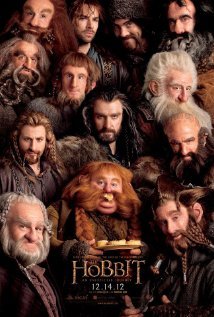
Now it’s time to tackle what is undoubtedly the pillar movie of this holiday season, The Hobbit. And don’t question me on that. I work at a movie theater and I’ve cleaned up enough BP-level popcorn spills in Hobbit theaters to prove that beyond all reasonable doubt.

Contrary to popular belief, that’s a broom in his hand.
For those of you unversed in cinematography, it is worth pointing out that Jackson (and select theaters near you) has made the choice to film the movie at a rate of 48 frames per second. The standard in modern cinema is 24 frames per second because, quite frankly, that’s pretty much all the eye can handle. The Hobbit holds the distinction for being the first movie to ever use this new and improved frame rate. It’s all part of Jackson’s innovative filmmaking experimentation (see: gimmickry).
The effect of exposing the eye to twice as many frames at a time creates a sort of hyperreality in which characters seem to be moving on fast forward while at the same time carrying on at a normal pace. It is about as disconcerting to watch as it is to write. Luckily, it’s pretty easy to get used to, and it is to tell the truth an incredible thing to watch.
In addition, the high frame rate has the effect of making the actors and sets seem much more immediate and real, in essence converting the film to have somewhat of the feel of a stage play, with the actors right there in the room with the audience. It is an absolutely intriguing technique but it out and out has no place in The Hobbit.
The Middle-earth of Jackson’s Lord of the Rings is all about spectacle, epic wonder, and the sheer scope of the land. However, the hyperrealism of the high frame rate allows a make-up spot here, a visible contact lens there, and some thoroughly unconvincing CGI everywhere to take the audience out of the fantasy.

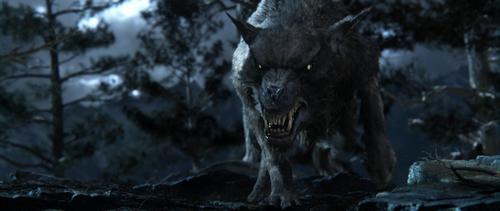
Look at that. Just embarrassing, isn’t it?
On to the plot, insofar as it exists.
The film follows Bilbo Baggins (Martin Freeman), a homebody hobbit from Bag End who is reluctantly dragged on an adventure across Middle-earth by the wizard Gandalf (Ian McKellen) to help some dwarves reclaim their captured kingdom.
That’s it. They don’t even make it. That’s for the next movie to cover.
With so little real meat to work with, the grotesquely bloated run time seeks to compensate for lack of material with an overabundance of antagonists. Two of which, the Necromancer, and the dragon Smaug are only briefly touched upon due to their commitments to the sequels. Even with those threats to deal with, our intrepid gang still has quite a task on their hands. Among the ranks of their enemies include a Goblin King and his army, the Pale Orc and his minions, a horde of trolls, massive rock giants, and the inimitable Gollum.
With such a group to face, the plot follows a “meet-defeat-on to the next one” pattern that is more suited for a video game than an actual narrative.
So, yes, this film has its flaws. But what Jackson Lord of the Rings film doesn’t?
The Hobbit offers enough action-packed sequences and canned movie wisdom to keep the audience entertained and enough knowledge of the Middle-earth universe to appease the hardcore Tolkien fans.
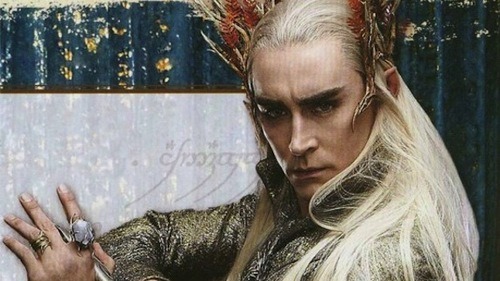
It also features a cameo appearance by Lee Pace, one of my favorite people ever, as the elf king Thranduil. The sight of his unsurpassable eyebrows appeased me, as did his comically over-the-top elf wig.
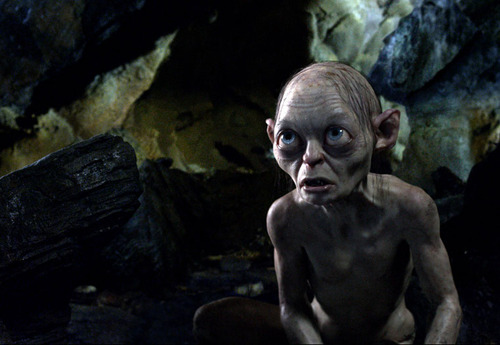
Also worth mentioning is Bilbo Baggins’ encounter with Gollum, by far the most entertaining, suspenseful, and well-composed scene of the film and that which makes the entire price of the ticket worthwhile. Is it bad that I think Gollum’s adorable?

Look at those big ‘ol eyes.
Andy Serkis surpasses himself with a pitch perfect rendition of one of the most beloved scenes in the novel. The man can do no wrong. Please, even if you are asleep until his scene and leave right after, at least come see the film for him.
TL;DR  The Hobbit is overlong, bloated, and features some unbelievably tacky CGI effects, but is redeemed by some strong actiony moments and Andy Serkis’s superb reprisal of the role of Gollum.
Rating: 6/10
Should I spend money on this? Yes, if only for the novel experience of the 48 fps and having Gollum blow you away. Did I mention Gollum?
Word Count: 896
Reviews In This Series
The Hobbit: An Unexpected Journey (Jackson, 2012)