Showing posts with label Lena Headey. Show all posts

Tuesday, December 13, 2016

Reviewing Jane: A Lady's Imagination Is Very Rabid

In which we review (almost) every film adapted from or inspired by the works of Jane Austen, as I read through her extended bibliography for the first time. (This is a previous review that has been retrofitted to be as such)

Year: 2016
Director: Burr Steers
Cast: Lily James, Sam Riley, Jack Huston
Run Time: 1 hour 48 minutes
MPAA Rating: PG-13

Would you believe that I’ve been waiting years for a Pride and Prejudice and Zombies movie? When I sat down to read the source material, Seth Grahame-Smith’s novelty mash-up novel, I was greatly disappointed to find that he had merely copy-pasted Jane Austen’s masterpiece and added a reference to zombies every other paragraph or so. It was a lazy cash grab, but I instantly hoped they would make it into a movie, because the concept is stellar and the visual medium would reduce its slavish devotion to the text of the novel.

I stand by that idea. A movie of Pride and Prejudice and Zombies is a great idea. Just not this movie.

Turns out, beggars CAN be choosers.

Running through the plot feels like a pointless exercise given the title of this movie, but let’s do it for the sake of tradition. Country girl Lizzy Bennet (Lily James) lives with her parents and sisters, all under pressure from their mother to get themselves married off, although she resists the idea. When Mr. Bingley (the preposterously beautiful Douglas Booth) moves into town with the sour zombie hunter Colonel Darcy (Sam Riley), Lizzys sister Jane (Bella Heathcoate) falls for Bingley while Lizzy herself catches Darcy’s eye.

Thus begins a tentative romance between two stubborn, star-crossed lovers as the British prepare for battle with the zombie hordes that threaten the London stronghold. Also, Lizzy has a brief dalliance with one Lt. George Wickham (Jack Huston, who you probably don’t recognize as the new Ben-Hur because nobody saw that movie), who shows her that the zombies may be forming an I Am Legend-esque society where they retain aspects of their humanity while the living senselessly slaughter them. But nothing comes of it because Grahame-Smith is not Richard Matheson.

Frankly, it’s insulting to even mention their names in the same sentence. Please accept my humblest apologies.

Pride and Prejudice and Zombies is in a weird place, tonally. The characters in the story must take themselves seriously in order for the absurdity of the premise to land. This is also true of the satire present in the source material. So far so good. Unfortunately the satirical elements of Austen are damped by the zombie mayhem, shifting the priorities of the characters too far from their original focus on marriage-above-all to be effective.

If the film had doubled down on its action sequences and gross zombie mutilations, it could have overcome that flaw by instilling a further sense of fun, but the gleefully grotesque potential is hampered by a PG-13 rating, leaving us with a social satire/absurdist mash-up in which neither of those halves are particularly funny. This maddeningly delicate tonal balance could still have worked, but it definitely required a lighter directorial hand than the one attached to 17 Again auteur Burr Steers.

According to IMDb, David O. Russell was originally attached to helm this movie. It probably would have still sucked, but imagine a universe where that happened. Delightful.

So, no. Pride and Prejudice and Zombies is not fun. It is not gory. It is not even a little bit campy. It’s still better than the book, but what’s the point of comparing a dumpster to a landfill? The film is mostly a desaturated, overserious slog that’s utterly dull to watch, like The Witch only with no obvious intention and not a single memorable frame. There are occasional sparks of life in the shambling corpse of a film, like the expositional opening credits presented in pop-up book form or a fun twist on the Indiana Jones map cutaway, depicting the characters’ journeys as a droplet of blood running down a map. But these genuinely delightful design elements are buried under a pile of glum, grey gunk.

It doesn’t help that the plot is a shambles. The guardrails of the Pride and Prejudice text (in which – spoilers, I guess – no major character dies) prevent anything particularly interesting or deadly from happening, and the one wholecloth addition to the plot – the zombie war and the unique way the zombies can avoid losing their human faculties – is a dreadful mess. The battlefront scenes require Gahame-Smith to use his own imagination, so they’re a nonsensical slurry. The main villain’s endgame is wholly perplexing and the film introduces a strangely supernatural element (four literal horsemen of the apocalypse) that it completely ignores. Pride and Prejudice and Zombies constantly hints that there’s a far more interesting film going on somewhere around the edges, but that just makes it all the more frustrating that we’re frogmarched through the Darcy-Lizzy romance, brought to life by two actors who have absolutely zero chemistry. (James is fine here, but Riley grumbles out his lines like he’s slowly being turned to stone).

Every addition to the source material is muddled, and their presence renders the power of the original story impotent, so there’s no particular reason for the film to exist. Jane Austen’s dialogue is still great, so at least it’s possible to sit through the film and survive the experience. And there’s one shining jewel in the film’s blasted, bloodless firmament: Matt Smith’s excellent and hilarious performance as the foppish Parson Collins. But this film stabs itself in the back at every turn, rendering it an extravagantly pointless affair.

TL;DR: Pride and Prejudice and Zombies is a boring sludge of taking itself too seriously.
Rating: 5/10
Word Count: 917
Other Films Based on Pride and Prejudice
Pride and Prejudice (Leonard, 1940)
Pride and Prejudice (miniseries - Langton, 1995)
Bridget Jones's Diary (Maguire, 2001)
Pride & Prejudice: A Latter-Day Comedy (Black, 2003)
Bride & Prejudice (Chadha, 2004)
Pride and Prejudice (Wright, 2005)
Unleashing Mr. Darcy (Winning, 2016)
Pride and Prejudice and Zombies (Steers, 2016)
Before the Fall (Geisler, 2016)
Marrying Mr. Darcy (Monroe, 2018)
Christmas at Pemberley Manor (Theys, 2018)
Pride, Prejudice, and Mistletoe (McBrearty, 2018)

Thursday, June 13, 2013

I've Seen the Future, and It Is Low Budget


Year: 2013
Director: James DeMonaco
Cast: Ethan Hawke, Lena Headey, Max Burkholder
Run Time: 1 hour 25 minutes
MPAA Rating: R

These home invasion movies are getting pretty big now, or so it would seem. A preview before The Purge for the upcoming film You're Next features a mind-numbingly similar plot line, and both films clearly raided the costume closet of The Strangers

Oh well. It's better than torture porn.

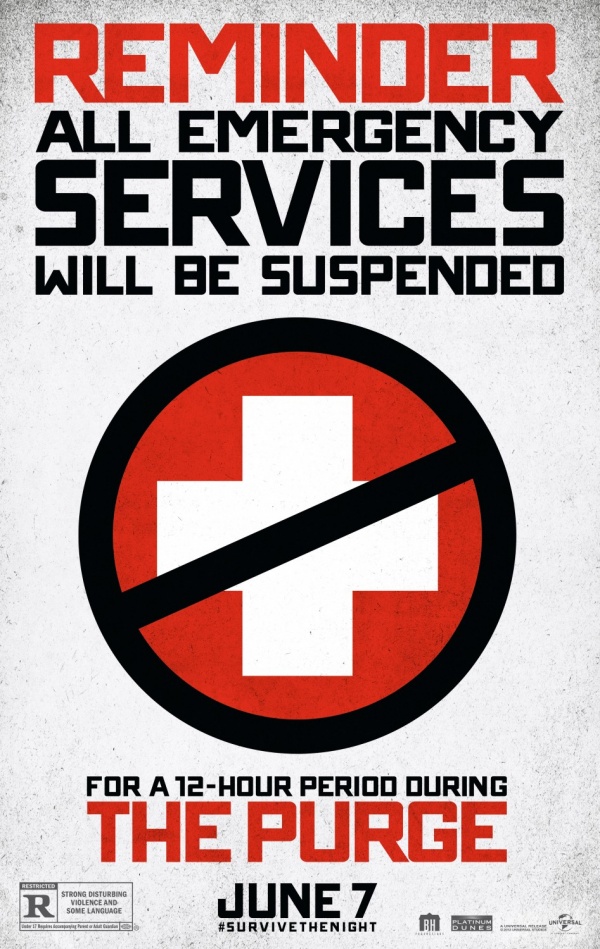
But I digress. Despite what it, let's say, borrows from its predecessors, The Purge has a leg to stand on with a solid and clever premise. It is the year 2022 and crime is at an all time low. The economy is booming and the quality of life is as never before, all because one night a year all crime is legal. Ordinary people can murder, rape, and pillage to their hearts' content ostensibly for the purpose of getting pent up aggression and violence out of their systems.

Our protagonists for the evening are the Sandin family - a wealthy clan living in a gated community. The father, James (Ethan Hawke), is a successful businessman who sells state-of-the-art security systems for use during the Purge. His wife Mary (Lena Headey, who I'm told is a Game of Throne) is a woman who womans. Their teenage daughter Zoey (Adelaide Kane) rebels against the strict rules laid down by her father, spurred on by her Statutory Rapey boyfriend, Henry (Tony Oller). The younger son Charlie (Max Burkholder) has invented a little remote-controlled robot that is equipped with night vision and silent wheels and has a secret hiding place behind a loose panel in his closet. You can practically hear Chekhov's gun getting cocked for the third act.

At 7 PM, the Purge begins and the family cozies up behind their thick steel barricades, safe in the knowledge that they will live to see another - oh, wait. Charlie let in a homeless man who is being pursued by a cadre of masked strangers.


Oh, that Charlie. What a goof.

The strangers, led by a charismatic and totally bonkers young man (Rhys Wakefield), have picked this man as their target for this year's Purge and will stop at nothing to see him dead. They threaten to murder the entire family if they don't turn the man over to them. The Sandins take issue with this, and prepare themselves for the longest night of their lives.

What a pickle!

The Purge is one of those magical movies through which I can convince my boyfriend I'm psychic by accurately predicting every story beat about 20 minutes before it happens, though that isn't necessarily a bad thing. There is some comfort in familiarity, after all, and The Purge delivers a mostly solidly constructed home invasion thriller that is engaging and (perhaps most importantly) brief.

By sticking with an 85 minute run time, credits included, The Purge ends before it can squander the underdog goodwill earned through its absurdly low $3 million budget. There are a few key movie sins that, had we been forced to spend more time with them, would have overwhelmed the production. For the sake of simplicity, I will divide these flaws into three categories.

First, The Purge is a less than flawless morality play about class division and right to life that frequently bludgeons the audience with its opinion. Obviously, the filmmakers had Something Very Important to say, and wanted to make sure nobody missed it.

This is not an unfounded concern. A good portion of the film is devoted to news coverage of the Purge showing people being mercilessly beaten and killed in every corner of the country. In a very Hunger Games-esque touch, this footage is compiled for the wealthy families to enjoy from the safety of their own homes. The point being that society at large is so desensitized to violence that real world atrocities have become nighttime entertainment. That this message occurs in a film in which the primary draw is the violence inflicted upon unwilling participants is not addressed. 

Most of the violence in the film is inflicted upon faceless, mask-wearing criminals or villains so cartoonishly evil that they are in fact stripped of all humanity. However, this doesn't change the fact that  this is exactly what the filmmakers are condemning, and that cognitive dissonance lingers throughout the film.


Yup, there's still humans under there. Isn't it weird how masks work?

Second, the editing is kind of a mess. The entire film takes place in a sprawling mansion but we the audience get very little sense of the geography of the house and where rooms are in relation to one another. Thus intercutting a scene of somebody about to get murdered in one room and somebody running to save them from another room has no real impact because we have no clue how close together those rooms actually are.

In addition, there is a lengthy stalking scene straight out of an 80's slasher movie in which Mary crosses three rooms pursued by a shadowy figure that, if the cross-cutting is to be believed, actually took place over a good half hour of filmic time. 

And do you know that scene in the end of every action movie where the hero is about to get stabbed/shot/freeze rayed but the villain screams and falls, revealing the sidekick holding a gun who miraculously saves the day? Do you like that scene? Good. It happens approximately 29 times.

Finally, the characters act like the worst of the worst Stupid Horror Movie Characters. They bumble all over the place slamming doors and turning lights on when they're trying to hide and getting jump scared around every corner. The first ten minutes even feature the hackneyed "something is hiding behind the refrigerator door!" scare.


Under the bed. Unique. Good work.

These scenes can be found in any commonplace horror movies from any decade basically since films have existed, and are the biggest detriment to the film. For The Purge is not at all a good horror movie. I would go so far as to suggest that it isn't even horror at all. Oh, it tries to be. But what the filmmakers ignore is that they actually have a pretty good action thriller on their hands.

All in all, despite its flaws, The Purge is a serviceable thriller that, while predictable, is built on a fresh premise and is accommodating in giving us what we want to see in terms of a butt-kicking good time (if you ignore all that high and mighty moral stuff). It also features some truly impressive world building. The Purge creates and inhabits its own universe, and not once did I doubt that this was a world in which the Purge has been happening for years.

In fact, one of my favorite details of the film was in the beginning. As the neighbors were preparing for that night's Purge, instead of saying "Good night" or "See you tomorrow," they said "Have a safe night." The manner in which it was said indicated that it was a commonplace saying, one that has long since gained acceptance in the lexicon of their world and that nobody really pays attention to. It's just a part of that pre-programmed script of small talk and daily pleasantries, tucked snugly between "Nice weather today" and "How's your kids?"

The Purge works best when it gets to play with the world it has created and luckily it doesn't disappoint. And even though it has some big problems, it is a genuine film and you can feel the personality of the filmmakers behind every frame, which is worth a couple extra points in my book.

TL;DR: The Purge isn't what it wants to be, but the thing it is isn't too shabby in and of itself.
Rating: 6/10
Should I spend money on this? Yes, because it really is an impressive movie for its miniscule budget.
Word Count: 1323
Reviews In This Series
The Purge (DeMonaco, 2013)
The Purge: Anarchy (DeMonaco, 2014)

The Purge: Election Year (DeMonaco, 2016)
The First Purge (McMurray, 2018)