Showing posts with label Ethan Hawke. Show all posts

Tuesday, May 12, 2015

Boogie Nights

Year: 2012
Director: Scott Derrickson
Cast: Ethan Hawke, Juliet Rylance, James Ransone
Run Time: 1 hour 50 minutes
MPAA Rating: R

The horror genre is tough. Hollywood has always and will always follow trends to their breaking point, if my constant hackings through the foliage of the slasher genre have taught us anything. But the problem with this is that the market becomes so inundated with identical flicks (*cough cough Marvel*) that genuinely good movies get forgotten in the shuffle or lose their impact due to their similarity to previous releases.

Today's biggest craze in the horror genre is the paranormal/haunting movie, with the biggest examples being the Paranormal Activity franchise, The Conjuring and its bloodsucking hanger-on Annabelle, and Insidious with its bevy of sequels

Over time, sameness sets into any genre like a rot. But when you consider that three of these films are directed by James Wan and star Patrick Wilson, and that over half of them have been contributed by Blumhouse Productions (who have become the It name for trendy horror), it's reasonable that a project like Sinister, also released by Blumhouse two years following the success of Insidious, would get lost in the swells.

They even use the same chiropractor between shots!

For what it's worth, Sinister didn't try very hard to separate itself from the Insidious routine other than shifting the main focus in the besieged nuclear family from the mother to the father. Inspired! 

The plot goes as follows: true crime author Ellison Oswalt (Ethan Hawke) has moved into a new home with his wife (Juliet Rylance), daughter (Clare Foley), and son (Michael Hall D'Addario). What he hasn't told them is that the house is the site of his latest subject, a family who were hung from the tree in the backyard before the youngest daughter went missing. (Side Note: If you can't figure out the mid-film twist before Ellison does, you are either asleep or watching a different movie.)

In the attic he finds a set of tapes with innocuous-sounding names ("Family Barbecue," "Pool Party," etc.) that depict a series of grotesque family murders from across the country, including the crime scene from his very backyard ("Hanging Out"). It doesn't take long for him to discover a demon known as Bughuul (Nick King) - aka Mr. Boogie because every respectable demon needs a ridiculous name that the local children can call him - resides within the images and haunts him and his family as he attempts to discover the secret behind the mysterious tapes and finish his book, upon which his entire faltering career hinges.

Maybe he's just confused that there are films that exist that weren't directed by Richard Linklater.

Certainly Sinister's plot takes the road most traveled, but that is perhaps the least of its sins. Although the bulk of its scare sequences are cribbed from other paranormal flicks, the film is quite creepy very often, especially whenever Ellison watches a new murder tape, which are grainy, grisly, and by far the most genuinely disturbing original element of the entire film. But the problem is that the film amasses flaws like an Alicia Silverstone character at the mall with her dad's credit card.

As I implied earlier, the central mystery is far too easy to figure out (making it all the more frustrating when Ellison fails to grasp it), and the wife character is inconsistently written, unbelievably gullible, and far too pliable when it comes to letting her children sleep in the bedrooms of murdered children. Not to mention that the nightly scare scenes become repetitive and downright exhausting. 

Seriously, Bughuul's nightly schedule (turn on a film in some unsuspecting part of the house, wait for Ellison to hear the flapping of film that his family is mysteriously numb to, appear in the shadows, repeat) is more rigorous and reliable than the Long Beach bus timetable.

The ending is flabby and runs out of gas long before the supposedly climactic reveal, and a series of useless characters shuffle briefly into the second act, only to provide explanatory but patently useless information far too late for the film to do anything interesting with it. 

In short, Sinister is a film in desperate need of tightening up. At nearly two hours, the film is far too sprawling for its relatively lean story. I suppose it's kind of ironic, considering that the main character spends the bulk of his time editing film footage together. But that irony is easily lost on the viewer as they snooze through the final third of the film.

It's a real shame, because aside from its extensive collection of film-maiming deficiencies, Sinister is really a quite good chiller. Alongside a series of authentic frights and a wonderfully effective comic relief in the form of Ellison's helper, Deputy So & So (James Ransone), it builds an enthralling mythology for its demon that separates it from the pack with thematic and engaging material. But it squanders these ideas by shuttling Bughuul off on other business while we are forced to watch Hawke try his darndest to keep his constant flailings at a film projector entertaining.

All in all, Sinister is decent, but utterly unmemorable, just like director Scott Derrickson's intensely muddled follow-up Deliver Us From Evil. There are enough good elements to prevent it from being a total flop (and I'm genuinely excited for Sinister 2, which seems like it cut the fat considerably), but it's not worth checking out amid the noise and clamor of the thousands of other lookalikes populating the genre at the moment.

TL;DR: Sinister is decently scary, but too generic and sprawling to overcome its flaws.
Rating: 6/10
Word Count: 943
Reviews In This Series
Sinister (Derrickson, 2012)
Sinister 2 (Foy, 2015)

Monday, January 12, 2015

Deeper By The Dozen

Year: 2014
Director: Richard Linklater
Cast: Ellar Coltrane, Patricia Arquette, Ethan Hawke
Run Time: 2 hours 45 minutes
MPAA Rating: R

Welcome back to the "Brennan's A Little Late" blog, where our current topic of discussion is Boyhood, Richard Linklater's 2014 critical darling. The film, depicting the coming of age of Texas boy Mason Evans, Jr. (Ellar Coltrane), was shot in pieces over the course of 12 years and compiled into a single narrative in which a sprawling tale of life is shown in more or less real time, as Coltrane ages, pupates, and grows before our eyes.

They might has well have just called the boy "Oscar" and gotten it over with.

As people do in life, characters come and go during Boyhood's decade and change, but at the film's center are Mason, his mother Olivia (Patricia Arquette), his absentee father Mason Sr. (Ethan Hawke), and his sister Samantha (Lorelei Linklater). Their lives are splayed out and dissected in intimate detail in front of us as Olivia cycles through a wheel of deadbeat husbands, Mason Sr. attempts to get his life together, Mason Jr. plays video games and mopes about glum philosophy, and Samantha watches Lady Gaga music videos and is generally a useless, petulant turd like most high schoolers.

No story beat really adheres to the next. Moment after moment occurs with no clear arc or progression, except for the inexorable march of time. The movie is so long that this storytelling style might have quickly become a problem, but Boyhood's frequent time jumps keep the pace brisk, turning a sprawling narrative into a series of short, pointedly unconnected vignettes.

The best thing I can say about the story and the stakes, as minimal as they may be at times, is that they avoid common tropes are unconventionally subtle for indie movie territory, largely avoiding the excesses and obscenities that other filmmakers might use, given a similar gimmick. Luckily, Linklater has proven himself as a master of low-key storytelling and ineffable patience with his Before [Whatever] trilogy, and his presence here is incalculably valuable.

In a way, his style is like... a magnifying glass that... lets us explore Ethan Hawke's face? (Captions are tough.)

But while its gestures toward innovation in storytelling are unique and precise, on the level of pure craft, Boyhood is a fairly average film. There are some long, lingering takes and impressive tracking shots that imperiously plant you in the time and place, but the cinematography generally avoids flashy tricks. It's an average looking film for an average looking life. The performances are likewise toned down and avoid grappling for attention. 

Patricia Arquette is by far the standout, bringing a magnetic gravity and realism to a woman blundering her way through life. And Ethan Hawke is no stranger to Linklater jerking him around a decade at a time, so his performance is skillful if less captivating. Ellar Coltrane does just fine (considering how hard it is to cast child actors and just pray that they improve as they age), although he isn't given much to work with besides being a gloomy teen. The weakest link is Lorelei Linklater, whose name gives the whole story away, I should think.

As a child, she demanded she be included in her father's movie, but after a couple years she grew bored of playing pretend. She finds her focus again later on as she retreats to the sidelines, but for several years she is inconsistent and shrill, actively battling against the tone of the movie. Likewise, her skin tone and hair color actively thwart the already One-Direction-biography thin pretense that the four actors involved are genetically related in any way.

How can Caucasian parents have a red son? It just doesn't make sense!

What I have described thus far is a film that's pleasant, but largely pointless. It's fun to watch time pass and marvel at the technological innovations and cultural signifiers (Harry Potter, Lady Gaga, Nintendo consoles, and Barack Obama get the biggest airtime. It's like a nostalgic treasure hunt.), but the stories themselves have no apparent link until the film's final moments, when the whole sprawling tableau lies before you in one wondrous piece.

It's no grand drama and there's no hero. There's no character arc or antagonist. There's no happy ending, nor is there a tragedy. The characters just bump into one another and, depending on the timing, stick around or don't. But that's just life, isn't it? Your ability to enjoy Boyhood as more than a series of average events lies in active viewership and contemplation about the nature of life, relationships, and aging rather than... you know, actually being an interesting story.

It's not quite as transcendently powerful as the rave reviews have been saying. And it's certainly not for everyone.

In fact, I get the sense that Mason himself wouldn't be a fan of it.

But Boyhood shows us that everybody is just as stuck in the moment and confused about the future as we are and that the mundane human experience is the thing we have most in common. If I might hazard a guess, I'd say this film only gets better as we get older. Speaking as a 20-year-old in Southern California, I'm less powerfully impacted by Boyhood's apparent randomness than, say, a middle aged father of three. But I see what the film has to say about life, the universe, and everything and haven't stopped thinking about it since I sat down to watch it. A film like that just doesn't come around every day. Even if that film is a little bit affably banal.

I certainly wish that the central figure was less of a wet mop and that the film didn't insist on making us watch Ethan Hawke playing the guitar so damn much, but the film rises above that sort of petty nonsense. Boyhood is a valuable film text for the young and old, as long as you have the patience to let it wash over you.

TL;DR: Boyhood is, from my angle, a tad too aimless, but nevertheless I am not immune to its charms.
Rating: 8/10
Word Count: 1024

Thursday, June 13, 2013

I've Seen the Future, and It Is Low Budget


Year: 2013
Director: James DeMonaco
Cast: Ethan Hawke, Lena Headey, Max Burkholder
Run Time: 1 hour 25 minutes
MPAA Rating: R

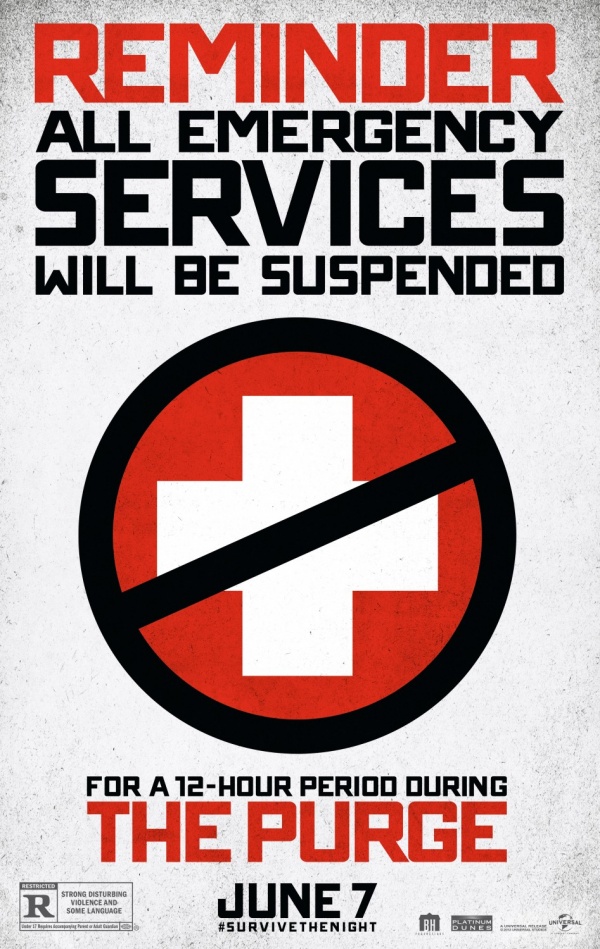
These home invasion movies are getting pretty big now, or so it would seem. A preview before The Purge for the upcoming film You're Next features a mind-numbingly similar plot line, and both films clearly raided the costume closet of The Strangers

Oh well. It's better than torture porn.

But I digress. Despite what it, let's say, borrows from its predecessors, The Purge has a leg to stand on with a solid and clever premise. It is the year 2022 and crime is at an all time low. The economy is booming and the quality of life is as never before, all because one night a year all crime is legal. Ordinary people can murder, rape, and pillage to their hearts' content ostensibly for the purpose of getting pent up aggression and violence out of their systems.

Our protagonists for the evening are the Sandin family - a wealthy clan living in a gated community. The father, James (Ethan Hawke), is a successful businessman who sells state-of-the-art security systems for use during the Purge. His wife Mary (Lena Headey, who I'm told is a Game of Throne) is a woman who womans. Their teenage daughter Zoey (Adelaide Kane) rebels against the strict rules laid down by her father, spurred on by her Statutory Rapey boyfriend, Henry (Tony Oller). The younger son Charlie (Max Burkholder) has invented a little remote-controlled robot that is equipped with night vision and silent wheels and has a secret hiding place behind a loose panel in his closet. You can practically hear Chekhov's gun getting cocked for the third act.

At 7 PM, the Purge begins and the family cozies up behind their thick steel barricades, safe in the knowledge that they will live to see another - oh, wait. Charlie let in a homeless man who is being pursued by a cadre of masked strangers.


Oh, that Charlie. What a goof.

The strangers, led by a charismatic and totally bonkers young man (Rhys Wakefield), have picked this man as their target for this year's Purge and will stop at nothing to see him dead. They threaten to murder the entire family if they don't turn the man over to them. The Sandins take issue with this, and prepare themselves for the longest night of their lives.

What a pickle!

The Purge is one of those magical movies through which I can convince my boyfriend I'm psychic by accurately predicting every story beat about 20 minutes before it happens, though that isn't necessarily a bad thing. There is some comfort in familiarity, after all, and The Purge delivers a mostly solidly constructed home invasion thriller that is engaging and (perhaps most importantly) brief.

By sticking with an 85 minute run time, credits included, The Purge ends before it can squander the underdog goodwill earned through its absurdly low $3 million budget. There are a few key movie sins that, had we been forced to spend more time with them, would have overwhelmed the production. For the sake of simplicity, I will divide these flaws into three categories.

First, The Purge is a less than flawless morality play about class division and right to life that frequently bludgeons the audience with its opinion. Obviously, the filmmakers had Something Very Important to say, and wanted to make sure nobody missed it.

This is not an unfounded concern. A good portion of the film is devoted to news coverage of the Purge showing people being mercilessly beaten and killed in every corner of the country. In a very Hunger Games-esque touch, this footage is compiled for the wealthy families to enjoy from the safety of their own homes. The point being that society at large is so desensitized to violence that real world atrocities have become nighttime entertainment. That this message occurs in a film in which the primary draw is the violence inflicted upon unwilling participants is not addressed. 

Most of the violence in the film is inflicted upon faceless, mask-wearing criminals or villains so cartoonishly evil that they are in fact stripped of all humanity. However, this doesn't change the fact that  this is exactly what the filmmakers are condemning, and that cognitive dissonance lingers throughout the film.


Yup, there's still humans under there. Isn't it weird how masks work?

Second, the editing is kind of a mess. The entire film takes place in a sprawling mansion but we the audience get very little sense of the geography of the house and where rooms are in relation to one another. Thus intercutting a scene of somebody about to get murdered in one room and somebody running to save them from another room has no real impact because we have no clue how close together those rooms actually are.

In addition, there is a lengthy stalking scene straight out of an 80's slasher movie in which Mary crosses three rooms pursued by a shadowy figure that, if the cross-cutting is to be believed, actually took place over a good half hour of filmic time. 

And do you know that scene in the end of every action movie where the hero is about to get stabbed/shot/freeze rayed but the villain screams and falls, revealing the sidekick holding a gun who miraculously saves the day? Do you like that scene? Good. It happens approximately 29 times.

Finally, the characters act like the worst of the worst Stupid Horror Movie Characters. They bumble all over the place slamming doors and turning lights on when they're trying to hide and getting jump scared around every corner. The first ten minutes even feature the hackneyed "something is hiding behind the refrigerator door!" scare.


Under the bed. Unique. Good work.

These scenes can be found in any commonplace horror movies from any decade basically since films have existed, and are the biggest detriment to the film. For The Purge is not at all a good horror movie. I would go so far as to suggest that it isn't even horror at all. Oh, it tries to be. But what the filmmakers ignore is that they actually have a pretty good action thriller on their hands.

All in all, despite its flaws, The Purge is a serviceable thriller that, while predictable, is built on a fresh premise and is accommodating in giving us what we want to see in terms of a butt-kicking good time (if you ignore all that high and mighty moral stuff). It also features some truly impressive world building. The Purge creates and inhabits its own universe, and not once did I doubt that this was a world in which the Purge has been happening for years.

In fact, one of my favorite details of the film was in the beginning. As the neighbors were preparing for that night's Purge, instead of saying "Good night" or "See you tomorrow," they said "Have a safe night." The manner in which it was said indicated that it was a commonplace saying, one that has long since gained acceptance in the lexicon of their world and that nobody really pays attention to. It's just a part of that pre-programmed script of small talk and daily pleasantries, tucked snugly between "Nice weather today" and "How's your kids?"

The Purge works best when it gets to play with the world it has created and luckily it doesn't disappoint. And even though it has some big problems, it is a genuine film and you can feel the personality of the filmmakers behind every frame, which is worth a couple extra points in my book.

TL;DR: The Purge isn't what it wants to be, but the thing it is isn't too shabby in and of itself.
Rating: 6/10
Should I spend money on this? Yes, because it really is an impressive movie for its miniscule budget.
Word Count: 1323
Reviews In This Series
The Purge (DeMonaco, 2013)
The Purge: Anarchy (DeMonaco, 2014)

The Purge: Election Year (DeMonaco, 2016)
The First Purge (McMurray, 2018)