Showing posts with label Ian McKellen. Show all posts

Wednesday, August 10, 2016

Q2 Review Purge: Volume 2

You thought I’d finished clearly out my backlog with just five measly reviews? Ha! You underestimate my movie-watching prowess. We’ve got another set of hot ‘n ready reviews coming atcha.

Night of the Comet (For the Scream 101 episode about this film, click here. For the Scream 101 interview with Kelli Maroney, click here.)


Year: 1984
Director: Thom Eberhardt
Cast: Catherine Mary Stewart, Kelli Maroney, Robert Beltran
Run Time: 1 hour 35 minutes
MPAA Rating: PG-13

After a deadly comet reduces the world’s population to ash, two valley girls must fight their way through a silent LA filled with radiation zombies, crooked scientists, and shopping montages.

Night of the Comet is one of those great 80’s movies that has not only a towering high concept, but an intimate, human story to tell within it. While the idea of “valley girls vs. the apocalypse” is like bread and butter for trashy horror fans, NotC is much more than meets the eye. Its valley girl veneer is certainly mined for comedy, but there’s something intensely thoughtful pulsing beneath the surface of the film. These are two girls with a severely narrow worldview (“This happened everywhere? Like, even in Burbank?”) that are stripped of everything they took for granted and forced to face a cold, dead world.

The shallow creature comforts they pursue pale in comparison to survival and connecting with the few humans that still remain. It’s hilarious because it’s so bleak, but the emotions that well up from time to time, especially in Kelli Maroney’s striking performance and Mary Woronov’s world-weary acceptance of destruction, are completely earned for that very same reason.

But Night of the Comet, despite its surprising heft, isn’t a tearjerker. It’s a cotton candy blast lit with bright, sci-fi comic slashes of neon color. While I do wish it had the budget to take its perfect concept even further, it’s an intelligent, fun movie with well-drawn characters, masterful production design, and a hellishly witty script jam packed with instantly memorable one-liners.

Rating: 8/10


The Changeling (For the Scream 101 episode about this film, click here.)

Year: 1980
Director: Peter Medak
Cast: George C. Scott, Trish Van Devere, Melvyn Douglas
Run Time: 1 hour 47 minutes
MPAA Rating: R

A bereaved composer takes up residence in a historical house that turns out to be haunted.

The Changeling is a very classical ghost story almost to a fault. Although the drawn-out, methodical scares pack a punch, sometimes the story lingers a little too much on the past. As our hero investigates the history of the house, the third act slowly unravels until it’s a feeble drama about two old men screeching at one another. Until, of course, it isn’t. The finale is the best kind of grandiose, plunging its low-key atmosphere into a shrieking inferno of special effects and frenzied, unpredictable editing.

While the third act swings from dull to gonzo, the first two are firmly set in traditional haunted house mode á là The Haunting. Though modern viewers may be numb to the effects of these scenes after decades of rip-offs and copycats, they’re expertly executed, with lurking camerawork suggesting an uninvited presence, sharp editing linking the protagonist’s tragic past to the history of the house, and an echoing, sinister sound design that will drives spikes of fear directly into your spine.

The two most startling sequences are birthed from this atmosphere: one the best séance I’ve ever seen, using performance and rhythm to scare rather than special effects, the other a subtle, lingering reaction shot that milks every last heebie jeebie out of something appearing somewhere it patently shouldn’t be.

Without talented filmmakers at the helm, The Changeling would be dry and predictable, but its perfectly crafted scares make it an indelible classic of the genre, even if the plot is a little been-there, done-that.

Rating: 7/10


Brokeback Mountain
Year: 2005
Director: Ang Lee
Cast: Jake Gyllenhaal, Heath Ledger, Michelle Williams
Run Time: 2 hours 14 minutes
MPAA Rating: R

Two gay cowboys fall in gay love with each other and it’s very gay but mostly sad.

As a gay gentleman myself, it’s basically sacrilege that I waited this long to watch Brokeback Mountain. But you know what I almost never want to watch on an average day? A tearjerker about how super duper hard and sad it is to be gay. At least nobody gets AIDS, like in every other gay movie ever made.

So no, Brokeback Mountain is not in my wheelhouse, though it’s a terrific film. A sweeping romance that spans decades (as evidenced by Anne Hathaway’s chain of increasingly preposterous wigs), it highlights two fantastic performers working at the peak of their abilities. Gyllenhaal and Ledger are so credible and grounded in real emotion that this “gay cowboy” movie becomes a universal love story about passion, loss, and disappointing your parents.

Opening with what’s essentially a silent film about two men thrown together slowly developing respect for one another and culminating in a violently lustful act, Brokeback Mountain uses its epic sprawl to detail the impact that one encounter can have on an entire life. Two entire lives. Its scope is set as wide as the Wyoming sky, covering topics of class disparity, marriage compromise, gender warfare, and dozens more without breaking a sweat. Do I ever want to watch it again? No. But I know I will.

Rating: 8/10


Lust, Caution
Year: 2007
Director: Ang Lee
Cast: Tony Chiu Wai Leung, Wei Tang, Joan Chen
Run Time: 2 hours 37 minutes
MPAA Rating: NC-17

A Chinese actress working for the rebellion poses as the mistress of a cruel government official to draw him into an assassination, but falls in love with him in the process.

Ang Lee needs to hire a better editor. After converting the short story Brokeback Mountain into a sprawling epic, he has taken Eileen Chang’s novella Sè Jiè and stretched it on the rack until it’s over two and a half hours long. It does not serve the material well.

Sure, the opening hour is great. While Lust, Caution is an espionage picture about rank amateurs playacting rebellion until it gets too real, it’s a piano wire thriller with a soaring sense of danger and fun. But then it turns into – gag me with a spoon – a love story, and things quickly spiral out of control. Despite the best efforts of its talented leads, Lust, Caution fails miserably to make a case for these two actually falling in love. Their cold, S&M style liaisons might be rendered romantic with a Pedro Almodóvar or, hell, even a Clive Barker at the helm, but Ang Lee suffocates the film. He draws out the relationship far longer than it can be sustained and his relentless formalism keeps us at a constant remove from his characters’ humanity.

What I do admire about Lee’s work here is that the man knows how to craft a visual metaphor. The endless rounds of mahjong underscore our heroine’s constant awareness that she’s playing a high stakes game, and the latter half is sprinkled with shots that indicate how she’s feeling, even if the movie is too chilly to actually explicitly express it. Lust, Caution isn’t a bad movie, it’s just needlessly prolonged. It’s well crafted but empty, like a Ming vase.

Rating: 6/10


X-Men: The Last Stand
Year: 2006
Director: Brett Ratner
Cast: Patrick Stewart, Hugh Jackman, Halle Berry
Run Time: 1 hour 44 minutes
MPAA Rating: PG-13

The mutant community is dived over a cure for the mutant gene, leading to an all-out war with humanity caught in the middle.

X-Men: The Last Stand, the third and final movie in the original cinematic X-Men chronology, has somewhat of a reputation for sucking hard. While I wouldn’t argue against the fact that it’s a tremendously silly potboiler, it’s hardly the worst movie ever made. It’s not even close to the worst X-Men movie ever made.

Yes, it has deep, fundamental flaws. The final battle is a rickety, one-liner-ridden disaster, and its secondary villain, Jean Grey’s dark alter ego The Phoenix, is both a botched pull from the comics and an egregious anticlimax. But people forget that silly movies can be fun.

I love me an unpredictable piece of cinema, and The Last Stand’s almost psychotic willingness to kill off its own characters is captivating. And the CGI is unforgivably crummy, but it provides a flavor blast of summer movie fun by upping the number of effects sequences to a delirious degree. Little comic touches in the script actually work, and two performers pull the beast back from the brink of destruction: Hugh Jackman and Ian McKellen. Jackman is a charismatic badass that provides Wolverine with gruff sympathy so well that he spackles most of the holes in his mothbitten plot. And McKellen is once again a crackerjack villain with a wounded human soul, relishing in his own dastardly ego while drawing from his Holocaust background to provide an actually powerful, compelling turn as Magneto once again.

There’s not a ton to praise about X-Men: The Last Stand, but it’s a sugar rush that only hurt your stomach a teensy bit.

Rating: 6/10
Word Count: 1528
Reviews In This Series
X-Men (Singer, 2000)
X2: X-Men United (Singer, 2003)
X-Men: The Last Stand (Ratner, 2006)
X-Men: First Class (Vaughn, 2011)
X-Men: Days of Future Past (Singer, 2014)
X-Men: Apocalypse (Singer, 2016)

Friday, June 24, 2016

Popcorn Kernels: Sequel-Itis

In which we write mini reviews of films that explore the dichotomy of movie sequels. Both follow flicks released in 2000. One’s a bigger, better improvement and the other is a no good, scum-sucking disappointment that let its nascent franchise wither on the vine.

X2: X-Men United


Year: 2003
Director: Bryan Singer
Cast: Patrick Stewart, Hugh Jackman, Halle Berry 
Run Time: 2 hours 14 minutes
MPAA Rating: PG-13

The X-Men and Magneto’s team of evil mutants must join forces to combat a bigger evil: a crazed colonel hellbent on destroying all mutantkind.

If you remember, Bryan Singer’s 2000 film X-Men was a slight but politically aware superhero movie that was fun but no masterpiece. What makes his followup X2 the pinnacle of the series is that it removes the slightness, but as close as it gets, it’s still no masterpiece. Beefing up the already sprawling number of X-Men with the teleporting Nightcrawler (Alan Cumming, rocking flawless blue makeup), the gender-bent Wolverine Lady Deathstrike (Kelly Hu of Friday the 3th Part VIII: Jason Takes Manhattan – got skeletons in your closet? Let me remove those for you.) and expanded roles for teen polar opposites Pyro (Aaron Stanford) and Iceman (Shawn Ashmore, wistful sigh), the cast is even more cumbersome but the political context is even more charged, coming in the wake of September 11th, 2001.

In X2, America is on the verge of Civil War as humans have become increasingly more aware (and afraid) of the mutants living among them. X2 puts all its cards on the table in the opening scene, in which Nightcrawler attempts to assassinate the president to promote Mutant rights. Not only is it a stunning action sequence on the bleeding edge of film technology at the time, it’s a heady parallel to both Abraham Lincoln and John F. Kennedy. The embers of political subtext (namely, gay rights) in X-Men have become a blazing inferno in the edgy paranoid grip of a post-9/11 society.

X2 maintains this social statement from frame one, though its intelligence flags at certain points. It’s astonishing that a film that contains a visual metaphor so complex as the scene where Professor X freezes all the humans at a museum right next to the exhibit depicting motionless Cro-Magnon figurines (indicating that humans are no longer the next big thing in evolution) could also be so wickedly unconvinced of its audience’s IQ that it needs Mystique to flash her eyes yellow in a place where she could easily be compromised just so we can know that it’s her in that dude’s body. But hey, this is Hollywood. Why should they have faith in us? We keep paying to see Transformers movies.

X2’s problem isn’t the occasional pandering, but rather the fact that its eyes are bigger than its screenplay. So many characters are crammed into these 2 hours that major players routinely vanish for half hours a time, and the movie heavily relies on X-Men to provide character backstories. Jean Grey and Cyclops get barely anything to do, Rogue has so little reason to be there that she’s literally tossed out of a plane, and Nightcrawler is shuffled to the back after we learn his tragic backstory, only to be called off the bench when the movie needs some deus ex machina, stat. The only new character given any real depth is its villain, Brian Cox’s Col. William Stryker.

But aside from that, X2 is even more fun and action-packed than the first. The fight sequences show a surer hand behind the camera, and the characters’ powers (especially Iceman) are far more integrated into both their fight choreography and their daily lives (Rogue blowing out ice cold breath after kissing Iceman is a playful, sexy detail that X1 could never have dreamed of). Plus returning arch-nemesis Ian McKellen is clearly having a ball here. His Magneto is alternately sassy, sardonic, and pure evil. He’s a joy to watch, and when McKellen is having a great time, you’re guaranteed one as well.

Rating: 8/10

American Psycho II: All-American Girl


Year: 2002
Director: Morgan J. Freeman
Cast: Mila Kunis, William Shatner, Geraint Wyn Davies 
Run Time: 1 hour 28 minutes
MPAA Rating: R

Rachel Newman (geddit?) murders her competitors for a sought-after TA position that will help her get into Quantico.

Could there be a more pointless sequel than American Psycho II? Well, Psycho II, I guess, but by all accounts that one’s actually OK. Let me rephrase that: Could there be a more pointless American Psycho sequel than American Psycho II: All-American Girl? Where the original was a cutting satire of yuppie consumerism and the pointless conformity of Wall Street, the sequel is about a quippy college student mowing down hardbodies so she can work for William Shatner. It might have been more at home in the 90’s alongside the likes of post-Freddy killers like the leprechaun, but it certainly has no place in 2002, poised at the very cutting edge of the torture porn zeitgeist. It’s an unnecessary, silly, and shallow slasher in a way that American Psycho is patently not.

Lucky for me, I have made a life out of enjoying silly and shallow slasher outcasts. Although American Psycho II still isn’t very good when you cut down to the core of it, it’s like Legally Blonde gone berserk, and I have room for that in my black, twisted heart. The novelty of seeing a wet-behind-the-ears Mila Kunis gnaw on a role that she has less than no grip on (her deep psychoses is mostly represented by a bunch of squinting) opposite an earth-shatteringly Shatnerian performance (ol’ Billy hisses every line like a syphilitic snake and It. Is. Sublime.) is certainly enough to power me through the duller parts, which this movie boasts in abundance.

The bloated second act is a repetitive slog of bloodless murder, apathetic alt-rock, and anemic puns livened up only by Robin Dunne as Brian, an entitled rich kid who’s hyperbolically venal and has the ill-advised hots for Mila Kunis. And he’s barely in it. This overly long portion of the film is a damn shame because, without it, American Psycho II would be a bad sequel magnum opus.

The opening act, which features a recast Patrick Bateman (Michael Kremko) being murdered by a little girl (yeah, sure) while Mila Kunis narrates, describing how she thinks they wrote a book about him (ha, ha), is a poppy, exciting chunk of early 2000’s schlock. Mila Kunis prowls the quad in a leather jacket and faces off against a lonely career counselor who has named her cat Ricky Martin. It’s a monster of pure innocence, cluelessly racking up scenes of hideously outdated trends and endearingly dim dialogue (Do you want to catch a bite to eat, maybe some dinner?”).

Then there’s the finale, which majestically unspools for a solid half hour after the plot has already ended, layering twist upon nonsensical twist atop a preternaturally straightforward story like an out-of-control soft serve machine. This is the act where we meet Rachel Newman’s mother, a blithering, incessantly complaining old hag ripped straight from the sweat-soaked pages of The Room (she even has a non sequitur line about breast cancer. What a time to be alive.) The interplay between this banshee and her crusty, leering husband is the stuff of f**king legend, a bad movie gold mine of biblical proportions.

I love so much about this movie’s bookending sequences that I feel bad rating it so poorly, but that middle third is so staunchly unimpressive that it drags its many glittering gems into the muck like a safe tossed into the Boston Harbor.

Rating: 5/10
Word Count: 1272
Reviews In This Series
X-Men (Singer, 2000)
X2: X-Men United (Singer, 2003)
X-Men: The Last Stand (Ratner, 2006)
X-Men: First Class (Vaughn, 2011)
X-Men: Days of Future Past (Singer, 2014)
X-Men: Apocalypse (Singer, 2016)

American Psycho (Harron, 2000)
American Psycho II: All-American Girl (Freeman, 2002)

Tuesday, June 14, 2016

Popcorn Kernels: Teamsters

In which we release mini-reviews of two films that pit two teams who have a lot in common against one another.

X-Men


Year: 2000
Director: Bryan Singer
Cast: Patrick Stewart, Hugh Jackman, Ian McKellen 
Run Time: 1 hour 44 minutes
MPAA Rating: PG-13

Metal-clawed Wolverine and life-sucking Rogue discover the X-Men, a team of mutants who want to stop the metal-controlling Magneto from carrying out an evil plot against the government, which is considering implementing a Mutant Registration Act.

You know the fiery hellscape of superhero movies that Hollywood has become? For better or for worse, our current boom of caped crusaders can be traced directly back to X-Men, director Bryan Singer’s first foray into comic books. X-Men was hardly the first Marvel movie, but it was the film that resurrected the brand, leading to the dizzying heights of Spider-Man and Iron Man and the crushing lows of Zack Snyder’s parade of half-cocked abortions.

But let’s scrub all that history and all those feelings away to come face to face with X-Men. The comic movie landscape has been quiet as of late. Hugh Jackman is not yet a megastar. Bryan Singer barely knew that Superman existed. It’s the turn of the millennium and the U.S. has survived the potential horror of Y2K, yet is about to be plunged into a long national nightmare the following September. But for now, the world looks fresh and full of potential. Nobody seems to have noticed yet that George W. Bush is a wee bit kooky. The Backstreet Boys are still a thing. For the time, the world seems pretty OK.

Enter X-Men. For a time of such (relative) peace, this film is starkly political, which was pretty much unheard of for comic adaptations. You see, although America was coasting along alright, there were plenty of minority groups that weren’t getting the TLC they deserved, one of which Bryan Singer had personal attachments to: the LGBT community. A group that was despised for something they were born with and couldn’t control, feared following the AIDS epidemic in the 80’s, they mapped almost perfectly onto the X-Men’s own persecution, updating the series’ original subtext, relating to the Civil Rights movement of the 60’s.

It’s a bleak, gray film with a sharp political edge, which makes it great. But it’s also a fun action film with engaging characters and the birth of Hugh Jackman’s meteoric rise to stardom, which made it massively successful. Mind you, it’s no masterpiece. As fun as the characters are to watch, there are plenty of X-Men who are choked out by the Big Guns (Wolverine, Rogue, Professor X, Magneto…) so they don’t get the development they sorely need, and everything about Halle Berry’s Storm is a head-to-toe misstep from her eviscerated South African accent to her battering ram dialogue (Do you know what happens to a blogger when he has to listen to that line about a toad being struck by lightning? The same perplexed disgust as everyone else.).

With a relatively low budget and certain pieces in place that wouldn’t fully begin to pay off until later entries in the series (*cough cough* Sabretooth), X-Men is better as a pilot for the franchise than it is as a work of cinema, but it’s still tremendous fun. From a mind-numbingly on-the-nose battle atop the Statue of Liberty to Ian McKellen’s James Bondian over-the-top gravity (including a massive mutation machine and a decked out Evil Lair), X-Men is a lurid comic book movie on top of its substantial political agenda, and I greatly enjoy both of those things.

Rating: 7/10

Bring It On
Year: 2000
Director: Peyton Reed
Cast: Kirsten Dunst, Eliza Dushku, Jesse Bradford 
Run Time: 1 hour 38 minutes
MPAA Rating: PG-13

When a high school senior becomes cheerleading captain, she discovers that her predecessor had been stealing routines from an underprivileged school. As she makes peace with an edgy newcomer, will she lead the team to a literal victory at the National Cheerleading Competition or a moral victory?

You know those zeitgeist movies that all your friends were quoting in middle school but you just never got around to watching? Bring It On is one of mine, and while I’m glad to have finally seen it, being immune to the nostalgia factor is like peeping behind the Wizard of Oz’s curtain. It’s not really as great as everyone would have you believe, though it’s hardly an awful movie. It’s just that, rather than being a gut-splitting, generation-defining work, it’s a decent wisp of teen fluff.

If you’ve seen any high school movie from the 90’s, you pretty much know what to expect here: Lots of emphatic teen acting that’s more Disney Channel than Uta Hagen and a heaping helping of fabricated slang that visibly begs for entry into the popular lexicon: “We can’t mack in front of the parentals.” “She puts the whore in horrifying.” This stuff practically carbon dates he film, as if the mix tape that’s actually on a cassette and the teen girl begging for a private phone line haven’t already done it well enough. It works as a cheesy glimpse into times gone by, but it’s a pretty routine film.

The story isn’t so much an organic arc as a 90-minute long montage of haphazardly-placed teen movie scene, but I would like to give it credit for having a surprising amount off grace when handling the topic of race relations and white privilege in the public school system. I can’t say I expected that in my cheerleading movie, but for the most part, bring it on is a little too concerned with the trivialities of cheerleading competitions to be of particular interest (although, amusingly, Glee would cop this movie’s exact formula for nearly every season finale).

Weighed down by too many tropes (the edgy girl who learns to embrace her femininity, the gay BFF who has almost zero interaction with dudes), Bring It On limps across the finish line in vaguely amusing but generally unimpressive style. The one scene that really did stand out to me is an awkward slumber party flirtation between Kirsten Dunst and her character’s best friend’s brother while brushing their teeth. It’s a perfect little microcosm of awkward teen romance. Their oddly competitive dental hygiene is effortlessly cute and terrifically acted, but it’s also romantically charged in a way that the rest of their interaction is patently not.

If I had to sit through the rest of this OK film in order to earn one sterling scene, it’s not a half-bad tradeoff. It’s just not an all-good one, which is disappointing.

Rating: 6/10
Word Count: 1102
Reviews In This Series
X-Men (Singer, 2000)
X2: X-Men United (Singer, 2003)
X-Men: The Last Stand (Ratner, 2006)
X-Men: First Class (Vaughn, 2011)
X-Men: Days of Future Past (Singer, 2014)
X-Men: Apocalypse (Singer, 2016)

Wednesday, January 7, 2015

There And Back Again

Year: 2014
Director: Peter Jackson
Cast: Ian McKellen, Martin Freeman, Richard Armitage
Run Time: 2 hours 24 minutes
MPAA Rating: PG-13

I wish I could say this was the end of the Middle Earth franchise. It seems like it is. But nobody could have predicted that after the conclusion of the Lord of the Rings trilogy, New Line Cinema could have ever become sufficiently desperate to drag a reluctant Peter Jackson into helming a trio of mirthless prequels based on the 300-page book The Hobbit. This is Hollywood, baby. Anything can happen. So take this with a grain of salt (or a handful of grains of salt around the rim of a margarita glass - I don't blame you if you feel the need to drown your sorrows), but we're finally, finally finished.

The Hobbit: The Battle of the Five Armies cost more money than you or I will ever make in our lifetimes. Combined. Armed with that budget, it guarantees that the film isn't, like, bad bad. The costumes are neat. And the sets are impressive. But if I've ever seen a film so extravagantly, effortfully pointless as this, I must have blocked it out of my memory long ago.

Oh dear, it's all rushing back to me.

The Hobbit: The Battle of the Five Armies opens its overlong run time (though it's mercifully shorter than the previous two entries) by leaping straight into where the last film left off. The dragon Smaug (Benedict Cumberbatch) is attacking Lake Town while the elf warrior Tauriel (Evangeline Lilly), the Master of Lake Town (Stephen Fry), like 517 dwarves, and the city's populace attempt to make an escape through the besieged canals.

If you are like me, you prepared for this film by neither re-watching The Desolation of Smaug nor poring over The Silmarillion quite as studiously as you might have, and thus are completely in the dark as to what exactly is happening, to whom, and why (for god's sake, why?). Who are these dozens of characters we're meant to keep track of? What does this dragon have against the seemingly peaceful, if a bit unhygienic denizens of Lake Town? Why, in a world where places are named things like Rivendell or Mordor, did anybody think "Lake Town" was a keen way to go? And - most importantly - Why are we supposed to take this dragon attack seriously when it looks like a slightly updated remaster of Castlevania? 

To be fair, the CGI here is nowhere as egregious as in previous entries, but it opens on what is by far its worst bit, compounded with the fact that we have no time to take a breath and adjust to the narrative universe before all hell breaks loose. The scene with Smaug has no bearing on the plot of the film at large and would be much better placed at the end of the second entry, though I'm glad Benedict Cumberbatch will be receiving a third paycheck. Atta boy, Cumbie. ...Bendy? We'll come up with a nickname later.

We don't have time to worry about nicknames. We've got a dozen dwarves to pretend we care about.

The rest of the film centers around various troops mobilizing to stake their claim over the now vacant Lonely Mountain. If you guessed that there were five of said armies, you're quite clever. Far too clever for the film, which (depending on who's counting) displays somewhere between 4 and 7 armies, only three of which are etched out in any real way. These three are the dwarves from the first two films, led by Thorin Oakenshield (Richard Armitage), who just want their home back, though Thorin begins to succumb to his miserly treasure-hoarding instinct; the elves, led by Thranduil (Lee Pace), who crave the return of some super cool fantasy gems that are rightfully theirs; and the humans of Lake Town, led by Bard (Luke Evans), who just want a place to stay and maybe a bit of reward money for helping the dwarves reclaim their kingdom and all. These armies face off against each other and a herd of orcs led by franchise villain the Pale Orc, and their battle for the kingdom lasts for pretty much the entirety of the film.

The Battle of the Five Armies gives up completely on developing character, especially for the dwarves in Thorin's crew, assuming (wrongly) that their work was completed for them in the first two thirds of the trilogy. Instead we get almost a solid hour and a half of action/war movie tropes so hoary and ancient that J. R. R. Tolkien himself would have thought they were cheesy. The day he was born. There's enough of them to make up the fifth titular army, including "we strike at dawn" (why wait?), name characters getting choked by villains instead of stabbed so somebody can come save them, and people switching between English and fictional languages with no rhyme or reason because nobody likes reading subtitles.

Perhaps the most indicative of these moments is one of those "lines heard earlier in the movie are repeated while a character makes a breakthrough" scenes, which lasts for about fifty minutes longer than it needs to and completely ignores the grandiosity of the film's attempted tone. It's melodramatic, operatic, and atrocious.

And these guys don't even get to kiss.

That scene is one among many that plays for sober grandeur, but ultimately winds up being supremely silly. I shan't spoil them, for this is a current film, after all. But just remember that by the time the pipe-cleaning scene rolls around, your brain will have rattled too far out of its socket to do you any good trying to make fun of it.

Even without its more idiotic moments, this heaving lump of a movie never finds its bearings, swiveling from one subplot to the next without a care in the world. Gandalf (Ian McKellen) fades into the background, only existing in the narrative as a conduit for several baffling cameos. The love triangle between Legolas (Orlando Bloom), Tauriel, and the dwarf Kili (Aidan Turner) gives a brief twitch before rotting away in ignominy. And the filmmakers are too focused on the machinations of war to remember that they're supposed to be wrapping up something. A trilogy, perhaps? One gets the sense that the idea of this film's finality is but a distant, foggy memory, clouded by opium and self-satisfaction.

At least the fight scenes are decent. None of them match the mayhem or kiddie fun of the barrel riding scene in the second film, but they're the kind of epic medieval battles we've come to expect from Jackson. Their large scale clanking makes for some enjoyable popcorn fun, the kind where you unfocus your eyes and just let it wash over you. Too many of the endlessly unspooling scenes repeat themselves for the film to be a terrifically exciting ride, but all in all it could be worse.

The Hobbit: The Battle of the Five Armies is a sprawling, miserly wreck. Between the scenes that require one to have substantial knowledge of the book and its battalion of appendices, the stunted characters, and the half-hearted computer graphics, one only gets the sense that it is a product of the most lazy, dispirited filmmaking on the market today. But Hollywood knows how to get butts in the seats and crams the movie full of shiny gewgaws, so at the very least you won't actively hate being in the theater.

TL;DR: The Hobbit: The Battle of the Five Armies is a shambling wreck, but at least its world is decently crafted.
Rating: 5/10
Should I Spend Money On This? I wouldn't, but it doesn't seem like very many of you are.
Word Count: 1291
Reviews In This Series
The Hobbit: An Unexpected Journey (Jackson, 2012)
The Hobbit: The Desolation of Smaug (Jackson, 2013)
The Hobbit: The Battle of the Five Armies (Jackson, 2014)

Friday, May 23, 2014

Time And Time Again

Year: 2014
Director: Bryan Singer
Cast: Patrick Stewart, Ian McKellen, Hugh Jackman
Run Time: 2 hours 11 minutes
MPAA Rating: PG-13

The X-Men film franchise has been going strong since its inception in 2000 with two sequels, two Wolverine spinoffs, and a quasi-prequel in 2011's X-Men: First Class. Because of the preponderance of alternate universes in comic books, which provide the source material for these films, First Class and its sequel Days of Future Past take place on an alternate timeline, which helps clear out some of the muck that has backed up over the years.

First Class was an interesting action exercise setting the origin of the X-Men into a historical context alongside the Cuban Missile Crisis. According to the sequel, this sort of mutant Forrest Gumping has continued for the following decade and our favorite heroes and villains have been involved in everything from the Vietnam War to the assassination of JFK.

And the invention of the lava lamp (probably).

All of this meddling has inspired the mutant-hating Bolivar Trask (Peter Dinklage) to create the Sentinel Program, a highly advanced robotic system designed to trace the X gene and wipe out the mutants before they bring upon the extinction of humanity. When Mystique (Jennifer Lawrence) murders him in his office in 1973, instead of stopping his intolerant menace, it merely proves to the government that mutants are a threat and they use her DNA to create Sentinels capable of adapting to any mutant attack.

This sets off a chain of events that leads to more or less the destruction of the entire mutant race and the planet. On the Earth of today, cities are desolate wastelands and the mutants roam the rubble in hordes, constantly on the move to escape the Sentinels that track their every step.

It's a bleak and grey world, but the return of some of the original X-Men cast brings me too much joy to be as disappointed in the state of the planet as I should. Although the roles hardly amount to more than glorified cameos, we get Magneto (Ian McKellen), Professor X (Patrick Stewart), Kitty Pryde (Ellen Page), Storm (Halle Berry), and Iceman (Shawn Ashmore, my one and only) back together again. 

It is enough to make any fan of the original trilogy weep tears of joy that wash away any and all traces of the emotional wreckage that X-Men Origins: Wolverine left in its path.

More than enough.

Kitty Pryde must use her newfound time traveling powers (if you have a complaint about this, please lodge it with Shannon) to send Wolverine (Hugh Jackman) back to 1973 and patch things up between ex-lovers friends Charles Xavier (James McAvoy) and Magneto (Michael Fassbender) to unite them in preventing Mystique from carrying out her murderous intentions against Trask and setting the world on a course that leads to ultimate destruction.

But time is limited, you see! The central conceit of the time travel this time around is that Wolverine is sent into a former consciousness, which means that he technically hasn't traveled backwards in time, merely into a shadow of his former self. So as time progresses in 1973, it does so in equal increments in the present day as the Sentinels draw closer and closer to their prey.

This is a genius way of creating a sense of urgency and raising the stakes, although it doesn't quite take until the second act, when cross-cutting becomes more of a prominent phenomenon. Although I do wish we could have spent more time with the original X-Men, this is a devoted sequel to First Class, remaining faithful to that film's characters, themes of discovering one's own identity amid the broad stokes of history, and sizzling homoerotic tension.

I'm serious. You can't make this stuff up.

The film is largely a success, deftly navigating through crackling action sequences and pithy humor with sure footing. In fact, the best scene of the film is a combination of both as the newly introduced Quicksilver (Evan Peters) uses his super speed to greatly amusing and powerful effect. 

Before the film's release, it was doubtful whether Peters would be able to hold his own when performing alongside such giants as Jackman, McKellen, Stewart, and Fassbender, but the kid seamlessly inserts himself into the universe as an important and necessary comic relief. The American Horror Story darling isn't about to get an Oscar nomination any day soon, but he's certainly proved that he is worthy of being respected as a character in his own right and not a one-off annoying cameo.

And that outfit doesn't look as stupid when it's within the context of 1973.

The film as a whole doesn't quite bring itself up to the level of First Class thanks to its reliance on generic screenwriting platitudes to drive the plot forward (there's lots of mumbo-jumbo about hope and the course of time and good vs evil and it's all been done before) and a penchant for overemphasizing certain plot points to make sure the audience gets it. But that doesn't mean that it's not an exciting and viable entry in one of the strongest (and longest-running) comic book film franchises of the century.

But before we go, a quick question. When did CGI get crappy again? We've been coasting along fine for years, but all of a sudden these last couple X-Men movies have been beholden to some truly questionable visual effects. It's not enough to take one out of the story, per se, but it's something to think about.

Let me just say that I am absolutely happy with what we got. A rad mutant power is a rad mutant power. But studios have gotta make sure they render before they export or something, because in a couple years, those plasticky-looking sentinel insides are going to get quite a laugh when viewed on Ultraviolet-restored Mega HD BluRay laser processors, or whatever the hell technology is coming down the pike.

But hey. It's X-Men. Sit back and enjoy the ride.

TL;DR: X-Men: Days of Future Past isn't quite as good as the movie that spawned it, but tells an exciting time travel narrative with compelling characters.
Rating: 7/10
Should I Spend Money On This? Definitely, if you're a fan of the X-Men. If you're not, go catch Godzilla instead.
Word Count: 1053
Reviews In This Series
X-Men (Singer, 2000)
X2: X-Men United (Singer, 2003)
X-Men: The Last Stand (Ratner, 2006)
X-Men: First Class (Vaughn, 2011)
X-Men: Days of Future Past (Singer, 2014)
X-Men: Apocalypse (Singer, 2016)

Wednesday, June 12, 2013

Archive: December 24, 2012

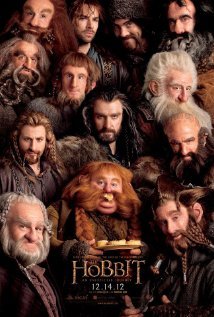
The Hobbit: An Unexpected Journey


Year: 2012
Director: Peter Jackson
Cast: Martin Freeman, Ian McKellen, Richard Armitage
Run Time: 2 hours, 49 minutes
MPAA Rating: PG-13
Sorry I haven’t been posting a lot recently, I’ve been super busy with finals and extremely important Netflix commitments. Not that you can complain, this is free and I don’t owe you nothing.
(The first thing they teach you in Blogging 101 is to alienate your audience within the first paragraph. Let’s see how this goes.)
However, now that I am on winter break, the boredom of no longer living in the city has led me to spend more time on two pursuits: namely, watching movies, and using the computer. Both of which are conducive to writing blog posts.
Now it’s time to tackle what is undoubtedly the pillar movie of this holiday season, The Hobbit. And don’t question me on that. I work at a movie theater and I’ve cleaned up enough BP-level popcorn spills in Hobbit theaters to prove that beyond all reasonable doubt.

Contrary to popular belief, that’s a broom in his hand.
For those of you unversed in cinematography, it is worth pointing out that Jackson (and select theaters near you) has made the choice to film the movie at a rate of 48 frames per second. The standard in modern cinema is 24 frames per second because, quite frankly, that’s pretty much all the eye can handle. The Hobbit holds the distinction for being the first movie to ever use this new and improved frame rate. It’s all part of Jackson’s innovative filmmaking experimentation (see: gimmickry).
The effect of exposing the eye to twice as many frames at a time creates a sort of hyperreality in which characters seem to be moving on fast forward while at the same time carrying on at a normal pace. It is about as disconcerting to watch as it is to write. Luckily, it’s pretty easy to get used to, and it is to tell the truth an incredible thing to watch.
In addition, the high frame rate has the effect of making the actors and sets seem much more immediate and real, in essence converting the film to have somewhat of the feel of a stage play, with the actors right there in the room with the audience. It is an absolutely intriguing technique but it out and out has no place in The Hobbit.
The Middle-earth of Jackson’s Lord of the Rings is all about spectacle, epic wonder, and the sheer scope of the land. However, the hyperrealism of the high frame rate allows a make-up spot here, a visible contact lens there, and some thoroughly unconvincing CGI everywhere to take the audience out of the fantasy.

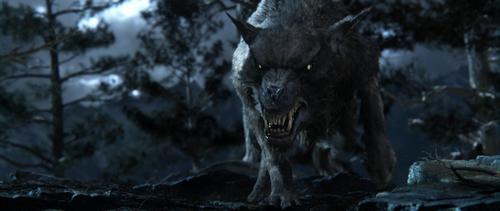
Look at that. Just embarrassing, isn’t it?
On to the plot, insofar as it exists.
The film follows Bilbo Baggins (Martin Freeman), a homebody hobbit from Bag End who is reluctantly dragged on an adventure across Middle-earth by the wizard Gandalf (Ian McKellen) to help some dwarves reclaim their captured kingdom.
That’s it. They don’t even make it. That’s for the next movie to cover.
With so little real meat to work with, the grotesquely bloated run time seeks to compensate for lack of material with an overabundance of antagonists. Two of which, the Necromancer, and the dragon Smaug are only briefly touched upon due to their commitments to the sequels. Even with those threats to deal with, our intrepid gang still has quite a task on their hands. Among the ranks of their enemies include a Goblin King and his army, the Pale Orc and his minions, a horde of trolls, massive rock giants, and the inimitable Gollum.
With such a group to face, the plot follows a “meet-defeat-on to the next one” pattern that is more suited for a video game than an actual narrative.
So, yes, this film has its flaws. But what Jackson Lord of the Rings film doesn’t?
The Hobbit offers enough action-packed sequences and canned movie wisdom to keep the audience entertained and enough knowledge of the Middle-earth universe to appease the hardcore Tolkien fans.
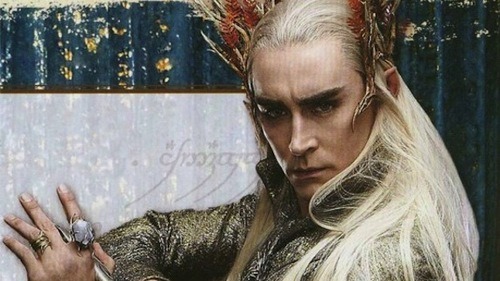
It also features a cameo appearance by Lee Pace, one of my favorite people ever, as the elf king Thranduil. The sight of his unsurpassable eyebrows appeased me, as did his comically over-the-top elf wig.
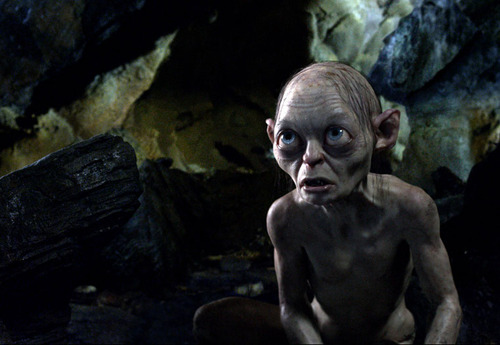
Also worth mentioning is Bilbo Baggins’ encounter with Gollum, by far the most entertaining, suspenseful, and well-composed scene of the film and that which makes the entire price of the ticket worthwhile. Is it bad that I think Gollum’s adorable?

Look at those big ‘ol eyes.
Andy Serkis surpasses himself with a pitch perfect rendition of one of the most beloved scenes in the novel. The man can do no wrong. Please, even if you are asleep until his scene and leave right after, at least come see the film for him.
TL;DR  The Hobbit is overlong, bloated, and features some unbelievably tacky CGI effects, but is redeemed by some strong actiony moments and Andy Serkis’s superb reprisal of the role of Gollum.
Rating: 6/10
Should I spend money on this? Yes, if only for the novel experience of the 48 fps and having Gollum blow you away. Did I mention Gollum?
Word Count: 896
Reviews In This Series
The Hobbit: An Unexpected Journey (Jackson, 2012)