Showing posts with label Juliette Lewis. Show all posts

Tuesday, August 30, 2016

Game of Phones

Year: 2016
Director: Henry Joost & Ariel Schulman
Cast: Emma Roberts, Dave Franco, Emily Meade
Run Time: 1 hour 36 minutes
MPAA Rating: PG-13

Before I went to see Nerve, I checked to see what some of my favorite reviewers said about it. Seeing how they’re all adult men, it turns out that none of them have actually seen it, making me the sole voice in the teenybopper darkness. I do it all for you.

Although my tolerance is waning for YA adaptations, especially single shot throwaways attempting to surf on the wake of Hunger Games, there was something that drew me to Nerve: directors Ariel Schulman and Henry Joost. the Catfish documentarians who co-directed Paranormal Activity 3 and 4. Although I’m wobbly on one of those movies and actively hate the other, I love when low budget horror directors are given a chance to helm a big Hollywood feature, especially when it’s in such a random genre. And I don’t know what it says about them, but Nerve is definitely their best work.
Although, with Paranormal Activity 4 on your CV, a Transformers movie would count as your best work.

In Nerve, timid teen Vee (Emma Roberts) is fed up with her life. She’s sick of her domineering cheerleader best friend Sydney (Emily Meade) – yeah, this is one of those movies where a girl who looks like Emma Roberts is supposed to be nerdy and undesirable – an her overprotective mom (Juliette Lewis) who hasn’t been the same since her older brother died. Trying to overcome her fear of taking risks, she signs up for Nerve, a user-generated dare game where she can win money for filming herself doing wild stunts like kissing strangers or sneaking into expensive stores. This will help her both get out of her shell and earn enough to go to her dream college.

Through the game she meets Ian (Dave Franco), another player who she teams up with, helping her gain watchers and rise up the charts. However, the further she gets, the more dangerous her dares become, and she begins to discover there’s a sick truth behind the game and those who participate in it.

It’s basically Pokémon Go with more nudity and violence.

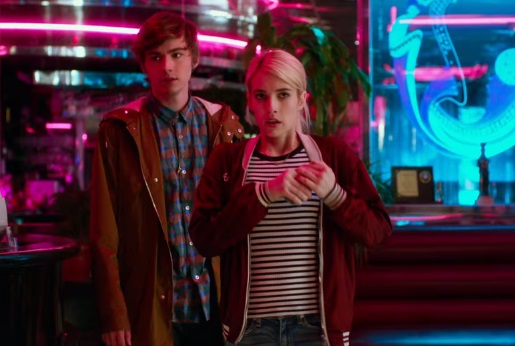
Nerve is definitely a teen movie, no two ways about it. Anyone who’s been on this planet for more than a decade and a half will scoff at the hyperbolic drama and the best friend’s unrequited love, but it’s the same crap we all fell for back in the day. If that stuff isn’t for you, then it’s not for you, but let me tell you this: I have no idea where Joost and Schulman are pulling this kind of visual artistry from, but it’s not only the most kinetic and exciting movie of their career, it might just be the most aesthetically stunning YA movie since Harry Potter and the Half-Blood Prince.

Now, I’m a sucker for a movie with a bold color scheme and a movie with unique integration of modern technology, but Nerve does both here in a way that manages to stay true to the inscrutable media whims of modern teen culture while remaining an enticing work of cinema. A lot of the slick cinematography and self-consciously hip soundtrack feels like they cracked open MTV and sprinkled it on top of everything, but that kind of pandering is a staple of these types of movies (“Don’t You (Forget About Me)” might be regarded as a classic, but there’s no denying it was birthed from that very same impulse) and I wouldn’t be rid of it for the world.

Clearly, I’ve gotten myself a little riled up so let me cut to the chase. Nerve’s production design (courtesy of Chris Trujillo of f**king Stranger Things) is a splendid treat, full of lavish, exuberantly excessive neon that turns the world into a bright, candy-colored technological wonderland which perfectly suits the thrumming synth score. The visual style complements this well, diving through, around, and into phone and computer screens and using digital flags to track players’ progress around the city, turning the act of using technology into something interactive and stimulating. Nerve’s world is just ours, but turned up to 11, which is perfect for its slightly fantastical premise.

ie. That someone could be playing a game on their phone all night and not run out of battery.

Nerve actually has a solid theme as well, about how online anonymity can turn people into monsters. It’s a little heavy-handed, but it’s a very relevant topic in modern teen culture that actually wasn’t present in the source novel at all (or so I’ve been told). This means that the filmmakers made a set of very conscious choices while adapting the 2012 book into a current text. This isn’t just an audiobook with visuals, it’s a unique piece of work that people actually put thought into making.

And if we set aside that heavy Brennan-y analysis, Nerve is still a fun thrill ride. With snappy dialogue, surprisingly tense action, and a mostly game cast (first time performer/white rapper Machine Gun Kelly is camp as all Hell), it’s a bubblegum splash of a story.

Of course, the third act is idiotic drivel, but at least they made it this far. When the story gets bogged down in Darknet technobabble, it loses a lot of its momentum. But if a gymnast doesn’t stick the landing, that doesn’t mean they didn’t still give a terrific, nail-biting performance. Nerve isn’t an all-out classic of teen cinema, but it’s a delightful breath of fresh air in an unremittingly dour summer.

TL;DR: Nerve is an exciting, colorful, cotton candy playground.
Rating: 8/10
Word Count: 947

Thursday, March 3, 2016

Glamour And Glitter, Fashion And Fame

Year: 2015
Director: Jon M. Chu
Cast: Aubrey Peeples, Stefanie Scott, Juliette Lewis
Run Time: 1 hour 58 minutes
MPAA Rating: PG

As is so often necessary in this modern Hollywood epoch of renewing and rebooting old properties, I must lead with a disclaimer. I have never seen the popular 80’s cartoon series Jem, from which the film Jem and the Holograms is loosely adapted. From what I’ve heard, hardcore fans of the show would have been better off pretending they’ve never seen it either if they wanted to avoid a deadly clot of frustration. Although, all things considered, the statistical likelihood that anybody reading this has actually watched the film is extremely low.

You see, Jem and the Holograms is now the record holder for worst wide release opening weekend of 2015, the fourth worst of all time (it’s only behind Delgo, The Oogieloves in the Big Balloon Adventure, and the genuinely embarrassing Saw 10th anniversary re-release). It made back approximately half its production budget and was pulled from cinemas after just two mortifying weeks. And even if you’re someone who wanted to see it (a demographic of pretty much just me), you couldn’t. It took me five different Redbox excursions to actually find the disc, and the exuberantly misinformed idea to price the retail DVD at $20+ could be the subject of the next Michael Lewis book. This kind of high profile disaster is music to my bad movie-loving ears, so of course I had to give it a look. Here’s my field report.

After procuring a pink wig and covering my natural scent by rolling in a pile of glitter, the Holograms are finally beginning to accept me as one of their own.

In Jem and the Holograms, Jerrica Benton (Aubrey Peeples) is your average teen girl from the “least likely” place ever: The Valley. After her father passed away, she and her sister Kimber (Stefanie Scott) moved in with their Aunt Bailey (Molly Ringwald for some reason) and became a part of her Polly Pocket Dream house family. Bailey owns a costume shop (because nobody in this universe is, like, a dentist or something), and her foster daughters Shana (Aurora Perrineau) and Aja (Hayley Kiyoko) are a fashionista and a gearhead respectively. Nobody seems to be interested in Netflix or videogames or have homework to do.

Yadda yadda yadda, Molly Ringwald is about to get evicted because the costume shop business ain’t what it used to be. But! After Jerrica puts on a wig and makeup and performs a song as Jem, which gets uploaded to YouTube, she becomes a viral sensation. Because if movies are to be believed, literally anything uploaded to the Internet will spread like wildfire, something this blog provides evidence against. She is being courted by record executive Erica Raymond (Juliette Lewis), and the money she’s offering could pay their bills! Jem insists that her sisters come along to be her band, and thus begins a month-long rocket to superstardom. The buzz from the original acoustic video is so huge that they already have a national fanbase based on that one song. Naturally, nothing they play is ever acoustic ever again.

But! Erica wants Jem to be a solo artist for some ill-defined reason. Will this cause a rift between her and her sisters? Will her secret Jem identity consume her soul? Will she ever get to make out with Erica’s super hot son Rio (Ryan Guzman), with whom she has so little chemistry that their atoms seem to actively repel one another? Also! Her dead dad left behind a robot called Synergy, which is leading her on an epic musical scavenger hunt across LA to learn about herself and her values or some crap.

Yeah, that sci-fi element sure worked its way into the story organically. What a triumph of naturalistic storytelling!

The truly weird thing about Jem and the Holograms is that it’s still manifestly a Blumhouse picture. Along with cherry-picking the rhythm of Whiplash and the teen savvy of Unfriended, with some occasional dips into the scavenged source material of Paranormal Activity, it also features some prominent new cast members from the Blumhouse stable: The Boy Next Door’s Ryan Guzman and Insidious: Chapter 3’s Stefanie Scott and Hayley Kiyoko. Plus, the entire film – a relatively massive budget for them – takes place on about six sets, spending at least an entire half hour in just a single suburban house. It’s an extremely odd effect, like watching a Disney Channel Original Movie being strangled before your eyes.

The whole film exists in this perpetual limbo, trapped between the extravagant glitzy lunacy it strives for and the low key realism it can afford. Normally I would watch a movie with an over-the-top teen angst girlgroup boilerplate plot that gets frequently derailed by an inexplicable subplot and abruptly swerves into a heist movie for a couple scenes in the third act and call it a fever dream masterpiece. However, the camp quality is cut off at the knees by the too-serious production, at least until the robot hums to life and overloads the system, sending the movie into its bizarre plot seizures.

You see, no matter how tempered the actual content frequently finds itself, the way it is presented is patently deranged. A solid years worth of story is compressed into less than a month, so any time a character mentions “that day by the pier” (yesterday) or “all this time” (one week), it’s an inexhaustible well of unintentional comedy. Drama arises offscreen and gets resolved instantly, sometimes within seconds, plot device explode into the frame without even considering being set up, and shots from the perspective of a security camera constantly undermine every last ounce of tension.

Also, dad apparently forgot that Kimber existed when setting up his Jigsaw-esque scavenger hunt.

Do you see the bind I find myself in? Jem is mostly not a good movie. Aubrey Peeples is a kind of non-presence, delivering a voiceover narration as devoid of nuance or emotion as a concrete brick, and the other girls are spunky but only vaguely etched out (and Aurora Perrineau might as well be an extra for all the focus she’s given), so there’s really nothing concrete in the A-plot to grab onto. However, a much livelier piece of bubblegum trash is constantly oozing out around the edges.

This movie is jam-packed (or should I say Jem-packed? No. I shouldn’t.) with microscopic appearances from actors I really adore (including Party Down’s Ryan Hansen, looking like an actual adult – a handsome adult), hilariously vacant and catchy pop music masquerading as True Art with a Message, and messily overstaged musical performances that only perpendicularly intersect with reality. And did I mention there’s a dress-up montage with people nodding or shaking their head to outfits, presented completely unironically? All while they’re supposed to be at a location across LA in 20 minutes? It’s magical. 

All this is ruled over by Juliette Lewis vamping her bones out of their sockets. She acts like she’s actually in the Jem cartoon, sashaying through every set with the hyperbolic malice of an evil queen, even before she is revealed in any way to be an antagonist. Shes utterly captivating any second she’s onscreen, and if every element of the film were keyed up to her level, Jem would be an instant cult classic.

As it stands, Jem and the Holograms is a generic, vaguely manic shell of a pop musical, scraped clean of meaning. Juliette Lewis and a shirtless Ryan Guzman edge it just enough over the line to recommend it, but it’s a movie you catch on TV, not one that you own. However, it must be said that it’s certainly not worse than most of the crap that gets foisted on the viewing audience on a weekly basis. Hell, it’s a whole lot better than Sinister 2. It didn’t deserve its box office whipping, but hopefully its martyrdom will help it find the right home on DVD. As soon as it ends up in dollar bins. That home is not with me, but it so could have been with just one or two adjustments.

TL;DR: Jem and the Holograms isn't the campy thrill ride it could have been, but it's fun enough in its ludicrous messiness.
Rating: 6/10
Word Count: 1386

Friday, December 27, 2013

The Summer Of Our Discontent

Year: 2013
Director: John Wells
Cast: Meryl Streep, Julia Roberts, Ewan McGregor
Run Time: 2 hours 1 minute
MPAA Rating: R

Typically, when adapting a play for the silver screen, a director will take advantage of the action not being required by theatrical necessity to take place in mainly just one room by either expanding the setting or utilizing filmic tricks to expand the narrative universe. 

In the 1986 musical adaptation Little Shop of Horrors, Frank Oz keeps the location consistent but uses various imaginative flourishes like fantasy sequences to keep the film alive and makes great use of inherently cinematic close-ups to show details of the story a theatrical audience wouldn't be able to get.

On film, Noises Off... becomes a cross-country journey of madcap proportions and Rosencrantz & Guildenstern Are Dead explores every intimate corner of Hamlet's universe.

In August: Osage County, based on the play of the same name by Tracy Letts, director John Wells makes the executive decision to do absolutely nothing. One gets the sense that what we see onscreen is the play as directly transcribed by a particularly dutiful screenwriter (who upon closer inspection turns out to be Tracy Letts himself, so maybe not so dutiful). 

As a man whose directorial credits up til now have only included 9 episodes of ER and one feature film three years ago, perhaps it was wise not to tool around with the script too much and to let the actors speak for themselves. With a powerhouse cast like this, this isn't a sin but the film itself feels as musty and dim as the house it takes place in.

But Meryl Streep.

This meandering family drama isn't so much a narrative as it is a showcase for today's brightest Hollywood talent. Everybody gets a chance to let their gray hair show and strip themselves of their star personas to bare their souls onscreen. This is the primary gift of August: Osage County, and it's not one to spit upon.

Meryl Streep stars as Violet Westin, the pill-popping cancer-ridden matriarch of a royally screwed up family. When her husband, the alcoholic poet Beverly (Sam Shepard), commits suicide, the extended family gathers for the funeral.

The visitors include Violet's sister Mattie Fae Aiken (Margo Martindale), her irritable husband Charlie (Chris Cooper), and their son Little Charles (Benedict Cumberbatch). Little Charles has a secret (something not uncommon to this family) - he's in love with the beautiful Ivy (Julianne Nicholson). Their relationship gives him a great deal of happiness, but the only problem is that she happens to be his cousin.

As Ivy tries to hide her incestuous tryst, so does her sister Barbara (Julia Roberts) try to hide her crumbling marriage with her unfaithful husband Bill (Ewan McGregor). And Barbara's daughter Jean (Abigail Breslin) tries to hide the fact that all she really wants to do is smoke pot with her Aunt Karen (Juliette Lewis)'s new boyfriend Steve (Dermot Mulroney), a sketchy gentleman at the best of times.

Basically the kissing' cousins have the most stable relationship in the entire film.

The cast does a uniformly terrific job bringing their characters to life (Cumberbatch, Nicholson, and Margo Martindale especially, although Meryl Streep's performance is of course unmatched), and in fact most if not all problems with August: Osage County are at the script level, if only because everything else resolutely refuses to get up to anything remotely interesting.

In fact, the few occasions where the other filmic elements peek up their tender heads, they seem to be actively conspiring against the performances. A key emotional point that is central to Meryl Streep's drug-addled breakdown is overtaken by shrieking sound design, an element that hadn't come into play before and wouldn't again, as if being punished for interjecting.

As the Westin family grapples with their manifold personal issues, tensions bubble and rise to a boil at a massive dinner table scene that probably lasted for an entire act in the original play. It is a monumental achievement in extended scene editing and provides a fantastic stopping off point, bringing all the interpersonal conflicts to a climax and exploding in a firework display-worthy exhibition of film performance.

Unfortunately the story has the tenacity to continue for a good 30 minutes beyond this point. The plot meanders, tossed like a beach ball between minor characters, of which there are too many too keep track of and fully flesh out. The film overextends itself in trying to showcase as many actors as possible and results in the sidelining of even the most important characters (Meryl Streep - duh - and Julia Roberts) for up to ten minutes at a time.

Pictured here deep in discussion about topics that really should have had more screentime than Abigail Breslin getting high.

It can't really juggle everything adequately and as such loses anything like a "theme" or a "conclusion," both of which are privileges reserved for more coherent stories. The story doesn't end so much as it peters out, but at least the final act has one solid scene - a confrontation between Violet, Barbara, and Ivy where the three women duke it out in a rampage of acting that culminates in my favorite line ever: "EAT THE FISH, BITCH!"

So the film definitely isn't a waste of time, but all the dramatics fade to vapor when the script turns up the heat and finds that it never really had anything to say in the first place. Definitely one to catch if you're in the mood to watch underused older Hollywood women eat it up, but it is a decidedly uneven piece of narrative cinema.

TL;DR: August: Osage County is a powder keg of great performers, but falls beneath the weight of a clunky script.
Rating: 6/10
Word Count: 963